Posts tagged ‘Faith’
Christianity ≠ Morality

Credit: Dietmut Teijgeman-Hansen
One of the topics I address often on this blog is that of morality. With a collapsing cultural consensus on what morality looks like around issues like human sexuality, childbearing, childrearing, gender, justice, and political discourse – to name only a few examples – offering a Christian perspective on what it means to be moral is, I believe, important and needed.
There is an implicit danger, however, in spending all of one’s energy arguing for a Christian morality in a secular society. Far too often, when we, as Christians, do nothing more than argue for a Christian morality in the public square, it can begin to appear that Christianity itself is nothing more than a set of moral propositions on controversial questions. Like in the 1980s, during the height of the Christian Moral Majority, Christianity can be perceived to be conterminous with a particular system of morality.
A couple of years ago, an op-ed piece appeared in the LA Times titled, “How secular family values stack up.” In it, Phil Zuckerman, a professor of sociology and secular studies at Pitzer College, argues that godless parents do a better job raising their children than do godly parents. He writes:
Studies have found that secular teenagers are far less likely to care what the “cool kids” think, or express a need to fit in with them, than their religious peers. When these teens mature into “godless” adults, they exhibit less racism than their religious counterparts, according to a 2010 Duke University study. Many psychological studies show that secular grownups tend to be less vengeful, less nationalistic, less militaristic, less authoritarian and more tolerant, on average, than religious adults.
Much of what these kids raised in secular homes grow up to be is good. A resistance to peer pressure, an eschewing of racism, a willingness to forgive, a measured sobriety about the positives and negatives of one’s country, a desire to avoid violence, a willingness to serve instead of to command, and a charitable tolerance toward all people are certainly all noble traits. Professor Zuckerman argues that since secular parenting has a statistically higher probability than does Christian parenting of producing children who act morally in these categories, Christian parenting serves no real purpose. But it is here that he misunderstands the goal of Christian parenting. The goal of Christian parenting is not to make your kids moral. It is to share with your kids faith in Christ. Morality is wonderful, but, in Christianity, faith comes first.
James, the brother of Jesus, describes the proper relationship between Christian morality and Christian faith when he writes:
What good is it, my brothers and sisters, if someone claims to have faith but has no deeds? Can such faith save them? Suppose a brother or a sister is without clothes and daily food. If one of you says to them, “Go in peace; keep warm and well fed,” but does nothing about their physical needs, what good is it? In the same way, faith by itself, if it is not accompanied by action, is dead. But someone will say, “You have faith; I have deeds.” Show me your faith without deeds, and I will show you my faith by my deeds. (James 2:14-18)
James here explains the absurdity of claiming to have faith apart from any sort of moral deeds. He says that if someone claims to have faith and no moral deeds, he really has no faith at all. He even goes so far as to challenge his readers to show him someone who has faith, but no moral deeds. This, in James’ mind, is an impossibility. Why? Because James knows that faith inevitably produces some sort of moral action. The real danger is not so much that someone will have faith and no moral action, but that someone will have plenty of moral action and no faith! Indeed, this is the problem Jesus has with the religious leaders when He says of them, “These people honor Me with their lips, but their hearts are far from Me” (Matthew 15:8). The religious leaders were supremely moral. But they did not have faith in Christ.
In our crusade to argue for a Christian morality in the midst of a morally relativistic secular society, let us be careful not to spend so much time trying to make people moral that we forget to share with them faith in Christ. For a Christianity that only makes people moral, ultimately, leads them the to same place that a secular moral relativism does – it leads to death. Morality, no matter what type of morality it is, cannot offer life. Only Christ can do that.
We are not here just to try to make people good. We are here to show people the One who is perfectly good. Let’s not forget what our real mission really is.
A Tenuous Time

It wasn’t supposed to be this way. As Christianity faded from prominence in the West, a secularized culture was supposed to emerge to take its place that was more tolerant, more enlightened, more harmonious, and less politically polarized than any other society in the history of the world. But as Peter Beinart explains in an excellent article for The Atlantic, what has emerged as Christianity’s western influence has waned is nothing of the sort:
As Americans have left organized religion, they haven’t stopped viewing politics as a struggle between “us” and “them.” Many have come to define us and them in even more primal and irreconcilable ways.[1]
Beinart goes on to explain how the traditional battle lines between conservatives and liberals have shifted in the wake of this irreligious surge. Specifically, with regard to the spiritually skeptical alt-right, Beinart notes:
They tend to redraw the boundaries of identity, de-emphasizing morality and religion and emphasizing race and nation…
The alt-right is ultra-conservatism for a more secular age. Its leaders like Christendom, an old-fashioned word for the West. But they’re suspicious of Christianity itself, because it crosses boundaries of blood and soil. As a college student, the alt-right leader Richard Spencer was deeply influenced by Friedrich Nietzsche, who famously hated Christianity. Radix, the journal Spencer founded, publishes articles with titles like “Why I Am a Pagan.” One essay notes that “critics of Christianity on the Alternative Right usually blame it for its universalism.”
It turns out that as faith allegiances have crumbled, a universal concern for others in the spirit of the Good Samaritan has too. Christianity’s cross-ethnic, cross-cultural, and international appeal has proven too much for the self-interested – or, perhaps more accurately, self-obsessed – spirit of our age.
As Christians, we must think through this irreligious political surge and provide a faithful witness in the midst of it. We also must be prepared to live in a very tricky tension because of this surge. As Rod Dreher explains in his newly released book, The Benedict Option:
Faithful Christians may have to choose between being a good American and being a good Christian. In a nation where “God and country” are so entwined, the idea that one’s citizenship might be at radical odds with one’s faith is a new one.[2]
Dreher’s analysis of the tension between being a citizen of a nation and being a child of God is true, but it is also somewhat amnesic. He is right that there is indeed an increasing tension. But he is wrong that this tension is anything new. Tensions between God and government have been longstanding, even in our society. And these tensions should not surprise us. It was a Roman governmental official, after all, who approved the request for Jesus’ crucifixion. Government has, for a great portion of history, had a problem with God, especially when people put Him before it.
The New Testament understands that this tension between God and government will never be fully resolved, at least on this side of the Last Day. While we may give to Caesar what is his, God also demands what is His, and when what Caesar wants contradicts what God wants, conflict ensues. Just ask Daniel, or Shadrach, Meshach, and Abednego, or the apostles. Our calling, as Christians, is to resist the urge to comfortably resolve this tension, whether that be by condemning this world and cloistering ourselves off from it or by compromising our faith for the lucrative perks of political power. Our calling is to live in this tension both faithfully and evangelically – holding fast to what we confess while lovingly sharing with others what we believe.
Beinart concludes his article:
For years, political commentators dreamed that the culture war over religious morality that began in the 1960s and ’70s would fade. It has. And the more secular, more ferociously national and racial culture war that has followed is worse.
Yes, indeed, it is worse – which is why we, as the Church, need to offer something better. We need to offer something loving. We need to over something hopeful. We need to offer something reconciling. We need to offer something that continually and conscientiously questions our nation’s nearsighted political orthodoxies for the sake of a time-tested theological orthodoxy. We need to offer Jesus, unabashedly and unashamedly. This is our mission. I pray we are up to it.
______________________________________
[1] Peter Beinart, “Breaking Faith,” The Atlantic (April 2017).
[2] Rod Dreher, The Benedict Option (New York: Sentinel, 2017), 89.
God and Country in Order

In his book, Destroyer of the gods, Larry Hurtado writes about why the Christian claim that there is only one God was especially offensive to those in the ancient Roman world. His analysis is worth quoting at length:
In the eyes of ancient pagans, the Jews’ refusal to worship any deity but their own, though often deemed bizarre and objectionable, was basically regarded as one, rather distinctive, example of national peculiarities…
The early Christian circles such as those addressed by Paul…could not claim any traditional ethnic privilege to justify their refusal to worship the gods. For, prior to their Christian conversion, these individuals, no doubt, had taken part in the worship of the traditional gods, likely as readily as other pagans of the time among their families, friends, and wider circles of their acquaintances…
Of course, a pagan might choose to convert fully to Judaism as a proselyte, which meant becoming a Jew and ceasing to be a member of his or her own ancestral people. By such a drastic act, proselytes effectively changed their ethnic status and so could thereafter try to justify a refusal to participate in worshipping the pagan gods as expressive of their new ethnic membership and religious identity. But this was not the move that Paul’s pagan converts made…
Indeed, Paul was at pains to emphasize that his pagan converts must not become Jewish proselytes. For Paul saw his mission to “Gentiles” as bringing to fulfillment biblical prophecies that the nations of the world would forsake idols and, as Gentiles, would renounce their idolatry and embrace the one true God. That is, unlike Jewish proselytes, Paul’s pagan converts did not change their ethnic identity.[1]
Categories of ethnicity and faith were not clearly delineated in the ancient world. Instead, they were broadly interchangeable. To be a part of the Jewish nation was to adhere to the Jewish faith. To be a Roman Gentile was to be a worshiper of the Roman gods. There was no concept of religious freedom like we know it today – where a person can worship and live out their convictions freely quite apart from their nationality. Thus, part of what made Christianity so offensive to the ancient pagans was that it began to decouple a presumed synonymy between ethnicity and faith. A person’s ethnicity, in the Christian conception, no longer informed ipso facto a person’s faith. A person could be a Roman Gentile and a Christian monotheist.
Not only did Christianity decouple ethnicity from faith, it actually claimed that a person’s ethnicity was subservient to faith! Again, to quote Hurtado:
Paul writes, “There is no longer Jew or Greek, there is no longer slave or free, there is no longer male or female; for all of you are one in Christ Jesus” (Galatians 3:28)…Whether you were Jew or Greek, slave or free, male or female, this was now to be secondary to your status “in Christ”…Irrespective of their particular ethnic, social, or biological categories, therefore, all believers were now to take on a new and supervening identity in Christ.[2]
According to Paul, Christ comes before clan.
Like the ancient Romans, we too have a tendency to couple our ethnicity with our faith, or, to put it in another, more recognizable, way, to couple our country with our God. When this happens, however, it is almost always our God who winds up serving our country. When it appears particularly expedient or reassuring in the midst of a dangerous and changing world, we can be all too willing to sacrifice fidelity to our faith for the prosperity of our nation. Hurtado offers us an important reminder: though we may retain our ethnicities and citizenships and still be Christians, ethnicities and citizenships are subservient to faith. Faith cannot be sacrificed for the sake of the State. Furthermore, as we are learning our increasingly secularized society, faith is often at odds with the goals of the State. Everything from the legal enshrinement of the sexual revolution to the often raucous and raunchy rhetoric of our most recent presidential campaign demonstrates this. So let’s makes sure we keep the State and our faith straight. Faith comes first. After all, the God of our faith will continue to stand, long after the State has fallen.
_______________________
[1] Larry Hurtado, Destroyer of the gods (Waco: Baylor University Press, 2016), 53, 55.
[2] Ibid., 55-56.
An Executive Order and an Immigration Debate

When President Trump issued an executive order two Saturdays ago putting a 90-day moratorium on all foreigners entering the United States from Iraq, Syria, Iran, Libya, Somalia, Sudan, and Yemen and a 120-day ban on all refugee admissions, the reaction was swift and splenetic. Protests erupted at airports across the country. Democratic politicians decried – and, quite literally, cried at – Mr. Trump’s executive order. And now, a federal judge in Washington has temporarily blocked enforcement of the president’s immigration stay.
Though much could be said – and has been said – from a policy standpoint about the president’s executive order and the heated debates that have ensued, it is worth it for us, as Christians, to use this moment as an opportunity step back and consider how Scripture frames the broader issues involved. After all, long after the embers of the fight over this particular executive order have cooled, the contentious disagreements that have bubbled to the top in this debate will remain. So here are a few things to keep in mind.
Safety and Sojourners
One of the roles of any government is to protect its people by punishing wrong and standing up for what is right. This is part of the reason Joshua led a conquest through the land of Canaan. This is also why the apostle Paul writes:
For the one in authority is God’s servant for your good. But if you do wrong, be afraid, for rulers do not bear the sword for no reason. They are God’s servants, agents of wrath to bring punishment on the wrongdoer. (Romans 3:4)
The preamble to our Constitution echoes this sentiment when it explains the very need for such a document thusly:
We the people of the United States, in order to form a more perfect union, establish justice, insure domestic tranquility, provide for the common defense, promote the general welfare, and secure the blessings of liberty to ourselves and our posterity, do ordain and establish this Constitution for the United States of America.
Likewise, President Trump, when his executive order was met with fiery backlash, defended it by saying that his order was about “terror and keeping our country safe.”
Safety is indeed a noble goal. But Scripture also has much to say about welcoming and helping sojourners. God commands the Israelites:
When a foreigner resides among you in your land, do not mistreat them. The foreigner residing among you must be treated as your native-born. Love them as yourself, for you were foreigners in Egypt. I am the LORD your God. (Leviticus 19:33-34)
One of Jesus’ most famous stories – the Parable of the Good Samaritan – has as its centerpiece a call to be kind to foreigners. In this day, for a Jew to talk about a “good Samaritan” would have sounded oxymoronic. The Samaritans, after all, were the ones who broke into the Jewish temple during Passover and desecrated it by scattering human bones through it. Jews did not consider Samaritans “safe.” But in Jesus’ story, a Samaritan ends up saving the life of a Jew.
As Christians, then, we are called to be concerned both with the safety and security of our families and nation as well as with the plights of others, such as Syrian refugees, doing whatever we can to welcome and care for those who need our help. A concern for safety and a love for sojourners are to go hand in hand.
Local and Global
Donald Trump’s short tenure as president has been marked by the theme of putting America first. In what was perhaps the most memorable line of his inauguration address, the president declared, “From this day forward, a new vision will govern our land. From this day forward, it’s going to be only America first, America first.”
Addressing concerns and challenges close to home is important. Charity, the old saw says, begins at home. Scripture echoes this theme when the apostle Paul encourages believers to take care of those closest to them: “Anyone who does not provide for their relatives, and especially for their own household, has denied the faith and is worse than an unbeliever” (1 Timothy 5:8). In this same letter, Paul also wonders out loud how a pastor who “does not know how to manage his own family…can…take care of God’s church” (1 Timothy 3:5). At issue here is a principle of subsidiarity, which encourages a focus on local affairs first.
But once again, as important as local affairs are, they are not the only concerns we should have. President Trump’s call of “America first” must never become that of “America only.”
Rodney Stark, in his seminal work The Triumph of Christianity, notes that Christianity is unique not only because it is:
…the largest religion in the world, [but because] it also is the least regionalized. There are only trivial numbers of Muslims in the Western Hemisphere and in Eastern Asia, but there is no region without significant numbers of Christians – even in the Arab region of North Africa.[1]
Christianity is decentralized because the faith’s founder gave His disciples a global mission: “Go and make disciples of all nations, baptizing them in the name of the Father and of the Son and of the Holy Spirit, and teaching them to obey everything I have commanded you” (Matthew 28:19-20). In the book of Acts, Christ encourages the Church to have both a local and a global vision for mission: “You will be My witnesses in Jerusalem, and in all Judea and Samaria, and to the ends of the earth” (Acts 1:8).
As Christians, then, though we are to tend to the affairs of our families, communities, and country, these cannot be our sole concerns. A world that is hurting is a world that needs our compassion, interest, and engagement. We are called to have eyes for both that which is local and for things which are global.
Government and Church
As Christians, we must remember that the affairs of the government are not always coterminous with the mission of the Church. Governments have a specific role to play. They are God’s servants, on a civic level, to promote and defend that which is right and to dissuade and punish that which is wrong. Likewise, the Church has a specific mission to carry out – to reach the world, in both word and deed, with the gospel on a personal level. Thus, while a government may seek to protect a nation, the Church continues to go forth to reach the nations.
As Christians, then, we live in two worlds. We are both members of Christ’s body, the Church, and citizens of an earthly nation. In such a politically-heated environment, however, it can be tempting to exalt the partisanship of politics over the community of the congregation. Indeed, one of the saddest aspects of our current crisis is that the millions of Syrian refugees who have been displaced from their homes and families have become, in the words of Pete Spiliakos:
…footballs in our partisan scrimmages. We insist on certain standards of hospitality to refugees, making those standards a test of “who we are,” opportunistically – when it is useful to our side.
In other words, we do not charitably welcome refugees while carefully stewarding our own national interests because it is right thing to do, we pick either the reasonable concerns of our nation or the sad plight of international refugees and turn one into a cause célèbre at the expense of the other because it is politically expedient. This is wrong both civically and ecclesiologically because it reduces people to pawns in a game of thrones. We are less concerned with doing justice and more concerned with wielding power.
In a debate that has become increasingly either/or, we, as Christians, have a message that is both/and. We can both seek the safety of our nation and be hospitable to sojourners. We can both address our local contexts and keep an eye on global crises. We can both live as responsible citizens and work as members of Christ’s body. One thing does not need to trump the other thing because, ultimately, over everything is Christ. He is the One who ultimately both keeps us safe and welcomes us into His kingdom as sojourners from this corrupt age. He is the One who both loves each of us locally and dies for the world globally. He is the One who both rules all rulers and is the head of His body, the Church. He is the One in whom “all things hold together” (Colossians 1:17).
As we seek to process today’s troubles, then, let us never forget who we are. We are not merely useful political plodders. We are the children of God in Christ, which means that we trust in Him, live with Him, and love like Him – both those who are near and those who are halfway across the world.
___________________________
[1] Rodney Stark, The Triumph of Christianity (New York: HarperCollins Publishers, 2011), 392.
The Inauguration of Donald J. Trump

Credit: Mario Tama/Getty Images
It’s official. As of last Friday, just after noon Eastern Standard Time, Donald J. Trump became the 45th President of the United States.
Though our nation has a new president, old partisan divides and rancor remain. Representative John Lewis, an icon of the civil rights movement, questioned the legitimacy of Mr. Trump’s election and promised to boycott his inauguration, which prompted a fiery response from the president via his Twitter account. Project Veritas uncovered the aspirations of a radical protest organization to detonate a butyric acid bomb at the inaugural ball. And then there were the protests just blocks away from the inauguration parade that erupted into riots. Indeed, there is no shortage of division in our society.
At this watershed moment in American history, it is worth it to take a moment and remind ourselves how we, as Christians, are to conduct ourselves in a world full of violence, threats, political infighting, and social media rants. So, as a new man settles into the world’s most powerful position, here are a few things to keep in mind.
Rulers come and rulers go.
Last week, a friend sent me a picture of the “Donald Trump Out of Office Countdown Wall Calendar.” It extends to 2021. Apparently, the calendar is not only counting down Mr. Trump’s term in office, but making a prediction about the next presidential election. Whatever you may think of the new president, and regardless of whether or not you hope he is elected to another term, this wall calendar provides an important reminder: Mr. Trump’s presidency will not last forever, just like all the presidencies before his did not last forever. Indeed, it is always interesting to hear discussions of how “history is being made” every time a new president is elected and inaugurated. We seem to know, even if only intuitively, that the present is only the present for a split second. It quickly becomes history – a past that is no longer pressing.
If you are concerned about Mr. Trump’s presidency, then, remember: it will not last forever. And if you are ecstatic about Mr. Trump’s presidency, remember: it will not last forever. This is why the Psalmist instructs us not to put our “trust in princes, in human beings, who cannot save. When their spirit departs, they return to the ground; on that very day their plans come to nothing” (Psalm 146:3-4). The reign of any earthly ruler never lasts. Every reign ends; every ruler dies – that is, except for One.
Rulers have limited authority.
No matter who resides at 1600 Pennsylvania avenue, a contingent of the electorate is always apoplectic, convinced that whoever happens to be president at the time will surely spell the end of American democracy, if not world order, as we know it. The reality of a president’s – or any ruler’s – authority is much less impressive. Scripture reminds us that every human authority is under God’s authority. The prophet Daniel declares that God “deposes kings and raises up others” (Daniel 2:21). The apostle Paul tells masters of slaves in the ancient world that One “who is both [your slave’s] Master and yours is in heaven, and there is no favoritism with Him” (Ephesians 6:9). No matter how much authority one person may have, no human authority can match God’s ultimate authority.
This should bring us peace and give us perspective. Leaders, ultimately, do not control the world. Instead, they simply steward, whether faithfully or poorly, whatever little corner of the world God has happened to give to them for a brief moment in time. It is never wise, therefore, to put too much faith in leaders we like or to have too much fear of leaders we don’t. Their power is not ultimate power.
Rulers need our prayers.
When we no longer put too much faith in our leaders or have too much fear of them, this frees us up to pray for them according to Scripture’s admonition: “I urge, then, first of all, that petitions, prayers, intercession and thanksgiving be made for all people – for kings and all those in authority, that we may live peaceful and quiet lives in all godliness and holiness” (1 Timothy 2:1-2). I find it especially striking that making it a common practice to pray for our leaders – no matter who they might be – is commanded by Paul not only because of the effects these prayers have on our leaders, but because of the effects these prayers have on us! When we pray for our leaders, Paul says, this leads us to peaceful and quiet lives even when the world around us feels troubled, and godly and holy lives even when the world around us seems to be careening into moral rot. When we pray for others, God strengthens us.
As Donald Trump assumes the responsibilities of the President of the United States, he needs our prayers. So keep President Trump and his family in your prayers. And while you’re at it, keep other leaders, be they on the national, statewide, or local levels, in your prayers as well. As a practical admonition, perhaps consider writing a note to one of your public servants asking how you can pray for them. Your note just might be a big blessing to them and encourage them to become a better leader. And that’s something our nation can always use.
Was Jesus a Liberal or a Conservative?

People love to claim Jesus. This is especially true in the realm of politics. At the beginning of the year, the Pew Research Center published a report about the faith commitments of those serving in Congress. As it turns out, Congress is a very religious place:
The U.S. Congress is about as Christian today as it was in the early 1960s…Among members of the new, 115th Congress, 91% describe themselves as Christians. This is nearly the same percentage as in the 87th Congress (1961 to 1962, the earliest years for which comparable data are available), when 95% of members were Christian.
Among the 293 Republicans elected to serve in the new, 115th Congress, all but two identify as Christians…Democrats in Congress also are overwhelmingly Christian (80%).
In a society where people who claim Christianity are on the decline, the fact that so many members of Congress would continue to identify as “Christian” is worthy of our attention. But claiming Christ is not always synonymous with following Christ. Indeed, both of our nation’s two major political parties have had moments where their actions did not comport particularly well with Christ’s commands.
Regardless of what politicians and parties may say about Jesus or how they may represent Jesus, in His own day, Jesus demonstrated a persistent refusal to be co-opted by any political power.
In Matthew 22, the Sadducees come to Jesus with a question about a woman who had been married seven times to seven brothers. Their question has to do with whose wife she will be at the resurrection of the dead on the Last Day: “At the resurrection, whose wife will she be of the seven, since all of them were married to her” (Matthew 22:28)? Sadly, their question is dripping with insincerity because the Sadducees did not even believe in the resurrection of the dead on the Last Day (cf. Acts 23:8). They were too enlightened to believe in something so outlandish. Another theological distinction of the Sadducees is that they accepted only the first five Old Testament books of Moses as canonical rather than the 39 books that other Jewish religious groups accepted. Though I have no historical proof of this, I am pretty sure the Sadducees had these five books printed in red and called themselves “Red-Letter Jews,” claiming that the rest of the Old Testament canon did not really matter – only what Moses had written. In today’s terms, the Sadducees would be aligned with theological liberals.
As Matthew 22 continues, on the heels of the Sadducees come the Pharisees. If the Sadducees were the theological liberals of their day, the Pharisees would have been the theological conservatives. They also have a question for Jesus: “Teacher, which is the greatest commandment in the Law” (Matthew 22:36)? This was a hotly debated theological question in the first century with no uniform answer. More progressive teachers like Rabbi Hillel summarized the law like this: “What is hateful to you, do not to your neighbor. That is the whole Torah, while the rest is the commentary” (b. Shabbat 31a). Other more conservative rabbis asserted that, because all Scripture is given by God, to try to distinguish between greater and lesser commandments in the Bible is foolish. When the Pharisees present their question to Jesus about the law, they want to know whether He will answer liberally or conservatively.
Whether it is the Sadducees or Pharisees who approach Him, Jesus refuses to play according to their liberal and conservative assumptions. Contra the liberal Sadducees, Jesus affirms the resurrection of the dead (Matthew 22:29-32). And contra the conservative Pharisees, Jesus says there is indeed a greatest commandment, but it is much weightier than the one postulated by Rabbi Hillel. One should not just avoid doing injury to someone else, one should actively love that other person in the same way he loves God Himself (Matthew 22:37-40).
Ultimately, the problem with both the Sadducees and Pharisees was this: both groups were self-assured. They were smug in their superiority and blinded by their own self-styled orthodoxies. And because they were so sure of themselves, they never could quite be sure of Jesus.
Of course, there is a third group of people with whom Jesus interacts. The Pharisees derisively refer to this group of people as “tax collectors and sinners” (Matthew 9:11). This group, however, out of all the groups of people with whom Jesus comes into contact, seems to get Him the best – not because the people in this group are so spiritually astute, but because they need an assurance they cannot find in themselves. So they find it in Jesus.
Regardless of your political persuasion, Jesus asks us: “Are you so sure of yourself that you cannot find security in Me? Are you so smug in your superiority that you cannot see the shamefulness of your own sin?” In the Gospels, Jesus lays bare all those who trust in themselves, whether conservative or liberal. He will not be co-opted. But He can be trusted. Where does your faith lie? In you, or in Him?
A Tale of Three Kings

Growing up, one of my favorite yuletide carols was “We Three Kings of Orient Are.” The lilting melody and encomium to the “star of wonder” and its “perfect light” captured my imagination. So you can imagine my disappointment when I learned that, at least from a historical perspective, this beloved song is probably all wrong. The men who came to visit Jesus from far away were not kings, they were astrologers. They also were probably not from the Orient, but instead from Babylon. And although we assume that there were three of them because of the number of gifts they brought, we do not know this for sure. There could have been more or fewer.
Even if the the song is wrong about the astrologers who come to visit Jesus, the Christmas story nevertheless does involve three kings. The first is a king who sits on a throne in Rome. His name is Caesar Augustus. He received the name Augustus as an honorary title from the Roman senate thanks to, according to his own account, his “virtue, mercy, justice, and piety.”[1] What a king Augustus must have been.
At the first waterfall of the Nile River, there is an inscription lauding Augustus that reads:
The emperor, ruler of oceans and continents, the divine father among men, who bears the same name as his heavenly father – Liberator, the marvelous star of the Greek world, shining with the brilliance of the great heavenly Savior.[2]
As it turns out, Caesar Augustus was hailed not only as a king, but as a divinity. And it is this king who lifts his finger to issue a decree for a census that sends the whole world, including a couple of peasants from Nazareth, scrambling:
And it came to pass in those days that a decree went out from Caesar Augustus that all the world should be registered. So all went to be registered, everyone to his own city. Joseph also went up from Galilee, out of the city of Nazareth, into Judea, to the city of David, which is called Bethlehem, because he was of the house and lineage of David, to be registered with Mary, his betrothed wife, who was with child. (Luke 2:1, 3-5)
The second king of the Christmas story is local ruler named Herod the Great. He too received a prestigious title from the Roman senate: “the king of the Jews.” Though his title was more baronial than Caesar’s supernatural titles, he was also proud of his position and fiercely sought to protect it regardless of the cost. He became exceedingly paranoid that those around him were jockeying for his throne so, one by one, he had them executed. First it was his brother-in-law, Aristobulus III, who Herod ordered drown. Then it was another brother-in-law, Kostobar. He even executed two of his own sons, Alexander and Aristobulus, accusing them of high treason. Herod’s murderous rampages became so infamous that Caesar Augustus is said to have once remarked, “I’d rather be Herod’s pig than Herod’s son.”
Considering Herod’s insecurities, it is no surprise that when a group of astrologers from a faraway land come to Herod and ask him, “Where is the one who has been born king of the Jews?” (Matthew 2:2), Herod impulsively and impetuously gives “orders to kill all the boys in Bethlehem and its vicinity who were two years old and under, in accordance with the time he had learned from the Magi” (Matthew 2:16).
This leads us to the third king in the Christmas story – the newborn king about which the Magi ask. When Jesus was born, He certainly didn’t look like a king. And yet, He inaugurated a kingdom that endures to this day, as a walk inside one of what are literally millions of churches will indicate.
Whether or not you believe Him to be an eternal king, Jesus is someone with whom everyone must grapple. Caesar Augustus grapples with Jesus by means of indifference. He didn’t know anything of Jesus and didn’t care to. He was, after all, a much more important figure than some impoverished infant sleeping in straw in Bethlehem. But what Caesar couldn’t have imagined is that it wouldn’t be his kingship that would eventually be celebrated with a worldwide holiday, it would be Jesus’ birth. It would not be Jesus who would become Caesars’ footnote in history, it would be Caesar who became Jesus’ footnote. We would nary talk about Caesar Augustus this time of year – or any time of year – were it not for Jesus. Caesar’s indifference falls in the face of Jesus’ kingdom.
Herod the Great grapples with Jesus in a different manner – by that of hostility. He hates Jesus and seeks to have Him killed. But not only does he fail, he fails miserably. Joseph takes his family and escapes to Egypt before Herod’s executioners can get to the child. Herod fails to end Jesus’ life as a child even as Pontius Pilate ultimately fails to finish Him off as an adult, as the story of Easter so gloriously reveals. Herod’s hostility, then, falls in the face of Jesus’ kingdom.
Though two millennia have passed, the reactions to Jesus’ kingship have not changed. Many people treat the celebration of Christmas – at least the part that involves Jesus’ birth – with a mild indifference, a distant secondary feature of a holiday that primarily consists of the niceties of parties, decorations, and, of course, plenty of presents. Others treat the story of the nativity with outright hostility – incensed that a holiday that has such blatantly Christian overtones would still be embraced and thought of as Christian by what should be an enlightened secular West. But Christmas marches on. And the fact that it does says something about Jesus’ kingdom. It does not and will not fail or fall because of our responses to it. Either it will endure for us and be a solace of salvation, or it will endure in spite of us and become an edict of execration. Which way will it endure for you? That’s the question of Christmas.
I hope you have an answer.
_______________________________
[1] Caesar Augustus, The Deeds of the Divine Augustus, Thomas Bushnell, trans., par. 34.
[2] Ethelbert Stauffer, Christ and the Caesars (Eugene: Wipf and Stock, 1952), 99.
President-Elect Donald J. Trump

Credit: Pablo Martinez Monsivais/AP Photo
Whether you love him, despise him, believe in him, are distasteful of him, are worried about him, or are indifferent to him, Donald J. Trump is the President-Elect of the United States. Regardless of which one of these categories you may occupy (or, perhaps, you’re in another category I missed), as Christians, there are a few things we are called to be during the transition from the end of Barack Obama’s presidency to the beginning of Donald Trump’s presidency. Perhaps you already know these things, but a little reminder never hurts.
Be prayerful.
The apostle Paul writes to Timothy:
I urge, then, first of all, that petitions, prayers, intercession and thanksgiving be made for all people – for kings and all those in authority, that we may live peaceful and quiet lives in all godliness and holiness. (1 Timothy 2:1-2)
Paul is clear that we, as Christians, ought to pray for our leaders. But there is something I think we often miss in this passage. Before Paul exhorts Timothy to pray “for kings and all those in authority,” he urges Timothy to pray “for all people.” The category of “leaders” is a subset of the category of “people.”
Though this may seem painfully obvious, it is important to remember that our leaders are, in fact, actual people. I say this because sometimes it can become far too easy for us to paint the leaders we don’t care for as soulless cartoonish villains, not worthy of even basic respect.
Regardless of what you think of President-Elect Trump, he is a person, made in the image of God and loved by God. He is also a husband, a father, and a grandfather. We should pray for him not only as a politician, but also as a person.
Be supportive.
Every person is sinful. And yet, as Jesus puts it, even evil people “know how to give good gifts to [their] children” (Matthew 7:11). In other words, just because no one is perfect doesn’t mean that everyone does everything wrong. Instead, we are all mixed bags. We do some things right and some things wrong. We do some things that are good and some things that are evil. Donald Trump, no doubt, will do some good things for America. For instance, his promise to support the cause of life and minimize the scourge of abortion is vital not only to our national wellbeing, but to our human decency as well. In cases such as this, Christians ought to graciously, thoughtfully, and humbly support that which is good and just.
Be skeptical.
Even as sinful people can do good things for which they should be commended, they can also, obviously, do sinful things for which they must be confronted. Christians should be willing to call sin for what it is regardless of the political party out of which it comes. Certainly, President-Elect Trump has said some things that are not only not befitting of the office of President of the United States, but also defy basic decorum, decency, and truthfulness. The warning of Jesus’ brother should ring in our minds: “The tongue also is a fire, a world of evil among the parts of the body. It corrupts the whole body, sets the whole course of one’s life on fire, and is itself set on fire by hell” (James 3:6). Reckless words may be legal in a society that has enshrined free speech, but legality does not equal morality. Christians should continue to call President-Elect Trump, and all of our public officials, to account when their behavior turns ugly.
Especially because of the rancorous nature of this year’s election cycle, I would add that we should be careful not to allow a healthy skepticism to turn into a bitter cynicism. Skepticism is honest that sin is constantly afoot and must be confronted. Cynicism, on the other hand, finds a certain schadenfreude in another’s sin because it can sanctimoniously condemn it and boast over it. Skepticism is wise. Cynicism is hateful. Let us not fall prey to the latter.
Be faith-filled.
Our nation is deeply divided, as even the statistical outcome of this election demonstrates. Donald Trump won in the electoral college and, hence, has secured the presidency, while Hillary Clinton bested Mr. Trump in the popular vote. As Christians, we have a uniquely unifying message because, in the midst of a division as deep as ours, we can point to a God who made us all and to His Son who sacrificed Himself for us all. Christ is the One who can break down what separates us. Now is the time to share Him.
Ultimately, whether you are satisfied with the outcome of this election or fearful because of it, remember to guard your faith. Fear can lead us to lash out in anger as we try to forcefully and artificially rectify something we think is wrong. Satisfaction can lead to gloating and glibness as we trust in a set of comfortable circumstances that will, finally, prove to be fleeting. Both of these reactions can lead us away from Christ rather than toward Him. A reaction of fear can refuse to trust in the peace Christ wants to give as it stews in its own self-righteous anger. An enshrinement of comfort can minimize the provision Christ wants of offer as it lounges in its own self-sufficiency.
Thus, what we need now as the presidency of the United States shifts parties and hands is what we have always needed and will always need:
Faith.
Do not put your trust in princes, in human beings, who cannot save. When their spirit departs, they return to the ground; on that very day their plans come to nothing. Blessed are those whose help is the God of Jacob, whose hope is in the LORD their God. (Psalm 146:3-5)
Who’s Afraid of Election Day?
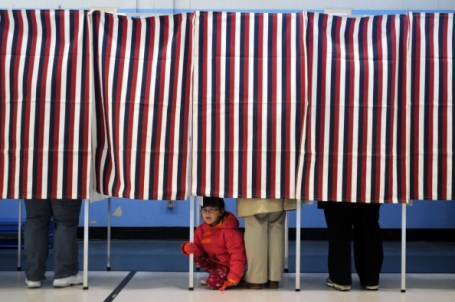
Credit: Darren McCollester / Getty Images
Tomorrow is the big day. Tomorrow, we the people turn out to vote for the next President of the United States. Though literally thousands of other politicians will be on the ballots that are cast tomorrow, the presidential election is the one that looms largest in the minds and hearts of most people. Indeed, I’ve heard it repeated over and over again throughout the course of this political season that “this is the most important presidential election of our lifetimes.” I honestly do not know whether or not it is. I do know that Walter Mondale told a crowd in 1984, “This is the most important election of our lives.” I would argue that history has probably proven him wrong. And history, eventually, may prove today’s claim about the importance of this election wrong – or, perhaps, right. We’ll just have to wait and see.
But whether or not voters and pundits prove to be historically correct in their estimation of the weightiness of this election, I do know that the immediate perceived importance of this election is enormous and is engendering deep fear in the minds and hearts of many. I have had conversation after conversation with people who are scared of what has happened and what will happen to our political system and to our nation.
This past weekend, I listened to a sermon on the topic of this year’s election. The pastor who preached this sermon argued forcefully, powerfully, and, at times, eloquently for what he believed about this election and even for whom he believed we, as Christians, should vote in this election. But what struck me most about this pastor’s sermon was its closing. He ended by talking about two fears that he has for the future of this nation. First, he explained his fear that there may be too many of “them” and too few of “us.” He sees postmodern secularism winning over the masses and driving Christianity to the fringes and he is worried that there is nothing we can do politically to beat it back. Second, he expressed his worry that we may simply be too late to make any difference. He thinks too many Christians have been too silent for too long, and now a day of reckoning has come.
Politically, this pastor seemed very knowledgeable. Theologically, however, if I can be so bold to say this, as I listened to his sermon, I became more and more convinced that he missed something very important. Here’s why I say that.
First, if anyone thinks that there are too many of “them” and too few of “us,” I would encourage that person to read the story of Gideon. When God takes the army Gideon has mustered to fight the Midianites and reduces it in force from 32,000 men to 300 men – a reduction of over 99 percent – it looks like there is no way Gideon and his tiny army can defeat the massive army of a whole tribe of people. But God specializes in doing great things when there are too many of “them” and too few of “us.” God made a whole nation out of one man Abraham. God redeemed a whole people from slavery through one man Moses. God changed the whole course of human history through twelve men He deemed “apostles.” And God brought salvation to our whole world in one man He calls His Son. God can do a lot with a little.
Second, if anyone thinks it is simply too late, I would point that person to the story of Jesus’ friend Lazarus. When Jesus learns that His friend has fallen ill, rather than rushing to see him, He waits for him to die. Why? Because, as Jesus says to Martha, He is “the resurrection and the life” (John 11:25). Even death is not too late for Jesus because He can snatch life from the jaws of death. When the hour on our clock strikes eleven and we begin to struggle and scramble, Jesus can bring forth a new dawn that we never saw coming.
What struck me most about this pastor’s sermon is that although he issued a clear call to his congregation to get out and vote, he never explicitly reminded his congregation to have faith – to trust in the One who holds everything from your house to the White House in His hands.
Politics has a bias toward action. Legislation gets passed when deals get made. Public officials are elected when votes are cast. Social change can be engineered when Supreme Court verdicts are rendered. Action is important to politics. But as Christians, we must remember that the centerpiece of who we are is not in what we do, but in whom we believe. “Believe in the Lord Jesus, and you will be saved” (Acts 16:31). Faith is the centerpiece of our life in Christ.
I think it’s this that gets to the root of our fear. Because if we get so stuck on the action of our vote and the action of our legislators and the action of some guy or gal who sits in an office that is shaped like an oval that we forget that our hope is nothing that we have done, are doing, will do, or can do, then we’ve missed what’s most important. Because we’ve missed Jesus. And you don’t get Jesus by action. You only get Jesus through faith. There’s a reason the Psalmist says, “When I am afraid, I put my trust in You” (Psalm 56:3).
So, if you are afraid of the outcome of this election and the future of this country, go ahead and vote, but don’t expect your vote to calm your fears. Because your fears cannot be calmed by electoral majority. Your fears can only be calmed by a Savior who died for you and me.
Trust in Him.
Standing for Life

I grew up in the first state in our union to legalize physician-assisted suicide. When Oregon passed the Death with Dignity Act in 1997, which allowed a terminally ill patient to administer lethal drugs to him or her self under the direction of a doctor, it stirred a lot of controversy. Though other states and regions have since followed suit, even nearly twenty years later, laws like the Death with Dignity Act still stir a lot of controversy and concern.
Our nation’s capital is now joining the fray of this debate with the D.C. Council readying themselves to vote tomorrow on legislation that would allow doctors to prescribe lethal drugs to terminally ill people. Fenit Nirappil of The Washington Post explains:
A majority of D.C. Council members say they plan to vote for the bill when it comes before them Tuesday.
But chances for enactment are unclear. The council will have to vote on the bill twice more by the end of the year. Mayor Muriel E. Bowser (D) has not indicated whether she will sign the legislation, although her health director has testified against it, saying it violates the Hippocratic oath. It is not certain that proponents have enough votes for an override. And Congress could also strike down the legislation.[1]
Many in the African-American community of Washington D.C. strongly oppose the legislation. The charge against the legislation is being led by Rev. Eugene Rivers III, who is leading a group called No DC Suicide. Rev. Rivers calls the legislation “back end eugenics,” and believes it is aimed at eliminating poor blacks. Leona Redmond, a community activist, echoes Rev. Rivers’ sentiment, saying, “It’s really aimed at old black people. It really is.” Proponents of the law have made countless assurances that there is no racial component to the legislation. Donna Smith, herself an African-American and the organizer for Compassion and Choices, argues, “This just isn’t a ‘white’ issue. This issue is for everyone who’s facing unbearable suffering at the end of life.”
Certainly, any move by any group to end people’s lives based on their race is repulsive. Indeed, if this legislation is enacted and, even if unintentionally, disproportionately affects a particular race, serious questions will need to be asked and stern objections will need to be raised. The problem for the Christian, however, extends beyond the boundaries of race to the dignity of humanity itself.
In the third article of the Nicene Creed, Christians confess, “I believe in the Holy Spirit, the Lord and giver of life.” Fundamental to what we confess as Christians is that God is the giver of life. When the apostle Peter is preaching a sermon on Pentecost day, he says to those assembled, “You killed the author of life, but God raised Him from the dead” (Acts 3:15). Because God is the author of life, Christians believe that life is a sacred gift from God to us and ought to be stewarded carefully and lovingly by us. This is why orthodox Christianity has consistently stood against the taking of life whether that be through abortion at life’s beginning or through physician-assisted suicide as life may be nearing its end. Both of these practices treat life not as a gift to be stewarded, but as burden to be manipulated and, ultimately, destroyed.
It is true that life can sometimes become burdensome. But when a young lady becomes terrified at the specter of an unexpected pregnancy, or when a person is suffering through the throes of a terminal illness, we must remind ourselves that life itself is not the culprit in these types of tragic situations. A world broken by sin is the culprit. So attacking life itself doesn’t relieve the burden. Instead, attacking life actually succumbs to the burden because it capitulates to what sin wants, which is always ultimately death. To fight against sin, therefore, is to fight for life.
As Christians fight for life, it is very important that they fight for all of life and not just certain moments in life. All too often, Christians have been concerned with fighting for those at the beginning of life as they stand against abortion, or fighting for those who may be nearing the end of life as they stand against physician-assisted suicide. But there is so much more to life than just its beginning and its end. Christians should be fighting against human trafficking, which treats lives as commodities to be traded rather than as souls to be cherished. Christians should be fighting against racism, which trades the beauty of a shared humanity for the dreadfulness of discriminatory distinctions. Christians should be concerned with genocide in places like Aleppo, as Syria’s army continues to launch indiscriminate military strikes against its own citizens with horrifying results. To celebrate life means to celebrate all of life – from the moment of conception to the moment of death and everything in between.
So let’s stand for and celebrate life. After all, after this life comes everlasting life through faith in Christ. Life will win out in the end. So we might as well surrender to and celebrate life now.
______________________________
[1] Fenit Nirappil, “Right-to-die law faces skepticism in nation’s capital: ‘It’s really aimed at old black people,’” The Washington Post (10.17.2016).


 Pastor Zach's Blog