Posts tagged ‘Faith’
Merry Christmas!

“Adoration of the Shepherds” by Gerard van Honthorst, 1622
On this Christmas Eve, I wanted to share with you a portion of a Christmas sermon from Martin Luther, dated 1521. Interestingly, Luther never actually preached this sermon. Rather, he wrote this sermon as part of a collection of homilies for other pastors to share with their congregations. At this time, he also translated the New Testament into German. Luther did this so people could read the Bible in their native tongue and pastors could faithfully preach the Bible to their congregants.
In this sermon, Luther beautifully brings out the centrality of Christmas – not just as a story that happened long ago, but as an eternity-shifting event which calls for faith. Without faith, Christmas brings only condemnation, for the world’s Judge has arrived. But by faith, Christmas is cause for rejoicing, for our Savior has come!
So, it is in faith that I wish you a merry Christmas!
The Gospel teaches that Christ was born for our sake and that He did everything and suffered all things for our sake, just as the angel says here: “I announce to you a great joy which will come to all people; for to you is born this day a Savior who is Christ the Lord” [Luke 2:10–11]. From these words you see clearly that He was born for us. He does not simply say: “Christ is born,” but: “for you is he born.” Again, he does not say: “I announce a joy,” but: “to you do I announce a great joy.” … This is the great joy, of which the angel speaks, this is the consolation and the superabundant goodness of God, that man (if he has this faith) may boast of such treasure as that Mary is his real mother, Christ his brother, and God his father. For these things are, all of them, true and they come to pass, provided we believe them; this is the chief part and chief good in all the gospels … Christ, above all things, must become ours and we His, before we undertake good works. That happens in no other way than through such faith; it teaches the right understanding of the gospels and it seizes hold on them in the right place. That makes for the right knowledge of Christ; from it the conscience becomes happy, free, and contented; from it grow love and praise of God, because it is He who has given us freely such superabundant goods in Christ … Therefore see to it that you derive from the Gospel not only enjoyment of the story as such, for that does not last long. Nor should you derive from it only an example, for that does not hold up without faith. But see to it that you make His birth your own, and that you make an exchange with Him, so that you rid yourself of your birth and receive, instead, His. This happens, if you have this faith. By this token you sit assuredly in the Virgin Mary’s lap and are her dear child. This faith you have to practice and to pray for as long as you live; you can never strengthen it enough. That is our foundation and our inheritance. (AE 52:14-16)
Eat Up!
 In the 2001 remake of the famed heist film, Ocean’s 11, I found my favorite character to be Rusty Ryan, played by Brad Pitt. Do I like him because he has the raw street smarts to pull off a $150 million heist at three Las Vegas Casinos simultaneously? Nope. Do I like him because he is able to coolly keep his partner, played by George Clooney, in check when as he plans this job only to impress his ex-wife? Not really. The reason I like Brad Pitt is because, in almost every scene, Brad Pitt is found chowing down on some piece of junk food. Indeed, this turned into an intentional gag, as Pitt later himself admitted: “I started eating, and couldn’t stop. I don’t know what happened. It’s just the idea that you never have time to sit down and have a meal while you’re trying to pull off this heist, so my character is grabbing food all the time.” Now there’s a man after my own heart. He starts eating and he can’t stop. I know the feeling.
In Luke 14, Jesus seems to be always eating. The chapter opens: “One Sabbath, Jesus went to eat in the house of a prominent Pharisee” (verse 1). From there, the food motif continues. Jesus tells a parable: “When someone invites you to a wedding feast, do not take the place of honor, for a person more distinguished than you may have been invited” (verse 8). He then follows up this food-based parable with another meal metaphor: “When you give a luncheon or dinner, do not invite your friends, your brothers or relatives, or your rich neighbors; if you do, they may invite you back and so you will be repaid” (verse 12). What is Jesus’ obsession with food? Is this some kind of intentional gag?
It is indeed intentional, but it is certainly no gag. The majority of people in the Ancient Near East subsided on next to nothing. That is, rather than having a super-abundance of food, they lived on scarcity. One famine, one drought, or one natural disaster could kill hundreds of thousands of people because they had few reserves in place to stymie a crisis. Thus, the Old Testament prophets would often promise a day when people would no longer have to contend with these restricted resources. They would speak of a day of feasting. The prophet Isaiah writes, for instance, “The LORD Almighty will prepare a feast of rich food for all peoples, a banquet of aged wine – the best of meats and the finest of wines” (Isaiah 25:6). The Psalmist promises likewise: “Those that be planted in the house of the LORD shall flourish in the courts of our God. They shall still bring forth fruit in old age; they shall be fat and flourishing” (Psalm 92:13-14). In our day, a promise of fatness is hardly desirable. But in the first century, when food was scarce, a promise of fatness was a promise of provision. It was a promise of a lavish feast.
When Jesus speaks of several feasts in Luke 14, He is saying: “I am the fulfillment of God’s provisional promises. With Me, God’s feast has come!” This is why Jesus continues with yet another parable on food:
A certain man was preparing a great banquet and invited many guests. At the time of the banquet he sent his servant to tell those who had been invited, “Come, for everything is now ready.” But they all alike began to make excuses. The first said, “I have just bought a field, and I must go and see it. Please excuse me.” Another said, “I have just bought five yoke of oxen, and I’m on my way to try them out. Please excuse me.” Still another said, “I just got married, so I can’t come.” (verses 16-20)
It is important to understand that the excuses these guests offer as to why they cannot attend this king’s feast are offensive and disingenuous. To turn down any invitation to share in a meal, much less to share in a lavish feast such as this one, would have been unthinkable in that day. But this is what these ungrateful invitees do. Thus, the king responds by ordering his servant: “Go out quickly into the streets and alleys of the town and bring in the poor, the crippled, the blind and the lame” (verse 21). This king, one way or another, will have guests at his feast. And these marginalized people will certainly not turn down the king’s invitation. And indeed they don’t. They come to the king’s feast. But even after they come, the servant returns to his king and says, “Sir, what you ordered has been done, but there is still room.” (verses 21-22).
I love these words. Even after the poor, the crippled, the blind, and lame fill the king’s banquet hall, there is still room. There is still room for more feasters. There is still room for more banqueters. There is still room.
The king in the parable, of course, is Jesus Himself. And the invitees to Jesus’ banquet are you and me. We are invited to share in Jesus’ feast of salvation. And here’s the good news: There is still room. There is still room enough for you to share in God’s salvation. There is still room enough for you to share in God’s grace. There is still room enough for you to share in God’s forgiveness. There is still room enough for you. So come to Jesus’ feast and share in His goodness. After all, there is still room enough at His table…just for you.
Christianity in a Culture of Narcissism: From Descartes to Kant
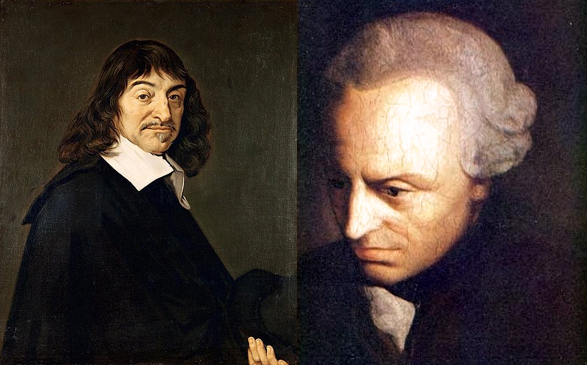
René Descartes and Immanuel Kant
It began in the Garden. When Adam and Eve ate of the forbidden fruit, they became history’s first narcissists. Narcissism is defined as “a consuming self-absorption or self-love; a type of egotism. Narcissists constantly assess their appearance and desires.”[1] Adam and Eve assessed their desires and decided that their desires trumped God’s command. Theologically, then, narcissism is as old as history itself. Philosophically, however, narcissism’s origin – or at least its willing sanction – is slightly more modern.
Narcissism finds its philosophical roots in the seventeenth century French philosopher René Descartes. In 1637, he published his seminal work, Discourse on Method, in which he undertook to find something concrete on which to rest his life – a point of certainty in an illusory and shifting universe. How would he discover such a point of certainty? By doubting everything he possibly could. He writes, “I ought to reject as absolutely false all opinions in regard to which I could suppose the least ground for doubt, in order to ascertain whether after that there remained aught in my belief that which was wholly indubitable.”[2] Descartes trumpets methodological doubt as his mechanism to discover certainty. For doubt and certainty are inimical to each other. This means that if Descartes can find something which he cannot doubt, then this thing must, by antonymic reasoning, be certain.
So what does Descartes doubt? Pretty much everything. He doubts human intelligence and insight. After all, Descartes says, there are a great “number of conflicting opinions touching a single matter that may be upheld by learned men.”[3] Thus, how is one to know who holds the correct opinion? We are left only with uncertainty. And where there is doubt, we must throw it out. Societal norms and traditions must also be doubted. For different societies have different and conflicting opinions and customs: “A person brought up in France or Germany exhibits [a very different character] from that which, with the same mind originally, this individual would have possessed had he always lived among the Chinese or the savages.”[4] Not even one’s own senses can be totally trusted, for “our senses sometimes deceive us.”[5]
So are we left with anything which cannot be doubted? Descartes says there is one indubitable thing:
Whilst I thus wished to think that all was false, it was absolutely necessary that I, who thus thought, should be somewhat; and I observed that this truth, I think, therefore I am, was so certain and of such evidence that no ground of doubt, however extravagant, could be alleged by the skeptics capable of shaking it.[6]
Here we have perhaps the most famous words spoken by any philosopher in any age: “I think, therefore I am.” This is what Descartes can know for certain: He exists. How does he know this? He thinks. Consciousness, in Descartes’ scheme, becomes the cause of one’s existence, for the very certainty of a person’s very existence is based on nothing else than that person’s very thinking! Everything a person can know, experience, or be certain of is found in nothing other than the person who is knowing, experiencing, and being certain. A person, then, is a completely self-contained and self-absorbed entity. And this, by definition, is narcissism.
It is important to note that, no matter how egocentric Descartes’ dictum may be, the philosopher styled himself as a committed Catholic and finally, at the end of Discourse on Method, seeks to make an argument for the existence of God. But consider how he fashions his argument: “I was led to inquire whence I had learned to think of something more perfect than myself; and I clearly recognized that I must hold this notion from some nature which in reality was more perfect.”[7] Descartes argues that because he can think of a being more perfect than himself, there must indeed be such a being! In other words, Descartes thinks of God, so there is God. He thinks, therefore God is.
Though Descartes ultimately exercises a certain amount of restraint in Discourse on Method, trying to steer clear of the unabated egoism that his philosophical system inevitably brings, Descartes’ “I” was quickly marshaled by other less scrupulous philosophers to plunge into a pool of silly solipsism and self-regarding subjectivism. The next century saw the rise of Immanuel Kant who championed the distinction between the noumenon and the phenomenon. The noumenon is what Kant referred to in German as the ding an sich, “the thing in itself.” That is, the noumenon is that which is outside of us. The phenomenon, conversely, is our personal experience, roughly analogous to the Cartesian “I.” Kant argued that a person has no access to the noumenon apart from the phenomenon. In other words, it is impossible for us to get outside of our phenomenal selves to directly observe the noumenal world. Kant asserts, “We cannot know these objects as things in themselves” (ding an sich). Thus, we are stuck in our hopelessly subjective phenomenal perspectives. Lest one believe that subjectivity is all there is, however, Kant quickly qualifies: “Though we cannot know these objects as things in themselves, we must yet be in a position at least to think them as things in themselves; otherwise we should be landed in the absurd conclusion that there can be appearance without anything that appears.”[8] Notice how closely Kant’s apology for the existence of the noumenon mirrors Descartes’ apology for the existence of God: “I can think it, so it must exist!”
With such a rosy view of the human intellect, it is no wonder that subsequent generations have quickly left behind Kant’s noumenon – since it was ultimately inaccessible anyway – in favor of the egoistic phenomenon. That is, what is “out there” noumenally no longer matters to many people. Some have even gone so far as to deny the existence of the noumenon altogether. It is only what is “in us” phenomenally that counts. This, in turn, has led to obsessive and unyielding introspection – a tell tale sign of narcissism.
Christianity, of course, tells a different story. We should not bow to what is “in us” as the ultimate grounds for our existence. Indeed, what is “in us” is suspect at best and, more realistically, downright evil. The prophet Jeremiah warns, “The heart is deceitful above all things and beyond cure. Who can understand it” (Jeremiah 17:9)? Our ability to understand even our own selves (not to mention the rest of the world) by ourselves is fatally flawed. Understanding must start from outside of us; not from inside of us. This is why, according to Scripture, wisdom and insight are finally gifts from an external God and not functions of an internal human intellect (e.g., 1 Kings 4:29).
Perhaps Descartes’ dictum would be better reversed: “I am, therefore I think.” Or, even better, “I am created, therefore I think.” In this dictum, creation – the mechanism by which we exist – precedes deliberation. We can only think because we have been endowed with an intellect by a loving Creator. He is the center and superlative of our being, for He is the source of our existence. Our narcissistic “I” must yield to His perfect glory.
[1] “Narcissism,” The American Heritage Dictionary, dictionary.com.
[2] Rene Descartes, Discourse on the Method of Rightly Conducting the Reason, and Seeking Truth in the Sciences (Forgotten Books, 2008), 28.
[3] Discourse on Method, 7.
[4] Discourse on Method, 14.
[5] Discourse on Method, 28.
[6] Discourse on Method, 28-29.
[7] Discourse on Method, 30.
[8] Vincent G. Potter, Readings in Epistemology: From Aquinas, Bacon, Galileo, Descartes, Locke, Berkeley, Hume, Kant (Fordham University Press, 1993), 198-199.
ABC Extra – In Sickness And In Health
 Death is inescapable. It doesn’t matter how rich or how poor, how healthy or how sick, how old or how young a person is. Eventually and inevitably, death comes for each one of us. After Steve Jobs passed away, many bloggers and journalists spoke of how Jobs sought to receive “the best care money could buy.” And indeed, he did receive terrific care from world-renowned doctors. But although they may have been able to prolong his life, they were not able to save it. He passed away last year. Death came for Steve Jobs. Shortly after the world-renowned and lovably cantankerous atheist apologist Christopher Hitchens was diagnosed with cancer, he described his ailment in his characteristically colorful tone: “Against me is the blind, emotionless alien, cheered on by some who have long wished me ill. But on the side of my continued life is a group of brilliant and selfless physicians plus an astonishing number of prayer groups.”[1]
Like Steve Jobs, Christopher Hitchens turned to the most “brilliant and selfless physicians” money could buy, and though they may have been able to prolong his life, they were not able to save it. He passed away last year. Death came for Christopher Hitchens.
Death is inescapable. And yet, I find it interesting that, particularly in the case of Christopher Hitchens, it wasn’t just medical professionals who were working to prolong his life, it was Christians who were praying to redeem his life.
In worship and ABC this past weekend, we looked at the story of a demon-possessed boy in Mark 9. Initially, the disciples try to heal this boy, but they cannot (cf. Mark 9:17-18). Jesus, however, is able to drive out the torturing spirit (cf. Mark 9:25-27). Beleaguered by their embarrassing failure, the disciples ask Jesus privately, “Why couldn’t we drive it out?” Jesus’ answer is clarifying and convicting: “This kind can come out only by prayer” (Mark 9:28-29). This boy could not be healed by a pill, a surgery, a physician, or an exorcism rite. Rather, persistent and consistent prayer was the key to this boy’s recovery.
For all of man’s collective medical wisdom, there are still some diseases which can be healed only by prayer. This is why James asks, “Is any one of you sick? He should call the elders of the church to pray over him and anoint him with oil in the name of the Lord” (James 5:14). Prayer is more powerful and potent than any human remedy. For prayer has God’s will and mercy as its answer.
Tragically, even in the face of certain death, Christopher Hitchens wrote, “Please do not trouble deaf heaven with your bootless cries.” Christopher Hitchens’ commitment to his atheism was unflappable. He refused to believe that his kind of sickness could “come out only by prayer.” Then again, after asking people not to pray for him, he added this little caveat: “Unless, of course, it makes you feel better.”[2]
Christopher Hitchens never came to understand and see that prayer is not just for the therapy of weak minds, it is for the strengthening of brave souls. Prayer, perhaps, really could have made him feel better – not only in his cancerous plight, but in his eternity as well. For not only can God hear our prayers and sometimes grant us a temporal recovery, He will hear our prayers and always grant us a glorious eternity through Christ. And that is a gift and blessing we dare not miss.
Want to learn more? Go to
www.ConcordiaLutheranChurch.com
and check out audio and video from Pastor Tucker’s
message or Pastor Zach’s ABC!
Where You Begin and Where You End
 I have often said, when teaching in various settings, “Where you begin is where you end.” This is my axiomatic, though admittedly somewhat simplistic, way of expressing the truth that all of us come to a situation, a problem, or a challenge with our own preconceived notions and biases. These preconceived notions and biases, in turn, inevitably color the conclusions we draw and the solutions we formulate. This is especially true when it comes to working with the text of Scripture. If you approach the Bible with a stance of pessimism and incredulity, what you find will be appropriately pessimistic and incredulous. Conversely, if you approach the Bible with a stance of awe and a desire to “give the Bible the benefit of the doubt,” as it were, the conclusions you draw will strengthen your faith soothe your troubled soul. It is no secret that I am in the latter camp of how I approach Holy Scripture. In light of my ABC yesterday on the doctrine of the inspiration of Scripture, I thought that this quote from Ben Witherington III, given at the Greer-Heard Forum last Saturday at New Orleans Baptist Seminary, offered some keen insight into why I am in this latter camp:
I don’t believe in “justification by doubt.” I don’t believe that philosophical skepticism is the same thing as critical thinking, and I also don’t think that the sort of historiography that is undergirded by such a prioris can help us very much with the question are the Gospels reliable, truthful witnesses when it comes to the historical Jesus. In fact, if you want to actually get at the truth of something, you have to enter into dialogue with that source giving it the benefit of the doubt, allowing it to have its say, and while one doesn’t put one’s critically thinking cap aside, if you do not approach the material with an open mind and a willingness to learn from it, you won’t get at the truth of the matter, not even the historical truth of the matter. You can’t possibly analyze the actual nature of a raging fire, by pouring cold water on it, and then picking over the ashes and charcoal thereafter.
ABC Extra – Faith and Fear
 My wife and I have very different sleep habits. I can fall asleep in five minutes or less with the lights on, the television blaring, the cats meowing, and my phone ringing. My wife, however, has to have complete darkness, total silence, and at least thirty minutes to get to sleep.
From conversations I have had with my married friends, it seems as though, many times, men have a much easier time falling asleep than do women. But, then again, I have always slept easier and better with light and noise than I have in darkness and silence. I can remember, even as a little child, finding complete darkness and total silence to be far too creepy and frightening for me to sleep soundly. And so, I would turn on my nightlight and my radio and settle down for a good night’s rest.
Though my fears of darkness and silence have long since passed away, I still prefer light and noise to silence and darkness, partly because, when our bedroom is completely dark, I have been known to crash into and fall over more than a few things! But as a child, darkness and silence petrified me.
Everyone fears something. It could be an unknown future, or a bank account that never seems to have enough money, or even a person – a bully or a parent – whose approval you can never seem to earn. Fear is a reflexive response programmed into every human being.
In one sense, then, I suppose that it was only natural for the disciples to be scared out of their wits at the situation they were facing in Matthew 8:23-27. A sudden storm had just descended on the Sea of Galilee. The winds were raging. The sea was rolling. Lightning was striking. Their boat was sinking. And Jesus, who was along for the ride on this trip, was…sleeping? Yes, sleeping! Upon being awoken by His disciples, Jesus gently chastises them for their fear in the face of this furious squall: “You of little faith,” Jesus says, “Why are you so afraid” (verse 26)? Shouldn’t the answer to Jesus’ question be obvious?! The disciples are afraid because their lives are in danger! The disciples are afraid because the storm surge is sure to spell their imminent doom! Wouldn’t anyone be scared in this situation?
Yes, it is only natural for the disciples to be afraid. But the disciples’ natural reaction in the face of this storm is not appropriate with a supernatural Savior on board the boat. Matthew explains: “Jesus got up and rebuked the winds and the waves, and it was completely calm” (verse 26). There was no need to fear because Jesus was here.
In his commentary on this episode, the great English theologian Matthew Henry remarks, “Jesus does not chide the disciples for disturbing Him with their prayers, but for disturbing themselves with their fears.” In other words, Henry asserts that it was perfectly acceptable for the disciples to cry out to their Savior to stop the storm. It was not appropriate, however, for the disciples to cripple their faith with their fears. They should have trusted in Jesus’ identity as the Son of God and His character as their loving Lord to take care of the storm. Their fear betrayed a lack of faith. And a lack of faith is always a problem.
Fear often is a symptom that we are trusting in ourselves and our own ability – or our own inability, as the case may be – to handle a situation or face a challenge. What are you scared of? Rather than letting anxiousness and fear take root in your heart, cry out to Jesus and ask him to quell your fears and meet your challenges. For the one who can conquer the wind and waves on the Sea of Galilee can also conquer the fears of your heart.
Want to learn more on this passage? Go to
www.ConcordiaLutheranChurch.com
and check out audio and video from Pastor Tucker’s
message or Pastor Zach’s ABC!


 Pastor Zach's Blog