Posts tagged ‘Christianity’
Christianity in a Culture of Narcissism: From Descartes to Kant
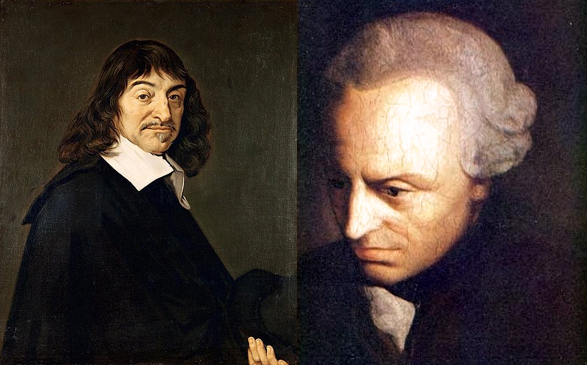
René Descartes and Immanuel Kant
It began in the Garden. When Adam and Eve ate of the forbidden fruit, they became history’s first narcissists. Narcissism is defined as “a consuming self-absorption or self-love; a type of egotism. Narcissists constantly assess their appearance and desires.”[1] Adam and Eve assessed their desires and decided that their desires trumped God’s command. Theologically, then, narcissism is as old as history itself. Philosophically, however, narcissism’s origin – or at least its willing sanction – is slightly more modern.
Narcissism finds its philosophical roots in the seventeenth century French philosopher René Descartes. In 1637, he published his seminal work, Discourse on Method, in which he undertook to find something concrete on which to rest his life – a point of certainty in an illusory and shifting universe. How would he discover such a point of certainty? By doubting everything he possibly could. He writes, “I ought to reject as absolutely false all opinions in regard to which I could suppose the least ground for doubt, in order to ascertain whether after that there remained aught in my belief that which was wholly indubitable.”[2] Descartes trumpets methodological doubt as his mechanism to discover certainty. For doubt and certainty are inimical to each other. This means that if Descartes can find something which he cannot doubt, then this thing must, by antonymic reasoning, be certain.
So what does Descartes doubt? Pretty much everything. He doubts human intelligence and insight. After all, Descartes says, there are a great “number of conflicting opinions touching a single matter that may be upheld by learned men.”[3] Thus, how is one to know who holds the correct opinion? We are left only with uncertainty. And where there is doubt, we must throw it out. Societal norms and traditions must also be doubted. For different societies have different and conflicting opinions and customs: “A person brought up in France or Germany exhibits [a very different character] from that which, with the same mind originally, this individual would have possessed had he always lived among the Chinese or the savages.”[4] Not even one’s own senses can be totally trusted, for “our senses sometimes deceive us.”[5]
So are we left with anything which cannot be doubted? Descartes says there is one indubitable thing:
Whilst I thus wished to think that all was false, it was absolutely necessary that I, who thus thought, should be somewhat; and I observed that this truth, I think, therefore I am, was so certain and of such evidence that no ground of doubt, however extravagant, could be alleged by the skeptics capable of shaking it.[6]
Here we have perhaps the most famous words spoken by any philosopher in any age: “I think, therefore I am.” This is what Descartes can know for certain: He exists. How does he know this? He thinks. Consciousness, in Descartes’ scheme, becomes the cause of one’s existence, for the very certainty of a person’s very existence is based on nothing else than that person’s very thinking! Everything a person can know, experience, or be certain of is found in nothing other than the person who is knowing, experiencing, and being certain. A person, then, is a completely self-contained and self-absorbed entity. And this, by definition, is narcissism.
It is important to note that, no matter how egocentric Descartes’ dictum may be, the philosopher styled himself as a committed Catholic and finally, at the end of Discourse on Method, seeks to make an argument for the existence of God. But consider how he fashions his argument: “I was led to inquire whence I had learned to think of something more perfect than myself; and I clearly recognized that I must hold this notion from some nature which in reality was more perfect.”[7] Descartes argues that because he can think of a being more perfect than himself, there must indeed be such a being! In other words, Descartes thinks of God, so there is God. He thinks, therefore God is.
Though Descartes ultimately exercises a certain amount of restraint in Discourse on Method, trying to steer clear of the unabated egoism that his philosophical system inevitably brings, Descartes’ “I” was quickly marshaled by other less scrupulous philosophers to plunge into a pool of silly solipsism and self-regarding subjectivism. The next century saw the rise of Immanuel Kant who championed the distinction between the noumenon and the phenomenon. The noumenon is what Kant referred to in German as the ding an sich, “the thing in itself.” That is, the noumenon is that which is outside of us. The phenomenon, conversely, is our personal experience, roughly analogous to the Cartesian “I.” Kant argued that a person has no access to the noumenon apart from the phenomenon. In other words, it is impossible for us to get outside of our phenomenal selves to directly observe the noumenal world. Kant asserts, “We cannot know these objects as things in themselves” (ding an sich). Thus, we are stuck in our hopelessly subjective phenomenal perspectives. Lest one believe that subjectivity is all there is, however, Kant quickly qualifies: “Though we cannot know these objects as things in themselves, we must yet be in a position at least to think them as things in themselves; otherwise we should be landed in the absurd conclusion that there can be appearance without anything that appears.”[8] Notice how closely Kant’s apology for the existence of the noumenon mirrors Descartes’ apology for the existence of God: “I can think it, so it must exist!”
With such a rosy view of the human intellect, it is no wonder that subsequent generations have quickly left behind Kant’s noumenon – since it was ultimately inaccessible anyway – in favor of the egoistic phenomenon. That is, what is “out there” noumenally no longer matters to many people. Some have even gone so far as to deny the existence of the noumenon altogether. It is only what is “in us” phenomenally that counts. This, in turn, has led to obsessive and unyielding introspection – a tell tale sign of narcissism.
Christianity, of course, tells a different story. We should not bow to what is “in us” as the ultimate grounds for our existence. Indeed, what is “in us” is suspect at best and, more realistically, downright evil. The prophet Jeremiah warns, “The heart is deceitful above all things and beyond cure. Who can understand it” (Jeremiah 17:9)? Our ability to understand even our own selves (not to mention the rest of the world) by ourselves is fatally flawed. Understanding must start from outside of us; not from inside of us. This is why, according to Scripture, wisdom and insight are finally gifts from an external God and not functions of an internal human intellect (e.g., 1 Kings 4:29).
Perhaps Descartes’ dictum would be better reversed: “I am, therefore I think.” Or, even better, “I am created, therefore I think.” In this dictum, creation – the mechanism by which we exist – precedes deliberation. We can only think because we have been endowed with an intellect by a loving Creator. He is the center and superlative of our being, for He is the source of our existence. Our narcissistic “I” must yield to His perfect glory.
[1] “Narcissism,” The American Heritage Dictionary, dictionary.com.
[2] Rene Descartes, Discourse on the Method of Rightly Conducting the Reason, and Seeking Truth in the Sciences (Forgotten Books, 2008), 28.
[3] Discourse on Method, 7.
[4] Discourse on Method, 14.
[5] Discourse on Method, 28.
[6] Discourse on Method, 28-29.
[7] Discourse on Method, 30.
[8] Vincent G. Potter, Readings in Epistemology: From Aquinas, Bacon, Galileo, Descartes, Locke, Berkeley, Hume, Kant (Fordham University Press, 1993), 198-199.
Christianity in a Culture of Narcissism

“Narcissus” by Caravaggio, 1596
“I wanna talk about me, wanna talk about I, wanna talk about number one, oh my me my.”
– Toby Keith, country singer[1]
“I think I’m fascinating.”
– Snooki, Jersey Shore star[2]
“What do you really want out of life? A bigger, better job? A hotter sex life? The lean, mean body you had in college? All of the above? Men’s Health can help you get there.”
– Men’s Health promotion[3]
As the Roman poet Ovid tells it, Narcissus was quite the heartbreaker. Narcissus was a handsome young hunter, furiously courted by every young lady who met him. But Narcissus rejected every advance of every young lady because Narcissus only had eyes for…himself. The story goes that one day, after an especially rigorous morning of hunting, Narcissus decided to rest for a moment on a verdant pasture next to a quiet pond. When he went to the pond to get a drink of water, what did he see, but himself! So enamored was Narcissus by his own appearance, that he eventually died there by that pool, for he was unable to pry himself away from his striking reflection.[4]
Narcissus, of course, serves as the namesake and the caution for the personality disorder we know as narcissism. I recently read that the American Psychiatric Association is considering removing narcissism from its highly influential Diagnostic and Statistical Manual of Mental Disorders (DSM). Why? Because more and more psychologists consider it to be “a manifestation of normal personality.”[5] Narcissism is now normal. Or so psychologists say.
One doesn’t need to look very far to see just how “normal” narcissism has become. From country singers who want to talk about themselves to faux reality TV stars who find themselves to be inexhaustibly interesting to magazines which unabatedly sell narcissism to self-absorbed, even if fitness-conscious, consumers, instances of narcissism are everywhere. Yet, I would argue that simply because narcissism is prevalent doesn’t necessarily mean it is normal. “Normal” refers to something which “conforms to a standard or common type.”[6] But what “standard or common type” norms that which is normal? In psychology, it is the standard of self. Whatever behavior, trait, or characteristic is most common among the majority of people is considered normal. Majority norms psychology. Hence, the reason narcissism is being considered for removal from the DSM. Theologically, however, things work differently. Normal is not defined by human prevalence but by divine revelation. And theologically, narcissism is most definitely abnormal – and worse, sinful. As the apostle Paul warns, “But mark this: There will be terrible times in the last days. People will be lovers of themselves” (2 Timothy 3:1-2). According to Paul, to be obsessed with self is a sinful sign of the terrible times. It’s time, then, to leave narcissism behind for something else – something better.
Over the next few weeks in my blog, I’ll be probing the foundations of narcissism in our society and asking, “How did we get here? How did narcissism become ‘normal’?” To this end, I’ll be exploring the historical underpinnings of narcissism philosophically, scientifically, and therapeutically. All of these disciplines, of course, will be discussed in light of the Bible’s verdict on narcissism theologically.
Ovid says of Narcissus’ narcissism, “Its empty being on thy self relies; Step thou aside, and the frail charmer dies.”[7] Here is a somber warning that we would do well to take to heart. Ovid cautions that narcissism finally leads to death. For in its emphasis on the self, narcissism leaves you only by yourself. And left by yourself, you will only die. For you are only mortal. This is why Jesus invites us to leave behind the deathly hallows of narcissism to find lasting life in Him: “If anyone would come after Me, he must deny himself and take up his cross and follow Me” (Mark 8:34). Jesus is clear: He and narcissism do not mix. Following Him is about losing yourself, not indulging yourself. For when you lose yourself, you happily wind up getting lost in Jesus Himself – His love, His grace, His mercy, His compassion, His identity, and His everlasting life. And He is better than you. In a culture of narcissism, this is what we, as Christians, are called to proclaim.
[1] Toby Keith, “I Wanna Talk About Me” (2001).
[2] Hillary Busis, “Barbara Walters Learns What ‘Smoosh’ Means During Interview With Jersey Shore Cast,” Mediaite (12.10.10).
[3] Email promotion from Men’s Health Magazine (5.31.11).
[4] Ovid, Metamorphoses, Book 3.
[5] NPR Staff, “It’s All About Me: But Is Narcissism A Disorder?” National Public Radio (12.11.10).
[7] Ovid, Metamorphoses, Book 3.
Why Didn’t God Do A Better Job?

Thomas Aquinas
“If…then why?” I have been asked many a question about God which involved these three words. “If God knew that Adam and Eve were going to eat the forbidden fruit, then why did God put the tree there in the first place?” “If God knew some people were going to reject Him, then why did He even create them?” “If God is so good and loving, then why do so many bad things happen?”
Truth be told, there are no easy or complete answers to these questions. Indeed, all of these questions have behind them the problem of “theodicy,” a term borrowed from Greek meaning, “the justice of God.” Theodicy describes the struggle to reconcile the perfect justice of God’s character with the sinful injustice in the world He created.
I have blogged about the problem of theodicy before. And yet, it is impossible to address this troubling issue exhaustively, for no human understands it completely. So, there is always more to say. Thus, I thought it might be helpful to interact with this problem once again from yet another angle. This time, Thomas Aquinas, the great thirteenth century theologian of the Roman Catholic Church, gives us some keen insight into theodicy.
Aquinas, in his seminal work Summa Theologica, makes a distinction between God’s absolute power and God’s ordained power. God’s absolute power refers to the nearly infinite number of possibilities which God could conceivably bring to pass while His ordained power describes what God actually does. Aquinas writes of God’s absolute power:
Now God cannot be said to be omnipotent through being able to do all things that are possible to created nature; for the divine power extends farther than that. If, however, we were to say that God is omnipotent because He can do all things that are possible to His power, there would be a vicious circle in explaining the nature of His power. For this would be saying nothing else but that God is omnipotent, because He can do all that He is able to do. It remains therefore, that God is called omnipotent because He can do all things that are possible absolutely; which is the second way of saying a thing is possible. For a thing is said to be possible or impossible absolutely, according to the relation in which the very terms stand to one another, possible if the predicate is not incompatible with the subject…and absolutely impossible when the predicate is altogether incompatible with the subject.[1]
Interestingly, even within the realm of God’s absolute power, Aquinas allows that there are certain things which are “absolutely impossible.” That is, there are certain things not even God is able to do – not because they fall outside of the purview of His power, but because to demand them is utterly nonsensical. For instance, the old cliché question “Can God make a rock so big He can’t move it?” is impossible to answer not because it exposes some hidden limit to God’s power, but because it doesn’t make any sense. To answer this question with either a “yes” or a “no” is to compromise God’s omnipotence in some way. In this sense, then, this question is not “possible” of God. It is not possible at all.
Aquinas then goes on to speak of God’s ordained power:
We must say that God can do other things by His absolute power than those He has foreknown and pre-ordained He would do. But it could not happen that He should do anything which He had not foreknown, and had not pre-ordained that He would do, because His actual doing is subject to His foreknowledge and pre-ordination, though His power, which is His nature, is not so. For God does things because He wills so to do; yet the power to do them does not come from His will, but from His nature.[2]
This is heady stuff, but it is nevertheless important. Aquinas explains that though there are many things God could do according to the omnipotence of His nature, there are many things God does not desire to do according to the foreknowledge of His will. If God were to do these “other” things, these would be in contradiction to His perfect foreknowledge, thus compromising the integrity of one attribute of God – His foreknowledge – for another – His omnipotence. And if God’s foreknowledge is compromised, ultimately, so is His omnipotence. For then God is not powerful enough to figure out even what He Himself is doing!
Thus, the only way we can understand the power of God is in what God actually does, not in what we wish He would do. This means, much to our chagrin, our many “If…then why” questions and accusations of God are futile. For we cannot deal with God theoretically and abstractly in His absolute power, we can only deal with Him realistically and concretely in His ordained power.
We are not the first generation to speculate concerning the possibilities of God’s absolute power over and against the realities of His ordained power. The fifteenth century Roman Catholic Desiderius Erasmus found many of the speculative questions the armchair theologians of his day were asking to be deplorable:
- Can God undo the past, such as making a harlot into a virgin?
- Could God have become a beetle or a cucumber, instead of a human?[3]
And you thought we had tough questions of God! Although the questions we ask concerning God’s absolute power may strike us as slightly less silly, they are nevertheless of the same ilk as the questions of Erasmus’ day. For they are conjectures based on nothing more than the supercilious speculations of our fertile imaginations.
So what does all this mean? On the one hand, it means that questions concerning why God created human beings if He knew they were going to sin and make a mess out of His world are not only unanswerable, they’re foolish. Alternate scenarios of the way God could have done things can be multiplied ad infinatum. The problem with these scenarios is that just when someone imagines one scenario that is better than the one we currently have, someone else imagines yet another scenario better than the already imagined one. Thus, even if we had another scenario, we would likely be imagining still other scenarios and asking God why we did not have those! To speculate about other scenarios that ask God “Why didn’t You do things this way?” is only to lead us down a careening path of theoretical improvement that ultimately leads and ends nowhere. On the other hand, we can also rest assured that, according to God’s ordained power, it’s not as if God doesn’t know what He’s doing. After all, everything is here and is the way it is according to God’s foreknowledge. In other words, He knew things were going to turn out this way all along. The question is: Do we trust that God knows what He’s doing in His ordained power, or do we belligerently complain to God, explaining how we could have done a better job than He?
Finally, speculation about the way things could be or the way we think things should be leads only to frustration. We have what is; not what is not. But we also hope for what will be. Though there is sin and despair in this world right now, it will not be this way forever. God has promised to us perfection at the Parousia. And His foreknowledge is immutable. This assures us that this perfection will come to pass. Thus, when we are content with what is while also looking forward to what is to come, we find true fulfillment.
So, frustration over what isn’t or fulfillment from trusting in a God who has created what is and will ultimately bring righteousness to reign – which would you rather have?
Facebook Follies
 “Does Facebook Wreck Marriages?” So asked the provocative title of Quentin Fottrell’s blog for the Wall Street Journal.[1] Of course, we know that Facebook in and of itself is not responsible for the breakdown of wedded bliss; rather, it is the way people use Facebook that damages marriages. Still, the statistics cited in Fottrell’s article are staggering:
- More than a third of divorce filings last year contained the word “Facebook.”
- Over 80% of U.S. divorce attorneys say they’ve seen a rise in the number of cases using social networking.
- Of the fifteen cases Gary Traystman, a divorce attorney in New London, Connecticut, handles per year where computer history, texts, and emails are admitted as evidence, 60% involve Facebook exclusively.
Why does Facebook play such a key role in so many connubial collapses? Fottrell brings in an expert for keen insights:
“Affairs happen with a lightning speed on Facebook,” says K. Jason Krafsky, who authored the book Facebook and Your Marriage with his wife Kelli. In the real world, he says, office romances and out-of-town trysts can take months or even years to develop. “On Facebook,” he says, “they happen in just a few clicks.” The social network is different from most social networks or dating sites in that it both re-connects old flames and allows people to “friend” someone they may only met once in passing. “It puts temptation in the path of people who would never in a million years risk having an affair,” he says.
Krafsky’s last line is key: “It puts temptation in the path of people.”
Jesus knew how readily people can fall to temptation when it is placed even peripherally in their path. This is why He warns His disciples, “Watch and pray so that you will not fall into temptation. The spirit is willing, but the body is weak” (Mark 14:38). Jesus’ caution against temptation and His diagnosis of the flesh’s relative spiritual strength, or rather, its lack thereof, ought to be taken seriously.
When a marriage is in disarray, Facebook can provide an all too easily accessible foray into the arena of temptation. Its appeal lies at two opposing poles. On the one side, Facebook provides a public forum for a scorned spouse to spout off about how he or she has been wronged and receive eager and many times blind support from friends who are, at best, only partially informed about the situation. On the other side, though Facebook is public, it deceptively feels private. After all, it’s only “friends” who can see what you are posting – that is, until a divorce attorney subpoenas records from your Facebook account and presents them in court as incriminating evidence.
Both the public and private faculties of Facebook make its appeal to those in rocky relationships almost irresistible. But when Facebook is used to arbitrate an unsettled union, it inevitably leads to ruin. For it allows couples to steep themselves in the sometimes rotten advice from friends or the sometimes illicit advances of lovers while avoiding conversation with the person they need to be talking with the most – the other spouse.
So, how can a couple use Facebook to connect with friends – old and new alike – while steering clear of its more seedy enticements? A few practical, common sense safeguards can go a long way to protecting your integrity – and your marriage.
- First, make sure your spouse has access to your Facebook account. There is no reason why your spouse should not know what you’re posting online. If you’re trying to surprise him or her using a little help from your Facebook friends, find another way. Sustained trust trumps an occasional need for the secrecy of a surprise.
- Second, if your marriage is troubled, personal details are not Facebook appropriate. You don’t need uneven advice from partial pals, you need professional guidance from a licensed therapist. Facebook is a great place to post thought-provoking quotes, interesting articles, and even pictures of your Memorial Day backyard barbeque or your newborn bouncing baby boy. It is not an appropriate place, however, to air your, or someone else’s, dirty laundry. Falstaff, though he was a shameful coward in Shakespeare’s Henry the Fourth, proved to be wise beyond his actions when he said, “The better part of valor is discretion, in the which better part I have sav’d my life.”[2] Discretion on Facebook may just save your marriage.
- Third, be discerning. Believe it or not, regardless of a person’s Facebook classification as your “friend,” not everyone you communicate with on social networking sites has your best interest at heart. And not everyone who proffers advice via the internet knows what he or she talking about, or, as the case may be, “posting” about. This means that you should not set yourself up to get bad advice from your Facebook friends by posting sordid details of your life gone awry, nor should you insert yourself via public posts into someone else’s messy Facebook spectacle. If you’re truly concerned about someone, a face-to-face conversation, or, if that is impossible, a private conversation by some other means, works much better than a public posting.
Finally, a sober estimation of your own sinful desires and weaknesses may be the best safeguard against the wily relational entrapments that internet social networking can bring. No matter how strong you may think your marriage is, all it takes is one click or keystroke to lead it down the road to ruin. And so we pray, “Lead us not into temptation” (Matthew 6:13).
[1] Quentin Fottrell, “Does Facebook Wreck Marriages?” The Wall Street Journal (5.21.12).
[2] William Shakespeare, Henry the Fourth (Part 1, Act 5, Scene 4).
Concordia’s New Series: tHE aBNORMAL lIFE
 We’re gearing up for our summer series at Concordia. It’s one you’re not going to want to miss! Even though you only have to wait one week to find out what it’s all about, we thought you might like a sneak peek. The series is based on the feedback we received from our beloved Concordia.
We asked: What is you biggest struggle in…
- Your relationship with God?
- Your relationships with others?
- Your finances?
- Your health?
- Your work?
In each of these important areas, we saw some common struggles emerge. The series outlined below reflects these common struggles and themes. We believe it will be helpful to you and we hope you’ll join us beginning June 10! We worship Saturdays at 6 pm and Sundays at 8, 9:30, and 11 am.
tHE aBNORMAL lIFE: Changing on Purpose
The word “abnormal” comes from the Latin word abnormis. Normis describes a “rule” or a “norm,” and ab is a preposition meaning “away from.” To be “abnormal,” then, means “to stray from the norm.” Scripture tells us that we have all strayed from the norm of God’s Word. This is why we all have abnormal lives! Yet, by His grace, God can bring us back to His norms.
Series Memory Verse: “We all, like sheep, have gone astray, each of us has turned to his own way; and the LORD has laid on Him the iniquity of us all” (Isaiah 53:6).
6/10 – Trusting God Totally
Based on Hosea 1:2-10.
God is in the business of asking people to do seemingly strange things. In the book of Hosea, God asks the prophet to take a prostitute as a wife. The prophet and the prostitute – what a combination! But through this odd coupling, God teaches Israel about being faithful to Him. Will we be faithful to God, even during difficult times?
What you’re saying about trusting God totally…
- “I have trouble going to God with everything, especially big decisions.”
- “It’s hard letting God take the driver’s seat.”
- “I want to let God be ruler over my life.”
- “I want to keep God first above all things.”
- “Trusting God always and following His will is hard!”
6/17 – Leadership God’s Way
Based on Psalm 1:1-6.
Many people struggle finding time for God in Bible study and prayer. For husbands and fathers, being rooted and grounded in these things is especially important, since they are called to lead their families spiritually. On Father’s Day, we reflect on the promise that a man who is grounded in God’s Word will have the strength to lead his family faithfully and well.
What you’re saying about being rooted in God’s Word and prayer…
- “I need to spend more time with God in prayer.”
- “I’m not able to attend a weeknight Bible study because of work.”
- “I want to be able to read the Bible every day.”
- “Keeping in touch with God through prayer is tough.”
- “I have trouble finding ways with my busy schedule to read the Bible.”
6/24 – Living with Loneliness
Based on Mark 14:27-31.
According to a study conducted by the AARP, 44 million people struggle with loneliness. This same study found 35% are chronically lonely, a 15% jump from ten years ago. Loneliness is epidemic. Jesus can sympathize with our loneliness. In His hour of deepest need – as He was on His way to the cross – His dear disciples left Him all alone. In spite of Jesus’ own loneliness, however, He makes us a promise to never leave us or forsake us.
What you’re saying about loneliness…
- “I feel like I live in a hole.”
- “I do not know many people.”
- “I need friends.”
- “I’m not sure I know how to attract a mate.”
- “I can’t find time to spend on relationships.”
- “I feel like some people don’t have time for me.”
7/1 – Learning to Forgive
Based on Jonah 4:2-11.
When someone wounds you deeply, it is difficult to forgive. Yet, forgiveness is what we are called to by God, for God Himself is forgiving. The prophet Jonah despised this attribute of God. He said, “I knew that You are a gracious and compassionate God, slow to anger and abounding in love, a God who relents from sending calamity” (Jonah 4:2). If we do not forgive, we are bound by those who hurt us. When we forgive, however, we are freed!
What you’re saying about forgiveness…
- “I have trouble trusting since I have been used and abused in the past.”
- “My relationship with my dad needs a lot of work.”
7/8 – Giving Grace, Telling Truth
Based on John 8:2-11.
As Christians, we are called to speak the truth in love (cf. Ephesians 4:15). However, holding love and truth together can be difficult. Sometimes, we are tempted to tell someone the truth self-righteously, lambasting him or her to make a point. Other times, we are tempted to avoid a tough conversation, preferring to offer only loving encouragement even when someone needs to be confronted in sin. When Jesus meets a woman caught in adultery in John 8, He holds both love, or grace, and truth together in perfect tension. He does not condemn this woman, but He also does not sanction her sin.
What you’re saying about giving grace and telling truth…
- “It’s hard loving difficult people.”
- “I need to try to see people using God’s eyes.”
- “I am trying not to communicate with a condescending attitude.”
- “I want to be more honest.”
- “I don’t know what to say to people who misuse God’s grace a license for sin.”
7/15 – The One Debt You Want
Based on Romans 13:8-10.
Many people struggle with out-of-control debt. God’s call is that we steward the resources He has given us faithfully and avoid debt as much as possible. Yet, there is one debt God wants us to have: the debt to love each other. On Pastor Tucker’s Twenty-Fifth Ordination Anniversary, President Emeritus of the Lutheran Church – Missouri Synod, Jerry Kieschnick, shares how the continuing debt to love each other is part of the pastoral ministry and every Christian’s ministry.
What you’re saying about debt…
- “I am in debt and financially insecure.”
- “I overspend on items and go over budget.”
- “I want to get out of debt.”
- “I want to learn how to pay off debt.”
- “How do I avoid debt?”
- “How do I pay off debt?”
7/22 – A Healthy Look At Me, Part 1
Based on Genesis 1:26-28, 31.
Many people struggle with feelings of worthlessness and unworthiness. However, when we remember that we are made in God’s image, we can rest assured that it is in Him that we have our worth and identity. It is from this that we can develop a healthy self-image.
What you’re saying about your self-image…
- “I don’t eat enough to nourish myself.”
- “I want to be able to look in the mirror and tell myself I am worthy.”
- “I want to look more Christ-like.”
- “I never think I have done enough.”
- “I have a hard time putting me first before my children and family.”
7/29 – A Healthy Look At Me, Part 2
Based on 1 Timothy 4:1-8.
The Hebrew word for “health” is shalom, which describes not only our physical health, but our mental, spiritual, and emotional health as well. God wants us to be healthy in all aspects of our lives. The foundation for holistic health, however, is our health in Christ. In this message, we discuss how all these areas of health intersect with each other.
What you’re saying about your health…
- “I need to exercise and change my eating habits.”
- “I eat too much junk food.”
- “I struggle with fear and worry.”
- “I struggle with depression.”
- “I need to lose weight.”
- “I’m trying to keep my diabetes under control.”
- “I’m having trouble facing my mortality.”
- “I’m challenged to make exercise a priority.”
8/5 – How to Pray
Based on Matthew 6:5-13.
Many people want to pray, they just don’t know how! Thankfully, Jesus gives us a great way to pray in His prayer – the Lord’s Prayer. But this prayer is not just a prayer to be recited, it’s a prayer to be followed. Praying for everything from God’s glory to forgiveness for sins to our daily needs are all appropriate topics for prayer. In this message, we learn how this one prayer can be a pattern for all of our praying.
What you’re saying about prayer…
- “I need to spend more time with God in prayer.”
- “How can I create time each day to spend with God in prayer?”
- “How can I hear God’s directions and answers in prayer?”
- “How do I keep in close touch with God through prayer?”
- “I need to develop a devoted prayer time.”
- “How do I pray?”
8/12 – Help! My Job Is Unfulfilling!
Based on Genesis 39:1-4, 11-15.
A recent feature in Psychology Today asked, “Is Your Job Killing You?” It’s no secret that some people do not like their jobs and feel like they are slowly having the life sucked out of them. How do you survive when work gets hard? You survive by remembering that, ultimately, even in a trying job, you can still serve God. This is what Joseph had to remember when he worked for Potiphar. His job was so bad that it landed him in jail. But God ultimately came through for Joseph and He will come through for you too.
What you’re saying about your job…
- “Accepting my lot in life is hard.”
- “It’s hard to stay focused and work as if I worked for God.”
- “My job is not stable.”
- “I love my job, but I can’t help but feel there’s more I should be doing.”
- “I’m not sure what I’m called to do.”
- “How do I find joy in housework?”
- “I’m presently unhappy at work and am ready for a change.”
- “My job is unfulfilling.”
8/19 – Budgeting and Tithing
Based on Proverbs 3:5-10.
Key to any theology of Christian stewardship is budgeting is giving. Solomon reminds us, “Honor the Lord with your wealth, with the firstfruits of all your crops; then your barns will be filled to overflowing, and your vats will brim over with new wine” (Proverbs 3:9-10). When we trust God to give back to Him what He has given us, our faith in Him to provide for all of our needs grows by leaps and bounds.
What you’re saying about budgeting and tithing…
- “I want to continue to pay my bills and help God’s Church and my family.”
- “I need God’s help for me to support His Church.”
- “I’m having trouble tithing and budgeting every month.”
- “I need to learn to budget more wisely and save.”
- “How do I build my faith so I can tithe?”
- “How can I know where God wants my finances to go?”
- “I need to stick to a budget.”
- “What do I do when my spouse doesn’t want to tithe?”
8/26 – Taking Work Home
Based on Exodus 20:8-12.
Many people take work home with them, either physically or emotionally. Some people are always on call or working on projects and are never able to stop. Other people carry the emotional weight of their work on their shoulders and are never able to relax. In this message, we look at the importance of balancing work and rest and note how in the Ten Commandments, a mandate to rest goes hand in hand with a mandate concerning relationships in the family.
What you’re saying about balancing work and life…
- “How do I stay healthy with so many things going on?”
- “How do I keep my physical health and mental capacity at peak performance?”
- “I never feel like I have enough done.”
- “I’ve been doing the same thing for so long, I feel stuck.”
- “I can’t find a good balance between work and home.”
- “How do I maintain the discipline I need to get everything done?”
9/2 – Retirement That Works
Based on Exodus 7:1-7.
Retirement involves more than playing golf and lounging around! When Moses led the children of Israel out of slavery in Egypt, he was eighty and his brother Aaron was eighty-four. Just because you retire doesn’t mean that God can’t use you to do amazing work! What work is God calling you to do for Him?
What you’re saying about retirement…
- “I need to retire!”
- “How do I use my retirement years to be faithful to the Lord?”
- “I’m retired and my volunteerism is limited. How can this change?”
- “I need to figure out what to do after years focused on raising children.”
The Problem with Our Politics
 “Our politics is broken.” I don’t know how many times I’ve heard a political pundit utter these words on a cable news show. Usually, when a pundit speaks of broken politics, he or she is referring to the divisive and downright derogatory displays that so regularly parade across our national stage. These pundits long for the days when politicians could reach across the aisle and work with others who held different points of view to get things done and to move our nation into a bold and bright new future. “Why can’t we all just get along?” these pundits wonder.
This dream, of course, is encapsulated in our nation’s de facto, though not official, longtime motto: E pluribus unum. “Out of many, one.” We dream of the day when those in the halls of power – and the population who votes for them – will finally be able act civilly. And yet, as nice of a sentiment as E pluribus unum is, it is neither Scriptural nor realistic. Simple observation verifies this. We may be many in this nation. But we are certainly not one.
This is why the Scriptural vision of unity, rather than being ad hoc and accidental, is grounded in Christ and is intentional. The apostle Paul explains:
There is one body and one Spirit – just as you were called to one hope when you were called – one Lord, one faith, one baptism; one God and Father of all, who is over all and through all and in all. (Ephesians 4:4-6)
Paul uses the adjective “one” seven times in these verses. And in each instance, the adjective modifies God and His gifts. Thus, true unity can only be founded in the one true, Triune God. Scriptural unity begins with oneness of God and not with the multiplicity of man, as does our folksy national motto.
But our problem goes deeper than a simple lack of political unity. For disunity is merely a symptom of a more systemic and sinister problem. Our deeper problem is that we buy into so many of the impossibly lofty things our politics and politicians promise. We have saddled our politics with the responsibility of:
Fostering unity, creating jobs, saving the environment, caring for the poor, reducing the deficit, cutting spending, supporting unions and workers’ rights, formulating corporately friendly economic policies, reforming entitlements, ensuring the long-term fiscal solvency of Social Security, Medicare, and Medicaid, providing for a world-class education, both deporting illegal immigrants and providing them a path to citizenship, and restoring prosperity.
If we just had all of that, then we would be happy. Hmmm. Is it any wonder we’re disaffected and disillusioned? Does anyone really believe any human institution can deliver on all that?
Last week, I came across a column by New York Times writer Ross Douthat, where he poetically and succinctly summarizes the problem with the demands we make on our politics. Douthat writes:
When strong religious impulses coexist with weak religious institutions, people become more likely to channel religious energy into partisan politics instead, and to freight partisan causes with more metaphysical significance than they can bear. The result, visible both in the “hope and change” fantasies of Obama’s 2008 campaign and the right-wing backlash it summoned up, is a politics that gives free rein to both utopian and apocalyptic delusions, and that encourages polarization without end.[1]
This is precisely right. For all the help politics and politicians might be able to offer, and for all the good they might be able to do (cf. Romans 13:1-5), they are not up to carrying the weight of the metaphysical freight of the divine. The expansive power of God is simply too much for them to bear. Indeed, it is too much for any human to bear. This is why strong religious institutions, as Douthat duly notes, that strongly trust in and teach the providence of God are so important. For they proclaim the message that there is only one Messiah of metaphysical proportions and powers –and His name is Jesus. Anyone else who attempts to do Jesus’ job for Him will fail miserably. It is foolish to place superhuman hopes on simple humans, be they politicians or anyone else.
The upshot of placing superhuman hopes on simple humans can do nothing but result in the disastrous vacillation between “utopian and apocalyptic delusions” to which Douthat refers. When a new politician is elected, we speak of him as if he will be able to usher in an eternal golden age of prosperity and unity. When he unsurprisingly fails, we cry that the sky is falling.
I would submit that the Church stands at a particularly privileged position in our current political environment. For we can serve as advocates for the One who can and does do what politics and politicians can only dream of. We can serve as advocates for the One who not only provides for human beings, but changes human hearts. We can serve as advocates for Jesus. Sadly, many Christians have all too readily and willingly traded an advocacy of Jesus for advocacy of a certain candidate or political position. Not that it is bad in and of itself to thoughtfully support a candidate, but we must remain clear on what our politics and politicians can and cannot do. For our politics and politicians will not last. And they also will not deliver – at least not in the way we might hope. Jesus and His promises, however, will last and they will deliver. In fact, not only will Jesus last and deliver, He will prevail. As the Church, then, our call is to advocate for Him first.
[1] Ross Douthat, “A Nation of Osteens and Obamas,” The Washington Post (5.16.12).
What We Say (And Don’t Say) About Homosexual Practice
 When President Obama declared his support for same-sex marriage in an interview with ABC News on May 9,[1] I knew I would get a lot of questions. And sure enough, I did. This is why the pastors of Concordia have prepared a Christian response to same-sex marriage specifically and homosexual practice generally. You can find the response here. This response will also be published this week in a booklet along with an appendix which will answer some of the questions we have received in response to the document.
I have found this whole brouhaha (to use a technical, theological term) to be fascinating – not so much because of the common, perennial questions I have received concerning same-sex marriage, but because of the way many prominent Christians have responded to this now top-of-mind topic.
It saddens me that when questions are asked, so many Christian people have responded in a breathtakingly nebulous way. Take, for instance, popular Christian blogger Rachel Held Evans. In her blog, “How To Win A Culture War And Lose A Generation,” she decries the way in which the Church has responded to homosexuality:
Every single student I have spoken with believes that the Church has mishandled its response to homosexuality.
Most have close gay and lesbian friends.
Most feel that the Church’s response to homosexuality is partly responsible for high rates of depression and suicide among their gay and lesbian friends, particularly those who are gay and Christian.
Most are highly suspicious of “ex-gay” ministries that encourage men and women with same-sex attractions to marry members of the opposite sex in spite of their feelings.
Most feel that the church is complicit, at least at some level, in anti-gay bullying.[2]
Here, Evans has no problem being sharply specific. Evans places her finger squarely on the pulse of something profoundly tragic: Those who are not Christian feel belittled and berated by the way traditional, orthodox Christians have often responded to homosexuality. They have come across as judgmental, self-righteous, bigoted, and they have even contributed, at least in a complicit way, to the heart-wrenching stories of anti-gay bullying we read in the news. Tragic.
So what is Evans’ way forward? Her last sentence, “Stop waging war and start washing feet,” seems to present itself as her proposed solution, but I am still left puzzled. Though I know there are some bigoted, self-righteous, mean-spirited Christians who delight in waging culture wars, brandishing about the word “sinner” like a weapon of mass destruction while refusing to serve and love according to Jesus’ call and command, I know many other Christians who make it their life’s work to humbly call sinners to repentance while serving them in love. I see the service part of a Christian’s vocation in her statement, “Start washing feet,” but what about the calling to repentance part? Are we not supposed to do both?
Interestingly, Evans wrote a follow-up post where she proposes yet another solution: “We need to listen to one another’s stories.”[3] People’s stories do matter. And listening is terrific, yes. But to what end? Do we have nothing other than our own stories to share? Isn’t the glory of Christianity that it is extra nos, that is, “outside of us” – that we have a righteousness not our own to save us from sin all too tragically our own (cf. Philippians 3:9)? We need to come to grips with the fact that what Jesus says about us is far more important than what we say about ourselves. His story matters more than ours because His story redeems ours.
There’s an old country song by Aaron Tippin where he sings, “You’ve got to stand for something, or you’ll fall for anything.”[4] I fear that, when it comes to homosexual practice and same-sex marriage, we have abdicated our duty of standing – not charging, not belittling, not berating, not politicking – but just standing – standing in the truth and speaking that truth with grace.
The apostle Paul writes, “Stand firm in the faith” (1 Corinthians 16:13). Notice the definite article in front of the word “faith.” We are to stand firm not just in any faith, but in the faith. This means that we say what the faith says: Homosexual practice is a sin. It is one of a million ways that humans have invented for themselves to break God’s law, just like I invent for myself a million ways to break God’s law too. But God loves sinners. God loves you. That’s why He sent Jesus to die and be raised for you. So repent of your sin and trust in Him. And please allow me to walk with you and love you as do so, or even if you do not.
There. Was that so hard?
[1] “Obama Affirms Support For Same Sex Marriage,” ABC News (5.9.12).
[2] Rachel Held Evans, “How To Win A Culture And Lose A Generation” (5.9.12).
[3] Rachel Held Evans, “From Waging War To Washing Feet: How Do We Move Forward?” (5.11.12).
[4] Aaron Tippin, “You’ve Got To Stand For Something,” RCA Records (1991).
ABC Extra – Building Your Endurance
 When I lived in north Austin, there was a park close to the house at which I was staying with a beautiful jogging trail, complete with lots of forested areas and a breathtaking open field full of wildflowers. At the time, I was overweight, so I decided taking up running might be just the thing to help me shed those unwanted pounds. So one afternoon, I hit the gravel. The trail was a mile and each tenth of a mile was marked. I made it about two- tenths of a mile before I had to stop. I was dripping with sweat. I was out of breath. But most of all, I was embarrassed. “Two-tents of a mile?” I thought to myself. “That’s not even once around a running track!”
After my embarrassing initial outing, I knew something had to change. So I went out again…and again…and again. I sweated. I grunted. I pushed myself. I was tempted to give up and tap out. But I knew the more I ran, the more my body and health would be transfigured and transmuted. And so, I endured. And that endurance made all the difference.
These days, I am thankfully many pounds lighter and can run much farther. A three-mile run is now a part of my daily routine. Although now, being a little older and wiser, I know that pre-dawn mornings in Texas are much better for running than are sun-scorched afternoons. But beyond the temperature, it is my endurance that made all the difference in my health and fitness. Endurance was the key.
In our text for this past weekend from 2 Corinthians 6, Paul rattles off a list of the hardships and joys he has experienced in ministry:
As servants of God we commend ourselves in every way: in great endurance; in troubles, hardships and distresses; in beatings, imprisonments and riots; in hard work, sleepless nights and hunger; in purity, understanding, patience and kindness; in the Holy Spirit and in sincere love; in truthful speech and in the power of God; with weapons of righteousness in the right hand and in the left; through glory and dishonor, bad report and good report; genuine, yet regarded as impostors; known, yet regarded as unknown; dying, and yet we live on; beaten, and yet not killed; sorrowful, yet always rejoicing; poor, yet making many rich; having nothing, and yet possessing everything. (2 Corinthians 6:4-10)
With such a lengthy list, it does not take long to discover that Paul has had more than his fair share of ups and downs in ministry – everything from beatings and imprisonments and sorrows to purity and love and rejoicing. Yet, it is the first thing in Paul’s list of ups and downs that sets the tone for the rest of Paul’s list: endurance. Paul writes, “As servants of God we commend ourselves in every way: in great endurance” (verse 4). Through all of ministry’s ups and downs, Paul highlights one thing that has made all the difference in his ministry: endurance. The Greek word for “endurance” is hypomone – mone, meaning “to stand,” and hypo, meaning “under.” Thus, to “endure” means to “stand up under” even the toughest times. The great New Testament scholar William Barclay comments on hypomone:
It describes the ability to bear things in such a triumphant way that it transfigures them and transmutes them. Chrysostom has a great panegyric on this, this triumphant Christian endurance. He calls it the root of all goods, the mother of piety, the fruit that never withers, a fortress that is never taken, a harbor that knows no storms.[1]
Barclay’s thoughts describe precisely what Paul does with the ups and downs of his ministry. He endures through them so that he might be transfigured and transmuted. Rather than giving up or tapping out, Paul endures. And you should too.
What ups and downs are you experiencing in your life? When you endure through them, God can change you by them. God can use them to “conform us to the likeness of His Son” (Romans 8:29). So stand up under hardship. Stand up under good times as well. For standing up under life, which is the very definition of endurance, can be used by God for His purposes. And God’s purposes will endure long after you fail and falter. His endurance is an endurance we all need – for life and for eternity.
Want to learn more? Go to
www.ConcordiaLutheranChurch.com
and check out audio and video from Pastor Tucker’s
message or Pastor Zach’s ABC!
[1] William Barclay, The Letters to the Corinthians (Philadelphia: The Westminster Press, 1954), 237.
A Pastoral Statement on President Obama’s Endorsement of Same-Sex Marriage
 Dear Friends in Christ,
The issues of same-sex marriage, or gay marriage, and the broader topic of homosexuality are not only “hot” topics in our society, they are also tender issues that reach to the heart of many families and individuals. These are issues laced with personal and familial experiences that strike at the basic need we all share to love and be loved. As a result, it is difficult to discuss these matters objectively. Our desire is to do that very thing – to present these issues from a loving and compassionate perspective that seeks to share Biblical truth without compromising our desire to love all people (as Christ has loved us) without regard for their sexual orientation.
The Christian Church is often painted as “the enemy” of homosexual people. Unfortunately, this picture has often been exacerbated by poor and confusing communication from the Church. We, however, see this characterization as a misunderstanding of the Church and its role. Christian people are called to commit themselves to God and His Word. In doing so, we are called to love all people unconditionally while also standing firm on the truths expressed in the holy Word of God.
In response to many questions and concerns expressed over President Obama’s recent statements regarding gay marriage, we have prepared this statement. On the surface, this may seem a clear-cut issue to people on all sides of the argument. However, it is our belief that this issue is complicated and worthy of careful consideration. As a result, this statement is lengthy. Please take the time to work your way through each of the topics and consider each point. Please also, as time allows, take the time to consider the additional resources listed at the end of this document.
Finally, as you read this statement, know that we, your pastors, love you and your families. Our passion to share God’s love and encouragement with you, your families, and all people is deep and compelling in our lives. If you have concerns or questions about this document, please contact us.
God bless you!

Bill Tucker, Senior Pastor
Concordia Lutheran Church, San Antonio, Texas
www.ConcordiaLutheranChurch.com
A Summary of the Statement
This past Wednesday, in an interview with ABC News, President Obama expressed his support of same-sex marriage. In response to the widespread questions over the president’s comments, we thought it would be helpful to address the biblical stance on same-sex marriage in a four-section statement, prepared by the pastors of Concordia Lutheran Church. Because we know that not everyone will have the time or the inclination to read the full statement, what follows is a brief summary of the major points of the paper.
Compassion and Conviction
As Christians, we are called to address every sin and every sinner with both compassion and conviction. This is also true when it comes to the sins of homosexual activity and same-sex marriage. We must speak compassionately to those in homosexual lifestyles, calling to their attention Jesus’ offer of salvation for those trapped in sexual sin (cf. Matthew 21:31). At the same time, we must also speak with conviction concerning the sinfulness of homosexual activity specifically and all sexual immorality generally (cf. Romans 1:25-27, 1 Corinthians 6:9-12).
The Marriage Model
Our society is losing respect for the biblical model of marriage as a lifelong covenant relationship between one man and one woman until death parts them (cf. Matthew 19:4-6). The passage of no-fault divorce laws in many states, the prevalence of adultery, pre-marital sex, pornography, and marital abuse all demonstrate this. President Obama’s endorsement of same-sex marriage is merely the latest example of an affront against the biblical model of marriage.
Civic Policy and the Divine Order
Christians can stand against same-sex marriage not only on the basis of the Scriptural witness, but also on the basis of natural, moral law. Because certain moral mandates are written on the heart of every human being (cf. Romans 2:14-15), our society adheres to a broad moral standard, derived from the natural order of things in our world. This is why murder, stealing, lying, and the like are punishable by our civic system. If we follow the natural order of things on these moral issues, why would we abandon this order when it comes to same-sex marriage?
Authority and Autonomy
Our society has a tendency to make moral judgments based not on absolute truth, but on shifting popular opinion. President Obama himself exemplifies this method of moralizing when, in his interview, he references practicing homosexuals he knows and has known as justification for his endorsement of same-sex marriage. As Christians, however, we cannot embrace the shifting sensibilities of our culture or our personal preferences to form our moral stances. Instead, we must turn to the one and final standard of morality and goodness: God Himself, revealed through His Word (cf. Luke 18:19).
We encourage you to read the full statement to learn more. As Christians committed to the witness of Scripture, this is most certainly an issue worthy of our time, attention, and thought.
A Pastoral Statement on President Obama’s Endorsement
of Same-Sex Marriage
This past Wednesday, in an interview with ABC News, President Obama expressed his support of what is commonly referred to as same-sex marriage, or gay marriage:
I have to tell you that over the course of several years as I have talked to friends and family and neighbors, when I think about members of my own staff who are in incredibly committed monogamous relationships, same-sex relationships, who are raising kids together, when I think about those soldiers or airmen or Marines or sailors who are out there fighting on my behalf and yet feel constrained, even now that Don’t Ask Don’t Tell is gone, because they are not able to commit themselves in a marriage, at a certain point I’ve just concluded that for me personally it is important for me to go ahead and affirm that I think same sex couples should be able to get married.[1]
President Obama’s comments mark a major milestone in presidential politics. Never has an incumbent president called for the transformation of one of society’s foundational institutions. Not surprisingly, a fury of political, sociological, and theological punditry has erupted around the president’s statements.
In response to the widespread questions over the president’s stance, because of the rampant confusion over homosexuality and its morality, and because this issue is not merely theoretical, but also relational and personal for many people, we thought it would be prudent to briefly address the biblical stance on this topic in four sections. These sections include: (1) The importance of speaking with both compassion and conviction about homosexuality and to homosexuals; (2) Reiterating the biblical model for marriage; (3) Understanding the interplay between the civic, political realm and the natural, moral realm; and (4) Submitting to Scripture’s authority while recognizing the dangers of our rampant cultural autonomy. Let’s address each of these areas briefly.
Compassion and Conviction
Holy Scripture is clear in its command: we are to show compassion to those caught in sexual sin, including homosexual sin, and we are to show and share the hope and forgiveness of the gospel with all sinners. Indeed, Jesus was known for His compassion toward those mired in sexual sin and even opened His kingdom to them. He says to the religious leaders of His day, “I tell you the truth, the tax collectors and the prostitutes are entering the kingdom of God ahead of you” (Matthew 21:31). People caught in sexual sin are included in God’s kingdom through faith in Christ. Such is the compassion and grace of our God. When a woman is caught in the act of adultery and the religious leaders seek to stone her, Jesus sends her accusers away and says, “I [do not] condemn you…Go now and leave your life of sin” (John 8:11). In an act of extravagant compassion and grace, Jesus forgives this woman’s sin and saves her life. It is important to note, however, that while Jesus offers His deep compassion, at the same time, He refuses to compromise His core conviction concerning the immorality of sexual sin. He calls this woman to repent of her sin and not to return to it. Thus, Jesus holds His compassion and conviction in perfect tension. This is why the Bible says that Jesus comes to us “full of grace [i.e., compassion] and truth [i.e., conviction]” (John 1:14). Both conviction and compassion are needed in a Christian’s response to homosexuality. This means that our homosexual neighbors, friends, and family members deserve both our love and kindness as well as our candid thoughts and concerns.
With this in mind, just as we are compelled by Holy Scripture to show compassion toward those trapped in homosexual sin, we are also compelled by Holy Scripture to state our conviction that homosexual activity is sinful. The apostle Paul writes pointedly:
[People have] exchanged the truth of God for a lie, and worshiped and served created things rather than the Creator – who is forever praised. Amen. Because of this, God gave them over to shameful lusts. Even their women exchanged natural relations for unnatural ones. In the same way the men also abandoned natural relations with women and were inflamed with lust for one another. Men committed indecent acts with other men, and received in themselves the due penalty for their perversion. (Romans 1:25-27)
Please notice two things about Paul’s statements, inspired by the Holy Spirit, concerning homosexuality. First, at the root of the sin of homosexual practice is the sin of idolatry. The apostle argues that homosexual relationships exchange “the truth of God for a lie” and worship “created things [i.e., sexual desire] rather than the Creator.” Sexual sin, along with every other sin, tries to do no less than dethrone God and crown our own desires as supreme, regardless of and in contradiction to God’s will! It is an affront against the First Commandment: “You shall have no other gods before Me” (Exodus 20:3). Second, Paul clearly sees homosexual activity as morally unacceptable. Words such as “indecent” and “perversion” in verse 27 make this clear enough. Moreover, in verse 24, Paul calls homosexual activity a “sinful desire,” “sexual impurity,” and “degrading.” Scripture’s conviction on the practice of homosexuality is unequivocal: it is sinful.
The Marriage Model
President Obama’s endorsement of same-sex marriage is merely the latest in a long line of attacks resulting in the slow erosion of respect for the biblical model of marriage. Skye Jethani of Christianity Today explains:
The church was silent when state after state passed no-fault divorce laws. These bills essentially removed the state from any interest in preserving or defining marriage. No fault divorce laws defined marriage as an agreement between two individuals that may be entered or dissolved as the individuals desire without state interference or prejudice.[2]
The final sentence is key. For if marriage is defined civically as merely “an agreement between two individuals that may be entered or dissolved as the individuals desire without state interference of prejudice,” the state is stripped of its ability to offer any definition of who those two individuals are and the kind of commitment those two individuals make. Is marriage between a man and a woman? A man and a man? A woman and a woman? Is it entered into under the assumption that it will be a lifelong union? None of this is defined à la our states’ no-fault divorce laws. Thus, so-called gay marriage is merely a consequential progression of the ambiguous marriage laws already on the books.
The Bible is not nearly so ambiguous. Its stance is clear: marriage is meant to be a life-long covenant relationship between one man and one woman until death parts them. This is part and parcel of God’s created order: “A man will leave his father and mother and be united to his wife, and they will become one flesh” (Genesis 2:24). This created order is reiterated and reinforced by Jesus Himself: “Haven’t you read…that at the beginning the Creator ‘made them male and female,’and said, ‘For this reason a man will leave his father and mother and be united to his wife, and the two will become one flesh’? So they are no longer two, but one. Therefore what God has joined together, let man not separate” (Matthew 19:4-6).
The desire of Christians, then, should not be only to stand against same-sex marriage while loving homosexual people, but to stand for biblical marriage, being defined as the union between one man and one woman. This means that we ought to raise the alarm not only over same-sex marriage, but over adultery, pornography, divorce, abuse, and anything else that impugns the biblical model of marriage where one woman and one man commit to each other, become one flesh through sexual intimacy, and serve, honor, and love each other. Indeed, every married Christian should strive to attain this model in his or her marriage. Marriage is God’s gift to us, bestowed in love, and is intended to be both an example of His love for us (cf. Ephesians 5:31-32) and an opportunity for us to experience the blessing and joy of loving each other.
Civic Policy and the Divine Order
When President Obama made his comments supporting same-sex marriage, more than one evangelical Christian rushed to his defense. Consider this from an evangelical blogger:
Supporting gay marriage is not supporting sin. I know it is hard to grasp, but this matter has nothing to do with whether or not homosexuality is a sin. If it does, then you are probably being inconsistent since there are lots of things that Christians consider “sinful” that they do not legislate against. For instance, if God wants us as a nation to live by His laws, why are we okay supporting the freedom of religion? Shouldn’t we be out trying to ban other religions? If we are okay with freedom of religion, which is a law that basically mandates that our country allow for idolatry (according to the Christian), aren’t we being hypocritical?[3]
At first glance, some may find this argument compelling. If we support legislation against gay marriage because of our Christian belief that homosexuality is a sin, what other legislation are we required to support? Is insisting on a federally mandated Christianity an inextricable consequence of supporting a traditional definition of marriage in our civic law as this blogger suggests?
It is important to understand that legislation supporting traditional marriage is not theologically identical to federally mandated Christianity. The difference between the two can be found in the distinction between general revelation and special revelation. General revelation is that which can be known apart from Holy Scripture simply by observing God’s created order and the moral implications of this created order. Another name for this is “natural law.” Many of the Ten Commandments fall under this category of natural, moral law. For instance, our society still recognizes that murder runs contrary to natural, moral law. Likewise, lying, stealing, and (before the no-fault divorce laws cited above) even adultery has been considered by society-at-large to run contrary to this law. Thus, one does not have to be a Christian to accept and adhere to natural, moral law because this law is written on the hearts of all people apart from Scripture and faith in Christ (cf. Romans 2:14-15). In light of the universal character of this law, there are (and always have been) legal consequences in our civic system for actions which contradict natural law.
Homosexual practice and its immorality fall squarely within the realm of general revelation and natural, moral law. Consider again Paul’s argument against homosexuality in Romans 1:
Women exchanged natural relations for unnatural ones. In the same way the men also abandoned natural relations with women and were inflamed with lust for one another. Men committed indecent acts with other men, and received in themselves the due penalty for their perversion. (Romans 1:26-27)
Once more, note Paul’s language. He speaks of “natural” and “unnatural” relations. “Natural” relations are those within heterosexual marriage while “unnatural” relations are those that are homosexual. In this passage, then, Paul does not argue against homosexuality using a divine command, but using creation’s natural order. Thus, same sex marriage is contrary to natural, moral law. And if we as a society honor natural, moral law in instances such as murder, stealing, lying, and the like, why abandon such a precedent when it comes to marriage?
Special revelation is a different matter. Special revelation refers to that which can be known only through the Bible and has to do with God’s specific and special plan to redeem humanity from its sinful condition. General revelation, then, encompasses all people while special revelation is found exclusively in the Old and New Testament Scriptures and declares a specific message of salvation through Christ. Thus, though Christians can support legislation that is broadly moral and applies to all according to the divine ordering of creation, we put ourselves in a precarious position when we demand civic laws that are specifically Christian in nature because faith in Christ cannot be coerced by legislation, it can only be shared by our witness. This is why, while standing against same-sex marriage, Christians do not demand legislation that forces people to worship the Triune God. Worship of the Triune God can be brought about only by faith in the gospel and not an edict of the government.
Authority and Autonomy
The way in which the news media has reported President Obama’s endorsement of same-sex marriage has been quite telling concerning the way many of us often craft our moral views. Consider the following from CNN: “A Gallup Poll released Tuesday indicated 50% of Americans believe same-sex marriages should be recognized by law as valid, with 48% saying such marriages should not be legal.”[4] Many will cite polls like this one to make the case for the moral acceptability of gay marriage, making morality a mere function of democratic enterprise. Indeed, President Obama even cited a democratic acceptance of homosexuality, albeit in an anecdotal way, as part of his reasoning for endorsing same-sex marriage. Consider again his statement:
I have to tell you that over the course of several years as I have talked to friends and family and neighbors, when I think about members of my own staff who are in incredibly committed monogamous relationships, same-sex relationships, who are raising kids together, when I think about those soldiers or airmen or Marines or sailors who are out there fighting on my behalf and yet feel constrained, even now that Don’t Ask Don’t Tell is gone, because they are not able to commit themselves in a marriage, at a certain point I’ve just concluded that for me personally it is important for me to go ahead and affirm that I think same sex couples should be able to get married.[5]
President Obama’s reasoning for same-sex marriage is simply this: because he knows many people who are practicing homosexuals and are in committed relationships, same-sex marriage must be allowed!
As Christians, we must recognize this kind of reasoning for what it is: the expression of an individual moral autonomy that has influenced the thinking of President Obama as well as many in our society. This autonomy refuses to believe in any authority outside of itself. Blogger Rod Dreher summarizes:
This is the fundamental problem we face when we argue over gay marriage, abortion, contraception, and so forth. It’s not about rights, not really; it’s about what it means to be a person, and what is the ultimate source of morality.[6]
The fact of the matter is, for many people, “the ultimate source of morality,” as Dreher calls it, is nothing more than an individual’s own sensibilities and sensitivities. In other words, there is no standard of morality external to each individual. All morality is merely a personal construct, erasing absolute truth. This view of morality, of course, runs directly contrary to the Christian moral imperative which sees moral standards as external, rooted in the divine order and, finally, in God Himself! As Jesus says, “No one is good – except God alone” (Luke 18:19). God is the one and final standard of goodness and morality. And He reveals His standard to us through His Word.
Moreover, when our culture’s autonomous morality is coupled with a selfish hedonism, the results are predictable. Many people cannot imagine a God who would not want them to be happy. If homosexual activity brings them such happiness, the argument runs, such activity cannot be wrong. Statements such as, “If anyone would come after Me, he must deny himself and take up his cross and follow Me. For whoever wants to save his life will lose it, but whoever loses his life for Me will find it” (Matthew 16:24-25) are either ignored or rejected as impediments to personal fulfillment and happiness. Denying personal and sinful desires in deference to Christ and His call is clearly out of step with our prevailing culture autonomy.
As Christians, we are called to witness to the vanity of such hedonistic pursuits. Even when denying oneself is difficult – especially in the arena of sexual desire, be that heterosexual or homosexual desire – we are called to declare the message that pursuing any desire in a way that is not consistent with God’s design will ultimately lead a person into choices that violate both divine law and basic moral constraints. True fulfillment and satisfaction, along with the strength to overcome our old, sinful nature, can be found only in Christ. As Paul writes, “My God will meet all your needs according to His glorious riches in Christ Jesus” (Philippians 4:19). And as Jesus promises, “I have come that they may have life, and have it to the full” (John 10:10). Everything we need for fullness of life is found in Christ!
It is our prayer that this statement serves as a guide to clarify both the biblical record and its natural, moral law corollaries on same-sex marriage. We believe such a stance is foundational and necessary to the decent order and function of society-at-large. We hope, as well, that this statement can be of help to those seeking to share with others a charitable Christian perspective on this issue. We remain committed to both the biblical conviction against same-sex marriage and the biblical mandate to compassionately share Christ’s love with all people regardless of sexual orientation.
Additional Resources
If you would like additional resources which address President Obama’s statement endorsing same-sex marriage from a Christian perspective, you can consult the following:
- http://thegospelcoalition.org/blogs/tgc/2012/05/09/how-to-win-the-public-on-homosexuality/
- http://www.edstetzer.com/2012/05/president-obama-and-same-sex-m.html
- http://www.outofur.com/archives/2012/05/obama_endorses.html#more
[1] Rick Klein, “Obama Declares Support for Gay Marriage” (5.9.12), http://news.yahoo.com/obama-announces-his-support-for-same-sex-marriage.html.
[2] Skye Jethani, “Obama Endorses Same Sex Marriage – Now What?” (5.10.12), http://www.outofur.com/archives/2012/05/obama_endorses.html.
[3] Jared Byas, “I Still Stand as an Evangelical for Gay Marriage” (5.9.12), http://jbyas.com/2012/05/09/i-still-stand-as-an-evangelical-for-gay-marriage/.
[4] Phil Gast, “Obama Announces He Supports Same-Sex Marriage” (5.9.12), http://www.cnn.com/2012/05/09/politics/obama-same-sex-marriage/index.html.
[6] Rod Dreher, “Same-Sex Marriage & Post-Christianity” (5.8.12), http://www.theamericanconservative.com/dreher/2012/05/08/same-sex-marriage-post-christian/.


 Pastor Zach's Blog
It’s All Relative
Nearly everybody cheats, but usually only a little…That’s because most of us think we are pretty wonderful. We can cheat a little and still keep that “good person” identity. Most people won’t cheat so much that it makes it harder to feel good about themselves.
The basis for Brooks’ thesis is a new book by Dan Ariely, a professor of psychology at Duke University, titled The (Honest) Truth About Dishonesty. Through a series of surprisingly creative studies, Ariely finds that people are disturbingly comfortable bending moral standards to suit their own purposes…as long as they don’t bend them too much. For instance, for the purposes of his book, Ariely asked a blind and a sighted colleague to take several taxi rides. The drivers happily cheated the sighted client by taking longer routes in order to rack up higher fares. They did not, however, cheat the blind client nearly as often because of the stinging psychological guilt associated with cheating a blind person.
Brooks summarizes Ariely’s findings:
For the past several centuries, most Westerners would have identified themselves fundamentally as Depraved Sinners. In this construct, sin is something you fight like a recurring cancer – part of a daily battle against evil.
But these days, people are more likely to believe in their essential goodness. People who live by the Good Person Construct try to balance their virtuous self-image with their selfish desires. They try to manage the moral plusses and minuses and keep their overall record in positive territory. In this construct, moral life is more like dieting: I give myself permission to have a few cookies because I had salads for lunch and dinner. I give myself permission to cheat a little because, when I look at my overall life, I see that I’m still a good person.
The Good Person isn’t shooting for perfection any more than most dieters are following their diet 100 percent. It’s enough to be workably suboptimal, a tolerant, harmless sinner and a generally good guy.
Brooks and Ariely assert that when it comes to our modern moral reckonings, most people assume close is good enough. But are Brooks and Ariely right in their analysis?
One of the bad habits I have is reading what commenters post at the bottom of online articles. These comments range from the insightful to the mundane to the paranoid to the bellicose. Nevertheless, the reason I read these commenters – as maddening as they can sometimes be – is because they give me a sense of our society’s zeitgeist. It is with this in mind that I had to chuckle at the top comment, as chosen by The New York Times, on David Brooks’ piece:
Most people in the world today are just trying to survive. A billion people don’t have access to clean water. In America, we see people who destroyed the economy not prosecuted. We see soldiers fight in far off lands, many coming home damaged for life. We see corporations allowed to buy elections. Millions of dollars are thrown away on tawdry campaign commercials that only enrich the coffers of media companies.
There is so much angst in the world today, and Mr. Brooks thinks we should worry about stealing office supplies, or eating an extra cookie.
Thank you for proving Mr. Brooks’ point, kind commenter. Notice how this commenter gauges morality. There are big moral issues – things like dirty drinking water, crimes left unprosecuted, physically and emotionally wounded soldiers, and corporate corruption – and there are small moral issues – things like stealing office supplies or eating an extra cookie. Who has time to sweat the small stuff when there are bigger fish to fry?
But notice the subversive self-aggrandizement that undergirds this commenter’s response. For all of the immoral injustices this commenter identifies are “out there.” Immorality resides in greedy politicians and corrupt corporations, not in people who casually comment on New York Times pieces. This commenter intimates his own morality by decrying others’ immorality. He implies his own relative goodness by opining about the macro-moral problems of our world while jettisoning the micro-moral failings of his life. He seems to believe, to use Brooks’ language, in his own “essential goodness.”
All this is not to say our macro-moral problems are somehow unimportant. They are vitally important. But our micro-moral problems matter too. Why? Because there is no macro-immorality problem in our world that did not begin as a micro-immorality problem in a life. Big injustices begin one person and one decision at a time. Just ask Adam and Eve.
David Brooks concludes his column with a sage warning: “We’re mostly unqualified to judge our own moral performances, so attach yourself to some exterior or social standards.” Brooks is almost right. An exterior standard is indeed necessary to gauge human morality in any sort of meaningful way. But I would argue that this exterior standard should not be a social one. For social standards, though they might be relatively external to us, are not absolutely external to us, because they are based on the collective consensus of human societies – you and me. Thus, even morality guided by social standards ultimately collapses into an internal moral narcissism. Only God is absolutely external. Therefore, in the Christian view, only God can serve as humanity’s enduring moral compass. Only God can judge our moral performances for what they truly are. Is it any wonder the preacher of Hebrews declares of the Lord, “‘It is mine to avenge; I will repay,’ and again, ‘The Lord will judge His people’” (Hebrews 10:30)?
Our modern moral mores decry judging other people’s morality. Christianity decries this too (cf. Matthew 7:1-2). But Christianity takes it a step further. For Christianity not only prohibits judging other people’s morality, it also prohibits judging our own morality. Christianity teaches that we are so morally depraved, we can do nothing less than judge ourselves with a foolhardy rose-colored ethical optimism. In other words, we dupe ourselves into believing we are better than we really are. This is why it is God’s job to adjudicate morality – all morality…our morality. And we are called to listen, follow, and believe God’s verdict on morality – all morality…our morality.
[1] David Brooks, “The Moral Diet,” The New York Times (6.7.2012).
June 18, 2012 at 5:15 am Leave a comment