Posts tagged ‘Christianity’
Wisdom That’s Not So Wise

Credit: wired.com
It was G.K. Chesterton who said, “It is always easy to let the age have its head; the difficult thing is to keep one’s own. It is always easy to be a modernist; as it is easy to be a snob.”[1] There just seems to be something about one’s own age the dupes those living in it into thinking they are living in the best age – they are living at the pinnacle of human achievement, intelligence, and insight, unsurpassed by anything that has come before it, or, for that matter, anything that will come after it.
Case in point: Albert Schweitzer, in his seminal work The Quest of the Historical Jesus, opens by touting his credentials:
When, at some future day, our period of civilization shall lie, closed and completed, before the eyes of later generations, German theology will stand out as great, a unique phenomenon in the mental and spiritual life of our time. For nowhere save in the German temperament can there be found in the same perfection the living complex of conditions and factors – of philosophic though, critical acumen, historical insight, and religious feeling – without which no deep philosophy is possible.[2]
At least Schweitzer doesn’t have a confidence problem.
The ironic thing about Schweitzer’s opening paragraph is that on the back of this very book is this review: “Schweitzer’s … proposals no longer command endorsement.” In other words, Schweitzer, who thought his age was so wise that the people, and specifically the Germans, in it could in no way be mistaken, were, in fact, mistaken. Perhaps his German pedigree wasn’t as intellectually impenetrable as he thought it was.
Whether or not we are as unabashedly arrogant as Schweitzer, we all, to one extent or another, use our age as the measuring rod for all ages. We project the sensibilities of our age back onto the past and even forward into the future.
Greg Miller of Wired Science recently published a pithy little post, “Here’s How People 100 Years Ago Thought We’d Be Living Today.”[3] Ed Fries, the former vice president of game publishing at Microsoft, shared with Miller a fascinating cache of vintage European postcards that offer a glimpse of how the people of yesteryear thought we would be living in our years. For instance, there is one postcard featuring a prop plane with a spotlight and luggage attached to the top of the cabin ushering a group of tourists to the moon for “just another weekend trip.” The year, according to the postcard, is 2012. Are any rockets needed? No. And the people on the aircraft seem to be blissfully unconcerned with the fact that their cabin is not pressurized. Another postcard features a videophone, projecting its picture onto a wall, just like the movies of the early 1900’s did. Apparently, those at the turn of the 20th century simply could not envision the hand-held screens we enjoy today. Perhaps most comically, the people in all of these postcards are decked out in their early 1900’s wears. As Miller wryly notes, though everything else underwent radical evolutions, “fashion stayed frozen in time.”
For all the fanciful things these postcards envision, they are embarrassingly transparent products of their time. No one would mistake these as accurate or modern depictions of our age. The people of the early 1900’s, it seems, were stuck in the early 1900’s.
We would do well to remember that just like the people of the early 1900’s were stuck in the early 1900’s, the people of the early 2000’s are, well, stuck in the early 2000’s. We too are products of our time. Not that this is all bad. Our age has much too offer. But our age cannot lead us to disparage other ages – especially past ages. For the wisdom of the past that we discount as foolishness in the present may just be the wisdom of our present that will be discounted as foolishness in the future. In other words, we should take the wisdom of our age with a grain of salt.
One of the wonderful things about Scripture is that it self-consciously bucks the human tendency to jump on the bandwagon of whatever zeitgeist happens to be popular at any given moment. Indeed, it sees past learning as key to present wisdom. As the apostle Paul says, “For everything that was written in the past was written to teach us, so that through endurance and the encouragement of the Scriptures we might have hope” (Romans 15:4). This is why, according to one count, the Old Testament is cited in the New Testament some 263 times.[4] Wisdom, according to Scripture, cannot be confined to just one age. It needs many ages.
When you look at your present, then, don’t assume that your day is the greatest day and your generation the greatest generation. Or, to use the words of Moses, “Remember the days of old; consider the generations long past” (Deuteronomy 32:7). Wisdom is not just when you are. It was before you. And it will continue after you. Wise, therefore, is the person whose memory and vision is long.
______________________
[1] G.K. Chesterton, Orthodoxy (New York: Dodd, Mead & Co., 1908).
[2] Albert Schweitzer, The Quest of the Historical Jesus (Mineola: Dover Publications, Inc., 1911), 1.
[3] Greg Miller, “Here’s How People 100 Years Ago Thought We’d Be Living Today,” wired.com (5.28.2014).
[4] “New Testament Citations of the Old Testament,” crossway.org (3.17.2006).
“Don’t Ask, Don’t Tell” Lives!
 Apparently, “Don’t ask, don’t tell” didn’t die in our Armed Forces, it just moved to our marriages. Recently, Redbook published a part-confessional, part-apologetic exposé titled, “How Affairs Make My Marriage Stronger.” The author, who, not surprisingly, chose to remain anonymous, opens salaciously:
It’s a Wednesday night, and my boyfriend and I are drinking wine and making out in the back booth of a dimly lit bar. It feels like nothing else in the world exists…until my phone vibrates.
“It’s my husband. The kids are in bed,” I say, then put my phone in my purse and pull my boyfriend toward me. I spend half a second staring at the diamond on my engagement ring before hiding my hand from my sight line. It’s not a secret that I’m married, but it’s also not something I want to think about right now.
Am I a horrible person? Without context, I know I sound horrible. But in my marriage, having affairs works. My husband and I don’t talk about it. But I’m certain our don’t-ask-don’t-tell rule is what has allowed our marriage to last as long as it has.
Notice that I didn’t say we’re in an open marriage – we’re not. An open marriage is transparent, with agreed-upon rules and an understanding of what both parties will and will not do with others. My marriage is opaque.[1]
What a sham of a marriage – full of affairs and cover-ups. It should be a soap opera. Instead, it’s real life.
What I find most striking about this apologetic for adultery is how kitschy it is – even according to the author’s own admission. In a telling line, she concedes, “The more I think about it, the less okay I am with our lifestyle, so I’ve become pretty good at shutting down that part of my brain.” If there ever was a line that affirmed the inescapably reality of natural, moral law, this is it! No matter what she may claim about she and her husband’s affairs, she can’t escape the feeling that something isn’t right. As the apostle Paul explains: “The requirements of the law are written on [people’s] hearts, their consciences also bearing witness, and their thoughts now accusing, now even defending them” (Romans 2:15).
As much moral ire as this article raises in me, it raises even more sympathetic pain. It’s hard to listen to this woman divulge her deeply held fears without having my heart broken:
Truth be told, I do worry that Dave might fall in love with someone else. That’s why when I see his secret smiles or notice him spending tons of time texting, I step it up on my end, asking him to be home on a certain night and initiating sex. I remind him how much I love him and how much our marriage means to me.
What’s the title of this article again? “How Affairs Make My Marriage Stronger”? What a lie. So let’s try some truth:
I take you to be my wedded beloved, to have and to hold from this day forward, for better, for worse, for richer, for poorer, in sickness and in health, to love and to cherish, till death us do part, according to God’s holy will; and I pledge to you my faithfulness.
You took the vow. You made the promise. So keep it. You’ll be better for it. Your heart will be filled with it. And you’ll please God by it.
_______________________
[1] Anonymous, as told to Anna Davies, “How Affairs Make My Marriage Stronger,” Redbook (5.18.2014).
1500-Year-Old Bible Discovered! Christianity Debunked! Not Exactly.
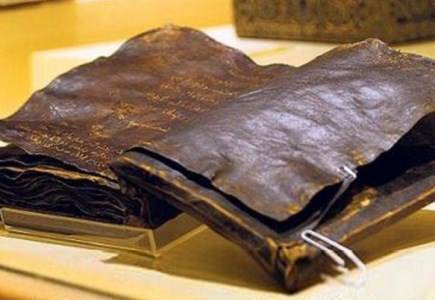 Here we go again.
I’ve been seeing it all over Facebook. The headline reads, “1,500 Year Old Bible Confirms That Jesus Christ Was Not Crucified – Vatican In Awe.” It seems startling. The only problem is, it’s not true. And, it’s nothing new. These kinds of articles that seek to undermine the veracity of the Bible have been being published for years now. Indeed, the discovery of this 1,500-year-old Bible is news that’s now better than two years old. But it’s just now hitting Facebook. And because many people are being confused by it, it’s worth a look.
The article opens:
Much to the dismay of the Vatican, an approximately 1,500 to 2,000 year old Bible was found in Turkey, in the Ethnography Museum of Ankara. Discovered and kept secret in the year 2000, the book contains the Gospel of Barnabas – a disciple of Christ – which shows that Jesus was not crucified, nor was He the Son of God, but a prophet. The book also calls apostle Paul “The Impostor.” The book also claims that Jesus ascended to heaven alive, and that Judas Iscariot was crucified in His place.[1]
Let’s separate some fact from fiction here.
“Much to the dismay of the Vatican…” The Vatican did, according to The Christian Post, make an “official request”[2] to see and study the Bible, but it was not out of dismay. Like any theological artifact, it piqued their curiosity. Many people desired to study this book.
“…an approximately 1,500 to 2,000 year old Bible…” Maybe. But probably not. There are reasons to believe this book is a forgery, probably written around AD 1500, which is, coincidentally enough, about a century after many scholars believe the Gospel of Barnabas itself was written.[3] Timothy Michael Law, a Junior Research Fellow at the Oxford Centre for Hebrew and Jewish Studies, has a nice blog on the antiquity of this Bible here.
“…the book contains the Gospel of Barnabas…” Again, maybe. But possibly not. We actually don’t know what the book contains because it has not been widely studied. The Christian Post quotes theology professor Ömer Faruk Harman who notes that people may be “disappointed to see that this copy … might have no relation with the content of the Gospel of Barnabas.”
“…which shows that Jesus was not crucified … and that Judas Iscariot was crucified in His place.” The Gospel of Barnabas does indeed purport that Judas Iscariot was crucified in Jesus’ place. But this is because this Gospel was written as an apologetic for Islam. Indeed, it prophesies the arrival of Muhammad, but, if the 15th century dating of this Gospel is correct, it does so about 800 years after Muhammad! In other words, its prophecies are really no prophecies at all, but polemical forgeries.
The line from this Facebook article that made me sigh the loudest is this one:
It is believed that, during the Council of Nicaea, the Catholic Church hand-picked the Gospels that form the Bible as we know it today; omitting the Gospel of Barnabas (among many others) in favor of the four canonical Gospels of Matthew, Mark, Luke, and John.
Ever since Dan Brown’s book The Da Vinci Code, this has been a canard that just won’t die. At no time during the Council of Nicaea did the Catholic Church hand-pick any Gospels. The four Gospels we have today were already widely accepted by the Church by the time of this council. If you want to read the canons issued by the Council of Nicaea for yourself, you can check them out here. None say anything about the Gospels. Indeed, none say anything about the canon of Scripture at all.
Ultimately, even if this Turkish Bible is indeed 1,500 years old and even if it does contain the Gospel of Barnabas, the Council of Nicaea was held in AD 325, which is still before the time of this Bible. Thus, part of the reason the Council of Nicaea never considered the Gospel of Barnabas during its meetings is because there was not yet a Gospel of Barnabas to consider!
It was David Hannum, criticizing P.T. Barnum, who said, “There’s a sucker born every minute.” Don’t be suckered by this Facebook article. The Bible as we have it still stands. And on it, your faith can still stand.
___________________________
[1] “1,500 Year Old Bible Confirms That Jesus Christ Was Not Crucified – Vatican In Awe,” Moorish Harem: Man’s Greatest Accomplishments (4.28.2014).
[2] Clara Morris, “Turkey’s 1500-Year-Old, $28M Bible Linked to Gospel of Barnabas?” The Christian Post (2.23.2012).
[3] See Jan Joosten, “The Gospel of Barnabas and the Diatessaron,” Harvard Theological Review 95, no. 1 (2002).
You’re not smart enough or good enough, even if people like you
 It was Stuart Smalley, played by Al Franken on Saturday Night Live, who said, “I’m good enough, I’m smart enough, and, doggone it, people like me!” As it turns out, many took Smalley’s credo to heart. And the results have been sadly predictable.
Case in point: the American Bible Society, in conjunction with the Barna Group, recently published its “State of the Bible” report for 2014. The report opens with plenty of punch:
Now there are just as many Americans skeptical of the Bible as there are engaged with the Bible. According to the fourth annual State of the Bible survey, 19 percent said that they were skeptical of the Bible. This number is up from 10 percent in 2011.
This trend is even more pronounced among the Millennial generation (who range in age from 18-29). According to the State of the Bible report, Millennials are
– Less likely to view the Bible as sacred literature (64 percent in comparison to 79 percent of adults),
– Less likely to believe the Bible contains everything a person needs to know to lead a meaningful life (35 percent in comparison to 50 percent of adults), and
– More likely to never read the Bible (39 percent compared in comparison to 26 percent of adults).[1]
It turns out that America’s latest generation is more suspicious of the Bible than any that has come before it.
Now, on the one hand, such suspicion requires solid biblical apologists – people who can argue for Scripture’s veracity, historicity, consistency, and even morality to a society that is increasingly questioning Scripture on all these fronts. Indeed, one factoid that came out of this report is that while 50 percent of all adults believe the Bible has too little influence on society, only 30 percent of Millennials believe this. This is, in part, because many Millennials no longer accept the basic premise that the Bible teaches right from wrong. Instead, many Millennials now believe the Bible promotes wrong rather than right – for instance, on topics like sexual ethics. Thus, they see the Bible as having a negative, rather than a positive, influence on society – one they would be happy to see continue to wane.
But there is more to this report than just what Millennials believe about the Bible. The statistic I found most telling from this report is this one: 19 percent of Millennials believe no literature is sacred compared to 13 percent of all adults who believe no literature is sacred. In other words, it’s not just that Millennials have a problem with the Bible in particular, it’s that they struggle with any literature that claims to be sacred in general.
It is here that we arrive at the core of this new generation’s struggle. For to claim a particular piece of literature is sacred is, at the same time, to say something about its authority. After all, something with a sacred, or divine, origin is, by definition, “above” me and can therefore make certain claims on me and demands from me. But this is something this current generation simply cannot endure. For to believe a book like the Bible has divine authority is to concede that if I disagree with the Bible, the Bible gets the right of way. But when I’ve been told, “I’m good enough, I’m smart enough, and, doggone it, people like me,” I cannot stand to have my goodness or moral intelligence questioned by some backward work from ancient antiquity. My modern, enlightened sensibilities cannot be wrong. I must be right. The only sacred literature left, then, is the moral script I’ve written for myself and carry around in myself – hence, the reason so many Millennials see not only the Bible as unsacred, but any religion’s holy book as unsacred.
So with all of this in mind, perhaps it’s worth it to do a little reflection on our assumption concerning the sapience and sacredness of our moral sensibilities. We have been told we are smart enough. But are we, really? Have we never made a wrong call, a tragic error, or a bumbling fumble? We have been told we are good enough. But are we, really? Have we never broken our own moral boundaries or changed them over time because of a shifting perspective, or, more cynically, because of coldly calculated expedience? A little bit of honest introspection is enough to remind us that what Stuart Smalley taught us is profoundly untrue. Indeed, it is downright silly. And it is supposed to be. That’s why it aired on Saturday Night Live.
So let’s stop looking to ourselves for truth and morality and start looking to something higher. Let’s take an honest look at the Bible. Who knows? We may find it’s smarter and better than even we are. And, doggone it, we might even learn to like that.
____________________________
[1] “State of the Bible 2014,” American Bible Society.
Not Just Any Old Crucifixion
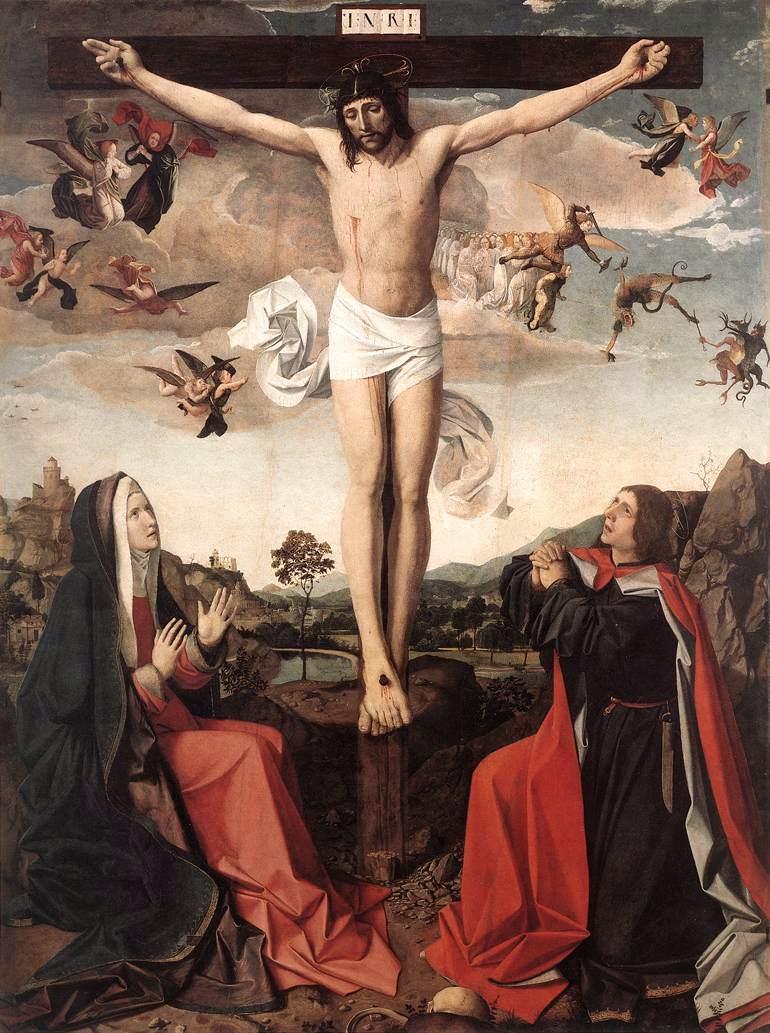
“Calvary” by Josse Lieferinxe, c. 1500
In the ancient world, crucifixions were a dime a dozen. Hardly a day passed without one. Consider these statistics:
- 519 BC: Darius I, king of Persia, crucifies 3,000 of the leading citizens of Babylon.
- 332 BC: Alexander the Great crucifies 2,000 people after invading the city of Tyre.
- 100 BC: Alexander Jannaeus, king of Judea, crucifies 800 Pharisees.
- 71 BC: A great uprising of slaves against the Roman Empire, led by the great gladiator Spartacus, leads to the crucifixion of 6,000 of his followers along a stretch of highway from Capua to Rome, totaling 120 miles.
- 4 BC: Varus, governor of Syria, crucifies 2,000 Jewish rebels who were leading a Messianic revolt.
- AD 70: The Roman general Titus sweeps into the city of Jerusalem, sacks it, and begins crucifying 500 people a day he runs out of wood to make crosses.
Crucifixions happened all the time. In fact, according to one estimate, as many as 30,000 people were crucified just in Israel by Jesus’ day.[1]
This Friday is Good Friday – a day when we commemorate a crucifixion. But with crucifixions being so commonplace in the ancient world, it’s worth it to ask: Why do we commemorate one particular crucifixion? Why don’t we commemorate the many crucifixions of the citizens of Babylon, or of Spartacus’ followers, or of the Jews under Titus’ reign of terror? Why do we commemorate only one crucifixion – Jesus’ crucifixion?
The Mishnah, an ancient compendium of Jewish rabbinical teaching, explains that if a criminal was condemned to execution, which would have included crucifixion, he was to say, “Let my death be atonement for all of my transgressions.”[2] The idea was that if a person’s crimes were so heinous that he was deserving of death, only death could save him from those crimes. Crucifixion, then, was connected not only to punitive punishment, but also to personal atonement.
Jesus’ crucifixion, however, was different. Rather than making recompense for His own sins by His death, Jesus asks for forgiveness for others’ sins: “Father, forgive them, for they do not know what they are doing” (Luke 23:34). And rather than seeking atonement for Himself by His execution, the apostle John says Jesus makes atonement for the world: “[Christ] is the atoning sacrifice for our sins, and not only for ours but also for the sins of the whole world” (1 John 2:2).
This is why we commemorate Jesus’ crucifixion. For we remember not only that Jesus was crucified, but why Jesus was crucified. He was crucified not for His own sins, but for ours. Jesus’ crucifixion did what no other crucifixion could do. It saved us. And that’s worth remembering…and celebrating. And that’s why this Friday is not just any Friday, but a Good Friday.
______________________________
[1] John MacArthur, The MacArthur New Testament Commentary: Matthew 24-28 (Chicago: The Moody Bible Institute, 1989), Matthew 27:27-37.
[2] m. Sanhedrin 6.2.
Common Question: What’s the Deal with the Apocrypha?
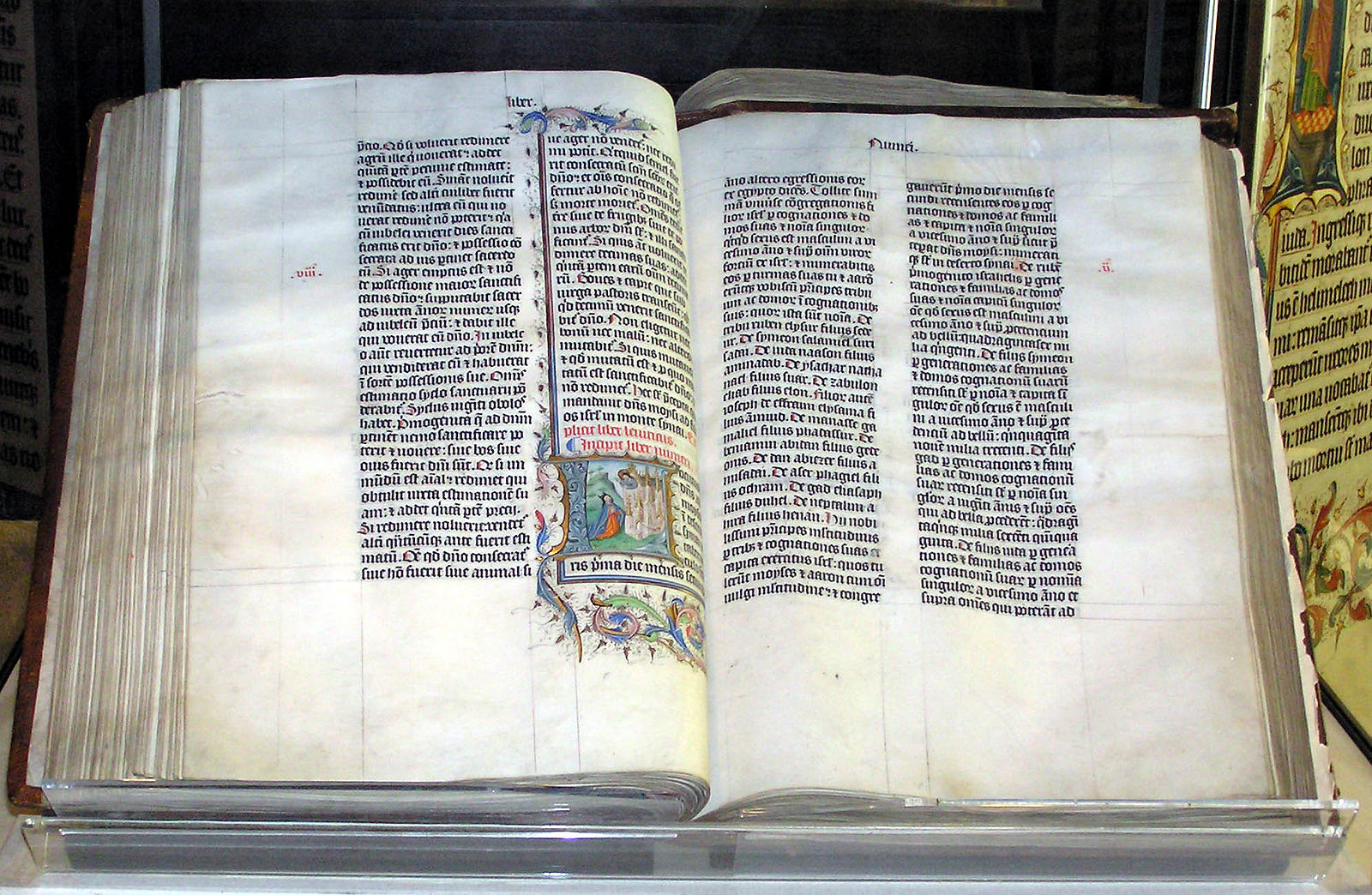 66 books. That’s how many books are in the Good Book. At least, that’s what I had always been taught. But then, a Roman Catholic friend of mine in high school claimed there was more to the Bible than the 66 books I had read since I was a little boy. There were actually 73 books, he explained. And these additional books had strange names like “Maccabees” and “Judith” and “Tobit” and even “Bel and the Dragon.” As he showed me these books, I was flummoxed. “Why hadn’t I ever heard of these books?” I asked myself.
These mysterious books to which I was introduced in high school are widely known as the “Apocrypha,” a Greek adjective meaning “hidden.” And though many Christians do not regularly read these books, they are indeed a part of the Roman Catholic canon of Scripture. In fact, one of the questions I often receive as a pastor is, “Why do Roman Catholics have ‘extra’ books in their Bible?”
Because the Apocrypha is a source of a lot of confusion, I thought it would be worth it to offer a brief history of these books along with an analysis of them from a Lutheran Christian perspective.
The books of the Apocrypha were written between the close of the Old Testament in 430 BC and the beginning of the New Testament. These books include historical accounts, supplements to famous Old Testament books such as Daniel and Esther, and wisdom books akin to the Proverbs.
From the beginning, these books were never fully embraced by the Church as inspired Scripture. Paul Maier, Professor Emeritus of Ancient History at Western Michigan University, explains:
The Apocrypha … were not included in the final canon of the Hebrew Bible, which was debated by rabbis at Jamnia (near Jerusalem) in AD 93. Thus they were also not included among the very 39 books that comprise the Old Testament in Christian Bibles today …
Early on … churchmen such as Origen of Alexandria noted a difference between the Apocrypha and the Hebrew Scriptures. Cyril of Jerusalem and Jerome also drew a line of separation between the two, using the term Apocrypha for the first time in reference to these writings. To be sure, Jerome included them in his Latin translation if the Bible, the Vulgate, but advised that the Apocrypha should be read for edification, not for supporting church dogma.[1]
Jerome’s warning against using the Apocrypha as a basis for Christian doctrine is especially important. His doctrinal concern is perhaps best illustrated by 2 Maccabees 12:44-45 when the Jewish liberator Judas Maccabeus prays for some who have died, seeking to make atonement for the sins they committed while they were still alive. From these verses, the Roman Catholic Church derives its doctrine of Purgatory, a place where deceased believers undergo a final purification from sin that readies them for the bliss of heaven. The Catechism of the Catholic Church explains the doctrine of Purgatory thusly:
All who die in God’s grace and friendship, but still imperfectly purified, are indeed assured of their eternal salvation; but after death the undergo purification, so as to achieve the holiness necessary to enter the joy of heaven.
The Church gives the name Purgatory to this final purification of the elect.[2]
This teaching runs contrary both to the broad teaching of canonical Scripture, which declares that a person enters either paradise or hell immediately upon death (e.g., Luke 16:19-31; 23:39-43), and to the gospel, because it adds to Christ’s perfectly purifying work on the cross our own work of purification in Purgatory by which we may “achieve the holiness necessary to enter the joy of heaven.” By adding our achievements to Christ’s achievement, the doctrine of Purgatory belittles and undermines the sufficiency of Christ’s sacrifice. Thus, the universal Church does not treat the Apocrypha as divinely inspired.
Interestingly, the Apocrypha was not even fully embraced by the Roman Catholic Church until the Fourth Session of the Council of Trent in 1546. In this session, it was declared:
But if any one receive not, as sacred and canonical, the said books entire with all their parts, as they have been used to be read in the Catholic Church, and as they are contained in the old Latin Vulgate edition; and knowingly and deliberately contemn the traditions aforesaid; let him be anathema.[3]
With this decree, the Roman Catholic Church effectively erased the distinction between ancient books that should be read for private edification and inspired books that should be appealed to for Christian doctrine – a distinction that Jerome, the very one who translated the Latin Vulgate, which Rome was here declaring to be its official translation, had made! Thus, Rome took Jerome’s translation, but disregarded his distinction. And the Church has been the worse for it over the years.
All of this is not to say that the Apocrypha should be altogether disregarded. Maier notes that “Clement of Alexandria, Polycarp, Tertullian, Hippolytus, Cyprian, and Augustine” cited heartily from the Apocrypha. These books give us much valuable historical insight into this time period and chronicle for us the origins of the religious parties we meet in the New Testament, such as the Pharisees and Sadducees. Thus, the Apocrypha is worth our time and study. We need to know about these books. Indeed, Martin Luther superscribed the books of the Apocrypha like this: “Books that are not be regarded as the equal of Holy Scripture but are nonetheless profitable and good to read.”[4]
If you’re looking for a good book, then, pick up the Apocrypha. If you’re looking for a divinely inspired book, however – that book still has only 66 books.
__________________________
[1] Paul Maier, “Foreword,” The Apocrypha: The Lutheran Edition with Notes (St. Louis: Concordia Publishing House, 2012), xv-xvi.
[2] See Catechism of the Catholic Church (Collegeville: The Liturgical Press, 1994), §1030-1031.
[3] The Fourth Session of the Council of Trent (April 1546).
[4] Martin Luther, What Luther Says, Ewald M. Plass, ed. (St. Louis: Concordia Publishing House, 1959), 1512, n. 20.
Beyond the Pale: What UK Hospitals Are Doing With Aborted Babies
 Moral standards are moving targets. Ask three people for their thoughts on a contentious moral or ethical issue and you’ll get four opinions. But there are some things so unequivocally horrifying – so undeniably mortifying – that they command universal and reflexive shock, outrage, and revulsion. Enter an exposé by London’s Telegraph newspaper on what’s heating some UK hospitals:
The bodies of thousands of aborted and miscarried babies were incinerated as clinical waste, with some even used to heat hospitals, an investigation has found.
Ten NHS trusts have admitted burning fetal remains alongside other rubbish while two others used the bodies in ‘waste-to-energy’ plants which generate power for heat.
Last night the Department of Health issued an instant ban on the practice which health minister Dr. Dan Poulter branded ‘totally unacceptable.’
At least 15,500 fetal remains were incinerated by 27 NHS trusts over the last two years alone …
One of the country’s leading hospitals, Addenbrooke’s in Cambridge, incinerated 797 babies below 13 weeks gestation at their own ‘waste to energy’ plant. The mothers were told the remains had been ‘cremated.’[1]
No matter how many times I read this article, it still makes me sick to my stomach. And I’m not the only one who finds this story nauseating, as the comments posted under the story indicate. One reader comments, “I think I am going to be sick.” Another writes, “The horror of it … what has our country become folks? This is just too much.” And still another existentially inquires, “Dear God, what have we become?”
Though much could be written about this story – and, I would add, I hope much is written about this because this is a story that needs to be thoroughly vetted – I want to offer two initial observations about this terrible, tragic report.
First, it must be admitted that here is an unabashed display of human depravity at it most dreadful depths. Just the thought of treating fetal remains so carelessly and callously should turn even the most hardened of stomachs. In Western society, we pride ourselves on making moral progress. We trumpet our advances on the frontier of human rights. A story like this one should give us a gut check. Moral progress is never far from moral regress. Indeed, even secular theorists are beginning to realize that humanity is not on an ever-improving, ever-increasing moral arc. Alan Dershowitz, one of the great secular thinkers of our time, admits as much in an interview with Albert Mohler when he says:
I think the 20th century is perhaps the most complicated, convoluted century in the history of the world perhaps because I lived in it, but it had the worst evil. Hitler’s evil and Stalin’s evil are unmatched in the magnitude in the world … On the other hand, it was the century in which we really ended discrimination based on race and based on gender. We made tremendous scientific progress … So I think the 20th century has really proved that progress doesn’t operate in a linear way … We don’t evolve morally, we don’t get better morally as time passes.[2]
Morally, we must be continually careful and endlessly vigilant. We will never become so good that we are no longer bad. To quote the caution of the apostle Paul: “If you think you are standing firm, be careful that you don’t fall” (1 Corinthians 10:12)!
The second observation I would offer on this story is that we are sadly deluded as a society if we decry the burning of fetuses on the one hand while supporting abortion on the other. There is a reason incinerating fetuses to heat hospitals has raised so many moral hackles. And it’s not because these fetuses are nothing more than “tissue.” Indeed, I find it quite telling that The Telegraph refers to these fetuses as “remains.” A quick perusal of a dictionary will find that the noun “remains” refers to “dead bodies,” or “corpses.” In other words, dead people. This is not just aborted tissue. These are aborted people. Aborted babies. But now these babies have passed. And to treat the dead in such an undignified manner as these UK hospitals have is unconscionable. The difference between the passing of these babies, however, and the passing of others who die in hospitals is that these babies have died intentionally at the hands of abortion doctors.
Yes, I am well aware of arguments for abortion that center on a woman’s right to do with her body as she pleases. But if she can do with her body as she wishes, I’m not sure why a hospital can’t do with its procedural remains as it wants. If it can throw away fluid drained from someone’s lungs in a biohazard bag, why can’t it burn a baby? Yes, I am aware that some may accuse me of making a fallacious “slippery slope” argument and they would counter-argue that you don’t need to ban abortion to decry the burning of fetal remains. But this counter-argument intimates that abortion is somehow a lesser evil than burning aborted corpses – an assumption I do not share. Indeed, I think abortion is a great and deep evil – but not just because I believe it deliberately ends the life of a child, but because I hate what abortions do to the women who suffer through them. Case in point: a recent study in The British Journal of Psychiatry shows that women who undergo abortions have an 81 percent higher risk of subsequent mental health problems.[3] Nevertheless, proponents of abortion could claim that one can support abortion without sliding all the way down the slope into the moral morass of these UK hospitals. But I would point out that we already have, in fact, slid all the way down this slope. The charred now non-remains of 15,500 babies testify to it. So perhaps it’s time to repent and, by the grace of God, start scaling the slope – and not just halfway up the slope, but all the way off the slope. Human depravity warns us that if we don’t, we’ll slide right back down again.
______________________
[1] Sarah Knapton, “Aborted babies incinerated to heat UK hospitals,” The Telegraph (3.24.2014).
[2] Albert Mohler, “Moral Reasoning in a Secular Age: A Conversation with Professor Alan Dershowitz,” albertmohler.com.
[3] Priscilla K. Coleman, “Abortion and mental health: quantitative synthesis and analysis of research published 1995–2009,” The British Journal of Psychology 199 (2011), 182.
Unreal Sales for Real Marriage
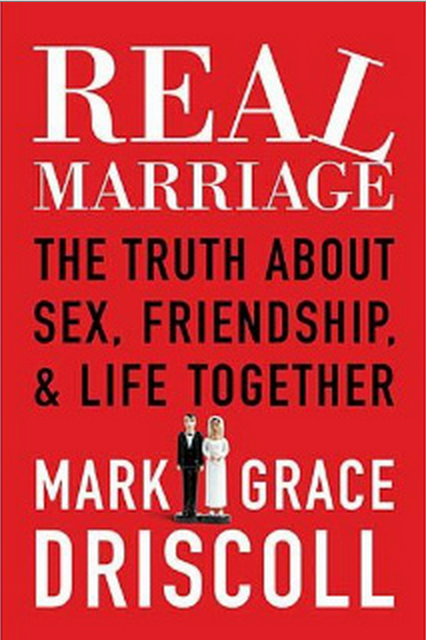 It seems as though the New York Times bestseller list just isn’t what it used to be. In an article for the Los Angeles Times, Carolyn Kellogg writes about the saga of a recent book that became a New York Times bestseller not because lots of people were buying it, but because a company called ResultSource was buying thousands of copies of the book with the express intent of turning it into a bestseller. Kellogg begins by citing from World magazine, the news outlet that broke the story:
“The contract called for the ‘author’ to ‘provide a minimum of 6,000 names and addresses for the individual orders and at least 90 names and address [sic] for the remaining 5,000 bulk orders. Please note that it is important that the makeup of the 6,000 individual orders include at least 1,000 different addresses with no more than 350 per state.’”
Measures like these are designed to game the systems set in place by BookScan and other book sales talliers to protect the integrity of their bestseller lists …
After getting thousands of names with geographic diversity, RSI took another step to place [the book] on bestseller lists, according to the World article. The agreement specifies, “RSI will use its own payment systems (ex. gift cards to ensure flawless reporting). Note: The largest obstacle to the reporting system is the tracking of credit cards. RSI uses over 1,000 different payment types (credit cards, gift cards, etc).”[1]
Wow. That sure sounds shady.
Did I mention the book in question is Real Marriage, written by famous mega-church pastor Mark Driscoll? And did I mention his church, Mars Hill in Seattle, shelled out, according to some reports, over $200,000 to get his book to the top of the New York Times bestseller list?
In many ways, Mark Driscoll and I are kindred spirits. We share many of the same theological commitments. When it comes to preaching, we both believe a good sermon must not primarily be about what we are to do, but about what God has done for us in Jesus Christ. When it comes to Scriptural authority, both of us hold doggedly to the doctrine of inerrancy, even though some voices are seeking to discredit it these days. When it comes to salvation, we both believe that, contrary to our society’s pluralistic ethos, salvation is found in no one but Christ. We share a lot in common. But for all our theological similarities, what happened with Real Marriage represents a weighty ethical difference.
I know sales number shenanigans are not at all unusual in the publishing world. Authors do this kind of thing all the time. Sarah Cunningham of the Huffington Post explains that Real Marriage’s marketing strategy is only a symptom of a systemic disease:
This book launch strategy … wasn’t shocking to anyone who has been involved in the publishing industry … There have always been ways to underwrite the success of authors in any field, religious or not, when the efforts were attached to a deep enough bank account. Don’t doubt for a second, then, that some of Mark’s … counterparts haven’t done (or tried to do) the same.[2]
According to Cunningham, when it comes to cooking sales numbers, “everybody’s doing it.” But this go-to teenage quip is a sorry justification for what is a seriously unethical practice.
When I visited ResultSource’s website, I found it curious that although they made all sorts of promises that they can get a book onto the New York Times bestseller list, they didn’t give a clear explanation of how they can get a book onto the New York Times bestseller list. Here’s a sampling of what their website boasts:
We partner with authors to create and tap an audience – to connect the potential buyers of your book directly with the bookseller to leverage your launch potential. Our goal is to reach further than just typical launch management – our deep relationships enable us to create opportunities outside of what’s expected, to gain substantial traction within the critical “first 90 days” of your launch – or booksellers will send your book back to the publisher.
RSI can:
Leverage our relationships with individuals in “Seven Channels of Influence” to promote your book. Research shows that people are influenced by multiple touch-points – and that our buying decisions are driven by as many as seven channels within our culture.
Send email promotions to as many as 300,000 book buyers on our proprietary database of business and self-help book buyers.
Write and design electronic promotions such as banners, excerpts, and Q&As.
Build a powerful merchandising program with key retailers like airport booksellers, Amazon, B&N (Brick-n-Mortar and BN.com), Borders, Books-A-Million and independent outlets. The key to a winning book launch campaign is to have copies of your book in prominent positions at as many retailers as possible – and then drive sell through.[3]
Now, besides being a little leery of any company that makes selling a book through Borders (NYSE: BGP $0.00 +0.00%) a featured component of their marketing strategy, I am also deeply unsettled by the ambiguity of their claims. I honestly have no idea what they’re talking about. What are the “Seven Channels of Influence”? What, exactly, does it mean to “build a powerful merchandising program with key retailers”? And why don’t they mention that their primary strategy to drive sales is for this company to buy thousands of copies of a particular book in a way that dupes bestseller lists into believing thousands of people are buying the book? If a company can’t talk openly and honestly about the services they offer, perhaps they shouldn’t be offering them.
Ultimately, I point out what happened with Real Marriage not to pick on Mark Driscoll, but because this scandal is indicative of a wider, toxic pattern that needs to be addressed. In this particular instance, I appreciate how the Board of Advisors and Accountability at Mars Hill has responded to this controversy, writing, “While not uncommon or illegal, this unwise strategy is not one we had used before or since, and not one we will use again.”[4] I am glad to hear that. I hope others follow suit.
From a theological perspective, Driscoll pinpoints the root of the problem in this whole saga in another one of his books when he writes, “This world’s fundamental problem is that we don’t understand who we truly are – children of God made in His image – and instead define ourselves by any number of things other than Jesus.”[5]
I couldn’t agree more. If the prestige of being a New York Times bestselling author is so bewitching that a whole company can be created to help authors pay their way onto this list, something is terribly and tragically awry. We are defining ourselves by all the wrong things.
Regardless of whether or not Mark Driscoll actually is a bestselling author, he is a child of God. So am I. And that’s good enough. Because, in the end, that’s what really matters.
[1] Carolyn Kellogg, “Can bestseller lists be bought?” Los Angeles Times (3.6.2014).
[2] Sarah Cunningham, “The Injustice of Silence: Why Our Culture Pulled Mark Driscoll Over For a Broken Headlight,” Huffington Post (3.6.2014).
[3] ResultSource.com, “Book Launch Campaigns.”
[4] “A Note From Our Board of Advisors & Accountability,” Mars Hill Church (3.7.2014).
[5] Mark Driscoll, Who Do You Think You Are? Finding Your True Identity In Christ (Nashville, Thomas Nelson, 2013), 2.
David Wise’s “Alternative” Lifestyle

Credit: David Calvert for The New York Times
He’s a husband. He’s a father. He’s a follower of Jesus who can see himself becoming a pastor one day. And, oh yeah, he’s also an Olympic freestyle skier of halfpipe who won that gold. His name is David Wise.
Recently, Skyler Wilder of NBC Sports wrote a profile on Wise in which he made a special note on Wise’s character:
Wise is mature far beyond his years. At only twenty-three years old, he has a wife, Alexandra, who was waiting patiently in the crowd, and together they have a two-year-old daughter waiting for them to return to their home in Reno, Nevada.
At such a young age, Wise has the lifestyle of an adult. He wears a Baby Bjorn baby carrier around the house. He also attends church regularly and says he could see himself becoming a pastor a little later down the road.[1]
When reading such a description of this young man and his family, you can’t help but envision something straight out of a Norman Rockwell painting – except that, as Wilder points out, Wise can “nail two double corks wearing baggy pants.”
What strikes me about Wilder’s profile of Wise, however, is not Wise’s fascinating life, but Wilder’s unique title for his profile: “David Wise’s alternative lifestyle leads to Olympic gold.” Wilder calls Wise’s lifestyle as husband, father, and Christian “alternative.”
When Wilder published his profile on Wise with this headline, almost immediately, people raised concerns and critiques. You can read some here, here, and here.
These concerns and critiques notwithstanding, frankly, I’m okay with the designation of Wise’s lifestyle as “alternative” – not because I like what it says about the values of our society, but because it’s true. Statistically, there can be little doubt that Wise’s lifestyle at Wise’s age is not mainstream. As David Weigel of Slate points out:
Wise got married and had a kid at a far younger age than most people. According to data published by the National Campaign to Prevent Teen and Unplanned Pregnancy, the median age of the American first marriage is 26 and a half. The average age for an American bringing the first child into his/her homes: About 25 and a half. So, yes, David Wise is very good at skiing, and he figured out, as the Internet might refer to it, that whole adulthood thing much faster than the median American or median famous Olympian.[2]
The character Wise has and the lifestyle he lives at the tender age of 23 is far beyond his years. In this sense, it is alternative. But it is also hopeful.
Several years ago, sociologist Rodney Stark wrote a book titled, The Rise of Christianity: How the Obscure, Marginal Jesus Movement Became the Dominant Religious Force in the Western World in a Few Centuries. Stark opens his book with some numbers:
For a starting number, Acts 1:14-15 suggests that several months after the Crucifixion there were 120 Christians … Yet only six decades later, Christians were so numerous that Constantine found it expedient to embrace the church … Goodenough estimated that 10 percent of the empire’s population were Christians by the time of Constantine. If we accepted 60 million as the total population at that time … this would mean that there were 6 million Christians at the start of the fourth century.[3]
The Christian Church grew from 120 to 6 million in just over three centuries. That’s staggering! But how did it happen? Though Christianity’s rise is thanks to multiple factors – not the least of which is the grace of God – one reason Christianity showed such incredible growth is because it offered an alternative. It was different from the rest of the world.
For instance, in the 160’s, and then again in the 260’s, a series of plagues struck the eastern provinces of Roman Empire. These plagues were so devastating that during a smallpox epidemic in 165, a quarter to a third of the population died. When these plagues swept through, most people – scared of becoming infected – took the sick and threw them into the streets to die. But there was one group of people who, rather than casting the sick out, brought the sick in: Christians. Dionysius, the bishop of Alexandria during the second sweep of plagues in the 260’s, writes about how Christians responded to these plagues:
Most of our brother Christians showed unbounded love and loyalty; never sparing themselves and thinking only of one another. Heedless of danger, they took charge of the sick, attending to their every need and ministering to them in Christ, and with them departed this life serenely happy; for they were infected by others with the disease, drawing on themselves the sickness of their neighbors and cheerfully accepting their pains. Many, in nursing and caring for others, transferred their death to themselves and died in their stead.[4]
While everyone else was casting the sick out, Christians were bringing the sick in – many of them dying because of their efforts. Christians offered an “alternative.” And the Church grew.
It is no secret that what Christians teach and the ways in which Christians live is out of step with our society’s Zeitgeist. We are “alternative.” But considering the pain, hopelessness, corruption, despair, emptiness, and oppression that our society’s Zeitgeist reaps (for examples, just look here, here, and here), don’t we need an alternative?
So when someone calls us “alternative,” perhaps we should embrace the distinction. For we do offer an alternative. We offer the alternative of Christ to the mainstream of sin. And when we offer that alternative, we offer hope. And hope is an alternative that our world sorely needs.
[1] Skyler Wilder, “David Wise’s alternative lifestyle leads to Olympic gold,” NBCOlympics.com (2.18.2014).
[2] David Weigel, “Will This Young, Happily Married Olympian Start a New Culture War?” Slate (2.19.2014).
[3] Rodney Stark, The Rise of Christianity: How the Obscure, Marginal Jesus Movement Became the Dominant Religious Force in the Western World in a Few Centuries (San Francisco: Harper Collins, 1997), 5-6.
[4] Dionysius of Alexandria in Rodney Stark, The Rise of Christianity, 82.
S.B. 1062
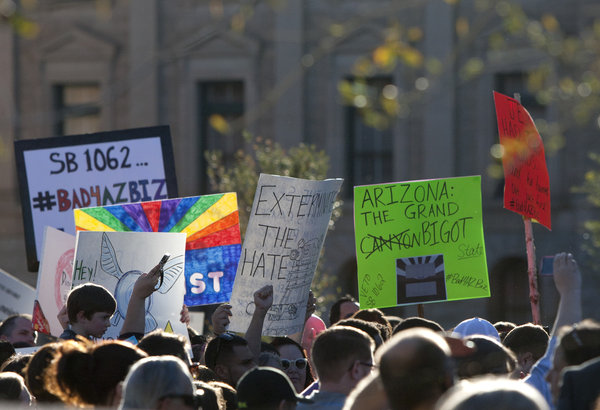
Credit: LA Times
A funny thing happened on my way back from a recent trip I took to Arizona. The state became embroiled in a heated political battle over Senate Bill 1062.[1] Okay, it may not have been funny. But these kinds of battles are common.
According to some, S.B. 1062 championed religious liberty, allowing business owners with religious convictions to deny service to a party if the business owner felt that serving that party would substantially burden or contradict his religious convictions. According to others, S.B. 1062 violated the civil rights of homosexuals by formally and legally legitimatizing discrimination against them.
Last Wednesday, Governor Jan Brewer vetoed the bill, explaining, “I have not heard of one example in Arizona where business owners’ religious liberty has been violated … The bill is broadly worded and could result in unintended and negative consequences.”[2] Of course, the political pressure on Governor Brewer was hot:
Companies such as Apple Inc. and American Airlines, and politicians including GOP Sen. John McCain and former Republican presidential nominee Mitt Romney were among those who urged Brewer to veto the legislation. The Arizona Super Bowl Host Committee, which is overseeing preparations for the 2015 game, came out with a statement against the legislation. The Hispanic National Bar Association on Wednesday said it canceled its 2015 convention in Phoenix over the measure.[3]
In observing the volley between supporters and detractors of this bill, two things strike me.
First, homosexuality – and, specifically, gay rights – is not only a hot topic in our society, it is the hot topic in our society. Interestingly, nowhere does S.B. 1062 mention homosexuality. It simply speaks of “the free exercise of religion.” Yet, USA Today reported on Governor Brewer’s veto of the bill with this headline: “Arizona governor vetoes anti-gay bill.”[4] These days, how a piece of legislation will affect the gay community is the litmus test as to whether or not a bill can or should pass, even if that bill does not specifically mention the gay community. Gay rights, then, are front and center. They are the battleground du jour of our society.
Second, there are a lot of homosexuals who deeply despise Christians with orthodox beliefs concerning the sinfulness of homosexual activity and will go to great – and even duplicitous – lengths to paint Christians as homophobic bigots. Stories abound of people who have concocted heinous hate crimes against themselves. Take, for instance, the lesbian couple that spray-painted their own garage with the message “Kill the gay.”[5] Or how about the Tennessee man who falsely claimed that three men beat him and robbed his store in an anti-gay attack?[6] Then, of course, there was the famed incident of the waitress who falsely claimed she was stiffed on a tip because she was a lesbian.[7] Personally, I don’t want to think of anyone in the homosexual community as my enemy. Life is too short to keep an enemies’ list. But I am not so naïve as to believe that there aren’t some in the homosexual community who think of me as their enemy.
So what am I to do?
Jesus’ admonition to pray for those who are on the outs with you (cf. Matthew 5:44) seems to be especially apropos for a time such as this. To this end, I would invite you to join me in praying for three things as the culture war over sexual rights continues to rage.
First, pray for forgiveness. Though it is painful to admit, it was not too long ago that it was exponentially more likely for a message like “Kill the gay” to be spray painted not by someone self-imposing a hate crime, but by someone committing one. And sometimes, that someone was even a self-professed Christian. This, of course, directly defies a myriad of biblical commandments concerning our conduct as Christians. Our call to tell the truth about sin must never be a license to commit sin – especially the sin of hate. We need forgiveness for our missteps – which are plenty – in this debate.
Second, pray for understanding. I want to be understood. I want people to understand and believe that I am not a homophobic hate monger who wants to oppress, humiliate, and exile those who do not share my same faith and ethical commitments. But if I want this for myself, it is only fair that I afford the same courtesy to others. Martin Luther summarized the Eighth Commandment by saying that, when dealing with our neighbors, we should “put the best construction on everything.”[8] I can think of no better way to respond to those who put the worst construction on Christians’ intentions than by putting the best construction on theirs. Generous understanding offers our greatest hope for peace in the midst of a hotly contested and, sadly, dirtily fought culture war.
Third, pray that true love would prevail. The “true” is just as important as the “love” here, for our society has settled for a counterfeit love that reduces love to nothing more than tolerance. Just the other day, I heard a caller to a radio talk show explain how one of the primary virtues of Christianity is tolerance. Really? A quick search of the word “tolerate” in the Bible brings up verses like these:
- Whoever slanders their neighbor in secret, I will put to silence; whoever has haughty eyes and a proud heart, I will not tolerate. (Psalm 101:5)
- Your eyes are too pure to look on evil; You cannot tolerate wrongdoing. Why then do You tolerate the treacherous? (Habakkuk 1:13)
- It is actually reported that there is sexual immorality among you, and of a kind that even pagans do not tolerate: A man is sleeping with his father’s wife. (1 Corinthians 5:1)
Tolerance does not seem to be the high brow Scriptural virtue that some would like to peddle it as. This is not to say that we shouldn’t live with, work alongside with, and care for people who do not share our same moral commitments. In this way, we should indeed be tolerant. But tolerance does not necessarily entail endorsement.
Ultimately, as Christians, we ought to aspire to a much higher value than that of tolerance. We ought to aspire to love. “Love,” the apostle Paul reminds us, “does not delight in evil but rejoices with the truth” (1 Corinthians 1:6). To love someone well, we must tell him the truth, even when the truth is unpopular. This is our calling with all sin – sexual and otherwise.
So these are my prayers. Now, it’s your turn. Will you join me in praying the same?
[2] Aaron Blake, “Arizona governor vetoes bill on denying services to gays,” The Washington Post (2.26.2014).
[3] Bob Christie, “Arizona Religious Bill That Angered Gays Vetoed,” ABC News (2.27.2014).
[4] Dan Nowicki, Yvonne Wingett Sanchez and Alia Beard Rau, “Arizona governor vetoes anti-gay bill,” USA Today (2.26.2014).
[5] Alyssa Newcomb, “Lesbian Couple Charged With Staging Hate Crime,” ABC News (2.19.2012).
[6] Chuck Ross, “Report: Man falsified police report in alleged anti-gay attack,” The Daily Caller (12.26.2013).
[7] Cavan Sieczkowski, “New Jersey Waitress In Anti-Gay Receipt Saga Reportedly Let Go From Job,” The Huffington Post (12.9.2013).


 Pastor Zach's Blog