Posts tagged ‘Christianity’
Subpoenaing Sermons

Credit: houstonmatters.org
“Show us your sermons.” This was the message of the City of Houston to five area pastors. Last May, Houston’s City Council passed an equal rights ordinance prohibiting “any type of discrimination based on sex, race, color, ethnicity, national origin, age, familial status, marital status, military status, religion, disability, sexual orientation, genetic information, gender identity, or pregnancy”[1] among private and public employers. Almost immediately, those in faith communities and even in some businesses raised concerns. Will this limit a pastor’s ability to address issues such as same-sex marriage and gender identity in his sermons? Could a business be sued for refusing to allow a transgender person to use the restroom of the gender with which that person identifies, even if that identity does not match up with his or her assigned gender?
Opponents of the ordinance rallied and gathered some 500,000 signatures in an effort to repeal it, but the validity of the signatures was called into question and the ordinance was not repealed. This is when things got really contentious. As The Washington Post reports:
A group of Christians sued the city. In response, city attorneys issued subpoenas to five local pastors during the case’s discovery phase, though the five pastors were not involved in the lawsuit.
The subpoenas sought “all speeches, presentations, or sermons related to HERO, the Petition, Mayor Annise Parker, homosexuality, or gender identity prepared by, delivered by, revised by, or approved by you or in your possession,” according to the Houston Chronicle.[2]
The City subpoenaed sermons. And people were furious. Indeed, when several national news outlets picked up on this story, the City had to change course. Mayor Parker announced last Friday that the City would narrow the scope of the subpoena and City Attorney David Feldman admitted, “When I looked at [the subpoena] I felt it was overly broad, I would not have worded it that way myself … It’s unfortunate that it has been construed as some effort to infringe upon religious liberty.”[3]
So what are we to make of all this?
On the one hand, as Eugene Volokh of The Washington Post notes, the City, by all reasonable standards, overreached and needs to be called to account:
I don’t quite see how “all speeches, presentations, or sermons related to HERO, the Petition, Mayor Annise Parker, homosexuality, or gender identity prepared by, delivered by, revised by, or approved by you or in your possession” would be relevant to the litigation about the validity of the referendum petitions.
At the very least, the subpoena seems vastly overbroad. And the fact that it seeks the contents of religious speeches does counsel in favor of making the subpoena as narrow as possible (which would likewise be the case if it sought the contents of political speeches). I’m not sure what sort of legally relevant information might be contained in the subpoenaed sermons. But the subpoena ought to be narrowed to that legally relevant information, not to all things about homosexuality, gender identity, the mayor, or even the petition or the ordinance.[4]
On the other hand, if these pastors were indeed “using the pulpit to do political organizing … [by] encouraging congregation members to sign petitions and help gather signatures for equal rights ordinance foes,”[5] as the City Attorney suggests, even if such conduct is Constitutionally permissible, theologically, this kind of political posturing can compromise the integrity of the Office of the Ministry and can actually impugn the Church’s witness on the moral and ethical issues of our day. Charles Colson explains why:
Because it tempts one to water down the truth of the gospel, ideological alignment, whether on the left or the right, accelerates the church’s secularization. When the Church aligns itself politically, it gives priority to the compromises and temporal successes of the political world rather than its Christian confession of eternal truth.[6]
When pastors try to address concerns that are, at their heart, theological by using political means like petitions, theology can all too readily and quickly – even if unknowingly – get sacrificed on the altar of political expediency. We need to be careful we don’t compromise our witness for the sake of cynical political gain.
Make no mistake about it: I do not believe City of Houston officials should, in any way, shape, form, or fashion critique or try silence what pastors preach. Such actions are beyond their purview of their vocations. But as a Christian, I also believe that what the Church and her pastors have to say about human sexuality and gender identity is best said from the Word of God and not with a petition.
So, to the pastors who have been subpoenaed, I say: rather than looking at these subpoenas as infringements on your rights, consider them opportunities for ministry (cf. Ephesians 5:15-16). City Hall – even if the wording of the subpoena has now been changed – has invited you to send in your sermons. So do so! Inundate City Hall with the sermons from God’s Word – and not just with sermons where you happen to mention sex or gender. Send in as many of your sermons as you can. While you’re at it, include a charitable note indicating that you are praying for your leaders and praying that your sermons will be a blessing to them.
Remember, with God’s Word comes God’s promise: “My word that goes out from My mouth: It will not return to me empty, but will accomplish what I desire” (Isaiah 55:11). The preaching of God’s Word can do more than a petition could ever hope to accomplish. A petition can win a political war. God’s Word can change a human heart.
Which sounds better to you?
_______________________________
[1] City of Houston, Texas, Ordinance No. 2014-530.
[2] Sarah Pulliam Bailey, “Houston subpoenas pastors’ sermons in gay rights ordinance case,” The Washington Post (10.15.2014).
[3] “Houston Backtracks on Church Subpoenas,” ktrh.com (10.15.2014).
[4] Eugene Volokh, “Is it constitutional for a court to enforce a subpoena of ministers’ sermons?” The Washington Post (10.15.2014).
[5] Jacob Gershman, “Houston Mayor Says City’s Sermon Subpoenas Came as a Surprise,” The Wall Street Journal (10.15.2014).
[6] Charles Colson in Render Unto Caesar…and Unto God: A Lutheran View of Church and State, A Report of the Commission on Theology and Church Relations of the Lutheran Church – Missouri Synod (September 1995), 60.
Why “No” and “Yes” Won’t Cut It: Turning the Tide of Sexual Assault
 In the wake of a horrifying barrage of sexual assaults on college campuses, university administrators – and now whole state governments – are scrambling to turn the tide. The California legislature passed a law at the end of August requiring what is referred to as “affirmative consent.” The measure requires not only that a person not say “no” to a sexual encounter, but also that he or she offer “an affirmative, conscious and voluntary agreement to engage in sexual activity.”[1] In other words, a person must say “yes” to a sexual encounter. Interestingly, according to the legislation, this “yes” need not be verbal. It can also be communicated through actions. Or, if you prefer, it can even be communicated electronically. Just like everything else in our high tech world, if you want to make sure you’re having consensual sex, there’s an app for that. Of course, trying to discern what constitutes affirmative consent, even when you have an app, is no easy task. Emma Goldberg, a member Students Against Sexual Violence at Yale, admits: “It’s obviously quite difficult for administrators to adjudicate affirmative consent, and there is always room for improvement in enforcement of these policies.”[2]
Ultimately, the problem with affirmative consent laws such as the one California lawmakers have passed is not that it is too strong, but too weak. Feeble legislative attempts that require mere consent will not and cannot address the deep moral realities of human sexuality.
Robert Reilly, a senior fellow at the American Foreign Policy Council, recently published a book dealing with modern sexual ethics. In the introduction, he insightfully notes that differing views on sex are rooted in different conceptions of reality:
There are two fundamental views of reality. One is that things have a Nature that is teleologically ordered to ends that inhere in their essence and make them what they are. In other words, things have inbuilt purposes. The other is that things do not have a Nature with ends: things are nothing in themselves, but are only what we make them to be according to our wills and desires. Therefore, we can make everything, including ourselves, anything that we wish and that we have the power to do.[3]
This is a stunning analysis of the worldview that permeates and shapes our sexual ethics. In a myriad of ways, we have worked to separate sex from its natural – what Reilly would call “real” – ends. We defy sex’s procreative reality with abortion. We fight against sex’s emotionally intimate reality with our hookup culture. We have placed sex and its moral entailments squarely in the confines our wills. If we want to have sex, sex is moral. If we don’t want to have sex, sex is immoral.
The fact of the matter is this: our wills cannot provide an adequate moral framework and reality for human sexuality. The contrail of shattered families, wrecked finances, and broken hearts that our sexual wills have left strewn in our societal sky is proof positive of this. Furthermore, teleological reality has a funny way of continually smacking us squarely in the face, no matter how stridently we may try to escape it. Through sex, babies will continue to be conceived. Because of fleeting trysts, people will continue to be riddled by regret. Sex will continue to impress its reality on us, whether or not we want it to. Perhaps we ought to start living in that reality rather than seeking to escape it.
In a society where we pretend that our mere wills can determine the morality of sexuality, states and universities can do no better than to legislate a “yes” before sex, no matter how insufficient, impotent, and fraught with adjudicative hair splitting such legislation may be. But as Christians, we can affirm that God had purposes in mind when He created sex. Therefore, as the Church, we can call for sexual ethics to be in line with these purposes and not just with our desires. So for those on college campuses, I ask, for the sake of God’s will and your wellbeing, to consider waiting not just for someone to say “yes” before you have sex, but to say “I do.”
It’ll work out a lot better.
_____________________________
[1] Aaron Mendelson, “California passes ‘yes-means-yes’ campus sexual assault bill,” Reuters (8.29.2014).
[2] Richard Pérez-Peña and Ian Lovett, “California Law on Sexual Consent Pleases Many but Leaves Some Doubters,” The New York Times (9.29.2014).
[3] Robert R. Reilly, Making Gay Okay: How Rationalizing Homosexual Behavior Is Changing Everything (San Francisco: Ignatius Press, 2014), xi-xii.
On Michael Brown and Darren Wilson

Credit: Reuters
They are the protests that just won’t stop. The cries of activists in Ferguson, Missouri are loud and only seem to be getting louder. One cry in particular caught my attention. MSNBC’s Chris Hayes was reporting from Ferguson when protestors began to throw rocks at him. Some of them yelled, “Tell the true story!” But one man shouted what I think is perhaps the most profound insight into this whole, sordid affair I have heard to date. “This isn’t about Mike Brown no more,” he said. “It’s a civil rights movement. It’s about all people.”
I agree with the protestor. Though they are often conflated, what’s happening in Ferguson today can and should be distinguished from what happened in Ferguson on August 9. This is not about Michael Brown anymore. This is about – be they real or perceived – civil rights grievances.
On the one hand, this is not all bad. This tragedy has ignited some important national conversations. On the other hand, in these conversations, we have taken the very real pain of two very real families – the Brown family and the family of the officer who shot him, the Wilson family – and turned it into an expedient talking point for rallies, protests, and cable news brawls. But their pain deserves more than our marginal mentions. We need to do more. We need to go deeper. We need to take some time to empathize with these families.
Empathy is when you take the human experience and personalize it. In other words, you use what you know from the human experience in general to try to understand one human’s experience in particular. What has happened in this case is the exact opposite. We have taken the personal experiences of two families and de-personalized them, hoisting their pain on our petard.
Michael Brown and Darren Wilson have become emblems. Michael Brown has become an emblem of racial tensions that have plagued Ferguson for decades. Darren Wilson has become an emblem of mistreated law enforcement officials. But these men are much more than impersonal emblems. Michael Brown was a son with college aspirations. Darren Wilson is a man with a family at home.
In an effort at empathy, I’ve been pondering what questions these families must be asking themselves as they watch all this unfold. I’ve been thinking about the questions I would be asking if was in their situation.
As I’ve been thinking about Michael Brown’s parents, I’ve wondered if they’ve asked themselves:
- Did Officer Wilson really have to use deadly force to subdue our son? He has lots of ways to subdue suspects.
- It was broad daylight! How in the world did the officer not know our son was not pointing a weapon at him?
- Did Officer Wilson overreact because he was scared of a black man?
- What is a jury going to say about all this? Is justice going to be served?
As I’ve been thinking about Officer Wilson and his family, I’ve wondered if they’ve asked themselves:
- Why can’t people understand how difficult it is to make snap decisions as a police officer?
- Why do people always assume officers have the worst of intentions?
- Don’t the protestors realize that their threats scare our whole family?
- What is a jury going to say about all this? Is justice going to be served?
Of course, I don’t know for sure what questions they’re asking. And I would never claim to understand how these families are feeling. But empathy is not about claiming to know how somebody feels. It’s about caring how somebody feels. And we should care about and for these families.
To this end, I would ask you to pray for these families – both of these families – and for peace to be restored in Ferguson. Try to empathize with them – their pain, their fear, their confusion – and then pray that God would give them strength, comfort, and hope during this difficult time. Remember, these families are more than causes, they’re people. We cannot forget that.
Allow me to add one final note. Just because I seek to uphold the value of empathizing with the Brown and Wilson families doesn’t mean I don’t believe larger discussions around race are unimportant. But I pray we don’t have these conversations like it’s 1963. I pray we’ve grown since then. I pray our discussions are more civil, our thinking is more compassionate, and our hearts are more, well, empathetic toward those who have different experiences and perspectives. But for now, my prayers are with the Brown and Wilson families. I hope yours are too.
Robin Williams: 1951-2014

Credit: Ticketmaster
I first heard of Robin Williams’ untimely death thanks to Facebook. My wife Melody was scrolling through her newsfeed when she let out a gasp of disbelief and exclaimed, “Robin Williams died?!” My immediate thought was, “That’s fake.” Celebrity death hoaxes are common, after all. On Facebook alone, I’ve learned of the Rock’s death while filming Fast and Furious 7. I’ve read of Sylvester Stallone’s demise in a snowboarding accident. And I’ve heard that Miley Cyrus took her own life. Of course, none of these death stories are true. But I found out very quickly that Robin Williams’ death story was.
As the world began to grieve, the gruesome details began to emerge. The Marin County, California Police Department held a press conference in which they offered up details – perhaps, too many details – on Williams’ demise. Whatever the gory specifics might be, the overarching cause of death is tragically clear. Robin Williams died by suicide.
Suicide.
Just the word makes people shudder. And ponder. And question.
There are two questions that people often ask me whenever an individual – or, in the case of Robin Williams, a culture – is confronted by the harsh realities of suicide. The first is an explicitly Christian question while the second is more generally transcendent.
First, people ask me, “Can a person who commits suicide go to heaven?”
The short answer to this question is, simply, “yes.” From a theological perspective, all of us commit what I call “slow-motion suicide.” Scripture is clear that “the wages of sin is death” (Romans 6:23). Do we know this? Yes. Do we still sin intentionally and willingly? Yes. Thus, we’re killing ourselves with sin. The only difference between what we do to ourselves and what Robin Williams did last Sunday evening is the speed with which he did it. He took his life quickly. We take our lives bit-by-bit, sin-by-sin. If the person who takes his life in an instant can’t be saved, neither can the person who takes his life over decades. News of a suicide, then, is never an opportunity for judgment, but a call to introspection.
I should add that, when Jesus speaks of His forgiveness, He never singles out suicide as some sort of an unforgivable sin. Jesus declares, “I tell you the truth, all the sins and blasphemies of men will be forgiven them” (Mark 3:28). How many sins does the word “all” include? All of them. Even suicide. Thus, a person who takes his own life can be forgiven by Jesus and saved by Jesus just as well as any other sinner can. If you want to know more about suicide from a theological perspective, you can check out a blog I wrote a couple of years ago here.
Second, people ask me, “Why?” Why would a person who had so much going for him snuff out his life so recklessly?
The question of “why” has become especially acute in Robin Williams’ case because he left no note. Sadly, where facts are in short supply, gossip and speculation are plenty. I would point out, however, that even when a note is left, the question of “why” is still left unanswered. Even if a person writes of “having nothing left to live for,” or how “people will be better off without me,” those left behind still wonder: “Why didn’t he realize that he had so much to live for?” Or, “Why didn’t he realize what his death would do to us – how it would tear us apart?”
I have come to understand that the question of “why,” when it comes to suicide, has no answer – mainly because the suicidal person himself cannot answer the question. The darkness and confusion that surrounds a person when he takes his own life is so deep that genuine reasoning falters under the crushing weight of depression.
So where does all this leave us? Allow me to offer two parting thoughts.
First, a thought to those contemplating suicide: suicide is a lie of Satan. Satan entices people into suicide by making promises to “free you” or “fix you.” But he wants no such thing for you. He only wants to end you. This is why he seeks to either kill us slowly by enticing us into sin after sin or, if he can, he’ll be delighted to kill us quickly at the bottom of the barrel of a gun or by the brink of a blade. So, if you are contemplating suicide, remember: everything it promises is a lie. Get help from someone who will tell you the truth.
Second, a thought to those who have lost loved ones to suicide: life is the truth of our God. God is the master of snatching life out of the jaws of death. He did it with His Son. And He can do it with those who take their own lives. Indeed, on the Last Day, He will do it with all who trust in Him. Wherever Satan peddles his lies, God crushes them with His truth. And His truth is this: by faith in Christ, your loved one is not beyond hope. Suicidal sinners can be saved too.
I’m looking forward to seeing more than a few of them in heaven.
Serving Others In Jesus’ Name
Credit: CBS News
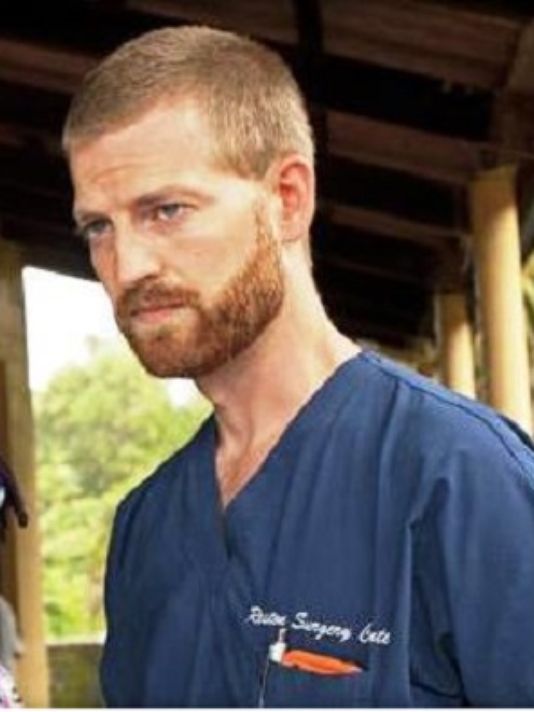
A state of emergency has been declared in Liberia. Guinea, Sierra Leone, and Nigeria have lost more than 930 people to the virus. Monrovia has set up a military blockade to keep people from regions known to have high instances of infections from entering the city.[1] And the World Health Organization is meeting to discuss whether or not to use experimental drugs to try to help those infected by the virus.[2]
All this over a virus called Ebola.
The problem is that there is no known cure for Ebola and, as President Sirleaf of Nigeria noted, “ignorance and poverty, as well as entrenched religious and cultural practices, continue to exacerbate the spread of the disease.”[3] Indeed, many people infected by the virus, rather than being quarantined at medical facilities to stem Ebola’s spread, remain at home and pass the virus on to their families.
The fear surrounding this outbreak is intense. When Dr. Kent Brantly, a medical missionary who contracted the disease while treating patients in Liberia, was brought home for treatment here in the States, some questioned the wisdom of bringing a man infected by a dreaded disease into this country.[4] Others took their criticism farther, like political pundit Ann Coulter, who lambasted Dr. Brantly for going to Africa in the first place:
I wonder how the Ebola doctor feels now that his humanitarian trip has cost a Christian charity much more than any services he rendered.
What was the point?
Whatever good Dr. Kent Brantly did in Liberia has now been overwhelmed by the more than $2 million already paid by the Christian charities Samaritan’s Purse and SIM USA just to fly him and his nurse home in separate Gulfstream jets, specially equipped with medical tents, and to care for them at one of America’s premier hospitals …
Can’t anyone serve Christ in America anymore?[5]
I would point out to Ms. Coulter that there are, in fact, many people and organizations that do indeed serve Christ in America like, well, Samaritan’s Purse. You can learn more about their local relief efforts here. I would also point out that Christ’s commission is to make disciples of “all nations” (Matthew 28:19), which, by definition, includes nations other than our own. Finally, I would point out that the Christian Church has a long and storied history of reaching out to those in dire medical need. For instance, in the 160s, and again in the 260s, a series of plagues struck the Roman Empire. These plagues were so devastating that during one smallpox epidemic, a quarter to a third of the population died. When these plagues swept through, most people – scared of becoming infected – took the sick and threw them into the streets to die. But Christians, rather than casting the sick out, brought the sick in. Dionysius, the bishop of Alexandria during the second sweep of plagues, writes about how Christians responded to these outbreaks:
Most of our brother Christians showed unbounded love and loyalty; never sparing themselves and thinking only of one another. Heedless of danger, they took charge of the sick, attending to their every need and ministering to them in Christ, and with them departed this life serenely happy; for they were infected by others with the disease, drawing on themselves the sickness of their neighbors and cheerfully accepting their pains. Many, in nursing and caring for others, transferred their death to themselves and died in their stead.[6]
The Christians in Dionysius’ day, like Dr. Brantly in our day, cared for the sick – many of them dying because of their efforts. Dr. Brantly’s faithfulness is to be commended, not derided as Ann Coulter has done.
With this being said, all Christians need not travel to Liberia to respond faithfully to this worldwide health crisis. We can be faithful in our prayers that the spread of Ebola would be stemmed, and we can certainly join in prayer for Dr. Brantly and others like him. Finally, we can reach out in Christian love to the sick in our own communities, offering them our prayers and support.
When I think of Dr. Brantly’s efforts, I can’t help but believe he will hear some very pleasant words one day: “I was sick and you looked after Me” (Matthew 25:36). Let’s make it our goal to hear these words too.
__________________________________
[1] “Liberia declares state of emergency over Ebola virus,” BBC News (8.7.2014).
[2] Sydney Lupkin, “World Health Organization to Debate Ethics of Using Experimental Ebola Drug in Outbreak,” ABC News (8.6.2014).
[3] “Liberia declares state of emergency over Ebola virus,” BBC News (8.7.2014).
[4] Joel Achenbach, Brady Dennis, & Caelainn Hogan, “American doctor infected with Ebola returns to U.S.,” The Washington Post (8.2.2014).
[5] Ann Coulter, “Ebola Doc’s Condition Downgraded To ‘Idiotic,’” anncoulter.com (8.6.2014).
[6] Dionysius of Alexandria in Rodney Stark, The Rise of Christianity: How the Obscure, Marginal Jesus Movement Became the Dominant Religious Force in the Western World in a Few Centuries (San Francisco: Harper Collins, 1997), 82.
Decidophobia

Credit: thebeaconmag.com
I have a confession to make: I suffer from decidophobia.
Now, before you accuse me of making up words, this term is not my own. Walter Kaufmann, who served as a philosophy professor for over 30 years at Princeton, coined it. He explains decidophobia like this:
In the fateful decisions that mold our future, freedom becomes tangible; and they are objects of extreme dread. Every such decision involves norms, standards, goals. Treating these as given lessens this dread. The comparison and choice of goals and standards arouses the most intense decidophobia.[1]
Here’s what Kaufmann is saying: decisions form futures. Those who suffer from decidophobia worry that their decisions will tank their futures.
Now, to a certain extent, this is true. Foolish decisions can lead to bad futures. If one wracks up a lot of debt now, it leads to a lot of bills in the future. If one is having an affair now, it can lead to a heart-wrenching divorce in the future.
But there are other decisions – decisions that don’t always carry with them the ethical clarity that getting into a bottomless pit of debt or having an affair do. Decisions like, “What job should I take?” “What vehicle should I buy?” “What house should I live in?” I am trying to make a decision on the last of these three quandaries. And I have come down with a bad case of decidophobia.
As I have looked at neighborhoods and floor plans and features and storage space, I’ve become worried and concerned. Will I make the right decision? But here’s what I’ve come to realize: decisions like these, though not always easy, are not devastatingly determinative of my future. If a house does not have all the features I might like, it will still provide me with a roof over my head at the end of the day. If a job you take does not meet all your dreams and expectations, you will still have a paycheck at the end of your pay period. If a car you buy isn’t the one you’ve dreamed of since you were a teenager, it will still get you from point A to point B by the end of your trip.
I have long suspected that God gives us some decisions to make not to teach us about decisions themselves, but to teach us about the anxiety that so many of us feel when we are in the throws of a decision-making process. I read somewhere that we should “not worry about tomorrow, for tomorrow will worry about itself” (Matthew 6:34). Many of the decisions we make carry with them no biblical mandate. Any decision we make will be fine. Being free from worry, however, does carry with it a biblical mandate. That’s why it’s time to stop incessantly fretting. Decidophobia is sinful.
So what’s causing you decidophobia? Before you get your stomach tied in knots, remind yourself of Christ’s words in Matthew 6:34. These decisions are not worth your worry. You are in God’s care.
___________________________
[1] Walter Kaufmann, Without Guilt and Justice: From Decidophobia to Autonomy (New York: Peter H. Wyden, Inc., 1973), 3.
It’s Not About The Supreme Court Ruling

Credit: Wikipedia
There was the ruling. And then there was the reaction to the ruling. When the Supreme Court ruled in favor of the arts and crafts chain Hobby Lobby, saying it did not have to pay for certain types of birth control as mandated by the Affordable Care Act because it considered them abortifacients which violated the theological beliefs of the company’s owners, the reaction was swift and fierce – from both sides. Mark Goldfeder, senior fellow at the Center for the Study of Law and Religion at Emory University, announced:
Here is what the decision means: People have First Amendment rights, and even if the corporations themselves are not entitled to Free Exercise exemptions, the people behind the corporate veil, the business owners themselves, certainly are.
On the other side, Judy Waxman, vice president of health and reproductive rights at the National Women’s Law Center, lamented:
We think it’s a bitter pill to swallow for women, and that the decision is saying that bosses know best and their religious beliefs can trump very basic health-care coverage. It’s especially harmful to women, but beyond this, down the line, there will be other cases, other challenges, that could have an even broader effect.[1]
Of course, along with these measured responses, there were also the less measured responses of the Twitterverse, like one post advocating arson: “#HobbyLobby are scum of the earth. Burn every single one down, build a homeless shelter there instead.”[2] Then, there was another very humble post from a person who agreed with SCOTUS’s ruling: “Ha. Ha. It’s The. Law.”[3]
What fascinates me about all these responses – whether they be sophisticated or sleazy – is how little they have to do with the actual legal ins and outs of this case and how much they reflect the radically disparate worldviews of our society. I have found no better synopsis of the clash of worldviews in this case than this from Trevin Wax:
A generation ago, a person’s religious observance was a public matter, a defining characteristic of one’s identity, while a person’s sexual activity was something private. Today, this situation is reversed. A person’s sexual behavior is now considered a defining characteristic of identity, a public matter to be affirmed (even subsidized) by others, while religious observance is private and personal, relegated to places of worship and not able to infringe upon or impact the public square.
The culture clash today is less about the role of religion in business or politics, and more about which vision of humanity best leads to flourishing and should therefore be enshrined in or favored by law.[4]
This is exactly right. Different people value different things. For some, their faith is their defining characteristic. Thus, they have a strong desire to practice their faith in every area and aspect of their lives, including their business dealings. For others, some other thing – like their sexuality – is their defining characteristic. And anything perceived as an affront to their sexual identity is worthy of unrestrained caustic choler.
As a Christian, I really have no choice when it comes to how I will define myself: my life must be defined by Christ. In the words of the apostle Paul, “It is no longer I who live, but Christ who lives in me” (Galatians 2:20). So what does this mean for my interactions with those who define themselves by other things? A few things come to mind.
First, I must love those with differing worldviews. As Ed Stetzer so pointedly says in his article on the Hobby Lobby ruling, “You can’t hate a people and reach a people at the same time.”[5] People who live outside a Christian worldview are not to be destroyed or oppressed in a political or judicial power grab, but loved through a winsome witness.
Second, I must realize that my worldview is no longer a privileged majority worldview in our society. Indeed, many people are not at all concerned that a Christian may be legislatively or legally forced to do something that goes against his conscience. Again, Ed Stetzer writes, “Most Americans are not as passionate about the religious liberty issue (when connected to contraception, even abortifacient contraception) as most evangelicals and conservative Catholics.” Trevin Wax reveals that “a record number of Americans (1 in 3) said the first amendment [which grants religious liberty] goes too far in the freedom it promises.” This is just a reality.
Third, I must make the case – through both a rigorous intellectual defense and a gentle, quiet lifestyle – why my worldview should be seriously considered and why it does indeed lead to true human flourishing. It is important to note that this case cannot be made quickly. Indeed, it cannot even be made by just my life or in just my lifetime. No, this is a case the whole Church must make. And blessedly, the Church has been making it for millennia. For instance, the Church made its case here. And here. And here. And here. This is why I doubt any Supreme Court ruling – be it in favor of or against religious liberty – will kill the Church’s case. For this is the case and cause of Christ.
Let’s keep making it.
______________________________
[1] Ashby Jones, “Legal Experts, Advocates React to Supreme Court’s Hobby Lobby Ruling,” The Wall Street Journal (6.30.2014).
[2] Costa Koutsoutis, @costa_kout, 6.30.2014
[3] Harriet Baldwin, @HarrietBaldwin, 6.30.2014
[4] Trevin Wax, The Supreme Court Agrees With Hobby Lobby, But Your Neighbor Probably Doesn’t,” The Gospel Coalition (6.30.2014).
[5] Ed Stetzer, “Hobby Lobby Wins: Where Do We Go from Here?” The Exchange (6.30.2014).
Practicing Patience
 The other day, I drove down to the Social Security office to apply to get a Social Security card for my daughter, Hope. Because she is adopted, she did not get one issued to her at the hospital. While I was on my way to visit my local friendly government agency, the skies opened up, thunder clapped, and rain poured down, slowing traffic to a crawl.
Now, usually, I hate being stuck in traffic. I’m always looking for a way to weave in and out of traffic and find that elusive lane that is going 40 miles per hour faster than all the other lanes. But not so on this day. It was raining so hard that, quite frankly, I was glad traffic was moving at a snail’s pace. I’d rather slosh down the road slowly and arrive safely at my destination than try to gun it and wind up in a wreck.
As I sat there contentedly in a sea of brake lights, my thoughts were drawn to the virtue of patience. After all, for once in my life, I actually felt patient. Here is what I realized in my moments spent reflecting: the virtue of patience leads to other virtues. It is what I call a “funnel virtue.” That is, if you practice patience, it will funnel you in to other important virtues.
For instance, take the virtue of responsibility. At the end of the day, my wife directs Hope to clean up her toys. But directing a one-year-old to clean up toys is never an easy – or a quick – task. Hope will drop a toy in her toy basket only to immediately pull it out again. But Melody knows it’s important to teach Hope responsibility. But to teach the virtue responsibility, Melody first needs to exercise the virtue of patience (which she does marvelously, by the way). Patience funnels into responsibility.
Or how about the virtue of joy? The disease of road rage is well documented. Drivers lose their minds because they feel the person in front of them is going too slow. But what would happen if they were patient? Perhaps they would rediscover the joy of a Sunday drive – motoring down the road more to take in the sights rater than to reach a destination. Patience could funnel into joy.
Then, of course, there is the virtue of love. There is perhaps no better expression of love than patience. This is why the very first virtue that Paul uses to describe love in 1 Corinthians 13:4 is, “Love is patient.” To be patient with someone teaches you to love someone because it forces you to put someone else’s pace and schedule above of and in front of your own.
Finally, patience also can serve as a funnel to fuller faith. Right now, we are in the process of buying a new home. I cannot tell you how many times I have prayed to God for an answer about something pertaining to this process…right now! God is answering my requests in some pretty miraculous ways, just not according to my schedule. And I am having to remember and re-learn that God really does have this all under control and I can trust Him to work things out. But here’s the key: the longer I have to wait on Him, the more I learn to trust Him. Patience funnels into faith.
As it turns out, when I got to the Social Security office, I was not able to get a card for Hope. The documentation requirements that I read in the Social Security brochure did not match the documentation requirements they had at the Social Security office. I left empty handed with an errand list of other government agencies I had to visit to get the required documents. I had wasted my time. And I found I was not nearly as patient on the way back from the Social Security office as I was on the way to the Social Security office.
Perhaps my patience funnel still has room to expand.
Four Lessons From The Spurs You Probably Already Know

Credit: Getty Images
This past week was a great one to be living in San Antonio. For the fifth time in franchise history, the San Antonio Spurs brought home the title of NBA National Champions. As much as I enjoyed watching Game 5 of the National Championship and seeing the Spurs come back from a 16-point deficit to win 104 to 87, the Spurs have a lot more going for them than just one big win in one big game. Their words and demeanor season after season offer some good, even if simple, lessons. Here are four that I’ve been thinking about.
A Lesson in Teamwork
The Spurs, as sportscasters, fans, and bystanders alike will tell you, are a team. But not just in the sense that they all happen to be wearing the same jersey. No, they play like a team. They act like a team. And they win like a team. Benjamin Morris noted that the Spurs “had nine different players take four or more field goal attempts per game throughout the playoffs, compared to just six for Miami.”[1] In San Antonio, everybody gets to play because, in San Antonio, everybody needs to play to bring home a win.
Playing as a team, of course, is needed not only on the court, but in the Christian life. To meet the challenges we face, everybody needs to play together. I think of the apostle Paul and all of his teammates, or, as he called them, “partners” (e.g., 2 Corinthians 8:23; Philippians 1:5; Philemon 1:7), in the gospel. With whom do you need to team up so you can share and show God’s love more effectively?
A Lesson in Humility
When Kawhi Leonard was named Most Valuable Player for the Finals, his shock was apparent – and endearing. I loved how he responded to his high honor: “Right now, it’s just surreal to me,” he said. “I have a great group of guys behind me.”[2] Kawhi knew he performed great in Game 5. But he also knew it wasn’t just about him. It was about them – all the Spurs behind him.
In a world where Facebook, Twitter, and Instagram are full of people shouting, “Look at me!” – to have a man point to the men behind him is impressive and important. This is true humility. Indeed, true humility is not about degrading yourself, but about lifting others up, which Leonard did beautifully. Who can you point to in humility?
A Lesson in Perseverance
Before they were the National Champion San Antonio Spurs of 2014, they were the team that let everything slip through their fingers in 2013. The front page of the San Antonio Express-News reflected last year’s heartbreak in its headline: “REDEMPTION!” But it took 362 days after a heartbreaking Game 6 loss to get that redemption. 362 long days. “A day didn’t go by when I didn’t think about Game 6,” said Coach Gregg Popovich. “For the group to have the fortitude to get back to this spot speaks volumes.”[3] The Spurs took a fall, yes, but they turned that fall into fuel for fortitude. In the words of Tim Duncan, “What happened last year definitely helped our drive … We could have reacted in different ways. We reacted the right way.”
Where you in your life do you need to persevere? Where do you need to take things that go wrong and learn from them so you can do right?
A Lesson in Inclusion
Scott Cacciola of The New York Times recently published an article hailing the Spurs as “The United Nations of the Hardwood”:
The Spurs, as has been well established, have developed an international flair under Coach Gregg Popovich. Eight players on the current roster were born outside the United States. Loosely translated, that means the Spurs use at least four languages – English, Spanish, French and Italian – to communicate among themselves.
Manu Ginobili, an Argentine, is the team’s one-man version of the United Nations, capable of conversing in Spanish with his Brazilian teammate Tiago Splitter and in Italian with Marco Belinelli, who was born outside Bologna. (Ginobili speaks in English with everybody else.)
Boris Diaw, who is from France, converses en français with Tony Parker, who was born in Belgium but grew up in France. Both players also know some Italian, enough to eavesdrop on conversations between Ginobili and Belinelli.
Even the two team’s two Australians, Patty Mills and Aron Baynes, have their own dialect.
“We’ll hear them and be like, ‘Whoa!’” the assistant coach Chad Forcier said.
Tim Duncan, who is from the United States Virgin Islands, is considered an international player by the NBA.[4]
During the championship ceremony, many of these players wrapped themselves in the flags of their home countries.
The inclusion of so many men from so many places, all together on one team, makes me smile. It reminds me of the promise that anyone from any “nation, tribe, people and language” (Revelation 7:9) can be included as one redeemed by the Lamb through faith. And the more, the merrier. That’s why one of my prayers is that heaven is chocked full. I’d hate to see one empty corner where a person could have been. So would the Lord. He wants as many people included in His Kingdom as possible. Who can you pray for to be included in eternity’s celebration?
In reality, these lessons are pretty simple and straightforward. Indeed, I suspect you have probably already learned these lessons somewhere along the way. Nothing in this blog is probably news to you. But lessons don’t have to be esoteric and unknown to be profound and helpful. They just have to be true. And these lessons most certainly are. That’s why I thought we could all use a little reminder.
So congratulations, Spurs. And thanks for the lessons. They’re great.
________________________________
[1] Benjamin Morris, “The Spurs Were an Outlier of Unselfishness,” FiveThirtyEight (6.17.2014).
[2] Associated Press, “Kawhi Leonard named Finals MVP,” ESPN (6.16.2014).
[3] Jeff McDonald, “High five! Spurs dethrone Heat for fifth NBA championship,” San Antonio Express-News (6.15.2014)
[4] Scott Cacciola, “The United Nations of the Hardwood,” The New York Times (6.15.2014).
A Deal With The Devil: How We Got Sergeant Bowe Bergdahl

Credit: Getty Images
One of my favorite movie lines comes at the end of “The American President.” After being excoriated by his opponent, Senator Bob Rumson, President Andrew Shepherd storms into the Press Briefing Room to deliver an apologetic for his presidency and his personal life with the cameras rolling. One of the things he says in this press conference that has long stuck with me is, “America isn’t easy.”
I couldn’t agree more. In twenty-first century America, we face tough challenges. We have to navigate complex issues. America isn’t easy.
The latest example of this truism comes to us courtesy the case of Army Sergeant Bowe Bergdahl. He was captured by the Taliban in 2009. On May 31 of this year, he was released. If this was all there was to this story, this would be a story of unambiguous triumph and joy. But the devil, as they say, is in the details. And the details here are sketchy, conflicting, and disturbing.
First, there is the detail of how Sergeant Bergdahl was captured. He claims it’s because he fell behind on a patrol and the Taliban swept in and abducted him. The Taliban claims he was captured drunk and wandering off base. According to an investigation by the Pentagon, Bergdahl may have deserted his unit – walking away from his post, which led to his capture. In an email dated June 27, 2009, Bergdahl expressed a rising dissatisfaction with his military service: “I am ashamed to be an american. And the title of US soldier is just the lie of fools.”[1] If Sergeant Bergdahl’s claims concerning his capture are true, this is a tragedy. If the Taliban’s claims are true, Bergdahl was foolish. But if the Pentagon’s story pans out, this is a story of one man’s faithlessness toward his brothers-in-arms. How all this began matters.
Then, there is the detail of what Sergeant Bergdahl’s release cost. Our government brokered a deal with the Taliban that released five Guantanamo Bay detainees in exchange for Bergdahl’s freedom. Before this deal, no fewer than five soldiers died on missions to rescue Bergdahl – all this for a man who may have despised many of the very people who were trying to rescue him. What Sergeant Bergdahl’s release cost matters.
So, what is the appropriate response to this sordid affair? At this point, I think it’s best to say there is no appropriate response – not because there is no appropriate response period, but because we do not have enough facts to formulate the kind of comprehensive response that this story demands and deserves. Thus, I am not so interested in deconstructing the details of this story itself, but I do want to address some of the ethical questions it raises. People want to know: “Was it right to sacrifice five lives and release five criminals for the freedom of a man who could have been a deserter?” “What price should we be willing to pay for the civic freedom of one person?” And, of course, “Is it ever right for the U.S. to negotiate with terrorists?”
In one sense, the saga of Sergeant Bergdahl is parabolic for the limits of human ethical decisions. Here, we have both good and bad comingled. Freeing a Prisoner of War – that’s good. Sacrificing the lives of at least five soldiers and releasing five hardened criminals – that’s bad. We did something bad to get something good. How do you reconcile that?
Such ethical angst is perhaps best encapsulated by Bruce Hoffman, director of Georgetown University’s Center for Security Studies, in an interview with USA Today. Commenting on our government’s deal with the Taliban, he notes that though the United States’ official stance is that we do not negotiate with terrorists, this is
…repeated as mantra more than fact. We have long negotiated with terrorists. Virtually every other country in the world has negotiated with terrorists despite pledges never to … We should be tough on terrorists, but not on our fellow countrymen who are their captives, which means having to make a deal with the devil when there is no alternative.[2]
Hoffman is right. We made a deal with the devil. And granted, out of this deal, some good has come: a soldier has been reunited with with his family. But whether or not any other good comes out of this deal remains to be seen. Questions concerning Bergdahl’s conduct still need to be asked and families who have lost loved ones in attempts to rescue this soldier still need to be comforted. This much I do know, however: deals with the devil are never as good as we think they are. There are always hidden costs and huge catches. In fact, as far as I can tell, only one deal with the devil has ever been truly successful. It’s the one where someone said: “Let’s make a deal. You can strike My heel. But I get to crush your head.”
May that divine deal help us navigate the moral complexities and save us from the moral compromises of our fallen deals.
___________________________
[1] Michael Hastings, “America’s Last Prisoner of War,” Rolling Stone (6.7.2012).
[2] Alan Gomez, “Is it ever right to negotiate with terrorists?” USA Today (6.2.2014).


 Pastor Zach's Blog