Posts tagged ‘Christianity’
The Pew Survey On Christianity: It’s Not As Bad Or As Good As You Might Think
 The Washington Post led with a headline that sounded nearly apocalyptic: “Christianity faces sharp decline as Americans are becoming even less affiliated with religion.”[1] The faithful quickly jumped in to temper the premature reports of Christianity’s cardiac arrest with op-ed pieces like this one by Ed Stetzer that ran in USA Today: “Survey fail – Christianity isn’t dying: Ed Stetzer.”[2]
The topic of discussion and debate is a new Pew Research Center poll that finds:
… the percentage of adults (ages 18 and older) who describe themselves as Christians has dropped by nearly eight percentage points in just seven years, from 78.4% in an equally massive Pew Research survey in 2007 to 70.6% in 2014. Over the same period, the percentage of Americans who are religiously unaffiliated – describing themselves as atheist, agnostic or “nothing in particular” – has jumped more than six points, from 16.1% to 22.8%.[3]
Taken by themselves, these statistics sound dire and dour. But, as Ed Stetzer helpfully points out in his article, there is more to these statistics than what first meets the eye:
Rather than predict the impending doom of the church in America, this latest study affirms what many researchers have said before. Christianity isn’t collapsing; it’s being clarified. Churches aren’t emptying; rather, those who were Christian in name only are now categorically identifying their lack of Christian conviction and engagement …
Nominals – people whose religious affiliation is in name only – are becoming nones – people who check “none of the above” box on a survey.
Those who value their faith enough to wake up on Sunday morning and head to their local church are mostly still going. What I have described as “convictional Christianity” will continue. Those who say their faith is very important to their lives are not suddenly jettisoning those beliefs to become atheists.
According to Pew, unaffiliated Americans grew from 16 to nearly 23% in the last seven years. That increase largely came from the ranks of Catholics and Mainline Protestants, religious traditions with high numbers of nominals.
Stetzer’s point is well taken. By no stretch of the imagination should we read the Pew survey as a funeral dirge for Christianity – especially for Evangelical Christianity, contrary to this misreading of the Pew survey.[4] Still, even if Pew’s numbers do not portend the sure demise of Christianity, they do indicate a real shift in Christianity. Here’s how.
For better or for worse, the nominal Christians who once warmed the pews in Mainline Protestant churches and are now hemorrhaging to the “nones” had as their counterparts the academic Protestant Christians among the elites. Names such as Reinhold Niebuhr, Harry Emerson Fosdick, Paul Tillich, and Karl Barth once held court as America’s public intellectuals – their books being widely read and disseminated not only into Protestant Christendom, but into society in general. These men enjoyed unrivaled cultural gravitas – so much so, that each of them took their turn gracing the cover of Time Magazine. And though none of these men can be considered orthodox in their doctrine in an Evangelical Christian sense, they nevertheless passed down to American society some generally and even genuinely Christian concerns and insights. Reinhold Niebuhr defended a robust doctrine of original sin, thundering against the pride of society and those who thought they were generally good people. Harry Emerson Fosdick, though he firmly espoused a liberal Protestant ethos, was not afraid to critique it by warning the Church against a blind cultural accommodation to the spirit of the age. Paul Tillich served as an apologist of sorts, explaining how life’s deepest existential questions can be answered by divine revelation. And Karl Barth bequeathed to us an 8,000 page series on church dogmatics that still informs – and occasionally irritates – Christian thinkers to this day. The work these and other men did kept Christian concerns in the forefront of people’s minds and Christian ethical commitments in the center of people’s worldviews.
The latest Pew survey reminds us that these Christian concerns and ethics are disappearing in broad society. The Protestant lions of old are being replaced by the secularist elites of today. The Pew survey, then, does not just tell the story of a non-committed Christian-esque demographic that, in a twist of delicious justice, is deservedly disappearing; it tells the story of a broader Christian influence that – even if it was of the liberal variety – is waning.
This, of course, is not all bad. The heterodoxy and, in some instances, the outright heresy of these Protestant theologians posed a serious challenge to orthodox Christianity. But, then again, the disappearance of influential Protestantism is also not all good. After all, these Protestant theologians did serve broadly, even if unintentionally, as a tenuous bridge between orthodox Christians on the one hand and powerful elites on the other, enabling the two sides to talk to each other.[5] But this bridge has now collapsed, leaving a yawning canyon between a group of orthodox Christians who are increasingly frightened by and hostile to secularism and a group of powerful elites who are increasingly uninformed about and uninhibited by a generally Christian view of life. Our challenge, then, is to bridge this canyon. And that is no easy task.
I agree with Ed Stetzer that Christians should not respond to the Pew survey apoplectically. But the survey does make me miss some of the Protestant leaders of yesteryear, no matter how much I may have been at odds with them theologically. They may have not always been right, but sometimes, they were helpful.
_______________________________________
[1] Sarah Pulliam Bailey, “Christianity faces sharp decline as Americans are becoming even less affiliated with religion,” The Washington Post (5.12.2015).
[2] Ed Stetzer, “Survey fail – Christianity isn’t dying: Ed Stetzer,” USA Today (5.13.2015).
[3] “America’s Changing Religious Landscape,” Pew Research Center (5.12.2015).
[4] Although I share many of Matt Walsh’s concerns with what he saw of Evangelical Christianity and would agree that many Evangelical churches need more robust and Christocentric teaching and preaching, his stated cause of Christianity’s losses is not specifically born out by the Pew data.
[5] For example, Billy Graham and Karl Barth were friends and were comfortable enough with each other to spar with each other on occasion. See Mark Noll, American Evangelical Christianity: An Introduction (Oxford: Blackwell Publishers, 2001), 47.
Hand, Meet Glove: Why We Need Both Justice and Morality
 It was George Washington who, in his farewell address, explained, “Of all the dispositions and habits which lead to political prosperity, religion and morality are indispensable supports.”[1] It was John Adams who, in a letter to Zabdiel Adams, said, “It is religion and morality alone, which can establish the principles upon which freedom can securely stand.”[2] It was Benjamin Franklin who, in a letter to the Abbés Chalut and Arnaud, wrote, “Only a virtuous people are capable of freedom. As nations become corrupt and vicious, they have more need of masters.”[3] The founding fathers of this country saw a rich and deep connection between morality and freedom. And rightly so. As Os Guinness points out:
Sustainable freedom depends on the character of the rulers and the ruled alike, and on the vital trust between them – both of which are far more than a matter of law. The Constitution, which is the foundational law of the land, should be supported and sustained by the faith, character and virtue of the entire citizenry, which comprises its moral constitution, or habits of the heart.[4]
A freedom that lacks morality is not a freedom that will last long. It will hemorrhage to death by the hand of its own hedonism. The founding fathers knew this.
Sadly, for all the concern that many of our founding fathers devoted to morality, ethics, and virtue, their concern did not always translate into active efforts toward justice. The failure to fight the institution of slavery and the racism behind it is just one of the many blights on this country’s history. In such instances, morality needed a push from democracy to blossom into justice, which is a sad twist of irony, considering this nation’s very charter has in its preamble its intention to “establish justice.”
The tragic reality is that our treatment of morality and justice has been and continues to be deeply schizophrenic. We persistently seek to separate one from the other. The philosophical and, for that matter, theological reality, however, is that morality and justice are inextricable concomitants of each other. This is why, in Scripture, we are treated both to warnings against those who “pervert the grace of our God into a license for immorality” (Jude 4) and to warnings against those who “devise injustice, and … mete out violence on the earth” (Psalm 58:2). Morality and justice go together.
Currently, I am concerned that, just as in the earlier days of our nation many preached a morality without justice, we have now moved into a time where many are preach justice while eschewing any steadying moral tiller. For instance, the sexual revolution, culminating in the legalization of abortion in 1973, was hailed by proponents as part of an inexorable march of justice toward freedom. No longer could people be told what to do in their bedrooms or with their bodies! The dragon of old-fashioned, constrictive sexual morality and its connection to marriage had finally been slain and severed. What happened? Those in economically depressed areas of this country found themselves economically oppressed by a new set of sexual freedoms as they had lots of children born outside of old-fashioned, constrictive marriages and, it turns out, born outside of the economic stability these old-fashioned, constrictive marriages afforded. Not even legalized abortion could stem the tide of out-of-wedlock births. It seems as though sexual justice, when ripped from its moorings of sexual morality, only boomeranged back to further perpetuate another kind of injustice – that of economic injustice.
Before we clamor for justice, we should always ask, “Is this justice moral?” And before we pontificate on morality, we should always ask, “Am I willing to turn my moral words into just actions?” Both are needed. Both are Scriptural. But neither are easy. And in a socio-political system where we all too often look for easy, or at least broadly palatable, answers to our society’s most difficult challenges, I’m afraid the hard hurdle of both justice and morality is one few are willing to try to jump.
___________________________________
[1] George Washington, Farewell Address (1796).
[2] John Adams, Letter to Zabdiel Adams (6.21.1776).
[3] Benjamin Franklin, Letter to the Abbés Chalut and Arnaud (4.17.1787).
[4] Os Guinness, A Free People’s Suicide: Sustainable Freedom and the American Future (Downer’s Grove: InterVarsity Press, 2012), 99.
Egalitarianism That Oppresses
 The Christian gospel is egalitarian in its effect. In the words of the apostle Paul: “There is neither Jew nor Greek, slave nor free, male nor female, for you are all one in Christ Jesus” (Galatians 3:28). In Christ, Paul argues, divisions between Jews and Greeks, slaves and free men, and males and females have been broken down. Social strata have no bearing in the economy of God’s salvation.
It is important to note that the locus of Paul’s egalitarianism is explicitly and specifically redemptive. In other words, Paul is not arguing that all societal differences between people should disappear. Rather, he is claiming that such differences have no bearing on whether or not Christ saves a person.
When Paul penned Galatians 3:28, the egalitarianism of which he spoke was nothing short of radical and, I would hasten to add, good. I am concerned, however, that Paul’s redemptive egalitarianism has been coopted by another kind of egalitarianism – one that is not so good.
In his book, To Change The World, James Davison Hunter speaks of a populism that:
…is often transformed into an oppressive egalitarianism that will suffer no distinction between higher and lower or better and worse. At its worse, it can take form as “tyranny of the majority” that will recognize no authority, nor hierarchy of value or quality or significance.[1]
Though it seems oxymoronic to speak of an “oppressive egalitarianism,” this is where, culturally, I fear we have arrived.
With the rise of postmodernity, Paul’s redemptive egalitarianism was traded for an ethical egalitarianism that eschewed distinctions between right and wrong, higher and lower, better and worse. Of course, such a refusal to place an ethical stake in the ground inevitably undermines traditional, historical, biblical morality. But it was this ethical egalitarianism, free from the nagging and wagging finger of traditional ethical commitments, that paved the way for another kind of egalitarianism – the populous egalitarianism of today that picks and chooses new ethical standards by simple majority vote (with a little front-end help, of course, from elite opinion leaders who not only shape, but sometimes shoehorn, certain elements of public policy). This is why serious ethical issues are regularly framed as little more than political squabbles with nothing more than polling data needed to solve them. This is what Hunter means when he speaks of the “tyranny of the majority.”
What happens to those who do not share the ethical sentiments of the majority? They are ridiculed and caricatured. They are philosophically discredited, even if by logically dubious means, and intellectually castigated. They become victims of an “oppressive egalitarianism.”
In the apostle Paul’s redemptive egalitarianism, egalitarianism is a gift, granted by Christ’s work on the cross. In today’s populous egalitarianism, egalitarianism is a locus of power – a way to oppress transcendent, historical ethical commitments with the fickle ethical commitments of the masses. Populist ethics, however, are never far from social chaos. After all, no matter what “we the people” may want ethically, transcendence has a funny way of eventually getting its way.
A populous egalitarianism that battles transcendent ethics is doomed to fail. Conversely, a redemptive egalitarianism that saves people regardless of their social standing is a promise from God. And, as such, it is destined to emerge victorious.
Let’s make sure we’re on the right side of the right kind of egalitarianism.
_______________________________
[1] James Davison Hunter, To Change the World: The Irony, Tragedy, and Possibility of Christianity in the Late Modern World (New York: Oxford University Press, 2010), 94.
Two Wrongs Don’t Make a Right: The Sad Story of Rolling Stone
Credit: Rappler.com
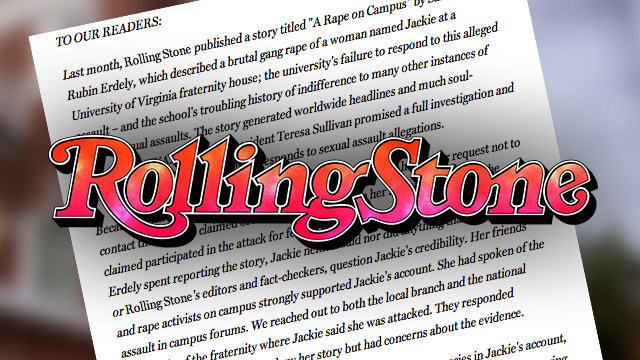
My mother used to tell me that two wrongs don’t make a right. Nowhere has this recently proven to be more true than in the case of a Rolling Stone cover article by Sabrina Erdely about the brutal gang rape of a young woman, identified only as Jackie, at the University of Virginia. The article received national attention for its gruesome detail, but aroused enough skepticism that an independent police investigation into Jackie’s story was launched. Ultimately, the investigators were unable to verify the details Jackie’s story as she described them them to Rolling Stone. Indeed, to some extent, her story appears to be misleading, if not out-and-out fabricated. Rolling Stone, embarrassed by their release of such a questionable article, commissioned the Columbia University Graduate School of Journalism to conduct an investigation as to what went wrong with its reporting. How could the magazine be fooled into running a potentially false story? The investigators found that the article was:
…a story of journalistic failure that was avoidable. The failure encompassed reporting, editing, editorial supervision and fact-checking. The magazine set aside or rationalized as unnecessary essential practices of reporting that, if pursued, would likely have led the magazine’s editors to reconsider publishing Jackie’s narrative so prominently, if at all.[1]
The report continues:
The editors and Erdely have concluded that their main fault was to be too accommodating of Jackie because she described herself as the survivor of a terrible sexual assault. Social scientists, psychologists and trauma specialists who support rape survivors have impressed upon journalists the need to respect the autonomy of victims, to avoid re-traumatizing them and to understand that rape survivors are as reliable in their testimony as other crime victims. These insights clearly influenced Erdely, Woods and Dana. “Ultimately, we were too deferential to our rape victim; we honored too many of her requests in our reporting,” Woods said. “We should have been much tougher, and in not doing that, we maybe did her a disservice.”
This is a story of two wrongs. First, there is the societal ill of rape, which sadly happens way too often on college campuses, often without those who perpetrate the assault being appropriately disciplined. But second, there are also the journalistic lapses in judgment by Rolling Stone, who apparently was so desperate to tell a sensational story that they checked not only their good sense, but their common sense, at the door. When these two wrongs came together, they didn’t make anything right. Instead, they just made a mess.
In reality, there is probably a third wrong here – that of deceit. Insofar as Jackie fabricated, misrepresented, or embellished what happened to her, she did a grave disservice to victims of rape all over the world. If she did tell the truth, I pray that comes to light – and quickly – so that she and Rolling Stone can be exonerated. If she did not tell the truth, I pray she is moved to confess her lies and apologize. There’s plenty of real sexual horror in our world. We don’t need to make up more of it.
Sadly, this whole, sordid affair is nothing less than a bit of empirical evidence of the depths of humanity’s depravity. The horrible reality of rape; the drive of a magazine to be so titillating that it forgets to be truthful; the mysterious and twisted desire of a young lady to tell a horrific story that could be false – there is no shortage of human folly on display here.
One of Jackie’s friends, Ryan Duffin, in an interview with New York Magazine, explained that though he wants to believe Jackie’s story, he has finally decided, “It doesn’t matter if it’s true or not, because whether this one incident is true, there’s still a huge problem with sexual assault in the United States.”[2]
I would beg to differ. I think the truthfulness of Jackie’s story does matter. It matters because one sin can never be solved another sin. Rape cannot be solved by deceit. Two wrongs don’t make a right.
My prayer is that any remaining wrongs in this story come to light so they can be corrected, amended, and, ultimately, forgiven. For all that’s gone wrong with this story, that’s the only hope for something to come out of this that’s right.
_________________________________
[1] Sheila Coronel, Steve Koll, and Derek Kravitz, “Rolling Stone and UVA: The Columbia University Graduate School of Journalism Report,” Rolling Stone (4.5.2015).
[2] Margaret Hartmann, “Everything We Know About the UVA Rape Case [Updated],” New York Magazine (4.6.15).
Why I Agree With Tim Cook

Credit: ABC News
I agree with Tim Cook.
When the CEO of Apple writes, “Discrimination, in all its forms, is bad for business,” I agree. Discrimination in its civil rights sense of, ironically, indiscriminately hating a whole group of people simply because of a particular characteristic, practice, or belief is unacceptable. When Cook says, “This is about how we treat each other as human beings,” I agree.[1] Treating each other without so much as a modicum of dignity and understanding is inexcusable.
I agree with Tim Cook. But I don’t think Tim Cook agrees with me.
In what has become the latest kerfuffle over religious rights and gay rights, Indiana Governor Mike Pence signed into law Senate Bill 568, stating:
A state or local government action may not substantially burden a person’s right to the exercise of religion unless it is demonstrated that applying the burden to the person’s exercise of religion is: (1) essential to further a compelling governmental interest; and (2) the least restrictive means of furthering the compelling governmental interest.
Almost immediately, a furor erupted. The Wall Street Journal reports:
Calls to boycott Indiana dominated Twitter on Friday. Tourism officials in Indianapolis fielded an onslaught of questions from convention planners … Even the NCAA, which is based in Indianapolis and is planning to host more than 100,000 basketball fans next weekend, expressed concerns about what the law means.[2]
At the root of this riot is a concern that this bill’s protection against government actions that “substantially burden a person right to the exercise of religion” could lead to public accommodations refusing to serve LGBT people because their owners may have ethical convictions that conflict with the convictions of many in the LGBT community. One thinks of the Oregon baker who refused to make a cake for a same-sex couple for their wedding and the Washington florist who refused to sell flower arrangements to another same-sex couple for their wedding.
The New York Times pulled no punches in its disdain for Indiana’s bill, publishing and op-ed piece by its editorial board titled, “In Indiana, Using Religion as a Cover for Bigotry.” And, as with Tim Cook, I can say that I agree with the editorial board of The New York Times insofar as I abhor the thought of religion being used to mask bigotry.
But at the same time I agree with them, I still don’t think they agree with me. Here’s why.
Tim Cook and The New York Times editorial board have taken up a moral crusade against bigotry. And I am happy to join them. Bigotry is wrong. But where they have one moral concern, I have two. Because at the same time I despise bigotry, I am also heartbroken by shifting social mores on human sexuality. Like bigotry, for me, the twisting of human sexuality is a moral issue that is tearing at the fabric of both our society and our souls. Lust is hurting us. Pornography is hurting us. Affairs are hurting us. Domineering husbands who demand sex from their wives are hurting us. And yes, sex outside of the context of marriages between husbands and wives is hurting us.
But to operate – even when I’m doing business – under such Christian conviction does not automatically equate to discrimination. And to say that I think something is wrong in a loving, thoughtful, and gentle way does not ineluctably constitute bigotry. In many ways, Christian conviction has proven itself an an indispensable blessing to business. Christian commitments to faithfulness, honesty, integrity, graciousness, and generosity can have amazingly positive impacts in cutthroat corporate cultures. Why would we not surmise that a loving commitment to some sort of sexual morality might not have a similar impact? This is where I think Tim Cook and the editorial board of The New York Times get things wrong – not in their moral repulsion at discrimination and bigotry, but in their use of the terms.
It is true that Christian conviction has sometimes been twisted toward bigoted ends. I think of the man in Colorado who marched into a bakery and ordered cakes with slogans like “God hates gays” written on them. When the bakery refused to make the cakes, he filed a lawsuit. That is not living by Christian conviction. That’s being a jerk. But that is not what I’m talking about. I’m simply trying to make the case that at the same time the likes of Tim Cook, The New York Times editorial board, and, for that matter, many Christians around the world believe that bigotry is a moral issue that needs to be addressed and confronted, many Christians around the world also believe that shifting ethics on human sexuality is a moral issue that needs to be addressed. I think it’s only fair and right to hear them out – and to refrain from labeling them as bigots. I also think it’s only decent to respect their consciences – especially when their consciences express themselves in love – even when they’re running public accommodations.
So let’s make a deal: let’s stand against bigotry together while respecting each others’ differences in conscience. Who knows? The result might just be a deeper understanding of each other and a deeper love for each other. And I hope those are two morals on which we can all agree.
_______________________
[1] Tim Cook, “Tim Cook: Pro-discrimination ‘religious freedom’ laws are dangerous,” The Washington Post (3.9.2015).
[2] Mark Peters and Jack Nicas, “Indiana Religious Freedom Law Sparks Fury,” The Wall Street Journal (3.27.2015).
Changing Racist Hearts
Credit: AP / The Washington Post
It’s been a tough week for race relations in America. Saturday, March 7 began with a march, led by President Obama and Representative John Lewis, across the Edmund Pettus bridge in Selma to commemorate the fiftieth anniversary of the day 600 voting rights demonstrators, led by Dr. Martin Luther King, Jr., crossed this same bridge and were met by state troopers who attacked them with billy clubs and tear gas. Indeed, Representative Lewis was among those seriously injured in that fateful march. Reflecting on the events of fifty years ago, the president noted:
In one afternoon fifty years ago, so much of our turbulent history – the stain of slavery and anguish of civil war; the yoke of segregation and tyranny of Jim Crow; the death of four little girls in Birmingham, and the dream of a Baptist preacher – all that history met on this bridge.
It was not a clash of armies, but a clash of wills; a contest to determine the true meaning of America.
And because of men and women like John Lewis, Joseph Lowery, Hosea Williams, Amelia Boynton, Diane Nash, Ralph Abernathy, C.T. Vivian, Andrew Young, Fred Shuttlesworth, Dr. Martin Luther King, Jr., so many others, the idea of a just America, and a fair America, an inclusive America, and a generous America – that idea ultimately triumphed …
What they did here will reverberate through the ages. Not because the change they won was preordained; not because their victory was complete; but because they proved that nonviolent change is possible; that love and hope can conquer hate.[1]
If only the president’s final line rang a truer longer.
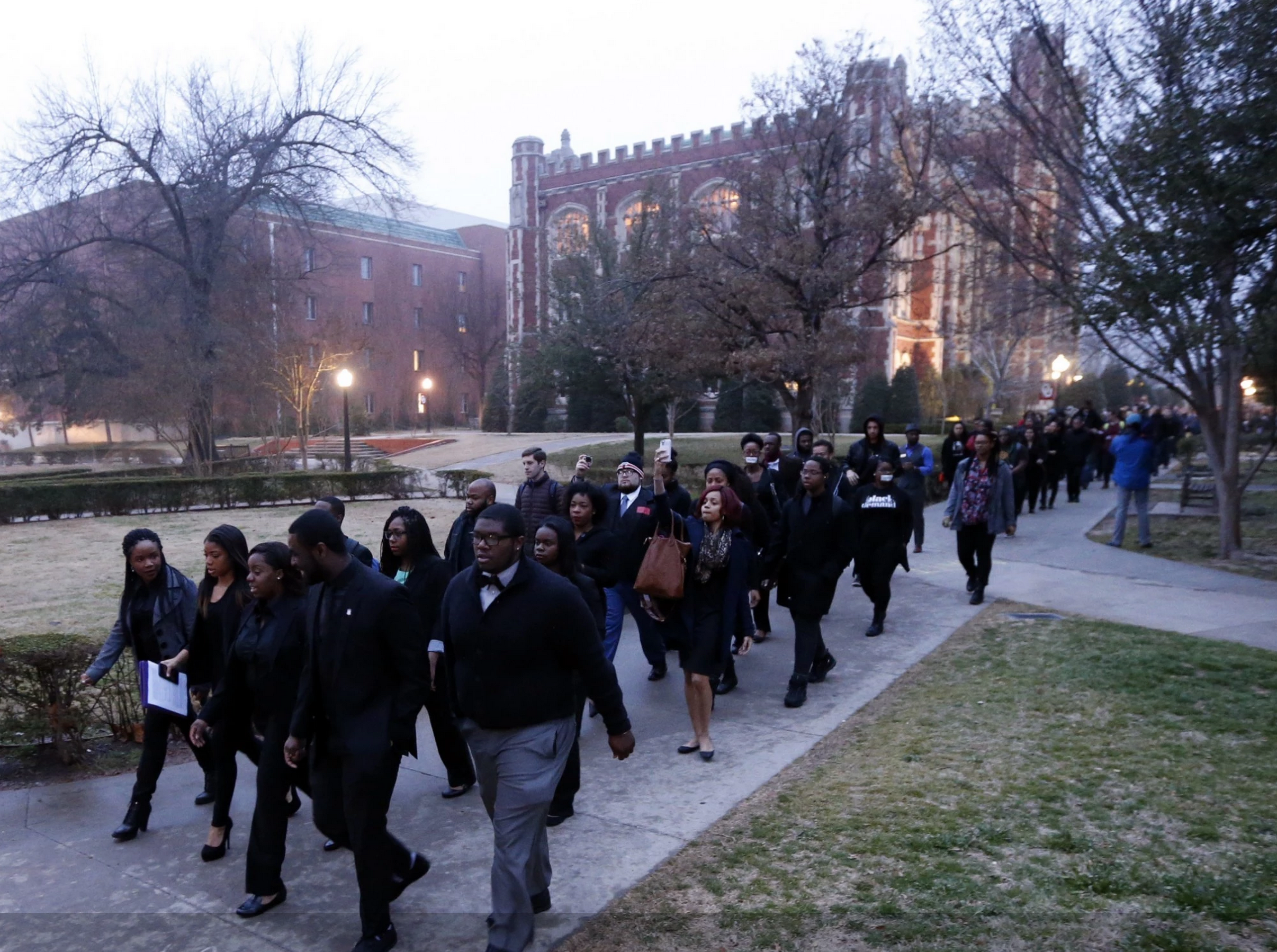
The very next day, a video surfaced showing members of the Sigma Alpha Epsilon fraternity at the University of Oklahoma singing a horrifyingly racist song on a bus. The University quickly denounced the video, suspended the fraternity from its campus, and expelled two of the students involved.
But then came this:
Attorneys and law professors have watched with interest this week as the University of Oklahoma moved swiftly to disband the school’s SAE chapter and expel two students on suspicion of leading the racist chant, which was captured on a now-viral video.
University President David Boren acted decisively in dismantling the chapter, but experts say the university may be on shaky legal ground.[2]
The issue at hand is whether or not the University of Oklahoma violated the students’ First Amendment rights by closing their fraternity and expelling two students simply because they sang a song that many find – and, I hasten to add, should find – offensive. As Terrence McCoy reports in an article for The Washington Post:
The expulsions immediately struck constitutional law experts such as professor Eugene Volokh, of the University of California at Los Angeles and the Volokh Conspiracy blog, as strange. Did the University of Oklahoma, a public institution, just punish speech that, while clearly abhorrent, was protected under the First Amendment? Was this a violation of the Constitution?
Private institutions – like Sigma Alpha Epsilon – can freely punish speech that breaches their codes or standards. But a public institution such as the University of Oklahoma, which takes public money, operates as an arm of the government under the law. “So, in effect, it’s not a university punishing a student for a racist video or social media post, it is the state itself acting against an individual – a person, importantly, with all the rights guaranteed under the First Amendment,” wrote the University of West Alabama’s Will Nevin on AL.com.[3]
This case is yet another example of how woefully inadequate civic laws can be to address the deeply moral aspects of the human condition and experience.
One the one hand, the First Amendment was put in place to serve an important common good – that of protecting this country’s citizens from being oppressed, even in their speech, by their government. This freedom is important and ought to be fiercely protected. On the other hand, we must never forget that societal freedom is inevitably fraught with personal danger. Free speech, it turns out, does not always translate into right speech. Just because legally we can say almost anything doesn’t mean that morally we should.
An opinion piece by Byron Williams of The Huffington Post struck me as especially lucid in regard to this story’s moral entailments:
America’s approach to the original sin of racism maintains an aspect of arrested development. It is too easy to temporarily transfer our moral indignation toward a fraternity at the University of Oklahoma that no longer exists than it is to take the more difficult path that could lead to a meaningful transformation.[4]
Notice the explicitly theological and moral category Williams uses for racism: it’s America’s “original sin.” But notice also how Williams also offers a distinctly non-civic answer to his distinctly theological and moral framing of this problem:
The expelled students have already succeeded in dismantling their fraternity chapter. Shouldn’t they be given opportunity for redemption? In lieu of expulsion, could the university have found another way to educate all involved about the poisons of racism?
The ease with which one can easily sing a song for amusement that dehumanizes another cannot be eradicated by an expulsion that, in my view, is unconstitutional.
Because racism is a learned behavior, it can be unlearned.
Moreover, it could prove to be the most meaningful class the students involved ever take.
To answer what he refers to as an “original sin,” Williams proposes a path to “redemption.” Though he does not frame redemption in a particularly Christian way, his argument is nevertheless rich with not-so-subtle theological overtones and vocabulary. Racists, as Williams notes, “cannot be eradicated by an expulsion.” In other words, if we want to root out racism from society, racists will need something more than punitive measures. As Christians, we know that racists will need Jesus – even as all sinners need Jesus. And racists will need followers of Jesus who are willing both to stand up against them and to seek the transformation of them.
One student’s words on last Monday’s NBC Nightly News broadcast express my hope for the students of Sigma Alpha Epsilon: “I want this to be a rehabilitory time for them.”[5] I hope it is. Because although the First Amendment may be able to defend them legally, it’s only Jesus who can change them internally. And it’s only Jesus who can heal people left broken by these students’ words relationally. So let’s lift our eyes to that hope. After a week like this last one, it’s a hope that we need.
_________________________
[1] Chris Cillizza, “A single photo that tells the powerful story of the 50th anniversary of Selma,” The Washington Post (3.7.2015).
[2] Matt Pearce, “Is University of Oklahoma frat’s racist chant protected by 1st Amendment?” Los Angeles Times (3.10.2015).
[3] Terrence McCoy, “Why expelled Oklahoma frat boys would have an ‘excellent chance’ in court,” The Washington Post (3.11.2015).
[4] Byron Williams, “It’s Not Unconstitutional to Be Racist,” The Huffington Post (3.11.2015).
[5] NBC Nightly News, Lester Holt reporting (3.9.2015).
Thoughts on Christianity and Secularism
 It’s hard to deny that secularism is on the ascendency in America. Indeed, even if one points to the fact that roughly the same number of adults believe in God now as did in 1947, secularism’s intellectual and cultural capital in broader society has steadily increased. As James Davison Hunter deftly notes, the raw numbers of a thing don’t always indicate the influence of a thing. He explains:
With cultural capital, it isn’t quantity but quality that matters most. It is the status of cultural credentials and accomplishment and status is organized between the “center” and the “periphery.” The individuals, networks and institutions most critically involved in the production of a culture operate in the “center” where prestige is the highest, not on the periphery, where status is low.
And so, USA Today may sell more copies of newspapers than the New York Times, but it is the New York Times that is the newspaper of record in America because it is at the center of cultural production, not the periphery, and its symbolic capital is much higher.[1]
Secularism’s proponents may not be large in number, but a great number of them are certainly at the center of our cultural production. And they are working hard to move Christians to the periphery. Even more, secularists are working hard to shift the center of Christianity itself to something that is closer to their way of thinking, even if it is not in perfect alignment with it. This is why there are great numbers of what could be called “secular Christians” who, though they may pay certain homage to the artifacts of their faith, are largely either politely mute or openly in disagreement with much of what historic Christianity confesses.
So how are Christians who are more traditionally orthodox in their confessions to respond?
In my sermon two weeks ago, I outlined three ways that Christians have sought to respond to secularism’s inroads over the past few decades. They are worth rehearsing here.
The first is that of capitulating. There are some Christians who, be it happily or reticently, capitulate to many of secularism’s tenets. These are the “secular Christians” of whom I spoke above. So, for example, one of secularism’s primary tenets is tolerance, or, stated more forcefully, relativism. In secularism’s creed, one religion’s claims cannot be truer than another religion’s claims unless, of course, that religion’s claims conflict with the claims of secularism. Christians who capitulate to the secular tenet of tolerance may speak of their personal path to God as through Christ, but will deny that Christ’s claims are exclusively true for everyone. There must be other, equally true, paths available to these people. These Christians thus capitulate to secularism’s tenets of tolerance and relativism.
The second response to secularism’s inroads is that of cloistering. There are some Christians who, horrified at secularism’s ascendency, immerse themselves in a Christian culture that breezily and probably unknowingly separates itself from broader culture with its many secular entailments by creating its own subculture. The Christians listen to Christian music, read Christian books, and frequent Christian businesses while looking with skepticism at what they perceive to be the irreversible corruption of broader cultural trends. They cloister themselves off in hopes of maintaining more “traditional” values.
The third response to secularism’s inroads is that of conquering. Christians who conquer are fully engaged in what is popularly known as “the culture wars,” launching a virulent apologetic against everything from abortion to gay marriage to Hollywood. They hope that if they can just take these institutions – as well as their sympathizers – down, usually by political means, a sanctified sanity will be restored to the culture-at-large.
I must say that I am largely disappointed by all three of these strategies for stemming secularism’s tide. I think each of these strategies, though they may have certain useful elements that should be retained, are largely ineffective and theologically anemic. Indeed, Scripture already outlines a strategy for engaging secularism in all its forms and with all its tentacles – that of converting. Simply stated, Christians are to seek opportunities to present Christ’s claims to as many as possible so that as many as possible – including secularists – may come to faith.
One of my favorite insights concerning secularism and conversion comes from Søren Kierkegaard, who wrote:
The world and Christianity have completely opposite conceptions. The world says of the apostles, of the Apostle Peter as their spokesman, “He is drunk,” and the Apostle Peter admonishes, “Become sober.” Consequently the secular mentality considers Christianity to be drunkenness, and Christianity considers the secular mentality to be drunkenness. “Do become reasonable, come to your senses, try to become sober.” Consequently the secular mentality considers Christianity to be drunkenness, and Christianity considers the secular mentality to be drunkenness.[2]
Here, Kierkegaard uses Peter’s speech in Acts 2 as a case study in just how far apart secularism and Christianity really are. Somewhat hyperbolically, Kierkegaard says they “have completely opposite conceptions.” So how does Peter counter the “completely opposite conception” of the secularism of his day? In Kierkegaard’s paraphrase, he admonishes the secularists, “Become sober.” In the Bible’s text, he says:
“Repent and be baptized, every one of you, in the name of Jesus Christ for the forgiveness of your sins. And you will receive the gift of the Holy Spirit. The promise is for you and your children and for all who are far off – for all whom the Lord our God will call.” (Acts 2:38-39)
Peter calls for conversion. And “those who accepted his message were baptized, and about three thousand were added to their number that day” (Acts 2:41).
Peter’s call to conversion, it seems, worked. Perhaps his call still ought to be our strategy – no matter how secular our age.
__________________________________
[1] James Davison Hunter, To Change The World (New York: Oxford University Press, 2010), 37.
[2] Cited in Lee C. Barrett & Jon Stewart, Kierkegaard and the Bible: The New Testament (Burlington, VT: Ashgate Publishing Company, 2010), 89, ftn. 62
In Response to ISIS

Credit: The Christian Post
The video was titled, “A Message Signed With Blood to the Nation of the Cross.” In it, 21 Egyptian Christians, dressed in orange jump suits, were gruesomely beheaded by ISIS militants along a beach in Tripoli. One of the final frames of the video zooms in on the waters of the Mediterranean, red with the blood of these martyrs.[1]
Christians aren’t the only targets of ISIS’ rage. Just last week, ISIS released images appearing to show gay men being thrown off buildings only to be stoned after they fell to the ground. A statement released by ISIS explained that the organization is “clamping down on sexual deviance.”[2]
The reaction to such savage killings has understandably been one of untempered ire. Egypt’s president pledged retaliation against ISIS for the slaughter of its Christians. Indeed, Muslims and Christians together are raising a unified chorus of disgust at ISIS’ actions. Andrea Zaki, vice president of the Protestant Churches of Egypt, noted, “With their blood [these martyrs] are unifying Egypt.”[3]
Though the slaughter of Egypt’s Christians has gotten more press than ISIS’ heinous injustices against gay people, both demand a response in addition to whatever political or military responses may be offered in the national and international arenas. Here are two responses that, I believe, are appropriate and important for a moment such as this.
First, we need an anthropological response. After all, whether we are Christian or Muslim, gay or straight, we are all human. Indeed, as Christians, we know and believe that we are all created in God’s image, which affords us not only a shared humanity, but a necessary dignity. This collective humanity and dignity, in turn, involves certain shared hopes and desires. We all desire safety. We all desire respect. We all desire love. When these shared desires are so violently violated, as ISIS has done, basic empathy leads to visceral revulsion. Thus, we can join the world in condemning these acts, if for no other reason than that we are all human.
Second, we also need a theological response. This response is especially urgent because far too many in the broadly secularized West have refused to admit that there are theological drivers behind ISIS’ actions. Writing for The Atlantic, Graeme Wood explains:
We are misled … by a well-intentioned but dishonest campaign to deny the Islamic State’s medieval religious nature … The reality is that the Islamic State is Islamic. Very Islamic. Yes, it has attracted psychopaths and adventure seekers, drawn largely from the disaffected populations of the Middle East and Europe. But the religion preached by its most ardent followers derives from coherent and even learned interpretations of Islam.
Virtually every major decision and law promulgated by the Islamic State adheres to what it calls, in its press and pronouncements, and on its billboards, license plates, stationery, and coins, “the Prophetic methodology,” which means following the prophecy and example of Muhammad, in punctilious detail. Muslims can reject the Islamic State; nearly all do. But pretending that it isn’t actually a religious, millenarian group, with theology that must be understood to be combatted, has already led the United States to underestimate it and back foolish schemes to counter it.[4]
I should point out that parts of Wood’s history of ISIS’ theological origins – especially his claim that ISIS’ theology is of a “medieval religious nature” – are questionable and, thankfully, have been appropriately critiqued. Nevertheless, his basic premise still stands. ISIS is acting in a way that is robustly and rigorously driven by a certain religious understanding. For ISIS, theology is no mere veneer to cover up some naked ambition for power. Theology is at the heart of who they are. Thus, it does us no good, for the sake of some self-imposed, naïve political de rigueur, to pretend that at least some of ISIS’ drivers are not theological.
This is where Christians are in a unique position to lend their voices to the challenges and crises presented by ISIS. For we can offer a better theology than ISIS’ theology. We can rebuke a theology that allows the slaughtering of people with whom they religiously and culturally disagree, as Jesus did with His disciples when they wanted to destroy the Samaritans because they were a people with whom the disciples religiously and culturally disagreed. And when a theology leaves room for stoning those who live outside of traditional sexual ethics, we can say with Jesus, “If any one of you is without sin, let him be the first to throw a stone” (John 8:7).
Blessedly, the parts of this “better theology” I outlined above are ones with which the majority of the Muslim world would agree – because even though this “better theology’s” origins are explicitly Christian, its implications are broadly ethical. And even if ISIS’ understanding of Islamic theology is real, it is certainly not catholic. Plenty – and, in fact, the vast majority – of Muslims share our higher ethical aspirations. Indeed, perhaps what was once a Judeo-Christian ethic can expand into a Judeo-Muslim-Christian ethic.
Ultimately, of course, although theology includes ethics, it is more than just ethical. It is finally soteriological. And this is good. Because this means that even as ISIS continues its campaign of terror, it cannot thwart the promise of God that the faithful who have died at ISIS’ hands are now safe under heaven’s altar. For this we can be thankful. And because of this we can continue to be hopeful.
______________________
[1] Leonardo Blair, “Heartbreaking: Egyptian Christians Were Calling for Jesus During Execution by ISIS in Libya,” The Christian Post (2.18.2015).
[2] Cassandra Vinograd, “ISIS Hurls Gay Men Off Buildings, Stones Them: Analysts,” NBC News (2.15.2015).
[3] Jayson Casper, “Libya’s 21 Christian Martyrs: ‘With Their Blood, They Are Unifying Egypt’” Christianity Today (2.18.2015)
[4] Graeme Wood, “What ISIS Really Wants,” The Atlantic (March 2015).
Mirror, Mirror On The Wall…
 A couple of weeks ago in Adult Bible Class, I talked about our society’s obsession with physical beauty. Though such obsession is often stereotyped as a female concern, males are increasingly sharing in our culture’s fixation on the physical. Take, for instance, this alarming report by Jeff Beckham for WIRED Magazine:
In a recent survey of 3,705 kids, 11 percent of teens in grades 9 through 12 reported having used synthetic human growth hormone without a prescription. That means that at any high school football game, it’s likely that at least two players on the field will have tried human growth hormone.[1]
In a world where playing well in high school football can mean “a financial scholarship to go to college … the pressures that are put on them to win by any means necessary” are enormous, says Travis Tygart, the CEO of the US Anti-Doping Agency, whom Beckham cites in his article.
But it’s not just success in sports that drives young men to use HGH. Beckham continues:
[A] survey, carried out by the Partnership for Drug-Free Kids and funded by a grant from the MetLife Foundation, found no statistically significant difference in the athletic involvement between synthetic HGH users and non-users …
Even for non-athletes, the spike in the reported use of HGH can be tied to societal pressure. A study in the January issue of JAMA Pediatrics found that nearly 18 percent of adolescent boys were highly concerned about their weight and physique. And boys were as likely to feel pressure to gain weight and muscle as to lose weight.
In other words, high school guys, just like their female counterparts, are becoming increasingly obsessed with their physical beauty. The study Beckham cites in JAMA Pediatrics also notes that at least 7.6% of young men are willing to engage in unhealthy behaviors in an attempt to attain what they perceive to be an ideal physique.[2] There is not much, it seems, that is too risky for young men when it comes to their attempts to look good.
Of course, something has to change. Our incessant obsession with how we look is not only an affront to the biblical and scientific reality that “beauty is fleeting,” (Proverbs 31:30), it also takes things that, at their best, can contribute to the health of our bodies – e.g., eating carefully and exercising – and twists them toward sadly unhealthy ends.
Who do you hold up as a standard of beauty for yourself? Who does your spouse hold up as his or her standard? How about your kids? If your standard is someone on the cover of a magazine or someone who takes the field for the NFL on a Sunday afternoon, it’s time to switch your standard. Your standard should be Scripture, which says, “Your beauty should not come from outward adornment … Instead, it should be that of your inner self, the unfading beauty of a gentle and quiet spirit, which is of great worth in God’s sight” (1 Peter 3:3-4). Beauty involves much more than how you look. It goes all the way down to who you are. So don’t just look good, be good. After all, being good will bless a lot more lives than just looking good. And, as a bonus, you’ll even be able to eat a cookie every once in a while without worrying about the calories. That sounds like a win-win to me.
___________________
[1] Jeff Beckham, “Growth Hormone Usage Rises Among Teens,” WIRED (12.4.2014).
[2] Alexis Conason, “Eating Disorders in Boys and Young Men,” Psychology Today (12.4.2014).
You’re A Saint!
“The Forerunners of Christ with Saints and Martyrs” by Fra Angelico (1423)
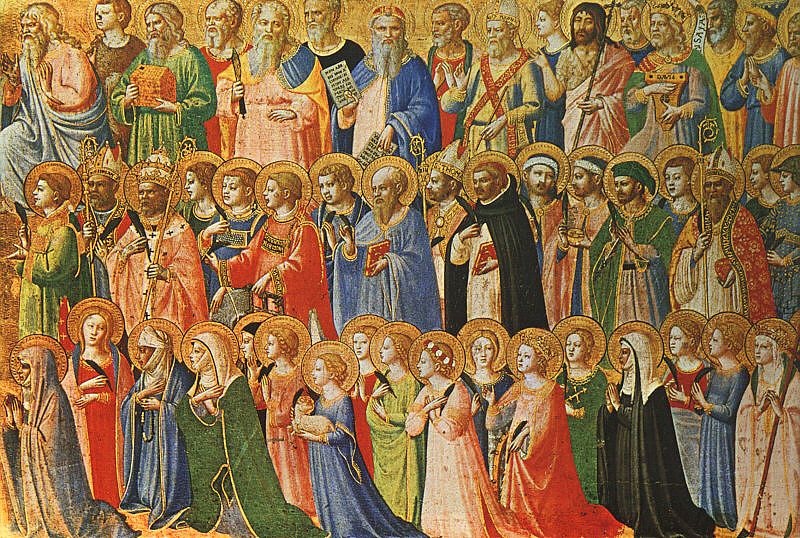
This past Friday, Melody and I dressed up our daughter Hope as an owl and, with great anticipation of the delight we were about to see in her eyes, took her out trick-or-treating. It was a fun evening. She was grinning ear to ear. But as much fun as we had during our Friday evening excursions, the day after held an especially poignant place in my heart. Saturday, according to Church tradition, was All Saints’ Day, a day on which we both remember those saints in Christ who have gone before us and celebrate how we have been made saints through Christ’s death and resurrection. When I think about all the saints who have gone to be with the Lord in glory this past year, my heart can’t help but be warmed even while my eyes get a little misty. It’s a special time of remembrance.
A traditional prayer for All Saints’ Day encapsulates the meaning of this day well:
O almighty God, by whom we are graciously knit together as one communion and fellowship in the mystical body of Jesus Christ, our Lord, grant us so to follow Your blessed saints in all virtuous and godly living that we may come to those unspeakable joys which You have prepared for those who sincerely love You; through our Lord Jesus Christ, Your Son, who lives and reigns with You and the Holy Spirit, one God, now and forever. Amen!
I love this prayer for two reasons. First, it appropriately reminds us that there is much to learn from the saints who have gone before us. Their ways of “virtuous and godly living” ought to be celebrated by us and their insights into God’s Word and Christ’s gospel ought to be studied by us. There is much to be said for remembering – and practicing – the ways of the saints of old. At the same time, we must understand that we do not become saints by remembering and practicing the holy ways of these historic Christians. Rather, we become “sainted” by being “knit together as one communion and fellowship in the mystical body of Jesus Christ.” Everyone who is a member of Christ’s body is properly called a saint, even as the apostle Paul says to the church at Corinth: “To the church of God that is in Corinth, to those sanctified by Christ Jesus, called to be saints together with all those who in every place call upon the name of our Lord Jesus Christ, both their Lord and ours” (1 Corinthians 1:2). How are we made saints? We are sanctified and called by Christ. Who are the saints? They are everyone, everywhere who calls on the name of Jesus.
It is this definition of sainthood that the Church has believed and confessed for millennia, for example, in the Apostles’ Creed when we say, “I believe in the communion of saints.”
This phrase, “the communion of saints,” carries with it two meanings. On the one hand, this phrase refers to all Christians from all times in all places, both in heaven and on earth. Nicetas, a fourth century Serbian bishop, explains:
What is the Church but the congregation of all saints? Patriarchs, prophets, apostles, martyrs, all the just who have been, are, or shall be, are one Church because sanctified by one faith and life, marked by one Spirit, they constitute one body. Believe, then, that in this one Church you will attain the communion of saints.[1]
On the other hand, the Greek word for “saints” in the New Testament can be either masculine, referring to people, or neuter, referring to things. Thus, “the communion of saints” can be taken to mean “the communion of sainted, or holy, things.” This is the way that Peter Abelard, the great twelfth century French theologian, understood this phrase. In this case, the phrase, “the communion of sainted things,” was understood to mean the holy things of God: His Word, baptism, and the Lord’s Supper. The Lutheran confessors incorporate both understandings of “the communion of saints” when they write, “The Church is the congregation of saints [sainted people], in which the Gospel is rightly taught and the Sacraments are rightly administered [sainted things].”[2] Thus, the Church is made up of the sainted people of God gathered around the sainted things of God!
But there is even more to this phrase, “the communion of saints.” The Greek word for “communion” in the Creed is koinonia, a term that, even in secular Greek, describes not primarily communion with other human beings, but communion with God. For example, the first century Greek philosopher Epictetus wrote of the noble man in his “poor mortal body thinking of his fellowship (koinonia) with Zeus.”[3] Even in the pagan mind, man desires to have koinonia with god, albeit with a false god. This word koinonia was subsequently commandeered by Christians to describe communion with the true God: “God is faithful, by whom you were called into the fellowship (koinonia) of His Son, Jesus Christ our Lord” (1 Corinthians 1:9). We have koinonia with Christ. The phrase, “communion of saints,” therefore, refers not only to the communion we, as Christians, have with each other, but to the communion we have with Christ.
Finally, then, to say, “I believe in the communion of saints” is to say, “I believe that I have communion with Christ and with others who are in Christ. I believe that Christ meets me by His Word and holy gifts, cleanses me by His blood, and sanctifies me by His Holy Spirit.” But saying all this is a mouthful. So we simply say, “I believe in the communion of saints.” It’s a simple phrase that means so much. For it describes not only who we are, but who we are with. We’re with Jesus. And being with Jesus makes me feel like – well – a saint.
____________________
[1] Nicetas in Charles Augustus Briggs, The Fundamental Christian Faith (New York: Charles Scribner’s Sons, 1913), 193-194.


 Pastor Zach's Blog