Posts tagged ‘Christianity’
2016 in Review

It’s difficult to believe, but another year has come and gone. Before we chug full steam ahead into 2017, I wanted to take a moment to reflect back on the year that was. Whenever I look back over what I have written over the course of a year on this blog, I am always amazed – and a little disturbed – by how much I have forgotten. Thus, it seems worth it to look back and linger a bit longer on 2016, lest we file away some important lessons from this year into the dusty rolodex of our fleeting historical memories too quickly. So, here is my Year in Review for 2016.
January
The biggest Powerball jackpot ever, valued at $1.5 billion, goes up for grabs. People across the country flock to convenience stores to buy their ticket, even though the chances of winning the jackpot stand at 1 in 292,201,338.
February
Fear of the Zika virus sweeps the nation as a woman in Dallas contracts the disease. Justice Antonin Scalia, a fierce proponent of Constitutional originalism, passes away, leaving a vacancy on the high court and an even split between more conservative and more progressive justices that remains to this day.
March
Terror strikes Brussels, Belgium as two coordinated attacks – one at the airport and another on a subway – are carried out simultaneously, killing 32.
April
A bathroom brouhaha erupts as retail giant Target announces it will allow “transgender team members and guests to use the restroom or fitting room facility that corresponds with their gender identity.” Massive boycotts of the chain ensue and concerns are raised over the misuse of the policy by predators.
May
Art Briles, head coach of the Baylor Bears football team, is dismissed after he is implicated in cover-ups of sexual assaults by his players. The University’s president, Ken Starr, also leaves the institution in connection with the mishandling of the assaults.
June
Omar Mateen opens fire in an LGBT-frequented Orlando nightclub, killing 50 and injuring 50 more. In a stunning electoral surprise, Britons vote to leave the European Union 52% to 48% in what has popularly become known as “Brexit.”
July
Police officers shoot black men in Baton Rouge and Saint Paul and five police officers are killed in Dallas by people protesting these shootings. The next week, 84 people are killed when a terrorist drives a large, white paneled truck into a crowd of revelers celebrating Bastille Day in Nice, France, 290 people are killed in a failed coup against the president of Turkey, and three more police officers are killed in Baton Rouge by a sniper.
August
More than 50 people are killed in Istanbul when a 14-year-old suicide bomber walks into a wedding party and blows himself up.
September
Nicholas Kristof pens a column in The New York Times issuing a call to rethink Christianity as a faith free from many of its traditional beliefs, such as opposition to abortion and an affirmation that marriage is between a man and woman.
October
After decimating Haiti and Cuba, Hurricane Matthew strikes Florida and slowly moves up the eastern seaboard. About 1,600 people are killed by the massive storm.
November
Donald Trump wins the presidential election over Hillary Clinton after taking many of the so-called “rust belt” states that, for the past several election cycles, have traditionally gone to Democratic candidates.
December
Fidel Castro, the longtime brutal dictator of the island nation of Cuba, dies. The Russian ambassador to Turkey is shot by a Turkish police officer in Istanbul while, on the same day, a Tunisian refugee drives a semi-truck into an open-air Christmas market in Berlin, killing twelve.
As I look back over the list of stories I blogged on this year, a few thoughts come to mind. First, the violence of this past year has been horrifying. From terrorist attacks to assassinations to sexual assaults, there is no shortage of violent acts in our world. Indeed, this new year has already brought new violence with a New Year’s Eve terrorist attack in Istanbul that killed 39 and injured many more. Second, the political season of 2016 has been a thing to behold. On this blog alone, I wrote about issues pertaining to this year’s presidential election here, here, here, here, and here. Politics was certainly front of mind for many.
What strikes me about these two themes in particular is that whether the stories were about violence or politics, these themes shared a common denominator – that of power. In the case of violence, acts of terrorism, for instance, seek to gain power by striking fear into the hearts of societies. People live on edge, never knowing when, where, and how a terrorist will strike. The terrorists gain power by “getting inside the heads,” as it were, of communities and nations. In the case of politics, it is obvious that the United States is painfully divided. Whether it is cast as a division between red states and blue states, the seaboards and middle America, or traditional America and progressive America, there is a pitched battle to define this nation, with each side fiercely fighting for its own interests.
As I wrote on this blog last weekend, power is not a bad thing in and of itself, but it can be used badly. Rightly used, power is a gift from God to be stewarded. But we all too often assume it’s a weapon of our own to be wielded. In other words, we are called to use whatever power we may be given to first serve others instead of serving ourselves. If the stories from 2016 are any indication, we still have a lot of work to do when it comes to stewarding power appropriately.
Perhaps the most notable thing about the stories from this past year is how impotent our potency ultimately proves to be. The spread of the Zika virus and the devastation wrought by Hurricane Matthew are sobering reminders that there is still much we do not and cannot control. What is true of these disasters is also true of the future. We cannot control what 2017 will bring. So perhaps the best posture to take as we head into a new year is one of humility toward the future and faith in the One who holds the future. He knows what is in store for us. And He will take care of us.
A Tale of Three Kings

Growing up, one of my favorite yuletide carols was “We Three Kings of Orient Are.” The lilting melody and encomium to the “star of wonder” and its “perfect light” captured my imagination. So you can imagine my disappointment when I learned that, at least from a historical perspective, this beloved song is probably all wrong. The men who came to visit Jesus from far away were not kings, they were astrologers. They also were probably not from the Orient, but instead from Babylon. And although we assume that there were three of them because of the number of gifts they brought, we do not know this for sure. There could have been more or fewer.
Even if the the song is wrong about the astrologers who come to visit Jesus, the Christmas story nevertheless does involve three kings. The first is a king who sits on a throne in Rome. His name is Caesar Augustus. He received the name Augustus as an honorary title from the Roman senate thanks to, according to his own account, his “virtue, mercy, justice, and piety.”[1] What a king Augustus must have been.
At the first waterfall of the Nile River, there is an inscription lauding Augustus that reads:
The emperor, ruler of oceans and continents, the divine father among men, who bears the same name as his heavenly father – Liberator, the marvelous star of the Greek world, shining with the brilliance of the great heavenly Savior.[2]
As it turns out, Caesar Augustus was hailed not only as a king, but as a divinity. And it is this king who lifts his finger to issue a decree for a census that sends the whole world, including a couple of peasants from Nazareth, scrambling:
And it came to pass in those days that a decree went out from Caesar Augustus that all the world should be registered. So all went to be registered, everyone to his own city. Joseph also went up from Galilee, out of the city of Nazareth, into Judea, to the city of David, which is called Bethlehem, because he was of the house and lineage of David, to be registered with Mary, his betrothed wife, who was with child. (Luke 2:1, 3-5)
The second king of the Christmas story is local ruler named Herod the Great. He too received a prestigious title from the Roman senate: “the king of the Jews.” Though his title was more baronial than Caesar’s supernatural titles, he was also proud of his position and fiercely sought to protect it regardless of the cost. He became exceedingly paranoid that those around him were jockeying for his throne so, one by one, he had them executed. First it was his brother-in-law, Aristobulus III, who Herod ordered drown. Then it was another brother-in-law, Kostobar. He even executed two of his own sons, Alexander and Aristobulus, accusing them of high treason. Herod’s murderous rampages became so infamous that Caesar Augustus is said to have once remarked, “I’d rather be Herod’s pig than Herod’s son.”
Considering Herod’s insecurities, it is no surprise that when a group of astrologers from a faraway land come to Herod and ask him, “Where is the one who has been born king of the Jews?” (Matthew 2:2), Herod impulsively and impetuously gives “orders to kill all the boys in Bethlehem and its vicinity who were two years old and under, in accordance with the time he had learned from the Magi” (Matthew 2:16).
This leads us to the third king in the Christmas story – the newborn king about which the Magi ask. When Jesus was born, He certainly didn’t look like a king. And yet, He inaugurated a kingdom that endures to this day, as a walk inside one of what are literally millions of churches will indicate.
Whether or not you believe Him to be an eternal king, Jesus is someone with whom everyone must grapple. Caesar Augustus grapples with Jesus by means of indifference. He didn’t know anything of Jesus and didn’t care to. He was, after all, a much more important figure than some impoverished infant sleeping in straw in Bethlehem. But what Caesar couldn’t have imagined is that it wouldn’t be his kingship that would eventually be celebrated with a worldwide holiday, it would be Jesus’ birth. It would not be Jesus who would become Caesars’ footnote in history, it would be Caesar who became Jesus’ footnote. We would nary talk about Caesar Augustus this time of year – or any time of year – were it not for Jesus. Caesar’s indifference falls in the face of Jesus’ kingdom.
Herod the Great grapples with Jesus in a different manner – by that of hostility. He hates Jesus and seeks to have Him killed. But not only does he fail, he fails miserably. Joseph takes his family and escapes to Egypt before Herod’s executioners can get to the child. Herod fails to end Jesus’ life as a child even as Pontius Pilate ultimately fails to finish Him off as an adult, as the story of Easter so gloriously reveals. Herod’s hostility, then, falls in the face of Jesus’ kingdom.
Though two millennia have passed, the reactions to Jesus’ kingship have not changed. Many people treat the celebration of Christmas – at least the part that involves Jesus’ birth – with a mild indifference, a distant secondary feature of a holiday that primarily consists of the niceties of parties, decorations, and, of course, plenty of presents. Others treat the story of the nativity with outright hostility – incensed that a holiday that has such blatantly Christian overtones would still be embraced and thought of as Christian by what should be an enlightened secular West. But Christmas marches on. And the fact that it does says something about Jesus’ kingdom. It does not and will not fail or fall because of our responses to it. Either it will endure for us and be a solace of salvation, or it will endure in spite of us and become an edict of execration. Which way will it endure for you? That’s the question of Christmas.
I hope you have an answer.
_______________________________
[1] Caesar Augustus, The Deeds of the Divine Augustus, Thomas Bushnell, trans., par. 34.
[2] Ethelbert Stauffer, Christ and the Caesars (Eugene: Wipf and Stock, 1952), 99.
The Real Truth About Fake News

Recently, I came across a New York Times feature piece bemoaning the increase of what are deemed “fake news sites.” These are websites that purport to share what which is newsworthy, but regularly play fast and loose with the facts, usually to further a particular political agenda. For instance, days before the election, a news story from The Denver Guardian received hundreds of thousands of shares on social media: “FBI AGENT SUSPECTED IN HILLARY EMAIL LEAKS FOUND DEAD IN APPARENT MURDER-SUICIDE.” It sounded salacious – and terrifying. There was only only problem: it was completely fabricated. For starters, The Denver Guardian did not exist before this year. Moreover, the article contained misspellings and demonstrably untrue details, such as a reference to the “Walkerville Police Department” in Maryland. Walkersville does not have a police department. It should also be noted that no other noted news outlets picked up this story, which, if true, would have caused a stir among at least certain corners of the media. Still, this article was shared more than half a million times on Facebook alone.
Of course, fake news is nothing new. Tabloids have been around for a long time and have managed to prove very profitable precisely because they are more concerned with feeding readers titillating stories than true ones. Indeed, each year, Oxford Dictionaries names a “word of the year.” This year’s word is “post-truth,” because it seems “to capture the English-speaking public’s mood and preoccupations…where people lived through divisive, populist upheavals that often seemed to prize passion above all else – including facts.”
This particular surge of fake news fury seems to have been fueled not only by political passion, but, at least in part, by what many perceive to be the bias of traditional news outlets. For example, the Pulitzer Prize winning website politifact.com has been widely panned because, though it purports to check the truthfulness of what politicians say in public forums, it has been shown to rate what some politicians say – especially those who are more conservative – as “false” even though some of the statements in question could reasonably be considered as true. In other words, a website that claims to be devoted to uncovering the truth has been shown to be, in some instances, clouding it.
Christians have long held the truth in high regard. We do, after all, follow a man who not only claims to “tell the truth,” but actually to “be the truth.” This is why it is so incumbent on us to watch what we say, what we write, what we teach, and, yes, what we post on social media. We have not always been the best at the this. For instance, have ever you heard it claimed that Christians divorce at the same rate as non-Christians? This may sound alarming. But it shouldn’t be. Because it’s not true.
One interesting trend in churches is that of fact-checking sermons. Many folks will now Google a statistic that a pastor cites or a publicly available anecdote that a pastor shares to check whether or not it is true. Can you imagine the damage done to the Christian witness if a pew-sitter finds that some of what a pastor is saying is not, in fact, true?
A willingness to be less than concerned with the truth can often be symptomatic of a deeper disease. On the one hand, it can be symptomatic of an intellectual laziness. With so many competing facts and figures floating around, sometimes it takes time to chase down what is accurate and what is not. Some people simply do not want to be bothered. It’s easier to take the first thing you find and run with it. But if you want to put in a little extra work to verify what you read, this terrific (and funny) article by Matt Masur offers some simple suggestions on how to fact check that Facebook post that raises your hackles.
A lack of concern with the truth can also be a symptom of a desperate desire to bolster a particular argument, even if that comes at the cost of the integrity of reality. That is, whether it is posting a cagey news story on social media or citing a suspect statistic in a sermon, some people simply cannot resist the kind of “slam-dunk” affirmations these kinds of stories and statistics provide. Unfortunately, once they are shown to be false, they can actually undermine the very argument they seek to make.
If we truly believe in whatever arguments we make, the truthful versions of these arguments ought to be persuasive enough. If we don’t think they are, we don’t need a sensationalistic zinger to make our case. We need different arguments. After all, Jesus is quite clear that deceit comes from only one place – a place that is the antithesis of the kingdom of God. The truth is enough. So let’s stick with the truth, celebrate the truth, and traffic in the truth.
President-Elect Donald J. Trump

Credit: Pablo Martinez Monsivais/AP Photo
Whether you love him, despise him, believe in him, are distasteful of him, are worried about him, or are indifferent to him, Donald J. Trump is the President-Elect of the United States. Regardless of which one of these categories you may occupy (or, perhaps, you’re in another category I missed), as Christians, there are a few things we are called to be during the transition from the end of Barack Obama’s presidency to the beginning of Donald Trump’s presidency. Perhaps you already know these things, but a little reminder never hurts.
Be prayerful.
The apostle Paul writes to Timothy:
I urge, then, first of all, that petitions, prayers, intercession and thanksgiving be made for all people – for kings and all those in authority, that we may live peaceful and quiet lives in all godliness and holiness. (1 Timothy 2:1-2)
Paul is clear that we, as Christians, ought to pray for our leaders. But there is something I think we often miss in this passage. Before Paul exhorts Timothy to pray “for kings and all those in authority,” he urges Timothy to pray “for all people.” The category of “leaders” is a subset of the category of “people.”
Though this may seem painfully obvious, it is important to remember that our leaders are, in fact, actual people. I say this because sometimes it can become far too easy for us to paint the leaders we don’t care for as soulless cartoonish villains, not worthy of even basic respect.
Regardless of what you think of President-Elect Trump, he is a person, made in the image of God and loved by God. He is also a husband, a father, and a grandfather. We should pray for him not only as a politician, but also as a person.
Be supportive.
Every person is sinful. And yet, as Jesus puts it, even evil people “know how to give good gifts to [their] children” (Matthew 7:11). In other words, just because no one is perfect doesn’t mean that everyone does everything wrong. Instead, we are all mixed bags. We do some things right and some things wrong. We do some things that are good and some things that are evil. Donald Trump, no doubt, will do some good things for America. For instance, his promise to support the cause of life and minimize the scourge of abortion is vital not only to our national wellbeing, but to our human decency as well. In cases such as this, Christians ought to graciously, thoughtfully, and humbly support that which is good and just.
Be skeptical.
Even as sinful people can do good things for which they should be commended, they can also, obviously, do sinful things for which they must be confronted. Christians should be willing to call sin for what it is regardless of the political party out of which it comes. Certainly, President-Elect Trump has said some things that are not only not befitting of the office of President of the United States, but also defy basic decorum, decency, and truthfulness. The warning of Jesus’ brother should ring in our minds: “The tongue also is a fire, a world of evil among the parts of the body. It corrupts the whole body, sets the whole course of one’s life on fire, and is itself set on fire by hell” (James 3:6). Reckless words may be legal in a society that has enshrined free speech, but legality does not equal morality. Christians should continue to call President-Elect Trump, and all of our public officials, to account when their behavior turns ugly.
Especially because of the rancorous nature of this year’s election cycle, I would add that we should be careful not to allow a healthy skepticism to turn into a bitter cynicism. Skepticism is honest that sin is constantly afoot and must be confronted. Cynicism, on the other hand, finds a certain schadenfreude in another’s sin because it can sanctimoniously condemn it and boast over it. Skepticism is wise. Cynicism is hateful. Let us not fall prey to the latter.
Be faith-filled.
Our nation is deeply divided, as even the statistical outcome of this election demonstrates. Donald Trump won in the electoral college and, hence, has secured the presidency, while Hillary Clinton bested Mr. Trump in the popular vote. As Christians, we have a uniquely unifying message because, in the midst of a division as deep as ours, we can point to a God who made us all and to His Son who sacrificed Himself for us all. Christ is the One who can break down what separates us. Now is the time to share Him.
Ultimately, whether you are satisfied with the outcome of this election or fearful because of it, remember to guard your faith. Fear can lead us to lash out in anger as we try to forcefully and artificially rectify something we think is wrong. Satisfaction can lead to gloating and glibness as we trust in a set of comfortable circumstances that will, finally, prove to be fleeting. Both of these reactions can lead us away from Christ rather than toward Him. A reaction of fear can refuse to trust in the peace Christ wants to give as it stews in its own self-righteous anger. An enshrinement of comfort can minimize the provision Christ wants of offer as it lounges in its own self-sufficiency.
Thus, what we need now as the presidency of the United States shifts parties and hands is what we have always needed and will always need:
Faith.
Do not put your trust in princes, in human beings, who cannot save. When their spirit departs, they return to the ground; on that very day their plans come to nothing. Blessed are those whose help is the God of Jacob, whose hope is in the LORD their God. (Psalm 146:3-5)
Who’s Afraid of Election Day?
Credit: Darren McCollester / Getty Images
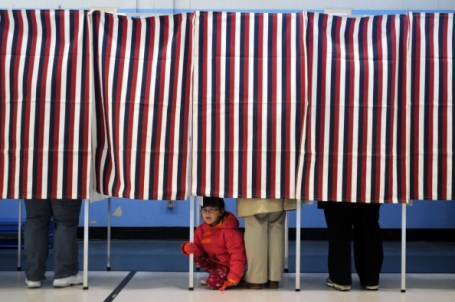
Tomorrow is the big day. Tomorrow, we the people turn out to vote for the next President of the United States. Though literally thousands of other politicians will be on the ballots that are cast tomorrow, the presidential election is the one that looms largest in the minds and hearts of most people. Indeed, I’ve heard it repeated over and over again throughout the course of this political season that “this is the most important presidential election of our lifetimes.” I honestly do not know whether or not it is. I do know that Walter Mondale told a crowd in 1984, “This is the most important election of our lives.” I would argue that history has probably proven him wrong. And history, eventually, may prove today’s claim about the importance of this election wrong – or, perhaps, right. We’ll just have to wait and see.
But whether or not voters and pundits prove to be historically correct in their estimation of the weightiness of this election, I do know that the immediate perceived importance of this election is enormous and is engendering deep fear in the minds and hearts of many. I have had conversation after conversation with people who are scared of what has happened and what will happen to our political system and to our nation.
This past weekend, I listened to a sermon on the topic of this year’s election. The pastor who preached this sermon argued forcefully, powerfully, and, at times, eloquently for what he believed about this election and even for whom he believed we, as Christians, should vote in this election. But what struck me most about this pastor’s sermon was its closing. He ended by talking about two fears that he has for the future of this nation. First, he explained his fear that there may be too many of “them” and too few of “us.” He sees postmodern secularism winning over the masses and driving Christianity to the fringes and he is worried that there is nothing we can do politically to beat it back. Second, he expressed his worry that we may simply be too late to make any difference. He thinks too many Christians have been too silent for too long, and now a day of reckoning has come.
Politically, this pastor seemed very knowledgeable. Theologically, however, if I can be so bold to say this, as I listened to his sermon, I became more and more convinced that he missed something very important. Here’s why I say that.
First, if anyone thinks that there are too many of “them” and too few of “us,” I would encourage that person to read the story of Gideon. When God takes the army Gideon has mustered to fight the Midianites and reduces it in force from 32,000 men to 300 men – a reduction of over 99 percent – it looks like there is no way Gideon and his tiny army can defeat the massive army of a whole tribe of people. But God specializes in doing great things when there are too many of “them” and too few of “us.” God made a whole nation out of one man Abraham. God redeemed a whole people from slavery through one man Moses. God changed the whole course of human history through twelve men He deemed “apostles.” And God brought salvation to our whole world in one man He calls His Son. God can do a lot with a little.
Second, if anyone thinks it is simply too late, I would point that person to the story of Jesus’ friend Lazarus. When Jesus learns that His friend has fallen ill, rather than rushing to see him, He waits for him to die. Why? Because, as Jesus says to Martha, He is “the resurrection and the life” (John 11:25). Even death is not too late for Jesus because He can snatch life from the jaws of death. When the hour on our clock strikes eleven and we begin to struggle and scramble, Jesus can bring forth a new dawn that we never saw coming.
What struck me most about this pastor’s sermon is that although he issued a clear call to his congregation to get out and vote, he never explicitly reminded his congregation to have faith – to trust in the One who holds everything from your house to the White House in His hands.
Politics has a bias toward action. Legislation gets passed when deals get made. Public officials are elected when votes are cast. Social change can be engineered when Supreme Court verdicts are rendered. Action is important to politics. But as Christians, we must remember that the centerpiece of who we are is not in what we do, but in whom we believe. “Believe in the Lord Jesus, and you will be saved” (Acts 16:31). Faith is the centerpiece of our life in Christ.
I think it’s this that gets to the root of our fear. Because if we get so stuck on the action of our vote and the action of our legislators and the action of some guy or gal who sits in an office that is shaped like an oval that we forget that our hope is nothing that we have done, are doing, will do, or can do, then we’ve missed what’s most important. Because we’ve missed Jesus. And you don’t get Jesus by action. You only get Jesus through faith. There’s a reason the Psalmist says, “When I am afraid, I put my trust in You” (Psalm 56:3).
So, if you are afraid of the outcome of this election and the future of this country, go ahead and vote, but don’t expect your vote to calm your fears. Because your fears cannot be calmed by electoral majority. Your fears can only be calmed by a Savior who died for you and me.
Trust in Him.
Standing for Life
I grew up in the first state in our union to legalize physician-assisted suicide. When Oregon passed the Death with Dignity Act in 1997, which allowed a terminally ill patient to administer lethal drugs to him or her self under the direction of a doctor, it stirred a lot of controversy. Though other states and regions have since followed suit, even nearly twenty years later, laws like the Death with Dignity Act still stir a lot of controversy and concern.
Our nation’s capital is now joining the fray of this debate with the D.C. Council readying themselves to vote tomorrow on legislation that would allow doctors to prescribe lethal drugs to terminally ill people. Fenit Nirappil of The Washington Post explains:
A majority of D.C. Council members say they plan to vote for the bill when it comes before them Tuesday.
But chances for enactment are unclear. The council will have to vote on the bill twice more by the end of the year. Mayor Muriel E. Bowser (D) has not indicated whether she will sign the legislation, although her health director has testified against it, saying it violates the Hippocratic oath. It is not certain that proponents have enough votes for an override. And Congress could also strike down the legislation.[1]
Many in the African-American community of Washington D.C. strongly oppose the legislation. The charge against the legislation is being led by Rev. Eugene Rivers III, who is leading a group called No DC Suicide. Rev. Rivers calls the legislation “back end eugenics,” and believes it is aimed at eliminating poor blacks. Leona Redmond, a community activist, echoes Rev. Rivers’ sentiment, saying, “It’s really aimed at old black people. It really is.” Proponents of the law have made countless assurances that there is no racial component to the legislation. Donna Smith, herself an African-American and the organizer for Compassion and Choices, argues, “This just isn’t a ‘white’ issue. This issue is for everyone who’s facing unbearable suffering at the end of life.”
Certainly, any move by any group to end people’s lives based on their race is repulsive. Indeed, if this legislation is enacted and, even if unintentionally, disproportionately affects a particular race, serious questions will need to be asked and stern objections will need to be raised. The problem for the Christian, however, extends beyond the boundaries of race to the dignity of humanity itself.
In the third article of the Nicene Creed, Christians confess, “I believe in the Holy Spirit, the Lord and giver of life.” Fundamental to what we confess as Christians is that God is the giver of life. When the apostle Peter is preaching a sermon on Pentecost day, he says to those assembled, “You killed the author of life, but God raised Him from the dead” (Acts 3:15). Because God is the author of life, Christians believe that life is a sacred gift from God to us and ought to be stewarded carefully and lovingly by us. This is why orthodox Christianity has consistently stood against the taking of life whether that be through abortion at life’s beginning or through physician-assisted suicide as life may be nearing its end. Both of these practices treat life not as a gift to be stewarded, but as burden to be manipulated and, ultimately, destroyed.
It is true that life can sometimes become burdensome. But when a young lady becomes terrified at the specter of an unexpected pregnancy, or when a person is suffering through the throes of a terminal illness, we must remind ourselves that life itself is not the culprit in these types of tragic situations. A world broken by sin is the culprit. So attacking life itself doesn’t relieve the burden. Instead, attacking life actually succumbs to the burden because it capitulates to what sin wants, which is always ultimately death. To fight against sin, therefore, is to fight for life.
As Christians fight for life, it is very important that they fight for all of life and not just certain moments in life. All too often, Christians have been concerned with fighting for those at the beginning of life as they stand against abortion, or fighting for those who may be nearing the end of life as they stand against physician-assisted suicide. But there is so much more to life than just its beginning and its end. Christians should be fighting against human trafficking, which treats lives as commodities to be traded rather than as souls to be cherished. Christians should be fighting against racism, which trades the beauty of a shared humanity for the dreadfulness of discriminatory distinctions. Christians should be concerned with genocide in places like Aleppo, as Syria’s army continues to launch indiscriminate military strikes against its own citizens with horrifying results. To celebrate life means to celebrate all of life – from the moment of conception to the moment of death and everything in between.
So let’s stand for and celebrate life. After all, after this life comes everlasting life through faith in Christ. Life will win out in the end. So we might as well surrender to and celebrate life now.
______________________________
[1] Fenit Nirappil, “Right-to-die law faces skepticism in nation’s capital: ‘It’s really aimed at old black people,’” The Washington Post (10.17.2016).
Election Day Fear

Credit: CNN
Last week, I was driving back to my office after teaching a Bible study at a local business. I happened to be listening to a radio talk show when a lady called who took my breath away. She was nearly in tears. She had just seen a movie forecasting what would happen if a particular candidate was elected President of the United States. She told the talk show host:
I am scared to death. I don’t sleep. I’m an absolute basket case. I want what’s good for my children, my grandchildren, my family. It’s all going down the tubes because, after watching that movie last night, all I saw was what’s coming down, what’s next, what they have planned.
Wow. What palpable fear. What genuine terror. What a heartbreaking phone call. Fear can wreak a lot of havoc in a person’s heart and life.
I know this caller is not the only one frightened right now. It seems as though every time a presidential election comes around, people’s fear becomes more and more acute. So here’s a gentle reminder: fear is not helpful. There is a reason why the most common command in the Bible is, “Do not be afraid.” There is a reason Jesus says, “Do not worry about tomorrow, for tomorrow will worry about itself” (Matthew 6:34). Fear is like an infection. Left unchecked, it can destroy people spiritually, emotionally, and relationally. So if you’re tempted toward fear, especially as it pertains to this upcoming election, here are a few things to keep in mind.
Fear tends toward hyperbole.
Every four years, I hear the same refrain from candidates and political pundits alike: “This is the most important election of our lifetimes.” Of course it is. That is, until the next election comes along. This claim, of course, is usually accompanied with dire predictions of what will happen if the wrong candidates get into political office. Of course factually, this claim cannot stand up under scrutiny because logically, this claim cannot be true more than once in a generation. And yet, it is assumed as true every four years. How can we believe a claim that is so logically ludicrous? Because we are afraid. And fear tends to look toward a certain point in time, such as an election, and wonder with worry: Is this the moment that will serve as the linchpin for the rest of history? Is this the moment when everything changes?
Christians have a confident answer to these questions. And our answer is “no.” We know that history’s linchpin moment has already come with Christ. No moment or election can even come close to comparing with Him. Indeed, I find it interesting that the primary way we know about political figures from the first century such as Pontius Pilate, Herod the Great, and even Caesar Augustus is through Scripture. But all of these men serve as paltry footnotes to the story of Jesus. It turns out they weren’t as important as everyone thought they were back then. Perhaps our leaders won’t be as important as we think they are right now. So why are we afraid?
Fear fosters self-righteousness.
It was Reinhold Niebuhr who wrote:
Political controversies are always conflicts between sinners and not between righteous men and sinners. It ought to mitigate the self-righteousness which is an inevitable concomitant of all human conflict.[1]
Niebuhr notes that, in politics, no party is completely right because no person is completely righteous. So we ought to be humbly honest about our sins rather arrogantly defensive in a smug self-righteousness. The problem with fear is that it tempts us to overlook the sins of ourselves and our party while gleefully pointing out the sins of the other party. Or worse, fear will justify the sins of our party by pointing to the purportedly worse sins of the other party. In this way, fear surrenders moral credibility because it puts itself through all sorts of intellectual and ethical contortions to make that which is self-evidentially wrong look right. This, by definition, is self-righteousness – something that Jesus unequivocally condemns. If Jesus condemns it, we should stay away from it. So do not let fear lead you into it.
Fear clouds decision-making.
Psychologists have long noted that fear is a great motivator. But fear has a funny way of impairing judgment. Just ask any deer who has been paralyzed by the two big lights that are barrelling toward him at a rapid rate of speed. Fear may promise to lead to rescue and safety, but, in the end, it leads to death. So why would we settle for election cycles that are continuously driven by fear?
Decisions made out of fear tend to be Consequentialist in nature. Consequentialism is a theory of ethics that says an act is good if it brings the least harm to the most people. The problem with Consequentialism, however, is twofold. First, because no one can fully predict the future, decisions based on future predictions, including the future predictions fueled by fear, usually have unintended – and often undesirable – consequences. Second, Consequentialism tends to degenerate into deep sinfulness as people become willing to excuse increasingly terrible acts to achieve some desired result. Consequentialism, then, may go after one good thing, but, in the process, it surrenders to and sanctions a bunch of bad things.
Decisions are much better made on principle rather than out of fear. Decisions made on principle allow the one making them to look at all facets of a decision rather than just an end result. They also place a high value on integrity rather than wantonly sacrificing that which is right for that which is expedient. Decisions made on principle are, ultimately, better decisions.
I know that eschewing fearfulness is much easier said than done. But fear must be fought – especially as it pertains to this upcoming election. Fear about this election and about the future solves nothing. It only manages to make the present miserable. So take heart and remember:
The LORD is with me; I will not be afraid.
What can mere mortals do to me? (Psalm 118:6)
Mortals cannot do nearly as much as we sometimes think they can, even if one of them becomes President of the United States. Things really will be okay, even if sinfulness does its worst.
Do not be afraid.
______________________
[1] Reinhold Niebuhr, Reinhold Niebuhr: Theologian of Public Life, Larry Rasmussen, ed. (Minneapolis: Fortress Press, 1991), 248.
Comfort in Stormy Times: Reflections on Hurricane Matthew

The people of Florida are picking up the pieces. Along with the people of Georgia. And the people of the Carolinas. And the people of Cuba. And the people of Haiti. As Hurricane Matthew churned its way through the Caribbean and up the east coast, it left a path of destruction in its wake. In Florida, mandatory evacuations were issued before the storm. Grocery store shelves were stripped bare. Gas stations were pumped dry.
It could have been worse. They eye of Hurricane Matthew skirted much of the eastern seaboard, sparing these regions from what could have been even greater damage. But even if things were not as bad as they could have been, this storm was still a whopper. For a brief time, Hurricane Matthew reached Category 5 status, making it the first storm to reach a hurricane’s most powerful potential since Hurricane Felix in 2007.
Whenever a natural disaster of this magnitude strikes, it presents a unique set of struggles and questions. When we suffer a man-made disaster in a shooting or in an accident or even in a terrorist attack, we can point to the source of the calamity and explain that the person who created the catastrophe is unstable or incompetent or even evil. When a hurricane strikes however, there is no one from whom we can demand a mea culpa, save nature and nature’s God. And such a mea culpa is tough to come by.
So how are we to process this disaster? Here are a few things to keep in mind.
We cannot control everything.
In an election year such as this one, it is easy to live under the illusion that we wield a great amount of power and authority. We do, after all, have a say – even if it is a small one – in who the leader of the free world should be. But for every bit of control we think we have, there are so many things that simply fall outside our hands. Hurricanes are one of these things. We can forecast them, but we cannot steer them. They strike where they may. They strike with the energy that water temperatures give to them. The smallness of our power when compared to the scope of something like the weather should lead us to marvel at the bigness of God’s creation. There is still so much we cannot tame.
We can help others.
Though we do not have power over all things, this does not mean that we can help in some things – like in hurricane relief. My congregation, Concordia Lutheran in San Antonio, has set up a relief fund to help those in Haiti. We are exploring opportunities to help those in other areas as well. You can donate by clicking here. Part of our calling as Christians is to be a neighbor to those in need. Being neighborly need not be constrained by proximity, nationality, economy, or any other earthly barrier. To help others is to love Christ! Rolling up our sleeves by opening up our pocketbooks is a great way to get involved.
There is someone who is in control.
In a world that seems shaky, it is important that we remind ourselves that just because we are not in control does not mean that everything is out of control. Christian theologians will often describe God as omnipotent, a word that means “all power.” In other words, God has all control. When a storm like Matthew strikes, it serves us well to consider the many instances in Scripture that remind us that God, quite literally, guides the weather. In the case of His disciples, Jesus saves them from a storm on the Sea of Galilee by calming it with just a word. In the case of Jonah, God saves him with a storm that forces some sailors he is with to toss him overboard so God can send a giant fish to take the prophet where he needs to be. In the words of the Psalmist, God can also save people through storms as they seek refuge in Him: “God is our refuge and strength, an ever-present help in trouble. Therefore we will not fear, though the earth give way and the mountains fall into the heart of the sea” (Psalm 46:1-2). God, then, does not use storms in the same way in every instance. Sometimes, He saves us from storms as weather patterns change. Other times, he saves us with storms as these trials turn us toward Him. Still other times, He gives us strength to make it through storms, even if they hit us straight on.
Ultimately, it is important to remember that no matter what storms – whether they be literal or figurative – this world may bring, we have assurance in them because of Christ. When Christ was on the cross, the Gospel writers tell us that “darkness came over all the land” (Matthew 27:45). In other words, it stormed. But what looked like a storm of death became a storm that gave way to life three days later. Jesus overcame the storm of the cross so that we would never be lost to the storms caused by sin. For even if a storm takes lives, as did Hurricane Matthew, we can be assured that those who die in Christ go to a place where there is “a sea of glass, clear as crystal” (Revelation 4:6). In other words, in heaven, the weather is a flat calm. There, every storm has been conquered by Christ.
With the extent of the damage from Hurricane Matthew just now becoming clear, there is still a lot – economically, emotionally, and theologically – to sort through. But this much is clear: God does not abandon us in storms like these. He is there. And He cares.
Politics, Power, and Sacrifice
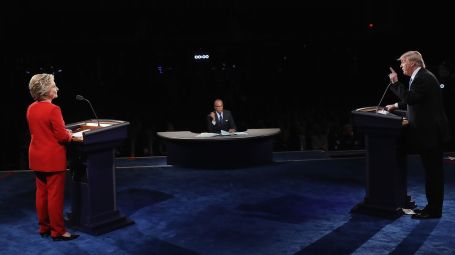
Originally, I wasn’t sure whether or not I was going to watch last Monday’s presidential debate. But my curiosity got the best of me, so I turned on the TV. I have seen many on social media bemoan the state of our politics in this presidential election and, I suppose, I would sympathize with their chorus. The tone of this election is grating. The discussion about this election often borders on and even ventures into the banal. And the goal of this election appears to be little more than an undisguised race for power. People across all points on our political spectrum are desperate to see their person in power so their interests can be furthered while others’ interests are overlooked, or, in some instances, even crushed.
Power is a funny thing, in part because it is such a dangerous thing. In the famous dictum of Lord Acton: “Power tends to corrupt, and absolute power corrupts absolutely. Great men are almost always bad men.” Power ought to come with a warning label: “Handle with care.”
Power, of course, isn’t always bad. God has plenty of power – indeed, He ultimately has all power – and is quite adept at using it. But it is also important to point out that God’s power always comes with a purpose. He uses His power in order to sustain the world. He uses His power in order to constrain evil. He uses His power in order to rescue us from hell. Power, for God, is a means to some very good ends.
The concern I have with so many in our political system is that power has become the means and the end. Politicians want power because, well, they want power! And this means that when they get power, they often use it in a most detrimental way – not to help others, but to help themselves.
Yoni Appelbaum discusses this reality in an article for The Atlantic titled, “America’s First Post-Christian Debate.” The way he describes America’s situation is jarring:
Civil religion died on Monday night.
For more than 90 minutes, two presidential candidates traded charges on stage. The bitterness and solipsism of their debate offered an unnerving glimpse of American politics in a post-Christian age, devoid of the framework that has long bound the nation together.[1]
He goes on to describe how traditionally Christian-esque values were not only not extolled in the first of our presidential debates, they were proudly repudiated. Virtues, Appelbaum says, were reframed as vices. Altruism was painted as a sucker’s game and sacrifice was left for those who are losers. “The Clinton-Trump debate,” he concludes, “was decidedly Marxian in its assumptions – all about material concerns, with little regard for higher purpose.” Yikes. I hope he’s wrong. But I couldn’t help but notice that not one transcendent concern made an appearance during the debate. We, as a nation, have become so obsessed with the exercise of power in the material realm that we pay little regard to the transcendent One who gives power as a gift to be stewarded rather than as a weapon to be wielded.
When the high priest of political pragmatism sirens us into trading cherished values like altruism and sacrifice for the formidable forces of power and control, something has gone terribly wrong. Such a trade fundamentally undermines the very purpose of power – at least in any Christian or morally traditional sense – in the first place. Power is to be used for the sake of altruism, not to dispense with it. Power is to be used in concert with sacrifice, not to insulate oneself from sacrifice. Any of the men and women in our nation’s Armed Forces can tell you that. Jesus certainly expressed His power in sacrifice. The cross was a place of no power and great power all at the same time. On the cross, Jesus gave up all power, even power over His very life, as “He gave up His spirit” (John 19:30). But through the cross, Jesus exercised great power, conquering sin, death, and the devil. Jesus’ power, to borrow a concept from the apostle Paul, came through weakness (cf. 2 Corinthians 12:10).
Political power might not involve dying on a cross, but it sure would be nice if it involved taking one up. It sure would be nice if politicians used their power to do the right thing, even if it involved some measure of sacrifice. It sure would be nice if politicians fashioned themselves more as public servants and less as demiurge saviors. It sure would be nice if voters stopped cynically leveraging the power-obsessed sins of an opposing candidate to minimize and rationalize the power-obsessed sins of their own candidate. A willingness to see sin as sin, even if it’s sin in the politician you happen to be voting for, is a first step to an honest and healthy analysis of our problems politically.
I understand that politicians are not always Christian, and I understand that non-Christians can be competent politicians. I am also not so naïve as to think that every politician will see his or her elected office as a cross to bear rather than as a career to manage, even if they should. I furthermore understand that the civil religion of which Appelbaum speaks in his article is not coterminous with – and in many ways is not compatible with – Christianity. But the virtues of Christianity it promotes – charity, selflessness, and humility, among others – are good for our world even as they are good in the Church. We need them. We need them because, to quote another proverb from Lord Acton, “Despotic power is always accompanied by corruption of morality.” The curbing of despotic power may not be the ultimate reason to foster and preserve Christian virtue in our political system, but it sure is a good reason.
We the people should expect of our politicians – and of ourselves – something more than a blunt exercise of power, even if that power happens to promote our interests. We the people should expect real virtue, both in the people we elect as well as in ourselves. Do we? If we don’t, there’s no better time than the present to change our expectations. Remember, the people we elect to public office are not just products of a corrupt political system, they are reflections of the values we celebrate and the vices we tolerate.
Perhaps it’s time for us to take a good, long look in the mirror.
__________________________
[1] Yoni Appelbaum, “America’s First Post-Christian Debate,” The Atlantic (9.27.2016).
Thoughts on Baptism

The Baptism of Augustine
Yesterday, I got to preach on an encounter that a disciple of Jesus named Philip had with an Ethiopian eunuch on a desert road. Through Philip’s witness, this eunuch was moved to faith and to baptism. In my message, I answered some common questions people have about baptism, but there was much I wanted to say about baptism that I didn’t get a chance to. So, in the interest of further exploring the richness of what baptism offers, I figured I’d repost some thoughts on baptism that I wrote several years ago. I hope you enjoy!
What is baptism?
Baptism is a divine ordinance, instituted by Christ Himself, whereby He makes disciples through water combined with God’s name. Jesus says, “Go and make disciples of all nations, baptizing them in the name of the Father and of the Son and of the Holy Spirit” (Matthew 28:19). The participle “baptizing” can be translated as a participle of means. Baptism, therefore, can be seen as a means by which disciples are made.
It is important to recognize that baptism is something God does for us and not something we do for God. This is why Paul says of baptism, “We were therefore buried with Christ through baptism into death in order that, just as Christ was raised from the dead through the glory of the Father, we too may live a new life” (Romans 6:4). Notice the passive voice of the verbs: “buried,” “raised.” These are divine passives, indicating that God is the One burying our old, sinful natures and raising us to new life in Christ. We are passive in the matter. This runs contrary to the teaching of some who describe baptism merely as an act of obedience while denying its divine power. Consider this quote from a large denomination’s confessional statement: “Baptism is an act of obedience symbolizing the believer’s faith in a crucified, buried, and risen Saviour, the believer’s death to sin, the burial of the old life, and the resurrection to walk in newness of life in Christ Jesus.”[1] Two things are especially notable about this statement. First, while obedience is emphasized, the blessings of baptism are not mentioned. Second, this statement references Romans 6:4, but relegates Paul’s language concerning burial and resurrection to that of symbolism, emphasizing the believer’s faith rather than God’s action. Paul, however, nowhere indicates that he is speaking symbolically in this verse. Rather, his language indicates that he has a lively confidence in an actual new life, offered by God through baptism.
Does baptism save?
Yes, baptism does save. Peter writes, “Baptism now saves you also – not the removal of dirt from the body but the pledge of a good conscience toward God. It saves you by the resurrection of Jesus Christ, who has gone into heaven and is at God’s right hand – with angels, authorities and powers in submission to Him” (1 Peter 3:21-22). Peter could not be clearer: Baptism saves you. However, it is important to note not only that baptism saves you, but how baptism saves you. It saves you “by the resurrection of Jesus Christ.” Without the resurrected Christ, baptism is emptied of its power and promise.
There are some who object to the teaching that baptism saves, saying, “Faith in Christ alone saves you!” They often quote Scripture passages such as Romans 10:9: “If you confess with your mouth, ‘Jesus is Lord,’ and believe in your heart that God raised him from the dead, you will be saved.” They then argue: “Paul says that faith in Christ saves you and nowhere mentions baptism in Romans 10:9. Therefore, faith in Christ, and not baptism, saves you.” This type of argument engages in what I call “Bible Verse Battleship.” In this game, people line up their favorite Bible verses to support their favorite pet positions and then, when shown Scriptural testimony which calls into question their position, rather than seeking to reconcile the verses and take into account the whole counsel of God’s Word, they simply declare, “Because my pet Bible verse is true, you must be incorrect! My Bible verse sunk your Bible verse!” We should never use Bible verses to “sink” other Bible verses. Rather, we should assume that all Scripture speaks with one, harmonious, voice concerning the one, true Christian faith. Thus, when Peter says, “Baptism now saves you” in 1 Peter 3:21, we ought to take his words as complimentary, and not contradictory, to what Paul says in Romans 10:9.
So then, how do we understand Romans 10:9 and 1 Peter 3:21 harmoniously? Like this: baptism does not save simply because it’s baptism, but because it has the promise of Jesus’ presence attached to it (cf. Matthew 28:19-20). This is why baptism is regularly referred to as a “means of grace.” God works through simple things such as water in baptism, bread and wine in the Lord’s Supper, and words on a page in Holy Scripture to speak to, meet with, and provide gifts for His people. Martin Luther explains wonderfully: “Without God’s word the water [of baptism] is plain water and no baptism. But with the word of God it is a baptism, that is, a life-giving water, rich in grace, and a washing of the new birth in the Holy Spirit.”[2] Thus, to say that baptism saves you is simply to say that Jesus saves you because Jesus is doing His work in and through baptism!
Why do Lutherans baptize infants?
Lutherans are not so interested in baptizing infants as we are interested in baptizing all people in accordance with Christ’s commands to baptize “all nations” (Matthew 28:19). The Bible teaches that all are born into sin and deserve God’s condemnation (cf. Psalm 51:5). Therefore, babies need the salvation Jesus gives in baptism just as much as adults do. The Bible nowhere prohibits baptizing babies. In fact, we are told specifically that the promise of baptism is indeed for children: “The promise [of baptism] is for you and your children and for all who are far off – for all whom the Lord our God will call” (Acts 2:39).
There are some who maintain that a profession of faith must precede baptism. And because a baby cannot profess his faith in Christ, he should not be baptized until he is old enough to make such a profession. In response to this objection, I would point out three things. First, I would question the assumption that a profession of faith is a necessary prerequisite of baptism. It often happens that that a person in Scripture confesses his faith before he is baptized, but common occurrence doesn’t always necessarily indicate a divine mandate. Just because the Bible offers a description of certain things and events (e.g., a person offering a profession of faith before baptism) does not necessarily mean that the Bible is mandating a universal prescription. Second, I would question the assumption that children cannot confess their faith. The Psalmist reminds us, “From the lips of children and infants You have ordained praise” (Psalm 8:2, cf. Matthew 21:16). Children can and do praise God, even if it is with broken grammar and babble. Finally, from a historical perspective, from the early days of the Christian Church, it was common practice to have parents or sponsors confess the Christian faith on behalf of their children. The Roman theologian Hippolytus writes this concerning baptism in AD 215: “The children shall be baptized first. All of the children who can answer for themselves, let them answer. If there are any children who cannot answer for themselves, let their parents answer for them, or someone else from their family.”[3]
Baptism is a joyous gift from God. For through it, God meets us with His gifts. Luther sums up the joy and promise of baptism nicely when he writes: “We see what a very splendid thing baptism is. It snatches us from the jaws of the devil, makes us God’s own, restrains and removes sin, and then daily strengthens the new man within us.”[4] Thus is the blessing and gift of baptism!
[1] “The Baptist Faith and Message,” VII.
[2] Luther’s Small Catechism, “Baptism,” 3.
[3] Hippolytus, Apostolic Tradition, 21.4.
[4] What Luther Says, Ewald M. Plass, ed. (St. Louis: Concordia Publishing House, 1959) 61.


 Pastor Zach's Blog