Posts tagged ‘Christianity’
The Austin Bombings Come To An End

Credit: Eric Gay / AP
The city of Austin is breathing a sigh of relief. After a total of five explosions spread over 19 days, the man responsible for planting nail-filled bombs wrapped in innocent looking parcels on porches and sidewalks all over the city blew himself up as police officers were closing in to apprehend him near a northside Austin hotel in the early morning hours of last Wednesday.
The bomber turned out to be 23-year-old Mark Anthony Conditt from Pflugerville – a northeastern suburb of Austin. According to his grandmother, he came from a tight-knit family, was homeschooled, and later attended Austin Community College, but did not graduate.
His family is shocked by his crimes and released a statement that reads, in part:
We are devastated and broken at the news that our family could be involved in such an awful way. We had no idea of the darkness that Mark must have been in … Right now our prayers are for those families that have lost loved ones, for those impacted in any way, and for the soul of our Mark. We are grieving and we are in shock.
There is no other word to describe Mark Conditt’s actions but “evil.” Human depravity was on full display in this man’s attacks. Thus, as our nation grapples with this sickening spate of bombings, it is worth it for us to reflect on the dangers of and collateral from human sin. Here, then, are three thoughts on sin and its consequences.
Sin defies logic.
Following the Las Vegas shooting, when the motive of the gunman began to elude – and, to this day, still eludes – investigators, I wrote:
The questions of “why” will always be, in some sense, unanswerable – even if a motive is discovered and a record of the assailant’s thinking is uncovered … Sin never leads people to act sanely.
What was true then is still true now. Even as law enforcement officials continue to try to untangle this bomber’s motives, it remains unfathomable how any grievance, any grudge, or any goal could drive anyone to commit these kinds of monstrous, and seemingly random, crimes. And yet, what feels utterly inscrutable has a strange way of becoming tragically possible when the darkness of human depravity collides with the astounding faculties of our God-given rationality. Sin corrupts and darkens minds. It makes the unthinkable, reasonable and the ghastly, justifiable. Mark Conditt’s actions are a consummate case-in-point.
Sin desires death.
The apostle Paul writes, “The wages of sin is death” (Romans 6:23). We can be tempted to excuse the apostle’s words here as a bit of hyperbole until we are confronted with a case like this. The bomber’s sin took the lives of two innocent people and, ultimately, his sin cost him his own life. Sin has a cunning way of leading us down a corridor to catastrophe before we even realize what is happening. The alcoholic who poisons his liver, the reckless driver who is killed in an accident, and the despot who commits genocide against his own people are only a few examples of just how slippery the slope can be from sin to death. And it’s awfully tough to stop ourselves halfway down the slope. This is why it’s best not even to start down it. The Psalmist says of God’s righteousness: “Your righteousness is like the highest mountains” (Psalm 36:6). Let’s stay on the summit and off of the slopes.
Sin doesn’t succeed.
This bomber saw five of his devilish devices detonated. He did not succeed, however, in taking five lives. This bomber thought he could perpetually terrorize a city. His plans were frustrated, however, by law enforcement officials who deserve our gratitude. This bomber’s sin got cut off and cut short again and again. He did not succeed – at least not as much as he wanted to.
Sadly, the fact remains that two lives are still lost because of Mark Conditt. There is a 39-year-old father, Anthony Stephan House, who won’t be coming home to his 8-year-old daughter because of this bomber. There is a 17-year-old aspiring musician, Draylen Mason, who will never get to experience college life at the University of Texas because of this bomber.
Even in these tragic cases, however, sin’s victory is tenuously temporary. The Christian Church will celebrate this Sunday that Christ has conquered death. And because Christ is risen, we too will rise. To quote, once again, the apostle Paul: “Christ has indeed been raised from the dead, the firstfruits of those who have fallen asleep” (1 Corinthians 15:20). Nails on a cross could not hold Christ down. And by faith in Him, nails from a bomb cannot take victims out.
This week, we can take comfort in these words: Christ is risen.
Who’s In Charge? The Self As the Source of Authority

Authority issues are nothing new. Conflicts over the source, scope, and systems of authority can be found in every socio-political upheaval, in every teenager who rebels against his parents, and in every rebellion going all the way back to Adam and Eve.
In our current cultural mise en scène, we seem to have two ascendant loci of authority: that of personal experience and that of corporate solidarity. The authority of personal experience claims that, simply by virtue of experiencing something, a person can speak conclusively, decisively, and intelligently on issues that intersect with his or her experience. It is assumed, for instance, that a person who identifies as gay can speak conclusively on LGBTQ concerns, or that a person who is an immigrant can speak decisively on border policy. These personal experiences, in turn, coalesce around a corporate solidarity where LGBTQ people come together to form the LGBTQ community, or where immigrants come together to form coalitions like the Dreamers. These communities then develop their own canons of orthodoxy and heresy, with individuals whose personal experiences or commitments do not conform to the broader communal experiences and commitments finding themselves marginalized or, sometimes, even shamed.
In many ways, our current secular assumptions about the wellsprings of authority parallel the experiments with authority in nineteenth-century theological liberalism. The German theologian Friedrich Schleiermacher, for example, located the foundation for authority in individual experience, claiming:
If the word “God” is in general originally at one with its attendant notion, and thus the term “God” presupposes some notion of it, then the following is to be said. This notion, which is nothing other than simply a declaration of the feeling of absolute dependence, or the most direct possible reflection of it, is the most primary notion with which we have to do here, completely independent from the primary knowing proper just mentioned. Moreover, the notion we have to do with here is conditioned only by our feeling of absolute dependence, with the result that for us “God” signifies, first of all, simply that which is codeterminant in this feeling and that to which we push back our being, that being viewed as what we are. Any content of this notion that would be derived from some other quarter, however, has to be explicated based on the fundamental content just specified.[1]
Schleiermacher claims that notions of God are founded on feelings of dependence. One’s feeling of the need for God becomes the basis for a transcendent understanding of God. In this way, divine authority is found first in personal feeling even as today’s authority is grounded in personal experience.
Likewise, the authority of corporate solidarity finds its advocate in another German theologian of this period named Albrecht Ristchl, who put a heavy emphasis on a theological authority that arises out of the Christian community. As his famed dictum summarizes: “the immediate object of theological knowledge is the faith of the community.” More fully, Ritschl writes:
Authentic and complete knowledge of Jesus’ significance – His significance, that is, as a founder of religion – depends on one’s reckoning oneself part of the community which He founded, and this precisely in so far as it believes itself to have received the forgiveness of sins as His peculiar gift. This religious faith does not take an unhistorical view of Jesus … We can discover the full compass of His historical activity solely from the faith in the Christian community.[2]
Though I am more sympathetic to Ritschl’s emphasis on community than I am to Schleiermacher’s obsession with individual feeling, Ritschl nevertheless strays when he not only celebrates the faith of the Christian community – that is, “the faith that was once for all entrusted to God’s holy people” (Jude 3) – but calls for faith in the Christian community, supplanting Christ Himself as the object of faith. Ultimate theological authority for Ritschl is found in the Christian community even as ultimate secular authority today is found in ascendant activist coalitions.
Whether it be the locus of personal experience or the locus of corporate solidarity, these loci are fundamentally one in the same, for they both ultimately point back to the self. And authority that is grounded in the self cannot endure because, even as many selves can come together in a corporate solidarity, inevitably, such alliances will fissure as factions arise and their lust for authority will lead to the horrors of war.
One of the fascinating features of our modern notion of the self as the ultimate source of authority is how regularly we seek to elide the responsibility that comes with authority. Many tout their personal experiences not only as authoritative testimonies, but as grievance litanies that explain why the problems they face are not their fault. Likewise, some corporate solidarities have a habit of tying the legitimacy of their authority to the severity of their oppression. Thus, while many may want to have the authority to complain about what’s wrong, they don’t want their authority to include responsibility for their own part in what’s wrong.
Orthodox Christianity grounds ultimate authority in a place quite different from that of the self or of the community. Christianity’s message is that ultimate authority is in no way humanly grounded, but is instead divinely founded. Ultimate authority is not in the self, but in a Savior who declares, “All authority in heaven and on earth has been given to Me” (Matthew 28:18).
Christianity invites all of us who have been unraveled by our own authority to trust in Jesus’ authority. For where our authority stumbles, His authority stands. Maybe it’s not so bad not to be in charge.
_____________________________________
[1] Friedrich Schleiermacher, Christian Faith, Volume 1, Terrence N. Nice, Catherine L. Kelsey, & Edwina Lawler, trans. (Louisville: Westminster John Knox Press, 2016), 31.
[2] Albrecht Ritschl in Wilfred Currier Keirstead, “Theological Presuppositions of Ritschl,” The American Journal of Theology 10, no. 2 (1906): 425.
Wall Street’s Wild Week

Credit: Richard Drew / Associated Press
Are we in a bull or a bear market? It’s hard to tell.
Last week was a roller coaster ride for Wall Street, to put it mildly. The Dow Jones opened the week down over 1,100 points on Monday for the single largest one-day drop by raw points, though certainly not by overall percentage. This freefall followed another precipitous drop the previous Friday of over 650 points. On Tuesday, the Dow rebounded by 568 points. But this was followed by another mammoth drop of over 1,000 points on Thursday.
Though the financial ride over these past several days has been bumpy, most economists believe the fundamentals of our economy remain strong. This has not stopped investors from being jittery, however. These kinds of swings are simply too disorienting not to have an effect on investor confidence.
After a financially tense week like this one, it is worth it for those of us who are Christians to remind ourselves of what a proper perspective on money looks like.
On the one hand, we are called, as Christians, to be stewards of money. This means we can earn money, save money, invest money, and, of course, share money! As people who steward money, financial news should be of interest to us. Having at least a passing awareness of what is happening in the stock market, the commodities market, the derivatives market, the futures market, and the many other types of financial markets can help us steward whatever resources God has given us as best as we possibly can.
On the other hand, we are also called, as Christians, not to put our hope in money. For when we put our hope in money, we don’t just manage it wisely; we look to it for our security, our identity, and our future. When we put our hope in money, all it takes is a slide in the stock market for our hope to be shattered and our joy to be sapped. When we put our hope in money, we are putting our hope in something that is volatile instead of in Someone who is solid.
To steward money means we think about the future of our money. To hope in money means we think about our money as the future. But as this latest stock market roller coaster ride has reminded us, hope that is placed in money is no real hope at all. Money can be earned and lost. Investments can rise and fall. Financial futures can soar and sag. Hope that is placed in money will always be a hope that eventually falters. This is why hope does not belong in money. Hope belongs in Jesus. After all, the return on His investment is far better than the return on our investments of a few dividends. The return on His investment of blood is our salvation.
Try finding that payout anywhere else.
You know that it was not with perishable things such as silver or gold that you were redeemed from the empty way of life handed down to you from your ancestors, but with the precious blood of Christ, a lamb without blemish or defect.
(1 Peter 1:18-19)
Advocating for Life

Over these past few weeks, lots of big news has been breaking regarding the abortion industry. Perhaps most notably, it was announced a week ago that Cecile Richards, who is the president of Planned Parenthood, has decided to step down from her position. Mrs. Richards’ time at the helm of Planned Parenthood has been marked by scandal, as a series of exposés were published accusing her organization of trafficking fetal parts, and by a total of some 3.5 million abortions.
Also in the news, new research has been published in the controversial Journal of American Physicians and Surgeons, which claims to shed light on the emotional pain that many women experience after going through an abortion. If the study’s findings are even close to accurate, they are shocking:
13% reported having visited a psychiatrist, psychologist, or counselor prior to the first pregnancy resulting in an abortion, compared to 67.5% who sought such professional services after their first abortion. Only 6.6% of respondents reported using prescription drugs for psychological health prior to the first pregnancy that ended in abortion, compared with 51% who reported prescription drug use after the first abortion.
Abortion, this study asserts, has deep, lasting, and adverse effects on women’s emotional health.
Digging deeper into the study, some of the individual responses given by women to researchers concerning how their abortions affected them are nothing short of heartbreaking. When asked, “What are the most significant positives, if any, that have come from your decision to abort?” one woman responded:
None, there are no positives. My life is no better, it is much worse. I carry the pain of a child lost forever. Although I know I am forgiven and have worked through the guilt and shame, the heart-wrenching pain is still there. I would rather have been a single mother of two and have my baby here to love and dote on than the pain of empty arms.
Another woman explained:
My child is dead and by my own choice. I spent years of anger, shame, and grief. It damaged my relationship with my husband, my children, and my God. For 30 years I did not speak of it to anyone but my husband. My grief overwhelmed him and left him powerless and ashamed. For years I cried every Sunday in church, experienced dark depressions, thoughts of suicide, and flashes of anger.
Clearly, the abortions these women endured were devastating to their emotional health.
Along with this research, there is also a proposed bill that addresses the care of babies who are born alive in failed abortion attempts. Representative Marsha Blackburn has introduced the “Born-Alive Abortion Survivors Protection Act,” which requires doctors, if a baby is born alive during an attempted abortion, to provide the same level of care for that child that would be offered to any child born at the same gestational age and to immediately admit that child to a hospital for further care. The House of Representatives has already passed the bill. It now awaits consideration in the Senate.
In all this news, opponents of abortion, among which I count myself, have much on which to reflect. A successful and, I should add, gigantic March for Life in Washington D.C. a few weeks ago demonstrates that the advocates for babies in the womb are both many and organized. Through academic investigation, state and federal legislation, mass demonstration, and, of course, one-on-one conversation, the cause of life marches forward. It marches forward for the babies who have yet to be born, and it marches forward for the women who have been emotionally scarred by their decisions to terminate their pregnancies. Babies in the womb deserve our protection and advocacy. Women who are hurting because of a decision to abort deserve our sympathy and support. The devastation abortion leaves – both in the lives of mothers and the deaths of children – must be revealed for what it is.
As a Christian, I am a firm believer that life is stubborn. It wants to triumph, even over death. This the promise of Easter. And this is what leads to hope for a world without abortion.
Victory, Truth, and Politics

When there’s the potential for dirt on everyone’s hands, it is easy to turn that dirt into mud to sling against your political opponents. This is what we are learning from the ongoing saga of Robert Mueller’s special counsel investigation into collusion between the Trump campaign and Russia during the 2016 presidential election. News broke last week that Mr. Mueller has interviewed some of the most powerful officials in Washington, including former FBI Director James Comey and Attorney General Jeff Sessions. Many are speculating that Mr. Mueller is close to asking for an interview with the president himself, and is moving beyond his initial collusion investigation and is now building a case for obstruction of justice against the Trump administration.
But it’s not just the Trump administration that is the subject of severe suspicion. Mr. Mueller and the FBI are too. Recently uncovered texts between two FBI agents who once worked for Mueller’s team seem to reveal a manifest “anti-Trump” bias. Coupled with the fact that some of the texts between these two agents seem to reveal that the FBI intentionally tempered an investigation they were conducting at the time into Mr. Trump’s opponent, Hillary Clinton, many people are becoming worried that something foul is afoot. Calls are now coming to appoint a special counsel to investigate the special counsel.
None of this, of course, is good. But neither is any of this particularly surprising. Politics, after all, is a dirty business and can often evolve into nothing far short of outright combat. It is also not surprising that, depending on your political convictions, you may find yourself rooting for one of these stories to overtake the other. Democrats are hoping that the Mueller investigation will reveal something that will discredit and perhaps even destroy the Trump presidency while Republicans are hoping that the Mueller investigation itself will be discredited and destroyed by the anti-Trump bias that was apparently harbored by some of the FBI agents connected to it.
Sadly, in politics, there seems to be an ascendant attitude that victory over an opponent is more important than the truth about an issue. Thus, overlooking shady dealings in the president’s administration if you’re a Republican, or ignoring serious questions of integrity in the FBI if you’re a Democrat, is simply an expedient necessity to achieve what many believe to be “the greater good” of their particular political party’s continued empowerment.
Christianity knows that real victory cannot be gained without a commitment to truth. The two go hand in hand. This is why, for instance, the Psalmist can implore God: “In Your majesty ride forth victoriously in the cause of truth, humility, and justice” (Psalm 45:4). The Psalmist knows that victory from the Lord is inexorably connected to the truth of the Lord.
As Christians, our hope and consolation are that what has been written about Christ’s victory over sin, death, and the devil is actually true! If it’s not, then there is no real victory. Thus, in a culture and in a political landscape that can sometimes love victory more than truth, let’s love both. Otherwise, we just might wind up with neither.
And that would be a tragedy.
One Perfect Parent

The Turpin House / Credit: Reuters
One of their only contacts with the outside world was when four of the kids were allowed to step outside their house in Perris, California to install some sod in the front yard, with their mother coldly watching from inside the front window. A neighbor who passed by and offered a friendly greeting to the children was surprised when none of them spoke a word in return to her. But one of the children, a 17-year-old girl, had been plotting her escape from the family compound where her parents, David and Louise Turpin, had held her and her twelve siblings, who range in age from 2 to 29, captive for years. She ran away and called the police using a cell phone she had found in the house.
As details of the children’s living arrangements have emerged, the picture that they paint is nothing short of horrifying. To keep their abuse from being discovered, the Turpin parents made their children stay up all night and sleep all day. They also tortured their children by feeding them next to nothing while they ate pies in front of them, by punishing them for getting water on their wrists while washing their hands, by allowing them to shower only once a year, and by tying them up with chains and padlocks. The couple has pleaded not guilty to the accusations and are each being held on $9 million bail.
Obviously, it is difficult to deduce and decipher the pure evil that would move two parents to commit such heinous crimes against their own children. Then again, it is also difficult to overestimate and over-celebrate the righteous bravery of a 17-year-old girl whose phone call to the police not only led to her own rescue, but to the rescue of her brothers and sisters.
It is at a time like this in the face of a story like this that we need to be reminded that, even as some earthly parents do their worst, we have a heavenly Father who loves us well. The Turpin children were forced to stay up in the dark. We have a heavenly Father who invites us to walk in His light (Isaiah 2:5). The Turpin children were deliberately starved. We have a heavenly Father who gives us food at just the right times (Psalm 104:27). The Turpin children were denied basic hygiene needs and baths. We have a heavenly Father who invites us to joyfully bathe in the waters of baptism (1 Peter 3:21). The Turpin children were tied up. We have a heavenly Father who sent His Son to untie us from that which binds us (Luke 13:15-16).
As a pastor, I have heard story after story of people who have been hurt by their parents. Though, thankfully, none of the stories I have encountered have been nearly as horrific as the story of the Turpins, there are many children – both young and grown – who carry around deep scars. There are many children who need the Father to fill what their father, or mother, would not or could not give to them. There are many children who need the Father to love them like their father, or mother, would not or could not love them.
Our Father in heaven has the love that we need. He loves us so much, the Scriptures say, that even our worst sins need not incur His eternal wrath. In the book of Hosea, the nation of Israel is repeatedly betraying the one true God by chasing after many false gods. Yet, even in the midst of their deep sin, while the Father declares His displeasure, He nevertheless promises, “I will show love…and I will save them…they will be called ‘children of the living God’” (Hosea 1:7, 10).
While some earthly parents may abuse their children for no apparent reason, we have a heavenly Father who loves us in spite of our sin for just one reason – the reason of His grace. His grace is a grace so strong that it makes us His children through His Son.
Now that’s some awesome parenting.
All You Need Is the Sermon on the Mount
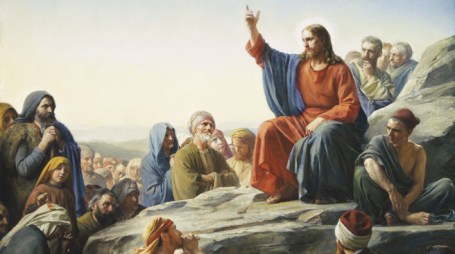
In what has become a kind of tradition for him, New York Times columnist Nicholas Kristof published an op-ed piece a couple of days before Christmas with this question: “Am I a Christian?” This time, he asked the question to Cardinal Joseph Tobin, but he has posed the same question to President Jimmy Carter and Pastor Timothy Keller in past columns.
Mr. Kristof is an admitted skeptic of many of the claims of Christianity. He opens his conversation with Cardinal Tobin like this:
Merry Christmas! Let me start with respectful skepticism. I revere Jesus’ teachings, but I have trouble with the miracles – including, since this is Christmas, the virgin birth. In Jesus’ time people believed that Athena was born from Zeus’ head, so it seemed natural to accept a great man walking on water or multiplying loaves and fishes; in 2017, not so much. Can’t we take the Sermon on the Mount but leave the supernatural?
Mr. Kristof holds a view of Christianity that sees Jesus as a talented and even a uniquely enlightened teacher. Believing that He was a worker of supernatural feats, however, is a bridge too far. Mr. Kristof’s Christianity is one that would prefer to, in his own words, “take the Sermon on the Mount but leave the supernatural” behind.
Mr. Kristof, of course, is not the only one who stumps for this kind of Christianity. President Obama, when he was making a case for same-sex unions back when he was campaigning for the presidency in 2008, stated:
If people find that controversial, then I would just refer them to the Sermon on the Mount, which I think is, in my mind, for my faith, more central than an obscure passage in Romans.
Instead of pitting against the miracles of Christ against the Sermon on the Mount, as does Mr. Kristof, President Obama pits the letters of Paul against the Sermon on the Mount, but the net effect is the same: if one wants a Christianity that is palatable, passable, and practical for the 21st century, Jesus’ Sermon on the Mount is the place to go.
Really?
Surely Mr. Kristoff can’t be talking about the Sermon on the Mount. He must have some other sermon in mind. For in the Sermon on the Mount Jesus says all sorts of things that are unmistakably contrary to our enlightened and modern sensibilities.
If Mr. Kristof finds a virgin birth impossible, what can he possibly find plausible about Jesus’ claim in the Sermon on the Mount to fulfill all of Scripture?
Do not think that I have come to abolish the Law or the Prophets; I have not come to abolish them but to fulfill them. (Matthew 5:17)
It should be pointed out that Jesus’ claim to fulfill “the Prophets” would include a prophecy about a virgin who will give birth, as Matthew so aptly notes at the beginning of his Gospel:
An angel of the Lord appeared to [Joseph] in a dream and said, “Joseph son of David, do not be afraid to take Mary home as your wife, because what is conceived in her is from the Holy Spirit. She will give birth to a son, and you are to give Him the name Jesus, because He will save His people from their sins.” All this took place to fulfill what the Lord had said through the prophet: “The virgin will conceive and give birth to a son, and they will call Him Immanuel” (which means “God with us”). (Matthew 1:20-23)
To hold to what Jesus says in the Sermon on the Mount would be to hold to who Jesus claims to be: the perfect fulfillment of around 1,000-years-worth of ancient literature. Is this really what Mr. Kristof believes?
Of course, Jesus says lots of other things in His Sermon on the Mount too, like:
You have heard that it was said, “You shall not commit adultery.” But I tell you that anyone who looks at a woman lustfully has already committed adultery with her in his heart. (Matthew 5:27-28)
And:
It has been said, “Anyone who divorces his wife must give her a certificate of divorce.” But I tell you that anyone who divorces his wife, except for sexual immorality, makes her the victim of adultery, and anyone who marries a divorced woman commits adultery. (Matthew 5:31-32)
And:
Be perfect, therefore, as your heavenly Father is perfect. (Matthew 5:48)
And:
Seek first [God’s] kingdom and His righteousness, and all these things will be given to you as well. (Matthew 6:33)
And:
Enter through the narrow gate. For wide is the gate and broad is the road that leads to destruction, and many enter through it. But small is the gate and narrow the road that leads to life, and only a few find it. (Matthew 7:13-14)
Do people who want to take Jesus’ Sermon on the Mount while leaving behind other portions of the Scriptures take Jesus at His word in all these matters?
I have a suspicion that when people argue for the primacy of Jesus’ Sermon on the Mount, they are arguing for the primacy of a very abridged version of the sermon, which usually amounts to some nice thoughts about loving your enemies, except, of course, if they are our political enemies, along with some other nice thoughts about not judging others, except, of course, when someone holds a position we deem worthy of mockery. It turns out that a Christianity that strips away the rest of the Scriptures in favor of the Sermon on the Mount only winds up stripping away the Sermon on the Mount itself.
So, allow me to make a suggestion. If you think all of Christianity can be competently considered using Jesus’ Sermon on the Mount, fine. But then take the whole Sermon on the Mount seriously. Believe that Jesus is the fulfillment of every jot and tittle of the Old Testament. Decry lust and divorce. Aim not just for respectable goodness, but for perfect righteousness. Put God’s kingdom first in every decision. Learn to love all those who hate you in a way that you are willing even to sacrifice for them. Guard against being judgmental, even of those you find intolerable. See Jesus as your narrow road to salvation.
Live like that.
But be warned: if you do live like that, you might just find yourself in agreement not only with Jesus’ Sermon on the Mount, but with the rest of the Scriptures as well, which means that perhaps Jesus’ sermon was actually what a sermon was always meant to be: not some stand-alone speech that can be divorced from everything around it, but a testimony to all of God’s truth as contained in the Scriptures.
Try as you might, to take the Sermon on the Mount seriously, you must take the rest of the Scriptures seriously. And if you take the rest of the Scriptures seriously, you will take Jesus seriously, for the Scriptures testify to Him. And if you take Jesus seriously, you may find out that He was not just another teacher, but One who has perfect authority over us, insight into us, and salvation for us.
Now, if you’re willing to believe all that about Jesus, which is what the Sermon on the Mount calls us to believe, is a virgin birth really all that difficult to fathom?
2017 in Review

2017 is officially history. And what a whirlwind of a year it was. As we gear up for what will more than likely be another fast-paced year in 2018, it is worth it to reflect on some of the biggest news stories of this past year and ask ourselves, “What lessons can we learn from what we’ve experienced?” After all, though the news cycle is continually churning out new tragedies, scandals, stresses, and messes to capture our immediate attention, the lessons we learn from these stories should linger, even if the stories themselves do not. Wisdom demands it. So, here is my year in review for 2017.
January
By far, the biggest story of January was the inauguration of Donald J. Trump into the office of President of the United States. After a campaign that was both contentious and raucous, many were on edge when he was inaugurated. As our nation increasingly fractures along partisan lines, Mr. Trump’s presidency continues to inspire both sycophantic adoration and overwrought incredulity.
February
A debate over immigration led the headlines in February as fallout over President Trump’s executive order banning immigrants from nations with known terror sympathies – including Iraq, Syria, Iran, Libya, Somalia, Sudan, and Yemen – came fast and fierce. The president’s travel ban was, until very recently, the subject of endless court battles.
March
The headlines jumped across the Atlantic in March when Khalid Masood, a British-born citizen apparently inspired by online terrorist propaganda, drove an SUV into pedestrians on the Westminster Bridge, leaving four dead and forty injured. After crashing his vehicle outside Parliament, he ran, fatally stabbing a police officer before he was fatally shot by law enforcement.
April
In one of the strangest stories of the year, Vice-President Mike Pence was both criticized and, at times, even mocked for refusing to dine alone with any woman who was not his wife or one of his close relatives. Many people interpreted his boundary as needlessly prudish. Mr. Pence viewed it as a wise way to guard his integrity.
May
Another story of terror echoed through the headlines in May, this time in Manchester, England, when suicide bomber Salman Abedi detonated himself at an Ariana Grande concert leaving 22 dead and 59 wounded.
June
The terrorist attacks continued in June as seven were killed and another 48 were wounded in London when a vehicle barreled into pedestrians on London Bridge. Three attackers then emerged to go on a stabbing rampage. Also, Steve Scalise, the majority whip for the House of Representatives, was seriously wounded when 66-year-old James Hodgkinson opened fire during a congressional baseball game.
July
President Trump and Pope Francis offered to provide medical care for the family of Charlie Gard, a baby born with mitochondrial DNA depletion syndrome. A judge in the UK, where the Gard family resides, ordered that Charlie be taken off life support because he saw no hope for Charlie’s recovery, which prompted the president’s and the pope’s overtures. Charlie was eventually removed from life support and passed away.
August
James Alex Fields killed one person and injured nineteen when he plowed his Dodge Challenger into a group of counter-protesters at an event called “Unite the Right” in Charlottesville, Virginia, which was protesting a decision by the city to remove a statue of Confederate General Robert E. Lee. Hurricane Harvey also ripped through Texas, devastating the Coastal Bend, the Houston area, and the Golden Triangle on the Texas-Louisiana border.
September
Hurricane Irma churned its way across Cuba, the Bahamas, Turks and Caicos, the Virgin Islands, Antigua, Barbuda, and, finally, Florida, leaving mass devastation in its wake.
October
The worst mass shooting in American history took place when James Paddock broke the window in his hotel suite at the Mandalay Bay in Las Vegas and fired onto a crowd of country concert goers below, killing 59 and injuring hundreds. In a much more heartwarming moment, the Christian Church celebrated the 500th anniversary of the Protestant Reformation.
November
On the heels of one mass shooting came another – this time at a tiny church outside San Antonio in Sutherland Springs. 26 people were killed when a gunman opened fire on the congregants inside in the middle of a Sunday service. A sexual assault epidemic also broke wide open, as man after man – from Hollywood moguls to politicians to television news personalities – were revealed to have engaged in sexually inappropriate behavior.
December
Devastating wildfires ripped through southern California, scorching thousands of acres and forcing hundreds of thousands of residents to evacuate.
These are only a few of the stories from 2017. There are, of course, countless others that I did not mention. So, what is there to learn from all these stories?
First, when I compare this year in review with others I have written, I am struck by how, in the words of Solomon, there really is “nothing new under the sun” (Ecclesiastes 1:9). Other years have featured other terrorist attacks, natural disasters, mass shootings, and political upheavals. Even the freshly revealed charges of sexual assault chronicle things that happened years, if not decades, ago. The news cycle seems to have a certain, sordid rhythm to it. The news may be saddening, but I’m not so sure it’s surprising.
Second, if anyone ever needed a bit of empirical verification of the biblical doctrine of human depravity, the news cycle would be a good place to find it. Both the drumbeat of dreariness in our news cycle and the fact that we, as a matter of course, are often more riveted by horrific stories than we are by uplifting ones are indications that something is seriously wrong in our world.
Finally, at the same time the news cycle testifies to human depravity, it must not be forgotten that, regardless of how bad the news cycle gets during any given year, hope seems to spring eternal for a better set of stories in the coming year. Yes, we may brace ourselves for the worst. But this cannot stop us from hoping for the best. Such a hope is a testimony to the fact that God has “set eternity in the human heart” (Ecclesiastes 3:11) – an eternity when everything that is wrong in this age will be set right in the next. We cannot help but yearn for that age to come.
So, here’s to hoping for a grand 2018. Yes, the news cycle may indeed take a turn toward the sour, but we also know that God has promised a new age to come, even if we do not yet know its day or hour.
The Dogs of North Korea

Credit: Korean Central News Agency
The more we learn about North Korea, the more sickening the regime there looks. Recently, U.N. Ambassador Nikki Haley held a meeting on human rights in North Korea, which featured Ji Hyeon-A, a woman who escaped from North Korea to South Korea in 2007. Fox News reported on her remarks:
“Pregnant women were forced into harsh labor all day,” she said. “At night, we heard pregnant mothers screaming and babies died without ever being able to see their mothers.”
North Korea does not allow for mixed-race babies, she said. At one detention center, she described how inmates starved to death. Their dead bodies, she said, were given to the guard dogs for food.
This is horrifying. But it is also tragically common in this isolated nation. So, how are we to respond?
First, we should pray for the protection of the citizens of North Korea. Living under the nation’s current dictator, Kim Jong-un, or its prior dictator, Kim Jong-il, as did Ji Hyeon-A, has to be terrifying emotionally, psychologically, spiritually, and physically. Just this past week it was reported that North Korea’s top military official, Hwang Pyong-so, second only to Kim Jong-il himself, is suspected dead after falling out of favor with the supreme leader. In North Korea, there is no reasonable assurance of life. Thus, prayers for the thousands whose lives are in danger every day are in order. In Psalm 22, the Psalmist prays:
But You, LORD, do not be far from me. You are my strength; come quickly to help me. Deliver me from the sword, my precious life from the power of the dogs. (Psalm 22:19-20)
The Psalmist’s prayer echoes an all-too-literal North Korean fear. For those who face the grisly specter of being fed to dogs, we must pray. For those who are oppressed or threatened in any way in North Korea, we must pray.
But we must go further. Our prayers must include not only petitions for protection, but cries for justice. The evil of the North Korean regime must be stopped.
When John has a vision of heaven in Revelation, he sees both those saved by God’s grace and those condemned by God’s judgment. He explains the scene thusly:
Blessed are those who wash their robes, that they may have the right to the tree of life and may go through the gates into the city. Outside are the dogs, those who practice magic arts, the sexually immoral, the murderers, the idolaters and everyone who loves and practices falsehood. (Revelation 22:14-15)
John offers a laundry list of those who will be “outside” salvation on the Last Day. But what is most interesting about this list is who heads it: “the dogs.” Considering dogs are such a ubiquitous part of American families that they have garnered the moniker of “man’s best friend,” the idea that dogs would be excluded from God’s kingdom may puzzle us. But in the ancient world, dogs were considered to be not pets, but dangerous, disease-ridden scavengers. They were reviled. In his vision, then, John sees dogs as symbols of all that is evil.
Those who feed people who have died to literal dogs can only be called dogs themselves, in the biblical sense. Yet, we have the assurance that, one day, these dogs will find themselves on the “outside,” just like John foresees – whether this means they lose power in this age, or in the age to come.
In Psalm 22, shortly before the Psalmist prays that God would deliver him from the dogs, he declares:
Dogs surround me, a pack of villains encircles me; they pierce my hands and my feet. (Psalm 22:16)
This psalm, it turns out, is not only a prayer for deliverance, but a prophecy of things to come – a prophecy of One who, just like in the psalm, would be surrounded by His enemies and pierced for them (Psalm 22:16; Luke 24:39), a prophecy of One who, just like in the psalm, would die humiliated as His enemies divided His clothes and cast lots for them (Psalm 22:18; Matthew 27:35), and a prophecy of one who, just like in the psalm, would cry out in despair, “My God, My God, why have You forsaken Me” (Psalm 22:1; Matthew 27:46)?
Jesus, just like the North Koreans, knew the horror of being surrounded by dogs while in the throes of death. Jesus, just like the North Koreans, experienced the most diabolical evils humans could perpetrate. But Jesus, while suffering death at the hands of evil, was not overcome by it. The dogs that surrounded Him were defeated when His tomb turned up empty. And the dogs that surround many in North Korea will be defeated when our tombs turn up empty too.
The dogs may maul. But Jesus’ resurrection is the promise of their defeat, and it is offered to all.
ISIS and Sufis

Credit: Akhtar Soomro / Reuters
Because it was over the long Thanksgiving weekend, the ISIS attack on an Egyptian Sufi mosque that killed 305 people a week ago Friday received some attention, but not as much as it might have normally. But it is important. The sheer scope of the tragedy is gut-wrenching. The mass shooting at the Mandalay Bay in Las Vegas claimed 59 lives. The mass shooting at the First Baptist Church in Sutherland Springs claimed 26. The attack on this mosque killed over 300. It is sobering to try to fathom.
Part of what makes this attack so disturbing is that one group of Muslims – or at least self-identified Muslims – in ISIS perpetrated this attack against another group of Muslims who are Sufi. At its heart, this attack was driven not by political or cultural differences, but by an all-out holy war. Rukmini Callimachi, in a report for The New York Times, explains:
After every attack of this nature, observers are perplexed at how a group claiming to be Islamic could kill members of its own faith. But the voluminous writings published by Islamic State and Qaeda media branches, as well as the writings of hard-liners from the Salafi sect and the Wahhabi school, make clear that these fundamentalists do not consider Sufis to be Muslims at all.
Their particular animus toward the Sufi practice involves the tradition of visiting the graves of holy figures. The act of praying to saints and worshiping at their tombs is an example of what extremists refer to as “shirk,” or polytheism.
Certainly, the veneration of the dead is a problem – not only for many Islamic systems of theology, but for orthodox Christianity as well. When the Israelites are preparing to enter the Promised Land, God warns them:
Let no one be found among you who sacrifices their son or daughter in the fire, who practices divination or sorcery, interprets omens, engages in witchcraft, or casts spells, or who is a medium or spiritist or who consults the dead. Anyone who does these things is detestable to the LORD; because of these same detestable practices the LORD your God will drive out those nations before you. (Deuteronomy 18:10-12)
On this, many Christians and Muslims agree: venerating the dead is not only superstitious and paganistic, it smacks of polytheism by exalting a departed soul to the position of God, or, at minimum, to a position that is god-like. Yet, one can decry the veneration of the dead without creating more dead, an understanding that many others in the Muslim world, apart from ISIS, seem to be able to maintain with ease. Theological disagreements can be occasions for robust debate, but they must never be made into excuses for bloodshed.
There are some in the Christian world, who, like Sufi Muslims, venerate those who are dead in ways that make other Christians very uncomfortable. Catholicism’s veneration of the saints, for instance, is rejected as unbiblical and spiritually dangerous by many Protestants, including me. But this does not mean that there are not many theological commitments that I don’t joyfully share with my Catholic brothers and sisters, including a creedal affirmation of Trinitarian theology as encapsulated in the ecumenical creeds of the Church. I may disagree with Catholics on many important points of doctrine, but they are still my friends in Christ whom I love.
Jesus famously challenged His hearers to “love your enemies and pray for those who persecute you” (Matthew 5:44). Part of what I find so compelling about Jesus’ challenge is not just its difficulty – though it is indeed very demanding to try to love someone who hates you – but its keen insight into the devastating consequences of hate. If you love your enemy, even when it’s difficult, you can most certainly love your friends, and, by God’s grace, you may even be able to make friends out of enemies when they become overwhelmed by your love. But if you hate your enemy, even your friends will eventually become your enemies, and you will hate them too. Why? Because hate inevitably begets more hate.
ISIS has made a theological system out of hate. Thus, they have no friends left to love. They only have enemies to kill, including other Muslims. Christians, however, worship a God who not only has love, but is love (1 John 4:16). For all the Sufis who are mourning, then, we offer not only our condolences, but our hearts, and we hold out the hope of the One who is not only the true God, but the one Savior, and who makes this promise: ISIS’s hate that leads to death is no match for Jesus’ love and His gift of life.


 Pastor Zach's Blog