Posts tagged ‘Christ’
Mark Driscoll’s Fruit Punch

Credit: Mars Hill Church
Jesus once explained how the world could recognize His disciples: “By their fruit you will recognize them” (Matthew 7:20). “Fruit,” of course, is what the apostle Paul describes as “love, joy, peace, patience, kindness, goodness, faithfulness, gentleness and self-control” (Galatians 5:22-23). Thus, if others want to know whether or not a person follows Jesus, they need only to look at how he acts.
Of course, there is a little more to it than just this. Because even people who follow Jesus do not always bear the kind of fruit Paul enumerates. Indeed, even Paul himself admits, “What I do is not the good I want to do; no, the evil I do not want to do – this I keep on doing” (Romans 7:19). Paul’s spiritual fruit is more like a fruit punch – a mix of good fruit and bad fruit, righteous fruit and sinful fruit.
This past week has been a tough one for Mars Hill Church of Seattle. Last Sunday, its pastor, Mark Driscoll, announced to the congregation that he will be taking at least six weeks away from the pulpit, explaining:
Storm clouds seem to be whirling around me more than ever in recent months and I have given much thought and sought much counsel as to why that is and what to do about it …
Some have challenged various aspects of my personality and leadership style, and while some of these challenges seem unfair, I have no problem admitting I am deserving of some of these criticisms based on my own past actions that I am sorry for …
I have requested a break for processing, healing, and growth for a minimum of six weeks while the leadership assigned by our bylaws conduct a thorough examination of accusations against me.[1]
Usually, when a pastor steps away from his pulpit because of some controversy or scandal, it makes no news. But Mars Hill Church is one of America’s most famous congregations. Thus, the controversy surrounding Driscoll has been very public – front page of The New York Times public, in fact. Two days before Driscoll announced his leave of absence, the Times published an exposé:
Mark Driscoll has long been an evangelical bad boy, a gifted orator and charismatic leader who built one of the nation’s most influential megachurches despite, or perhaps fueled by, a foul mouth, a sharp temper and frank talk about sex …
But now Mr. Driscoll’s empire appears to be imploding. He has been accused of creating a culture of fear at the church, of plagiarizing, of inappropriately using church funds and of consolidating power to such a degree that it has become difficult for anyone to challenge or even question him. A flood of former Mars Hill staff members and congregants have come forward, primarily on the Internet but also at a protest in front of the church, to share stories of what they describe as bullying or “spiritual abuse,” and 21 former pastors have filed a formal complaint in which they call for Mr. Driscoll’s removal as the church’s leader.
Mr. Driscoll is rapidly becoming a pariah in the world that once cheered him.[2]
When The New York Times says your empire is “imploding” and calls you a “pariah,” that’s not good. But this is what Mark Driscoll is now facing.
As I’ve been reading people’s comments on Driscoll’s absence from Mars Hill’s pulpit, it’s been fascinating to read both the comments of his fervent supporters as well as those of his vociferous detractors. On Mark Driscoll’s Facebook page, people came out with glowing messages of support and prayer:
BEST BIBLE TEACHER EVER! Love you pastor Mark, thanks for teaching me how to man up and love Jesus and my family! Your sermons helped me through one of the most difficult moments in my life. I thank God for your faithfulness in teaching his word and I can’t wait to see you come back and do more amazing things!
And this:
Pastor Mark, I got baptized a few years back with Mars Hill on Easter and my now husband got baptized this past Easter. What makes it even more amazing is that after he got baptized he turned and baptized his 9 year old son … You have changed us and my marriage is truly saved by the grace of God but we wouldn’t have gotten here if it wasn’t for your teachings.[3]
On a blog critical of Mark Driscoll, readers can be treated to comments like this:
Driscoll needs to step down for good, not for 6 weeks. The man is dangerous. He has fired high ranking members of his staff on the spot, and created a culture of spiritual abuse disguised as “church discipline.” He is mean, he has publicly insulted “effeminate worship leaders” and implied Ted Haggard’s homosexuality
was the result of “wives who let themselves go,” to name but a few of many highlights.
And this:
[Mark] has repeatedly found himself embroiled in accusations of abuse, stealing others intellectual property, fleecing his church to pay for his best seller status, fleecing his church with his fake global fund … He has lived more as a son of the devil than the son of GOD.[4]
There doesn’t seem to be a lot of middle ground when it comes to opinions about Mark Driscoll. Even his apology has gotten mixed reviews. Some people believe Driscoll has sincerely repented of his sin and is the best man to lead Mars Hill Church while others doubt Mark’s sincerity. One person commented, “I listened to Mark’s ‘apology’ and I didn’t see any repentance.”[5]
So what are we to make of all this?
In a sentence, I would say: Mark Driscoll has made fruit punch. Like the apostle Paul, Mark has born both good fruit and bad fruit, righteous fruit and sinful fruit. And whether or not you applaud or denounce him has to do with what fruit of his you are looking at. To only applaud his good fruit while ignoring his bad is to make an idol out of him. Only Jesus bears only good fruit. But to only denounce his bad fruit while overlooking his good is to stand in self-righteous condemnation of him. We must never forget that it’s not only Mark Driscoll who makes fruit punch. We do too.
So from one fruit-punch-making pastor to another I say, “Mark, I’m praying for you. And, I’m praying that the team of overseers who are reviewing the charges against you make a decision that is best for you, for Mars Hill, and for the glory of God’s Kingdom.” Then, for all Christians who make fruit punch – and we all do – I am also praying. I am praying that we would continue to be “transformed into [the Lord’s] likeness with ever-increasing glory” (2 Corinthians 3:18) until our fruit punch becomes the Spirit’s pure fruit in heaven.
_______________________________________
[1] Mark Driscoll, “An Update From Pastor Mark,” marshill.com (8.24.2014).
[2] Michael Paulson, “A Brash Style That Filled Pews, Until Followers Had Their Fill,” The New York Times (8.22.2014).
[4] Warren Throckmorton, “Announcement: Mark Driscoll Will Take At Least Six Weeks Off,” patheos.com (8.24.2014).
[5] Celeste Gracey, “Forgiving My Pastor, Mark Driscoll,” Christianity Today (August 2014).
The Limits of Human Freedom
 We, in America, like freedom. We talk about it. We write about it. We even sing about it. Anyone who has ever attended a sporting event where our national anthem was sung has heard in soaring melody how we live in “the land of the free and the home of the brave.”
We, in America, like freedom. And we will fight, protest, and lobby to protect the freedoms most near and dear to our hearts. Some fight, protest, and lobby to protect the freedom of religion – to practice their beliefs as they choose. Others fight, protest, and lobby for the freedom to keep and bear arms. Still others fight, protest, and lobby for the freedom to marry whoever they want – even if whoever they want is of the same gender.
Perhaps it is our love of freedom that makes the doctrine of predestination so offensive to so many. Jesus summarizes predestination thusly: “You did not choose Me, but I chose you and appointed you so that you might go and bear fruit – fruit that will last” (John 15:16). The doctrine of predestination, then, is simply this: it is God, not us, who is in charge of our salvation. When it comes to our salvation, we are not free!
This is where the hackles of our freedom-loving hearts can get raised. Indeed, the most common objection that I hear whenever I teach on predestination is, “But what about our free wills? Doesn’t predestination mean that God turns us into automatons – unable to accept or reject Him?”
I have addressed this question many times and in many ways. But to address it this time, I would turn your attention the midcentury American sociologist Philip Rieff who, I believe, writes about the limits of our free wills – and the goodness of these limits – in a poignant and powerful way. Rieff writes:
There is no feeling more desperate than that of being free to choose, and yet without the specific compulsion of being chosen. After all, one does not really choose; one is chosen. This is one way of stating the difference between gods and men. Gods choose; men are chosen. What men lose when they become as free as gods is precisely that sense of being chosen, which encourages them, in their gratitude, to take their subsequent choices seriously.[1]
To choose without first being chosen, Rieff explains, is a miserable manner of existence. After all, if there is no God who loves you enough to choose you, what does your choice of Him – or of anything else, for that matter – matter? Who would want to choose a God in their limited power who doesn’t care enough to first choose them out of His infinite power? This is why the apostle Paul speaks of predestination in such glowing terms:
Praise be to the God and Father of our Lord Jesus Christ, who has blessed us in the heavenly realms with every spiritual blessing in Christ. For He chose us in Him before the creation of the world to be holy and blameless in His sight. In love He predestined us to be adopted as His sons through Jesus Christ, in accordance with His pleasure and will – to the praise of His glorious grace, which He has freely given us in the One He loves. (Ephesians 1:3-7)
Paul is thrilled by the doctrine of predestination! For Paul knows that the only way he is free to make decisions worth making is when believes and sees that he himself is a decision that God thought was worth making in predestination. Paul’s limited free will is of no consequence if it cannot come under the tender loving care of God’s perfect free will.
So, do you long to be free? Do you fight, protest, and lobby to protect the freedoms that are near and dear to your heart? If you do, remember that your freedom of choice is only as good and meaningful as your bondage to Christ. Without being under Christ’s rule and reign, your freedom is futile. Under Christ’s rule and reign, however, your freedom is purposeful. And I don’t know about you, but I want my freedom to mean something.
_______________________
[1] Philip Rieff, The Triumph of the Therapeutic (Chicago: The University of Chicago Press, 1966), 93.
When Cultures Clash
 Three weeks ago on this blog, I shared a quote from The Gospel Coalition’s Trevin Wax that I think brilliantly summarizes a radical shift in our culture:
A generation ago, a person’s religious observance was a public matter, a defining characteristic of one’s identity, while a person’s sexual activity was something private. Today, this situation is reversed. A person’s sexual behavior is now considered a defining characteristic of identity, a public matter to be affirmed (even subsidized) by others, while religious observance is private and personal, relegated to places of worship and not able to infringe upon or impact the public square.
The culture clash today is less about the role of religion in business or politics, and more about which vision of humanity best leads to flourishing and should therefore be enshrined in or favored by law.[1]
Sex has become a – if not the – defining characteristic for many in our society. I recently read an article about a professor who, in a women’s studies course, asked the class to write down the moment they realized they were gay, straight, bisexual, or queer.[2] For many, one’s sexual awakening has become their road to Emmaus. It is nothing less than their conversion experience. I grew up Baptist, and the question I was often asked was, “When did you ask Jesus into your heart?” Now the question is, “When did you have your sexual awakening?” Sexuality is what gives many their meaning, purpose, and identity.
As I wrote three weeks ago, as a Christian, I cannot define myself in the way so many in our society have chosen to define themselves. I must define myself by Christ and His Gospel. I am, however, well aware that when I define myself in this way, I offend a whole host of societal sensibilities, especially as they pertain to sexuality.
As I’ve been pondering this clash of values, I’ve come to realize that Jesus faced much the same situation. First century society was rife with sexual standards that were radically different from His. Take for instance, the emperor of Rome during Jesus’ day, Tiberius Caesar, who, according to the Roman historian Suetonius, enjoyed watching group sex.[3] This type of sexual licentiousness is, thankfully, offensive to many in our day, but, sadly, nevertheless acceptable and practiced among some. So how did Jesus respond to sexual ethics that contradicted His own?
First, Jesus was ethically rigorous. Jesus didn’t compromise His sexual standards in an effort win allies or appear tolerant. I think of Jesus’ clash with the religious leaders over divorce. In a world where many religious teachers taught that it was acceptable for a man “to divorce his wife for any and every reason,” Jesus responds, “I tell you that anyone who divorces his wife, except for marital unfaithfulness, and marries another woman commits adultery” (Matthew 19:3, 9). This sexual standard was so rigorous that Jesus’ own disciples exclaimed, “If this is the situation between a husband and wife, it is better not to marry” (Matthew 19:10).
It was William Ralph Inge, Dean of St. Paul’s Cathedral in London, who famously quipped: “Whoever marries the spirit of this age will find himself a widower in the next.”[4] Jesus was not interested in conforming to the sexual spirit of His age. We should not be interested in conforming either.
But there is another side to Jesus’ engagement with the sexual spirit of His society. For at the same time that Jesus was ethically rigorous, He was also relationally generous. In other words, even if people were in lifestyles He could not condone, He did not shun them. He loved them. I think of the woman at the well in John 4. Or the woman caught in adultery in John 8. Or the woman who anoints Jesus with perfume in Luke 7. Jesus cared deeply for these people. We should too – even if they do not share our ethical commitments.
A faithful Christian response to the sexual standards of our society, then, demands that we answer two questions. First, where do we stand? Have we compromised biblical sexual standards to kowtow to the spirit of our age? If so, no less than the living Lord commands that we hold the line. But second, who are our friends? Do we generously befriend those who do not think or live like we do? If our friends are only those who share our ethical commitments, we have traded Jesus’ love for quarantined law. And that helps no one.
As Christians, we need both ethical standards and relational grace. I hope you have both. You should. Jesus has given you both. After all, how do you think He befriended you?
_____________________________
[1] Trevin Wax, “The Supreme Court Agrees With Hobby Lobby, But Your Neighbor Probably Doesn’t,” The Gospel Coalition (6.30.2014).
[2] W. Blue, “When Did You Know You Were Gay?” Psychology Today (7.15.2014).
[3] Suetonius, Life of Tiberius 43.
[4] Tony Lane, Exploring Christian Doctrine: A Guide to What Christians Believe (Downers Grove, IL: InterVarsity Press, 2014), 48.
Four Lessons From The Spurs You Probably Already Know

Credit: Getty Images
This past week was a great one to be living in San Antonio. For the fifth time in franchise history, the San Antonio Spurs brought home the title of NBA National Champions. As much as I enjoyed watching Game 5 of the National Championship and seeing the Spurs come back from a 16-point deficit to win 104 to 87, the Spurs have a lot more going for them than just one big win in one big game. Their words and demeanor season after season offer some good, even if simple, lessons. Here are four that I’ve been thinking about.
A Lesson in Teamwork
The Spurs, as sportscasters, fans, and bystanders alike will tell you, are a team. But not just in the sense that they all happen to be wearing the same jersey. No, they play like a team. They act like a team. And they win like a team. Benjamin Morris noted that the Spurs “had nine different players take four or more field goal attempts per game throughout the playoffs, compared to just six for Miami.”[1] In San Antonio, everybody gets to play because, in San Antonio, everybody needs to play to bring home a win.
Playing as a team, of course, is needed not only on the court, but in the Christian life. To meet the challenges we face, everybody needs to play together. I think of the apostle Paul and all of his teammates, or, as he called them, “partners” (e.g., 2 Corinthians 8:23; Philippians 1:5; Philemon 1:7), in the gospel. With whom do you need to team up so you can share and show God’s love more effectively?
A Lesson in Humility
When Kawhi Leonard was named Most Valuable Player for the Finals, his shock was apparent – and endearing. I loved how he responded to his high honor: “Right now, it’s just surreal to me,” he said. “I have a great group of guys behind me.”[2] Kawhi knew he performed great in Game 5. But he also knew it wasn’t just about him. It was about them – all the Spurs behind him.
In a world where Facebook, Twitter, and Instagram are full of people shouting, “Look at me!” – to have a man point to the men behind him is impressive and important. This is true humility. Indeed, true humility is not about degrading yourself, but about lifting others up, which Leonard did beautifully. Who can you point to in humility?
A Lesson in Perseverance
Before they were the National Champion San Antonio Spurs of 2014, they were the team that let everything slip through their fingers in 2013. The front page of the San Antonio Express-News reflected last year’s heartbreak in its headline: “REDEMPTION!” But it took 362 days after a heartbreaking Game 6 loss to get that redemption. 362 long days. “A day didn’t go by when I didn’t think about Game 6,” said Coach Gregg Popovich. “For the group to have the fortitude to get back to this spot speaks volumes.”[3] The Spurs took a fall, yes, but they turned that fall into fuel for fortitude. In the words of Tim Duncan, “What happened last year definitely helped our drive … We could have reacted in different ways. We reacted the right way.”
Where you in your life do you need to persevere? Where do you need to take things that go wrong and learn from them so you can do right?
A Lesson in Inclusion
Scott Cacciola of The New York Times recently published an article hailing the Spurs as “The United Nations of the Hardwood”:
The Spurs, as has been well established, have developed an international flair under Coach Gregg Popovich. Eight players on the current roster were born outside the United States. Loosely translated, that means the Spurs use at least four languages – English, Spanish, French and Italian – to communicate among themselves.
Manu Ginobili, an Argentine, is the team’s one-man version of the United Nations, capable of conversing in Spanish with his Brazilian teammate Tiago Splitter and in Italian with Marco Belinelli, who was born outside Bologna. (Ginobili speaks in English with everybody else.)
Boris Diaw, who is from France, converses en français with Tony Parker, who was born in Belgium but grew up in France. Both players also know some Italian, enough to eavesdrop on conversations between Ginobili and Belinelli.
Even the two team’s two Australians, Patty Mills and Aron Baynes, have their own dialect.
“We’ll hear them and be like, ‘Whoa!’” the assistant coach Chad Forcier said.
Tim Duncan, who is from the United States Virgin Islands, is considered an international player by the NBA.[4]
During the championship ceremony, many of these players wrapped themselves in the flags of their home countries.
The inclusion of so many men from so many places, all together on one team, makes me smile. It reminds me of the promise that anyone from any “nation, tribe, people and language” (Revelation 7:9) can be included as one redeemed by the Lamb through faith. And the more, the merrier. That’s why one of my prayers is that heaven is chocked full. I’d hate to see one empty corner where a person could have been. So would the Lord. He wants as many people included in His Kingdom as possible. Who can you pray for to be included in eternity’s celebration?
In reality, these lessons are pretty simple and straightforward. Indeed, I suspect you have probably already learned these lessons somewhere along the way. Nothing in this blog is probably news to you. But lessons don’t have to be esoteric and unknown to be profound and helpful. They just have to be true. And these lessons most certainly are. That’s why I thought we could all use a little reminder.
So congratulations, Spurs. And thanks for the lessons. They’re great.
________________________________
[1] Benjamin Morris, “The Spurs Were an Outlier of Unselfishness,” FiveThirtyEight (6.17.2014).
[2] Associated Press, “Kawhi Leonard named Finals MVP,” ESPN (6.16.2014).
[3] Jeff McDonald, “High five! Spurs dethrone Heat for fifth NBA championship,” San Antonio Express-News (6.15.2014)
[4] Scott Cacciola, “The United Nations of the Hardwood,” The New York Times (6.15.2014).
#Blessed

Credit: socialmediaexaminer.com
I don’t know how many times I’ve received the prayer request. But it’s definitely more times than I can remember. “Pray that God will bless my…” and then fill in the blank. “Finances.” “Job Search.” “Move.” “Golf Game.” “Baby Shower.” And the list could go on and on.
Now, on the one hand, I have no particular problem with these kinds of prayer requests per se. Indeed, when people come to me with these kinds of prayers, I gladly oblige. But on the other hand, even though we pray to be blessed, I’m not so sure we always understand what it truly entails to be blessed, at least not biblically.
The other day, I came across an article by Jessica Bennett of The New York Times chronicling all the blessings she has stumbled across on social media. She opens:
Here are a few of the ways that God has touched my social network over the past few months:
S(he) helped a friend get accepted into graduate school. (She was “blessed” to be there.)
S(he) made it possible for a yoga instructor’s Caribbean spa retreat. (“Blessed to be teaching in paradise,” she wrote.)
S(he) helped a new mom outfit her infant in a tiny designer frock. (“A year of patiently waiting and it finally fits! Feeling blessed.”)
S(he) graced a colleague with at least 57 Facebook wall postings about her birthday. (“So blessed for all the love,” she wrote, to approximately 900 of her closest friends.)
God has, in fact, recently blessed my network with dazzling job promotions, coveted speaking gigs, the most wonderful fiancés ever, front row seats at Fashion Week, and nominations for many a “30 under 30” list. And, blessings aren’t limited to the little people, either. S(he) blessed Macklemore with a wardrobe designer (thanks for the heads up, Instagram!) and Jamie Lynn Spears with an engagement ring (“#blessed #blessed #blessed!” she wrote on Twitter). S(he)’s been known to bless Kanye West and Kim Kardashian with exotic getaways and expensive bottles of Champagne, overlooking sunsets of biblical proportion (naturally).[1]
Apparently, Bennett has a lot of extraordinarily “blessed” friends. She even tells the story of a girl who posted a picture of her posterior on Facebook with the caption, “Blessed.” Really?
The theology behind the kind of blessing Bennett outlines is shallow at best and likely heretical in actuality. The so-called “god” who bestows these social media blessings is ill-defined and vacuous, as Bennett intimates with her references to “god” as “s(he),” and the blessings from this divine turn out to be quite petty. Frocks that fit, birthday wishes on Facebook, and financial windfalls all qualify to be part of the “blessed” life.
All this leads Bennett to suspect that these “blessings” are really nothing more than people cynically
… invoking holiness as a way to brag about [their] life … Calling something “blessed,” has become the go-to term for those who want to boast about an accomplishment while pretending to be humble, fish for a compliment, acknowledge a success (without sounding too conceited), or purposely elicit envy.
That sounds about right. “Blessed” is just a word people use to thinly disguise a brag.
True biblical blessing, of course, is quite different – and much messier. Jesus’ list of blessings sounds quite different from what you’ll find on Facebook:
Blessed are you who are poor, for yours is the kingdom of God. Blessed are you who hunger now, for you will be satisfied. Blessed are you who weep now, for you will laugh. Blessed are you when men hate you, when they exclude you and insult you and reject your name as evil, because of the Son of Man. (Luke 6:20-22)
Poverty, hunger, mourning, and persecution all qualify to be part of the blessed life. Why? Because true blessing involves much more than what happens to you in this life. It involves God’s promises for the next.
All this is not to say that the good gifts we receive in this life are not blessings. But such blessings must be received with a proper perspective – that they are blessings not just because we happen to like them, but because it is God who gives them. Indeed, one of the most interesting features of the Hebrew word for “blessing,” barak, is that it can be translated either as “bless” (e.g., Numbers 6:24) or as “curse” (e.g., Psalm 10:3), depending on context. What makes the difference between whether something is a blessing or a curse? Faith – a confidence that a blessing is defined not in terms of what something is, but in terms of who gives it. This is why when we are poor, hungry, mourning, and persecuted, we can still be blessed. Because we can still have the Lord. And there is no better blessing than Him.
Put that on Instagram.
__________________________
[1] Jessica Bennett, “They Feel ‘Blessed,’” The New York Times (5.2.2014).
You’re not smart enough or good enough, even if people like you
 It was Stuart Smalley, played by Al Franken on Saturday Night Live, who said, “I’m good enough, I’m smart enough, and, doggone it, people like me!” As it turns out, many took Smalley’s credo to heart. And the results have been sadly predictable.
Case in point: the American Bible Society, in conjunction with the Barna Group, recently published its “State of the Bible” report for 2014. The report opens with plenty of punch:
Now there are just as many Americans skeptical of the Bible as there are engaged with the Bible. According to the fourth annual State of the Bible survey, 19 percent said that they were skeptical of the Bible. This number is up from 10 percent in 2011.
This trend is even more pronounced among the Millennial generation (who range in age from 18-29). According to the State of the Bible report, Millennials are
– Less likely to view the Bible as sacred literature (64 percent in comparison to 79 percent of adults),
– Less likely to believe the Bible contains everything a person needs to know to lead a meaningful life (35 percent in comparison to 50 percent of adults), and
– More likely to never read the Bible (39 percent compared in comparison to 26 percent of adults).[1]
It turns out that America’s latest generation is more suspicious of the Bible than any that has come before it.
Now, on the one hand, such suspicion requires solid biblical apologists – people who can argue for Scripture’s veracity, historicity, consistency, and even morality to a society that is increasingly questioning Scripture on all these fronts. Indeed, one factoid that came out of this report is that while 50 percent of all adults believe the Bible has too little influence on society, only 30 percent of Millennials believe this. This is, in part, because many Millennials no longer accept the basic premise that the Bible teaches right from wrong. Instead, many Millennials now believe the Bible promotes wrong rather than right – for instance, on topics like sexual ethics. Thus, they see the Bible as having a negative, rather than a positive, influence on society – one they would be happy to see continue to wane.
But there is more to this report than just what Millennials believe about the Bible. The statistic I found most telling from this report is this one: 19 percent of Millennials believe no literature is sacred compared to 13 percent of all adults who believe no literature is sacred. In other words, it’s not just that Millennials have a problem with the Bible in particular, it’s that they struggle with any literature that claims to be sacred in general.
It is here that we arrive at the core of this new generation’s struggle. For to claim a particular piece of literature is sacred is, at the same time, to say something about its authority. After all, something with a sacred, or divine, origin is, by definition, “above” me and can therefore make certain claims on me and demands from me. But this is something this current generation simply cannot endure. For to believe a book like the Bible has divine authority is to concede that if I disagree with the Bible, the Bible gets the right of way. But when I’ve been told, “I’m good enough, I’m smart enough, and, doggone it, people like me,” I cannot stand to have my goodness or moral intelligence questioned by some backward work from ancient antiquity. My modern, enlightened sensibilities cannot be wrong. I must be right. The only sacred literature left, then, is the moral script I’ve written for myself and carry around in myself – hence, the reason so many Millennials see not only the Bible as unsacred, but any religion’s holy book as unsacred.
So with all of this in mind, perhaps it’s worth it to do a little reflection on our assumption concerning the sapience and sacredness of our moral sensibilities. We have been told we are smart enough. But are we, really? Have we never made a wrong call, a tragic error, or a bumbling fumble? We have been told we are good enough. But are we, really? Have we never broken our own moral boundaries or changed them over time because of a shifting perspective, or, more cynically, because of coldly calculated expedience? A little bit of honest introspection is enough to remind us that what Stuart Smalley taught us is profoundly untrue. Indeed, it is downright silly. And it is supposed to be. That’s why it aired on Saturday Night Live.
So let’s stop looking to ourselves for truth and morality and start looking to something higher. Let’s take an honest look at the Bible. Who knows? We may find it’s smarter and better than even we are. And, doggone it, we might even learn to like that.
____________________________
[1] “State of the Bible 2014,” American Bible Society.
Common Question: What’s the Deal with the Apocrypha?
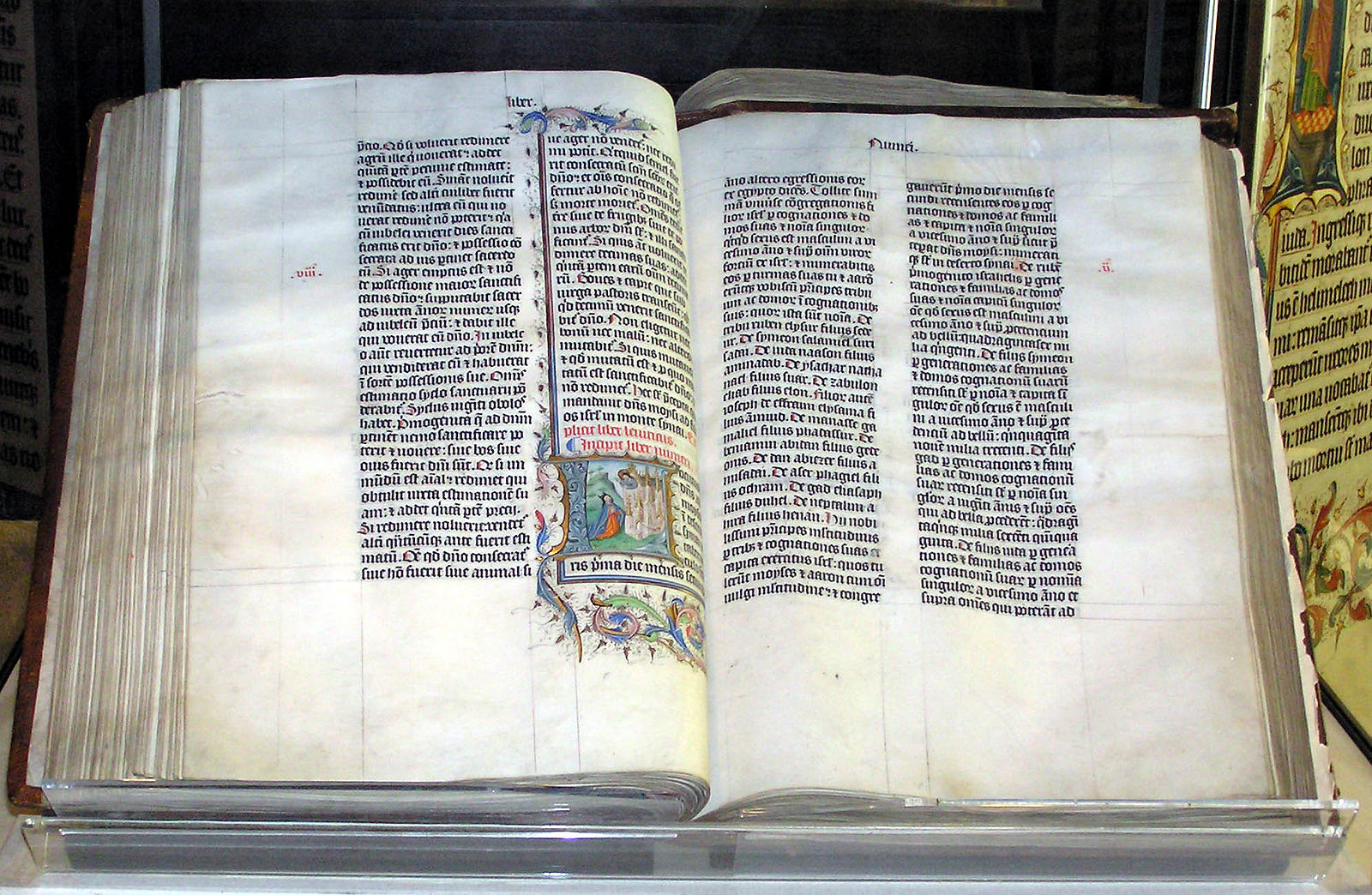 66 books. That’s how many books are in the Good Book. At least, that’s what I had always been taught. But then, a Roman Catholic friend of mine in high school claimed there was more to the Bible than the 66 books I had read since I was a little boy. There were actually 73 books, he explained. And these additional books had strange names like “Maccabees” and “Judith” and “Tobit” and even “Bel and the Dragon.” As he showed me these books, I was flummoxed. “Why hadn’t I ever heard of these books?” I asked myself.
These mysterious books to which I was introduced in high school are widely known as the “Apocrypha,” a Greek adjective meaning “hidden.” And though many Christians do not regularly read these books, they are indeed a part of the Roman Catholic canon of Scripture. In fact, one of the questions I often receive as a pastor is, “Why do Roman Catholics have ‘extra’ books in their Bible?”
Because the Apocrypha is a source of a lot of confusion, I thought it would be worth it to offer a brief history of these books along with an analysis of them from a Lutheran Christian perspective.
The books of the Apocrypha were written between the close of the Old Testament in 430 BC and the beginning of the New Testament. These books include historical accounts, supplements to famous Old Testament books such as Daniel and Esther, and wisdom books akin to the Proverbs.
From the beginning, these books were never fully embraced by the Church as inspired Scripture. Paul Maier, Professor Emeritus of Ancient History at Western Michigan University, explains:
The Apocrypha … were not included in the final canon of the Hebrew Bible, which was debated by rabbis at Jamnia (near Jerusalem) in AD 93. Thus they were also not included among the very 39 books that comprise the Old Testament in Christian Bibles today …
Early on … churchmen such as Origen of Alexandria noted a difference between the Apocrypha and the Hebrew Scriptures. Cyril of Jerusalem and Jerome also drew a line of separation between the two, using the term Apocrypha for the first time in reference to these writings. To be sure, Jerome included them in his Latin translation if the Bible, the Vulgate, but advised that the Apocrypha should be read for edification, not for supporting church dogma.[1]
Jerome’s warning against using the Apocrypha as a basis for Christian doctrine is especially important. His doctrinal concern is perhaps best illustrated by 2 Maccabees 12:44-45 when the Jewish liberator Judas Maccabeus prays for some who have died, seeking to make atonement for the sins they committed while they were still alive. From these verses, the Roman Catholic Church derives its doctrine of Purgatory, a place where deceased believers undergo a final purification from sin that readies them for the bliss of heaven. The Catechism of the Catholic Church explains the doctrine of Purgatory thusly:
All who die in God’s grace and friendship, but still imperfectly purified, are indeed assured of their eternal salvation; but after death the undergo purification, so as to achieve the holiness necessary to enter the joy of heaven.
The Church gives the name Purgatory to this final purification of the elect.[2]
This teaching runs contrary both to the broad teaching of canonical Scripture, which declares that a person enters either paradise or hell immediately upon death (e.g., Luke 16:19-31; 23:39-43), and to the gospel, because it adds to Christ’s perfectly purifying work on the cross our own work of purification in Purgatory by which we may “achieve the holiness necessary to enter the joy of heaven.” By adding our achievements to Christ’s achievement, the doctrine of Purgatory belittles and undermines the sufficiency of Christ’s sacrifice. Thus, the universal Church does not treat the Apocrypha as divinely inspired.
Interestingly, the Apocrypha was not even fully embraced by the Roman Catholic Church until the Fourth Session of the Council of Trent in 1546. In this session, it was declared:
But if any one receive not, as sacred and canonical, the said books entire with all their parts, as they have been used to be read in the Catholic Church, and as they are contained in the old Latin Vulgate edition; and knowingly and deliberately contemn the traditions aforesaid; let him be anathema.[3]
With this decree, the Roman Catholic Church effectively erased the distinction between ancient books that should be read for private edification and inspired books that should be appealed to for Christian doctrine – a distinction that Jerome, the very one who translated the Latin Vulgate, which Rome was here declaring to be its official translation, had made! Thus, Rome took Jerome’s translation, but disregarded his distinction. And the Church has been the worse for it over the years.
All of this is not to say that the Apocrypha should be altogether disregarded. Maier notes that “Clement of Alexandria, Polycarp, Tertullian, Hippolytus, Cyprian, and Augustine” cited heartily from the Apocrypha. These books give us much valuable historical insight into this time period and chronicle for us the origins of the religious parties we meet in the New Testament, such as the Pharisees and Sadducees. Thus, the Apocrypha is worth our time and study. We need to know about these books. Indeed, Martin Luther superscribed the books of the Apocrypha like this: “Books that are not be regarded as the equal of Holy Scripture but are nonetheless profitable and good to read.”[4]
If you’re looking for a good book, then, pick up the Apocrypha. If you’re looking for a divinely inspired book, however – that book still has only 66 books.
__________________________
[1] Paul Maier, “Foreword,” The Apocrypha: The Lutheran Edition with Notes (St. Louis: Concordia Publishing House, 2012), xv-xvi.
[2] See Catechism of the Catholic Church (Collegeville: The Liturgical Press, 1994), §1030-1031.
[3] The Fourth Session of the Council of Trent (April 1546).
[4] Martin Luther, What Luther Says, Ewald M. Plass, ed. (St. Louis: Concordia Publishing House, 1959), 1512, n. 20.
Beyond the Pale: What UK Hospitals Are Doing With Aborted Babies
 Moral standards are moving targets. Ask three people for their thoughts on a contentious moral or ethical issue and you’ll get four opinions. But there are some things so unequivocally horrifying – so undeniably mortifying – that they command universal and reflexive shock, outrage, and revulsion. Enter an exposé by London’s Telegraph newspaper on what’s heating some UK hospitals:
The bodies of thousands of aborted and miscarried babies were incinerated as clinical waste, with some even used to heat hospitals, an investigation has found.
Ten NHS trusts have admitted burning fetal remains alongside other rubbish while two others used the bodies in ‘waste-to-energy’ plants which generate power for heat.
Last night the Department of Health issued an instant ban on the practice which health minister Dr. Dan Poulter branded ‘totally unacceptable.’
At least 15,500 fetal remains were incinerated by 27 NHS trusts over the last two years alone …
One of the country’s leading hospitals, Addenbrooke’s in Cambridge, incinerated 797 babies below 13 weeks gestation at their own ‘waste to energy’ plant. The mothers were told the remains had been ‘cremated.’[1]
No matter how many times I read this article, it still makes me sick to my stomach. And I’m not the only one who finds this story nauseating, as the comments posted under the story indicate. One reader comments, “I think I am going to be sick.” Another writes, “The horror of it … what has our country become folks? This is just too much.” And still another existentially inquires, “Dear God, what have we become?”
Though much could be written about this story – and, I would add, I hope much is written about this because this is a story that needs to be thoroughly vetted – I want to offer two initial observations about this terrible, tragic report.
First, it must be admitted that here is an unabashed display of human depravity at it most dreadful depths. Just the thought of treating fetal remains so carelessly and callously should turn even the most hardened of stomachs. In Western society, we pride ourselves on making moral progress. We trumpet our advances on the frontier of human rights. A story like this one should give us a gut check. Moral progress is never far from moral regress. Indeed, even secular theorists are beginning to realize that humanity is not on an ever-improving, ever-increasing moral arc. Alan Dershowitz, one of the great secular thinkers of our time, admits as much in an interview with Albert Mohler when he says:
I think the 20th century is perhaps the most complicated, convoluted century in the history of the world perhaps because I lived in it, but it had the worst evil. Hitler’s evil and Stalin’s evil are unmatched in the magnitude in the world … On the other hand, it was the century in which we really ended discrimination based on race and based on gender. We made tremendous scientific progress … So I think the 20th century has really proved that progress doesn’t operate in a linear way … We don’t evolve morally, we don’t get better morally as time passes.[2]
Morally, we must be continually careful and endlessly vigilant. We will never become so good that we are no longer bad. To quote the caution of the apostle Paul: “If you think you are standing firm, be careful that you don’t fall” (1 Corinthians 10:12)!
The second observation I would offer on this story is that we are sadly deluded as a society if we decry the burning of fetuses on the one hand while supporting abortion on the other. There is a reason incinerating fetuses to heat hospitals has raised so many moral hackles. And it’s not because these fetuses are nothing more than “tissue.” Indeed, I find it quite telling that The Telegraph refers to these fetuses as “remains.” A quick perusal of a dictionary will find that the noun “remains” refers to “dead bodies,” or “corpses.” In other words, dead people. This is not just aborted tissue. These are aborted people. Aborted babies. But now these babies have passed. And to treat the dead in such an undignified manner as these UK hospitals have is unconscionable. The difference between the passing of these babies, however, and the passing of others who die in hospitals is that these babies have died intentionally at the hands of abortion doctors.
Yes, I am well aware of arguments for abortion that center on a woman’s right to do with her body as she pleases. But if she can do with her body as she wishes, I’m not sure why a hospital can’t do with its procedural remains as it wants. If it can throw away fluid drained from someone’s lungs in a biohazard bag, why can’t it burn a baby? Yes, I am aware that some may accuse me of making a fallacious “slippery slope” argument and they would counter-argue that you don’t need to ban abortion to decry the burning of fetal remains. But this counter-argument intimates that abortion is somehow a lesser evil than burning aborted corpses – an assumption I do not share. Indeed, I think abortion is a great and deep evil – but not just because I believe it deliberately ends the life of a child, but because I hate what abortions do to the women who suffer through them. Case in point: a recent study in The British Journal of Psychiatry shows that women who undergo abortions have an 81 percent higher risk of subsequent mental health problems.[3] Nevertheless, proponents of abortion could claim that one can support abortion without sliding all the way down the slope into the moral morass of these UK hospitals. But I would point out that we already have, in fact, slid all the way down this slope. The charred now non-remains of 15,500 babies testify to it. So perhaps it’s time to repent and, by the grace of God, start scaling the slope – and not just halfway up the slope, but all the way off the slope. Human depravity warns us that if we don’t, we’ll slide right back down again.
______________________
[1] Sarah Knapton, “Aborted babies incinerated to heat UK hospitals,” The Telegraph (3.24.2014).
[2] Albert Mohler, “Moral Reasoning in a Secular Age: A Conversation with Professor Alan Dershowitz,” albertmohler.com.
[3] Priscilla K. Coleman, “Abortion and mental health: quantitative synthesis and analysis of research published 1995–2009,” The British Journal of Psychology 199 (2011), 182.
Truly God, Truly Man
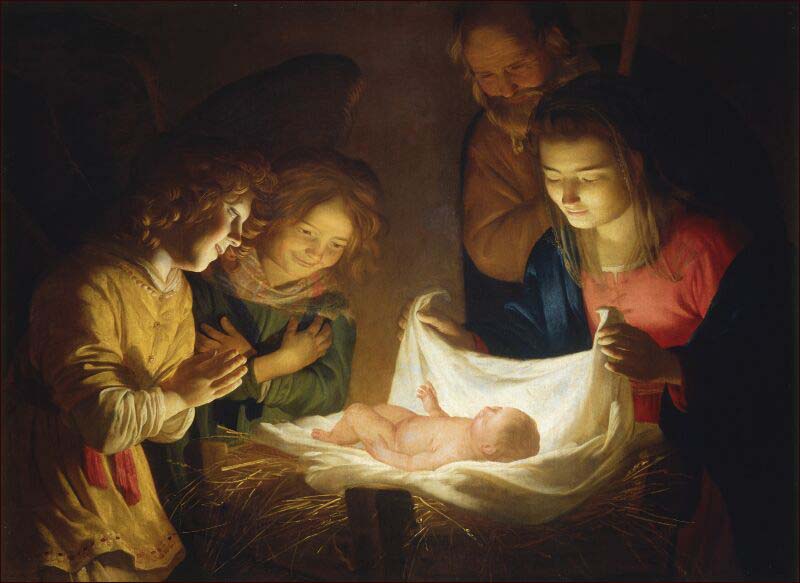
“The Adoration of the Shepherds” by Gerard van Honthorst, 1622.
During the Christmas season, it is important to focus not only on the birth of Christ, but on the person of Christ. That is, it is important for us to remember not only that Jesus was born, but who Jesus was born as. For it is not the simple fact of Jesus’ birth that gives the Christmas story significance. After all, people are born all the time. But Jesus’ identity as it is revealed in the Christmas story makes Jesus’ birth significant even 2,000 years later.
In Matthew’s Gospel, we get a clue concerning Jesus’ identity beginning with Mathew’s opening line: “A record of the genealogy of Jesus Christ the son of David, the son of Abraham” (Matthew 1:1). From here, Matthew goes on to give an extensive genealogy of Jesus’ family tree, going all the way back to Abraham. The genealogy in Luke’s Gospel goes back even farther – all the way to Adam (cf. Luke 3:23-38). These two genealogies, it should be noted, are quite different from each other, making Jesus’ family tree look quite disparate. Indeed, over the years, scholars have debated the differences between the Matthew and Luke’s genealogies of Jesus. Most often, scholars have conjectured that Matthew presents the royal genealogy of Jesus through Joseph, his stepfather, while Luke presents the biological genealogy of Jesus through Mary, His mother. What is often left out of such discussions and debates, however, is that there is actually a third Christmas genealogy that all too regularly goes unnoticed.
Where is this third genealogy? Beginning in Matthew 1:18: “This is how the birth of Jesus Christ came about: His mother Mary was pledged to be married to Joseph, but before they came together, she was found to be with child through the Holy Spirit.” The Greek word for “birth” is genesis, from which we get our English word “genealogy” In fact, this is the same word Matthew uses in 1:1 when he introduces his “genealogy [in Greek, genesis] of Jesus Christ the son of David, the son of Abraham.” Thus, in just one chapter, Matthew presents two genealogies.
So how are to understand these two genealogies? In Matthew’s first genealogy, we read of Jesus’ human origin. He is the son of David and the son of Abraham. In Matthew’s second genealogy, we read about Jesus’ divine origin. He is of the Holy Spirit. Thus, Jesus is truly man, the son of Abraham and David; but He is also truly God, conceived by the Holy Spirit and born of the virgin Mary.
Ultimately, Jesus’ status as truly man and truly God is what gives the Christmas story its significance. For as a man, Jesus can identify with us men – our weakness, struggles, and trials. But as God, Jesus can save us from our sin.
Truly man. Truly God. All of this wrapped in a manger. What an incredible story! And what a terrific reason to say, “Merry Christmas.”
Rob Bell and Inerrancy
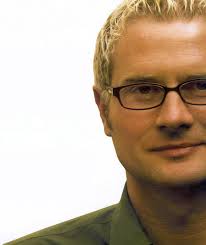 The other day, a friend sent me an article by pastor and provocateur Rob Bell on the subject of inerrancy. Traditionally, the term “inerrancy” has been defined as the belief that the biblical authors, guided and inspired by God’s Spirit, “are absolutely truthful according to their intended purposes.”[1] In other words, the biblical authors, under divine inspiration, produced writings that are “without error.” It is important to clarify that to say the Bible is “without error” does note preclude “a lack of modern technical precision, irregularities of grammar or spelling, observational descriptions of nature, the reporting of falsehoods, the use of hyperbole and round numbers, the topical arrangement of material, variant selections of material in parallel accounts, or the use of free citations.”[2] In other words, part of claiming biblical inerrancy is recognizing what does and does not constitute an actual “error.”
Regardless of the specifics concerning what does and does not constitute error, it is clear that “inerrancy” asserts an extraordinarily high view of the nature and reliability of Holy Writ. Some, however, including Rob Bell, are troubled by such an assertion.
Rob Bell teases out his beef with inerrancy thusly:
My 13 year old son is currently doing an education program that requires him to listen to a certain amount of classical music every day. So on the way to school each morning instead of listening to our usual Blink 182 and rap, he listens to…Mozart. Not his first choice, but just lately he admitted that classical music has grown on him. (How does a parent not smile at that?)
A few questions, then, about Mozart:Did Mozart’s music win?
Would you say that the work of Mozart is on top?
Is Mozart the MVP?
In your estimation, has Mozart prevailed?
Do Mozart’s songs take the cake?
Odd questions, right?
They’re odd because that’s not how you think of Mozart’s music. They’re the wrong categories.
Why?
Because what you do with Mozart’s music is you listen to it and you enjoy it.
Which brings us to inerrancy: it’s not a helpful category. And if you had only ever heard about Mozart as the one who wins, those arguments would probably get in the way of you actually listening to and enjoying Mozart.[3]
So Rob Bell’s problem with inerrancy is that for him it’s not a helpful category.
Though Rob may question the usefulness of the inerrancy “category,” countless followers of Christ have, do, and will continue to find this designation extraordinarily helpful. Yes, the word “inerrancy” is of fairly recent origin. But what it denotes – the trustworthiness of Scripture because of divine origin of Scripture – is as old as Christianity itself. Nichols and Brandt, in their book Ancient Word, Changing Worlds, helpfully sample some patristic evidence that indicates how the early Church saw the divine origin and inspiration of Scripture:
Clement of Rome, writing in 96, exhorted, “Look carefully into the Scriptures, which are the true utterances of the Holy Spirit.” Another Clement, Bishop of Alexandria, declared similarly, “I could produce then thousand Scriptures of which not ‘one tittle will pass away,’ without being fulfilled. For the mouth of the Lord, the Holy Spirit, has spoken these things.” As for a statement about the whole Bible, Origen once observed, “For the proof of our statements, we take testimonies from that which is called the Old Testament and that which is called the New – which we believe to be divine writings.”[4]
Jumping ahead to the sixteenth century, Nichols and Brandt note that John Calvin referred to Scripture as “the sure and infallible record,” “the inerring standard,” “the pure Word of God,” “the infallible rule of His Holy Truth,” “free from every stain or defect,” “the inerring certainty,” “the certain and unerring rule,” “unerring light,” “infallible Word of God,” “has nothing belonging to man mixed with it,” “inviolable,” “infallible oracles.”[5] Whoa. Calvin leaves no question as to where he stands on inerrancy.
Rob does offer some reasons as to why he believes inerrancy is not a helpful category, the first of which is, “This isn’t a word the Bible uses about itself.” But this is like saying “Trinity” is not a helpful term to describe God because it is not a term God uses to describe Himself. Terms can be helpful even when they’re not used in the Bible if these terms describe what the Bible itself teaches. And the Bible does indeed claim inerrancy for itself. One need to look no farther than the Word of God’s magnum opus on the Word of God, Psalm 19: “The law of the LORD is perfect, refreshing the soul. The statutes of the LORD are trustworthy, making wise the simple” (Psalm 19:7). If the word “perfect” doesn’t include being “without error,” what does it include?
Rob finally plays his hand as to why he is uncomfortable with inerrancy: “The power of the Bible comes not from avoiding what it is but embracing what it is. Books written by actual, finite, limited, flawed people.” Rob Bell takes issue with inerrancy because he takes issue with the doctrine of divine inspiration. He takes issue with what Clement of Rome, Clement of Alexandria, Origen, John Calvin, and, for that matter, the Bible itself claim about the Bible. Rather than being a book a written by God using men (cf. 1 Peter 1:21), the Bible for Rob is a book written by men who recount their experiences with God, which, by the way, could be mistaken and wrongheaded.[6] How do we know if their experiences with God are mistaken and wrongheaded? Rob answers: “Central to maturity is discernment, the growing acknowledgement that reality is not as clean and neat and simple as we’d like.” In other words, it’s up to us to figure out what in the Bible is wrong and what in the Bible is right. But if our world’s genocides, sexual promiscuity, oppression, economic injustice, and refusal to stand for truth because we’re not even sure of what truth is serve as any indication of our powers of discernment, in the words of Ricky Ricardo, we “have some splainin’ to do.”
Perhaps we’re not as discerning as we think we are. Perhaps, rather than tooting the horns of our own discernment faculties, we should ask the question of the Psalmist: “But who can discern their own errors” (Psalm 19:12)? Our blind spots are bigger and darker than most of us recognize.
I will grant that inerrancy has sometimes all too gleefully been used as a bully club against supposed – and, in some instances, presupposed – heretics. But I will not give up the word or the doctrine. For when inerrancy is properly understood, it is not meant as a club, but as a promise. It is a promise that we can trust this book – even more than we can trust ourselves. For this book is God’s book. And I, for one, delight in that promise because I delight in the Lord.
[1] James Voelz, What Does This Mean? Principles of Biblical Interpretation in the Post-Modern World, 2nd ed. (St. Louis: Concordia Publishing House, 1995), 239.
[2] “Chicago Statement on Biblical Inerrancy,” Article XIII (October 1978).
[3] Rob Bell, “What is the Bible? Part 21: In Air, In Sea,” robbellcom.tumblr.com (12.10.2013)
[4] Stephen Nichols and Eric Brandt, Ancient Word, Changing Worlds (Wheaton: Crossway Books, 2009), 78.
[5] Ancient Word, Changing Worlds, 78-79.
[6] Bell writes of the biblical authors in another post, “They had experiences. They told stories. They did their best to share those stories and put language to those experiences” (“What is the Bible? Part 17: Assumptions and AA Meetings”).


 Pastor Zach's Blog