Weekend Extra – Agnostic No More!

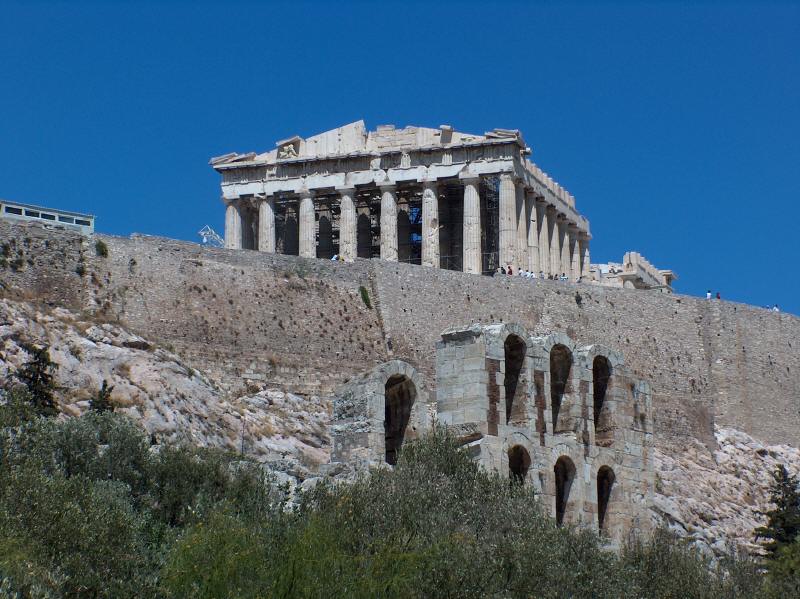
Agnostoi Theoi.  This was the inscription that graced one of a countless number of altars in the city of Athens in the first century.  It means, “To an unknown god.”  Theoi means “to god” and we get our word “agnostic” from the word agnostoi.  Though the Athenians of the first century built many altars to the gods they knew – Zeus, Poseidon, Hades, Helios and, of course, Athena, the patron goddess of Athens – the Athenians wanted to leave no god un-worshipped.  And so they built an altar to a god they might have missed.

The Athenians were agnostic – at least when it came to the god for whom they had built this altar.  But the apostle Paul refuses to leave the Athenians content in their agnosticism.  He says:

What you worship as something unknown I am going to proclaim to you. The God who made the world and everything in it is the Lord of heaven and earth and does not live in temples built by hands. In the past God overlooked such ignorance, but now He commands all people everywhere to repent. For He has set a day when He will judge the world with justice by the man He has appointed. He has given proof of this to all men by raising Him from the dead. (Acts 17:23-24, 30-31)

“Your agnosticism,” Paul says, “is not acceptable.  The God you call ‘unknown’ is not unknown at all!  He has a name – Jesus Christ!”

Importantly, Paul also says this God has “made the world and everything in it” and “is the Lord of heaven and earth.”  Zeus was the god of the sky.  Poseidon was the god of the sea.  Hades was the god of the underworld.  Helios was the god of the sun.  Athena was the goddess of Athens.  Jesus is the God of…everything.  This makes Jesus far greater than any of these other gods.  Indeed, finally, all of these other gods are not only lesser, they are not even truly gods!  Paul says to the Athenians, “Men of Athens!  I see that in every way you are very religious” (Acts 17:22).  The Greek word for “very religious” is deisidaimon.  This word can have either a positive connotation, meaning “devotion,” or a negative connotation, meaning “superstition.”  Though Paul is probably appealing to the positive sense of the word out of courtesy, finally, the Greek pantheon of gods is nothing more than superstition – and a dangerous superstition at that.  The word deisidaimon contains the word daimon, the Greek word for “demon.”  Scripturally speaking, because there is only one true God (cf. Deuteronomy 6:4), all other gods are not gods at all, but demons.  It will not suffice, then, to be merely “religious,” worshipping whatever god may suit your fancy.  For there is only one true God – Father, Son, and Holy Spirit.  Every other god is a delusion of Satan.

This past weekend in worship Pastor Tucker spoke about the mission trip a group of seventy-seven Concordians took to Crownpoint, New Mexico, a Navajo Indian community nestled in the high hills of the desert Southwest.  On the bus ride there, one of our college studnets spent a good deal of time in conversation with one of our bus drivers who was very spiritually confused.  He spoke about everyone from Mohammed to Jesus as if they were all essentially the same.  The god he worshipped was not specific or defined, but unknown.  Blessedly, our student made known to him the true gospel of Jesus Christ.  He followed the lead of the apostle Paul.

How about you?  Will you follow the apostle’s example?  Our world is full of far too much agnosticism.  But people can be transformed from ambiguous agnostics to defined disciples of Christ by the gospel.  Make the gospel known to someone who needs to hear it!

Want to learn more? Go to
www.ConcordiaLutheranChurch.com
and check out audio and video from Pastor Tucker’s
message!

Praying for our Government

Today begins Concordia’s Thirty Hour Famine for our youth.  During this special period of fasting, Concordia’s youth will devote themselves to prayer, as is the norm in Scripture: “I turned to the Lord God and pleaded with Him in prayer and petition, in fasting” (Daniel 9:3).  Among the items for which we are urging our youth to pray is our government.  In our politically divisive and derisive climate, it is important to remind ourselves what the Scriptures say about how Christians should relate to their government.  Thus, I have prepared a short synopsis of what the Scriptures say concerning governmental authorities which will be used as part of the Thirty Hour Famine.  Though simple, I thought I would publish it on my blog as a reminder of how we should appropriately engage in the political process.  I hope it’s a blessing to you!

Everyone must submit himself to the governing authorities, for there is no authority except that which God has established. The authorities that exist have been established by God.  Consequently, he who rebels against the authority is rebelling against what God has instituted, and those who do so will bring judgment on themselves.  (Romans 13:1-2)

Submit yourselves for the Lord’s sake to every authority instituted among men: whether to the king, as the supreme authority, or to governors, who are sent by him to punish those who do wrong and to commend those who do right.  (1 Peter 2:13-14)

I urge, then, first of all, that requests, prayers, intercession and thanksgiving be made for everyone – for kings and all those in authority, that we may live peaceful and quiet lives in all godliness and holiness.  (1 Timothy 2:1-2)

These passages from Scripture remind us of the importance of honoring our governmental authorities.   From these passages we learn:

  • God’s authority stands behind government’s authority.  God Himself has established all political authorities.
  • Because God’s authority is behind government’s authority, we ought to submit to our government as long as its policies do not conflict with God’s Word (cf. Acts 5:29).
  • Not only should we passively submit to the government’s authority, we should actively pray for our officials.  They deserve our prayers and honor.

Clearly, many people do not obey the Bible’s guidance when it comes to governmental authority.  Rather than respecting and praying for our governmental officials, many people mock and ridicule them and, in some extreme instances, even threaten them.  Yet, when all of these biblical admonitions to respect the governing authorities were written, the person in power was the Roman emperor Nero.  Nero hated Christians.  Some traditions hold that it was Nero who was at least indirectly responsible for the deaths of Peter and Paul, the authors of the above biblical quotes.  When a fire destroyed Rome in AD 64, Nero blamed the Christians for the city’s destruction and launched a fierce campaign of persecution against them.  The first century Roman historian Tacitus writes of Nero’s persecution:  “Covered with the skins of beasts, the Christians were torn by dogs and perished, or were nailed to crosses, or were doomed to the flames and burnt, to serve as a nightly illumination, when daylight had expired” (Tacitus, Annals 15.44).  In spite of all of this, the biblical authors still urged Christians to respect the governing authorities.

Whether or not we agree with the policies and politics of our elected officials, we should still respect our governing authorities and pray for them.  We should especially pray for them when they do things out of step with God’s Word.  We should pray that they would repent and listen to God’s voice.  We should also pray that God’s will be done, even if it is done through imperfect politicians.

Finally, we must remember that no matter who is in power, government will not and cannot solve all of this world’s problems.  Many people seem to believe that if one or another political party would only gain power in Congress and the White House, then all of our problems would be solved.  Though governmental officials can do many things, they cannot save the world.  Only Jesus can do that.  This is why, while respecting our governmental authorities, we do not put our ultimate trust in them.  We put our ultimate trust in Christ alone.