Dirt to Stars

At the church where I serve, we end each service with a commission from the apostle Paul:
Shine like stars in the universe as you hold out the word of life. (Philippians 2:15-16)
This picture from Paul is tied to the very beginning of history.
When God creates the cosmos, He fashions a couple of ruling bodies. On creation’s fourth day, He speaks into existence the ruling bodies in the sky:
God said, “Let there be lights in the vault of the sky to separate the day from the night, and let them serve as signs to mark sacred times, and days and years, and let them be lights in the vault of the sky to give light on the earth.” And it was so. God made two great lights – the greater light to govern the day and the lesser light to govern the night. He also made the stars. God set them in the vault of the sky to give light on the earth, to govern the day and the night, and to separate light from darkness. And God saw that it was good. (Genesis 1:14-18)
The stars, moon, and sun, Genesis says, “govern” the day and night. They are heavenly ruling bodies.
Then, on the sixth day, He creates some more ruling bodies on the earth:
God said, “Let Us make mankind in Our image, in Our likeness, so that they may rule over the fish in the sea and the birds in the sky, over the livestock and all the wild animals, and over all the creatures that move along the ground.” So God created mankind in His own image, in the image of God He created them; male and female He created them. God blessed them and said to them, “Be fruitful and increase in number; fill the earth and subdue it. Rule over the fish in the sea and the birds in the sky and over every living creature that moves on the ground.” (Genesis 1:26-28)
Human beings, Genesis says, “rule” over all creatures. They are earthly ruling bodies.
As Genesis goes on to explain, these human beings who rule over the earth come from the earth:
The LORD God formed a man from the dust of the ground and breathed into his nostrils the breath of life, and the man became a living being. (Genesis 2:7)
And yet, there is this hope that human beings, like the heavenly ruling bodies, will not just be dirty and dark, but will shine like the lights in the sky. Sin, of course, dashes this hope when God tells Adam that He will return to the dirt:
Dust you are and to dust you will return. (Genesis 3:19)
But Paul restores this hope. He says we will “shine like stars in the universe” (Philippians 2:15). But how? Paul explains:
Do everything without grumbling or arguing, so that you may become blameless and pure, “children of God without fault in a warped and crooked generation.” (Philippians 2:14-15)
Paul says when we live without grumbling or arguing, we shine. We go from being dirt from the world to offering light and hope for the world.
This world is full of dirty stuff. Let’s not add to it by our grumbling and arguing. Let’s shine light on it by our joy and peacefulness. This is our world’s need – and the Church’s call.
Anger and Forgiveness

A new study published in the Oxford Journal of Gerontology finds that those who work to resolve arguments quickly – or avoid arguments altogether – improve their long-term health. Researchers from Oregon State University found that the longer a person lets an unresolved conflict linger, the heavier and more significant it begins to feel. Robert Stawski, the senior author of the study, explains:
Everyone experiences stress in their daily lives. You aren’t going to stop stressful things from happening. But the extent to which you can tie them off, bring them to an end, and resolve them is definitely going to pay dividends in terms of your well-being. Resolving your arguments is quite important for maintaining well-being in daily life.
The study found that, if possible, it is best to resolve a conflict the same day it arises. Dr. Stawski added:
The extent to which you can tie off the stress so it’s not having this gnawing impact at you over the course of the day or a few days will help minimize the potential long-term impact.
Of course, this insight of resolving conflict within a day is not new to this study. Long before there was this study, there was the apostle Paul who wrote:
“In your anger do not sin”: Do not let the sun go down while you are still angry, and do not give the devil a foothold. (Ephesians 4:26-27)
Unresolved anger is dangerous, Paul writes – not only emotionally, but spiritually. It gives the devil himself a foothold in your heart.
As a pastor, it is not uncommon for me to have a conversation with someone who is nursing a grudge and stewing in anger. And, to put it bluntly, they’re miserable. The problem is it’s difficult to stop a feeling. When I become angry, I don’t consciously choose to become angry. Anger just, well, happens. But even if I don’t consciously choose to become angry, I can consciously choose to calm down. I can talk to a friend who I trust to give me perspective. I can talk to myself and remind myself that my anger solves nothing. I can talk to the Lord and ask Him to bring me peace. And I can forgive. To quote the apostle Paul again:
Get rid of all bitterness, rage and anger, brawling and slander, along with every form of malice. (Ephesians 4:31)
In other words, even if you can’t stop anger from bubbling up in your heart, when it does, you are called to get rid of it as fast as you can. But how? Paul tells us in the very next verse:
Be kind and compassionate to one another, forgiving each other, just as in Christ God forgave you. (Ephesians 4:32)
Anger, Paul says, is nothing forgiveness can’t fix. Yes, forgiveness is hard. Choosing to release a grudge against someone when they have hurt you is a heavy task. But anger is dangerous. And it’s heavy, too. So, choose what is better for them – and for you. Choose forgiveness.
God’s Presence in Pain
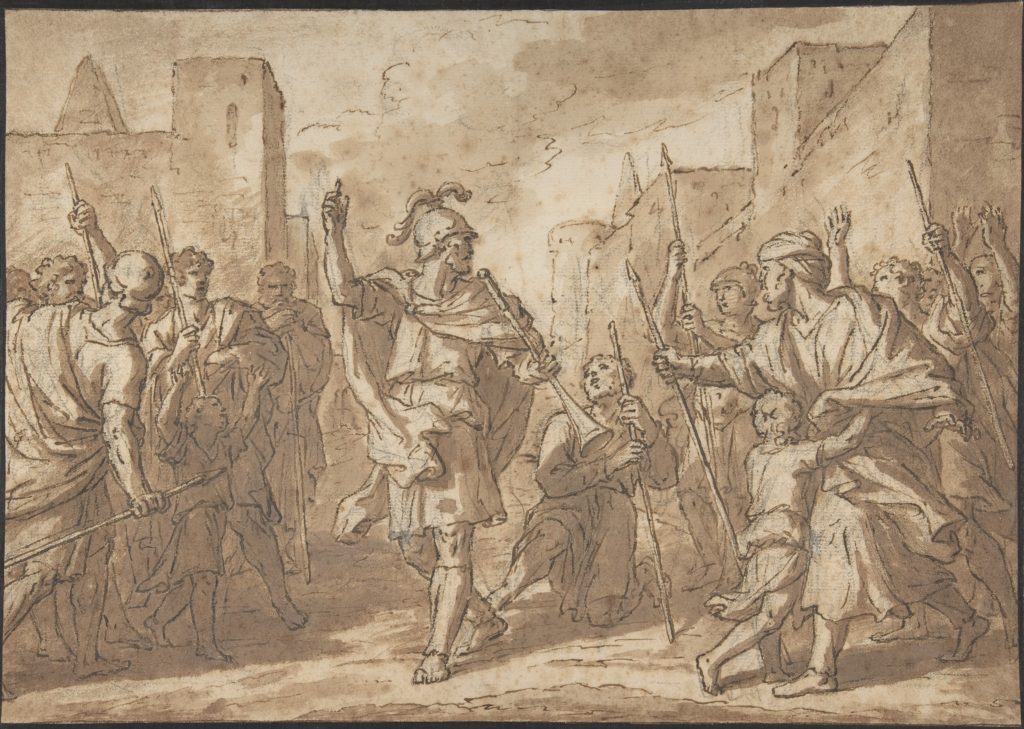
In Judges 6, the Midianites are warring with the Israelites. The Midianites are so successful in their campaign against Israel that the Israelites head for the hills – literally:
Because the power of Midian was so oppressive, the Israelites prepared shelters for themselves in mountain clefts, caves and strongholds. (Judges 6:2)
But God is preparing to rescue the Israelites from their oppressors. He appears to a man named Gideon and greets him with a flattering title and a promise of his presence:
The LORD is with you, mighty warrior. (Judges 6:12)
Gideon, however, is not dazzled, but dubious:
If the LORD is with us, why has all this happened to us? (Judges 6:13)
Gideon’s question is a perennial one. When bad things happen to us, it is easy to assume that God has taken a leave of absence from us. But nothing could be further from the truth.
Gideon’s story opens with this setting:
The Israelites did evil in the eyes of the LORD, and for seven years He gave them into the hands of the Midianites. (Judges 6:1)
It turns out not that God was deserting the Israelites, but that the Israelites were rejecting Him. They were turning their backs on the Lord in sin. God sends suffering not because He has deserted Israel, but because He is appealing to Israel: “Repent and turn toward Me!” He wants the Israelites’ suffering to drive them into His arms.
Our suffering can be similar. People sometimes wonder if some suffering they are experiencing is a result of some sin they have committed, as is the case with the Israelites in Gideon’s time. Oftentimes, it is not. Commenting on a recent slaughter of Galileans by Pontius Pilate, Jesus asks:
Do you think that these Galileans were worse sinners than all the other Galileans because they suffered this way? I tell you, no! (Luke 13:2-3)
Jesus is clear that suffering need not be connected to a specific sin. But, in the final analysis, why suffering happens is far less important than what suffering can accomplish. It can drive us to God and strengthen our faith. As Peter writes:
Now for a little while you may have had to suffer grief in all kinds of trials.These have come so that the proven genuineness of your faith – of greater worth than gold, which perishes even though refined by fire – may result in praise, glory and honor when Jesus Christ is revealed. (1 Peter 1:6-7)
Are you suffering? Are you troubled? God’s words to Gideon are also God’s words to you:
The Lord is with you.
God walks with you in suffering. You are not alone.
Put Down Your Sword

When I was in seminary, I took a road trip with some buddies to the tiny west Texas town of Marfa, famed for its “mystery lights.” These lights appear regularly at dusk and before dawn on Mitchell Flat, just east of Marfa. Strange orbs hover in the night sky – joining with and separating from each other, appearing and disappearing, and changing colors. For decades, researchers, scientists, and curious onlookers have tried to figure out the mystery of the lights. Some say they’re a mirage caused by sharp temperature gradients between cold and warm layers of air. Others say they’re headlights from nearby U.S. Highway 67. Others have paranormal explanations.
The night I and my buddies saw the lights, we made it our mission to solve the mystery once and for all. We took my friend’s Camaro off-roading across the plain to catch the lights. Shockingly enough, we did not. We did, however, raise the hackles of some very annoyed locals who did not like us leaving tire tracks across their land. They let us know in no uncertain terms that the plain was off-limits and it was time for us to leave.
When Adam and Eve stray from God’s command to not eat from the fruit of the tree of the knowledge of good and evil and go off-roading into evil, God lets them know in no uncertain terms that the idyllic Garden of Eden in which He has placed them is now off-limits and that it is time for them to leave. In fact, just to ensure they never enter the Garden again, He installs what is quite literally a “flashy” security system:
He placed on the east side of the Garden of Eden cherubim and a flaming sword flashing back and forth to guard the way to the tree of life. (Genesis 3:24)
Adam and Eve were able to eat from the tree of life before their fall into sin because they were designed to live eternally. But now, that tree and God’s garden is blocked by a sword that will bring about their death if they try to breach it.
The night before Jesus goes to the cross, He, like Adam and Eve, finds Himself in a garden – the Garden of Gethsemane. After He spends some agonizing moments in prayer about His impending torture and death, a coterie of Jesus’ enemies comes to arrest Him and drag Him away to a series of show trials to try to convict Him of heresy against Jewish theological teaching and treason against the Roman government. Peter, who is with Jesus, boldly brandishes his sword and cuts off the ear of the high priest’s servant, who is part of the seditious mob. But Jesus, instead of thanking Peter for his loyalty, rebukes him:
Put your sword back in its place, for all who draw the sword will die by the sword. (Matthew 26:52)
It was a sword that once guarded Adam and Eve from a garden. But Jesus will not allow a sword to guard Him in a garden.
Jesus, it turns out, has come to cast out the sword from the garden. As He makes His way to the cross, He is systematically disarming the curse of sin that blocks us from eternal life and threatens our eternal death. The sword is disarmed. The garden is open. As Charles Wesley says in his great Easter hymn:
Love’s redeeming work is done, Alleluia!
Fought the fight, the battle won, Alleluia!
Death in vain forbids His rise, Alleluia!
Christ hath opened paradise, Alleluia!
The paradise that was once closed by a curse to Adam and Eve has been opened to us by a cross. That most certainly deserves our hearty, “Alleluia!”
Why We Need Easter

In an article for The Washington Post, Emma Pattee writes about how the COVID-19 pandemic has brought us face-to-face with the reality of our mortality:
You probably remember where you were that day in March when you first realized that the novel coronavirus was something …
I remember where I was: driving to the gym for a Mommy & Me boot camp.
I pulled up to a red light and locked eyes with my 6-month-old baby in the rearview mirror. I felt unsettled and scared. I had an inexplicable urge to go home, and also to call everyone I knew and check on them. Yet nothing had happened. I was safe, healthy and employed. At that point, in mid-March, I was more likely to die of a car accident than of contracting covid-19 …
That eerie uncomfortable feeling has been described as grief. As fear. Or anxiety. But Sheldon Solomon, a social psychologist and professor at Skidmore College, has a more robust explanation: It is the existential anxiety caused by reminders of our own mortality.
Simply put, to function as a conscious being, it’s imperative that you be in denial about your impending death. How else would you go about the mundane aspects of your daily life – cleaning the gutters, paying the bills, sitting in traffic – if you were constantly aware of the inevitability of your own death?
Ms. Pattee goes on to cite studies that have found that we seem to be hardwired to fear death and to avoid thinking about it:
A neurological study was published in 2019 about a mechanism in the brain that avoids awareness of a person’s own mortality and that categorizes death as something unfortunate that happens to other people. …
An Israeli study showed some participants a flier about death anxiety and others one about back pain. When subjects were then offered an alcoholic beverage, one-third of the death flier group bought alcohol vs. one-tenth of the back-pain group.
We don’t like death. And the day we celebrated yesterday – Easter – gives us an answer as to why.
Scripture’s story is that we were created not to die, but to live. But when our first parents, Adam and Eve, fell into sin, they reaped the wage of sin, which is death (Romans 6:23). But this wage disordered the way creation was designed to be. It was designed to be filled with life – not marred by death.
Our dislike and fear of death, then, can be rightly said to be a yearning for the way we know things “should be.” We should not have to mourn the loss of our loved ones. We should not have to struggle and suffer through a pandemic. We should not have to endure horrific acts of violence that lead to death like wars and mass shootings. We should not have to deal with death. We can sense that dealing with death is, in some way, profoundly unnatural.
This is why we need Easter. Easter is the beginning of a return to the way they were always supposed to be. As Timothy Keller puts it in his book Hope in Times of Fear:
The resurrection was indeed a miraculous display of God’s power, but we should not see it as a suspension of the natural order of the world. Rather it was the beginning of the restoration of the natural order of the world, the world as God intended it to be.
In other words, death is wrong. Resurrection is right. Life is what the world was designed for, which is why it’s what we yearn for. And our yearnings will be fulfilled.
Christ’s resurrection is not only a feat against death, but a forecast that death will not have the last word. Christ’s resurrection, the apostle Paul says, is a “firstfruits” of our own resurrections (1 Corinthians 15:20). As Christ is risen, we will rise. And death will die. This is the message and the promise of Easter.
I hope you celebrated Easter well yesterday. And I hope you’ll hold on to all that Easter is today – and every day.
The Fig Tree Undone

Yesterday began Holy Week, which commemorates the final days of Jesus’ life along with His crucifixion and resurrection. On the Monday of Holy Week, Jesus performs one of His most puzzling acts:
Jesus was hungry. Seeing in the distance a fig tree in leaf, He went to find out if it had any fruit. When He reached it, He found nothing but leaves, because it was not the season for figs. Then He said to the tree, “May no one ever eat fruit from you again.” And His disciples heard Him say it.
In the morning, as they went along, they saw the fig tree withered from the roots. Peter remembered and said to Jesus, “Rabbi, look! The fig tree You cursed has withered!” (Mark 11:12-14, 20-21)
What an odd episode. Jesus fierily curses a fig tree for no apparent reason. What is going on?
When Adam and Eve fall into sin after disobeying God’s command not to eat the fruit from the tree of the knowledge of good and evil, Genesis records:
The eyes of both of them were opened, and they realized they were naked; so they sewed fig leaves together and made coverings for themselves. (Genesis 3:7)
An old Jewish tradition claims that the forbidden fruit itself was figs, with a Talmudic rabbi writing:
That which caused their downfall was then used to rectify them.
In other words, Adam and Eve tried to use the fruit with which they sinned to cover their sin.
But Adam and Eve’s pitiful fig leaf getups prove useless. They cannot hide their sin from God. God confronts them in their sin, curses them because of their sin, but then blesses them despite their sin:
The LORD God made garments of skin for Adam and his wife and clothed them. (Genesis 3:21)
God sacrifices and skins an animal to make a garment far better than anything they can make for themselves.
Jesus’ strange fig tree curse hearkens back to Adam and Eve’s fig leaf failure. Our pathetic attempts to hide our sin never work. So, on His way to the cross, Jesus graphically condemns every human attempt to fix ourselves in our sin when He curses a fig tree and its leaves. But in its place, God sacrifices His Son and gives us a garment infinitely better than anything we can come up with by ourselves – “a robe of His righteousness” (Isaiah 61:10)
Jesus’ curse on the fig tree undoes the curse of our sin and reminds us that there is a better tree – not a fig tree that brings death, but a cruciform tree that grants life.
New Discoveries of Old Scrolls
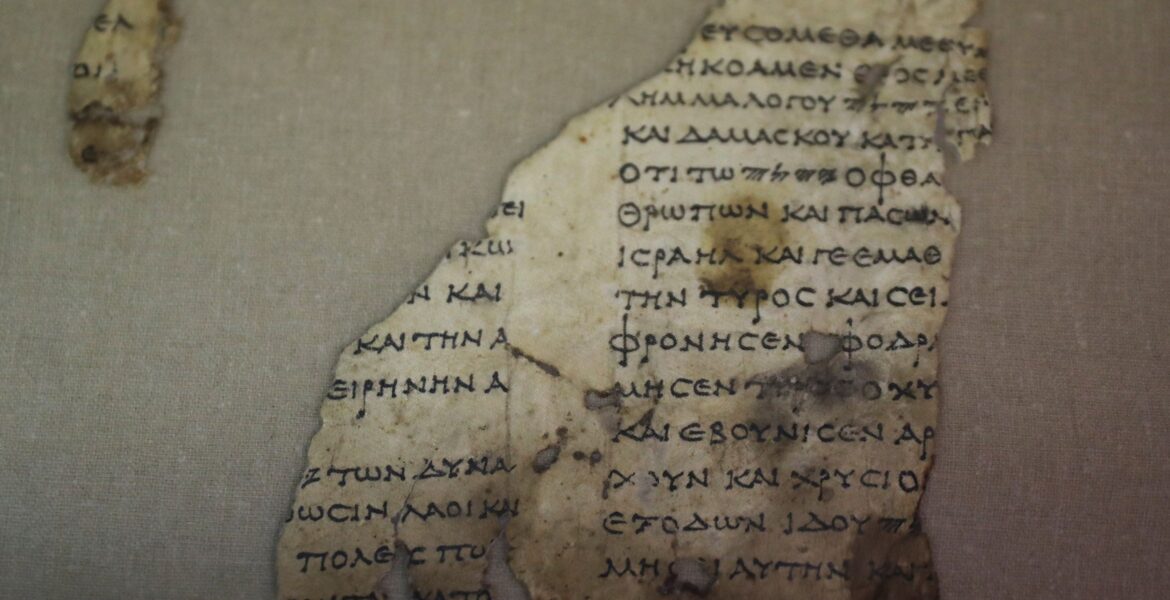
Last Tuesday, researchers unveiled newly discovered fragments of some Dead Sea Scrolls. These fragments represent the first discovery of Dead Sea Scrolls in over 50 years and contain verses from Zechariah 8:16-17 and Nahum 1:5-6. And there’s plenty notable about these discoveries.
First, the text of these fragments is written in Greek, the language of the New Testament, instead of in Hebrew, the language of the Old Testament, even though Zechariah and Nahum are Old Testament prophets. This is because these scrolls were written in the first century AD when the world spoke Greek. This is a reminder that the Jewish people treated their Hebrew Scriptures as eminently important, so they translated them into the lingua franca of the ancient world so that as many people as possible could read them and learn from them. They believed their Scriptures were good for the world and needed by the world.
Second, these fragments seem to indicate that there was some debate over how certain passages should be translated from their original Hebrew into the contemporary Greek of their day. The translation work in these fragments represents a revision of an older Greek translation of the Hebrew Bible. So, for instance, in Zechariah 8:17, the older Greek translation renders a Hebrew word ish as “each other.” The verse reads, “Do not plot evil against each other.” This fragment, however, notices that, in the Hebrew manuscript, ish is the first word in the sentence and therefore leaves it there, and translates it using its most common meaning of “man.” It translates: “As for a man, do not plot evil against his neighbor in your heart.” This shows that, dating all the way back into the first century, people took translating the Scriptures seriously, even debating how to best translate various verses and difficult grammatical constructions. Their goal was to provide as accurate a rendering as possible of the original language texts they had because they held the Scriptures in such high regard. They wanted to be supremely careful in how they translated these holy documents.
Finally, these fragments also, quite uniquely, use the personal name for God: Yahweh. The scrolls leave the name of God in Hebrew with Hebrew letters, even though these are Greek manuscripts. Traditionally, in an attempt to avoid coming even close to misusing God’s name, translators would address God formally as “Lord” instead of invoking God’s name personally as “Yahweh.” But these manuscripts get personal. These translators seemed to have wanted to emphasize that there is a personal God who cares about people – personally.
A discovery like this reminds us that people have long revered the Scriptures and treated them with the utmost care. These were always considered to be sacred documents. They were not exalted to such a status later. This discovery also provides us a window into the faith of our forefathers, who trusted in a personal God and His personal concern for them. From them, we have learned the faith. From them, we have learned the Gospel. And for them, we should be thankful.
The COVID-19 Vaccines

It’s been a long year, but there finally seems to be some good news in the battle against COVID 19. New infections, hospitalizations, and deaths are down. Vaccinations against the virus are up. Two weeks ago, vaccination sites across the nation doled out 2.2 million shots in arms. The CDC has also issued fresh guidance for those who have been fully vaccinated, allowing them to gather in small groups without face coverings or social distancing. In even more good news, new research shows that the Pfizer-BioNTech vaccine is effective at neutralizing many of the virus variants. Hope seems to be dawning, even if there’s still more work to do.
But with new hope comes new questions. One of the most concerning questions I have heard recently has to do with how the COVID-19 vaccines are connected to abortion. Abortion is one of the gravest moral issues of our day, so a concern like this deserves and demands our serious consideration.
The question of how the COVID-19 vaccines are connected to abortion arises out of how these shots were developed and tested. They were developed and tested using fetal cell lines, grown in laboratories, that began as fetal tissue from elective abortions, though the cells used in conjunction with these vaccines are now thousands of generations removed from the original fetal tissue.
The Pfizer-BioNTech and Moderna vaccines, to the best of my knowledge, were not developed from fetal cell lines, but were tested on fetal cell lines. The Johnson & Johnson vaccine is a different story. It did indeed use a fetal cell line in the process of its development. In the case of the Johnson & Johnson vaccine, then, a fetal cell line was an actual source for the vaccine. Without that fetal cell line, there might have, ostensibly, been no Johnson & Johnson vaccine. In the cases of Pfizer-BioNTech and Moderna, their vaccines could have still existed quite apart from any interaction with a fetal cell line.
Do such interactions with these fetal cell lines raise serious ethical questions? Yes. Are the answers to these ethical questions easy or straightforward? Not so much. Some Roman Catholic archdioceses, for instance, are encouraging people to try to avoid taking the Johnson & Johnson vaccine because of how it was developed while other archdioceses are encouraging people to take whatever vaccine is offered them.
As I’ve been considering the complicated questions involved in the development and research of these vaccines, there is a biblical framework that has been helpful to me. When an angry crowd demands Jesus’ death, they do so in a great act of evil. But from Jesus’ unjust death springs forth awesome life, as Easter so wonderfully demonstrates. Likewise, these fetal cell lines spring from abortive acts that tragically and painfully brought about death. But even after these abortions, life has stubbornly held on in fetal cell lines. Though I continue to have weighty ethical reservations about these cell lines, this framework does provide me with a surprising reminder that no matter how final and grim death may seem, life will ultimately prove victorious.
If you are trying to figure out whether you should receive a COVID-19 vaccine, I would encourage you to prayerfully, carefully, and conscientiously consider the ethical concerns and questions, and consult with your physician. The benefits of receiving a vaccine are immense. That researchers, scientists, and medical professionals developed a vaccine for a novel coronavirus inside of nine months can be rightly regarded as astounding. But I also understand the ethical questions are real. I am thankful for these vaccines. I also look forward to the day when, just like we work tirelessly to save lives at risk in a pandemic, every life in every womb will be honored and celebrated.
The Shadow-Side of Freedom

Last week, the latch on our backdoor handle got stuck. After working it loose, I discovered that the whole handle was worn out and needed to be replaced. I groaned inwardly because I am not known for being handy. To put it mildly, I am “home improvement compromised.” But, after trudging to Lowe’s to purchase a new handle, I scoured YouTube and found a guy with a thick southern accent who walked me through the process of replacing a door handle step-by-step. Everything was replaced, rekeyed, and ready to go within a few minutes. And I was more than a little thankful for the YouTube handyman who was wiser to the ways of door handles than I was.
In a famous 1946 lecture, existentialist philosopher Jean-Paul Sartre quipped:
Man cannot find anything to depend upon either within or outside himself. He discovers forthwith, that he is without excuse.
Sartre argues that when it comes to living, you just have to “figure it out.” He goes on to tell the story of a young man, who was once a student of his, who struggled to decide whether to stay and care for his mother in Paris or join the Free French Forces and fight the Nazis. Sartre asks of this young man’s moral dilemma:
What could help him to choose? Could the Christian doctrine? No. Christian doctrine says: Act with charity, love your neighbor, deny yourself for others, choose the way which is hardest, and so forth. But which is the harder road? To whom does one owe the more brotherly love, the patriot or the mother?
If values are uncertain, if they are still too abstract to determine the particular, concrete case under consideration, nothing remains but to trust in our instincts.
According to Sartre, this young man was just going to have to “figure it out.”
Sartre concludes his lecture:
Life is nothing until it is lived; but it is yours to make sense of, and the value of it is nothing else but the sense that you choose.
Sartre’s lecture, at first glance, carries with a lucrative offer of freedom. There is no higher authority of power, he argues, to which you can appeal to make life’s decisions than yourself. You can choose for yourself by looking to yourself. But, as my door handle experience reminded me, there are times where looking to yourself is not freeing, but frightening. Sartre admits as much when he says:
Man is condemned to be free. Condemned, because he did not create himself, yet is nevertheless at liberty, and from the moment that he is thrown into this world he is responsible for everything he does.
Too much freedom, it turns out, can feel like condemnation because, as initially nice as it may be to jettison a higher authority who looks over your shoulder and tells you what to do, you are still not truly free in one very important way – you are not free not to choose. You must choose something and then live with the consequences of your choice, no matter how awful. Everything rests on you, and you just have to “figure it out.”
The promise of Christianity is not that it removes or avoids all human responsibility and choice. There are plenty of calls in the pages of Scripture for humans to live morally and to choose wisely. But all of this human responsibility is placed inside a larger story of divine sovereignty. God is ultimately in control, offering guidance so that we may make righteous decisions and offering forgiveness for all the times we do not. We are not left merely to our own devices to “figure it out.”
One of the implicit criticisms Sartre levels against Christianity is in the story of his young student who is trying to decide between remaining in Paris to take care of his mother or joining the Free French Forces to fight the Nazis. Sartre explains that divine guidance will do this man no good because there is no divine guidance to tell this man what to do:
What could help him to choose? Could the Christian doctrine? No. Christian doctrine says: Act with charity, love your neighbor, deny yourself for others, choose the way which is hardest, and so forth. But which is the harder road? To whom does one owe the more brotherly love, the patriot or the mother?
But Sartre misses something in his characterization of God’s guidance. The young man in Sartre’s story faces two choices that could be considered moral. But just because there is no divine command that will make this young man’s particular decision for him does not mean that there is no sovereign help.
The Psalmist says:
The LORD is with me; He is my helper. (Psalm 118:7)
A lack of specific guidance from God about a specific decision does not mean that there is a lack of the presence of God through every decision. God will be with us – in our best decisions and our worst – with a freedom that removes burdens instead of one that creates them. For even when we don’t know what to do, He will help us through, and He will work things out, even when things – or when we – go astray. We don’t just have to “figure it out.” Instead, we can trust in Him.
Jesus’ Love For Children Lost

One of the most moving moments of being a pastor is sitting with a family who has just lost a child. Perhaps they had a miscarriage. Perhaps their baby never made it out of the NICU. Perhaps their child lost their life in a tragic accident. There are many questions that a family asks at a moment like this:
How could God allow this to happen?
Did this happen because we did something wrong?
But there is one question I want to focus on in this blog:
Is my child in heaven with Jesus?
This is a weighty question because it reaches beyond a parent’s present pain and cries out desperately for an eternal hope. It deserves our serious consideration.
There is a famous episode in Mark 10 that gives us a glimpse into Jesus’ relationship with children:
People were bringing little children to Jesus for Him to place His hands on them, but the disciples rebuked them. When Jesus saw this, He was indignant. He said to them, “Let the little children come to Me, and do not hinder them, for the kingdom of God belongs to such as these. Truly I tell you, anyone who will not receive the kingdom of God like a little child will never enter it.” And He took the children in His arms, placed His hands on them and blessed them. (Mark 10:13-16)
There is an interesting debate over Jesus’ words in verse 14 when He says, “The kingdom of God belongs to such as these.” What is the referent of “such as these”? Some say the referent is found at the beginning of verse 14 in “the little children.” This means that Jesus is not only welcoming a particular group of little children into His arms at this moment, but making a broader declaration about how the kingdom of God belongs to many other little children who are like these but who are also beyond these. The phrase “such as these,” then, reminds us that “Jesus loves the little children – all the children of the world.”
There are others, however, who argue that the phrase “such as these” is better informed by the word “anyone” in the next verse. In this interpretation, Jesus is not declaring that little children can enter His kingdom. Instead, He is only calling people in general to have a childlike faith. Though Jesus is certainly calling people to have a childlike faith in verse 15, syntactically, the specific referent of “such as these” is quite clear. In Greek, the word for the phrase “such as these” is tointoun, which is neuter. The word for the children who come to Jesus is paidia, which is also neuter. The word for “anyone” in verse 15 is hos, which is masculine. It is important to note that the genders of each of these words are incidental features of Greek syntax and not determinative of which genders of human beings can and cannot enter God’s kingdom. Syntactically, however, Greek pronouns and nouns do need to generally match in their genders. Thus, the first interpretation of which referent is the appropriate one for the phrase “such as these” is correct: it is children like the ones who are coming to Jesus in Mark 10 who can enter God’s kingdom. Age is no barrier to a relationship with God through Jesus Christ.
Of course, I would not walk a grieving family who has just lost a child through the technicalities of the Greek syntax in Mark 10 like I did in this blog. But a careful consideration of the syntax is important for my pastoral ministry because it allows me to confidently proclaim:
Jesus welcomes children into His kingdom.
Just because a baby cannot intellectually assent to the great truths of the Christian faith does not mean they are barred from eternal life. Indeed, one of the reasons that adults can have a faith like a child is because there is such a thing as a faith of a child (cf. Matthew 18:6). Children – and even babies – can sing babbling praises to the Lord (Matthew 21:15-16). Babies – and even infants in the womb – can respond to God’s good news of a Messiah (Luke 1:41-42). A child lost to a parent does not mean a child lost to the Lord.
If you are reading this and you have lost a child, this I want you to know:
Jesus welcomes children into His kingdom.
You can have hope.
If you are reading this and you have a child or are expecting one, share with them God’s Word, even from the womb. Allow them to hear the voice of their Savior calling them. It’s never too early to teach the faith because it’s never too early for someone to have faith. And it is by faith that we live – and live eternally.


 Pastor Zach's Blog