“Word for Today” – Luke 14 – www.concordialutheranchurch.com
 In the 2001 remake of the famed heist film, Ocean’s 11, I found my favorite character to be Rusty Ryan, played by Brad Pitt. Do I like him because he has the raw street smarts to pull off a $150 million heist at three Las Vegas Casinos simultaneously? Nope. Do I like him because he is able to coolly keep his partner, played by George Clooney, in check when as he plans this job only to impress his ex-wife? Not really. The reason I like Brad Pitt is because, in almost every scene, Brad Pitt is found chowing down on some piece of junk food. Indeed, this turned into an intentional gag, as Pitt later himself admitted: “I started eating, and couldn’t stop. I don’t know what happened. It’s just the idea that you never have time to sit down and have a meal while you’re trying to pull off this heist, so my character is grabbing food all the time.” Now there’s a man after my own heart. He starts eating and he can’t stop. I know the feeling.
In our reading for today from Luke 14, Jesus seems to be always eating. The chapter opens: “One Sabbath, Jesus went to eat in the house of a prominent Pharisee” (verse 1). From there, the food motif continues. Jesus tells a parable: “When someone invites you to a wedding feast, do not take the place of honor, for a person more distinguished than you may have been invited” (verse 8). He then follows up this food-based parable with another meal metaphor: “When you give a luncheon or dinner, do not invite your friends, your brothers or relatives, or your rich neighbors; if you do, they may invite you back and so you will be repaid” (verse 12). What is Jesus’ obsession with food? Is this some kind of intentional gag?
It is indeed intentional, but it is certainly no gag. The majority of people in the Ancient Near East subsided on next to nothing. That is, rather than having a super-abundance of food, they lived on scarcity. One famine, one drought, or one natural disaster could kill hundreds of thousands of people because they had few reserves in place to stymie a crisis. Thus, the Old Testament prophets would often promise a day when people would no longer have to contend with these restricted resources. They would speak of a day of feasting. The prophet Isaiah writes, for instance, “The LORD Almighty will prepare a feast of rich food for all peoples, a banquet of aged wine – the best of meats and the finest of wines” (Isaiah 25:6). The Psalmist promises likewise: “Those that be planted in the house of the LORD shall flourish in the courts of our God. They shall still bring forth fruit in old age; they shall be fat and flourishing” (Psalm 92:13-14). In our day, a promise of fatness is hardly desirable. But in the first century, when food was scarce, a promise of fatness was a promise of provision. It was a promise of a lavish feast.
When Jesus speaks of several feasts in Luke 14, he is saying: “I am the fulfillment of God’s provisional promises. With me, God’s feast has come!” This is why Jesus continues with yet another parable on food:
A certain man was preparing a great banquet and invited many guests. At the time of the banquet he sent his servant to tell those who had been invited, “Come, for everything is now ready.” But they all alike began to make excuses. The first said, “I have just bought a field, and I must go and see it. Please excuse me.” Another said, “I have just bought five yoke of oxen, and I’m on my way to try them out. Please excuse me.” Still another said, “I just got married, so I can’t come.” (verses 16-20)
It is important to understand that the excuses these guests offer as to why they cannot attend this king’s feast are offensive and disingenuous. To turn down any invitation to share in a meal, much less to share in a lavish feast such as this one, would have been unthinkable in that day. But this is what these ungrateful invitees do. Thus, the king responds by ordering his servant: “Go out quickly into the streets and alleys of the town and bring in the poor, the crippled, the blind and the lame” (verse 21). This king, one way or another, will have guests at his feast. And these marginalized people will certainly not turn down the king’s invitation. And indeed they don’t. They come to the king’s feast. But even after they come, the servant returns to his king and says, “Sir, what you ordered has been done, but there is still room.” (verses 21-22).
I love these words. Even after the poor, the crippled, the blind, and lame fill the king’s banquet hall, there is still room. There is still room for more feasters. There is still room for more banqueters. There is still room.
The king in the parable, of course, is Jesus himself. And the invitees to Jesus’ banquet are you and me. We are invited to share in Jesus’ feast of salvation. And if you have not yet trusted in Jesus’ invitation to salvation, I have some good news for you: There is still room. There is still room enough for you to share in God’s salvation. There is still room enough for you to share in God’s grace. There is still room enough for you to share in God’s forgiveness. There is still room enough for you. So come to Jesus’ feast and share in his goodness. After all, there is still room enough at his table…just for you.
“Word for Today” – Luke 13 – www.concordialutheranchurch.com
 I know the stereotype demands that, when preparing for a trip, guys pack light while women bring five suitcases for a two-night stay, but as much as I hate to confess this, I tend to pack pretty heavily myself. Granted, I don’t necessarily bring an exorbitantly large number of personal effects, but I always bring my work bag, crammed with books and papers, determined to “catch up” on a bunch of work while I have some “down time.”
When I’m flying, it’s my workbag that I take with me as my carry on. However, it is almost always comically bursting at the seams as I lug it down the jet way to my aircraft. This means that it also becomes incredibly difficult to fit my overstuffed carry on under the seat in front of me. But that’s okay. I have a system. I start with the bottom of my bag and begin to jam it under the seat. Then, if it doesn’t fit, I pull out a book or two and hold them in my lap. After all, I’ll want to read those on the flight anyway. If it still doesn’t fit, it’s nothing a good-old-fashioned kick can’t solve. And with that, my bag becomes irremovably lodged under the seat in front of me. I always stand amazed at how much carry on I can fit into such a small space. There’s a lot more space under that seat than you might first think.
In our reading for today from Luke 13, Jesus is asked a question: “Lord, are only a few people going to be saved” (verse 23)? This man wants to know: “How many people can God cram into the kingdom of heaven?” Interestingly, Jesus does not answer this man’s question directly, but instead offers a picture of the door which leads to salvation:
Make every effort to enter through the narrow door, because many, I tell you, will try to enter and will not be able to. Once the owner of the house gets up and closes the door, you will stand outside knocking and pleading, “Sir open the door for us.” But he will answer, “I don’t know you or where you came from…Away from me, you evildoers!” (verses 24-25, 27)
Jesus calls heaven’s entrance a “narrow door.” Some have taken this to mean, as Jesus’ questioner opines, that only an elect few will be saved. An old nineteenth century Baptist hymn expresses this sentiment thusly: “We are the Lord’s elected few, let all the rest be damned. There’s room enough in hell for you; we don’t want heaven crammed!” As you have hopefully already deduced, this is hardly an accurate paraphrase of Jesus’ teaching.
The Greek here is interesting. The word for “door” is pule which is commonly used to describe not the doors of normal, everyday houses, but the gates of cities and palaces. In other words, a pule is not just a door, it’s a large door. Thus, Jesus’ language is almost oxymoronic: “Make every effort to enter through the little big door.”
What is Jesus’ point? The door to salvation does indeed look narrow and small. And you may wonder how anyone can fit through such a small space. But there’s a lot more room in heaven than you might first think, for the door to heaven is a little big door.
Indeed, this is exactly what Jesus says: “People will come from east and west and north and south, and will take their places at the feast in the kingdom of God” (verse 29). Even though the gate to heaven is narrow, and even though many will be left outside “weeping and gnashing their teeth” (verse 28) because of unbelief, heaven will still be packed with believers from every corner of the earth – east and west, north and south.
Jesus draws his words concerning the earth’s four corners in verse 29 from Psalm 107:
Give thanks to the LORD, for he is good; his love endures forever. Let the redeemed of the LORD say this – those he redeemed from the hand of the foe, those he gathered from the lands, from east and west, from north and south. (Psalm 107:1-3)
God will redeem people from every corner of the earth, says the Psalmist. The Psalmist then continues:
Some wandered in desert wastelands, finding no way to a city where they could settle. Then they cried out to the LORD in their trouble, and he delivered them from their distress. Some sat in darkness and the deepest gloom, prisoners suffering in iron chains. Then they cried to the LORD in their trouble, and he saved them from their distress. Some became fools through their rebellious ways and suffered affliction because of their iniquities. Then they cried to the LORD in their trouble, and he saved them from their distress. (Psalm 107:4, 6, 10, 13, 17, 19)
Some from here, some from there. Some from north, south, east, and west. And by the time you put all these people together, you find there’s a lot more room in heaven than you might first think. A lot of people will finally fit through that little big door. And you know what the best news is? By faith, you’ll fit too.
“Word for Today” – Luke 12 – www.concordialutheranchurch.com
 I know it’s obnoxiously expensive, but I splurge. I splurge on bottled water. Yes, I understand that I can purify my own water and fill my own bottle for pennies on the dollar to what I spend on bottled water, but this luxury’s convenience makes it worth the money. Granted, I will forgo my pricey bottled water and fill a glass of my own with water when I’m enjoying a leisurely evening supper, but in the morning when I’m racing out the door, the grab and go convenience of bottled water is too alluring for me to pass up.
One of the things which helps assuage my guilt over the price of bottled water is the cases in which I buy it. Most of the time, these cases contain twenty-four bottles. But every once in a while, the manufacturer, in an effort to keep folks like me buying their water, will offer a discount: A twenty-eight pack of water rather than a twenty-four pack for the same price. And just so I am sure to notice this enticing bargain, on the package will be proudly emblazoned: “Buy 24 and get 4 free!”
The promotion of buying one thing and getting something for free is a nearly ubiquitous fixture in our free market society. Hostess does it with its cupcake packages which periodically contain three, rather than the normal two, cupcakes. Old Navy does it with its clothing. If I buy one t-shirt, another awaits me for free. During the low-point of this recession, I even heard a commercial from a car dealer who promised that if you bought one truck, he’d give you another for free! Now that’s a bargain!
Although we may think the “buy one, get one free” gimmick is a comparatively recent phenomenon of American capitalism, its origins seem to be much more ancient. In our reading for today from Luke 12, Jesus speaks of the care of his heavenly Father using this analogy: “Are not five sparrows sold for two pennies? Yet not one of them is forgotten by God. Indeed, the very hairs of your head are all numbered. Don’t be afraid; you are worth more than many sparrows” (verses 6-7). The word which Jesus uses for “pennies” is a Greek form of a Latin loanword: assarion. An assarion was the lowest valued Roman coin, being equal to about half-an-hour’s minimum wage. The sparrows which went five for two assaria were the cheapest things sold in the ancient market.
But wait. Something doesn’t quite add up here. In Matthew’s gospel, Jesus is again teaching on God’s care when he uses this same analogy of sparrows, but with a twist: “Are not two sparrows sold for a penny? Yet not one of them will fall to the ground apart from the will of your Father. And even the very hairs of your head are all numbered. So don’t be afraid; you are worth more than many sparrows” (Matthew 10:29-31). In Matthew, two sparrows are sold for a penny. That means in Luke, four sparrows should be sold for two pennies. But instead, Jesus says that five sparrows are sold for two pennies. It’s a cut-rate price for sparrows at the ancient Roman market! Buy four…get one free!
This, then, is the exquisiteness of God’s care: Not only does he care for the four sparrows which are valued at an already paltry two for a penny, he even cares for the fifth sparrow which is valued at absolutely nothing. What the world gives away for free is tremendously valued in God’s sight.
Perhaps today, you feel somewhat like a fifth sparrow – you feel undervalued if not unvalued. If this is you, take this promise to heart: Jesus cares for and about the fifth sparrow, even when that fifth sparrow is you. Of course, no matter how you might subjectively feel, in objective reality, you are worth much more than any sparrow and even many sparrows, as Jesus himself says: “Don’t be afraid; you are worth more than many sparrows” (verse 7). And as the apostle Paul will later write: “You were bought at a price” (1 Corinthians 6:20). And this price was very steep indeed. For it was the price of God’s only Son. So take heart! You are valuable in God’s sight. Rejoice in your value today.
“Word for Today” – Luke 11 – www.concordialutheranchurch.com
 My first Christmas as a pastor, I was living in Corpus Christi and was thrilled at the prospect of preaching at my first Christmas Eve candlelight service ever. I spent hours crafting my message, I carefully scoured the sanctuary’s Christmas decorations, making sure everything was in its place, and painstakingly proofread the service several times. The big evening came and with anxious expectancy, I arrived at the church two hours before the service was to begin. But then something completely unexpected happened. I glanced out the church windows and noticed our parking lot was turning white. “How can blacktop turn white?” I wondered to myself. So I walked outside to investigate further. That is when I discovered, falling from the sky, these little, white, crystallized flakes. In South Texas, I don’t think these flakes have an official name, but in other regions of the country, I hear they call them “snow.”
Unfortunately, because South Texas snow on Christmas Eve is a once-in-a-century phenomenon, our Christmas Eve worship attendance was abysmal. People either did not want to drive in what for them was a menacing white powder, or they took the opportunity to spend a white Christmas around the comfort of their living room fireplaces. The snow was indeed beautiful. But after all of my planning for our Christmas Eve service, the attendance was disappointing.
Apparently, Jesus wasn’t battling inclement weather in Luke 11. Attendance at Jesus’ church services was increasing exponentially. Luke 11:29 begins, “As the crowds increased…” That pretty much says it all. People were cramming into synagogues to hear Jesus preach. And Jesus does indeed preach. Addressing a packed house, he begins his sermon for the day: “This is a wicked generation” (verse 29).
Uh, maybe Jesus needs to go back to seminary and take a remedial preaching course. I was taught to begin a sermon on a slightly more upbeat note. But Jesus, even in front of one of his largest crowds yet, wastes no time cutting the hearts of his hearers: “This is a wicked generation. It asks for a miraculous sign” (verse 29). It seems as though with Jesus’ ever-increasing crowds came the crowds’ ever-increasing appetite for miraculous feats. But this crowd’s appetite was not a hungering for faith in Jesus as the Son of God; rather, it was a hungering for the cheap chills and thrills that miracles inevitably bring. But Jesus refuses to feed the crowd this kind of spiritual junk food. Jesus offers no miraculous thrill, but instead an ominous sign: “No sign will be given except the sign of Jonah” (verse 29). In Matthew’s account of this story, Jesus further explains his statement: “As Jonah was three days and three nights in the belly of a huge fish, so the Son of Man will be three days and three nights in the heart of the earth” (Matthew 12:40). “I will die and be buried,” Jesus warns. “But I will only be dead for three days.”
One of the marks of a good sermon is that it moves people to do something. For instance, if a pastor preaches a sermon on reconciliation, one of his hopes might naturally be that his congregants will seek to reconcile their own broken relationships even as Christ reconciled us to God through Christ. Jesus’ sermon, then, which is not only a good, but a perfect, sermon, is meant to move his listeners to action, as Jesus himself says: “Blessed are those who hear the word of God and obey it” (verse 28). Sadly, the people listening on this day do not obey, but rather rebel: “When Jesus left, the Pharisees and the teachers of the law began to oppose him fiercely and to besiege him with questions, waiting to catch him in something he might say” (verses 53-54). Jesus’ sermon leads his listeners to action, but not to obedient action. Instead, it leads his listeners to persecute him. Indeed, his listeners eventually kill him and bury him for three days, according to the very miraculous sign he has just preached about. Thus, his persecutors become part of his sign.
Jesus still preaches. He still preaches through his Word. But Jesus doesn’t only preach so that we will passively soak in his message, he also preaches so that we will do something with his message – so that we will obey him. And happily, Jesus has given us plenty to obey. From loving our neighbors to helping the poor to comforting the bereaved to approaching God in prayer, there’s plenty to do today. I hope you’ll heed God’s voice and do it.
“Word for Today” – Luke 10 – www.concordialutheranchurch.com
 When President Obama nominated Judge Sonia Sotomayor to replace David Souter as a justice on the Supreme Court, his endorsement ignited a firestorm of controversy and suspicion because of a 2007 speech where he outlined his philosophy in selecting Supreme Court justices. The president said:
The issues that come before the court are not sport. They’re life and death. And we need somebody who’s got the heart to recogni… – the empathy to recognize what it’s like to be a young, teenaged mom; the empathy to understand what it’s like to be poor or African-American or gay or disabled or old. And that’s the criteria by which I’m going to be selecting my judges. (President Obama, July 17, 2007)
Obama’s so-called “empathy-standard” became almost instantaneously infamous and led many to believe that the president desired judges and justices who would not only interpret the law, but actively make it.
Whatever one might think of Obama’s judicial philosophy, our reading for today from Luke 10 makes one thing is clear: The “expert in the law” whom we meet in this chapter would not have measured up to Obama’s benchmark of empathy: “On one occasion an expert in the law stood up to test Jesus” (verse 25). I like the King James rendering of this verse: “And, behold, a certain lawyer stood up, and tempted Jesus.” This expert in the law has an agenda when he speaks with Jesus, but it’s not an empathetic one; rather, it’s a vitriolic one. This man wants to trick and trap Jesus in his own words. And he tries to trick and trap Jesus with this question:
“Teacher, what must I do to inherit eternal life?” “What is written in the Law?” Jesus replied. “How do you read it?” He answered: “‘Love the Lord your God with all your heart and with all your soul and with all your strength and with all your mind’; and, ‘Love your neighbor as yourself.’” “You have answered correctly,” Jesus replied. “Do this and you will live.” (verses 25-28)
This lawyer tries to bait Jesus with a question. But Jesus will not take the bait. This expert in the law, rather than getting Jesus to answer to his question, ends up answering his own question, and fails to trick and trap Jesus in his own words. And so, Luke tells us, this lawyer tries again: “But the expert in the law wanted to justify himself, so he asked Jesus, ‘And who is my neighbor’” (verse 29)?
In 1963, famed psychologists Elliot Aronson and J. Merrill Carlsmith conducted an experiment where they left two groups of children in a room with a variety of toys including a highly desirable steam shovel toy. Upon leaving the room, a researcher informed the first group of children that there would be a severe punishment if they were to play with the steam shovel while informing the second group that there would be only a mild punishment if they were to play with that same toy. Some time later, the researcher returned to both groups of children and told them that they were now free to play with any of the toys, including the steam shovel. Interestingly, those with the threat of a severe punishment went immediately to play with the steam shovel while those with the threat of a mild punishment still did not play with the toy. The researchers concluded that this was a case of “self-justification.” Because the children who had received a threat of only mild punishment did not have sufficient initial grounds not to play with the steam shovel, they had to justify in their own minds, on the basis of other grounds, why they should not play with the toy. Thus, even when the threat of punishment was removed, their self-justification as to why they should not play with the toy remained.
Humans, even from their youngest years, seem to have a penchant for self-justification. Even when we know we’re in the wrong, we will still regularly seek to minimalize, marginalize, and rationalize our thoughts, words, and actions. But the Christian faith has no room for self-justification. Indeed, the very crux of Christianity is that we do not and cannot justify ourselves; rather, we are justified by Jesus’ blood, as Paul says: “We have now been justified by his blood” (Romans 5:9).
Today, is there anything for which you need to stop making excuses? Is there any area in which you need to stop trying to justify yourself and simply, humbly, and honestly admit that you are wrong? If so, then confess your sins instead of trying to justify them. There is no need for that. For you have already been justified by Christ. And he does a better job at justification than we can ever hope to.
“Word for Today” – Luke 9 – www.concordialutheranchurch.com
 I am a creature of habit. There are certain things I do each and every day if for no other reason than simply that I’ve done these things each and every day for so long. I always stumble out of bed and begin my day with a workout. I always follow up my workout with a cup of coffee and some time in prayer and Scripture. I always peruse the morning’s news stories. In the evening, I always brush my teeth and floss them (yes, I’m one of those people) and I always give my wife a goodnight kiss. I am a creature of habit.
There are, of course, dangers in habits. Thoughtlessly going through the motions of everyday tasks can result in drudgery, depression, and even a disparaging of things which should rightly be received and rejoiced in as blessings from God. Then again, habits can be beautiful things when appropriately used. Good health habits can save a person from a crush of physical ailments later in life. Good spiritual habits can help a person walk closely with Jesus. Indeed, in many corners of the Christian church, religious orders will actually wear habits, that is, certain kinds of dress. The Greek word for this kind of a “habit” is schema, a word denoting an outward expression of an inward disposition. Thus, these people wear outward clothing to express their inward habits toward Jesus.
In our reading for today from Luke 9, Jesus gives to his disciples an important habit: “If anyone would come after me, he must deny himself and take up his cross daily and follow me” (verse 23). Did you catch Jesus’ habit-forming word? A Christian, he says, is to take up his cross and follow him daily. Just like morning workouts and cups of coffee and evening flossing and kisses, a Christian – each and every day – is to take up his cross. What does this mean? It means three things.
First, to take up a cross means that a Christian, each and every day, is a forgiven child of God. Right before Jesus speaks of a Christian’s cross, he speaks of his own: “The Son of Man must suffer many things and be rejected by the elders, chief priests and teachers of the law, and he must be killed and on the third day be raised to life” (verse 21). This is Jesus’ redemptive work. Thus, while Jesus died and rose once, the effects of that death and resurrection are received by us daily through faith. We daily live in the shadow of the cross.
Second, to take up a cross means that the Christian’s life, each and every day, comes with challenges. A Christian’s life is not easy. In our chapter for today, Peter announces that Jesus is “the Christ of God” (verse 20). But for Peter, this confession does not come with the realization that to call Jesus “the Christ” is also to call him “a Suffering Servant.” But Jesus did suffer. And we will too, as Jesus himself says: “If they persecuted me, they will persecute you also” (John 15:20). To take up our cross is to bear up under challenges, hardships, and persecutions.
Finally, to take up a cross means that a Christian, each and every day, is to confess and share his faith in Christ. Jesus warns, “If anyone is ashamed of me and my words, the Son of Man will be ashamed of him when he comes in his glory and in the glory of the Father and of the holy angels” (verse 26). Every Christian should wear his cross like every monk wears his habit – boldly and without shame. Our faith should be readily apparent to others.
We all have many habits. But in the midst of our many habits, do we take the time to cultivate the most important habit that anyone can have on this earth – taking up a cross from Christ? My prayer is that this habit is a habit which is ingrained deep in your soul. My prayer is that this habit is a habit which you cheerfully undertake – each and every day.
“Word for Today” – Luke 8 – www.concordialutheranchurch.com
 Last week, the New York Times published an article titled, “Believers Invest in the Gospel of Getting Rich.” In her piece, Laurie Goodstein chronicled a Fort Worth crusade, headlined by the reigning patriarch and matriarch of prosperity theology, Kenneth and Gloria Copeland. Goodstein writes:
Even in an economic downturn, preachers in the “prosperity gospel” movement are drawing sizable, adoring audiences. Their message – that if you have sufficient faith in God and the Bible and donate generously, God will multiply your offerings a hundredfold – is reassuring to many in hard times.
Goodstein’s summary, I would say, is a fair encapsulation of what prosperity theology believes and teaches. No less than Copeland himself has said, “Faith is a spiritual force….It is substance. Faith has the ability to effect natural substance.” What is Copeland’s premise? If a person has enough faith, he can, quite literally, bring things into being – things like money and luxury items and good times. All he needs to do is believe strongly and make a donation to Kenneth Copeland Ministries, of course.
Prosperity theology is a false theology, partly because it promises far too little. It promises only mere pittances of worldly provision whereas the true gospel promises nothing less than forgiveness of sins, life, and salvation – the things most sorely needed by any human. Moreover, prosperity theology’s connection between faith and reward is disingenuous and dangerous. I know many people with incredibly strong faith who still struggle deeply, whether those struggles are financial, relational, or physical. A strong faith does not necessarily result in a lavish lifestyle. Indeed, this is precisely the case in our reading for today from Luke 8.
Jesus has just returned to his home base of Galilee following a brief stint in the Decapolis. The crowds stand elated at Jesus’ return:
Now when Jesus returned, a crowd welcomed him, for they were all expecting him. Then a man named Jairus, a ruler of the synagogue, came and fell at Jesus’ feet, pleading with him to come to his house because his only daughter, a girl of about twelve, was dying. (verses 40-42)
Jairus is a man of strong faith. He publicly and unashamedly falls at Jesus’ feet and pleads with him to heal his daughter. According to prosperity theology, he should be a shoe-in for instant blessing. But Luke’s narrative doesn’t play out that way:
As Jesus was on his way, the crowds almost crushed him. And a woman was there who had been subject to bleeding for twelve years, but no one could heal her. She came up behind him and touched the edge of his cloak, and immediately her bleeding stopped. “Who touched me?” Jesus asked. When they all denied it, Peter said, “Master, the people are crowding and pressing against you.” But Jesus said, “Someone touched me; I know that power has gone out from me.” Then the woman, seeing that she could not go unnoticed, came trembling and fell at his feet. In the presence of all the people, she told why she had touched him and how she had been instantly healed. Then he said to her, “Daughter, your faith has healed you. Go in peace.” (verses 42-48)
This doesn’t make any sense! Here is this woman whose faith is so timid and so weak that she tries to “sneak a healing,” as it were, out of Jesus. And she gets one! Not only that, but Jesus commends her faith! But then there’s Jairus, a man with a strong and public faith, and he’s still waiting. Indeed, things even take a turn for the worse: “While Jesus was still speaking, someone came from the house of Jairus, the synagogue ruler. ‘Your daughter is dead,’ he said. ‘Don’t bother the teacher anymore’” (verse 49). A timid faith results in healing. A bold faith leaves a man with a dead daughter. How much more backward can this be?
In the end, Jesus travels to Jairus’ home and, gloriously, raises his daughter from the dead. This story does indeed have a happy ending. But not every story does. Some sicknesses end in deaths that are not immediately thwarted. Some depression tightens rather than loosens its grip. Some emotional wounds never get healed in this life. It doesn’t matter how much faith you have.
Although it may not sound like it at first, the discontinuity between the strength of our faith and the severity of our suffering is actually good news. Because this discontinuity serves as a promise that we need not have superhero-like faith in order to receive God’s blessings. For this anonymous woman’s faith was anything was bold, but it received healing from Jesus nonetheless. That’s because the blessings of our faith are not the results of our faith’s intrinsic strength; rather, they are the results of the strength of the One to whom our faith clings: Jesus Christ. And Jesus is always strong, even when our faith is weak.
So whether your faith feels strong or weak right now, remember, Jesus still has good things for you. Maybe not things like lots of money and perfect health charts, but he does have things much better than those. He has things for you like forgiveness of sins, life, and salvation – his best blessings. And I’ll take those any day.
“Word for Today” – Luke 7 – www.concordialutheranchurch.com
 One of my favorite country songs is Alabama’s “Cheap Seats.” It sings the praises of that minor league baseball magic – everything from the blind umps to the players’ unknown names to the flat beer and greasy hot dogs – that is so prevalent throughout many American midsized towns. Perhaps the reason this song strikes such a deep chord in me is because when I lived in the Coastal Bend, I was one of those cheap seat dwellers.
A favorite pastime of mine on a sweltering Sunday afternoon was to spend five dollars and sit on the general admission lawn of Whataburger Field in the way, way, way outfield to watch the Corpus Christi Hooks play ball. Sure, the drinks were five bucks and the burgers were seven, but experiencing America’s favorite pastime was priceless.
In our reading for today from Luke 7, we meet a woman who has “lived a sinful life” (verse 36). Exactly what her sinful life entailed, we do not know. In 591, Pope Gregory preached a sermon in which he identified her sin as that of prostitution. This identification, although speculative, has become a traditional one. Whatever the nature of her sin, this woman invites herself a dinner party, hosted by a prominent Pharisee, which Jesus himself is attending. To do this would not have been especially unusual per se. For in this day, people of ill repute would often come to an elite meal, but they would always stay outside, away from the honorable guests who dined inside. In other words, they would sit in the “cheap seats,” hoping to catch wind of the mealtime conversation that was taking place in the more expensive seats.
It is not scandalous, then, that this sinful woman would come to a house full of religious leaders where a well-known and well- respected teacher like Jesus was dining. What is scandalous, however, is that she would actually enter the house and approach Jesus:
She brought an alabaster jar of perfume, and as she stood behind him at his feet weeping, she began to wet his feet with her tears. Then she wiped them with her hair, kissed them and poured perfume on them. (verses 37-38)
What in the world is this woman doing? She is leaving her cheap seat outside of this dinner party and heading for an expensive seat right next to Jesus! And Jesus does nothing about it! The Pharisee hosting the dinner party cannot contain his incredulity at this shocking breach of social etiquette. He says, “If this man were a prophet, he would know who is touching him and what kind of woman she is – that she is a sinner” (verse 39). The syntax of this Pharisee’s sentence is instructive. In Greek, this is a contrary-to-fact conditional statement. That is, this Pharisee implies that Jesus is not a prophet. A paraphrase of this sentence might read, “If you were a prophet Jesus, but you’re not, then you would know that this is a sinful woman who is anointing you!”
Jesus wastes no time responding to this man’s stinging accusation:
Do you see this woman? I came into your house. You did not give me any water for my feet, but she wet my feet with her tears and wiped them with her hair. You did not give me a kiss, but this woman, from the time I entered, has not stopped kissing my feet. You did not put oil on my head, but she has poured perfume on my feet. Therefore, I tell you, her many sins have been forgiven. (verses 44-47)
Jesus forgives this woman’s sins. He “pays the price,” as it were, for her to sit next to him in an expensive seat around the mealtime table. Without cost, Jesus moves this woman up from the cheap seat of her sin to the costly seat of his salvation.
Every once in a while, I would get to sit in a front row seat right on the third base line at a Corpus Christi Hooks game. There was a friend of mine at the congregation I was serving who had season tickets for the Hooks and would regularly invite me to go to games with him. Interestingly, these “expensive seats” were actually less costly for me than even my five dollar “cheap seats” because my friend would always pick up the tab. On these occasions, my seat wasn’t just cheap, it was free.
So it is with the forgiveness that comes from God. When Jesus moves us up from the cheap seats of our sin to the privileged seat of his salvation, he doesn’t just do it for cheap, he does it for free. For he has already paid the price for that seat of salvation on the cross. So today, take a seat with Jesus. It won’t cost you a thing.
“Word for Today” – Luke 6 – www.concordialutheranchurch.com
 It wasn’t fair, really. The Pharisees were just no match for Jesus. After all, they had to try to hide their intentions from a man who could read their very minds. In our text for today from Luke 6, Jesus is engaged in a series of so-called “Sabbath controversies” with the religious leaders who are accusing Jesus and his followers of brazenly disregarding the day’s rules for rest. In the second of these controversies, the Pharisees are “watching Jesus closely to see if he would heal on the Sabbath” (verse 7). The Greek for “watching him closely” is paratereo, meaning “to spy,” or, as one Greek dictionary puts it, “to watch scrupulously.” The sense is that the Pharisees are peering at Jesus out of the corners of their eyes, hoping that Jesus will not notice their ill-intended paratereo. But Jesus does notice: “But Jesus knew what they were thinking” (verse 8). The Pharisees’ spying, it seems, is not match for Jesus’ mind reading.
In order to rebuke the Pharisees’ ill-intended paratereo, Jesus calls to himself a man with an atrophied hand. He asks the religious leaders, “Which is lawful on the Sabbath: to do good or to do evil, to save life or to destroy it” (verse 9)? No one responds. There is only dead silence. Jesus continues by saying to the man, “‘Stretch out your hand.’ The man did so, and his hand was completely restored” (verse 10).
Interestingly, in this particular Sabbath controversy, Jesus does nothing that could be considered Sabbath-breaking, even by the legalistic standards of the religious leaders. Jesus does not physically assist this ailing man, nor does he even touch him, he simply speaks to him: “Stretch out your hand.” And speaking is surely not prohibited on the Sabbath! The man whom Jesus heals also does nothing which would transgress Sabbath laws. After all, reaching out a hand hardly constitutes doing work.
Jesus does nothing here that would break Sabbath law or tradition. And yet, the Pharisees, even when Jesus adheres to their Sabbath stipulation playbook, become blinded with rage at Jesus: “They were furious and began to discuss with one another what they might do to Jesus” (verse 11). Once again, the Greek is instructive. The word for “furious” is anoia. This is a compound word made up of noos, the Greek word for “mind” and a, a Greek negative prefix. Thus, the religious leaders are so angry at Jesus that they literally “loose their minds.” Their fury toward Jesus is baseless. It has no logical grounding in what Jesus has actually done. It is insane anger.
All too often, our anger echoes that of the religious leaders. It is anoia anger. It is insane rage. Last week, I took my wife Melody to a bed and breakfast in the Texas Hill Country in celebration of her birthday. On our way, we, of course, got stuck in heavy traffic on I-35. As we were sitting there, bumper to bumper and brake light to brake light, I could feel my temperature rising. My hands gripped the wheel, my head craned forward trying to see when this traffic snarl might end, and I almost lost it. I almost began griping passionately and crassly about the traffic tribulation that is I-35 and how they really need to do something about this horrible highway. Thankfully, I caught myself…this time. I took a deep breath, I loosened my grip on the steering wheel, and I tried to relax. Sadly, I am not always so self-controlled. Sometimes, I become livid over something as innocuous as a traffic jam. There is nothing I can do about it, no way I can fix it, but nevertheless, I blindly froth with rage as I sit, stopped on the highway in my truck. I become, even if only momentarily, anoia.
What is it that raises your ire, even when there is no real cause for anger? It is little wonder that Scripture reminds us, “Man’s anger does not bring about the righteous life that God desires” (James 1:20). I find it gripping that, in the final analysis, the religious leaders never had true cause for anger against Jesus, for Jesus, as God’s Son, never acted out of accordance with his Father’s will. The anger of the religious leaders toward Jesus was always baseless. How often is it the same for us?
Today, rather than losing your mind to anger, rest in the peace of God, which surpasses and salves human anger. For this is the kind of righteous life that God desires. I hope you desire it for yourself as well.
“Word for Today” – Luke 5 – www.concordialutheranchurch.com
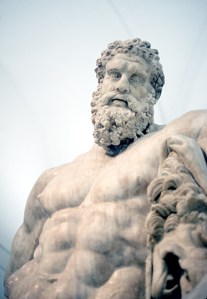 The famed Aesop relays the story of a wagoner who was driving a heavy load of cargo along a road muddied by a recent rainstorm. The wagoner came to a spot where the road was especially treacherous and his wheels sunk deep into the mire. The harder the wagoner whipped his horses to pull, the deeper his wheels sank. Finally, the wagoner exited his chariot, knelt, and prayed to Hercules: “O Hercules, help me in this my hour of distress.” Incredibly, Hercules appeared and responded: “Tut, man, don’t sprawl there. Get up and put your shoulder to the wheel. The gods help those who help themselves.” Such is the origin of this well-known cliché.
Not only is the above cliché well known, it is also widely believed, even among Christians. In fact, in a recent survey, some eighty percent of Christians who describe themselves as “born-again” believe that Aesop’s moralism is a direct quote from the Bible!
As it is in our day, so it was in ancient antiquity. The sentiment that “God helps those who help themselves” was well regarded among the theological elite of Jesus’ day. The rabbis taught, for instance, that God would not help sinners or liars. But then Jesus came to this earth. And Jesus, contrary to prevailing theological sentiments, believed and acted as if God, instead of only helping those who can help themselves, actually helps those who can’t help themselves. Such is the case in our reading for today from Luke 5.
In this chapter, Luke introduces us to a paralytic – an archetypal image of a helpless man. By this point, Jesus’ reputation as a healer has already spread so far and wide and that a huge crowd gathers, hoping to see another miraculous salving. But in the case of this paralytic, Jesus surprises everyone. Rather than soothing his sickness, Jesus says to this man: “Friend, your sins are forgiven” (verse 20). The crowd thought it was this man’s paralysis that made him helpless. Jesus had another idea. It was his sin that left him truly helpless. For his sin paralyzed him not physically, but spiritually.
The rabbis taught, “A sick man does not recover from his sickness until all his sins are forgiven him” (Babylonian Talmud Nedarim 41a). Jesus, in this instance, extols the salutariness of this rabbinical statement and does what is more vital first: he forgives this man’s sins. Ironically, the religious leaders, contrary to their own teaching and tradition, become indignant: “Who is this fellow who speaks blasphemy? Who can forgive sins but God alone” (verse 21)? Jesus, in order demonstrate his authority to forgive sins, responds, “That you may know that the Son of Man has authority on earth to forgive sins…I tell you, get up, take your mat and go home” (verse 24). And the man does! The man is no longer helpless – physically or spiritually. For he has been healed and forgiven by Christ.
The unequivocal affirmation of Scripture is that we are all helpless. Sin has left us this way. And yet, God’s good news is that “while we were still helpless, at the right time Christ died for the ungodly” (Romans 5:6). God doesn’t help those who can help themselves, he helps those who can’t help themselves.
So where are you feeling helpless? Has your financial situation spiraled out of control? Is a relationship in shambles? Is there a sinful addiction you just can’t break? Before you vainly try to help yourself, cry out to God for his help – for his strength, endurance, and forgiveness. Because it’s then, and only then, that you can take appropriate and wise steps to help yourself – and others.


 Pastor Zach's Blog