Luther on Romans 12
 This morning’s text in worship is Romans 12. Paul opens this chapter, “Therefore, I urge you, brothers, in view of God’s mercy, to offer your bodies as living sacrifices, holy and pleasing to God – this is your spiritual act of worship.” Luther offers some great context on this verse – what comes before it and what follows it – in his commentary on Romans:
In the preceding chapters, the apostle laid “the true foundation which is Christ” (1 Corinthians 3:11), or “the first rock,” upon which the wise man builds (Matthew 7:24), and he destroyed the false foundation, namely, man’s self-righteousness and merits, which are as “the sand” upon which the foolish man builds (Matthew 7:26). Here now he proceeds to “build upon this foundation gold, silver, and previous stones” (1 Corinthians 3:12). Good works, which are the building, must above all have a sure and dependable foundation on which the heart can purpose to stand and to rely forever, so that, even in the case that the site may not yet have been built upon, the site is ready to do so. The moralists do the opposite of this with their good works. They seek to put their trust in their conscience and, when they have performed many good works, they think they have done enough for themselves, so that they can feel secure. This is nothing else than to build on the sand and to reject Christ. The apostle tries hard to prevent this; this is the purpose of all his letters. To say, as is commonly done, that “sand” means the riches of the world is a superficial and weak exegesis. For Christ speaks here of the people who build (i.e., who do good) and not of misers and worldlings who rather destroy themselves than build up anything.
Hence, it is good works that the apostle calls “sand.” And it is upon this foundation that these people try to build their righteousness in order to obtain a dwelling place for the conscience and peace of mind. But, as a matter of fact, only Christ is this foundation – and before all good works. For even before we think of doing enough or building up, He has given us the foundation as a free gift, namely, a quiet conscience and a trusting heart. Has there ever been a builder stupid enough to lay also the foundation? Do not the builders look for the foundation that is already laid in the earth or do they not accept what is offered to them? So then, just as the earth offers us a foundation without our effort, so Christ offers Himself without us as our righteousness, peace, and security of conscience in order that from then on we can continually build upon Him in doing good. (WA 56)
ABC Extra – You’re So Vain, I Bet You Think This Blog Is About You
 “Mirror, mirror on the wall, who in the land is fairest of all?” asks the wicked queen to her magic mirror in the fairy tale, Snow White and the Seven Dwarves. For years, the answer always came back the same: “You, my queen, are fairest of all.” But when a young maiden named Snow White comes of age, the mirror’s rejoinder changes: “Queen, you are fair, tis true, but Snow White is fairer than you.” After hearing the mirror’s reply to what was supposed to be a foregone answer to a rhetorical question, the wicked queen spends the balance of the story trying to kill Snow White so that, once again, she can be the fairest in the land. First, she tries to suffocate Snow White with stay laces. Next, she tries to kill her with a poison comb. Finally, the queen offers her the dreaded and infamous poison apple, which lulls her into a deep sleep until, of course, she is wakened by her charming prince.
Being a fairy tale, this story is splashed with an unambiguous principled paint that could perhaps be better nuanced. Nevertheless, its fundamental moral should still be well taken, for its basic point is this: The queen’s vanity destroys the queen’s life. And real life vanity can do to the same to us. It can sneak and creep into our lives, take root in our hearts, and suffocate our souls.
This past weekend in worship and ABC, we kicked off a new series titled “Fit for Life II,” meant to be a second round of messages and Bible studies on health and wellness to follow up the series of the same name that we did last spring. As an introduction to this series, I offered what I call “A Theology of the Body.” People, when talking about and thinking about their bodies, tend to make one of two errors. They assume either that the body is bad and only a cumbersome drag on a pure soul, or they make the body their “god” and spend exorbitant amounts of money, time, and energy either by feeding its sometimes sinful desires in gluttony or pruning and primping it in vanity.
In truth, the body is neither “bad,” nor is it “god.” Rather, it is “good.” It is a good gift of the true God, meant to be faithfully stewarded by us. This is why we take care of our bodies through diet and exercise – not so that we can drop three dress sizes, or boast six-pack abs, or look ten years younger. Instead, we take care of our bodies to the glory of God because they are the temples of God, as Paul says: “Do you not know that your body is a temple of the Holy Spirit, who is in you, whom you have received from God? You are not your own; you were bought at a price. Therefore honor God with your body” (1 Corinthians 6:19-20).
Do you ever treat your body as if it’s bad? Do you spend endless hours complaining about your aches and pains, your wrinkles and your warts, rather than giving thanks to God for the body with which He has blessed you? Do you ever treat your body as if it’s god? Do you linger in front of your mirror, even if it’s not a magic one, just a little too long, obsessed with how others will see you rather than being satisfied with how the true God has made you? This time of year, many people are still trying to follow through on their resolutions to “lose some weight” or “get in shape.” Rather than just losing a few inches off your waste line or enlarging a couple of biceps, may you resolve to steward your body to God’s glory in what you eat, in how you exercise, and in everything you say and do. For this is where true fitness lies.
Want to learn more on this passage? Go to
www.ConcordiaLutheranChurch.com
and check out audio and video from Pastor Tucker’s
message or Pastor Zach’s ABC!
ABC Extra – Serious Joy
 “Behold, the star that they had seen when it rose went before them until it came to rest over the place where the child was. When they saw the star, they rejoiced exceedingly with great joy” (Matthew 2:9-10). Now that’s some big time joy! After all, the wise men didn’t just rejoice, they rejoiced exceedingly. And they didn’t only have joy, they had great joy.
C.S. Lewis wrote, “Joy is the serious business of heaven” (Letters to Malcolm, 93). Dallas Willard puts it like this: “God is the happiest being in the universe” (“Wide Awake,” Leadership, Fall 1994). Thus, when the wise men “rejoice exceedingly with great joy,” they are simply reflecting the character of God by responding appropriately to the gift of God. They respond with joy to Jesus Christ.
Unfortunately, many of us do not heed C.S. Lewis’ call to take joy seriously nearly seriously enough. We are all too often content with being bitter, anxious, or forlorn. But joy is not only the serious business of heaven, it is also the serious business of Christians on earth. This is why Paul, when speaking of the fruit of the Spirit, places joy only second to love (cf. Galatians 5:22). He elsewhere says, “Be joyful always” (1 Thessalonians 5:16). Joy, then, is not an option, but a command!
With this in mind, it is worth reflecting on how joyful you really are. Here are some questions that may help you think about your joyfulness:
- When was the last time a person made you smile with a kind action or gift?
- How often do you chuckle at the marvel of God’s creation – whether it be a pet who does something goofy or a scene from nature which brings a smile to your face?
- When you worship, does your heart leap within you as it did with the Psalmist (cf. Psalm 28:7)?
- When was the last time you laughed so hard you cried?
Certainly life comes with its ups and downs and, sometimes, things can become so wearisome that joy is the farthest thing from your mind. Indeed, during these times, you may even look at Paul’s admonition to “be joyful always” with a mild contempt and silently grumble about the unrealistic nature of such a command. But it is at times like these that it is important to remember that joy is not only a command, it is a gift. It is a gift to dull a hard season and heal a broken heart. And it is a gift that comes straight from the character of God.
Hard seasons are things the wise men knew well. For they arrived at Bethlehem only after a long journey from an undisclosed location back east, followed by an interrogation from a menacing despot named Herod. The wise men had a lot to be stressed and upset about. But they nevertheless found joy because they nevertheless found Jesus. And Jesus is where true joy is to be found.
So are you feeling stressed and upset? Does joy elude you? Like the wise men, cling to the cradle of the Christ. For in the gurgle of this Child is the joy of the ages. In the words of Johann Sebastian Bach:
Jesu, joy of man’s desiring,
Holy wisdom, love most bright;
Drawn by Thee, our souls aspiring
Soar to uncreated light.
Word of God, our flesh that fashioned,
With the fire of life impassioned,
Striving still to truth unknown,
Soaring, dying round Thy throne.
Through the way where hope is guiding,
Hark, what peaceful music rings;
Where the flock, in Thee confiding,
Drink of joy from deathless springs.
Theirs is beauty’s fairest pleasure;
Theirs is wisdom’s holiest treasure.
Thou dost ever lead Thine own
In the love of joys unknown.
Want to learn more on this passage? Go to
www.ConcordiaLutheranChurch.com
and check out audio and video from Pastor Tucker’s
message or Pastor Zach’s ABC!
Weekend Extra – “If it’s good enough for Jesus…”
 It’s an apocryphal story, but one that has tenaciously hung on, thanks to everything from its publication in the New York Times to its unrelenting retelling by Kinky Friedman. The story goes that Ma Ferguson, Texas’ first woman governor, was infuriated by the suggestion that Spanish speaking immigrants would benefit from public school classes taught in their own native language. In a fit of rage, she picked up a copy of the King James Version of the Bible and exclaimed, “If English was good enough for Jesus, it’s good enough for Texas!”
English, at least in the way we know it today in the King James Bible, did not arise until 1550. And the King James Version was not translated until 1611. Jesus did not speak English. He spoke Aramaic. Whoops.
Though Ma Ferguson’s fabled declaration is goofy because it betrays a complete ignorance of the history of language, the principle behind her statement, even if she never said it, is actually quite profound: “If it was good enough for Jesus, perhaps it ought to be good enough for us.” Indeed, Jesus Himself puts forth this principle when He says things like, “A servant is not greater than his master. If they persecuted Me, they will also persecute you” (John 15:20). Jesus is essentially saying, “If the way of suffering, persecution, and the cross is good enough for Me, it’s good enough for you also. You too will suffer.” As Jesus elsewhere teaches, “If anyone would come after Me, let him deny himself and take up his cross and follow Me” (Matthew 16:24).
Over the course of my ministry, I have occasionally encountered Christians who, for one reason or another, do not want to be baptized. Sometimes they will tell me, “I’m just not ready yet.” Other times, their excuses are a little more nuanced: “I already believe in Jesus and that means I’m already saved! So why do I need to be baptized?” My response to such objections echoes Ma Ferguson’s: “If it’s good enough for Jesus, it’s good enough for you!” Indeed, this is precisely what Jesus Himself teaches in the text we studied this past weekend in worship.
In Matthew 3, Jesus travels from His home in Galilee to the Jordan so that He may be baptized by John. John, knowing that Jesus is sinless, and, as far as he can tell, in no need of a regenerative bath, objects: “I need to be baptized by You, and do You come to me” (Matthew 3:14)? Jesus responds, “Let it be so now, for thus it is fitting for us to fulfill all righteousness” (Matthew 3:15). I appreciate Hippolytus’ paraphrase of and commentary on Jesus’ statement:
Let it be so now, for it so becomes us to fulfill all righteousness. I am the Fulfiller of the law; I seek to leave nothing wanting to its whole fulfillment, so that after Me Paul may exclaim, “Christ is the fulfilling of the law for righteousness to every one that believes.” Let it be so now, for it so becomes us to fulfill all righteousness. Baptize Me, John, in order that no one may despise baptism. I am baptized by you, the servant, that no one among kings or dignitaries may scorn to be baptized by the hand of a poor priest. (ANF 5:236).
Hippolytus states Jesus’ point this way: Christ is baptized so that no one may despise, eschew, or reject baptism. In other words, if baptism is good enough for Jesus, it ought be good enough for us! So do not despise it!
Have you been baptized? If not, let me ask you a simple question: “If baptism is good enough for Jesus, shouldn’t it be good enough for you?” Moreover, think about the promises attached to this Sacrament. Luther explains: “Baptism works forgiveness of sins, rescues from death and the devil, and gives eternal salvation to all who believe this, as the words and promises of God declare” (Small Catechism). With promises such as these, why wouldn’t you want to be baptized?
Finally, baptism is good enough for you not only because it was good enough for Jesus, but because you’re bad enough for baptism. You, as Scripture declares, are sinful. And you need God’s holy bath to wash you clean. So, “be baptized and wash your sins away” (Acts 22:16)!
Want to learn more on this passage? Go to
www.ConcordiaLutheranChurch.com
and check out audio and video from Pastor Tucker’s
message!
Weekend Extra – “Departing ____ Peace”
 As a pastor, I have had the weighty responsibility, but also the profound privilege, of counseling with many people who are near death. Over the course of these conversations, I have noticed some themes have emerged. Many of the terminally ill are scared of death, which, at least in my opinion, is completely understandable. Others are worried about organizing their affairs before they pass away. One theme that always emerges from these conversations is a wish for a peaceful death. “I hope I die in my sleep,” some say. “I hope I have friends and family with me,” others say. No one wants to die in fear or alone. People want to die peacefully.
This desire to die peacefully is nothing new. Indeed, in our reading from this past weekend from Luke 2, we are introduced to an old man named Simeon who himself is near death. Knowing this, Simeon gives thanks to the Lord that He is “letting His servant depart in peace” (Luke 2:29). Simeon believes, even as his prayer indicates, that his death will be a peaceful one. But why does Simeon believe such a thing? How does Simeon know whether his death will peaceful or agonizing?
Luke explains why Simeon believes he will die peacefully:
Now there was a man in Jerusalem, whose name was Simeon, and this man was righteous and devout, waiting for the consolation of Israel, and the Holy Spirit was upon him. And it had been revealed to him by the Holy Spirit that he would not see death before he had seen the Lord’s Christ. And he came in the Spirit into the temple, and when the parents brought in the child Jesus, to do for him according to the custom of the Law, he took him up in his arms and blessed God and said, “Lord, now You are letting Your servant depart in peace, according to Your word; for my eyes have seen Your salvation.” (Luke 2:25-30)
Simeon believes he will die peacefully because he has seen and held the One who is “the consolation of Israel” (verse 25) and “the Lord’s Christ” (verse 26). Because he has held the One who is peace (cf. Ephesians 2:14), Simeon believes that he will depart in peace.
Notably, when Simeon thanks the Lord for allowing him to depart “in peace,” the Greek word for the preposition “in” is en. This preposition is one of the most versatile in the Greek language. One Greek-English lexicon translates this single preposition as “in,” “at,” “near,” “before,” “for,” “with,” and “among,” among many others. In other words, this preposition is a catchall preposition. Indeed, Simeon’s words could nearly be translated, “Lord, now You are letting Your servant depart *INSERT PREPOSITION HERE* peace!”
This catchall preposition en reveals a profound truth of the peace that Christ gives us. For Christ’s peace makes us at peace with God (2 Peter 2:14), near God in faith (Hebrews 10:22), before God as His justified people (Luke 18:14), for God in love (1 John 5:3), with God unto eternity (Revelation 21:3), and among God as we serve His people (Matthew 25:40). There is no preposition that the peace of Christ cannot cover! And this makes Christ’s peace a profound peace.
What peace do you need? Do you need peace with your past? Do you need peace at work? Do you need peace for an upcoming decision? Then pray with Simeon, “Lord, now You are letting Your servant depart *INSERT PREPOSITION HERE* peace!” For the peace of Christ covers whatever preposition you might have in this life – or even in the next. What a precious peace is the peace of Christ! As Augustine says, “Peace shall be your gold. Peace shall be your silver. Peace shall be you lands. Peace shall be your life, your God Peace” (Augustine NPNF1 8:94)!
Want to learn more on this passage? Go to
www.ConcordiaLutheranChurch.com
and check out audio and video from this weekend’s message!
ABC Extra – Peace and Passivity
 In 1969, John Lennon and Yoko Ono held a series of two-week long “Bed-Ins” in Amsterdam and Montreal as a way to protest the ongoing Vietnam War and promote peace. They simply stayed in bed for their honeymoon, a place they felt was “peaceful,” in hopes of watching peace reign not only in their hotel room, but in the world. It was during his second “Bed-In” in Montreal that John Lennon penned his famous single, “Give Peace A Chance.” The lyrics are strange, but memorable: “Everybody’s talking about Bagism, Madism, Dragism, Shagism, Ragism, Tagism, this -ism, that -ism. All we are saying is give peace a chance.” Despite his plea, the war did not end until some six years later.
The popular conception of peace can often be deduced from the context in which the word is used. Contextually, John and Yoko wanted to “give peace a chance.” That is, they thought that peace, if allowed to take its due course, would eventually carry the day. And so they took a chance on peace. And they lost. The Vietnam War did not end when they wanted. And many wars have since taken its place. Peace is not best left to chance.
Jesus conceives of peace in a wholly different manner. Jesus says, “Blessed are the peacemakers, for they shall be called sons of God” (Matthew 5:9). In a world that seeks only to chance peace, Jesus wants something else: He wants to make peace. This is radically different from John and Yoko’s vision of peace. For their vision of peace was essentially passive. If people just “gave peace a chance,” peace might carry the day. Jesus’ vision of peace, however, leaves nothing to chance. Thus, Jesus’ vision of peace is essentially active. Where there is no peace, Jesus calls on His followers to make peace. For Jesus knows that, in a sinful, fallen, broken world like ours, peace must be made, not just allowed.
This active vision of peace is reflected in our text from this past weekend. The apostle Paul writes to two feuding women: “I entreat Euodia and I entreat Syntyche to agree in the Lord” (Philippians 4:2). When Euodia’s and Syntyche’s peace is shattered by a feud, Paul does not just sit around, ready to “give peace a chance”; rather, he actively seeks to reconcile the differences between these two women so that peace may result. He “entreats” them.
Paul, of course, is simply following the example of his Savior who, when Jews and Gentiles were estranged because of their adherence to God’s Law, abolished “the law of commandments expressed in ordinances, that He might create in Himself one new man in place of the two, so making peace, and might reconcile us both to God in one body through the cross, thereby killing the hostility” (Ephesians 2:16-17). Christ, through the cross, makes peace, both with God and with others, and gives us that peace by faith. We, in turn, are called to reflect Christ’s effort at peace in our own lives, as Paul elsewhere writes, “Make every effort to do what leads to peace and to mutual edification” (Romans 14:19).
What kind of premium do you put on peace? Are you content merely to “give peace a chance,” or are you more active in your efforts at peace? When you get into a fight with someone else, do you go seek them out to reconcile with them, or do you wait for them to come to you? When you see a marriage in trouble, do you actively speak God’s Word into that couple’s life, or do you simply stay away, scared to confront this couple’s sin? God’s peace is not a passive idea, it’s an active reality. Finally, this active reality is embodied by Jesus who actively lived, suffered, and died so that we may have peace. May you actively pursue peace for the sake of others…and for the sake of yourself.
Want to learn more on this passage? Go to
www.ConcordiaLutheranChurch.com
and check out audio and video from Pastor Tucker’s
message or Pastor Zach’s ABC!
ABC Extra – Repeating the Past
 “Those who cannot remember the past are condemned to repeat it.” So said the Spanish philosopher George Santayana in his 1905 opus magnum The Life of Reason. If only Santayana was right. If only it was only those who had somehow forgotten the past who, ignorant of the lessons of yesteryear, repeated them in these years. Unfortunately, even those who do remember the past, as debase as it might be, often repeat it. The son who knows his father is an alcoholic drinks excessively himself and develops the same addiction. The daughter who is bitter and vindictive remembers well the grudges her mother held against others. The father who hits his wife passes his legacy down to a son who raises his hand to his girlfriend in a fit of rage. We have no problem remembering past calamities. But in spite of our well-defined memories, we all too often repeat them.
What reason can be given concerning those who remember the past and nevertheless consign themselves to repeat it? In our text from this weekend, the apostle Peter reminds us that we are all heirs to “the empty way of life handed to us by our forefathers” (1 Peter 1:18). The Greek word for “empty” is instructive. It is the word mataios which denotes the appearance of a thing as distinct from its essence. That is, mataios allows for a thing to look enticing in its appearance while leading to sin, despair, and death in its essence. One cannot help but think of how Satan tempted Adam and Eve in the Garden: “When the woman saw that the fruit of the tree was good for food and pleasing to the eye, and also desirable for gaining wisdom, she took some and ate it. She also gave some to her husband, who was with her, and he ate it” (Genesis 3:6). Satan tempted history’s first couple with the appearance of wisdom. But what Satan was leading Adam and Eve to, as appealing as its appearance may have seemed, was, in its essence, sin, despair, and death.
What Satan did with Adam and Eve he continues to do with us. He tempts us with a thing that has an appealing appearance, but, in its essence, leads us to sin, despair, and death. Satan tempts us with the appearance of joy through drunkenness. But that ephemeral joy quickly melts into the essence of regret as we suffer through a hangover. Satan tempts us with the appearance of pleasure through sex outside of marriage. But that illusory pleasure quickly melts into essence of pain as a marriage is destroyed. The temptations of Satan look full and marvelous, but, in reality, they are empty and tragic. They are mataios.
Thus, it is no surprise that we fall for temptations from our past. For though we may remember their appealing appearances, we all too often minimize or even forget their essential brokenness.
What remedy is there against Satan’s enticements toward all things mataios? Peter answers, “Set your hope fully on the grace to be given you when Jesus Christ is revealed” (1 Peter 1:13). Again, the Greek for the word “given” is instructive. It is the word phero which refers to something that is not only “given,” but “brought.” That is, God desires not only to give us His grace, He has actually made provision for it to be brought to us through His Son Jesus Christ. Indeed, this is what we celebrate at Christmas: How God was not content to leave His grace supinely suspended in heaven and so deigned to bring His grace to earth in the person and work of Jesus. Our ancestors, beginning with Adam and Eve, may have handed down to us the impoverished ways of mataios, but our God brings down to us His amazing grace in Christ. So instead of trying to remember the pain of past mataios so that you can learn from it, instead, rejoice in the peace of God’s present grace. Because, in the light of God’s eternal grace, mataios loses its appealing appearance. For we now have God’s grace and its incomparable essence of forgiveness. And that’s good news.
Want to learn more on this passage? Go to
www.ConcordiaLutheranChurch.com
and check out audio and video from Pastor Tucker’s
message or Pastor Zach’s ABC!
Cosmology and Philosophy
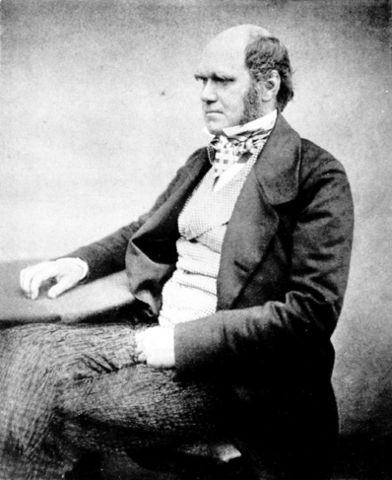 Your philosophy is an inextricable concomitant of your cosmology. Charles Darwin knew this all too well. Most people are at least passingly familiar with Darwin’s seminal work, The Origin of Species. In it, he proffers a framework for understanding the origins of human life – and all life – using his mechanism of evolution by natural selection. In his own words, here is Darwin’s theory in a nutshell:
As many more individuals of each species are born than can possibly survive, and as, consequently, there is a frequently recurring struggle for existence, it follows that any being, if it vary however slightly in any manner profitable to itself, under the complex and sometimes varying conditions of life, will have a better chance of surviving, and thus be naturally selected. From the strong principle of inheritance, any selected variety will tend to propagate its new and modified form. (Origin of Species, p. 29)
Darwin begins with the assumption that life, at its root, is a struggle for survival. He then concludes that those who win the struggle for survival carry on while those who lose the struggle do not. This is natural selection. Moreover, those who win the struggle for survival propagate more of their kind and develop “modified” characteristics which further benefit them in their struggle. This is evolution. Over time – indeed, over lots and lots of time – these beneficial characteristics continue to evolve so radically that whole new species arise from common ancestors while other, weaker species die out. This, then, is the origin of species. This is the origin of our species. We are the product of the cold hand of evolution by natural selection. This is Darwin’s cosmology, that is, his view of the laws of the world and, by extension, the cosmos.
But how you view things cosmologically inevitably informs how you view things philosophically. That is why, after publishing The Origin of Species, Darwin published The Descent of Man, a philosophical take on his cosmological theory. Thus, Darwin lamented according to the presuppositions of his cosmological theory of evolution:
We civilized men do our utmost to check the process of elimination; we build asylums for the imbecile, the maimed, and the sick; we institute poor-laws; and our medical men exert their utmost skill to save the life of every one to the last moment. There is reason to believe that vaccination has preserved thousands, who from a weak constitution would formerly have succumbed to small-pox. Thus, the weak members of civilized societies propagate their kind. No one who has attended to the breeding of domestic animals will doubt that this must be highly injurious to the race of man. It is surprising how soon a want of care, or care wrongly directed, leads to the degeneration of a domestic race; but excepting in the case of man himself, hardly any one so ignorant as to allow his worst animals to breed. (Descent of Man, p. 168)
Darwin laments that humans work against evolutionary progress through wrongheaded ignorant attempts to save and care for those which natural selection would eliminate. If evolution by natural selection is the incontrovertible law of the forward progress of life, then to work against it by tending to the weak and sick is to take life backwards rather than forwards.
Most people, of course, are not nearly so bold connecting cosmological evolution to philosophical evolution as was Darwin. Allowing our sick and maimed to die in the name of natural selection would appall the vast majority us. And yet, Darwin is simply teasing out the philosophical inevitabilities of his cosmological presuppositions. He is being perfectly consistent. Why aren’t we?
The fact of the matter is, the way one views the universe informs and, finally, dictates the morals and ethics one holds. Darwinian evolution, if it is perceived to be the engine behind the improvement of life, cannot be meddled with by the likes of so-called “do-gooders” who are not really doing good at all. For such people are slowing evolution’s forward march by caring for the lesser evolved among us.
Christianity, of course, has a very different view of humanity’s place and value. According to Christianity, human beings are not merely the products of an inexorable evolutionary march, eventually to be displaced as the kings of the cosmos by a better and higher form of life thanks to natural selection. Rather, we are specially created by God “in His own image” (Genesis 1:27) to be the caretakers of His creation (cf. Genesis 1:28-31). Thus, we can, and are even bound, not by some unfathomably lengthy evolutionary progress, but by the intentions of our Creator. And one of His intentions for us is “to love mercy” (Micah 6:8). So, we are merciful to each other. We care for those who cannot care for themselves.
Your philosophy is an inextricable concomitant of your cosmology. So what is your cosmology? One that is driven by evolution by natural selection? Or one that rejoices in the merciful, creative hand of our God? How you answer that question makes all the difference in how you view your life…and the lives of others.
ABC Extra – Not Just Mighty, Almighty
 My Thanksgiving started out well enough. Melody and I hosted our family’s Thanksgiving dinner this year, complete with turkey, dressing, and all the trimmings. The food was delicious. In fact, everyone had to loosen their belts a couple of notches when we were finished. Thanksgiving success! But the most exciting part of my Thanksgiving was yet to come.
After having to turn down tickets three times this season because of previous commitments, I was offered some tickets to go see my Texas Longhorns play the Aggies on Thanksgiving night in Austin. I could hardly wait. It didn’t matter that I was full and tired. It didn’t matter that a cold front was blowing through, dropping temperatures to near freezing. I was ready for some football! And so, I arrived at Darryl K. Royal Memorial Stadium, decked out in orange, ready to watch the Longhorns run, pass, and tackle their way to victory in a last ditch effort to get a bowl bid. And we almost had it…until that interception at the end of the game. Final score: 24-17. Aggies win.
It was a long drive home that night. Last year, the scenario of a losing season seemed impossible. After all, less than a year ago, we were playing in the BCS Championship game. We were the mighty warriors of the gridiron. But what a difference a year makes. Oh, how the mighty have fallen (cf. 2 Samuel 1:25)!
Even the mightiest of men can fall. Isaiah puts it well: “Even youths shall faint and be weary; and young men shall fall exhausted” (Isaiah 40:30). This is demonstrated time and time again in the pages of Scripture.
In Joshua 10:2, we read about the city of Gibeon: “Gibeon was a great city, like one of the royal cities…and all its men were warriors.” The Hebrew word for “warriors” is gibor, meaning “mighty.” And yet, even the mighty men of Gibeon are no match for the Israelites. For the Gibeonites “fear greatly for their lives” (9:24) because of the Israelites’ success in their campaign against the nations of Canaan and even seek to make a peace treaty with the them. The Gibeonites’ mightiness fails.
Then, in 1 Samuel 17:51, we read about the Philistine fighter Goliath: “David ran and stood over the Philistine and took his sword and drew it out of its sheath and killed him and cut off his head with it. When the Philistines saw that their champion was dead, they fled.” The Hebrew word for “champion” is again gibor. With a smooth stone and a sling, David does what a whole Israelite army cannot: he slays the mighty man Goliath. And Goliath’s mightiness fails.
The mightiness of men, be they warriors or football players, fails. The mightiness of our God, however, does not.
Some 725 years before the birth of Christ, Isaiah prophesies concerning Him: “For to us a child is born, to us a son is given; and the government shall be upon His shoulder, and His name shall be called Wonderful Counselor, Mighty God, Everlasting Father, Prince of Peace” (Isaiah 9:6). “A child will be born,” Isaiah says, “and he will be called, ‘Mighty.’” The Hebrew word for “mighty” is, once again, gibor. However, this mighty One is unlike other mighty ones in the Bible. For when the word gibor is used, it is often used in conjunction with the word ish, the Hebrew word for “man.” But when it is used in Isaiah 9:6, it is used with the word el, Hebrew for “God.” And this makes all the difference. For when the Scriptures talk about the mightiness of men, time and time again, we watch their mightiness fall, falter, and fail. But when the Scriptures speak of the mightiness of God, they speak of it in eternal and unfailing terms. As Nehemiah explains, “God, the great, the mighty, and the awesome God, keeps covenant and steadfast love” (Nehemiah 9:32). God’s keeps His mightiness going, as demonstrated through His faithfulness to His covenant promises and His steadfast love to you and me.
Finally, our God is not just mighty, He is Almighty. That is, He is the supreme Mighty One. For this reason, we trust that His mightiness will never fail. So trust not in your own strength! Trust not in your own gibor! For you have someone much mightier than you. And He’s lying in a manger.
Want to learn more on this passage? Go to
www.ConcordiaLutheranChurch.com
and check out audio and video from Pastor Tucker’s
message or Pastor Nordlie’s ABC!
ABC Extra – The Man with the Plan
 Have you ever had a plan go south on you in a hurry? When I was in college, I was in charge of planning the Christmas service for our campus chapel. The plans did not come together as I expected. Right before the service, my choir director fell ill and was not able to lead the choir. My instrumentalists also did not rehearse as they should have. In fact, there was one instrumentalist who still stands out in my mind to this day.
One of the carols I had planned for the service was “Joy to the World.” Because this is such a boisterous song, I decided to incorporate some cymbal crashes into the arrangement. The difficulty was, the only pair of cymbals our college had were monstrous. Even a gentle crash of the cymbals easily filled the chapel. My cymbal player, however, did not know this. Thus, the beloved lyric, “And heaven and nature sing,” was answered by the biggest, baddest, moist boisterous cymbal crash I have ever heard. In fact, it wasn’t just a crash, it was a smash! The whole congregation jumped. And the joy of the song was replaced by snickers at the surprise.
Sometimes, our plans go south in a hurry. For our planning is never airtight and mistake-proof. The unexpected can smash even our best-laid plans.
This weekend in worship and ABC, we kicked off a new series for Advent titled, “Hello! My Name Is…” In this series, we are taking a look at the names for Jesus as they are famously given to us in Isaiah 9:6: “For to us a child is born, to us a son is given; and the government shall be upon His shoulder, and His name shall be called Wonderful Counselor, Mighty God, Everlasting Father, Prince of Peace.” This past weekend, we talked about what it means for Jesus to be our “Wonderful Counselor.”
In Hebrew, the word for “Counselor” is ya’as. In the Greek translation of the Old Testament, known as the Septuagint, this word is translated as boule. Notably, boule is often translated as the word “plan.” A couple examples will suffice:
- “If this plan or this undertaking is of man, it will fail; but if it is of God, you will not be able to overthrow them. You might even be found opposing God!” (Acts 5:38-39)
- When God desired to show more convincingly to the heirs of the promise the unchangeable character of His plan, He guaranteed it with an oath. (Hebrews 6:17)
In the first example, the Pharisee Gamaliel notes that though man’s plans eventually fail, God’s plans always endure and stand. The Psalmist explains it this way: “The LORD brings the plans of the nations to nothing; He frustrates the plans of the peoples. The plan of the LORD stands forever, the plans of His heart to all generations” (Psalm 33:10-11). Thus, what God plans to do, He always accomplishes, even when His plan includes the death of His one and only Son, as Peter attests to in his Pentecost sermon: “Men of Israel, hear these words: Jesus of Nazareth, a man attested to you by God with mighty works and wonders and signs that God did through Him in your midst, as you yourselves know – this Jesus, delivered up according to the definite plan and foreknowledge of God, you crucified and killed by the hands of lawless men” (Acts 2:22-23). It was God’s plan to kill His Son for the forgiveness of our sins all along. And God’s plan prevails.
God’s plan prevails. This is great comfort as we trust Christ, our Wonderful Counselor. For our Counselor’s plans are sure and good. After all, He has had our salvation planned from the very foundation of the world (cf. Matthew 25:34) and His plan came to pass with the cross. Thus, we can always trust His counsel because we know that it is part of His plan. And whereas our plans can fail, falter, and wind up in disaster, God’s plan remains, is resolved, and winds up in glory. Trust in the plan, found in God’s Word, of your Wonderful Counselor!
Want to learn more on this passage? Go to
www.ConcordiaLutheranChurch.com
and check out audio and video from Pastor Tucker’s
message or Pastor Zach’s ABC!


 Pastor Zach's Blog