The Waning of Marriage
 Right now at the church where I serve, we are in a series on marriage called “We Do.” As I see it, this series is important not only because many marriages are in trouble and in need of help, but because many marriages are not even getting started in the first place. The precipitous decline of marriage in this country is well documented. Take, for instance, the recent alarm sounded by Robert J. Samuelson of The Washington Post:
In 1960, only 12 percent of adults ages 25 to 34 had never married; by the time they were 45 to 54, the never-married share had dropped to 5 percent. Now fast forward. In 2010, 47 percent of Americans 25 to 34 had never married.[1]
Marriage rates are in a free-fall. But Samuelson’s explanation as to why marriage rates are tumbling is especially fascinating to me:
The stranglehold that marriage had on middle-class thinking and behavior began to weaken in the 1960s with birth control pills, publication of Betty Friedan’s The Feminine Mystique — an assault on women’s traditional housecleaning and child-rearing roles — and the gradual liberalization of divorce laws.
The resulting expansion of personal choice has been breathtaking. Those liberalized divorce laws have freed millions of women and men from unsatisfying or abusive marriages. (From 1960 to 1980, the divorce rate rose nearly 150 percent; it has since reversed about half that gain.) Taboos against premarital sex and cohabitation have virtually vanished. So has the stigma of out-of-wedlock birth or, for married couples, of not having children. With more job opportunities, women flooded the labor market.
Samuelson connects the decline of marriage to the “expansion of personal choice.” In other words, the more choices a person has – from the choice of pre-marital sex to birth control to cohabitation to divorce – the lower the chance a person will choose to marry or, as the case may be, stay married.
Sadly, the “expansion of personal choice” does not insure against the unintended and often painful consequences of personal choice. Samuelson cites Isabell Sawhill, author of Generation Unbound: Drifting into Sex and Parenthood without Marriage:
“New choices for adults,” Sawhill writes, “have not generally been helpful to the well-being of children.” Single-parent families have exploded. In 1950, they were 7 percent of families with children under 18; by 2013, they were 31 percent. Nor was the shift isolated. The share was 27 percent for whites, 34 percent for Hispanics and 62 percent for African Americans. By harming children’s emotional and intellectual development, the expansion of adult choices may have reduced society’s collective welfare.
It is not (as Sawhill repeatedly says) that all single-parent households are bad or that all two-parent families are good. But the advantage lies with the approach that can provide children more financial support and personal attention. Two low-income paychecks, or two good listeners, are better than one. With a colleague, Sawhill simulated the effect today if the marriage rates of 1970 still prevailed. The result: The child poverty rate would drop by about 20 percent — a “huge effect” compared with most government programs.
Our emancipation from marriage comes with a price – a price born by the children of those who have emancipated themselves from marriage. A higher poverty rate is the price most easily measured, but other things, such as the lack of “two listening ears” Sawhill refers to, are also among the prices our children must pay.
I am well aware, of course, that there are certain situations where a person should not get married or cannot stay married. But these situations are far fewer and farther between than our culture makes them out to be.
At the heart of our marriage-phobia is the fact that marriage calls on us to think beyond ourselves, which is not easy when we have all the freedom in the world to make decisions for ourselves. It turns out that when we are given unrestrained freedom to make decisions, we make selfish ones.
But this is where the Church has much to offer. We do, after all, worship a Savior who not only thought beyond Himself, but lived beyond Himself and died by Himself so we could be a family in God.
Ultimately, as followers of Christ, our hope is for a marriage on the Last Day when it will be sung: “Hallelujah! For our Lord God Almighty reigns. Let us rejoice and be glad and give Him glory! For the wedding of the Lamb has come, and His bride has made herself ready” (Revelation 19:6-7).
If this is what we’re preparing and hoping for, we might as well get a little practice for our marriage on the Last Day by being married in this day. And that’s why marriage is good – even if it isn’t always easy.
____________________
[1] Robert J. Samuelson, “The family deficit,” The Washington Post (10.26.2014).
Rocking Your Vote
 Last Tuesday, I went to vote in the midterm elections. Even though news outlets and political pundits like to play the part of Chicken Little every time an election cycle hits, the line at the voting booth seemed much more reasonable and relaxed.
As I listen to the rhetoric that comes with each passing election, I can’t help but be concerned – not because acerbic political rhetoric is anything new – politicians have been tearing into each other for a long time – but because the rhetoric isn’t right.
The word “politics” comes from the word polis, the Greek word for “city.” Politics has to do with how we order our communities under a set of authorities. The great Greek philosopher Aristotle spoke of the goal of politics thusly: “It comes to be for the sake of living, but it remains in existence for the sake of living well.”[1] For Aristotle, politics was a way of doing what was best for a community by ordering the community under responsible and thoughtful authorities. The ultimate goal of politics, then, was to serve the common good. Sadly, I think many have lost sight of this goal.
In running for office, one Senate candidate said of his political opponent, “Let’s go out there and sock it to them!” The state chair of this candidate’s party went farther: “We need to crush it. We need to grab it, run with it, push their heads under over and over again until they cannot breathe anymore.”[2] Somehow, I am not sure this was the type of political goal Aristotle had in mind. Many of our politicians have become so obsessed with winning that they have forgotten their true call to work for the common good. Politicians are not be snooty sovereigns, but public servants.
As Christians in a democratic system, we have a unique privilege that is also a heavy burden. In Romans 13:1, we are called to submit ourselves to the governing authorities. But in our political system, as Micah Watson of The Gospel Coalition explains, “We are called to yield to authority, yet we also wield authority.”[3] We wield authority through our vote. My concern is that we, like the politicians for whom we are voting, have become far too concerned with using our authority to defeat and destroy the people and party with whom we disagree and have forgotten that a healthy political process is meant to have as its goal the common good. We have traded Aristotle for Machiavelli.
God has given humans limited and provisional authority in a host of different arenas (e.g., Genesis 1:26-28, Matthew 10:1, Titus 2:15). But because such authority is from God, we must use it only in accordance with God (Colossians 2:10). Jesus reminds us how we are not to use our authority:
You know that the rulers of the Gentiles lord it over them, and their high officials exercise authority over them. Not so with you. Instead, whoever wants to become great among you must be your servant, and whoever wants to be first must be your slave. (Matthew 20:25-27)
Jesus is clear. We are to use our authority to serve others, which means, when we cast our vote, we use our authority as “We the people” not to clobber our enemy, but to love and serve our community. When you vote, what do you have in mind?
____________________________
[1] Aristotle, Politics 1.2.1252b29-30.
[2] David A. Fahrenthold, Katie Zezima & Paul Kane, “Math is forbidding for Democrats in struggle for Senate,” The Washington Post (11.3.2014).
[3] Micah Watson, “Why Christians Should Vote,” The Gospel Coalition (11.3.2014).
You’re A Saint!

“The Forerunners of Christ with Saints and Martyrs” by Fra Angelico (1423)
This past Friday, Melody and I dressed up our daughter Hope as an owl and, with great anticipation of the delight we were about to see in her eyes, took her out trick-or-treating. It was a fun evening. She was grinning ear to ear. But as much fun as we had during our Friday evening excursions, the day after held an especially poignant place in my heart. Saturday, according to Church tradition, was All Saints’ Day, a day on which we both remember those saints in Christ who have gone before us and celebrate how we have been made saints through Christ’s death and resurrection. When I think about all the saints who have gone to be with the Lord in glory this past year, my heart can’t help but be warmed even while my eyes get a little misty. It’s a special time of remembrance.
A traditional prayer for All Saints’ Day encapsulates the meaning of this day well:
O almighty God, by whom we are graciously knit together as one communion and fellowship in the mystical body of Jesus Christ, our Lord, grant us so to follow Your blessed saints in all virtuous and godly living that we may come to those unspeakable joys which You have prepared for those who sincerely love You; through our Lord Jesus Christ, Your Son, who lives and reigns with You and the Holy Spirit, one God, now and forever. Amen!
I love this prayer for two reasons. First, it appropriately reminds us that there is much to learn from the saints who have gone before us. Their ways of “virtuous and godly living” ought to be celebrated by us and their insights into God’s Word and Christ’s gospel ought to be studied by us. There is much to be said for remembering – and practicing – the ways of the saints of old. At the same time, we must understand that we do not become saints by remembering and practicing the holy ways of these historic Christians. Rather, we become “sainted” by being “knit together as one communion and fellowship in the mystical body of Jesus Christ.” Everyone who is a member of Christ’s body is properly called a saint, even as the apostle Paul says to the church at Corinth: “To the church of God that is in Corinth, to those sanctified by Christ Jesus, called to be saints together with all those who in every place call upon the name of our Lord Jesus Christ, both their Lord and ours” (1 Corinthians 1:2). How are we made saints? We are sanctified and called by Christ. Who are the saints? They are everyone, everywhere who calls on the name of Jesus.
It is this definition of sainthood that the Church has believed and confessed for millennia, for example, in the Apostles’ Creed when we say, “I believe in the communion of saints.”
This phrase, “the communion of saints,” carries with it two meanings. On the one hand, this phrase refers to all Christians from all times in all places, both in heaven and on earth. Nicetas, a fourth century Serbian bishop, explains:
What is the Church but the congregation of all saints? Patriarchs, prophets, apostles, martyrs, all the just who have been, are, or shall be, are one Church because sanctified by one faith and life, marked by one Spirit, they constitute one body. Believe, then, that in this one Church you will attain the communion of saints.[1]
On the other hand, the Greek word for “saints” in the New Testament can be either masculine, referring to people, or neuter, referring to things. Thus, “the communion of saints” can be taken to mean “the communion of sainted, or holy, things.” This is the way that Peter Abelard, the great twelfth century French theologian, understood this phrase. In this case, the phrase, “the communion of sainted things,” was understood to mean the holy things of God: His Word, baptism, and the Lord’s Supper. The Lutheran confessors incorporate both understandings of “the communion of saints” when they write, “The Church is the congregation of saints [sainted people], in which the Gospel is rightly taught and the Sacraments are rightly administered [sainted things].”[2] Thus, the Church is made up of the sainted people of God gathered around the sainted things of God!
But there is even more to this phrase, “the communion of saints.” The Greek word for “communion” in the Creed is koinonia, a term that, even in secular Greek, describes not primarily communion with other human beings, but communion with God. For example, the first century Greek philosopher Epictetus wrote of the noble man in his “poor mortal body thinking of his fellowship (koinonia) with Zeus.”[3] Even in the pagan mind, man desires to have koinonia with god, albeit with a false god. This word koinonia was subsequently commandeered by Christians to describe communion with the true God: “God is faithful, by whom you were called into the fellowship (koinonia) of His Son, Jesus Christ our Lord” (1 Corinthians 1:9). We have koinonia with Christ. The phrase, “communion of saints,” therefore, refers not only to the communion we, as Christians, have with each other, but to the communion we have with Christ.
Finally, then, to say, “I believe in the communion of saints” is to say, “I believe that I have communion with Christ and with others who are in Christ. I believe that Christ meets me by His Word and holy gifts, cleanses me by His blood, and sanctifies me by His Holy Spirit.” But saying all this is a mouthful. So we simply say, “I believe in the communion of saints.” It’s a simple phrase that means so much. For it describes not only who we are, but who we are with. We’re with Jesus. And being with Jesus makes me feel like – well – a saint.
____________________
[1] Nicetas in Charles Augustus Briggs, The Fundamental Christian Faith (New York: Charles Scribner’s Sons, 1913), 193-194.
Where’s Your Advantage?
 A few months ago, I reworked my retirement portfolio. Though I pray it will be a long time before I have to draw anything from it, there were some changes I wanted to make now because I know they will be to my advantage later. And I always like gaining an advantage.
As time goes by, I have been traveling on business more and more. One of the things I have been doing recently is joining a bunch of rewards programs because they offer so many advantages. I get airline miles for one trip from another trip. I get points for free nights whenever I stay enough nights at a hotel chain. I get occasional discounts and supreme customer service because I rent a lot of cars. These reward programs come with a lot of advantages. And I always like gaining an advantage.
The other night at the elders meeting at my church, I shared some words from the apostle Paul: “What advantage, then, is there in being a Jew, or what value is there in circumcision? Much in every way! First of all, they have been entrusted with the very words of God” (Romans 3:1-2).
If you were to ask a Jew in the first century what advantage he had, he would probably quickly respond by saying he was a son of Abraham (cf. John 8:33). He might also brag a bit about his devotion and virtue (cf. Romans 2:17-20). But when Paul speaks of a Jew’s advantage, he has something different in mind. “First of all,” Paul writes, “they have been entrusted with the very words of God.” What gives a Jew an advantage is not his pedigree as a son of Abraham or his piety as a squeaky-clean rule-follower, but God’s self-disclosure in His Word. What gives a Jew a spiritual advantage is, very simply, the Bible.
Of course, this advantage is not just for the Jew. It is for anyone and everyone who calls on the Lord. The Bible can give us an advantage in marriage as we look to God’s Word to enrich our relationships with our spouses. The Bible can give us an advantage in work as we understand our labor as God’s calling. Most importantly, the Bible can give us an advantage with God as it reveals to us God’s Son who died for our salvation. The Bible is our supreme advantage because it shows us Christ’s advantageous work on our behalf.
It is no secret that most people love to have an advantage, whether that advantage be on the field, or in the office, or in an investment portfolio. Some people will even go so far as to take advantage of someone else in order to gain an advantage for themselves. Paul’s question of us, however, is: Where’s your advantage? Paul says that our first advantage should always and only be God’s Word. Indeed, when Paul writes, “First of all, [you] have been entrusted with the very words of God,” we assume that, because Paul writes about the Bible as our first advantage, there will also be a second, and perhaps even a third, advantage. But Paul never names another advantage. After all, with an advantage like God’s Word, what other advantage could we possibly need – or want?
So please, take advantage of the advantage of God’s Word. After all, airline miles expire. Hotel points have blackout dates. Rental car companies tack on hidden fees. But God’s Word endures forever. And there’s just no better advantage than that.
Subpoenaing Sermons

Credit: houstonmatters.org
“Show us your sermons.” This was the message of the City of Houston to five area pastors. Last May, Houston’s City Council passed an equal rights ordinance prohibiting “any type of discrimination based on sex, race, color, ethnicity, national origin, age, familial status, marital status, military status, religion, disability, sexual orientation, genetic information, gender identity, or pregnancy”[1] among private and public employers. Almost immediately, those in faith communities and even in some businesses raised concerns. Will this limit a pastor’s ability to address issues such as same-sex marriage and gender identity in his sermons? Could a business be sued for refusing to allow a transgender person to use the restroom of the gender with which that person identifies, even if that identity does not match up with his or her assigned gender?
Opponents of the ordinance rallied and gathered some 500,000 signatures in an effort to repeal it, but the validity of the signatures was called into question and the ordinance was not repealed. This is when things got really contentious. As The Washington Post reports:
A group of Christians sued the city. In response, city attorneys issued subpoenas to five local pastors during the case’s discovery phase, though the five pastors were not involved in the lawsuit.
The subpoenas sought “all speeches, presentations, or sermons related to HERO, the Petition, Mayor Annise Parker, homosexuality, or gender identity prepared by, delivered by, revised by, or approved by you or in your possession,” according to the Houston Chronicle.[2]
The City subpoenaed sermons. And people were furious. Indeed, when several national news outlets picked up on this story, the City had to change course. Mayor Parker announced last Friday that the City would narrow the scope of the subpoena and City Attorney David Feldman admitted, “When I looked at [the subpoena] I felt it was overly broad, I would not have worded it that way myself … It’s unfortunate that it has been construed as some effort to infringe upon religious liberty.”[3]
So what are we to make of all this?
On the one hand, as Eugene Volokh of The Washington Post notes, the City, by all reasonable standards, overreached and needs to be called to account:
I don’t quite see how “all speeches, presentations, or sermons related to HERO, the Petition, Mayor Annise Parker, homosexuality, or gender identity prepared by, delivered by, revised by, or approved by you or in your possession” would be relevant to the litigation about the validity of the referendum petitions.
At the very least, the subpoena seems vastly overbroad. And the fact that it seeks the contents of religious speeches does counsel in favor of making the subpoena as narrow as possible (which would likewise be the case if it sought the contents of political speeches). I’m not sure what sort of legally relevant information might be contained in the subpoenaed sermons. But the subpoena ought to be narrowed to that legally relevant information, not to all things about homosexuality, gender identity, the mayor, or even the petition or the ordinance.[4]
On the other hand, if these pastors were indeed “using the pulpit to do political organizing … [by] encouraging congregation members to sign petitions and help gather signatures for equal rights ordinance foes,”[5] as the City Attorney suggests, even if such conduct is Constitutionally permissible, theologically, this kind of political posturing can compromise the integrity of the Office of the Ministry and can actually impugn the Church’s witness on the moral and ethical issues of our day. Charles Colson explains why:
Because it tempts one to water down the truth of the gospel, ideological alignment, whether on the left or the right, accelerates the church’s secularization. When the Church aligns itself politically, it gives priority to the compromises and temporal successes of the political world rather than its Christian confession of eternal truth.[6]
When pastors try to address concerns that are, at their heart, theological by using political means like petitions, theology can all too readily and quickly – even if unknowingly – get sacrificed on the altar of political expediency. We need to be careful we don’t compromise our witness for the sake of cynical political gain.
Make no mistake about it: I do not believe City of Houston officials should, in any way, shape, form, or fashion critique or try silence what pastors preach. Such actions are beyond their purview of their vocations. But as a Christian, I also believe that what the Church and her pastors have to say about human sexuality and gender identity is best said from the Word of God and not with a petition.
So, to the pastors who have been subpoenaed, I say: rather than looking at these subpoenas as infringements on your rights, consider them opportunities for ministry (cf. Ephesians 5:15-16). City Hall – even if the wording of the subpoena has now been changed – has invited you to send in your sermons. So do so! Inundate City Hall with the sermons from God’s Word – and not just with sermons where you happen to mention sex or gender. Send in as many of your sermons as you can. While you’re at it, include a charitable note indicating that you are praying for your leaders and praying that your sermons will be a blessing to them.
Remember, with God’s Word comes God’s promise: “My word that goes out from My mouth: It will not return to me empty, but will accomplish what I desire” (Isaiah 55:11). The preaching of God’s Word can do more than a petition could ever hope to accomplish. A petition can win a political war. God’s Word can change a human heart.
Which sounds better to you?
_______________________________
[1] City of Houston, Texas, Ordinance No. 2014-530.
[2] Sarah Pulliam Bailey, “Houston subpoenas pastors’ sermons in gay rights ordinance case,” The Washington Post (10.15.2014).
[3] “Houston Backtracks on Church Subpoenas,” ktrh.com (10.15.2014).
[4] Eugene Volokh, “Is it constitutional for a court to enforce a subpoena of ministers’ sermons?” The Washington Post (10.15.2014).
[5] Jacob Gershman, “Houston Mayor Says City’s Sermon Subpoenas Came as a Surprise,” The Wall Street Journal (10.15.2014).
[6] Charles Colson in Render Unto Caesar…and Unto God: A Lutheran View of Church and State, A Report of the Commission on Theology and Church Relations of the Lutheran Church – Missouri Synod (September 1995), 60.
The Pursuit of Perfection

Credit: nsunews.nova.edu
Somehow, I knew just by the title of the article that “Confessions of a Mormon housewife” was not going be particularly titillating reading. And sure enough, I was right. This Mormon housewife’s confession was that when she became sick, and when ladies from her ward came to visit her, she “started to become insecure with [her] appearance and the state of [her] home.”[1] Jill Strassburg, the housewife in question, explains:
When they would come visit me, they were completely “put together,” and I began to think that they were perfect.
So I stopped answering my door. I didn’t want them to see me sick or see that the house wasn’t cleaned up. The thoughts I was having made me feel like I was, somehow, less of a woman.
I was beginning to realize that I was living in a culture of attaining perfection. And I started to wonder, why do so many Mormon women strive for perfection?
On the one hand, when I read Jill’s confession of worry over the cleanliness of her home, I think of Johann von Staupitz’s admonition to Martin Luther. Exasperated by Luther’s overwhelming guilty conscience and never-ending confessions, Staupitz eventually quips:
Look here, brother Martin. If you’re going to confess so much, why don’t you go do something worth confessing? Kill your mother or father! Commit adultery! Quit coming in here with such peccadillos![2]
Worry, although definitely a sin according to Jesus in Matthew 6:25, is also a societally safe sin. No one has ever been jailed or shunned for worry.
On the other hand, the nature of her sin aside, Jill’s question haunts me: “I started to wonder, why do so many Mormon women strive for perfection?”
This is a profound question. But Jill’s answer leaves me puzzled. She writes: “While I’m not a historian, scholar or official representative for the LDS church, I think this obsession with perfection is rooted in the church’s historical values and traditions.” She goes on to talk about how Mormon women “followed traditional roles of womanhood” and how the church still promotes “traditional values.” But traditional gender roles and values are not the same thing as perfection. A person can be traditional without aspiring to or feeling pressured to be perfect.
I can’t help but think that the true culprit of the Mormon quest for perfection is theological. Indeed, foundational to Mormonism’s doctrine of salvation is a striving for perfection. Consider this from the Book of Mormon:
Yea, come unto Christ, and be perfected in Him, and deny yourselves of all ungodliness; and if ye shall deny yourselves of all ungodliness, and love God with all your might, mind and strength, then is His grace sufficient for you, that by His grace ye may be perfect in Christ.[3]
According to the Book of Mormon, God has grace for a person unto salvation, but only after he has denied all ungodliness and loved God with everything in him. In other words, God has grace for you, but only if you’re perfect – or at least pretty close to it.
How do you know when you’ve denied enough ungodliness and loved God to such an extent that God’s grace will be sufficient for you? Herein lies Mormonism’s existential crisis that results in its relentless pursuit of perfection. Mormons cannot know whether or not they will be good enough to merit God’s grace. They can only wish and hope.
Jill finally admits:
We all know that perfection is unattainable, but we should still strive to be the best we can be every day. If we could actually be perfect, there would be nothing to work toward. There wouldn’t be anything left to gain from this life that we live.
Jill knows she can’t be perfect. But in her mind, that doesn’t mean she shouldn’t try.
Holy Scripture paints quite a different picture from the Book of Mormon of what it means to pursue perfection: “When perfection comes, the imperfect disappears” (1 Corinthians 13:10). Paul says perfection is not something to be pursued, but a promise that will pursue us and come to us on the Last Day. Indeed, more than that, perfection is a person who will pursue us and come to us on the Last Day when Jesus comes for us on the Last Day. This is why, finally, I’m not really interested in attaining some depersonalized virtue of perfection. I’m much more interested in Jesus. In my mind, being forgiven by a perfect Savior is much better – and a lot less stressful – than trying to be a perfect person.
I pray Jill comes to the same realization.
_________________________________
[1] Jill Strasburg, “Confessions of a Mormon housewife,” CNN (10.2.2014).
[2] Gerald R. McDermott, The Great Theologians: A Brief Guide (Downer’s Grove: InterVarsity Press, 2010), 83.
Why “No” and “Yes” Won’t Cut It: Turning the Tide of Sexual Assault
 In the wake of a horrifying barrage of sexual assaults on college campuses, university administrators – and now whole state governments – are scrambling to turn the tide. The California legislature passed a law at the end of August requiring what is referred to as “affirmative consent.” The measure requires not only that a person not say “no” to a sexual encounter, but also that he or she offer “an affirmative, conscious and voluntary agreement to engage in sexual activity.”[1] In other words, a person must say “yes” to a sexual encounter. Interestingly, according to the legislation, this “yes” need not be verbal. It can also be communicated through actions. Or, if you prefer, it can even be communicated electronically. Just like everything else in our high tech world, if you want to make sure you’re having consensual sex, there’s an app for that. Of course, trying to discern what constitutes affirmative consent, even when you have an app, is no easy task. Emma Goldberg, a member Students Against Sexual Violence at Yale, admits: “It’s obviously quite difficult for administrators to adjudicate affirmative consent, and there is always room for improvement in enforcement of these policies.”[2]
Ultimately, the problem with affirmative consent laws such as the one California lawmakers have passed is not that it is too strong, but too weak. Feeble legislative attempts that require mere consent will not and cannot address the deep moral realities of human sexuality.
Robert Reilly, a senior fellow at the American Foreign Policy Council, recently published a book dealing with modern sexual ethics. In the introduction, he insightfully notes that differing views on sex are rooted in different conceptions of reality:
There are two fundamental views of reality. One is that things have a Nature that is teleologically ordered to ends that inhere in their essence and make them what they are. In other words, things have inbuilt purposes. The other is that things do not have a Nature with ends: things are nothing in themselves, but are only what we make them to be according to our wills and desires. Therefore, we can make everything, including ourselves, anything that we wish and that we have the power to do.[3]
This is a stunning analysis of the worldview that permeates and shapes our sexual ethics. In a myriad of ways, we have worked to separate sex from its natural – what Reilly would call “real” – ends. We defy sex’s procreative reality with abortion. We fight against sex’s emotionally intimate reality with our hookup culture. We have placed sex and its moral entailments squarely in the confines our wills. If we want to have sex, sex is moral. If we don’t want to have sex, sex is immoral.
The fact of the matter is this: our wills cannot provide an adequate moral framework and reality for human sexuality. The contrail of shattered families, wrecked finances, and broken hearts that our sexual wills have left strewn in our societal sky is proof positive of this. Furthermore, teleological reality has a funny way of continually smacking us squarely in the face, no matter how stridently we may try to escape it. Through sex, babies will continue to be conceived. Because of fleeting trysts, people will continue to be riddled by regret. Sex will continue to impress its reality on us, whether or not we want it to. Perhaps we ought to start living in that reality rather than seeking to escape it.
In a society where we pretend that our mere wills can determine the morality of sexuality, states and universities can do no better than to legislate a “yes” before sex, no matter how insufficient, impotent, and fraught with adjudicative hair splitting such legislation may be. But as Christians, we can affirm that God had purposes in mind when He created sex. Therefore, as the Church, we can call for sexual ethics to be in line with these purposes and not just with our desires. So for those on college campuses, I ask, for the sake of God’s will and your wellbeing, to consider waiting not just for someone to say “yes” before you have sex, but to say “I do.”
It’ll work out a lot better.
_____________________________
[1] Aaron Mendelson, “California passes ‘yes-means-yes’ campus sexual assault bill,” Reuters (8.29.2014).
[2] Richard Pérez-Peña and Ian Lovett, “California Law on Sexual Consent Pleases Many but Leaves Some Doubters,” The New York Times (9.29.2014).
[3] Robert R. Reilly, Making Gay Okay: How Rationalizing Homosexual Behavior Is Changing Everything (San Francisco: Ignatius Press, 2014), xi-xii.
Finding Our Place: Navigating Unionism and Sectarianism
 Last week, I was answering some questions for a friend who is studying to become a pastor. His professor had given him two questions for me to answer as part of assignment. One of the questions really struck me: Where do you think Lutheranism fits within the wider Christian community?
This is an important question. After all, for some, it is not evident that Lutheranism does fit within the wider Christian community – at least in a way that encourages engagement with and learning from that community. Last week, I watched with an aching heart as some of my Lutheran brothers in ministry harshly and sometimes sarcastically criticized some of my other Lutheran brothers for engaging with and learning from people outside of my Lutheran community. These criticisms reminded me of how important questions about where Lutherans fit in the Church with a capital “C” really are.
In order to explore these questions, I think it’s important to note the Lutheran identity at its best is a confessional Lutheran identity. The word “confessional” is rooted in the Greek word homologeo, which means, “to say the same thing.” To be a confessional Lutheran, then, means to say the same thing as Jesus and His Word. It means to be devoted to a clear and accurate declaration and explanation of the gospel and sacred Scripture, which, I should point out, can be found in our community’s confessional documents.
When engaging the Christian community at large, this devotion to the gospel and Scripture means two things. First, it means that Lutherans eschew unionism. Unionists are those who conceal differences between Christian communities and pretend that all – or most all – Christians say the same thing about Jesus and His Word. At the same time confessional Lutheranism guards against unionism, however, it also stands against sectarianism. In other words, though Lutherans do not paper over differences between their confession of faith the confessions of other Christian communities, they also celebrate and affirm areas of agreement. Thus, Lutherans are very much a part of the wider Christian community, for they share many of the same theological commitments.
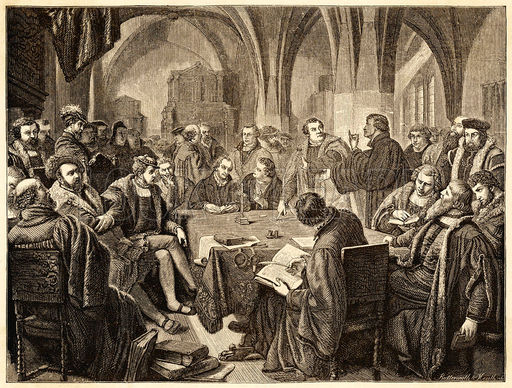
The most famous historical test case for the kind of confessional Lutheranism that abjures both unionism and sectarianism came in 1529 when Martin Luther and Huldrych Zwingli met at Marburg to discuss areas of agreement and disagreement between their two reforming movements. At Marburg, they discovered they agreed on fourteen articles of faith spanning from the nature of the Trinity to justification by faith to the role of governing authorities. But they could not agree on one point: the character of Christ’s presence in the Lord’s Supper. The dispute was formally summarized like this:
We all believe and hold concerning the Supper of our dear Lord Jesus Christ that both kinds should be used according to the institution by Christ; also that the mass is not a work with which one can secure grace for someone else, whether he is dead or alive; also that the Sacrament of the Altar is a sacrament of the true body and blood of Jesus Christ and that the spiritual partaking of the same body and blood is especially necessary for every Christian. Similarly, that the use of the sacrament, like the word, has been given and ordained by God Almighty in order that weak consciences may thereby be excited to faith by the Holy Spirit. And although at this time, we have not reached an agreement as to whether the true body and blood of Christ are bodily present in the bread and wine, nevertheless, each side should show Christian love to the other side insofar as conscience will permit, and both sides should diligently pray to Almighty God that through His Spirit He might confirm us in the right understanding. Amen.[1]
This is a masterful statement. Luther and Zwingli carefully avoid unionism by clearly, winsomely, concernedly, and lovingly explaining where they disagree, but are also in no way sectarian, for they commit themselves to “show Christian love” and “diligently pray to Almighty God that through His Spirit He might confirm us in the right understanding.” In other words, they unreservedly confess their positions while humbly asking the Lord to show them if and where they could be out of step with His Word. Here is confessional Lutheranism at its finest.
In a culture where truth is often either relegated to relativity or regarded as unimportant, confessional Lutheranism has not only much to say, but a time-tested strategy to offer. The ability to stand up for truth against error while also standing with the truth wherever it can be found is sorely needed not only in the Church, but in our world. So, as a confessional Lutheran, I will continue to be honest about areas of disagreement. But I will also never forget to look for areas of agreement. Finally, I will pray that those areas of agreement would continue to increase among others and myself until we all agree with Jesus. For agreeing with Him is what matters most.
__________________________________
[1] Martin Luther, Luther’s Works, vol. 38, J. J. Pelikan, H. C. Oswald & H. T. Lehmann, eds. (Philadelphia: Fortress Press, 1971), 88–89.
It’s Time For A Change

Credit: Mateusz Stachowski
Periodically, I receive email solicitations encouraging me to “take a stand.” I need to “take a stand” against abortion. I need to “take a stand” against sexual immorality. I need to “take a stand” against poverty. There is a whole myriad of things against which I need to “take a stand.”
Now, on the one hand, it is important to stand for truth in a world full of lies. The apostle Paul makes this clear enough when he writes of the armor of God: “Stand firm then, with the belt of truth buckled around your waist” (Ephesians 6:14). Indeed, I have written about the importance taking a stand elsewhere. On the other hand, if all we’re doing is standing against sin in our world, we are falling woefully short of our calling as Christians.
When Martin Luther sparked a reformation of the Church by posting 95 theses for discussion to a church door in Wittenberg, Germany in 1517, his first thesis described the heart and soul of what it means to be – and for that matter, to become – a Christian: “When our Lord and Master, Jesus Christ, said ‘Repent,’ He called for the entire life of believers to be one of repentance.”[1] The Christian life, Luther asserted, is grounded in repentance.
In Greek, the word “repentance” is metanoia, which is made up of two parts. The prefix meta means “to change” and the noun nous refers to the mind. To repent, then, means “to change your mind.” For instance, if a husband wants to divorce his wife because he is no longer happy in his marriage, for him to repent would mean that he stop thinking his marriage is all about his happiness and instead see it as a reflection of the commitment that Christ has to His bride, the Church. Repentance requires a shift in one’s worldview. It asks a person to stop thinking the way he used to think.
When Christ launched His ministry, He launched it with a message of repentance: “Repent, for the kingdom of heaven has come near” (Matthew 4:17). Christ’s desire was not just to take a stand against sin, but to change people’s minds about sin. He wanted people who looked at infants as disposable entities who could be left outside to die – which many in the ancient world did – to change their minds and believe that every life is precious to God. He wanted people who believed it was fine to sleep around – as many in Jesus’ day did – to change their minds and instead be faithful and tender to their spouses. He wanted people who looked past the impoverished – as the rich man in Jesus’ story about the beggar Lazarus did – to change their minds and offer what they could in Jesus’ name.
I have heard many a discussion about the sins that beset our culture and how the Church should respond to these sins. Sadly, more often than not, people want the Church only to “take a stand” while ignoring the fact that, first and foremost, the Church is to help “make a change.” The Church is to call people to repentance.
How can the Church do this? By making two shifts.
First, we must stop looking at people who are far from God as merely evil and start looking at them as lost. Looking at people who are far from God as merely “evil” incites our indignation. Seeing them as “lost” arouses our compassion.
I heard a story last week at a conference I was attending about a man who was at the deathbed of his brother. His brother was a recalcitrant non-believer. He refused to trust in Jesus, even as he was drawing his final gasping breaths. As this man stood by his brother’s bedside, trying to comfort him, the thought passed through his mind: “This is the last time my brother will ever experience any comfort. After this, it will only be eternal separation from Christ.” If that doesn’t break your heart, I don’t know what will.
There are millions of people headed for the same destiny as this man’s brother. How can we only get angry at them as evil without caring for them as lost?
Second, we must stop playing only defense when it comes to evil and start playing offense. I get the impression that some people think if we could just outlaw certain evils, our problems would be solved. But legislation against evil only defensively curbs it. It doesn’t offensively change people’s mind about the fundamental nature of right and wrong. This is why legislation passed in one Congress is so easily reversed by the next Congress. As Christians, our legislative efforts need to take a backseat to our desire to understand and empathize with how our culture thinks so we can winsomely respond to what our culture thinks. If you need a good place to start learning how to do this, I would recommend reading The Reason for God by Timothy Keller. I would also add that changing people’s minds takes time. Sometimes, it takes lots of time. So be patient! A mind changed is worth the wait.
“Taking a stand” may reveal the sin in our world. However, “making a change” – repentance – conquers the sin in our world because it leads people to Christ. And I’d much rather win against sin instead of just complaining about sin.
____________________________
[1] Martin Luther, “Disputation on the Power and Efficacy of Indulgences,” (October 31, 1517).
Act Like Men: Sobering Lessons From Ray Rice and Janay Palmer
 We’ve known about it since last February. But last Monday, when TMZ released video of former Ravens running back Ray Rice hitting his then fiancée and now wife Janay Palmer in an elevator, knocking her unconscious, the flames of public outrage instantly erupted. The video was so shocking and the violence so brutal that, hours after the video was released, the Ravens terminated Rice and the NFL banned him indefinitely.
Much of the discussion surrounding the assault and the release of this video has centered on the NFL’s inept handling of this terrible tragedy. People want to know: Why was the NFL’s initial reaction to this domestic violence story so weak? Originally, Rice received only a paltry two-game suspension. Why did the NFL change its response once the video was released, considering the video gave us no new information? It just confirms what we already knew. New information indicates that the NFL did, in fact, have a copy of this video in their possession as early as last April. Why didn’t the NFL take swift and decisive action against Rice then?
These are important questions. But for the purposes of this blog, I want to focus on Rice himself. His brutal actions serve as clear cautions and teach us important lessons. Here are three of those lessons.
Lesson 1: Humans deserve dignity.
Time and time again, Scripture upholds the dignity every human being. The Psalmist writes:
What is man that You are mindful of him, the son of man that You care for him? You made him a little lower than the heavenly beings and crowned him with glory and honor. You made him ruler over the works of Your hands; You put everything under his feet: all flocks and herds, and the beasts of the field, the birds of the air, and the fish of the sea, all that swim the paths of the seas. (Psalm 8:4-8)
The Psalmist extols man as the crown of God’s creation. Though on earth, he is just a little lower than heavenly beings and is called to steward and rule God’s creation. Man has preeminent dignity in God’s created order.
Part of the reason what Ray Rice did to Janay Palmer is so appalling is because it robbed her of this dignity. To knock out your soon-to-be spouse and then to drag her out of an elevator is to treat her with contempt rather than, as Solomon says, a “crown” (Proverbs 12:4). Rice treated Palmer as someone less than human. And this is unacceptable.
Lesson 2: Humans need patience.
Though we do not know the specific circumstances that led to this incident, it is not a stretch to surmise that Rice punched Palmer because he was angry with her. Something had been said or done that sent him reeling.
What Rice needed was patience.
The apostle Paul famously extols patience as part of the fruit of the Spirit: “The fruit of the Spirit is love, joy, peace, patience, kindness, goodness, faithfulness, gentleness and self-control” (Galatians 5:22-23). The Greek word Paul uses for “patience” is makrothymia. This word is made up of two parts. Makros means “long” and thymos means “hot.” To be patient, then, means to take a long time to get hot. It means to keep your cool when everyone else is losing theirs.
Everyone gets frustrated. Everyone has disagreements. Everyone endures a pricked pride from time to time. What makes the difference in how these troubles turn out is how we react. Do we react in anger? Or do we take a long time to get hot?
Patience can protect your job and sustain your reputation. But most importantly, it can save your relationships. This is why, when Paul discusses how to love another person well, the very first thing he says is “Love is patient” (1 Corinthians 13:4).
Lesson 3: Humans value trust.
I have counseled with far too many battered women. Some have been hit many times. Others have been hit only once. Regardless of the number of times these women have been abused, one refrain remains consistent: “I don’t know if I can trust him anymore. I’m afraid he’ll do it again.”
Violence breaks trust. It breaks trusting communication because you never know if something you say will set the other off. It breaks trusting intimacy because the same hands that reach out to hold you once hit you. Violence cannot be quarantined and contained as merely “one problem” in an otherwise healthy relationship because it breaks trust in every area of a relationship. So men, let me say this as clearly as I can: Raising your hand at a lady, even just one time, is one time too many. Don’t even think about it. Go for a walk to cool off. Call a trusted friend or your pastor for counsel. Pray for strength to keep your cool. But do not raise your hand. Ever. No exceptions. No excuses.
Is there forgiveness from God for men who break this rule? Of course there is. Can breaking this rule end a man’s marriage and irreparably harm a precious daughter of God? You bet it can. So just don’t do it.
Coming to Dallas this November, and then to Chicago next May, is a Christian conference called “Act Like Men.” It’s based on Paul’s admonition to the Corinthians: “Be watchful, stand firm in the faith, act like men, be strong” (1 Corinthians 16:13). A man who hits a woman rejects Paul’s admonition. He does not act like a man. He acts like a brute.
So what does it mean to act like a man? It means simply this: to act like Christ. So whether you’re a famed NFL running back, an affluent businessman, or an unknown factory worker, it’s time to put down your hand and take up your cross.


 Pastor Zach's Blog