Two Wrongs Don’t Make a Right: The Sad Story of Rolling Stone
Credit: Rappler.com
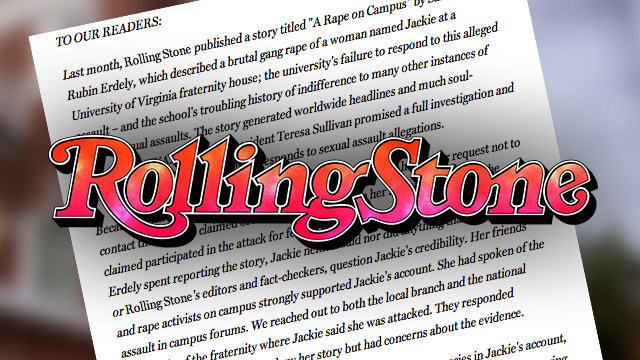
My mother used to tell me that two wrongs don’t make a right. Nowhere has this recently proven to be more true than in the case of a Rolling Stone cover article by Sabrina Erdely about the brutal gang rape of a young woman, identified only as Jackie, at the University of Virginia. The article received national attention for its gruesome detail, but aroused enough skepticism that an independent police investigation into Jackie’s story was launched. Ultimately, the investigators were unable to verify the details Jackie’s story as she described them them to Rolling Stone. Indeed, to some extent, her story appears to be misleading, if not out-and-out fabricated. Rolling Stone, embarrassed by their release of such a questionable article, commissioned the Columbia University Graduate School of Journalism to conduct an investigation as to what went wrong with its reporting. How could the magazine be fooled into running a potentially false story? The investigators found that the article was:
…a story of journalistic failure that was avoidable. The failure encompassed reporting, editing, editorial supervision and fact-checking. The magazine set aside or rationalized as unnecessary essential practices of reporting that, if pursued, would likely have led the magazine’s editors to reconsider publishing Jackie’s narrative so prominently, if at all.[1]
The report continues:
The editors and Erdely have concluded that their main fault was to be too accommodating of Jackie because she described herself as the survivor of a terrible sexual assault. Social scientists, psychologists and trauma specialists who support rape survivors have impressed upon journalists the need to respect the autonomy of victims, to avoid re-traumatizing them and to understand that rape survivors are as reliable in their testimony as other crime victims. These insights clearly influenced Erdely, Woods and Dana. “Ultimately, we were too deferential to our rape victim; we honored too many of her requests in our reporting,” Woods said. “We should have been much tougher, and in not doing that, we maybe did her a disservice.”
This is a story of two wrongs. First, there is the societal ill of rape, which sadly happens way too often on college campuses, often without those who perpetrate the assault being appropriately disciplined. But second, there are also the journalistic lapses in judgment by Rolling Stone, who apparently was so desperate to tell a sensational story that they checked not only their good sense, but their common sense, at the door. When these two wrongs came together, they didn’t make anything right. Instead, they just made a mess.
In reality, there is probably a third wrong here – that of deceit. Insofar as Jackie fabricated, misrepresented, or embellished what happened to her, she did a grave disservice to victims of rape all over the world. If she did tell the truth, I pray that comes to light – and quickly – so that she and Rolling Stone can be exonerated. If she did not tell the truth, I pray she is moved to confess her lies and apologize. There’s plenty of real sexual horror in our world. We don’t need to make up more of it.
Sadly, this whole, sordid affair is nothing less than a bit of empirical evidence of the depths of humanity’s depravity. The horrible reality of rape; the drive of a magazine to be so titillating that it forgets to be truthful; the mysterious and twisted desire of a young lady to tell a horrific story that could be false – there is no shortage of human folly on display here.
One of Jackie’s friends, Ryan Duffin, in an interview with New York Magazine, explained that though he wants to believe Jackie’s story, he has finally decided, “It doesn’t matter if it’s true or not, because whether this one incident is true, there’s still a huge problem with sexual assault in the United States.”[2]
I would beg to differ. I think the truthfulness of Jackie’s story does matter. It matters because one sin can never be solved another sin. Rape cannot be solved by deceit. Two wrongs don’t make a right.
My prayer is that any remaining wrongs in this story come to light so they can be corrected, amended, and, ultimately, forgiven. For all that’s gone wrong with this story, that’s the only hope for something to come out of this that’s right.
_________________________________
[1] Sheila Coronel, Steve Koll, and Derek Kravitz, “Rolling Stone and UVA: The Columbia University Graduate School of Journalism Report,” Rolling Stone (4.5.2015).
[2] Margaret Hartmann, “Everything We Know About the UVA Rape Case [Updated],” New York Magazine (4.6.15).
Why I Agree With Tim Cook

Credit: ABC News
I agree with Tim Cook.
When the CEO of Apple writes, “Discrimination, in all its forms, is bad for business,” I agree. Discrimination in its civil rights sense of, ironically, indiscriminately hating a whole group of people simply because of a particular characteristic, practice, or belief is unacceptable. When Cook says, “This is about how we treat each other as human beings,” I agree.[1] Treating each other without so much as a modicum of dignity and understanding is inexcusable.
I agree with Tim Cook. But I don’t think Tim Cook agrees with me.
In what has become the latest kerfuffle over religious rights and gay rights, Indiana Governor Mike Pence signed into law Senate Bill 568, stating:
A state or local government action may not substantially burden a person’s right to the exercise of religion unless it is demonstrated that applying the burden to the person’s exercise of religion is: (1) essential to further a compelling governmental interest; and (2) the least restrictive means of furthering the compelling governmental interest.
Almost immediately, a furor erupted. The Wall Street Journal reports:
Calls to boycott Indiana dominated Twitter on Friday. Tourism officials in Indianapolis fielded an onslaught of questions from convention planners … Even the NCAA, which is based in Indianapolis and is planning to host more than 100,000 basketball fans next weekend, expressed concerns about what the law means.[2]
At the root of this riot is a concern that this bill’s protection against government actions that “substantially burden a person right to the exercise of religion” could lead to public accommodations refusing to serve LGBT people because their owners may have ethical convictions that conflict with the convictions of many in the LGBT community. One thinks of the Oregon baker who refused to make a cake for a same-sex couple for their wedding and the Washington florist who refused to sell flower arrangements to another same-sex couple for their wedding.
The New York Times pulled no punches in its disdain for Indiana’s bill, publishing and op-ed piece by its editorial board titled, “In Indiana, Using Religion as a Cover for Bigotry.” And, as with Tim Cook, I can say that I agree with the editorial board of The New York Times insofar as I abhor the thought of religion being used to mask bigotry.
But at the same time I agree with them, I still don’t think they agree with me. Here’s why.
Tim Cook and The New York Times editorial board have taken up a moral crusade against bigotry. And I am happy to join them. Bigotry is wrong. But where they have one moral concern, I have two. Because at the same time I despise bigotry, I am also heartbroken by shifting social mores on human sexuality. Like bigotry, for me, the twisting of human sexuality is a moral issue that is tearing at the fabric of both our society and our souls. Lust is hurting us. Pornography is hurting us. Affairs are hurting us. Domineering husbands who demand sex from their wives are hurting us. And yes, sex outside of the context of marriages between husbands and wives is hurting us.
But to operate – even when I’m doing business – under such Christian conviction does not automatically equate to discrimination. And to say that I think something is wrong in a loving, thoughtful, and gentle way does not ineluctably constitute bigotry. In many ways, Christian conviction has proven itself an an indispensable blessing to business. Christian commitments to faithfulness, honesty, integrity, graciousness, and generosity can have amazingly positive impacts in cutthroat corporate cultures. Why would we not surmise that a loving commitment to some sort of sexual morality might not have a similar impact? This is where I think Tim Cook and the editorial board of The New York Times get things wrong – not in their moral repulsion at discrimination and bigotry, but in their use of the terms.
It is true that Christian conviction has sometimes been twisted toward bigoted ends. I think of the man in Colorado who marched into a bakery and ordered cakes with slogans like “God hates gays” written on them. When the bakery refused to make the cakes, he filed a lawsuit. That is not living by Christian conviction. That’s being a jerk. But that is not what I’m talking about. I’m simply trying to make the case that at the same time the likes of Tim Cook, The New York Times editorial board, and, for that matter, many Christians around the world believe that bigotry is a moral issue that needs to be addressed and confronted, many Christians around the world also believe that shifting ethics on human sexuality is a moral issue that needs to be addressed. I think it’s only fair and right to hear them out – and to refrain from labeling them as bigots. I also think it’s only decent to respect their consciences – especially when their consciences express themselves in love – even when they’re running public accommodations.
So let’s make a deal: let’s stand against bigotry together while respecting each others’ differences in conscience. Who knows? The result might just be a deeper understanding of each other and a deeper love for each other. And I hope those are two morals on which we can all agree.
_______________________
[1] Tim Cook, “Tim Cook: Pro-discrimination ‘religious freedom’ laws are dangerous,” The Washington Post (3.9.2015).
[2] Mark Peters and Jack Nicas, “Indiana Religious Freedom Law Sparks Fury,” The Wall Street Journal (3.27.2015).
The Greatest Show On Earth
 This past weekend at the church where I serve, we presented our annual Palm Sunday pageant depicting the birth, life, death, and resurrection of Jesus Christ. It is a lot of work for all involved, but I always come out of the pageant with a deep sense of satisfaction and awe, for I have the privilege of working with amazing people who have amazing gifts and know how to use them in amazing ways. I am deeply thankful for the people with whom I get to work. They are a blessing to me.
In one way, our pageant can be characterized as a spectacle. It has moving music featuring a live orchestra and choir, well-choreographed lights, lots of actors, and a graphic enough depiction of Christ’s death that we make available an alternative worship service for small children who may be unsettled by what they see. But, of course, it isn’t the spectacle of our Palm Sunday pageant that makes it valuable and powerful. It’s the message. There is simply no better message than the gospel message – that Christ was crucified for sinners. Our prayer is that this message – as it is presented in the pageant – leads hearts to repentance and faith, even as God has promised in His Word.
In Luke’s account of Jesus’ crucifixion, there is an interesting reaction to His death from the bystanders: “All the crowds that had assembled for this spectacle, when they saw what had taken place, returned home beating their breasts” (Luke 23:48). The word for “spectacle” in Greek is theoria, related to our English word “theatre.” This is a most appropriate word because crucifixions were indeed gory theatre. If someone was an enemy of the Roman State, the governing officials, though they could have executed such a person in other, more efficient and less gruesome ways, chose crucifixion. Why? Because crucifixion served as a public, humiliating spectacle. In fact, most criminals were crucified naked so as to shamefully expose them. Jesus is no exception. His crucifixion is meant to be theatre. It is meant to be spectacle. It is meant to be theoria, just as Luke says.
But in the middle of this spectacle, something unexpected happens.
When the crowds see the darkness that covers the land, when they hear the news that the curtain of Jerusalem’s temple has been torn in two, when they hear Jesus commend Himself into His Father’s hands, and when they are startled by the testimony of one of Jesus’ executioners saying, “Certainly this man was innocent” (cf. Luke 23:44-47), they “return home beating their breasts.” In Jewish piety, this is a sign of repentance (e.g., Luke 18:13). What begins as theatre and spectacle becomes a life-changing event that testifies to the truth of Jesus’ identity and to the promise of God’s salvation.
At many churches this Holy Week, there will be a certain amount of spectacle. There will be Maundy Thursday services that conclude dramatically with a reading of Psalm 22 and a stripping of the church’s altar to remind us of Christ’s humiliation on the cross. There will be moving Good Friday Tenebrae services that turn sanctuaries black with darkness to remind worshipers of the darkness of sin and of Jesus’ death. And, of course, there will be energetic Easter services, complete with Easter lilies, rafter-shaking music, and the historic, thrilling Easter greeting, “Christ is risen!” to which the congregation will respond, “He is risen indeed! Alleluia!” Yes, there will be plenty of spectacle this week. And this, I would note, is great. I love the spectacle of this time of year.
My prayer, however, is that even as spectacle may be an inevitable and helpful part of Holy Week, we remember that it is not all of Holy Week. For the spectacle is meant to point to something better – and to Someone greater. The spectacle is meant to point us to the cross – and to the One who died on it. And Jesus is more than a spectacle. He is your Savior. That’s what those bystanders at Jesus’ cross discovered as they beat their breasts. And that’s what we are called to believe.
Spiritual Speech About Social Concerns
 Last week on this blog, I discussed a video showing some members of the Sigma Alpha Epsilon fraternity at the University of Oklahoma singing a racist chant. In my analysis, I cited Byron Williams of The Huffington Post and his use of theological language to address the incident:
America’s approach to the original sin of racism maintains an aspect of arrested development. It is too easy to temporarily transfer our moral indignation toward a fraternity at the University of Oklahoma that no longer exists than it is to take the more difficult path that could lead to a meaningful transformation …
The expelled students have already succeeded in dismantling their fraternity chapter. Shouldn’t they be given opportunity for redemption? In lieu of expulsion, could the university have found another way to educate all involved about the poisons of racism?[1]
Williams attaches a lot of theological freight to his analysis of this incident – and, I would argue, rightly so – with words like “original sin” and “redemption.” But I would also argue that he does not frame his theological terminology in a particularly Christian way. Williams’ description of “redemption,” for instance, is more closely aligned with AA’s call to make amends than it is with Christ’s redemptive work on the cross. To be clear, I by no means think that these students should not have to make amends. Indeed, I think such action would be extraordinarily salutary – both for the people they hurt and for the offending students themselves. I only point out Williams’ unconventional use of theological language as an example of how, while many in our culture still have strong theological instincts, such instincts are often not expressly Christian in their content or context.
In an article for The Weekly Standard, Roman Catholic theologian Joseph Bottum frames the issue of racism and its attendant issue of white privilege, as does Williams, in the theological terminology of original sin:
“All have sinned,” writes St. Paul in the fifth chapter of his letter to the Christians in Rome, even those who have “not sinned after the similitude of Adam’s transgression.” And so too are we all guilty of racism, even those who have never harbored an explicitly racist thought or said an explicitly racist word or performed an explicitly racist deed. “We have to get away from this idea that there is one sort of racism and it wears a Klan hood,” as Berkeley law professor Ian Haney-López explains. “Of course, that is an egregious form of racism, but there are many other forms of racism. There are racisms.” Racisms under which we all suffer.[2]
Bottum astutely notes that for all the talk of secularism’s encroachments on Western society, our essential impulses are still spiritual. Just look at how we talk about racism as not just a set of actions, or even as a worldview, but as a blight for which we must make atonement.
But as strong as our spiritual impulses may be, something is missing:
The doctrine of original sin is probably incoherent, and certainly gloomy, in the absence of its pairing with the concept of a divine savior – and so Paul concludes Romans 5 with a turn to the Redeemer and the possibility of hope: “As sin hath reigned unto death, even so might grace reign through righteousness unto eternal life by Jesus Christ our Lord.” Think of it as a car’s engine or transmission scattered in pieces around a junkyard: The individual bits of Christian theology don’t actually work all that well when they’re broken apart from one another.
We are stuck in a societal Anfechtung, Bottum says. For on the one hand, our culture does indeed have strong spiritual impulses. This is why we confess and agonize over “original sins” like racism. But on the other hand, our spiritual impulses do not lead us to the relief of Christ’s cross. Instead, our impulsive anxieties are left to stew in their own juices until they inevitably begin to search for relief and redemption in other ways – in our day, usually in the ways of our body politic. In large part, we in the West have traded the theologia crucis for legislative sausage making.
In many regards, this way of theologizing is merely the inexorable upshot of the liberal Protestantism of the twentieth century. As Bottum explains:
Early in the twentieth century … the main denominations of liberal American Protestantism gradually came to a new view of sin, understanding our innate failings as fundamentally social rather than personal. Crystallized by Walter Rauschenbusch’s influential Christianity and the Social Crisis (1907), the Social Gospel movement saw such sins as militarism and bigotry as the forces that Christ revealed in his preaching – the social forces that crucified Him and the social forces against which He was resurrected. Not that Christ mattered all that much in the Social Gospel’s construal. Theological critics from John Gresham Machen in the 1920s to Reinhold Niebuhr in the 1950s pointed out that the Social Gospel left little for the Redeemer to do: Living after His revelation, what further use do have we of Him? Jesus may be the ladder by which we climbed to a higher ledge of morality, but once there, we no longer need the ladder …
The Social Gospel’s loss of a strong sense of Christ facilitated the drift of congregants – particularly the elite and college-educated classes – out of the mainline that had once defined the country. Out of the churches and into a generally secularized milieu.
They did not leave empty-handed. Born in the Christian churches, the civil rights movement had focused on bigotry as the most pressing of social sins in the 1950s and 1960s, and when the mainline Protestants began to leave their denominations, they carried with them the Christian shape of social and moral ideas, however much they imagined they had rejected Christian content.
When I read Bottum’s analysis of our current situation, I can’t help but think of Rudolf Bultmann, the famed twentieth century German theologian, who sought to free Christianity from its so-called “mythical” trappings – trappings like Jesus’ miracles, Jesus’ teachings, and, ultimately, Jesus’ very resurrection. I wonder if this old liberal theologian isn’t smiling down on us right now. After all, his project of demythologizing Christianity has now been completed, probably more thoroughly than he could have ever imagined. For Christianity in secular society has indeed been stripped of all its mythical trappings – including, as it turns out, Christ Himself. We are left only with the residual ghosts of Christian morality to convict us of socially abhorrent sins without the historical cross of the resurrected Christ to comfort us in all sin.
Of course, orthodox Christians cannot accept Bultmann’s project or its outcome. But even if we cannot accept it, it is important that we understand it. For if we do not understand the theological shape of our secular society, we will perhaps miss opportunities to offer our salvific rest of the story to our society’s guilt-ridden part of the story.
And that would be a sin.
_________________________
[1] Byron Williams, “It’s Not Unconstitutional to Be Racist,” The Huffington Post (3.11.2015).
[2] Joseph Bottum, “The Spiritual Shape of Political Ideas,” The Weekly Standard (12.1.2014).
Changing Racist Hearts
Credit: AP / The Washington Post
It’s been a tough week for race relations in America. Saturday, March 7 began with a march, led by President Obama and Representative John Lewis, across the Edmund Pettus bridge in Selma to commemorate the fiftieth anniversary of the day 600 voting rights demonstrators, led by Dr. Martin Luther King, Jr., crossed this same bridge and were met by state troopers who attacked them with billy clubs and tear gas. Indeed, Representative Lewis was among those seriously injured in that fateful march. Reflecting on the events of fifty years ago, the president noted:
In one afternoon fifty years ago, so much of our turbulent history – the stain of slavery and anguish of civil war; the yoke of segregation and tyranny of Jim Crow; the death of four little girls in Birmingham, and the dream of a Baptist preacher – all that history met on this bridge.
It was not a clash of armies, but a clash of wills; a contest to determine the true meaning of America.
And because of men and women like John Lewis, Joseph Lowery, Hosea Williams, Amelia Boynton, Diane Nash, Ralph Abernathy, C.T. Vivian, Andrew Young, Fred Shuttlesworth, Dr. Martin Luther King, Jr., so many others, the idea of a just America, and a fair America, an inclusive America, and a generous America – that idea ultimately triumphed …
What they did here will reverberate through the ages. Not because the change they won was preordained; not because their victory was complete; but because they proved that nonviolent change is possible; that love and hope can conquer hate.[1]
If only the president’s final line rang a truer longer.
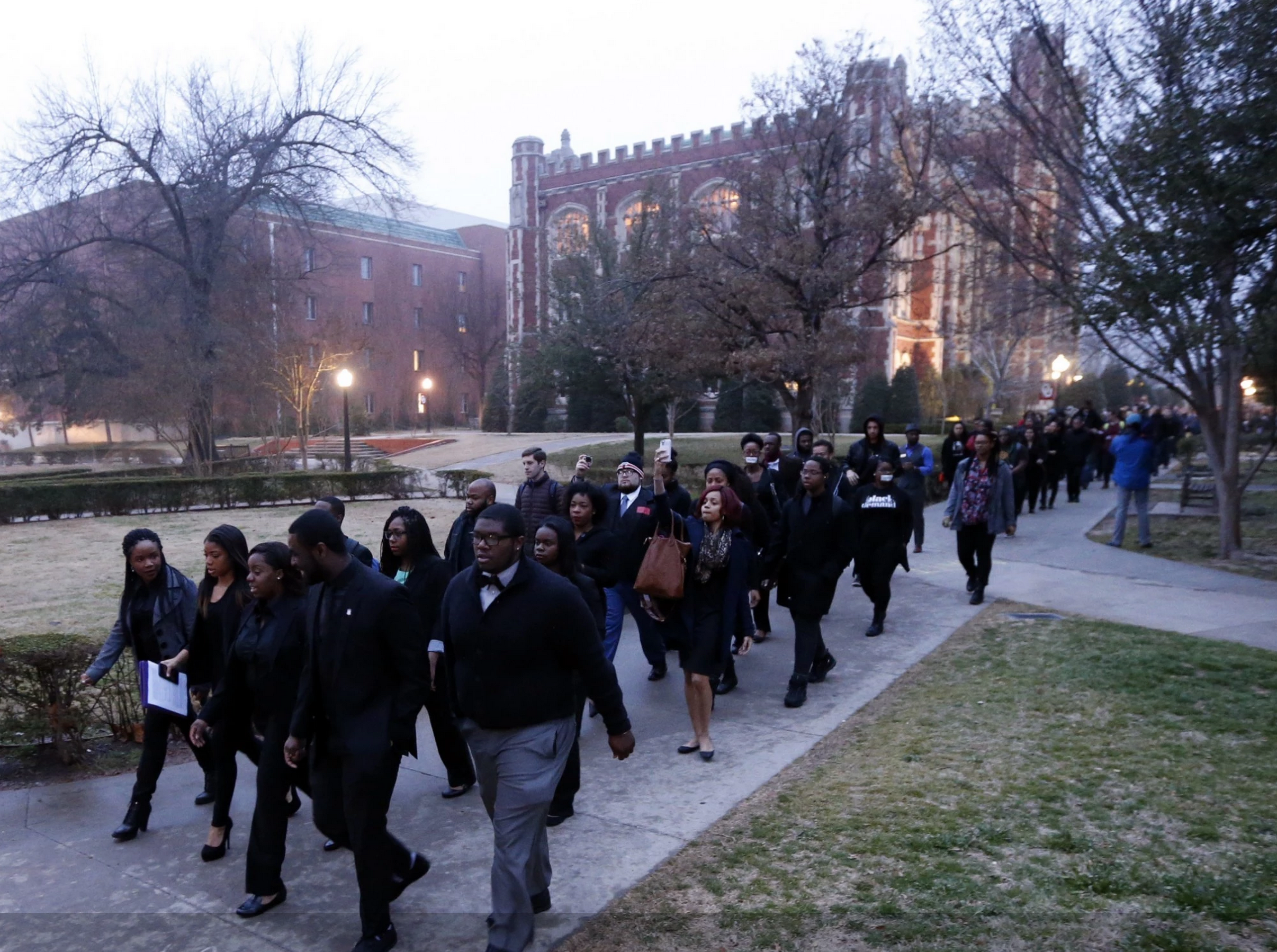
The very next day, a video surfaced showing members of the Sigma Alpha Epsilon fraternity at the University of Oklahoma singing a horrifyingly racist song on a bus. The University quickly denounced the video, suspended the fraternity from its campus, and expelled two of the students involved.
But then came this:
Attorneys and law professors have watched with interest this week as the University of Oklahoma moved swiftly to disband the school’s SAE chapter and expel two students on suspicion of leading the racist chant, which was captured on a now-viral video.
University President David Boren acted decisively in dismantling the chapter, but experts say the university may be on shaky legal ground.[2]
The issue at hand is whether or not the University of Oklahoma violated the students’ First Amendment rights by closing their fraternity and expelling two students simply because they sang a song that many find – and, I hasten to add, should find – offensive. As Terrence McCoy reports in an article for The Washington Post:
The expulsions immediately struck constitutional law experts such as professor Eugene Volokh, of the University of California at Los Angeles and the Volokh Conspiracy blog, as strange. Did the University of Oklahoma, a public institution, just punish speech that, while clearly abhorrent, was protected under the First Amendment? Was this a violation of the Constitution?
Private institutions – like Sigma Alpha Epsilon – can freely punish speech that breaches their codes or standards. But a public institution such as the University of Oklahoma, which takes public money, operates as an arm of the government under the law. “So, in effect, it’s not a university punishing a student for a racist video or social media post, it is the state itself acting against an individual – a person, importantly, with all the rights guaranteed under the First Amendment,” wrote the University of West Alabama’s Will Nevin on AL.com.[3]
This case is yet another example of how woefully inadequate civic laws can be to address the deeply moral aspects of the human condition and experience.
One the one hand, the First Amendment was put in place to serve an important common good – that of protecting this country’s citizens from being oppressed, even in their speech, by their government. This freedom is important and ought to be fiercely protected. On the other hand, we must never forget that societal freedom is inevitably fraught with personal danger. Free speech, it turns out, does not always translate into right speech. Just because legally we can say almost anything doesn’t mean that morally we should.
An opinion piece by Byron Williams of The Huffington Post struck me as especially lucid in regard to this story’s moral entailments:
America’s approach to the original sin of racism maintains an aspect of arrested development. It is too easy to temporarily transfer our moral indignation toward a fraternity at the University of Oklahoma that no longer exists than it is to take the more difficult path that could lead to a meaningful transformation.[4]
Notice the explicitly theological and moral category Williams uses for racism: it’s America’s “original sin.” But notice also how Williams also offers a distinctly non-civic answer to his distinctly theological and moral framing of this problem:
The expelled students have already succeeded in dismantling their fraternity chapter. Shouldn’t they be given opportunity for redemption? In lieu of expulsion, could the university have found another way to educate all involved about the poisons of racism?
The ease with which one can easily sing a song for amusement that dehumanizes another cannot be eradicated by an expulsion that, in my view, is unconstitutional.
Because racism is a learned behavior, it can be unlearned.
Moreover, it could prove to be the most meaningful class the students involved ever take.
To answer what he refers to as an “original sin,” Williams proposes a path to “redemption.” Though he does not frame redemption in a particularly Christian way, his argument is nevertheless rich with not-so-subtle theological overtones and vocabulary. Racists, as Williams notes, “cannot be eradicated by an expulsion.” In other words, if we want to root out racism from society, racists will need something more than punitive measures. As Christians, we know that racists will need Jesus – even as all sinners need Jesus. And racists will need followers of Jesus who are willing both to stand up against them and to seek the transformation of them.
One student’s words on last Monday’s NBC Nightly News broadcast express my hope for the students of Sigma Alpha Epsilon: “I want this to be a rehabilitory time for them.”[5] I hope it is. Because although the First Amendment may be able to defend them legally, it’s only Jesus who can change them internally. And it’s only Jesus who can heal people left broken by these students’ words relationally. So let’s lift our eyes to that hope. After a week like this last one, it’s a hope that we need.
_________________________
[1] Chris Cillizza, “A single photo that tells the powerful story of the 50th anniversary of Selma,” The Washington Post (3.7.2015).
[2] Matt Pearce, “Is University of Oklahoma frat’s racist chant protected by 1st Amendment?” Los Angeles Times (3.10.2015).
[3] Terrence McCoy, “Why expelled Oklahoma frat boys would have an ‘excellent chance’ in court,” The Washington Post (3.11.2015).
[4] Byron Williams, “It’s Not Unconstitutional to Be Racist,” The Huffington Post (3.11.2015).
[5] NBC Nightly News, Lester Holt reporting (3.9.2015).
Private Conversation and Public Rebuke
 When I was in college, I had a professor tell me that if you get five churchmen in a room to discuss a particular issue, they will have six different opinions. It’s true. Disagreements – especially in ecclesiastical contexts – arise often. Offenses against others are committed often. Jesus, as Lord of the Church, knows this. This is why Jesus gives us instruction on how to address disagreements and offenses among us:
If your brother sins against you, go and show him his fault, just between the two of you. If he listens to you, you have won your brother over. But if he will not listen, take one or two others along, so that “every matter may be established by the testimony of two or three witnesses.” If he refuses to listen to them, tell it to the church; and if he refuses to listen even to the church, treat him as you would a pagan or a tax collector. (Matthew 18:15-17)
Jesus is clear. Disagreements and offenses are best and first addressed privately before they are addressed publicly. Sadly, in the church body of which I am a part, the Lutheran Church – Missouri Synod, I have seen Jesus’ pattern disregarded again and again.
Over the past few months, I have been able to attend two conferences hosted by different congregations of my church body. During these events, some took to social media to malign these conferences – often in acerbic and sarcastic ways – over differences they had with the presenters and presentations. When confronted about these uncharitable comments in light of Jesus’ words in Matthew 18, some of the people posting these comments maintained that because the teaching at these conferences was public and, in their opinion, false, the rebuke of these teachers was also appropriately public. They cited Martin Luther’s words: “Where the sin is public, the rebuke also must be public, that everyone may learn to guard against it.”[1] These people saw no need to have a private conversation with those with whom they disagreed.
Because my church body is doggedly committed to properly and carefully interpreting Scripture, I believe it is worth reminding ourselves what Scripture says concerning how to address disagreements among us. For I believe that those who argue for public rebuke apart from any private conversation are either misled, or perhaps even misleading.
First, it needs to be said that sarcasm that only attacks instead of seeking to correct is always wrong. As Solomon sagely warns, “Whoever belittles his neighbor lacks sense” (Proverbs 11:12). In our disagreements with each other, we must be careful never to be belittling of each other.
Second, it is important to note that the Scriptures – and especially the Pauline letters – are full of public rebukes. For instance, Paul rebukes a member of the church at Corinth for his gross sexual immorality, of which the Corinthians were foolishly approving (cf. 1 Corinthians 5:1-2). He also rebukes his fellow apostle Peter for refusing to eat with Gentile believers (cf. Galatians 2:11-14). Then, in 1 Timothy 5:19-20, Paul provides his young pastor protégé with some guidance on how to publicly rebuke false teaching:
Do not entertain an accusation against an elder unless it is brought by two or three witnesses. Those who sin are to be rebuked publicly, so that the others may take warning.
Two points are worth noting in this passage. First, accusations of false teachings are not to be made ad hoc. Just because one person sees false teaching in someone’s ministry does not mean that there is, in fact, false teaching. False teaching must be discerned corporately; not individually. After all, an accuser may himself turn out to be a false teacher – or, in some instances, a false accuser! Second, the primary reason for a public rebuke is “so that others may take warning.” In other words, public rebukes are for those who are in danger of being swayed by false teaching. They are not for the false teacher.
But what about the false teacher? How does one deal with him? Here is where Jesus’ words concerning private conversation commend themselves to us. For they are meant to help a false teacher see the error of his ways and, by God’s grace, come to repentance.
This leads me to my concern with much of the discussion surrounding public rebuke in my church body. There are some who use Paul’s words concerning public rebuke as an excuse to not heed Jesus’ words concerning private conversation. But both private conversation and public rebuke are needed, for both false teachers and those who are falsely taught need help. Public rebuke cannot be used to supplant private conversation.
I know that, sometimes, private conversation is impossible. Indeed, I have warned against false teachers and teachings on this very blog. False teaching is worthy of a warning! But if we can have private conversations with teachers about whom we have concerns, I see no reason not to have these conversations. Scripture commands it. The integrity of our consciences demands it.
Allow me to offer one final distinction as a kind of postscript. When confronting false teaching, we must be careful that we don’t characterize a person’s unintentional misstatement as a malicious falsehood. Malicious liars are very different from unclear communicators. One needs to be firmly rebuked. The other needs to be gently corrected. May we be wise enough to know the difference – and pastoral enough to care both for those who teach and for those who are taught.
__________________________
[1] Concordia: The Lutheran Confessions, Second Edition, Paul McCain, ed. (St. Louis: Concordia Publishing House, 2006), 391 (LC 284).
Thoughts on Christianity and Secularism
 It’s hard to deny that secularism is on the ascendency in America. Indeed, even if one points to the fact that roughly the same number of adults believe in God now as did in 1947, secularism’s intellectual and cultural capital in broader society has steadily increased. As James Davison Hunter deftly notes, the raw numbers of a thing don’t always indicate the influence of a thing. He explains:
With cultural capital, it isn’t quantity but quality that matters most. It is the status of cultural credentials and accomplishment and status is organized between the “center” and the “periphery.” The individuals, networks and institutions most critically involved in the production of a culture operate in the “center” where prestige is the highest, not on the periphery, where status is low.
And so, USA Today may sell more copies of newspapers than the New York Times, but it is the New York Times that is the newspaper of record in America because it is at the center of cultural production, not the periphery, and its symbolic capital is much higher.[1]
Secularism’s proponents may not be large in number, but a great number of them are certainly at the center of our cultural production. And they are working hard to move Christians to the periphery. Even more, secularists are working hard to shift the center of Christianity itself to something that is closer to their way of thinking, even if it is not in perfect alignment with it. This is why there are great numbers of what could be called “secular Christians” who, though they may pay certain homage to the artifacts of their faith, are largely either politely mute or openly in disagreement with much of what historic Christianity confesses.
So how are Christians who are more traditionally orthodox in their confessions to respond?
In my sermon two weeks ago, I outlined three ways that Christians have sought to respond to secularism’s inroads over the past few decades. They are worth rehearsing here.
The first is that of capitulating. There are some Christians who, be it happily or reticently, capitulate to many of secularism’s tenets. These are the “secular Christians” of whom I spoke above. So, for example, one of secularism’s primary tenets is tolerance, or, stated more forcefully, relativism. In secularism’s creed, one religion’s claims cannot be truer than another religion’s claims unless, of course, that religion’s claims conflict with the claims of secularism. Christians who capitulate to the secular tenet of tolerance may speak of their personal path to God as through Christ, but will deny that Christ’s claims are exclusively true for everyone. There must be other, equally true, paths available to these people. These Christians thus capitulate to secularism’s tenets of tolerance and relativism.
The second response to secularism’s inroads is that of cloistering. There are some Christians who, horrified at secularism’s ascendency, immerse themselves in a Christian culture that breezily and probably unknowingly separates itself from broader culture with its many secular entailments by creating its own subculture. The Christians listen to Christian music, read Christian books, and frequent Christian businesses while looking with skepticism at what they perceive to be the irreversible corruption of broader cultural trends. They cloister themselves off in hopes of maintaining more “traditional” values.
The third response to secularism’s inroads is that of conquering. Christians who conquer are fully engaged in what is popularly known as “the culture wars,” launching a virulent apologetic against everything from abortion to gay marriage to Hollywood. They hope that if they can just take these institutions – as well as their sympathizers – down, usually by political means, a sanctified sanity will be restored to the culture-at-large.
I must say that I am largely disappointed by all three of these strategies for stemming secularism’s tide. I think each of these strategies, though they may have certain useful elements that should be retained, are largely ineffective and theologically anemic. Indeed, Scripture already outlines a strategy for engaging secularism in all its forms and with all its tentacles – that of converting. Simply stated, Christians are to seek opportunities to present Christ’s claims to as many as possible so that as many as possible – including secularists – may come to faith.
One of my favorite insights concerning secularism and conversion comes from Søren Kierkegaard, who wrote:
The world and Christianity have completely opposite conceptions. The world says of the apostles, of the Apostle Peter as their spokesman, “He is drunk,” and the Apostle Peter admonishes, “Become sober.” Consequently the secular mentality considers Christianity to be drunkenness, and Christianity considers the secular mentality to be drunkenness. “Do become reasonable, come to your senses, try to become sober.” Consequently the secular mentality considers Christianity to be drunkenness, and Christianity considers the secular mentality to be drunkenness.[2]
Here, Kierkegaard uses Peter’s speech in Acts 2 as a case study in just how far apart secularism and Christianity really are. Somewhat hyperbolically, Kierkegaard says they “have completely opposite conceptions.” So how does Peter counter the “completely opposite conception” of the secularism of his day? In Kierkegaard’s paraphrase, he admonishes the secularists, “Become sober.” In the Bible’s text, he says:
“Repent and be baptized, every one of you, in the name of Jesus Christ for the forgiveness of your sins. And you will receive the gift of the Holy Spirit. The promise is for you and your children and for all who are far off – for all whom the Lord our God will call.” (Acts 2:38-39)
Peter calls for conversion. And “those who accepted his message were baptized, and about three thousand were added to their number that day” (Acts 2:41).
Peter’s call to conversion, it seems, worked. Perhaps his call still ought to be our strategy – no matter how secular our age.
__________________________________
[1] James Davison Hunter, To Change The World (New York: Oxford University Press, 2010), 37.
[2] Cited in Lee C. Barrett & Jon Stewart, Kierkegaard and the Bible: The New Testament (Burlington, VT: Ashgate Publishing Company, 2010), 89, ftn. 62
In Response to ISIS

Credit: The Christian Post
The video was titled, “A Message Signed With Blood to the Nation of the Cross.” In it, 21 Egyptian Christians, dressed in orange jump suits, were gruesomely beheaded by ISIS militants along a beach in Tripoli. One of the final frames of the video zooms in on the waters of the Mediterranean, red with the blood of these martyrs.[1]
Christians aren’t the only targets of ISIS’ rage. Just last week, ISIS released images appearing to show gay men being thrown off buildings only to be stoned after they fell to the ground. A statement released by ISIS explained that the organization is “clamping down on sexual deviance.”[2]
The reaction to such savage killings has understandably been one of untempered ire. Egypt’s president pledged retaliation against ISIS for the slaughter of its Christians. Indeed, Muslims and Christians together are raising a unified chorus of disgust at ISIS’ actions. Andrea Zaki, vice president of the Protestant Churches of Egypt, noted, “With their blood [these martyrs] are unifying Egypt.”[3]
Though the slaughter of Egypt’s Christians has gotten more press than ISIS’ heinous injustices against gay people, both demand a response in addition to whatever political or military responses may be offered in the national and international arenas. Here are two responses that, I believe, are appropriate and important for a moment such as this.
First, we need an anthropological response. After all, whether we are Christian or Muslim, gay or straight, we are all human. Indeed, as Christians, we know and believe that we are all created in God’s image, which affords us not only a shared humanity, but a necessary dignity. This collective humanity and dignity, in turn, involves certain shared hopes and desires. We all desire safety. We all desire respect. We all desire love. When these shared desires are so violently violated, as ISIS has done, basic empathy leads to visceral revulsion. Thus, we can join the world in condemning these acts, if for no other reason than that we are all human.
Second, we also need a theological response. This response is especially urgent because far too many in the broadly secularized West have refused to admit that there are theological drivers behind ISIS’ actions. Writing for The Atlantic, Graeme Wood explains:
We are misled … by a well-intentioned but dishonest campaign to deny the Islamic State’s medieval religious nature … The reality is that the Islamic State is Islamic. Very Islamic. Yes, it has attracted psychopaths and adventure seekers, drawn largely from the disaffected populations of the Middle East and Europe. But the religion preached by its most ardent followers derives from coherent and even learned interpretations of Islam.
Virtually every major decision and law promulgated by the Islamic State adheres to what it calls, in its press and pronouncements, and on its billboards, license plates, stationery, and coins, “the Prophetic methodology,” which means following the prophecy and example of Muhammad, in punctilious detail. Muslims can reject the Islamic State; nearly all do. But pretending that it isn’t actually a religious, millenarian group, with theology that must be understood to be combatted, has already led the United States to underestimate it and back foolish schemes to counter it.[4]
I should point out that parts of Wood’s history of ISIS’ theological origins – especially his claim that ISIS’ theology is of a “medieval religious nature” – are questionable and, thankfully, have been appropriately critiqued. Nevertheless, his basic premise still stands. ISIS is acting in a way that is robustly and rigorously driven by a certain religious understanding. For ISIS, theology is no mere veneer to cover up some naked ambition for power. Theology is at the heart of who they are. Thus, it does us no good, for the sake of some self-imposed, naïve political de rigueur, to pretend that at least some of ISIS’ drivers are not theological.
This is where Christians are in a unique position to lend their voices to the challenges and crises presented by ISIS. For we can offer a better theology than ISIS’ theology. We can rebuke a theology that allows the slaughtering of people with whom they religiously and culturally disagree, as Jesus did with His disciples when they wanted to destroy the Samaritans because they were a people with whom the disciples religiously and culturally disagreed. And when a theology leaves room for stoning those who live outside of traditional sexual ethics, we can say with Jesus, “If any one of you is without sin, let him be the first to throw a stone” (John 8:7).
Blessedly, the parts of this “better theology” I outlined above are ones with which the majority of the Muslim world would agree – because even though this “better theology’s” origins are explicitly Christian, its implications are broadly ethical. And even if ISIS’ understanding of Islamic theology is real, it is certainly not catholic. Plenty – and, in fact, the vast majority – of Muslims share our higher ethical aspirations. Indeed, perhaps what was once a Judeo-Christian ethic can expand into a Judeo-Muslim-Christian ethic.
Ultimately, of course, although theology includes ethics, it is more than just ethical. It is finally soteriological. And this is good. Because this means that even as ISIS continues its campaign of terror, it cannot thwart the promise of God that the faithful who have died at ISIS’ hands are now safe under heaven’s altar. For this we can be thankful. And because of this we can continue to be hopeful.
______________________
[1] Leonardo Blair, “Heartbreaking: Egyptian Christians Were Calling for Jesus During Execution by ISIS in Libya,” The Christian Post (2.18.2015).
[2] Cassandra Vinograd, “ISIS Hurls Gay Men Off Buildings, Stones Them: Analysts,” NBC News (2.15.2015).
[3] Jayson Casper, “Libya’s 21 Christian Martyrs: ‘With Their Blood, They Are Unifying Egypt’” Christianity Today (2.18.2015)
[4] Graeme Wood, “What ISIS Really Wants,” The Atlantic (March 2015).
Why Brian Williams Is Just Like You (And Vice Versa)
 Six months. That’s how long NBC has suspended Brian Williams, the anchor and managing editor of NBC Nightly News, in response to inaccurate statements he made about riding in a Chinook helicopter that was hit by an RPG while reporting from Iraq in 2003.[1]
Before I proceed any farther with this story, a bit of disclosure: I like Brian Williams. I have been watching Brian, and before him Tom Brokaw, on NBC Nightly News for years. I suspect I’m not the only one.
But this blog is not so much about the misdeeds and subsequent suspension of Brian Williams as it is about the public response to the misdeeds and subsequent suspension of Brian Williams. Two primary responses to this debacle seem to have emerged.
The first is that of antipathy. On Twitter, whole hashtags are devoted to ripping Williams for his sloppy retelling of his time in Iraq. The crush of critics reveling in what can only be described as a psychotic schadenfreude is unnerving to newsmen such as Bill O’Reilly, who told Jimmy Kimmel: “Anybody who is enjoying the destruction of this man — you got to look at yourself. And there’s a lot of people who seem to be real happy his career is going down the drain. That disturbs me.”[2] I couldn’t agree more. The prophet Obadiah warns, “You should not look down on your brother in the day of his misfortune, nor rejoice over…people… in the day of their destruction, nor boast so much in the day of their trouble” (Obadiah 12). But this is exactly what some people are doing. They are filled with gleeful antipathy.
But this isn’t the only response to this sordid affair. There’s another, much more supportive response to the embattled reporter – that of sympathy. Some folks have rallied to Williams’ side, especially on the Facebook page for Nightly News. Again and again, supporters have commented, “Bring back Brian Williams!!!!!!” (Sometimes, their messages have included even more exclamation points). These people are willing to overlook Williams’ faux pas and offer their unreserved, untempered support. They feel bad for the news anchor and believe his actions should get a pass.
Honestly, I am not comfortable with either of these responses. The antipathy of some smacks of an arrogant judgmentalism while the sympathy of others seems to be little more than a sappy sentimentalism. As Christians, I believe the best thing we can offer Brian Williams – and others caught in similar transgressions – is our empathy.
Though the word “empathy” was coined only at the beginning of the twentieth century, it is an important and helpful term to describe the similarities between others and ourselves. When we understand how much we share in common with others, it helps us help others. This is part of what the preacher of Hebrews says constitutes the very heart of Jesus’ ministry: “We do not have a high priest who is unable to empathize with our weaknesses, but we have one who has been tempted in every way, just as we are – yet He did not sin” (Hebrews 4:15). Jesus, through His incarnation, empathizes with us. He puts Himself in our place and knows exactly how we feel. He then helps us accordingly.
So what does it mean to empathize with Brian Williams? It means we need to admit that we, like he, are prone to yarn spinning. It means we need to be willing to say, to borrow a mantra from the Charlie Hebdo tragedy, “Je suis Brian Williams.” Those who are highly antipathetic toward Brian Williams seem to have forgotten this. From their perch of righteous indignation, they throw stones, ignoring that their perch sits in a glass house. The apostle Paul’s words are especially apropos here: “You, therefore, have no excuse, you who pass judgment on someone else, for at whatever point you judge the other, you are condemning yourself, because you who pass judgment do the same things” (Romans 2:1).
But true empathy goes farther than just identifying with another person. True empathy leads to helping that person. How can we help Brian Williams? In the same way Jesus helps us. He calls us to repentance. This is where folks highly sympathetic to Brian Williams go wrong. In their zeal to support the anchor, they have minimized and rationalized his sin.
I find it hopeful that in a statement released by Steve Burke, CEO and President of NBC Universal, Mr. Burke indicated that Brian “shared his deep remorse with me and he is committed to winning back everyone’s trust.”[3] Remorse can be well and good, but not unless it is what Paul calls “Godly sorrow [that] brings repentance” (2 Corinthians 7:10). My prayer is that Brian Williams’ remorse is a Godly remorse.
Do you know what the best part of repentance for Brian Williams will be? At this point, Brian has no guarantee that his suspension will not ultimately become his termination. NBC has refused to guarantee his position. But even if NBC says, “You’re fired,” in repentance, Jesus says, “You’re forgiven.” And that’s better than any anchor chair. And that’s a promise good not only for a national news anchor, but for low-profile, everyday sinners like you and me.
_____________________________
[1] Roger Yu and Melanie Eversley, “NBC: Brian Williams suspended for six months,” USA Today (2.11.2015).
[2] “Bill O’Reilly says Brian Williams ‘made a mistake,’ not sure he will keep job,” Fox News (2.10.2015).
[3] Erik Wemple, “How can NBC News’s Brian Williams ‘win back everyone’s trust’ from the beach?” Washington Post (2.10.2015).
Why Fifty Shades of Grey is Black and White
 Coming to a theatre near you this Friday, just in time for Valentine’s Day: 110 minutes of expectation and titillation wrapped in the package of a movie based on a best-selling novel. E.L. James’ Fifty Shades of Grey has been widely panned by literary critics. Jesse Kornbluth, writing for the Huffington Post, admits, “As a reading experience, Fifty Shades of Grey is a sad joke, puny of plot, padded with conversations that are repeated five or six times and email exchanges that are neither romantic nor witty.”[1] A quick tour through a few of the novel’s more infamous lines quickly reveals just how bad the writing really is:
- His voice is warm and husky like dark melted chocolate fudge caramel…or something.
- My subconscious is furious, medusa-like in her anger, hair flying, her hands clenched around her face like Edvard Munch’s Scream.
- Finally, my medulla oblongata recalls its purpose. I breathe.[2]
If you think the line, “Finally, my medulla oblongata recalls its purpose, I breathe” makes for a good novel, in the timeless words of the professor from Waterboy, “There’s something wrong with your medulla oblongata.” I’ve never read either of these authors, but something tells me E.L. James makes Danielle Steele look downright Shakespearean. Something also tells me that when James was writing her novel, clicks on Thesaurus.com went through the roof. Yet, over 10 million copies of this stilted, silly prose have been sold worldwide.
In all honesty, though the awful writing really does bother me, there is a much more sinister side to Fifty Shades of Grey – something that deserves serious theological reflection. This novel unashamedly, unabashedly revels in its sexual depravity. It is a sick foray into all sorts of sexual sin. Some reviewers have gone so far as to call it “mommy porn.”[3] The overarching plot line explores the sexually abusive relationship between a wealthy 27-year old entrepreneur named Christian Grey and a 21-year old college senior named Ana Steele. Christian warns Ana that he is not “a hearts and flowers kind of guy” and introduces her to his room full of BDSM toys. It is their masochistic sexual encounters that form the meat of the novel. Indeed, reports indicate that in the 110-minute movie version, over 20 minutes are devoted to sex scenes.[4] And people have worked themselves into a flurry of anxious anticipation to see them.
Let me cut through the grey and be black and white for a moment: You should not go see this movie. You should not read the book. That’s the bottom line of this blog. You don’t need to encounter the explicit contents of this book and movie firsthand to know its implications are evil. Allow me to give you three reasons why I believe this.
1. Fifty Shades of Grey robs people – and especially women – of their dignity.
I myself do not know all the illicit details of the sexual encounters between Christian and Ana, nor do I care to. But I do know that BDSM – whether it be in a novel, in a movie, or in real life – is an affront to basic human dignity. Tying up another person and calling them all sorts of nasty names, as is common in these types of sexual encounters, cannot be anywhere near what God had in mind when He designed sex so “two [could] become one flesh” (Genesis 2:24). In fact, the description of the righteous woman in Proverbs 31 haunts me as I think about the relationship peddled by this book: “Strength and dignity are her clothing, and she laughs at the time to come” (Proverbs 31:25). Ana is robbed of both her strength and dignity in this story. May what is fiction never become what is reality.
One additional note on this topic: even if you are married and trust each other implicitly, BDSM still degrades the divine design for human sexuality. It simply does not square with what Paul writes concerning the marital relationship: “Husbands, love your wives and do not be harsh with them” (Colossians 3:19). Sex and marriage need tenderness.
2. Fifty Shades of Grey portrays people as little more than the sum of their desires.
Somehow, we have bought into this myth that if we do not indulge whatever sexual desires, fantasies, dreams, or fetishes we might have, we are not being true to ourselves. We are repressing ourselves. First, allow me to say a word about our feckless use of the word “repression.” Repression is when a person pushes something – usually a memory – out of their conscious awareness as a defense mechanism against the pain it causes. Repression often requires psychological help. Suppression, on the other hand, is when a person consciously chooses not to indulge a particular appetite. Repression is almost always dangerous. Suppression, on the other hand, can often be good. For example, I have often desired to try to take out the 72-ounce steak at the Big Texan Steak Ranch in Amarillo, but I have suppressed myself. Why? Because there is no way that would be good for me. I also sometimes desire to sleep in rather than to get up early to work out. But I suppress my sleep and get up. Why? Because I know working out is good for me.
Just because we desire something doesn’t make it good or good for us. This is why the apostle Peter warns: “Dear friends, I urge you, as aliens and strangers in the world, to abstain from sinful desires, which war against your soul” (1 Peter 2:11). You are more than the sum of your desires. And you are most true to yourself not when you’re following every whim and desire, but when you’re following Jesus.
3. Fifty Shades of Grey gives false hope for a happy ending.
Perhaps what disturbs me most about Fifty Shades of Grey is not its graphic descriptions of bizarre sexual encounters, but the arc of the broader plot line over the whole Fifty Shades trilogy. In volume two, Christian and Ana get married. By the end of volume three, the reader learns the couple has two children. Christian, it seems, has been tamed. And even though it’s left unspoken, the emotion of the ending is clear: “And they lived happily ever after.”
Here’s the problem with this ending: if the first part of the story is true, the last part cannot be. The Fifty Shades trilogy tells the story of light being born out of darkness. It tells the story of tender love emerging out of sadomasochism. In real life, however, this does not happen – at least not in the way Fifty Shades presents it. Evil does not wake up one morning and decide, “I’m going to birth something good.” No. Evil begets evil. If you don’t believe me, read up on the doctrine of original sin. The only way for good to emerge from evil is not by evil’s behest, but by evil’s demise. Jesus didn’t come and ask evil to be a little better. He came and nailed it to a cross. There’s where the hope for a “happily ever after” ending is. Not in some accidental stumbling of righteousness out of wickedness.
I hope this is enough – if you were thinking about seeing the movie or reading the book – to stop you. Researching the story and thinking through its repercussions is certainly enough for me. And I also hope this is enough – if you’re trapped in a real-life abusive relationship – for you to get the help you need to get out. You’re too fearfully and wonderfully made not to.
_______________________________
[1] Jesse Kornbluth, “‘Fifty Shades Of Grey’: Is The Hottest-Selling Book In America Really Just ‘S&M For Dummies?’” Huffington Post (3.12.2012)
[2] Brenton Dickieson, “50 Shades of Bad Writing,” A Pilgrim in Narnia (9.21.2012).
[3] Julie Bosman, “Discreetly Digital, Erotic Novel Sets American Women Abuzz,” The New York Times (3.9.2012).
[4] Jess Denham, “Fifty Shades of Grey movie banned in Malaysia for being ‘more like pornography than a film,’” The Independent (2.5.2015).


 Pastor Zach's Blog