Venezuelan Victims

As our national attention is riveted on a myriad of local stories, most of which are political in nature, the people of Venezuela are languishing. In what is perhaps one of the most underreported stories of this year, Venezuelans are on the brink of staging an all out revolt. Tensions are so high in this volatile South American nation that even the future of Venezuelan president Nicolás Maduro is uncertain.
A confluence of calamities has brought the country to the brink of collapse. Plummeting crude oil prices have pilfered Venezuela’s economy and a severe drought has strained the nation’s hydroelectric power supply, forcing the government to enact rolling blackouts and enforce a two-day work week just to save power. Along with these troubles, food is becoming scarce and medical care is becoming even poorer than it already was. A headline from The New York Times says it all: “Dying Infants and No Medicine: Inside Venezuela’s Failing Hospitals.”
Venezuela’s humanitarian crisis is something that deserves and demands our attention and thoughtfulness. There are lessons to be learned here.
We can learn that corruption – no matter how powerful it may seem for a season – cannot stand. Like Hugo Chavez before him, Mr. Maduro is a corrupt head of a corrupt government. By one count, government officials there have stolen some $350 billion public tax dollars, using them to line their personal pockets. Outside economic factors certainly play a roll in Venezuela’s high poverty rate, but the government isn’t helping matters. Venezuela’s politicians are stealing from their own people, taxing them into poverty while they live in luxury. And the people have had enough. And they are revolting.
The apostle Paul reminds us that the government is “that which God has established” (Romans 13:1). And this is certainly true. God establishes governing authorities and we are to respect and pray for them. But, to borrow a phrase from Job, “The LORD gives, and the LORD takes away” (Job 1:21). If history is any indication, the Lord has no problem wresting power from governments that would misuse and abuse their authority against their own people. And the Venezuelan government’s turn for downfall – with Mr. Maduro at its head – may be coming soon.
It is also important to point out that human crises, no matter how foreign or far away they may seem from our perspective, cry out for our compassion and attention. Scenes of cold incubators and critically wounded people in squalid conditions betray not only the incompetence and corruption of a government that demands our repudiation, but the pain and fear of a people who deserve our compassion. Stories of people’s pain – even if they’re a hemisphere away – demand our engagement.
All this is to say that Venezuela needs a change. What is happening there now cannot continue. Americans, understandably, have not been all too friendly with the Venezuelan government. And this is wise. Cozying up to corruption, after all, only breeds and makes one complicit in further corruption. Furthermore, sending relief to the Venezuelan people is complicated. What we send often ends up in the wrong hands. But even with these complicating factors, the Venezuelan people are hurting. And as such, they deserve our notice – and our prayers.
May they find the relief, the resources, and the freedom they seek.
Of Quibbles and Quarrels

Last week, I had the privilege of having dinner with a well-known Christian author. I talked to him about his career, what inspired him to get into writing, and what he’s thinking about these days. I also talked to him about his most popular book, which was published several years ago. In it, he addresses some of the challenging questions the Church needs to answer as our society continues to drift into a morally post-Christian morass. As we were talking about his book and the challenges he raises in it, he shared that he had received plenty of hate mail when his book was first published, accusing him of everything from heresy to being a tool of the devil himself. I couldn’t help but grimace. I myself do not agree with everything this author has written, but I hardly think of him as a heretic or a spawn of Satan. I simply process some of the challenges the Church is facing a little differently than he does.
Sadly, the ways we address differences in our society have become increasingly polemicized as our ability to have civil, thoughtful, and helpful conversations has become progressively nominalized. This is especially true in politics, as any comments section on a political article or political Facebook post will indicate. But it is also true in other areas that span from philosophy to morality to theology. We are no longer able to respond measuredly to someone with whom we disagree.
It is useful to remember that there is a difference between a quibble and a quarrel. A quibble is a point of concern that needs to be addressed. A quarrel is spawned by a dangerous and damaging falsity that demands a repudiation. People who are willing to quibble, rather than quarrel, with us are important because they serve to sharpen our thinking and hone our worldview. Solomon explains the value of quibbling with a metaphor: “As iron sharpens iron, so one person sharpens another” (Proverbs 27:17). Quibbling can, at times, seem to be little more than nitpicking. But when it is received graciously, it can be invaluably helpful.
The problem is that too many people are too quick to take quibbles and turn them into quarrels. Among some Christians, for instance, heresy is no longer defined by teachings that fly in the face of the ecumenical creeds, but by whether a person uses a version of the Bible that is not King James or by whether a person believes that it’s okay for a congregation to be even selectively purpose-driven. In these instances, we would do well to remember the words the apostle Paul: “Avoid foolish controversies and genealogies and arguments and quarrels about the law, because these are unprofitable and useless” (Titus 3:9). In other words, don’t take quibbles and turn them into quarrels.
In the case of the author with whom I had dinner, most of the quarrels about his book centered around his critiques of the Church, in which he can seem to imply, at times, a decrease in the Church’s value. Frankly, I too am concerned by any argument that would somehow diminish the Church. The Church is, after all, the Bride of Christ. I still don’t think, however, that this author is a spawn of Satan. I also know, if the fruit of his career is any indication, that he loves the Church and seeks to serve the Church with everything in him, even as he critiques it. Indeed, his love for the Church is probably why he critiques it. So perhaps a robust discussion of the nuances of his ecclesiology is needed before we launch into accusations of heresy.
Ultimately, making a quarrel out of a quibble robs us of the opportunity sharpen each other because we’re too busy bludgeoning each other. So if you aspire to serve the Lord, keep these words in mind: “The Lord’s servant must not be quarrelsome but must be kind to everyone, able to teach, not resentful” (2 Timothy 2:24).
The next time you disagree with someone, there’s a verse to remember – and practice.
The Price of Mercy
 If I was David, I would have been tempted to say, “The devil made me do it.”
When “Satan rises up against Israel and incites David to take a census of Israel” (1 Chronicles 21:1), David can’t resist the opportunity to figure out just how big and powerful his empire really is. David, it seems, has become more prone to glorifying his nation than he is to glorifying his God. But the Lord is not pleased. So “He punishes Israel” (1 Chronicles 21:7).
David may be easily conned by folly, but, in this instance, he is also a man of quick repentance: “I have sinned greatly by doing this. Now, I beg you, take away the guilt of your servant. I have done a very foolish thing” (1 Chronicles 21:8). God answers by giving David three options for punishment. Israel can (1) endure three years of famine; (2) endure three months of attacks from surrounding enemies; or (3) suffer three days of attacks by the Lord Himself against Israel. David chooses option three, citing this reasoning: “Let me fall into the hands of the LORD, for His mercy is very great; but do not let me fall into human hands” (1 Chronicles 21:13).
God gets to work. In a flash, 70,000 people die. David’s census numbers must be amended. God then sends His angel to destroy Jerusalem, but “as the angel was doing so, the LORD saw it and relented concerning the disaster and said to the angel who was destroying the people, ‘Enough! Withdraw your hand’” (1 Chronicles 21:15). It is at this point that it becomes clear that what David has said about God is true of God: His mercy really is very great. Three days would have been more than enough time for God to destroy everything. But instead, God preserves most things.
David, however, is not convinced that God’s tour of destruction has ended. So he cries out to God, “Was it not I who ordered the fighting men to be counted? I, the shepherd, have sinned and done wrong. These are but sheep. What have they done? LORD my God, let Your hand fall on me and my family, but do not let this plague remain on Your people” (1 Chronicles 21:17). To a God who David has just called “merciful,” David offers his blood. David may say God is merciful, but he doesn’t really seem to trust in His mercy.
But God does have mercy – even for David. Indeed, God, mercifully, does not ask for David’s blood. But He does ask for an altar and a sacrifice: “Then the angel of the LORD ordered Gad to tell David to go up and build an altar to the LORD on the threshing floor of Araunah the Jebusite” (1 Chronicles 21:18). So David goes to Araunah who offers both his land and all the materials needed as a gift to David so he can make his offering. But David refuses Araunah’s gift: “No, I insist on paying the full price. I will not take for the LORD what is yours, or sacrifice a burnt offering that costs me nothing” (1 Chronicles 21:24). David deems it unacceptable to offer to God a sacrifice that costs him nothing.
But why?
Abraham didn’t seem to have any problem offering God a sacrifice that cost him nothing when, in place of his son Isaac, he offered a ram caught in the thicket – a ram that God Himself provided. And the very sacrifice to end all sacrifices – the sacrifice of God’s Son – cost humanity nothing even as it cost God everything. The best sacrifices, it seems, are the ones that come as gifts.
God acts mercifully toward David when He tells him to go the field of a man who will offer everything David needs to make a sacrifice, but David can’t quite bring himself to receive the gift. He’d rather pay. David may call God merciful, but again, he doesn’t really seem ready to rejoice in His mercy.
It is true that sacrifices can be costly for those who offer them. Indeed, sometimes, sacrifices should be costly for those who offer them. Such sacrifices can stretch us and help us grow in our faith. But sacrifices can also come as free gifts. And it’s not wise to despise a gift.
How often do we, like David, confess God to be merciful as a matter of doctrinal truth, but then refuse the very mercy that God tries to give? We’d rather pay.
God received David’s sacrifice, even though David did not receive Araunah’s gift: “The LORD answered David with fire from heaven on the altar of burnt offering” (1 Chronicles 21:26). But I can’t help but wonder what would have happened if rather than saying to Araunah, “Let me pay!” David simply said, “Thank you.” I can’t help but wonder if God would have been pleased with David’s sacrifice just the same.
The apostle Paul writes, “I urge you, brothers and sisters, in view of God’s mercy, to offer your bodies as a living sacrifice, holy and pleasing to God – this is your true and proper worship” (Romans 12:1). A holy and pleasing sacrifice does not require a payment from us. Rather, a holy and pleasing sacrifice can simply flow from the mercy of God.
So the next time God is merciful to you (which should be in no time at all), remember to receive His mercy. You don’t need to pay. You can just say, “Thank you.”
Ministry Myth: Jesus Always Addressed Felt Needs
 A while back, I was in a meeting with church leaders from across the country who are devoted to bringing Christ’s gospel to all nations. In our discussions, one of these leaders pointed out that, as important as church programs and friendly atmospheres may be for engaging people who don’t know Christ, ultimately, what reaches people is the preaching of the gospel. “It is the Word of God,” he said, “that touches and transforms hearts.” To this, another person replied, “Yes, the gospel is important. But we can’t start with the gospel because the gospel alone won’t reach people. We need to begin with people’s felt needs. Jesus always began with people’s felt needs.”
Well, yes He did…except when He didn’t.
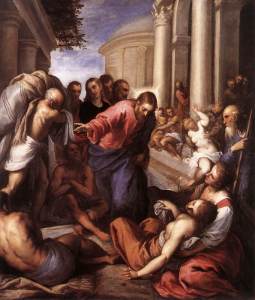
Like the time a paralytic’s friends brought him to Jesus. Jesus saw that they had faith enough to bring their friend to Him for healing. But He did not respond to their felt need for healing – at least not right away. Instead, He said, “Son, your sins are forgiven” (Mark 2:5). Jesus dealt with this man’s deeper need – his need for forgiveness – before He dealt with this man’s felt need – his need to be healed from his paralysis.
Or how about the time one of Jesus’ dearest friends – a man named Lazarus – fell ill? His sisters, Mary and Martha, begged Jesus to hurry over and heal him. But Jesus did not meet their need. Instead, He intentionally let His dear friend die. Why? So that Jesus could address humanity’s deeper need – the need to be rescued from death – which far outweighs the felt need of being temporarily healed from a frustrating ailment. This is why Jesus says to Martha, “I am the resurrection and the life. The one who believes in Me will live, even though they die; and whoever lives by believing in Me will never die” (John 11:25-26).
Don’t get me wrong. I am not saying that Jesus never began by addressing people’s felt needs. After all, He fed a crowd of 5,000 by miraculously multiplying loaves of bread before declaring Himself to be the bread of life (cf. John 6:1-35). He began with a felt need for physical food before He moved to a deeper need for heavenly food. Jesus does sometimes initiate an engagement by addressing people’s felt needs. However, Jesus does not always begin this way. Indeed, sometimes, He flat out denies people’s felt needs as He challenges them with their deeper needs.
The problem with felt needs is that, often, felt needs are not helpful needs. Sometimes, felt needs can even be sinfully selfish needs. Jesus has little interest in meeting our felt needs for riches, for ease, and even for happiness. Thus, for us to begin and base our ministries on what people think they need, and then to try to meet those needs before we share Jesus, can devolve, if we are not careful, into merely enabling sin.
I have learned over the years that Jesus has a funny way of resisting the easy ministry models we like to apply to Him. To those who say that Jesus always begins by addressing people’s felt needs so they will be open to the gospel, I must say, “I think you’re wrong.” But then again, to those who say that Jesus never begins by addressing people’s felt needs as a foray to share the gospel, I also must say, “I think you’re wrong.” Jesus does both.
We should too.
Perhaps we would do well to learn to pray a slightly modified version of Reinhold Niebuhr’s famous, though contested, Serenity Prayer as we seek to faithfully reach the world with the gospel: “God, grant me the tenderness to address people’s felt needs at certain times, the boldness to challenge them with their deepest needs at other times, and the wisdom to know when to do which.”
That’s my prayer as I seek to reach out with the gospel. Will you join me in praying the same?
It’s Not About Gay Rights Versus Religious Freedom

Frank Bruni, columnist for The New York Times, has written a refreshingly honest, even if somewhat frightening, piece in response to the passage of the Religious Freedom Restoration Act in Indiana, which was signed into law last month by Governor Mike Pence. The Act prohibits “a governmental entity [from] substantially burden[ing] a person’s exercise of religion.”[1] LGBT groups are furious, arguing that this Act will open the door for Christian business owners to discriminate against LGBT people by refusing to offer them certain services because these business owners will be able to claim that offering these services, particularly services that have to do with same-sex weddings, would violate their religious tenets.
Mr. Bruni offers the following take:
The drama in Indiana last week and the larger debate over so-called religious freedom laws in other states portray homosexuality and devout Christianity as forces in fierce collision.
They’re not – at least not in several prominent denominations, which have come to a new understanding of what the Bible does and doesn’t decree, of what people can and cannot divine in regard to God’s will …
In the end, the continued view of gays, lesbians and bisexuals as sinners is a decision. It’s a choice. It prioritizes scattered passages of ancient texts over all that has been learned since — as if time had stood still, as if the advances of science and knowledge meant nothing …
So our debate about religious freedom should include a conversation about freeing religions and religious people from prejudices that they needn’t cling to and can indeed jettison, much as they’ve jettisoned other aspects of their faith’s history, rightly bowing to the enlightenments of modernity.[2]
Mr. Bruni is not only interested in whether a Christian small business owner should be forced to, let’s say, bake a cake for a gay wedding, he also launches into a critique of traditional Christian theology as a whole, stating that the faith should be “rightly bowing to the enlightenments of modernity.” This assumes, of course, that modernity is, in fact, enlightened – an assertion that Mr. Bruni seems to feel little need to defend. This also assumes that the Western version of modernity that embraces LGBT beliefs about human sexuality is the rightful moral pacesetter of our world, something with which many modernized Eastern nations may take issue. This also assumes that Christians should not only love LGBT individuals, but endorse LGBT lifestyles as morally acceptable.
The irony is not lost on me that although Mr. Bruni does address “the florists and bakers who want to turn [LGBT customers] away” because of the owners’ moral convictions, he is silent concerning the many businesses that are jettisoning the state of Indiana in light of its religious freedom law because of their owners’ moral convictions. Why the inconsistency? Because, for Mr. Bruni, this is not an issue of religious freedom or even of gay rights. This is an issue of what version of morality should hold sway in our society. In Mr. Bruni’s worldview, for a Christian to try to avoid baking a cake for a gay wedding is morally reprehensible. For a business to avoid a state because of a religious freedom act is morally commendable. Thus, it is not inconsistent that one business, whose owners are working out of a set of traditional Christian moral convictions, should not be able to avoid providing services for a same-sex wedding while another business, whose owners have more secularized moral convictions, should be able to dump a whole state. After all, the Christian set of moral convictions is, for Mr. Bruni, immoral! And immorality must be squelched.
Pastor Timothy Keller explains the necessary moral entailments of the debate over gay marriage using a brilliant analogy:
Imagine an Anglo-Saxon warrior in Britain in AD 800. He has two very strong inner impulses and feelings. One is aggression. He loves to smash and kill people when they show him disrespect. Living in a shame-and-honor culture with its warrior ethic, he will identify with that feeling. He will say to himself, That’s me! That’s who I am! I will express that. The other feeling he senses is same-sex attraction. To that he will say, That’s not me. I will control and suppress that impulse. Now imagine a young man walking around Manhattan today. He has the same two inward impulses, both equally strong, both difficult to control. What will he say? He will look at the aggression and think, This is not who I want to be, and will seek deliverance in therapy and anger-management programs. He will look at his sexual desire, however, and conclude, That is who I am.
What does this thought experiment show us? Primarily it reveals that we do not get our identity simply from within. Rather, we receive some interpretive moral grid, lay it down over our various feelings and impulses, and sift them through it. This grid helps us decide which feelings are “me” and should be expressed – and which are not and should not be.[3]
Being LGBT has often been cast in terms of identity. Pastor Keller argues that the issue at hand is really about morality. Is it acceptable or unacceptable to be a violent aggressor? Is it noble or troublesome to be in a same-sex relationship? Feelings and impulses do not give us the answers to these questions. Only moral grids do.
Frank Bruni offers some refreshing candor in his column. He knows that, ultimately, the fight over gay rights and religious freedom isn’t a fight over gay rights and religious freedom. It is a fight over what’s moral. And his conclusion bears witness to his moral conviction:
Creech and Mitchell Gold, a prominent furniture maker and gay philanthropist, founded an advocacy group, Faith in America, which aims to mitigate the damage done to LGBT people by what it calls “religion-based bigotry.”
Gold told me that church leaders must be made “to take homosexuality off the sin list.”
His commandment is worthy – and warranted.
Mr. Bruni is clear. Christians must be made to accept homosexuality. To settle for anything less would be unworthy and unwarranted. In other words, it would be immoral.
I would beg to differ.
But at least we know where he stands.
__________________________
[1] S.B. 101, 119th Leg., 1st sess. (Indiana 2015)
[2] Frank Bruni, “Bigotry, the Bible and the Lessons of Indiana,” The New York Times (4.3.2016).
[3] Timothy Keller, Preaching: Communicating Faith in an Age of Skepticism (New York: Viking, 2015), 135-136.
The Panama Pilferage

It used to be that Switzerland was the place to hide money. Now, apparently, Panama is the place.
A week ago Sunday, a massive cache of some 11 million financial documents from the Panamaniam law firm, Mossack Fonseca, was leaked to the media. These files contained information about an “extensive worldwide network of offshore ‘shell’ companies – including ones with ties to Russian President Vladimir Putin – that allow the wealthy to hide their assets from taxes and, in some cases, to launder billions in cash.”[1] Several world leaders are implicated in this leak including the prime ministers of Iceland, Argentina, Ukraine, Saudi Arabia, and Iraq, and the former prime ministers of Georgia, Jordan, and Qatar. According to Lexi Finnigan of The Telegraph, the files “also contain new details of offshore dealings by the late father of British Prime Minister David Cameron.”[2]
Some of what has happened in these offshore accounts may be legal. As Ms. Finnigan explains in her article:
There is nothing unlawful about the use of offshore companies. However, the disclosures raise questions about the ways in which the system can be used – and abused. More than half of the 300,000 firms said to have used Mossack Fonseca are registered in British-administered tax havens, which Mr. Cameron has vowed to crack down on. And in one instance, an American millionaire was apparently offered fake ownership records to hide money from the authorities.
What has happened here is certainly troubling, even if it is not, at least for me, particularly surprising. Giving to Caesar what is Caesar’s may be a biblical mandate, but it is not a pleasant experience – even, as it turns out, when you happen to be Caesar. Nobody wants to pay taxes.
It should be reiterated that, in some instances, what appears to have happened with some of these accounts is little more than tax sheltering, which is legal and, according to many accountants, advisable. Others, however, have crossed a line into tax evasion, which is a crime. Still others have out and out used offshore accounts to try to launder dirty money.
Most world leaders are certainly not poor. So why would such a number of them be so allergic to paying the very taxes that ensure their gainful employment and continued power that they would engage in shady offshore deals? Perhaps it’s because Solomon was right: “Whoever loves money never has enough; whoever loves wealth is never satisfied with their income” (Ecclesiastes 5:10). Even a lot of money is never enough money when a person loves money.
Lust for more, of course, is not only a problem for world leaders, it is a problem for many people. Studies have shown that, proportionally, those who have higher financial means give less, as a percentage of their income, than those who have lower financial means. As Ken Stern reports for The Atlantic:
In 2011, the wealthiest Americans – those with earnings in the top 20 percent – contributed on average 1.3 percent of their income to charity. By comparison, Americans at the base of the income pyramid—those in the bottom 20 percent –donated 3.2 percent of their income. The relative generosity of lower-income Americans is accentuated by the fact that, unlike middle-class and wealthy donors, most of them cannot take advantage of the charitable tax deduction, because they do not itemize deductions on their income-tax returns.[3]
Just because a person has more doesn’t mean he will give more. Indeed, oftentimes, the more a person has, the more a person seems to think he needs, so the less he gives.
Perhaps we should keep in mind what Solomon says about money and the love thereof right after he explains that people who love money always want more money. He writes, “This too is meaningless.”
The love of money may be tempting, but it is not meaningful. It is not fulfilling. It is not worthwhile. This is a lesson, I fear, that these world leaders may have learned too late. May their folly be our warning.
_________________________
[1] Greg Toppo, “Massive data leak in Panama reveals money rings of global leaders,” USA Today (4.5.2016).
[2] Lexi Finnigan, “What are the Panama Papers, who is involved and what is a tax haven?” The Telegraph (4.7.2016).
[3] Ken Stern, “Why the Rich Don’t Give to Charity,” The Atlantic (April 2013).
The Art of Manliness
 “I see some men that are men in mind and body and a great many that are only men in body.”[1] So said a Union soldier who fought in the Civil War.
In her book, The Gentlemen and the Roughs, Lorien Foote, professor of history of Texas A&M University, outlines two distinct types of masculinity prevalent during the Civil War. One was a gentlemanly type of masculinity, centered on self-control, character, and faithfulness. This type of masculinity embodied what we might think of today as “the family man.” The other type of masculinity was that of the “roughs” – those who are “rough around the edges,” so to speak. This type of masculinity focused on physical domination and sexual exploitation.
Writing for The New York Times, David Brooks outlines these same two types of masculinities when he writes:
The ideal man, at least in polite society, gracefully achieves a series of balances. He is steady and strong, but also verbal and vulnerable. He is emotionally open and willing to cry, but also restrained and resilient. He is physical, and also intellectual.
Today’s ideal man honors the women in his life in whatever they want to do. He treats them with respect in the workplace and romance in the bedroom. He is successful in the competitive world of the marketplace but enthusiastic in the kitchen and gentle during kids’ bath time.
This new masculine ideal is an unalloyed improvement on all the earlier masculine ideals. It’s a great achievement of our culture. But it is demanding and involves reconciling a difficult series of tensions. And it has sparked a bad-boy protest movement and counterculture.[2]
Brooks’ “new masculine ideal” is not really all that new. It shares much in common with the older masculine ideal of what it means to be a gentleman. Foote, in her book, writes about Francis Lieber, a nineteenth century political philosopher who outlined some rules for warfare that eventually came to serve as the basis for the Geneva Convention. Along with rules for warfare, Lieber also outlined traits essential to being a gentleman that included “self-possession,” “calmness of mind,” “a studious avoidance of giving offense to others,” and a refusal to indulge “in careless vulgarity, unmanly exaggeration, or violent coarseness.” The New York Illustrated News, in a fawning review of Lieber’s gentlemanly characteristics, wrote, “Let us have a new chivalry instituted – a new order of intellectual and moral knighthood.”[3] Lieber’s ideal masculinity was nothing short of a perfectly balanced chivalry that shares much, though not everything, in common with Brooks’ “new masculine ideal.”
There is much for us, as Christians, to learn from these two types of masculinity. Although neither comports perfectly with what it means to be a Christian man, one certainly comports better. A masculinity that is crude, sexually exploitive, and ostentatious not only does not make a man, it hurts a man because it is flatly sinful. On the other hand, masculinity cannot simply be reduced to a list of traits, as Lieber and Brooks attempt to do, no matter how virtuous those traits may be. After all, not every man is the same, so different men will inevitably display different traits, and not every life situation calls for the same masculine characteristics. Ultimately, to be a Christian man is much more about living out a vocation – a divine calling – than it is about living up to a checklist of virtues that inevitably changes, both in content and in emphasis, with each successive generation. To be a Christian man means to reflect Christ. To hearken back to the Union solider quoted at the beginning of this blog, being a man is not about only your body biologically, it is also about your mind. You can be a man in body without being a man whose mind has been renewed by Christ (cf. Romans 12:2).
In his column, David Brooks’ concern lies in how faulty masculinities affect the political arena. He notes that in this election cycle, there has been “a revolution in manners, a rejection of the civility codes.” This is certainly true and it is certainly troublesome. But what is even more troublesome is not how faulty masculinities affect our politics, but how they affect our families. Study after study has shown how men who reject their vocation to reflect Christ adversely affect their families. Faulty masculinities do not just plague national elections, they plague your neighbors down the street. And, if you’re really honest, they may even plague you.
So gentlemen – and I hope you do fashion yourself as and aspire to be gentlemen – the next time are tempted toward a masculinity that does not reflect your Savior, remember, to quote one more time from David Brooks, “This is the world your daughters are going to grow up in.”
That alone should be enough to make you stop and think.
__________________________
[1] Cited in Lorien Foote, The Gentlemen and the Roughs: Violence, Honor, and Manhood in the Union Army (New York: New York University Press, 2010), 3.
[2] David Brooks, “The Sexual Politics of 2016,” The New York Times (3.29.2016).
[3] Lorien Foote, The Gentlemen and the Roughs, 55.
Blessed Are Those Who Mourn
 The women on that first Easter went to the tomb to mourn. They went to mourn the loss of their friend. They went to mourn the loss of, for one of the women, a family member. They went to mourn the loss of hope. Of course, when they arrived the tomb, they got something they had never bargained for. They were greeted by a glorious being with an unlikely message: “Do not be afraid, for I know that you are looking for Jesus, who was crucified. He is not here; He has risen, just as He said” (Matthew 28:5-6).
It was on Easter morning that these women, to use the words of the prophet Jeremiah, had their “mourning [turned] into gladness” and received “comfort and joy instead of sorrow” (Jeremiah 31:13).
Mourning may not be pleasant, but it is needed. In many ways, I would argue that we don’t mourn enough. At funerals, rather than addressing the reality of death, people will often try to dull the pain of a loss by casting the service in terms of a celebration of the person who has died. A eulogist will say something like, “This person wouldn’t have wanted us to be sad!” Mourning, which is nothing other than the natural and inescapable response to something as heinous as death, is dismissed, downplayed, and depressed in favor of a skin-deep smile.
To make matters worse, when we are not mourning something as intense as the loss of a loved one, we can wind up jettisoning mourning altogether. We not only try to moderate our mourning, we can replace our mourning with something different entirely.
There is plenty that should command our mournfulness. Greed, corruption, malfeasance, and general godlessness should pain us all. Sadly, rather than mourning these things, we often trade mourning for grumbling. This seems especially true in the political arena. We grumble about health care. We grumble about immigration. We grumble about political constituencies that are not our political constituencies. But replacing mourning with grumbling is dangerous.
The ancient Israelites were experts at grumbling. Exodus 16:2 says, “In the desert the whole community grumbled against Moses and Aaron.” Numbers 14:2 repeats the same refrain: “All the Israelites grumbled against Moses and Aaron, and the whole assembly said to them, ‘If only we had died in Egypt! Or in this wilderness!’” The ancient Israelites were experts at grumbling. But their grumbling carried with it consequences. The Psalmist recounts the story of Israel during her wandering in the wilderness and says: “They grumbled in their tents and did not obey the LORD. So He swore to them with uplifted hand that He would make them fall in the wilderness” (Psalm 106:25-26). The apostle Paul admonishes his readers to “not grumble, as some of [the Israelites] did – and were killed by the destroying angel” (1 Corinthians 10:10). Clearly, God has little time or tolerance for grumbling. Why? Because grumbling leads nowhere good. It leads to rebellion. The Israelites grumbled about God and then built a golden calf in rebellion against God. It leads to revenge. Cain grumbled about his brother Abel’s sacrifice to God right before he killed his brother. Grumbling leads to sin. James puts it quite succinctly when he writes, “Don’t grumble against one another, brothers and sisters, or you will be judged” (James 5:9).
There is plenty for us, in our day, to mourn. But sincere mourning over sin is quite different from self-righteous grumbling against sinners. One perpetuates sin by doing little more than whining about it. The other fights sin by asking the Lord to rescue us from it.
In a world filled with grumbling, may we remember how to mourn. And may we also believe Christ’s promise: “Blessed are those who mourn, for they will be comforted” (Matthew 5:4). Mourning, Jesus says, is blessed. Grumbling, Scripture warns, is condemned. Let’s make sure we’re doing what God blesses rather than falling prey to what He condemns.
Terror Hits Brussels: How Should Christians Respond?

It happened again.
Just four days after Paris terror suspect Salah Abdeslam was captured by Belgian law enforcement officials, two coordinated attacks – one at the airport and another on a subway – were carried out in Brussels at approximately 8 am local time. ISIS is taking responsibility for both.
Most of the scenes on the news right now are coming from the airport attack, and the pictures are ghastly. Physicians treating the wounded are describing severe nail injuries, indicating that the explosives were packed with materials designed to inflict maximum injury. As of the posting of this blog, CNN is reporting the provisional death toll at 34: 14 dead at the airport with 20 people killed in the subway bombing. We do not know whether or not the toll will rise.
At a time like this, it is always worthwhile to pause and reflect on how we, as Christians, are called to respond and react to a tragedy such as this. Christians are, after all, in a unique position to respond and react to tragedy, for our very faith was born out of tragedy, as this Good Friday will remind us. Our faith is rooted in “Christ and Him crucified” (1 Corinthians 2:2) – a gruesome thought if left by itself. So here are a few things to keep in mind.
Pray for Brussels
When terrorists attacked Paris, I wrote, “Pray for Paris.” The first thing we should do in an event like this is pray – always. For the vast majority of us, there is no help we can offer Brussels physically – we are not omnipresent. And there is no way we can thwart another attack in this beleaguered city – we are not omnipotent. So we must entrust Brussels and its future to the One who is omnipresent and omnipotent. We must entrust Brussels and its future to the One who can actually help. Such is the power of prayer. It not only offers real help to hurting people because it turns to a God who is in the business of helping hurting people, it also grows our faith when we cannot take charge of a situation like this because it teaches us to trust the One who is in charge of every situation like this.
Mourn for Brussels
The old saying goes, “Familiarity breeds contempt.” We have become all too familiar with terror attacks. With another one in the news this morning, although we may not be tempted to become outright contemptuous of what has happened, we may be tempted to respond to it with a mild dismissiveness. We see. We react with a bit of a groan. And we move on. I would encourage us to saunter at the scenes from Brussels for a bit. Look at the damage done at the airport. Look at the horrified faces of the people escaping from a bombed subway car. And grieve. Terror may be common nowadays, but that shouldn’t make it any less tragic in our hearts and minds. What has happened in Brussels is worth our grief. It is worth our sadness. It is worth our pain. We worship a Savior who shares in all our pain. He never passes us by “on the other side” (Luke 10:31). We should be willing to share in each other’s pain as well. For when we do, we “carry each other’s burdens” (Galatians 6:2).
Hope for Brussels
Christianity may have been borne out of the tragedy of death, but it is carried forth by the glory of life. This is what this Holy Week is all about – death on a Friday followed by life on a Sunday. The hope we have for Brussels, then, is the hope we have for all the world – that no matter how many people terrorists may kill, they cannot win by death because “death has been swallowed up in victory” (1 Corinthians 15:54). Christ portended our ultimate ends when, on Easter, He conquered His would-be end by walking out of His grave. We now share in the promise that our graves will not be our ends. Resurrection is coming.
One of my favorite Bible stories is the story of Armageddon – that great cosmic battle between good and evil at the end of days. The reason I love it so much is not just because of who wins, but because of how the battle is fought. The forces of evil, John says, are gathered “to the place that in Hebrew is called Armageddon. The seventh angel poured out his bowl into the air, and out of the temple came a loud voice from the throne, saying, ‘It is done’” (Revelation 16:16-17). And that’s the end of the battle. There are no swords drawn. There are no bullets fired. There are no bombs dropped. The forces of darkness combine to bring their worst. But they are no match for God’s simple declaration: “It is done.” In Greek, the declaration is just one word: gegonen. It turns out that even just one little word, to borrow a phrase from Martin Luther, really can fell Satan and his sympathizers.
We live in a world where deranged terrorists wage twisted jihad. But as Christians, we hope for a kingdom where battles are not won by an armed detachment, but by a divine decree: “Gegonen.” “It is done.”
And it will be.
Christianity, Culture, and Comparison
 There can be little doubt that Christianity is losing its place of primacy in American culture. According to a survey conducted last year by the Pew Research Center, Americans are becoming increasingly less religious and less willing to affiliate themselves with any particular religious tradition. As The Washington Post reports:
The “nones,” or religiously unaffiliated, include atheists, agnostics and those who say they believe in “nothing in particular.” Of those who are unaffiliated, 31 percent describe themselves as atheists or agnostics, up six points from 2007.[1]
A six-point increase of the religiously unaffiliated in eight years is not only statistically significant, it is an irreligious coup d’état. Consider this, also from The Washington Post: “There are more religiously unaffiliated Americans (23 percent) than Catholics (21 percent) and mainline Protestants (15 percent).”
Even among those who self-identify as religious, identifying as a faith does not necessarily correlate to the practice of that faith. One of the most striking demographic factoids of this presidential election cycle has been how evangelicals who attend church more frequently differ substantially in their candidate preferences from those who attend church less frequently.
Clearly, the religious terrain of America is experiencing tectonic shifts. What was once America’s so-called “moral majority” is now an apprehensive minority. So what is the way forward?
Myriads of options have been proposed and tried. Some people want to fight the secularizing spiral of American culture while others are more amicable to bargaining with and even capitulating to it. Still others, such as Rod Dreher, argue for a limited withdrawal from American culture, eschewing what they see as the culture’s inherently dangerous facets and foci. In many ways, these tensions and postures toward the broader culture are nothing new, as a read through H. Richard Niebuhr’s famous book, Christ and Culture, will reveal.
As worthy of discussion as all of these options may be, in this post, I would propose that it is just as important that we look at what we should not do as it is that we look at what we should do. Here’s why.
At the root of our anxiety over shrinking Christian cultural influence is our penchant to compare. We look at the political arena and we notice that we don’t wield the power we once did. And we compare the influence we had to the power we have. Or we look at demographic studies and we begin to notice that non-believers are on the increase while we’re on the decrease. And we compare the assembly of the despisers to the flock of the convinced.
Martin Luther has some great guidance when we are tempted toward comparison:
They surpass us by so many thousands, and all that we have seems to recede into nothing. But do not compare yourselves with them. No, compare yourselves with your Lord, and it will be wonderful to see how superior you will be … They would easily overcome us, but they cannot overcome that Christ who is in us.[2]
Comparing ourselves with the world as a starting place for responding to the world is dangerous business. It can lead us to an arrogant triumphalism if the world seems to be persuaded to our side. But it can also lead to an angry despair if the world rejects us. It is little wonder that the apostle Paul once wrote, “We do not dare to classify or compare ourselves with some who commend themselves” (2 Corinthians 10:12). If we are to compare ourselves with anyone or anything, it should be with the One who reminds us that even if we are a “little flock” in this age (Luke 12:32) – with little power, little influence, and little prestige – we are a “multitude that one one can count” (Revelation 7:9) in the next.
What strikes me about so many of our responses to Christianity’s diminishing cultural influence is not that they are wrong per se, but that they flow from the wrong place – they flow from anxious comparisons that grumble over Christianity’s diminishing cultural capital rather than from faith in Christ’s commandments and promises.
Perhaps it’s time to work less out of fear and more out of faith. Perhaps it’s time to stop comparing and start trusting – not because the decline of Christianity isn’t sad, but because the victory of Christ is certain.
_________________________
[1] Sarah Pulliam Bailey, “Christianity faces sharp decline as Americans are becoming even less affiliated with religion,” The Washington Post (5.12.2015).
[2] Martin Luther, Luther’s Works, vol. 30 (St. Louis: Concordia Publishing House, 1967), 289


 Pastor Zach's Blog