Monogamish Is Nothing Like Monogamous

The opening of Zachary Zane’s op-ed piece for The Washington Post reads almost like satire:
During my exploratory college years, I was often confused about my sexuality. I knew I had loved women, but found myself, drunkenly, in the arms of various men. I wasn’t sure why I was doing it. Was I in denial of being gay? Was I simply an open-minded straight guy? Or was I just a drunk and horny hot mess?
These questions kept me up at night.
This has all the trappings of a hackneyed B-list movie about a frat guy caught in an existential crisis fueled by alcohol and lust. But Mr. Zane isn’t playing on silly stereotypes. He’s serious. This becomes all too clear as he continues:
My senior year of college, I entertained the idea that I might be bisexual, but I didn’t embrace the label until a year after graduating. That’s when I learned that I didn’t have to like men and women equally to be bisexual. I learned that sexuality was a spectrum, and my point on the spectrum wasn’t fixed…
In my queer theory class in college, I also learned that gender, too, is on a spectrum. Some of us don’t view ourselves as strictly male or female. We can be both, neither, or somewhere in between, a.k.a. bigender, agender or genderqueer.
This led me to ask the question: Since sexuality and gender aren’t understood as binary anymore, does monogamy have to be?
The morphological ludicrousness of the claim that monogamy can be on a continuum aside – “mono,” after all, does mean “one” and “gamos” refers to marriage, which means that any romantic relationship that involves more than one person committing themselves to one other person is, by definition, no longer monogamy – this claim also brings with it a whole host of relational, emotional, and theological problems.
Relationally and emotionally, polyamorous relationships are recipes for ruin. Narratively, the Bible makes this clear enough in its description of the disastrous polygamous relationships of patriarchs like Jacob and Solomon. Theologically, however, the problem goes deeper than just ill-fated relationships.
Timothy Keller makes the point that Christianity places a high value on self-sacrifice. Indeed, the heart of the Christian faith is found in a man who sacrificed Himself on a cross and invites us to deny ourselves by taking up our own crosses and following Him (cf. Matthew 16:24). Our culture sees things differently. Rather than placing a premium on self-sacrifice, our culture tends to value and even idolize self-assertion. We are obsessed with asserting who we believe ourselves to be and demanding that those around us accept and celebrate who we say we are.
The problem with self-assertion is that it is often little more than a flimsy mask for self-indulgence and self-centeredness. This is why polyamorous relationships are so dangerous. When two people are more concerned with their own sexual desires than with committing themselves and giving themselves sexually to their partner, they wind up using each other instead of loving each other. In this way, self-assertion is the very antithesis of love. The words of the apostle Paul come to mind here: “Love is not self-seeking” (1 Corinthians 13:5). You can’t love someone well and seek first yourself.
I understand that two people may freely agree to live in a polyamorous relationship. But is this because they are truly committed to each other, or is this because they are secretly committed to themselves? I also understand that monogamy can be difficult. I have counseled enough couples rocked by affairs to know how easily and how often marriage vows can be broken. But I have also seen how deeply an affair hurts the cheated upon and the children in a family. The person having the affair may find some measure of self-indulgent satisfaction, but only while exacting out of others a steep and terrible price of brokenness and pain.
Ultimately, we need to ask ourselves: what kind of people should we be? People who indulge our fetishes, chase our desires, and flex our selfishness, even as we try to disguise our shamefully selfish selves under a facile moral-esque construct of self-assertion? Or should we be people who think about others before we think about ourselves, even if that means denying our desires and even if those desires include our sexuality?
Christianity’s answer is clear. To repeat Jesus’ call to us all: “Whoever wants to be My disciple must deny themselves and take up their cross and follow Me” (Matthew 16:24).
“Deny themselves.”
Deny the money you could spend on yourself to give it to someone else.
Deny the time you could keep for yourself to be present with someone else.
And yes, deny the sexual desires you feel in yourself to be devoted to someone else.
Why? Because when you deny the desire to assert yourself for the sake of someone else, that’s when you find the things in life that matter most. Indeed, that’s when you find yourself.
“Whoever loses their life for Me will find it” (Matthew 16:25).
That’s self-sacrifice. And that’s a life well-lived.
Castro’s Death and the Christian’s Hope

When news first came a little over a week ago that the longtime brutal dictator of the island nation of Cuba, Fidel Castro, had died, the reactions to his death ranged from the viscerally ecstatic to the weirdly and inappropriately sublime. Many reports simply sought to chronicle the events of Castro’s life without much moral commentary, but, as Christians, we know that a man who, over the course of his raucous reign, murdered, according to one Harvard-trained economist, close to 78,000 people is due at least some sort of moral scrutiny. As Cuba concludes a time of mourning over the death of a man who himself brought much death, I humbly offer these few thoughts on how we, as Christians, should ethically process the life of one of history’s most famous and infamous leaders.
We should not be afraid to call wickedness what it is.
It is true that there were some bright spots in the midst of Castro’s morally dark oppression of Cuba. Cuba’s literacy rate, for instance, stands at 99.8 percent thanks to its government’s emphasis on education. It has also been reported that the robust healthcare system there has resulted in one of the lowest infant mortality rates in the world at 5.8 deaths per 1,000 births, although The Wall Street Journal has called this number into question.
Whatever good Castro may have done should not excuse or serve as rationalization for his gruesome human rights violations. As ABC News reports:
Over the course of Castro’s rule, his regime rounded up people for nonviolent opposition to his government and subjected many to torture and decades-long imprisonment.
In a January 1967 interview with Playboy magazine, Castro admitted there were 20,000 “counter-revolutionary criminals” in Cuba’s prisons…
Under his dictatorship, Castro arrested dissidents and gay citizens and forced them into labor or prison, according to human rights groups. He is also responsible for mass executions of people who spoke out against his government.
There is simply no way to mask or minimize the atrocities that Castro committed. They were – and are – evil. As Christians, we should be willing to call evil for what it is – not only for the sake of upholding moral standards, but for the sake of being honest about the way in which Castro’s immorality took countless human lives.
We should remember those who Castro brutalized and pay attention to those who are currently being brutalized.
The website cubaarchive.org is devoted to remembering those Castro murdered. The stories in the “Case Profiles” section of the site are heart-rending. In one case, a tugboat carrying children was intentionally sunk by order of Castro himself because the people on it were trying to escape Cuba. In another case, U.S. citizen Francis Brown was given a lethal injection at a Guantanamo hospital that ultimately killed him while, on that same day, his daughter’s full term unborn child was murdered by doctors at a Havana hospital. These stories should not be forgotten. These are victims who should not fade into the recesses of history, for they remind us who Fidel Castro really was – an egomaniacal madman with no regard for any life besides his own.
These stories should also lead us to seek justice for those currently suffering under oppressive and brutal regimes. The stories of people in places like Syria, Iraq, and Sudan should demand our attention and touch our hearts.
Though we should not eulogize Castro’s life, we also should not revel in his death.
It is understandable that many have celebrated the death of a despot like Castro. Indeed, Scripture understands and points to this reality: “When the righteous prosper, the city rejoices; when the wicked perish, there are shouts of joy” (Proverbs 11:10). But even if this is an understandable and natural reaction to the death of a dictator, we do well to remember that God’s reaction to the death of the wicked is more measured: “I take no pleasure in the death of the wicked, but rather that they turn from their ways and live. Turn! Turn from your evil ways” (Ezekiel 33:11)! God refuses to rejoice at the death of the wicked because He understands that such rejoicing ultimately serves no purpose. For when the wicked die, they stand eternally lost and condemned. This helps no one and fixes nothing. This is why God’s preference is not death, but repentance. Death is merely the result of wickedness. Repentance is the remedy to wickedness. God would much prefer to fix wickedness than to let it run its course.
As Christians, we are called to mimic God’s character in our responses to the death of the wicked: “Do not gloat when your enemy falls; when they stumble, do not let your heart rejoice, or the LORD will see and disapprove and turn His wrath away from them” (Proverbs 24:17-18). These verses caution us not to revel in the death of an enemy while also reminding us that God will render a just judgment on the wicked. And God’s justice is better than our jeers.
We should find our hope in the One over whose death the world once reveled.
Perhaps the most striking aspect of God’s refusal to rejoice in the death of the wicked is the fact that the wicked once reveled in the death of His perfectly righteous Son. The Gospel writer Mark records that when Jesus was on the cross:
Those who passed by hurled insults at Him, shaking their heads and saying, “So! You who are going to destroy the temple and build it in three days, come down from the cross and save Yourself!” In the same way the chief priests and the teachers of the law mocked Him among themselves. “He saved others,” they said, “but He can’t save Himself! Let this Messiah, this king of Israel, come down now from the cross, that we may see and believe.” (Mark 15:29-32)
For God not to rejoice in the death of the wicked when the wicked rejoiced in the death of His Son reveals not only God’s gracious character, but His perfect plan. For God deigned that, by the mocking of the wicked, wickedness itself should be defeated. Indeed, at the very moment the wicked thought they had succeeded in defeating God’s Holy One, God’s Holy One had accomplished His mission of opening salvation to the wicked. Our hope, then, is not in the death of a wicked man, but in the crucifixion of a righteous One. His righteousness is stronger than Castro’s wickedness. That is the reason we can rejoice.
Abortion, Absolution, and Pope Francis

In a letter dated Sunday, November 20, Pope Francis announced that any woman who has had an abortion can now be forgiven for that sin by a priest. This move toward priestly absolution for abortion began a full year ago when the pope announced a “Year of Mercy.” Before this special year, only ecclesiastical higher ups could absolve someone of an abortion unless a particular region gave special disposition to its local priests to absolve this sin, which the Catholic Church in the United States had already done. The pope’s announcement of a Year of Mercy gave this right to priests worldwide. And now the pope has extended this right into perpetuity. In his missive, the pope explained:
We have celebrated an intense Jubilee Year in which we have received the grace of mercy in abundance. Like a gusting but wholesome wind, the Lord’s goodness and mercy have swept through the entire world. Because each of us has experienced at length this loving gaze of God, we cannot remain unaffected, for it changes our lives…
Lest any obstacle arise between the request for reconciliation and God’s forgiveness, I henceforth grant to all priests, in virtue of their ministry, the faculty to absolve those who have committed the sin of procured abortion. The provision I had made in this regard, limited to the duration of the Extraordinary Holy Year, is hereby extended, notwithstanding anything to the contrary.
When the pope first announced his Year of Mercy, The New York Times ran an editorial by Jill Filipovic titled, “The Pope’s Unforgiving Message of Forgiveness on Abortion.” In her piece, Ms. Filipovic decries the idea that those who had obtained an abortion should need forgiveness. She writes:
Instead of treating women as adults who make their own decisions, the pope condescends to “all the women who have resorted to abortion,” saying he is “well aware of the pressure that has led them to this decision.” The threat of excommunication, at the very least, makes the church’s views on women’s rights clear. Offering forgiveness is a softer version of the same judgment: that the millions of women around the world who have abortions every year are sinners. Inviting women to feel shame and guilt for their abortions isn’t a mercy; it’s cruelty.
At issue for Ms. Filipovic is the fact that abortion would be classified as a sin at all. For her, forgiveness for an abortion is neither needed nor desirable. What is needed is a wholehearted endorsement and promotion of abortion itself.
The biblical position on abortion and forgiveness undermines both the Roman Catholic Church’s strange view of absolution, especially before this recent papal pronouncement, along with the secularist’s cynicism toward the sinfulness of abortion. The secular view of abortion and forgiveness is inadequate precisely because the emotions of “shame and guilt,” contrary to Ms. Filipovic’s assertion, should be the affective outcome of any sin, including abortion. Our sin should make us feel bad – at least if we take what God commands seriously. Only God’s gospel can remedy our shame and guilt as it releases our sins to Christ on the cross. Abortion cannot be excused and explained away. It can only be forgiven.
Likewise, the Roman Catholic Church’s view on abortion and forgiveness also will not do. The now former restriction on priestly absolution for abortion seems to have been largely meant as a threatening deterrent against particularly grievous sins, as is explained in the Baltimore Catechism:
The absolution from some sins is reserved to the pope or bishop to deter or prevent, by this special restriction, persons from committing them, either on account of the greatness of the sin itself or on account of its evil consequences.
This restriction overlooks the fact that, theologically speaking, every sin is an affront against all divine law, therefore making any sin damnable. It also overlooks the fact that to make forgiveness difficult to obtain via a barrage of ecclesiastical red tape takes what is meant to be a gift from God and perverts it into a work of man. This makes the forgiveness spoken of here antithetical to the gospel rather than the center of the gospel, for the gospel is never about what we do, but about what God has done for us in Jesus Christ.
So where does this leave us? It leaves us here: if you are a woman who has had an abortion, there is hope beyond shame, release beyond burden, and wholeness beyond brokenness. Not because there shouldn’t be any shame, any burden, or any brokenness. And not because you can somehow claw your way out shame, burden, and brokenness by a work, even if that work is a work of self-debasing sorrow before a bishop or a priest. No, there is hope and release and wholeness because of Jesus. After all, He suffered death to conquer death, which means, even if a life has been lost to abortion, that life can be recovered too. And your life can be made new.
That’s the promise abortion needs.
The Real Truth About Fake News

Recently, I came across a New York Times feature piece bemoaning the increase of what are deemed “fake news sites.” These are websites that purport to share what which is newsworthy, but regularly play fast and loose with the facts, usually to further a particular political agenda. For instance, days before the election, a news story from The Denver Guardian received hundreds of thousands of shares on social media: “FBI AGENT SUSPECTED IN HILLARY EMAIL LEAKS FOUND DEAD IN APPARENT MURDER-SUICIDE.” It sounded salacious – and terrifying. There was only only problem: it was completely fabricated. For starters, The Denver Guardian did not exist before this year. Moreover, the article contained misspellings and demonstrably untrue details, such as a reference to the “Walkerville Police Department” in Maryland. Walkersville does not have a police department. It should also be noted that no other noted news outlets picked up this story, which, if true, would have caused a stir among at least certain corners of the media. Still, this article was shared more than half a million times on Facebook alone.
Of course, fake news is nothing new. Tabloids have been around for a long time and have managed to prove very profitable precisely because they are more concerned with feeding readers titillating stories than true ones. Indeed, each year, Oxford Dictionaries names a “word of the year.” This year’s word is “post-truth,” because it seems “to capture the English-speaking public’s mood and preoccupations…where people lived through divisive, populist upheavals that often seemed to prize passion above all else – including facts.”
This particular surge of fake news fury seems to have been fueled not only by political passion, but, at least in part, by what many perceive to be the bias of traditional news outlets. For example, the Pulitzer Prize winning website politifact.com has been widely panned because, though it purports to check the truthfulness of what politicians say in public forums, it has been shown to rate what some politicians say – especially those who are more conservative – as “false” even though some of the statements in question could reasonably be considered as true. In other words, a website that claims to be devoted to uncovering the truth has been shown to be, in some instances, clouding it.
Christians have long held the truth in high regard. We do, after all, follow a man who not only claims to “tell the truth,” but actually to “be the truth.” This is why it is so incumbent on us to watch what we say, what we write, what we teach, and, yes, what we post on social media. We have not always been the best at the this. For instance, have ever you heard it claimed that Christians divorce at the same rate as non-Christians? This may sound alarming. But it shouldn’t be. Because it’s not true.
One interesting trend in churches is that of fact-checking sermons. Many folks will now Google a statistic that a pastor cites or a publicly available anecdote that a pastor shares to check whether or not it is true. Can you imagine the damage done to the Christian witness if a pew-sitter finds that some of what a pastor is saying is not, in fact, true?
A willingness to be less than concerned with the truth can often be symptomatic of a deeper disease. On the one hand, it can be symptomatic of an intellectual laziness. With so many competing facts and figures floating around, sometimes it takes time to chase down what is accurate and what is not. Some people simply do not want to be bothered. It’s easier to take the first thing you find and run with it. But if you want to put in a little extra work to verify what you read, this terrific (and funny) article by Matt Masur offers some simple suggestions on how to fact check that Facebook post that raises your hackles.
A lack of concern with the truth can also be a symptom of a desperate desire to bolster a particular argument, even if that comes at the cost of the integrity of reality. That is, whether it is posting a cagey news story on social media or citing a suspect statistic in a sermon, some people simply cannot resist the kind of “slam-dunk” affirmations these kinds of stories and statistics provide. Unfortunately, once they are shown to be false, they can actually undermine the very argument they seek to make.
If we truly believe in whatever arguments we make, the truthful versions of these arguments ought to be persuasive enough. If we don’t think they are, we don’t need a sensationalistic zinger to make our case. We need different arguments. After all, Jesus is quite clear that deceit comes from only one place – a place that is the antithesis of the kingdom of God. The truth is enough. So let’s stick with the truth, celebrate the truth, and traffic in the truth.
President-Elect Donald J. Trump

Credit: Pablo Martinez Monsivais/AP Photo
Whether you love him, despise him, believe in him, are distasteful of him, are worried about him, or are indifferent to him, Donald J. Trump is the President-Elect of the United States. Regardless of which one of these categories you may occupy (or, perhaps, you’re in another category I missed), as Christians, there are a few things we are called to be during the transition from the end of Barack Obama’s presidency to the beginning of Donald Trump’s presidency. Perhaps you already know these things, but a little reminder never hurts.
Be prayerful.
The apostle Paul writes to Timothy:
I urge, then, first of all, that petitions, prayers, intercession and thanksgiving be made for all people – for kings and all those in authority, that we may live peaceful and quiet lives in all godliness and holiness. (1 Timothy 2:1-2)
Paul is clear that we, as Christians, ought to pray for our leaders. But there is something I think we often miss in this passage. Before Paul exhorts Timothy to pray “for kings and all those in authority,” he urges Timothy to pray “for all people.” The category of “leaders” is a subset of the category of “people.”
Though this may seem painfully obvious, it is important to remember that our leaders are, in fact, actual people. I say this because sometimes it can become far too easy for us to paint the leaders we don’t care for as soulless cartoonish villains, not worthy of even basic respect.
Regardless of what you think of President-Elect Trump, he is a person, made in the image of God and loved by God. He is also a husband, a father, and a grandfather. We should pray for him not only as a politician, but also as a person.
Be supportive.
Every person is sinful. And yet, as Jesus puts it, even evil people “know how to give good gifts to [their] children” (Matthew 7:11). In other words, just because no one is perfect doesn’t mean that everyone does everything wrong. Instead, we are all mixed bags. We do some things right and some things wrong. We do some things that are good and some things that are evil. Donald Trump, no doubt, will do some good things for America. For instance, his promise to support the cause of life and minimize the scourge of abortion is vital not only to our national wellbeing, but to our human decency as well. In cases such as this, Christians ought to graciously, thoughtfully, and humbly support that which is good and just.
Be skeptical.
Even as sinful people can do good things for which they should be commended, they can also, obviously, do sinful things for which they must be confronted. Christians should be willing to call sin for what it is regardless of the political party out of which it comes. Certainly, President-Elect Trump has said some things that are not only not befitting of the office of President of the United States, but also defy basic decorum, decency, and truthfulness. The warning of Jesus’ brother should ring in our minds: “The tongue also is a fire, a world of evil among the parts of the body. It corrupts the whole body, sets the whole course of one’s life on fire, and is itself set on fire by hell” (James 3:6). Reckless words may be legal in a society that has enshrined free speech, but legality does not equal morality. Christians should continue to call President-Elect Trump, and all of our public officials, to account when their behavior turns ugly.
Especially because of the rancorous nature of this year’s election cycle, I would add that we should be careful not to allow a healthy skepticism to turn into a bitter cynicism. Skepticism is honest that sin is constantly afoot and must be confronted. Cynicism, on the other hand, finds a certain schadenfreude in another’s sin because it can sanctimoniously condemn it and boast over it. Skepticism is wise. Cynicism is hateful. Let us not fall prey to the latter.
Be faith-filled.
Our nation is deeply divided, as even the statistical outcome of this election demonstrates. Donald Trump won in the electoral college and, hence, has secured the presidency, while Hillary Clinton bested Mr. Trump in the popular vote. As Christians, we have a uniquely unifying message because, in the midst of a division as deep as ours, we can point to a God who made us all and to His Son who sacrificed Himself for us all. Christ is the One who can break down what separates us. Now is the time to share Him.
Ultimately, whether you are satisfied with the outcome of this election or fearful because of it, remember to guard your faith. Fear can lead us to lash out in anger as we try to forcefully and artificially rectify something we think is wrong. Satisfaction can lead to gloating and glibness as we trust in a set of comfortable circumstances that will, finally, prove to be fleeting. Both of these reactions can lead us away from Christ rather than toward Him. A reaction of fear can refuse to trust in the peace Christ wants to give as it stews in its own self-righteous anger. An enshrinement of comfort can minimize the provision Christ wants of offer as it lounges in its own self-sufficiency.
Thus, what we need now as the presidency of the United States shifts parties and hands is what we have always needed and will always need:
Faith.
Do not put your trust in princes, in human beings, who cannot save. When their spirit departs, they return to the ground; on that very day their plans come to nothing. Blessed are those whose help is the God of Jacob, whose hope is in the LORD their God. (Psalm 146:3-5)
Who’s Afraid of Election Day?
Credit: Darren McCollester / Getty Images
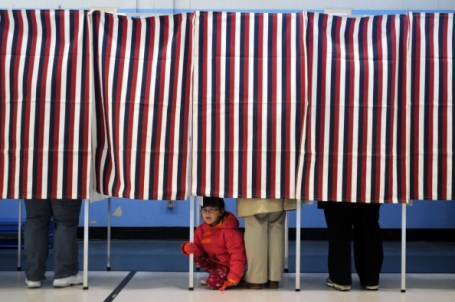
Tomorrow is the big day. Tomorrow, we the people turn out to vote for the next President of the United States. Though literally thousands of other politicians will be on the ballots that are cast tomorrow, the presidential election is the one that looms largest in the minds and hearts of most people. Indeed, I’ve heard it repeated over and over again throughout the course of this political season that “this is the most important presidential election of our lifetimes.” I honestly do not know whether or not it is. I do know that Walter Mondale told a crowd in 1984, “This is the most important election of our lives.” I would argue that history has probably proven him wrong. And history, eventually, may prove today’s claim about the importance of this election wrong – or, perhaps, right. We’ll just have to wait and see.
But whether or not voters and pundits prove to be historically correct in their estimation of the weightiness of this election, I do know that the immediate perceived importance of this election is enormous and is engendering deep fear in the minds and hearts of many. I have had conversation after conversation with people who are scared of what has happened and what will happen to our political system and to our nation.
This past weekend, I listened to a sermon on the topic of this year’s election. The pastor who preached this sermon argued forcefully, powerfully, and, at times, eloquently for what he believed about this election and even for whom he believed we, as Christians, should vote in this election. But what struck me most about this pastor’s sermon was its closing. He ended by talking about two fears that he has for the future of this nation. First, he explained his fear that there may be too many of “them” and too few of “us.” He sees postmodern secularism winning over the masses and driving Christianity to the fringes and he is worried that there is nothing we can do politically to beat it back. Second, he expressed his worry that we may simply be too late to make any difference. He thinks too many Christians have been too silent for too long, and now a day of reckoning has come.
Politically, this pastor seemed very knowledgeable. Theologically, however, if I can be so bold to say this, as I listened to his sermon, I became more and more convinced that he missed something very important. Here’s why I say that.
First, if anyone thinks that there are too many of “them” and too few of “us,” I would encourage that person to read the story of Gideon. When God takes the army Gideon has mustered to fight the Midianites and reduces it in force from 32,000 men to 300 men – a reduction of over 99 percent – it looks like there is no way Gideon and his tiny army can defeat the massive army of a whole tribe of people. But God specializes in doing great things when there are too many of “them” and too few of “us.” God made a whole nation out of one man Abraham. God redeemed a whole people from slavery through one man Moses. God changed the whole course of human history through twelve men He deemed “apostles.” And God brought salvation to our whole world in one man He calls His Son. God can do a lot with a little.
Second, if anyone thinks it is simply too late, I would point that person to the story of Jesus’ friend Lazarus. When Jesus learns that His friend has fallen ill, rather than rushing to see him, He waits for him to die. Why? Because, as Jesus says to Martha, He is “the resurrection and the life” (John 11:25). Even death is not too late for Jesus because He can snatch life from the jaws of death. When the hour on our clock strikes eleven and we begin to struggle and scramble, Jesus can bring forth a new dawn that we never saw coming.
What struck me most about this pastor’s sermon is that although he issued a clear call to his congregation to get out and vote, he never explicitly reminded his congregation to have faith – to trust in the One who holds everything from your house to the White House in His hands.
Politics has a bias toward action. Legislation gets passed when deals get made. Public officials are elected when votes are cast. Social change can be engineered when Supreme Court verdicts are rendered. Action is important to politics. But as Christians, we must remember that the centerpiece of who we are is not in what we do, but in whom we believe. “Believe in the Lord Jesus, and you will be saved” (Acts 16:31). Faith is the centerpiece of our life in Christ.
I think it’s this that gets to the root of our fear. Because if we get so stuck on the action of our vote and the action of our legislators and the action of some guy or gal who sits in an office that is shaped like an oval that we forget that our hope is nothing that we have done, are doing, will do, or can do, then we’ve missed what’s most important. Because we’ve missed Jesus. And you don’t get Jesus by action. You only get Jesus through faith. There’s a reason the Psalmist says, “When I am afraid, I put my trust in You” (Psalm 56:3).
So, if you are afraid of the outcome of this election and the future of this country, go ahead and vote, but don’t expect your vote to calm your fears. Because your fears cannot be calmed by electoral majority. Your fears can only be calmed by a Savior who died for you and me.
Trust in Him.
The ISIS Atrocities You Probably Haven’t Heard About

ISIS must be stopped. It’s difficult to come to any other conclusion when story after story of the group’s atrocities continue to pour in. In a horrifying iteration of violence that has become ISIS’s trademark, a woman named Alice Assaf recounted how when jihadis marched into her town over two years ago, they killed her son for refusing to disown his faith in Christ, murdered at least six men by baking them alive in ovens, and killed 250 children by massacring them in dough kneading machines at a local bakery.
Are you sick to your stomach yet? I certainly was when I read the news story.
But too many people have not read this story. Stories about emails and Tweets among the two major party presidential candidates have relegated ISIS’s atrocities to the background. Certainly, this year’s presidential election with all of its crazy ups and downs is important. But when many people lose track of, or, I fear, even lose interest in ISIS’s activities, something has gone tragically wrong.
Just last August, it was being argued that we should ignore, or at least downplay, ISIS’s crimes. During an official visit to Bangladesh, Secretary of State John Kerry explained:
No country is immune from terrorism. It’s easy to terrorize. Government and law enforcement have to be correct 24 hours a day, 7 days a week, 365 days a year. But if you decide one day you’re going to be a terrorist and you’re willing to kill yourself, you can go out and kill some people. You can make some noise. Perhaps the media would do us all a service if they didn’t cover it quite as much. People wouldn’t know what’s going on.[1]
The Secretary of State was arguing that by featuring terror attacks in the headlines, we are only emboldening the terrorists by giving them what they want – free publicity, which leads to more recruiting power, which leads to more killings. As it turns out, however, even as ISIS’s publicity retreats, the atrocities continue. A lack of headlines does not seem to temper ISIS’s bloodlust.
We must understand that what drives ISIS, ultimately, is not a desire for fame, for land, or for money. A theology is what drives the group. I am sympathetic to Muslim theologians who argue that ISIS’s theology is not Islamic or representative of Allah in any meaningful or traditional sense, but even if this is the case, ISIS nevertheless has a theology. It has a conception of a god who calls and commands its adherents to do the things they do. And the things this god calls and commands them to do are horrifying. But they will continue to do them, whether or not the world is watching, because they think their god is watching – and is pleased with them.
This is why we must continue to pay attention. We must continue to pay attention because we serve and worship a God who does not order the execution of the oppressed, but cares about the plight of the oppressed and invites us to do the same. We must continue to pay attention because we serve and worship a God who hates injustice and promises to confront it and conquer it with righteousness.
Perhaps what was most shocking to me about the article I read outlining ISIS’s bakery massacre was the headlines in the “Related Stories” column of the website I was visiting:
- “ISIS Boils 6 Men Alive in Vats of Tar After Sharia Court Orders Death Sentence”
- “ISIS Executes 6 of Its Leaders by Using a Flamethrower”
- “ISIS Sends Parents Video of Daughters Being Raped, Tortured; Bag Carrying Their Body Parts”
All of these articles carried datelines of August and September of this year. ISIS is still on the loose, even if we don’t see it or know it. Perhaps it’s time to see and notice once again. After all, the blood of those it has slaughtered is crying out.
Are we listening?
____________________________
[1] Jeryl Bier, “Kerry in Bangladesh: Media Should Cover Terrorism Less,” The Weekly Standard (8.29.2016).
Standing for Life
I grew up in the first state in our union to legalize physician-assisted suicide. When Oregon passed the Death with Dignity Act in 1997, which allowed a terminally ill patient to administer lethal drugs to him or her self under the direction of a doctor, it stirred a lot of controversy. Though other states and regions have since followed suit, even nearly twenty years later, laws like the Death with Dignity Act still stir a lot of controversy and concern.
Our nation’s capital is now joining the fray of this debate with the D.C. Council readying themselves to vote tomorrow on legislation that would allow doctors to prescribe lethal drugs to terminally ill people. Fenit Nirappil of The Washington Post explains:
A majority of D.C. Council members say they plan to vote for the bill when it comes before them Tuesday.
But chances for enactment are unclear. The council will have to vote on the bill twice more by the end of the year. Mayor Muriel E. Bowser (D) has not indicated whether she will sign the legislation, although her health director has testified against it, saying it violates the Hippocratic oath. It is not certain that proponents have enough votes for an override. And Congress could also strike down the legislation.[1]
Many in the African-American community of Washington D.C. strongly oppose the legislation. The charge against the legislation is being led by Rev. Eugene Rivers III, who is leading a group called No DC Suicide. Rev. Rivers calls the legislation “back end eugenics,” and believes it is aimed at eliminating poor blacks. Leona Redmond, a community activist, echoes Rev. Rivers’ sentiment, saying, “It’s really aimed at old black people. It really is.” Proponents of the law have made countless assurances that there is no racial component to the legislation. Donna Smith, herself an African-American and the organizer for Compassion and Choices, argues, “This just isn’t a ‘white’ issue. This issue is for everyone who’s facing unbearable suffering at the end of life.”
Certainly, any move by any group to end people’s lives based on their race is repulsive. Indeed, if this legislation is enacted and, even if unintentionally, disproportionately affects a particular race, serious questions will need to be asked and stern objections will need to be raised. The problem for the Christian, however, extends beyond the boundaries of race to the dignity of humanity itself.
In the third article of the Nicene Creed, Christians confess, “I believe in the Holy Spirit, the Lord and giver of life.” Fundamental to what we confess as Christians is that God is the giver of life. When the apostle Peter is preaching a sermon on Pentecost day, he says to those assembled, “You killed the author of life, but God raised Him from the dead” (Acts 3:15). Because God is the author of life, Christians believe that life is a sacred gift from God to us and ought to be stewarded carefully and lovingly by us. This is why orthodox Christianity has consistently stood against the taking of life whether that be through abortion at life’s beginning or through physician-assisted suicide as life may be nearing its end. Both of these practices treat life not as a gift to be stewarded, but as burden to be manipulated and, ultimately, destroyed.
It is true that life can sometimes become burdensome. But when a young lady becomes terrified at the specter of an unexpected pregnancy, or when a person is suffering through the throes of a terminal illness, we must remind ourselves that life itself is not the culprit in these types of tragic situations. A world broken by sin is the culprit. So attacking life itself doesn’t relieve the burden. Instead, attacking life actually succumbs to the burden because it capitulates to what sin wants, which is always ultimately death. To fight against sin, therefore, is to fight for life.
As Christians fight for life, it is very important that they fight for all of life and not just certain moments in life. All too often, Christians have been concerned with fighting for those at the beginning of life as they stand against abortion, or fighting for those who may be nearing the end of life as they stand against physician-assisted suicide. But there is so much more to life than just its beginning and its end. Christians should be fighting against human trafficking, which treats lives as commodities to be traded rather than as souls to be cherished. Christians should be fighting against racism, which trades the beauty of a shared humanity for the dreadfulness of discriminatory distinctions. Christians should be concerned with genocide in places like Aleppo, as Syria’s army continues to launch indiscriminate military strikes against its own citizens with horrifying results. To celebrate life means to celebrate all of life – from the moment of conception to the moment of death and everything in between.
So let’s stand for and celebrate life. After all, after this life comes everlasting life through faith in Christ. Life will win out in the end. So we might as well surrender to and celebrate life now.
______________________________
[1] Fenit Nirappil, “Right-to-die law faces skepticism in nation’s capital: ‘It’s really aimed at old black people,’” The Washington Post (10.17.2016).
Election Day Fear

Credit: CNN
Last week, I was driving back to my office after teaching a Bible study at a local business. I happened to be listening to a radio talk show when a lady called who took my breath away. She was nearly in tears. She had just seen a movie forecasting what would happen if a particular candidate was elected President of the United States. She told the talk show host:
I am scared to death. I don’t sleep. I’m an absolute basket case. I want what’s good for my children, my grandchildren, my family. It’s all going down the tubes because, after watching that movie last night, all I saw was what’s coming down, what’s next, what they have planned.
Wow. What palpable fear. What genuine terror. What a heartbreaking phone call. Fear can wreak a lot of havoc in a person’s heart and life.
I know this caller is not the only one frightened right now. It seems as though every time a presidential election comes around, people’s fear becomes more and more acute. So here’s a gentle reminder: fear is not helpful. There is a reason why the most common command in the Bible is, “Do not be afraid.” There is a reason Jesus says, “Do not worry about tomorrow, for tomorrow will worry about itself” (Matthew 6:34). Fear is like an infection. Left unchecked, it can destroy people spiritually, emotionally, and relationally. So if you’re tempted toward fear, especially as it pertains to this upcoming election, here are a few things to keep in mind.
Fear tends toward hyperbole.
Every four years, I hear the same refrain from candidates and political pundits alike: “This is the most important election of our lifetimes.” Of course it is. That is, until the next election comes along. This claim, of course, is usually accompanied with dire predictions of what will happen if the wrong candidates get into political office. Of course factually, this claim cannot stand up under scrutiny because logically, this claim cannot be true more than once in a generation. And yet, it is assumed as true every four years. How can we believe a claim that is so logically ludicrous? Because we are afraid. And fear tends to look toward a certain point in time, such as an election, and wonder with worry: Is this the moment that will serve as the linchpin for the rest of history? Is this the moment when everything changes?
Christians have a confident answer to these questions. And our answer is “no.” We know that history’s linchpin moment has already come with Christ. No moment or election can even come close to comparing with Him. Indeed, I find it interesting that the primary way we know about political figures from the first century such as Pontius Pilate, Herod the Great, and even Caesar Augustus is through Scripture. But all of these men serve as paltry footnotes to the story of Jesus. It turns out they weren’t as important as everyone thought they were back then. Perhaps our leaders won’t be as important as we think they are right now. So why are we afraid?
Fear fosters self-righteousness.
It was Reinhold Niebuhr who wrote:
Political controversies are always conflicts between sinners and not between righteous men and sinners. It ought to mitigate the self-righteousness which is an inevitable concomitant of all human conflict.[1]
Niebuhr notes that, in politics, no party is completely right because no person is completely righteous. So we ought to be humbly honest about our sins rather arrogantly defensive in a smug self-righteousness. The problem with fear is that it tempts us to overlook the sins of ourselves and our party while gleefully pointing out the sins of the other party. Or worse, fear will justify the sins of our party by pointing to the purportedly worse sins of the other party. In this way, fear surrenders moral credibility because it puts itself through all sorts of intellectual and ethical contortions to make that which is self-evidentially wrong look right. This, by definition, is self-righteousness – something that Jesus unequivocally condemns. If Jesus condemns it, we should stay away from it. So do not let fear lead you into it.
Fear clouds decision-making.
Psychologists have long noted that fear is a great motivator. But fear has a funny way of impairing judgment. Just ask any deer who has been paralyzed by the two big lights that are barrelling toward him at a rapid rate of speed. Fear may promise to lead to rescue and safety, but, in the end, it leads to death. So why would we settle for election cycles that are continuously driven by fear?
Decisions made out of fear tend to be Consequentialist in nature. Consequentialism is a theory of ethics that says an act is good if it brings the least harm to the most people. The problem with Consequentialism, however, is twofold. First, because no one can fully predict the future, decisions based on future predictions, including the future predictions fueled by fear, usually have unintended – and often undesirable – consequences. Second, Consequentialism tends to degenerate into deep sinfulness as people become willing to excuse increasingly terrible acts to achieve some desired result. Consequentialism, then, may go after one good thing, but, in the process, it surrenders to and sanctions a bunch of bad things.
Decisions are much better made on principle rather than out of fear. Decisions made on principle allow the one making them to look at all facets of a decision rather than just an end result. They also place a high value on integrity rather than wantonly sacrificing that which is right for that which is expedient. Decisions made on principle are, ultimately, better decisions.
I know that eschewing fearfulness is much easier said than done. But fear must be fought – especially as it pertains to this upcoming election. Fear about this election and about the future solves nothing. It only manages to make the present miserable. So take heart and remember:
The LORD is with me; I will not be afraid.
What can mere mortals do to me? (Psalm 118:6)
Mortals cannot do nearly as much as we sometimes think they can, even if one of them becomes President of the United States. Things really will be okay, even if sinfulness does its worst.
Do not be afraid.
______________________
[1] Reinhold Niebuhr, Reinhold Niebuhr: Theologian of Public Life, Larry Rasmussen, ed. (Minneapolis: Fortress Press, 1991), 248.
Comfort in Stormy Times: Reflections on Hurricane Matthew

The people of Florida are picking up the pieces. Along with the people of Georgia. And the people of the Carolinas. And the people of Cuba. And the people of Haiti. As Hurricane Matthew churned its way through the Caribbean and up the east coast, it left a path of destruction in its wake. In Florida, mandatory evacuations were issued before the storm. Grocery store shelves were stripped bare. Gas stations were pumped dry.
It could have been worse. They eye of Hurricane Matthew skirted much of the eastern seaboard, sparing these regions from what could have been even greater damage. But even if things were not as bad as they could have been, this storm was still a whopper. For a brief time, Hurricane Matthew reached Category 5 status, making it the first storm to reach a hurricane’s most powerful potential since Hurricane Felix in 2007.
Whenever a natural disaster of this magnitude strikes, it presents a unique set of struggles and questions. When we suffer a man-made disaster in a shooting or in an accident or even in a terrorist attack, we can point to the source of the calamity and explain that the person who created the catastrophe is unstable or incompetent or even evil. When a hurricane strikes however, there is no one from whom we can demand a mea culpa, save nature and nature’s God. And such a mea culpa is tough to come by.
So how are we to process this disaster? Here are a few things to keep in mind.
We cannot control everything.
In an election year such as this one, it is easy to live under the illusion that we wield a great amount of power and authority. We do, after all, have a say – even if it is a small one – in who the leader of the free world should be. But for every bit of control we think we have, there are so many things that simply fall outside our hands. Hurricanes are one of these things. We can forecast them, but we cannot steer them. They strike where they may. They strike with the energy that water temperatures give to them. The smallness of our power when compared to the scope of something like the weather should lead us to marvel at the bigness of God’s creation. There is still so much we cannot tame.
We can help others.
Though we do not have power over all things, this does not mean that we can help in some things – like in hurricane relief. My congregation, Concordia Lutheran in San Antonio, has set up a relief fund to help those in Haiti. We are exploring opportunities to help those in other areas as well. You can donate by clicking here. Part of our calling as Christians is to be a neighbor to those in need. Being neighborly need not be constrained by proximity, nationality, economy, or any other earthly barrier. To help others is to love Christ! Rolling up our sleeves by opening up our pocketbooks is a great way to get involved.
There is someone who is in control.
In a world that seems shaky, it is important that we remind ourselves that just because we are not in control does not mean that everything is out of control. Christian theologians will often describe God as omnipotent, a word that means “all power.” In other words, God has all control. When a storm like Matthew strikes, it serves us well to consider the many instances in Scripture that remind us that God, quite literally, guides the weather. In the case of His disciples, Jesus saves them from a storm on the Sea of Galilee by calming it with just a word. In the case of Jonah, God saves him with a storm that forces some sailors he is with to toss him overboard so God can send a giant fish to take the prophet where he needs to be. In the words of the Psalmist, God can also save people through storms as they seek refuge in Him: “God is our refuge and strength, an ever-present help in trouble. Therefore we will not fear, though the earth give way and the mountains fall into the heart of the sea” (Psalm 46:1-2). God, then, does not use storms in the same way in every instance. Sometimes, He saves us from storms as weather patterns change. Other times, he saves us with storms as these trials turn us toward Him. Still other times, He gives us strength to make it through storms, even if they hit us straight on.
Ultimately, it is important to remember that no matter what storms – whether they be literal or figurative – this world may bring, we have assurance in them because of Christ. When Christ was on the cross, the Gospel writers tell us that “darkness came over all the land” (Matthew 27:45). In other words, it stormed. But what looked like a storm of death became a storm that gave way to life three days later. Jesus overcame the storm of the cross so that we would never be lost to the storms caused by sin. For even if a storm takes lives, as did Hurricane Matthew, we can be assured that those who die in Christ go to a place where there is “a sea of glass, clear as crystal” (Revelation 4:6). In other words, in heaven, the weather is a flat calm. There, every storm has been conquered by Christ.
With the extent of the damage from Hurricane Matthew just now becoming clear, there is still a lot – economically, emotionally, and theologically – to sort through. But this much is clear: God does not abandon us in storms like these. He is there. And He cares.


 Pastor Zach's Blog