One Perfect Parent

The Turpin House / Credit: Reuters
One of their only contacts with the outside world was when four of the kids were allowed to step outside their house in Perris, California to install some sod in the front yard, with their mother coldly watching from inside the front window. A neighbor who passed by and offered a friendly greeting to the children was surprised when none of them spoke a word in return to her. But one of the children, a 17-year-old girl, had been plotting her escape from the family compound where her parents, David and Louise Turpin, had held her and her twelve siblings, who range in age from 2 to 29, captive for years. She ran away and called the police using a cell phone she had found in the house.
As details of the children’s living arrangements have emerged, the picture that they paint is nothing short of horrifying. To keep their abuse from being discovered, the Turpin parents made their children stay up all night and sleep all day. They also tortured their children by feeding them next to nothing while they ate pies in front of them, by punishing them for getting water on their wrists while washing their hands, by allowing them to shower only once a year, and by tying them up with chains and padlocks. The couple has pleaded not guilty to the accusations and are each being held on $9 million bail.
Obviously, it is difficult to deduce and decipher the pure evil that would move two parents to commit such heinous crimes against their own children. Then again, it is also difficult to overestimate and over-celebrate the righteous bravery of a 17-year-old girl whose phone call to the police not only led to her own rescue, but to the rescue of her brothers and sisters.
It is at a time like this in the face of a story like this that we need to be reminded that, even as some earthly parents do their worst, we have a heavenly Father who loves us well. The Turpin children were forced to stay up in the dark. We have a heavenly Father who invites us to walk in His light (Isaiah 2:5). The Turpin children were deliberately starved. We have a heavenly Father who gives us food at just the right times (Psalm 104:27). The Turpin children were denied basic hygiene needs and baths. We have a heavenly Father who invites us to joyfully bathe in the waters of baptism (1 Peter 3:21). The Turpin children were tied up. We have a heavenly Father who sent His Son to untie us from that which binds us (Luke 13:15-16).
As a pastor, I have heard story after story of people who have been hurt by their parents. Though, thankfully, none of the stories I have encountered have been nearly as horrific as the story of the Turpins, there are many children – both young and grown – who carry around deep scars. There are many children who need the Father to fill what their father, or mother, would not or could not give to them. There are many children who need the Father to love them like their father, or mother, would not or could not love them.
Our Father in heaven has the love that we need. He loves us so much, the Scriptures say, that even our worst sins need not incur His eternal wrath. In the book of Hosea, the nation of Israel is repeatedly betraying the one true God by chasing after many false gods. Yet, even in the midst of their deep sin, while the Father declares His displeasure, He nevertheless promises, “I will show love…and I will save them…they will be called ‘children of the living God’” (Hosea 1:7, 10).
While some earthly parents may abuse their children for no apparent reason, we have a heavenly Father who loves us in spite of our sin for just one reason – the reason of His grace. His grace is a grace so strong that it makes us His children through His Son.
Now that’s some awesome parenting.
Persons, Nations, and Immigration

What a week it has been in politics. Immigration took center stage this past week with President Trump first holding a meeting with both Republicans and Democrats in front of the cameras, discussing everything from the DACA to a border wall to chain migration to comprehensive immigration reform. This televised meeting, however, was quickly eclipsed by some comments the president allegedly made behind closed doors, where he expressed, supposedly in vulgar terms, dismay at accepting immigrants from places like Haiti and Africa and wondered out loud why the U.S. was not more interested in encouraging emigration from places like Norway. The president has since denied that he made the disparaging remarks attributed to him, tweeting:
The language used by me at the DACA meeting was tough, but this was not the language used. What was really tough was the outlandish proposal made – a big setback for DACA!
– Donald J. Trump (@realDonaldTrump) January 12, 2018
Whatever the president’s actual remarks were, his alleged remarks, predictably, ignited a firestorm of a debate over how we should view other countries and the peoples from those countries. Some found the president’s alleged remarks to be simply a realistic diagnosis of the awful living conditions that plague third-world countries. Others decried his remarks as racist. Is there any way forward?
The famed poet Dorothy Sayers once wrote:
What is repugnant to every human being is to be reckoned always as a member of a class and not as an individual person. A certain amount of classification is, of course, necessary for practical purposes … What is unreasonable is to assume that all one’s tastes and preferences have to be conditioned by the class to which one belongs.[1]
In the midst of a white-hot debate over immigration, Sayers’ insight is a good one for us to keep in mind. The problem with making or defending disparaging remarks concerning whole countries with regard to immigration is that whole countries do not immigrate. Individual persons do. And individuals ought to be treated as unique, precious, and worthy of our consideration and compassion.
But, as Sayers also notes, this does not mean that we should dismiss any and every classification. For instance, the Scriptures themselves use the classifications of “image” and “child.” “Image” is a classification that applies to creation. Every person, Scripture says, is created in God’s image. “Child” is a classification that applies specifically to redemption. When one believes in Christ, they are adopted as God’s child. And though these two classifications are certainly not comprehensive, they can be instructive in that they remind us that the classifications we use, first, should be generous. Disparaging classifications are generally not helpful or productive.
Scripture cautions us against both an arrogant individualism and a dismissive collectivism. It is important for us to remember that we are not solely individuals who have only ourselves to thank for who we are. We are who we are due in large part to our cultural backgrounds, our experiences with others, and the help we receive from others, among many other factors. All of these things collectively shape us. At the same time, we are still individuals, specially and preciously created and redeemed, one at a time, by God, and we are always more than the sum total of our cultural backgrounds, our experiences with others, and the help we receive from others. This is why, in Christ, we come to realize that so many of the classifications we once used to define ourselves, and that others use to define us, are not ultimate or unabridged. As the apostle Paul writes:
In Christ Jesus you are all children of God through faith, for all of you who were baptized into Christ have clothed yourselves with Christ. There is neither Jew nor Gentile, neither slave nor free, nor is there male and female, for you are all one in Christ Jesus. (Galatians 3:26-28)
In the middle of a debate over what does and does not constitute appropriate classifications for nations, let us never forget who we are as persons. And, by God’s grace, let us treat each other accordingly.
__________________________________
[1] Dorothy L. Sayers, Are Women Human? (Grand Rapids: Eerdmans, 2005), 24-25.
All You Need Is the Sermon on the Mount
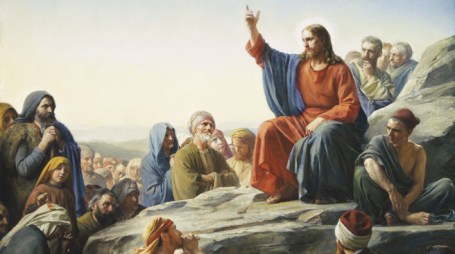
In what has become a kind of tradition for him, New York Times columnist Nicholas Kristof published an op-ed piece a couple of days before Christmas with this question: “Am I a Christian?” This time, he asked the question to Cardinal Joseph Tobin, but he has posed the same question to President Jimmy Carter and Pastor Timothy Keller in past columns.
Mr. Kristof is an admitted skeptic of many of the claims of Christianity. He opens his conversation with Cardinal Tobin like this:
Merry Christmas! Let me start with respectful skepticism. I revere Jesus’ teachings, but I have trouble with the miracles – including, since this is Christmas, the virgin birth. In Jesus’ time people believed that Athena was born from Zeus’ head, so it seemed natural to accept a great man walking on water or multiplying loaves and fishes; in 2017, not so much. Can’t we take the Sermon on the Mount but leave the supernatural?
Mr. Kristof holds a view of Christianity that sees Jesus as a talented and even a uniquely enlightened teacher. Believing that He was a worker of supernatural feats, however, is a bridge too far. Mr. Kristof’s Christianity is one that would prefer to, in his own words, “take the Sermon on the Mount but leave the supernatural” behind.
Mr. Kristof, of course, is not the only one who stumps for this kind of Christianity. President Obama, when he was making a case for same-sex unions back when he was campaigning for the presidency in 2008, stated:
If people find that controversial, then I would just refer them to the Sermon on the Mount, which I think is, in my mind, for my faith, more central than an obscure passage in Romans.
Instead of pitting against the miracles of Christ against the Sermon on the Mount, as does Mr. Kristof, President Obama pits the letters of Paul against the Sermon on the Mount, but the net effect is the same: if one wants a Christianity that is palatable, passable, and practical for the 21st century, Jesus’ Sermon on the Mount is the place to go.
Really?
Surely Mr. Kristoff can’t be talking about the Sermon on the Mount. He must have some other sermon in mind. For in the Sermon on the Mount Jesus says all sorts of things that are unmistakably contrary to our enlightened and modern sensibilities.
If Mr. Kristof finds a virgin birth impossible, what can he possibly find plausible about Jesus’ claim in the Sermon on the Mount to fulfill all of Scripture?
Do not think that I have come to abolish the Law or the Prophets; I have not come to abolish them but to fulfill them. (Matthew 5:17)
It should be pointed out that Jesus’ claim to fulfill “the Prophets” would include a prophecy about a virgin who will give birth, as Matthew so aptly notes at the beginning of his Gospel:
An angel of the Lord appeared to [Joseph] in a dream and said, “Joseph son of David, do not be afraid to take Mary home as your wife, because what is conceived in her is from the Holy Spirit. She will give birth to a son, and you are to give Him the name Jesus, because He will save His people from their sins.” All this took place to fulfill what the Lord had said through the prophet: “The virgin will conceive and give birth to a son, and they will call Him Immanuel” (which means “God with us”). (Matthew 1:20-23)
To hold to what Jesus says in the Sermon on the Mount would be to hold to who Jesus claims to be: the perfect fulfillment of around 1,000-years-worth of ancient literature. Is this really what Mr. Kristof believes?
Of course, Jesus says lots of other things in His Sermon on the Mount too, like:
You have heard that it was said, “You shall not commit adultery.” But I tell you that anyone who looks at a woman lustfully has already committed adultery with her in his heart. (Matthew 5:27-28)
And:
It has been said, “Anyone who divorces his wife must give her a certificate of divorce.” But I tell you that anyone who divorces his wife, except for sexual immorality, makes her the victim of adultery, and anyone who marries a divorced woman commits adultery. (Matthew 5:31-32)
And:
Be perfect, therefore, as your heavenly Father is perfect. (Matthew 5:48)
And:
Seek first [God’s] kingdom and His righteousness, and all these things will be given to you as well. (Matthew 6:33)
And:
Enter through the narrow gate. For wide is the gate and broad is the road that leads to destruction, and many enter through it. But small is the gate and narrow the road that leads to life, and only a few find it. (Matthew 7:13-14)
Do people who want to take Jesus’ Sermon on the Mount while leaving behind other portions of the Scriptures take Jesus at His word in all these matters?
I have a suspicion that when people argue for the primacy of Jesus’ Sermon on the Mount, they are arguing for the primacy of a very abridged version of the sermon, which usually amounts to some nice thoughts about loving your enemies, except, of course, if they are our political enemies, along with some other nice thoughts about not judging others, except, of course, when someone holds a position we deem worthy of mockery. It turns out that a Christianity that strips away the rest of the Scriptures in favor of the Sermon on the Mount only winds up stripping away the Sermon on the Mount itself.
So, allow me to make a suggestion. If you think all of Christianity can be competently considered using Jesus’ Sermon on the Mount, fine. But then take the whole Sermon on the Mount seriously. Believe that Jesus is the fulfillment of every jot and tittle of the Old Testament. Decry lust and divorce. Aim not just for respectable goodness, but for perfect righteousness. Put God’s kingdom first in every decision. Learn to love all those who hate you in a way that you are willing even to sacrifice for them. Guard against being judgmental, even of those you find intolerable. See Jesus as your narrow road to salvation.
Live like that.
But be warned: if you do live like that, you might just find yourself in agreement not only with Jesus’ Sermon on the Mount, but with the rest of the Scriptures as well, which means that perhaps Jesus’ sermon was actually what a sermon was always meant to be: not some stand-alone speech that can be divorced from everything around it, but a testimony to all of God’s truth as contained in the Scriptures.
Try as you might, to take the Sermon on the Mount seriously, you must take the rest of the Scriptures seriously. And if you take the rest of the Scriptures seriously, you will take Jesus seriously, for the Scriptures testify to Him. And if you take Jesus seriously, you may find out that He was not just another teacher, but One who has perfect authority over us, insight into us, and salvation for us.
Now, if you’re willing to believe all that about Jesus, which is what the Sermon on the Mount calls us to believe, is a virgin birth really all that difficult to fathom?
2017 in Review

2017 is officially history. And what a whirlwind of a year it was. As we gear up for what will more than likely be another fast-paced year in 2018, it is worth it to reflect on some of the biggest news stories of this past year and ask ourselves, “What lessons can we learn from what we’ve experienced?” After all, though the news cycle is continually churning out new tragedies, scandals, stresses, and messes to capture our immediate attention, the lessons we learn from these stories should linger, even if the stories themselves do not. Wisdom demands it. So, here is my year in review for 2017.
January
By far, the biggest story of January was the inauguration of Donald J. Trump into the office of President of the United States. After a campaign that was both contentious and raucous, many were on edge when he was inaugurated. As our nation increasingly fractures along partisan lines, Mr. Trump’s presidency continues to inspire both sycophantic adoration and overwrought incredulity.
February
A debate over immigration led the headlines in February as fallout over President Trump’s executive order banning immigrants from nations with known terror sympathies – including Iraq, Syria, Iran, Libya, Somalia, Sudan, and Yemen – came fast and fierce. The president’s travel ban was, until very recently, the subject of endless court battles.
March
The headlines jumped across the Atlantic in March when Khalid Masood, a British-born citizen apparently inspired by online terrorist propaganda, drove an SUV into pedestrians on the Westminster Bridge, leaving four dead and forty injured. After crashing his vehicle outside Parliament, he ran, fatally stabbing a police officer before he was fatally shot by law enforcement.
April
In one of the strangest stories of the year, Vice-President Mike Pence was both criticized and, at times, even mocked for refusing to dine alone with any woman who was not his wife or one of his close relatives. Many people interpreted his boundary as needlessly prudish. Mr. Pence viewed it as a wise way to guard his integrity.
May
Another story of terror echoed through the headlines in May, this time in Manchester, England, when suicide bomber Salman Abedi detonated himself at an Ariana Grande concert leaving 22 dead and 59 wounded.
June
The terrorist attacks continued in June as seven were killed and another 48 were wounded in London when a vehicle barreled into pedestrians on London Bridge. Three attackers then emerged to go on a stabbing rampage. Also, Steve Scalise, the majority whip for the House of Representatives, was seriously wounded when 66-year-old James Hodgkinson opened fire during a congressional baseball game.
July
President Trump and Pope Francis offered to provide medical care for the family of Charlie Gard, a baby born with mitochondrial DNA depletion syndrome. A judge in the UK, where the Gard family resides, ordered that Charlie be taken off life support because he saw no hope for Charlie’s recovery, which prompted the president’s and the pope’s overtures. Charlie was eventually removed from life support and passed away.
August
James Alex Fields killed one person and injured nineteen when he plowed his Dodge Challenger into a group of counter-protesters at an event called “Unite the Right” in Charlottesville, Virginia, which was protesting a decision by the city to remove a statue of Confederate General Robert E. Lee. Hurricane Harvey also ripped through Texas, devastating the Coastal Bend, the Houston area, and the Golden Triangle on the Texas-Louisiana border.
September
Hurricane Irma churned its way across Cuba, the Bahamas, Turks and Caicos, the Virgin Islands, Antigua, Barbuda, and, finally, Florida, leaving mass devastation in its wake.
October
The worst mass shooting in American history took place when James Paddock broke the window in his hotel suite at the Mandalay Bay in Las Vegas and fired onto a crowd of country concert goers below, killing 59 and injuring hundreds. In a much more heartwarming moment, the Christian Church celebrated the 500th anniversary of the Protestant Reformation.
November
On the heels of one mass shooting came another – this time at a tiny church outside San Antonio in Sutherland Springs. 26 people were killed when a gunman opened fire on the congregants inside in the middle of a Sunday service. A sexual assault epidemic also broke wide open, as man after man – from Hollywood moguls to politicians to television news personalities – were revealed to have engaged in sexually inappropriate behavior.
December
Devastating wildfires ripped through southern California, scorching thousands of acres and forcing hundreds of thousands of residents to evacuate.
These are only a few of the stories from 2017. There are, of course, countless others that I did not mention. So, what is there to learn from all these stories?
First, when I compare this year in review with others I have written, I am struck by how, in the words of Solomon, there really is “nothing new under the sun” (Ecclesiastes 1:9). Other years have featured other terrorist attacks, natural disasters, mass shootings, and political upheavals. Even the freshly revealed charges of sexual assault chronicle things that happened years, if not decades, ago. The news cycle seems to have a certain, sordid rhythm to it. The news may be saddening, but I’m not so sure it’s surprising.
Second, if anyone ever needed a bit of empirical verification of the biblical doctrine of human depravity, the news cycle would be a good place to find it. Both the drumbeat of dreariness in our news cycle and the fact that we, as a matter of course, are often more riveted by horrific stories than we are by uplifting ones are indications that something is seriously wrong in our world.
Finally, at the same time the news cycle testifies to human depravity, it must not be forgotten that, regardless of how bad the news cycle gets during any given year, hope seems to spring eternal for a better set of stories in the coming year. Yes, we may brace ourselves for the worst. But this cannot stop us from hoping for the best. Such a hope is a testimony to the fact that God has “set eternity in the human heart” (Ecclesiastes 3:11) – an eternity when everything that is wrong in this age will be set right in the next. We cannot help but yearn for that age to come.
So, here’s to hoping for a grand 2018. Yes, the news cycle may indeed take a turn toward the sour, but we also know that God has promised a new age to come, even if we do not yet know its day or hour.
Every Day Can Be Christmas

Adoration of the Shepherds by Gerard van Honthorst, 1622
The first Christmas was a work day.
These days, Christmas is one of the few days of the year widely marked by time off. But for the first people to hear of Christ’s birth, Christmas day was not a holiday, but a normal day:
And in the same region there were shepherds out in the field, keeping watch over their flock by night. And an angel of the Lord appeared to them, and the glory of the Lord shone around them, and they were filled with great fear. And the angel said to them, “Fear not, for behold, I bring you good news of great joy that will be for all the people. For unto you is born this day in the city of David a Savior, who is Christ the Lord.” (Luke 2:8-11)
There was no glistening tree, no holiday feast, no gift exchange, no melodic carols, and no time off to be with family when an angel appeared to some shepherds that first Christmas night. There was only another day at the office of the open field, with lots of sheep milling about. The first Christmas was a work day.
The holiday of Christmas is, of course, precious. I love to open gifts with my family and enjoy all the traditions and accoutrements that accompany this time of year. But if the message of Christmas is kept within the boundaries of the actual holiday of Christmas, the truth of Christmas will be quickly lost.
The heart of the Christmas message is that God became human in the person of Jesus Christ. He “took and flesh and made His dwelling among us” (John 1:14). But Jesus did not become human to give us a holiday, as wonderful as that holiday may be, but to change our everyday. This is why Jesus poured Himself into twelve men for three years. This is why He healed the sick and fed the masses. This is why He taught the curious and rebuffed the self-righteous. He poured Himself into the everyday lives, struggles, and sins of people not to give them another holiday, but to show them that He was for and with them every day.
Assuming the traditional chronology of Jesus’ crucifixion and resurrection is correct, I find it telling that the climax of Jesus’ work – His death and resurrection – occurred between holidays. The Thursday night before Jesus died, He celebrated the high holy Jewish holiday of Passover with His disciples. The Saturday Jesus was in the grave was the holiday of a Sabbath. Jesus died on a Friday and rose on a Sunday. He accomplished His mission not on important holidays, but during two common days.
The message of Christmas extends long beyond the holiday of Christmas, for the message of Christmas reminds us that Christ is with us not just during a day full of carols, decorations, presents, and food, but “always, to the very end of the age” (Matthew 28:20). So, as we celebrate Christmas today, let’s not forget why need Christmas tomorrow – and all year long.
The Dogs of North Korea

Credit: Korean Central News Agency
The more we learn about North Korea, the more sickening the regime there looks. Recently, U.N. Ambassador Nikki Haley held a meeting on human rights in North Korea, which featured Ji Hyeon-A, a woman who escaped from North Korea to South Korea in 2007. Fox News reported on her remarks:
“Pregnant women were forced into harsh labor all day,” she said. “At night, we heard pregnant mothers screaming and babies died without ever being able to see their mothers.”
North Korea does not allow for mixed-race babies, she said. At one detention center, she described how inmates starved to death. Their dead bodies, she said, were given to the guard dogs for food.
This is horrifying. But it is also tragically common in this isolated nation. So, how are we to respond?
First, we should pray for the protection of the citizens of North Korea. Living under the nation’s current dictator, Kim Jong-un, or its prior dictator, Kim Jong-il, as did Ji Hyeon-A, has to be terrifying emotionally, psychologically, spiritually, and physically. Just this past week it was reported that North Korea’s top military official, Hwang Pyong-so, second only to Kim Jong-il himself, is suspected dead after falling out of favor with the supreme leader. In North Korea, there is no reasonable assurance of life. Thus, prayers for the thousands whose lives are in danger every day are in order. In Psalm 22, the Psalmist prays:
But You, LORD, do not be far from me. You are my strength; come quickly to help me. Deliver me from the sword, my precious life from the power of the dogs. (Psalm 22:19-20)
The Psalmist’s prayer echoes an all-too-literal North Korean fear. For those who face the grisly specter of being fed to dogs, we must pray. For those who are oppressed or threatened in any way in North Korea, we must pray.
But we must go further. Our prayers must include not only petitions for protection, but cries for justice. The evil of the North Korean regime must be stopped.
When John has a vision of heaven in Revelation, he sees both those saved by God’s grace and those condemned by God’s judgment. He explains the scene thusly:
Blessed are those who wash their robes, that they may have the right to the tree of life and may go through the gates into the city. Outside are the dogs, those who practice magic arts, the sexually immoral, the murderers, the idolaters and everyone who loves and practices falsehood. (Revelation 22:14-15)
John offers a laundry list of those who will be “outside” salvation on the Last Day. But what is most interesting about this list is who heads it: “the dogs.” Considering dogs are such a ubiquitous part of American families that they have garnered the moniker of “man’s best friend,” the idea that dogs would be excluded from God’s kingdom may puzzle us. But in the ancient world, dogs were considered to be not pets, but dangerous, disease-ridden scavengers. They were reviled. In his vision, then, John sees dogs as symbols of all that is evil.
Those who feed people who have died to literal dogs can only be called dogs themselves, in the biblical sense. Yet, we have the assurance that, one day, these dogs will find themselves on the “outside,” just like John foresees – whether this means they lose power in this age, or in the age to come.
In Psalm 22, shortly before the Psalmist prays that God would deliver him from the dogs, he declares:
Dogs surround me, a pack of villains encircles me; they pierce my hands and my feet. (Psalm 22:16)
This psalm, it turns out, is not only a prayer for deliverance, but a prophecy of things to come – a prophecy of One who, just like in the psalm, would be surrounded by His enemies and pierced for them (Psalm 22:16; Luke 24:39), a prophecy of One who, just like in the psalm, would die humiliated as His enemies divided His clothes and cast lots for them (Psalm 22:18; Matthew 27:35), and a prophecy of one who, just like in the psalm, would cry out in despair, “My God, My God, why have You forsaken Me” (Psalm 22:1; Matthew 27:46)?
Jesus, just like the North Koreans, knew the horror of being surrounded by dogs while in the throes of death. Jesus, just like the North Koreans, experienced the most diabolical evils humans could perpetrate. But Jesus, while suffering death at the hands of evil, was not overcome by it. The dogs that surrounded Him were defeated when His tomb turned up empty. And the dogs that surround many in North Korea will be defeated when our tombs turn up empty too.
The dogs may maul. But Jesus’ resurrection is the promise of their defeat, and it is offered to all.
Christmas When Disaster Strikes

Though wildfires in Southern California are not an unusual occurrence, the ones now tearing through the Los Angeles area are truly historic. Hundreds of thousands residents are under mandatory evacuations, hundreds of thousands of acres have been burned, and many of the fires are not contained. The fires are effortlessly jumping major freeways, including the 405, and engulfing everything in their path.
The stories emerging from the wildfires are heartbreaking. On NBC Nightly News, images and stories of grieving and tearful people who have lost their homes have been commonplace. In one image, a man stands on his roof staring down a massive wildfire with a garden hose in hand. He doesn’t even look hopeful. He knows it’s futile.
Even as I see tears and hear sobs, it is difficult for me to imagine how these people must feel. At a time of year that is known for its bounty of gifts, there are thousands who have suffered the loss of so much.
One of my favorite Christmas carols is “Joy to the World.” Its famously bouncy melody, however, can mask its realistic estimation of the trials of this world:
No more let sins and sorrows grow,
Nor thorns infest the ground;
He comes to make His blessings flow
Far as the curse is found.
This world, the carol concedes, is full of sins, sorrows, and thorns. And yet, the hope of Christmas is that a Savior has been born who “comes to make His blessings flow far as the curse is found.” The tension of this lyric is thick. A catastrophe like the California fires is certainly a result of the curse – a world broken by sin. Natural disasters were never meant to be part of God’s good creation. But God comes into this world, cursed by sin, to make His blessings flow. In other words, even in the midst of the fires, God’s blessings are not withheld, but bestowed. But when you’re fighting a massive fire with a garden hose, God’s blessings can be awfully tough to spot.
Christmas can help us see how God’s blessings arrive, even when all we see is the curse. God’s blessings arrive not in brash and bold and bawdy ways, but in small and poor and humble ways. They arrive in little towns like Bethlehem. They arrive through peasant people like Mary and Joseph. They arrive with a baby who sleeps in some hay. In other words, they arrive in ways that are easy to miss in a world where the curse looms large. But those who take the time to see these blessings cannot help but be changed by them.
One story coming out of the California fires involves a family whose mansion burned to the ground last week. When firefighters ordered an evacuation of the area shortly before the fires engulfed this family’s home, one firefighter asked the homeowner, “If we could save just one thing, what would you want it to be?” The homeowner replied, “Please save my Christmas tree for my kids because it’s got so many memories.” The family no longer has a home. But they still have their tree. They still have a reminder of this season and what it’s all about – the greatest blessing of God’s Son. The curse may have taken this family’s house, but it did not take this family’s Christmas.
He comes to make His blessings flow
Far as the curse is found.
He really does – even if it’s in the smallest of ways.
ISIS and Sufis

Credit: Akhtar Soomro / Reuters
Because it was over the long Thanksgiving weekend, the ISIS attack on an Egyptian Sufi mosque that killed 305 people a week ago Friday received some attention, but not as much as it might have normally. But it is important. The sheer scope of the tragedy is gut-wrenching. The mass shooting at the Mandalay Bay in Las Vegas claimed 59 lives. The mass shooting at the First Baptist Church in Sutherland Springs claimed 26. The attack on this mosque killed over 300. It is sobering to try to fathom.
Part of what makes this attack so disturbing is that one group of Muslims – or at least self-identified Muslims – in ISIS perpetrated this attack against another group of Muslims who are Sufi. At its heart, this attack was driven not by political or cultural differences, but by an all-out holy war. Rukmini Callimachi, in a report for The New York Times, explains:
After every attack of this nature, observers are perplexed at how a group claiming to be Islamic could kill members of its own faith. But the voluminous writings published by Islamic State and Qaeda media branches, as well as the writings of hard-liners from the Salafi sect and the Wahhabi school, make clear that these fundamentalists do not consider Sufis to be Muslims at all.
Their particular animus toward the Sufi practice involves the tradition of visiting the graves of holy figures. The act of praying to saints and worshiping at their tombs is an example of what extremists refer to as “shirk,” or polytheism.
Certainly, the veneration of the dead is a problem – not only for many Islamic systems of theology, but for orthodox Christianity as well. When the Israelites are preparing to enter the Promised Land, God warns them:
Let no one be found among you who sacrifices their son or daughter in the fire, who practices divination or sorcery, interprets omens, engages in witchcraft, or casts spells, or who is a medium or spiritist or who consults the dead. Anyone who does these things is detestable to the LORD; because of these same detestable practices the LORD your God will drive out those nations before you. (Deuteronomy 18:10-12)
On this, many Christians and Muslims agree: venerating the dead is not only superstitious and paganistic, it smacks of polytheism by exalting a departed soul to the position of God, or, at minimum, to a position that is god-like. Yet, one can decry the veneration of the dead without creating more dead, an understanding that many others in the Muslim world, apart from ISIS, seem to be able to maintain with ease. Theological disagreements can be occasions for robust debate, but they must never be made into excuses for bloodshed.
There are some in the Christian world, who, like Sufi Muslims, venerate those who are dead in ways that make other Christians very uncomfortable. Catholicism’s veneration of the saints, for instance, is rejected as unbiblical and spiritually dangerous by many Protestants, including me. But this does not mean that there are not many theological commitments that I don’t joyfully share with my Catholic brothers and sisters, including a creedal affirmation of Trinitarian theology as encapsulated in the ecumenical creeds of the Church. I may disagree with Catholics on many important points of doctrine, but they are still my friends in Christ whom I love.
Jesus famously challenged His hearers to “love your enemies and pray for those who persecute you” (Matthew 5:44). Part of what I find so compelling about Jesus’ challenge is not just its difficulty – though it is indeed very demanding to try to love someone who hates you – but its keen insight into the devastating consequences of hate. If you love your enemy, even when it’s difficult, you can most certainly love your friends, and, by God’s grace, you may even be able to make friends out of enemies when they become overwhelmed by your love. But if you hate your enemy, even your friends will eventually become your enemies, and you will hate them too. Why? Because hate inevitably begets more hate.
ISIS has made a theological system out of hate. Thus, they have no friends left to love. They only have enemies to kill, including other Muslims. Christians, however, worship a God who not only has love, but is love (1 John 4:16). For all the Sufis who are mourning, then, we offer not only our condolences, but our hearts, and we hold out the hope of the One who is not only the true God, but the one Savior, and who makes this promise: ISIS’s hate that leads to death is no match for Jesus’ love and His gift of life.
Thanksgiving Lessons From Lincoln

Credit: Luminary PhotoProject / Flickr
I have made it a tradition of sorts to read one of Abraham Lincoln’s Thanksgiving proclamations each year during this time. His proclamations are not only extraordinarily well-crafted pieces of oratory statecraft, they are also genuinely theologically rich. In his Thanksgiving Proclamation of 1863, Mr. Lincoln recounts the blessings God has bestowed on this nation and then declares:
No human counsel hath devised nor hath any mortal hand worked out these great things. They are the gracious gifts of the Most High God, who, while dealing with us in anger for our sins, hath nevertheless remembered mercy.
President Lincoln beseeches the nation to give thanks on its knees, humbly recognizing that anything it has is not due to some inherent civic merit or to some twisted theology of a manifest destiny (a concept Mr. Lincoln resolutely opposed), but to the unmerited mercy of God. In other words, the president recognized that rather than judging this nation as its sins deserved in wrath, God instead blessed this nation apart from its sins out of grace. And for this, Mr. Lincoln was thankful.
What struck me the most about President Lincoln’s Thanksgiving Proclamation as I read it this year was how the president believed divine mercy should lead to concrete action. Mr. Lincoln concludes his proclamation thusly:
I recommend to them that while offering up the ascriptions justly due to God for such singular deliverances and blessings they do also, with humble penitence for our national perverseness and disobedience, commend to His tender care all those who have become widows, orphans, mourners, or sufferers in the lamentable civil strife in which we are unavoidably engaged, and fervently implore the interposition of the Almighty hand to heal the wounds of the nation and to restore it, as soon as may be consistent with the divine purposes, to the full enjoyment of peace, harmony, tranquility, and union.
In view of God’s mercy, the president invites the American people to three things: repentance, remembrance, and restoration. He invites the American people to repent of their sins, both in the North and in the South, understanding that any snooty swagger of self-righteousness can never receive mercy from God because it does not understand the need for the grace of God. He also invites the American people to a remembrance of those who are suffering – those who have become widows, orphans, and mourners in the strife of the Civil War. He finally calls the American people to restoration – to be healed from a wound of division that runs so deep that it has led Americans to take up arms against Americans.
As I reflect on the wisdom in President Lincoln’s proclamation, the words of the teacher in Ecclesiastes come to mind: “What has been will be again, what has been done will be done again; there is nothing new under the sun” (Ecclesiastes 1:9). Today, as in Mr. Lincoln’s day, examples of delusional self-righteousness abound – both among the secular and the spiritual – which close us off to appreciating and receiving God’s mercy. Today, as in Mr. Lincoln’s day, widows, orphans, and mourners still live among us, often unnoticed and sometimes even ill-regarded, suffering silently and in desperate need of our help. Today, as in Mr. Lincoln’s day, America still suffers from a wound of division, which some, almost masochistically, delight in ripping open farther and cutting into deeper for their own cynical political purposes. The problems that plagued our nation in 1863 still plague our nation today in 2017. Our problems persist. But so too does the mercy of God.
154 years later, we are still extravagantly blessed with bounty. 154 years later, our republic has not dissolved, even as it has frayed. 154 years later, God still is not treating us as our sins deserve. Our sinful rebellion, it seems, cannot thwart the tenacious grace of God. And for that, on this Thanksgiving, I am thankful.
The Scandals Keep Coming

It’s far better to take refuge in the LORD than to trust any human. It’s far better to take refuge in the LORD than to trust any human leader. (Psalm 118:8-9)
If there were ever words we needed to read, re-read, and take to heart in the chaos of our heady political milieu, it would be these. Our human leaders fail us again and again – time after time, leader after leader, politician after politician.
The latest political failures come conveniently in both a left and a right form – a liberal scandal and a conservative one. On the liberal side, there is U.S. Senator Al Franken from Minnesota, who was revealed to have groped a radio newscaster during a 2006 U.S.O. tour. The senator has issued an apology, but there are already questions boiling under the surface as to whether or not this kind of behavior was common for him.
On the conservative side, there is the candidate for the U.S. Senate, Judge Roy Moore from Alabama, who stands accused making unwanted advances at female teenagers in the early 80s and, according to the two most serious allegations, sexually assaulting one girl who, at the time, was 14 and attacking another girl who, at the time, was 16, by squeezing her neck and attempting to force her head into his groin. Judge Moore was in his 30s when the alleged assaults took place and he has denied the allegations.
Senators Mitch McConnell and Chuck Schumer have called for an investigation of Senator Franken by the Senate Ethics Committee, a move which Senator Franken himself supports. Politicians on both sides of the aisle have called on Judge Moore to drop out of the Alabama Senate race, with some interesting exceptions. Alabama State Auditor Jim Zeigler defended the judge’s alleged actions using what can only be described as a tortured – and, it must be added, an incorrect and incoherent –theological logic, saying:
Take the Bible – Zechariah and Elizabeth, for instance. Zechariah was extremely old to marry Elizabeth and they became the parents of John the Baptist. Also, take Joseph and Mary. Mary was a teenager and Joseph was an adult carpenter. They became parents of Jesus. There’s just nothing immoral or illegal here. Maybe just a little bit unusual.
Alabama Representative Mo Brooks defended Judge Moore more straightforwardly by calculating the political cost of electing a Democrat to the Senate instead of a firebrand conservative like the judge. He said:
America faces huge challenges that are vastly more important than contested sexual allegations from four decades ago … Who will vote in America’s best interests on Supreme Court justices, deficit and debt, economic growth, border security, national defense, and the like? Socialist Democrat Doug Jones will vote wrong. Roy Moore will vote right. Hence, I will vote for Roy Moore.
Whether among Democrats or Republicans, it seems as though the stakes on every election, every seat, every position, and every appointment – yea, every scrap of political power – have become sky high. A national apocalypse, it can feel like, is only one political loss away.
New York Times columnist David Brooks recently bemoaned how our perceived astronomical political stakes have turned politics itself into an idol for many in our society. He wrote:
People on the left and on the right who try to use politics to find their moral meaning are turning politics into an idol. Idolatry is what happens when people give ultimate allegiance to something that should be serving only an intermediate purpose, whether it is money, technology, alcohol, success or politics.
In his column, Mr. Brooks quotes Andy Crouch, who is the executive editor at Christianity Today, and his excellent description of what idols do in his book Playing God:
All idols begin by offering great things for a very small price. All idols then fail, more and more consistently, to deliver on their original promises, while ratcheting up their demands, which initially seemed so reasonable, for worship and sacrifice. In the end they fail completely, even as they make categorical demands. In the memorable phrase of the psychiatrist Jeffrey Satinover, idols ask for more and more, while giving less and less, until eventually they demand everything and give nothing.[1]
This is most certainly true. All idols fail. This means that if we fancy our politicians to be saviors who can rescue us from the wiles of our political opponents and some looming national apocalypse, those for whom we vote will inevitably fail – sometimes modestly by an inability to pass key legislation, and other times spectacularly in some grave moral collapse. Senator Franken and Judge Moore are just the latest examples of this.
David French, in a recent article for National Review concerning the Judge Moore scandal, wrote simply, “There is no way around dependence on God.” These scandals serve to remind us of this profound truth. The fact that our politicians fail should grieve us, as sin always should, but it should not scare us. After all, even if a national apocalypse should come, it is still no match for the Apocalypse, when, instead of a politician, a perfect Potentate will appear to set the world right. That’s not an apocalypse of which to be scared; that’s an apocalypse by which to be comforted. I hope you are.
_____________________________
[1] Andy Crouch, Playing God: Redeeming the Gift of Power (Downers Grove, IL: InterVarsity Press), 56


 Pastor Zach's Blog