The Rebuilding of Notre Dame and the Resurrection of Jesus Christ
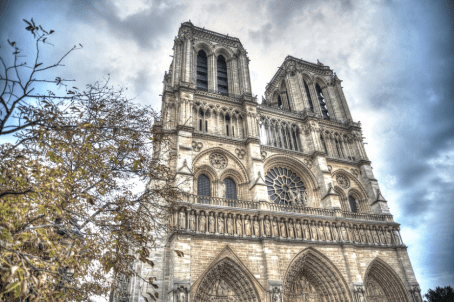
The world watched in horror as a medieval Gothic treasure was wrecked last Monday when flames ripped through Notre Dame Cathedral in Paris. Parts of the building, the construction of which began in 1163, still stand. But much of the roof, which was made out of timber and original to the structure, along with the cathedral’s grand spire, also made out of wood and iron and rebuilt in 1844, is no more.
Reports indicate that many of the cathedral’s priceless relics, including what is claimed to have been the crown of thorns Jesus wore during His crucifixion, were rescued from the blaze. Other relics, like a supposed piece of Jesus’ cross, may not have been so fortunate. Its status is still unknown. Parisians, Catholics, Protestants, and countless others across the world are still coming to terms with how a landmark as staid and majestic as Notre Dame – which withstood everything from the French Revolution and its virulently anti-Theist cult of reason to Hitler’s invasion of Paris and his order, thankfully disobeyed by one of his generals, to trigger explosives placed inside the grand façade – could come crashing down due to an accidental fire, likely triggered by an electrical short circuit.
The French president, Emmanuel Macron, vowed to rebuild the cathedral under an ambitious timeline. “We will rebuild Notre Dame even more beautifully and I want it to be completed in five years,” the president said in an address last Tuesday. This is indeed a highly aggressive timeline and one of which many experts are skeptical, suspecting that the rebuilding may take decades instead of years. When the structure was first built, it took 182 years to complete.
Jesus, as He began His public ministry, gazed upon the temple in Jerusalem, which would have been the ancient Jewish version of Notre Dame, and declared, “Destroy this temple, and I will raise it again in three days” (John 2:19). Apparently, President Macron’s ambitious building timeline has nothing on Jesus. The temple had already been rebuilt once after being destroyed by the Babylonians in 586 BC. Herod the Great had begun a restoration and expansion of the temple in 20 BC, which continued into Jesus’ day. So, you can imagine the incredulity of those listening when Jesus declared that He could rebuild the temple from the ground up in three days. This is why the people responded, “It has taken forty-six years to build this temple, and You are going to raise it in three days” (John 2:20)? But, of course, there’s a secret that the people listening to Jesus do not yet know or understand that John happily lets us in on: “The temple He had spoken about was His body” (John 2:21).
Yesterday, Christians all over the world celebrated the truth that Jesus’ building project was a stunning success. He did at the end of His public ministry precisely what He said He would do at the beginning of His public ministry. His body was crushed on a cross. But in three days, He was not only rebuilt, He was resurrected. Because of Him, even as the storied nave of Notre Dame sat sadly empty yesterday as a house of worship, hearts across the world were full of joy in celebration of the One who is to be worshiped.
When Notre Dame burned, the world lost a precious space. But Christians did not lose their Christ. And Christ did not lose His Church. In the words of the old hymn:
Built on the Rock the Church doth stand,
Even when steeples are falling;
Crumbled have spires in every land,
Bells still are chiming and calling,
Calling the young and old to rest,
But above all the soul distressed,
Longing for rest everlasting.
Work on Notre Dame began 856 years ago because of this promise. May work begin again on this grand old lady for this same reason.
“I am thirsty.”

Credit: Gerard de la Vallée, “Longinus piercing Christ’s side with a spear,” 17th cent.
This Friday, Christians around the world will commemorate the death of Jesus Christ. At the church where I serve, we will hold services centering around the traditional seven final phrases that Jesus speaks from the cross. Many of these phrases are extraordinarily well-regarded and famous. For instance, when Jesus prays for His executioners, saying, “Father, forgive them, for they do not know what they are doing” (Luke 23:34), we are treated to a tour de force in what true forgiveness looks like. When Jesus cries out, “My God, My God, why have You forsaken Me?” (Mark 15:34) we hear in His words both an ache for God’s presence in suffering as well as a separation from God because of sin.
One of my favorite phrases from Jesus on the cross is one that can sometimes be overlooked:
“I am thirsty.” (John 19:28)
This hardly seems like a profound statement. It seems more like a mundane request. A man who is baking in the hot ancient Near Eastern sun while hanging exposed on a cross has developed a case of cotton mouth. And yet, these words represent not only the cry of a parched mouth, but the yearning of a scorched soul.
The Psalmist once said:
As the deer pants for streams of water, so my soul pants for You, my God. My soul thirsts for God, for the living God. When can I go and meet with God? (Psalm 42:1-2)
The Psalmist describes his desperate thirst for God. And how does God respond to his thirst?
Deep calls to deep in the roar of Your waterfalls; all Your waves and breakers have swept over me. (Psalm 42:7)
God not only gives the Psalmist’s soul spiritual water, He offers the Psalmist a superabundance of this water in the form of waves and breakers.
Jesus invites anyone who has a thirst like the Psalmist’s:
“Let anyone who is thirsty come to Me and drink. Whoever believes in Me, as Scripture has said, rivers of living water will flow from within them.” (John 7:37-38)
But this takes us back to Jesus’ words from the cross. For when Jesus, who offers all men refreshment for their souls, Himself complains of thirst, how do men respond to Him?
A jar of wine vinegar was there, so they soaked a sponge in it, put the sponge on a stalk of the hyssop plant, and lifted it to Jesus’ lips. (John 19:29)
God responds to human thirst with refreshing water. Humans respond to God’s thirst with bitter vinegar. What a contrast.
And yet, the incredible thing about Jesus’ death on the cross is that sin’s vinegar never quite manages to strip Him of His life-giving water:
One of the soldiers pierced Jesus’ side with a spear, bringing a sudden flow of blood and water. (John 19:34)
The water of life stubbornly remains, flowing from the side of the One who died.
This week, as we reflect on and remember Jesus’ death, may we drink deeply from the water of His life. For the water of His life gives us eternal life.
A Better Root For Human Intimacy

Two stories recently hit the headlines, one which made a big splash and one which went largely unnoticed.
In the story that made a big splash, last week, the nation of Brunei enacted new penalties for certain sexual acts. Amy Gunia reports for Time:
Despite international condemnation, Brunei enacted new Islamic criminal laws Wednesday, including harsh anti-LGBT measures that make gay sex punishable by stoning to death. The implementation of the draconian penal code is part of the predominantly Muslim country’s rollout of Sharia law …
Homosexuality was already illegal in Brunei, but it was previously punishable with prison time. The new legislation mandates death by stoning for gay sex and a number of other acts, including rape, adultery, sodomy, extramarital sex and insulting the Prophet Muhammed.
The new penal code also punishes lesbian sex through whipping and theft with amputation, and criminalizes teaching children about any religion except Islam.
The second story that made headlines, albeit in a much more modest way, was last month’s repeal of some anti-adultery laws, still officially on the books, though not enforced, in the state of Utah. Paulina Dedaj explains for Fox News:
The governor of Utah signed a bill repealing a 1973 law that criminalized sex outside marriage … The offense, which was not enforced by police, was classified as a class B misdemeanor punishable by up to six months in jail and a $1,000 fine.
These two stories pull in two very different directions. But both of them point to just how contentious questions concerning human sexuality have become.
It must be stated that the new penalties in Brunei are nothing short of appalling. Stoning people is inhumane as a matter of course, regardless of the reason behind it. But, especially for Christians, stoning people for crossing sexual boundaries should have a special kind of cringe factor to it when one stops to consider how Jesus, in a story from John 8, advocates for a woman caught in the act of adultery by sending her accusers, who wanted to stone her, away.
The repeal of Utah’s law banning sex outside of marriage, though certainly not as flashy as the story out of Brunei, is also worthy of our attention and consideration. Using legislation to uphold the kinds of sexual mores Utah’s law did, even if those mores are laudable, strikes me as a recipe for corruption and selective enforcement. Corruption and selective enforcement are certainly endemic to the story of that woman caught in adultery. Her interlocutors are unquestionably corrupt and selective in how they enforce their penalty of stoning, considering that they bring only her, and not the man in the tryst, in front of Jesus to face the death penalty. Though I am a wholehearted proponent of traditional sexual morality, I’m not sure if what is moral always requires codification by what is legal.
I am thankful that there are certain pieces of sexual legislation on our books. The criminalization of pedophilia, for example, is wise and needed for the protection of our most vulnerable. I also wish we had more legislation bearing down on the pornography industry, which makes its billions by flagrantly degrading the dignity of human beings and, as with pedophilia, by preying on society’s most vulnerable by enticing them with money to humiliate themselves on camera to churn out a never-ending stream of smut.
With this being said, however, the larger debate over sexual mores will take something more than legislation to solve, especially when it comes to the hot-button sexual debates of our day, which often center not so much around widely agreed upon boundaries to sexual activity, but around deeper contentions concerning sexual identity.
In the West especially, views on human sexuality are broadly rooted in two things: the sentimental and the carnal. The sentimental root of sex is what we generally think of as romantic love. Two people fall in love and express their love for each other sexually. The weakness in this root however, as countless broken marriages and relationships can testify, is that the feeling of love can dry up with time or, as many who have affairs will argue, can even shift to another person. This root by itself, therefore, is not sufficient as a foundation for human sexuality. This root is simply not rooted enough.
The carnal root of sex is usually conceived of as the uninhibited expression of desire – or, to put it more bluntly, as lust. This root of sex is what drives the pornography industry’s ubiquity and the hookup culture found on many college campuses. The weaknesses in this root are manifold. People are objectified. Some are even raped. And relationships rooted in carnality have literally no chance – and that is not an exaggeration – of lasting. Such relationships are fundamentally selfish. And selfishness is a sin that sexual commitment and wholeness cannot endure.
One of the unique gifts that Christianity brings to today’s debates over human sexuality is that while it celebrates the importance of love in sexual relationships and readily acknowledges and makes provisions for the reality that people struggle with carnal lust, it offers human sexuality another – and, I would argue, better – root. It adds to the sentimental and to the carnal the aspirational. This root sees human sexuality as something that reaches beyond the private love of two individuals and certainly beyond the fleshly lusts of one individual and seeks to reflect something of God’s love and His created order in its expression of human love and our relational order. This aspirational root, rather than self-righteously condemning people who fall short of it, grieves over sexual sin and gently invites sexual sinners to turn from their sin and aim higher, just as Jesus does with the woman caught in adultery when He invites her to, “Go now and leave your life of sin” (John 8:11). The Christian aspirational root of sex trades the brutality of Brunei for the blessings of rightly ordered relationships and the legislative problems of Utah for the redemption won by Christ.
The best picture of aspirational sexuality can be found in Christian marriage, which is itself an aspirational picture of Christ’s love for the Church – a love so deep that it led Him to lay down His life on a cross. On the cross, perfect righteousness and infinite forgiveness meet. May we, as those who follow Christ, aspire to hold forth to sexual sinners what Christ first held out to us from the cross. He is our way forward.
The Problem With The New York Times’ God Problem

God the Father by Cima da Conegliano, c. 1515
The polemical can sometimes become the enemy of the thoughtful. This seems to be what has happened in an opinion piece penned by Peter Atterton for The New York Times titled, “A God Problem.”
Mr. Atterton is a professor of philosophy at San Diego State University who spends his piece trotting out well-worn and, if I may be frank, tired arguments against the logical integrity of Theism. He begins with this classic:
Can God create a stone that cannot be lifted? If God can create such a stone, then He is not all powerful, since He Himself cannot lift it. On the other hand, if He cannot create a stone that cannot be lifted, then He is not all powerful, since He cannot create the unliftable stone. Either way, God is not all powerful.
This is popularly known as the “omnipotence paradox.” God either cannot create an unliftable stone or He can create an unliftable stone, but then He cannot lift it. Either way, there is something God cannot do, which, the argument goes, means His omnipotence is rendered impotent. C.S. Lewis’ classic rejoinder to this paradox remains the most cogent:
God’s omnipotence means power to do all that is intrinsically possible, not to do the intrinsically impossible. You may attribute miracles to Him, but not nonsense. This is no limit to His power. If you choose to say, ‘God can give a creature free will and at the same time withhold free will from it,’ you have not succeeded in saying anything about God: meaningless combinations of words do not suddenly acquire meaning simply because we prefix to them the two other words, ‘God can’ … Nonsense remains nonsense even when we talk it about God.
Lewis’ position is the position the Bible itself takes when speaking of God. Logically, there are some things Scripture says God cannot do – not because He lacks power, but simply because to pose even their possibility is to traffic in utter nonsense. The apostle Paul, for instance, writes, “If we are faithless, God remains faithful, for He cannot disown Himself” (2 Timothy 2:13). In other words, God cannot not be God. He also cannot create liftable unliftable stones – again, not because He lacks power, but because liftable unliftable stones aren’t about exercising power over some theoretical state of nature. They’re about the law of noncontradiction. And to try to break the law of noncontradiction doesn’t mean you have unlimited power. It just means you’re incoherent and incompetent. And God is neither. To insist that God use His power to perform senseless and silly acts so that we may be properly impressed seems to be worthy of the kind of rebuke Jesus once gave to the religious leaders who demanded from Him a powerful sign: “A wicked and adulterous generation asks for a sign” (Matthew 12:39)!
Ultimately, the omnipotence paradox strips God’s power of any purpose by demanding a brute cracking of an irrational and useless quandary. And to have power without purpose only results in disaster. For instance, uncontrolled explosions are powerful, but they are also, paradoxically, powerless, because they cannot exercise any ordered power over their chaotic power. Omnipotence requires that there is power over uncontrolled power that directs and contains it toward generative ends. This is how God’s power is classically conceived. Just look at the creation story. God’s power needs purpose to be omnipotence, which is precisely what God’s power has, and precisely what the omnipotence paradox does not care to address.
For his second objection against God, Mr. Atterton turns to the problem of evil:
Can God create a world in which evil does not exist? This does appear to be logically possible. Presumably God could have created such a world without contradiction. It evidently would be a world very different from the one we currently inhabit, but a possible world all the same. Indeed, if God is morally perfect, it is difficult to see why He wouldn’t have created such a world. So why didn’t He?
According to the Bible, God did create a world where evil did not exist. It was called Eden. And God will re-create a world where evil will not exist. It will be called the New Jerusalem. As for the evil that Adam and Eve brought into the world, this much is sure: God is more than up to the task of dealing with the evil that they, and we, have welcomed. He has conquered and is conquering it in Christ.
With this being said, a common objection remains: Why did and does God allow evil to remain in this time – in our time? Or, to take the objection back to evil’s initial entry into creation: Why would God allow for the possibility of evil by putting a tree in the center of Eden if He knew Adam and Eve were going to eat from it and bring sin into the world? This objection, however, misses the true locus of evil. The true locus of evil was not the tree. It was Adam and Eve, who wanted to usurp God’s authority. They were tempted not by a tree, but by a futile aspiration: “You can be like God, knowing good and evil” (Genesis 3:5). If Adam and Eve wouldn’t have had a tree around to use to try to usurp God’s prerogative, they almost assuredly would have tried to use something else. The tree was only an incidental means for them to indulge the evil pride they harbored in their hearts. If God wanted to create a world where evil most assuredly would never exist, then, He would have had to create a world without us.
Thus, I’m not quite sure what there’s to object to here. The story of evil’s entrance into creation doesn’t sound like the story of a feckless God who can’t get things right. It sounds like the story of a loving God who willingly sacrifices to make right the things He already knows we will get wrong even before He puts us here. God decides from eternity that we are worth His Son’s suffering.
The final objection to God leveled by Mr. Atterton has to do with God’s omniscience:
If God knows all there is to know, then He knows at least as much as we know. But if He knows what we know, then this would appear to detract from His perfection. Why?
There are some things that we know that, if they were also known to God, would automatically make Him a sinner, which of course is in contradiction with the concept of God. As the late American philosopher Michael Martin has already pointed out, if God knows all that is knowable, then God must know things that we do, like lust and envy. But one cannot know lust and envy unless one has experienced them. But to have had feelings of lust and envy is to have sinned, in which case God cannot be morally perfect.
This is the weakest of Mr. Atterton’s three objections. One can have knowledge without experience. I know about murder even though I have never taken a knife or gun to someone. God can know about lust and envy even if He has not lusted and envied. The preacher of Hebrews explains well how God can know sin and yet not commit sin as he describes Jesus’ struggles under temptation: “We do not have a high priest who is unable to empathize with our weaknesses, but we have one who has been tempted in every way, just as we are – yet He did not sin” (Hebrews 4:15). Jesus was confronted with every sinful temptation, so He knows what sin is, but He also refused to swim to sin’s siren songs. The difference, then, is not in what He knows and we know. The difference is in how He responds to what He knows and how we respond to what we know.
One additional point is in order. Though I believe Mr. Atterton’s assertion that one cannot know certain things “unless one has experienced them” is questionable, it can nevertheless be addressed on its own terms by Christianity. On the cross, Christians believe that every sin was laid upon Christ, who thereby became sin for us. In other words, Christ, on the cross, became the chief of sinners, suffering the penalty that every sinner deserved, while, in exchange, giving us the righteous life that only He could live (see 2 Corinthians 5:21). In this way, then, Christ has experienced every sin on the cross because He has borne every sin on the cross. Thus, even according to Mr. Atterton’s own rules for knowing, in Christ, God can know everything through Christ, including every sin.
I should conclude with a confession about a hunch. I am a little suspicious whether or not this 1,140-word opinion piece in The New York Times decrying faith in God as illogical was written in, ahem, good faith. This piece and its arguments feel a little too meandering and scattershot and seem a little too clickbait-y to be serious. Nevertheless, this is a piece that has gained a lot of traction and talk. I’m not sure that the traction and talk, rather than the arguments, weren’t the point.
Whatever the case, Theism has certainly seen more compelling and interesting interlocutions than this piece. God, blessedly, is still safely on His throne.
Wise Decisions in a Crisis

It’s been a tragic couple of weeks in aviation. Following the crash of Ethiopian Airlines Flight 302 two weeks ago, similarities began to emerge between this crash and the crash of Lion Air Flight 610 last October. Both planes went down only minutes after takeoff. Both crashes involved sudden changes in altitude with the planes crashing at a nose down angle. And both tragedies involved Boeing 727 Max 8 aircrafts.
An investigation by The Dallas Morning News uncovered five complaints, filed by domestic pilots, about problems with a new software system in the Max 8, known as MCAS. The system is supposed to force the nose of the plane downward if needed to avoid a stall. But erroneous data from a sensor might have forced the noses of the recently doomed flights down into their crashes.
It is also being reported that Boeing had been heavily involved with the federal certification process for the Max 8 in 2012. Boeing employees were able to help FAA officials in certifying the aircrafts for flight, and, according to The New York Times, senior FAA officials weren’t even aware of the new MCAS system. The FBI has now joined an investigation into the certification process as people wonder whether having a manufacturer play such a large role in the safety certifications of its own products presents an inherent conflict of interests.
With so many questions out there, people are scrambling for answers. Why didn’t the FAA ground the Max 8 aircrafts sooner? The FAA didn’t ground the Max 8s in the U.S. until days after nations like Canada, Australia, and the whole European Union grounded theirs. Why weren’t pilot complaints made months before heeded? Why didn’t pilots initially receive any specialized training on the MCAS system? And why, ultimately, did Ethiopian Airlines Flight 302 crash? There are still no firm answers.
In a crisis like this, decision making can be difficult. Of course, safety concerns are paramount. But investigators don’t even know for sure whether there is a broad based safety concern. When one combines a lack of information about the recent Max 8 crashes with the inevitable confusion and suspicion that ensues when planes are grounded and investigations are launched, air carriers, aircraft manufacturers, and government regulators are left with no particularly appealing options.
Scripture is clear that, whether it’s with crisis over planes or personal problems with piety, people are not particularly skilled at making wise decisions that involve high stakes. Before following Him, Jesus invites people to carefully consider the cost of being His disciple:
Suppose one of you wants to build a tower. Won’t you first sit down and estimate the cost to see if you have enough money to complete it? For if you lay the foundation and are not able to finish it, everyone who sees it will ridicule you, saying, “This person began to build and wasn’t able to finish.” Or suppose a king is about to go to war against another king. Won’t he first sit down and consider whether he is able with ten thousand men to oppose the one coming against him with twenty thousand? If he is not able, he will send a delegation while the other is still a long way off and will ask for terms of peace. In the same way, those of you who do not give up everything you have cannot be My disciples. (Luke 14:28-33)
Jesus’ final line is jarring. What will following Jesus cost? Everything. And some people, after doing a cost-benefit analysis, find the cost unbearably high. Just consider the rich young man who, after Jesus invites him to “sell everything you have and give to the poor, and…then come, follow Me,” becomes crestfallen and walks “away sad, because he had great wealth” (Mark 10:21-22). The rich man thought the cost of following Jesus was too steep. Selling everything he had was too risky. So he chose to stay his course. And he was sorely mistaken to do so.
One of the reasons we make poor choices is because most of us tend to have a bias toward preservation over and against modification. The rich man did not want to modify his spending habits. The FAA, Boeing, and major airlines did not necessarily want to modify how they certify aircraft and how they train pilots. But so often, our bias towards preservation – maintaining the status quo – only makes matters worse.
Risk taking is a part of decision making. And sometimes, a decision that initially looks riskier – like the grounding of a bunch of planes and the launching of a thorough investigation into the airworthiness of these planes – is the decision that winds up being safer.
Thankfully, for most of us, these past couple of weeks did not involve decisions with stakes so high. But this does not mean we should not consider the costs of the choices that are laid before us. And, as the FAA and Boeing are learning, if our first decisions turn out not to be our best decisions, we need to be humble enough to make the right decisions. You’ll be better because of it. And the people around you will thank you for it.
Terror Strikes New Zealand
Credit: RTE News
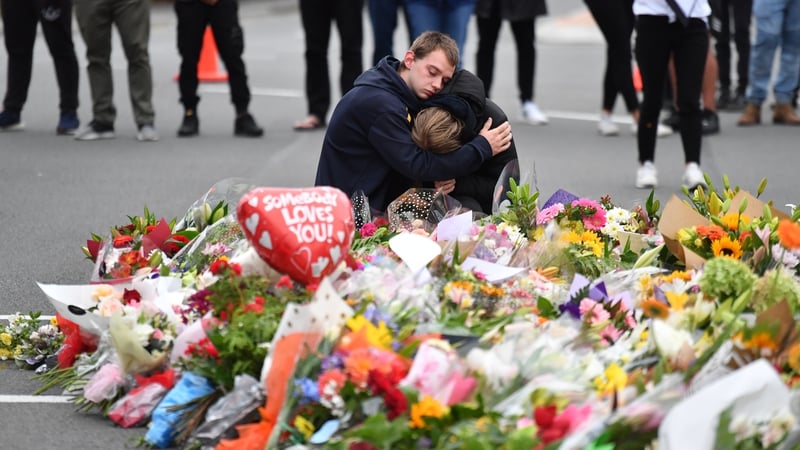
“The wages of sin is death,” the apostle Paul writes in Romans 6:23. These words were horrifyingly instantiated this past Friday when a terrorist gunman opened fire on two mosques in Christchurch, New Zealand, killing 50. The crime was, in every way, monstrous. Minutes before he went on his rampage, he emailed top government officials a rambling and incoherent manifesto, outlining his ardent white nationalistic beliefs. He then strapped on a helmet camera so he could livestream his attack on social media. Finally, he shot many worshipers at these mosques, which included several children, at point blank range as they cowered in corners.
If anyone ever doubted the dastardly death that sin – including philosophical sin like white nationalism – can bring, now would be the time to become a true believer in the devastations of depravity.
Near the end of the book of Genesis, we read of a man named Jacob and his twelve sons, the favorite of whom is Joseph. Joseph’s brothers, Genesis 37:4 says, “hated him” because of his status as his father’s favorite son. Their hatred eventually spawned a plot among the brothers to kill their kinsman. And they would have, were it not for a last-second intercession by one of the brothers, Judah, who decided it would be more financially advantageous if, instead of killing Joseph, they sold him into slavery (Genesis 37:26-27).
Hatred is an acid that eats up the soul. This is why the Bible’s consistent and continuous call is to love – and not just to love those who are like us. The Bible’s consistent and continuous call is to love those who are very different from us and even hate us. As Jesus puts it:
Love your enemies and pray for those who persecute you … If you love those who love you, what reward will you get? Are not even the tax collectors doing that? And if you greet only your own people, what are you doing more than others? Do not even pagans do that? (Matthew 5:44, 46-47)
White nationalism explicitly tramples on Jesus’ command. It not only fails to love its enemies, it actually creates enemies where there need be none and becomes an enemy to those who do not fit its arbitrarily contrived ethnic and philosophical strictures. It trades the foundational and universal sanctity of life for a hackneyed and exclusionary solidarity of race.
Blessedly, love did manage to rise up and break through when hatred was spraying a hail of bullets into two mosques in Christchurch. 48-year-old Abdul Aziz was at the second of the mosques. He was there with his four children to pray. When the terrorist began firing in the parking lot of the mosque, rather than running away, Mr. Aziz ran into the lot with the only thing he could find – a credit card machine. After firing off many rounds, the terrorist returned to his vehicle to grab a second weapon, and Mr. Aziz hurled the credit card machine at him. The terrorist then fired off another series of rounds at Mr. Aziz, who managed to protect himself by ducking between cars. When the terrorist returned to his vehicle yet again to grab yet another weapon, Mr. Aziz found one of the guns he had dropped and, after realizing it was empty, threw it at the windshield of the terrorist’s car. The windshield shattered. The terrorist was spooked. He sped off. And many lives were saved.
Mr. Aziz explained, in an interview with The New York Times, “I was prepared to give my life to save another life.” That’s love. And it stopped hate dead when hate was trying to speed death.
Christianity teaches that there was another man – a perfect man, who was also God – who was prepared to give His life to save other lives. His name was Jesus. And He not only was prepared to die. He did die. And He not only saved lives by His death. He bought for us eternal life with His death.
“The wages of sin is death,” the apostle Paul writes in Romans 6:23. But he continues: “But the gift of God is eternal life in Christ Jesus our Lord.” In Jesus’ death, love killed hate. May this be our confidence and our conviction as we mourn the tragic losses in Christchurch.
Venezuela’s Humanitarian Crisis

Credit: Wikipedia
Venezuela is in crisis. Nicolás Maduro, the nation’s president, stands accused of all sorts of heinous crimes against humanity. Luis Almagro, writing for the Washington Post, exposes some gruesome examples, including:
…subjecting opposition demonstrators such as Echenagusia Guzmán to electric shocks, beating them with nightsticks, kicks and fists and burning them with cigarettes. And [the Maduro regime will] continue to douse young men such as 18-year-old Marco Cello with gasoline, threatening to burn him, or fracture the skull of others such as Jorge León, beating him with rifle butts and helmets.
This is disgusting. But it is also only just the beginning. Mr. Maduro’s government stands accused of murdering some 8,290 people between 2015 and 2017. His penchant for corrupt governance has turned what was one of Latin America’s richest countries into an economic and humanitarian disaster.
Recently, however, the heat has been turned up on Mr. Maduro. Opposition leader Juan Guaidó is gaining political traction among the Venezuelan people and is now recognized as the interim president of Venezuela by the U.S. Still, Mr. Guaidó’s path to power is anything but certain. When the U.S. attempted to send some much needed aid to this desperately impoverished country, Venezuela’s neighbor, Colombia, stepped in to prevent it from reaching its desired destination, fearing a messy clash at the border between supporters of Mr. Guaidó, who were delivering the aid, and supporters of Mr. Maduro, who oppose all U.S. intervention.
In these types of situations, there are never any perfect – or, many times, even great – options. Unfortunately, this reality is often used as a justification for a failure to act against morally abhorrent realities in the name of a cynical realpolitik.
Genocide and starvation are simply not acceptable status quos – not only because they destabilize whole regions by creating floods of refugees, but because genocide and starvation are objectively and grossly immoral. Period.
Yes, other nations must think and carefully strategize before attempting to exert influence in a situation like Venezuela’s. But thinking cannot become a conveniently indefinite buffer against acting. Something has to change. Lives are at stake.
For us in the general public, perhaps the first step is simply paying attention. Our news cycles are dominated by domestic affairs – soap operatic machinations of a deeply divided Washington D.C. Special counsels, special investigations, salacious testimonies, presidential tweets, executive orders, and border walls fill our headlines. International crises often register only as a blip on our consciences, if at all. But they should and they must.
In Venezuela, people are needlessly dying. And as Christians, if there’s anything we should want to stand up to, it’s death.
A Vote Splits the United Methodist Church

In a world where views on human sexuality serve as wedges the drive deep disunity, the United Methodist Church voted last week in a special conference to retain its practice of not ordaining practicing homosexuals into ministry, according to the stance outlined in its Book of Discipline:
The practice of homosexuality is incompatible with Christian teaching. Therefore self-avowed practicing homosexuals are not to be certified as candidates, ordained as ministers, or appointed to serve in the United Methodist Church.
The UMC is almost certainly headed for a split. The vote was close: 53 percent to 47 percent were in favor of not ordaining practicing homosexuals. What is especially interesting is from where many of these more traditional votes came. The New York Times reports:
While membership has steadily declined in the United States over the past 25 years – a trend that is true for most mainline Protestant denominations – it has been growing in Africa. About 30 percent of the church’s members are now from African nations, which typically have conservative Christian views; in many of them, homosexuality is a crime.
What Methodists believe in the progressive West turns out to be very different from what Methodists believe in the African South.
In one sense, those who reject a traditional and, I would argue, orthodox view of human sexuality are stuck with a Gordian knot that is not easily cut. On the one hand, anything less than a full endorsement of all the causes célèbres of the LGBTQ movement is anathema in many progressive circles. On the other hand, the same progressive circles that demand an affirmation of all kinds of human sexualities also decry a Western cultural imperialism that seeks hegemony over other cultures that think and act differently. But it is difficult to see the reactions of many progressives within the UMC as anything other than a soft form of the very imperialism these progressives claim to reject. Take, for instance, the response of Will Willimon, a longtime prominent voice in Methodism, to the vote:
The traditionalists did a bang-up job of political organizing and counting the votes. The progressives were all busy talking about unity and community and listening and loving. The conservatives were on the floor getting the votes.
Willimon’s inference seems to be that traditionalists played politics cynically while progressives loved selflessly. I’m not sure this accusation adequately captures the truth of this debate – or this vote.
Those who claim Christ’s name are called to love, care for, listen to, defend, and invite in those who are LGBTQ while also upholding certain guidelines and guards around human sexuality. The only way to cut the Gordian knots of competing cultures is to look beyond these cultures to the One who loves all people from every culture.
As a Christian, I uphold a traditional – and, I would argue, biblical – sexual ethic because I have this hunch that the culture and the age in which I live does not always know what’s best for it. There are truths that are bigger than what we can see or know right now that stretch across space and through time. The Christian sexual ethic extends beyond my zip code, my state, and my nation. It also extends beyond my time. It was around before me. And it will continue on after me. Thus, I am called by Scripture to humbly submit myself to this ethic while also loving those who vehemently disagree with this ethic. After all, love is a really important Christian ethic, too.
So, instead of choosing the ethic of sexual restraint or the ethic of reckless love, I think I’ll keep both. For the Church needs both as it lives under the name of the One who displayed both.
The Case of Jussie Smollett

Credit: Wikipedia
An affirmation of the inherent dignity of humanity is a bedrock in any functioning society. This is why our nation’s founders unapologetically argued, “All men are created equal.” This is why Scripture – from front to back, from creation to restoration – celebrates and upholds the value of every life. People are created, Scripture says, “in God’s image” (Genesis 1:27) and are “fearfully and wonderfully made” (Psalm 139:14). The dignity of humanity is part of the reasoning behind Jesus’ golden rule: “In everything, do to others what you would have them do to you” (Matthew 7:12). Just as we expect to be treated with respect and esteem by virtue of our humanity, we ought to treat others likewise.
Sadly, the same human dignity the Bible upholds has been the dignity we, as humans, have violated. Racism in the forms of sketchy shootings and startling yearbook photos has violated human dignity. So has homophobia in the forms of bullying and lynching. We have plenty of work to do when it comes to loving each other better.
There is a difference, however, between uncovering evidence of racist and homophobic problems and creating evidence of these problems. This is what Jussie Smollett, an actor in the hit show “Empire,” is accused of doing. Mr. Smollett initially claimed that, while walking home one night in Chicago, two men attacked him by wrapping a rope around his neck and pouring bleach on his face, all while shouting racist and homophobic slurs. The story, on its face, was shocking and deeply disturbing. No one should ever be attacked because of their race or sexual orientation. But it didn’t take long for Mr. Smollett’s story to begin to unravel. Prosecutors now say that Mr. Smollett staged the attack, paying these two men to jump him, and even sent himself a threatening letter laced with slurs beforehand, all in an attempt to boost his acting career and command a higher salary. This, of course, presents us with a whole new set of problems.
In the twentieth century, there lived a self-styled archaeologist named Ron Wyatt. Mr. Wyatt claimed to have found everything from the Ark or the Covenant to chariot wheels at the bottom of the Red Sea, which he dated from the time of the Pharaoh during the Israelite exodus. These would have been spectacular finds – if they were real. But they weren’t. To this day, people debate whether Mr. Wyatt was sincere and incompetent or a charlatan and malicious. Either way, his fake archaeological finds, even if his intent was to bring attention to the truthfulness of Scripture, did not bolster Scripture’s credibility. They only provided fodder for those who doubted Scripture’s accuracy.
What is true of fake archaeological finds that supposedly support the Bible is also true of staged racist and homophobic attacks. A manufactured instance of racism and homophobia does not help the case for the reality of a broader racism and homophobia.
People often have very deep feelings, on all sides, on the current state of race relations and the treatment of those who identify as LBGTQ. It is incumbent upon Christians to seek to understand people’s feelings and positions and to engage in sensitive, non-combative conversation, drenched in love, for the sake of mutual understanding and societal reconciliation. But it is also okay, as a part of these conversations, to study and analyze facts around evils like racism and homophobia, as best as we can know them. Facts are our friends. And facts do not need our help. Our job is not to create facts, as Mr. Smollett has done. Our job is listen to them and learn from them. For when we understand reality better, we can love each other deeper – both by empathizing with each other’s pain and by speaking to each other the truth, even when that truth is difficult, in the name of the One who is the truth (John 14:6).
Both our charity and our honesty are needed if we hope to move toward a better society.
More Sexual Assault in Churches Comes to Light
Credit: Bill Nicholls
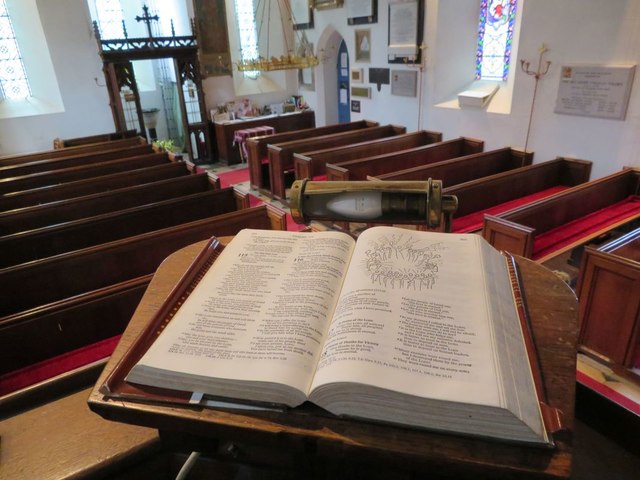
Although I find my theological and confessional home in the Lutheran Church – Missouri Synod, I have long been partial to the Southern Baptist Convention. I admire its commitment to the primacy of the gospel, the authority of Scripture, and the need for evangelism. This is why it disturbed me deeply when, last Sunday, the Houston Chronicle, in conjunction with the San Antonio Express-News, published a bombshell report chronicling decades of sexual abuse by hundreds of leaders inside the SBC. The report opens with the heart-shuddering story of Debbie Vasquez:
She was 14, she said, when she was first molested by her pastor in Sanger, a tiny prairie town an hour north of Dallas. It was the first of many assaults that Vasquez said destroyed her teenage years and, at 18, left her pregnant by the Southern Baptist pastor, a married man more than a dozen years older.
How did her church’s leadership respond when they learned she was pregnant by their pastor?
When Vasquez became pregnant, she said, leaders of her church forced her to stand in front of the congregation and ask for forgiveness without saying who had fathered the child.
She said church members were generally supportive but were never told the child was their pastor’s. Church leadership shunned her, asked her to get an abortion and, when she said no, threatened her and her child, she said. She moved abroad soon after.
The reporters who worked on this story uncovered 700 victims of sexual abuse in SBC churches over a 20-year time period. But, as the president of the SBC, J.D. Greear, noted in a blog post: “700 is not the total number.” He knows that for every case that has been uncovered, there is likely a case that remains under-cover.
Sexual abuse scandals in churches seem to be everywhere these days, and victims are left with lives that are shattered and, in some cases, lives that are ended. The report goes on to tell of Heather Schneider, a 14-year old girl who:
…was molested in a choir room at Houston’s Second Baptist Church, according to criminal and civil court records. Her mother, Gwen Casados, said church leaders waited months to fire the attacker, who later pleaded no contest. In response to her lawsuit, church leaders also denied responsibility.
Schneider slit her wrists the day after that attack in 1994, Casados said. She survived, but she died 14 years later from a drug overdose that her mother blames on the trauma.
“I never got her back,” Casados said.
This abuse is evil and it must stop.
The question, of course, is: How does it stop? Here are three thoughts that, though by no means exhaustive, may provide a starting place to address and curb sexual abuse.
Care for victims.
A common denominator in so many of today’s sexual abuse stories is that victims, rather than being supported and cared for, are dismissed, or worse, blamed. A congregation grappling with a sexual abuse scandal becomes so focused on protecting itself as an institution that it forgets about its people.
Jesus’ care for sexually broken situations can serve as our model when we are confronted with cases of sexual assault. In John 8, a group of religious leaders drag a woman before Jesus who has been “caught in adultery” (John 8:3). Even if her encounter with this man was consensual, as it seems to be, the fact that the religious leaders do not bring the man to stand trial with her speaks volumes. In a patriarchal culture such as this one, men could engage in sexual exploits and conquests, often, without repercussion. It was, in fact, a boys’ club. This case is no exception. The “boy” is nowhere to be found while the religious leaders are howling for this lady to be stoned. Jesus, however, sees through the religious leaders’ hypocrisy and cares for this accused woman by protecting her and ultimately rescuing her from her would-be executioners (John 8:7-11).
If this is how Jesus addresses a situation where a woman seems to have had some willful role in a sexual encounter, how much more should we seek to protect and rescue those who have had no willful role, as in cases of sexual abuse?
Bring darkness to light.
Sexual abuse continues because it is allowed to remain under the cover of darkness – many times for decades on end. Bringing it to light may be the single greatest strategy to stop sexual abuse before it starts. It sends a clear and present warning to any abuser that they will be brought to justice. President Greear’s invitation to victims to “get help” is supremely important. His list of crisis hotlines is worth reposting here:
- The National Hotline for Domestic Violence number is 1-800-799-SAFE (7233).
- The National Child Abuse Hotline number is 1-800-422-4453.
- The Rape, Abuse, & Incest National Network number is 1-800-656-HOPE (4673).
Again, Jesus can serve as our model for what bringing dark hurt into the light looks like. In Mark 5, when a woman who suffers from a form of hemophilia seeks to secretly steal a healing from Jesus by touching the edge of His cloak, Jesus will not let her remain in the shadows. He wants to speak to her in her pain. He wants her to come into the light. So, He seeks her out and, after she reveals herself, He tenderly calls her, “Daughter” (Mark 5:34). May the victims among us be met with the same tenderness as they bring their darkest secret hurts into the light of open truth.
Recommit ourselves to a biblical sexual ethic.
There is no way around it: the hypocrisy between what we who attend church say about sexuality and what we live out in our own sexualities is sometimes stunning. The Christian sexual ethic is good. It exalts commitment. It encourages tenderness. It dignifies humanity. Sadly, many in our churches have spent so much time criticizing what happens sexually “out there” in the world that we overlook the sexual assault happening “in here” among our congregations. Let’s remove the redwood-sized sin from our own eyes before trying to help others with the sawdust-sized sin in theirs (Matthew 7:3-5). Each one of us in the church should be asking ourselves: How am I falling short sexually? How am I tempted sexually? How can I get help?
The apostle Paul says that Jesus treats His Church like His bride (Ephesians 5:25). What does this mean? It means He loves her. It means He is faithful to her. It means He honors her. It means He exalts her. It means He seeks her purity. It means He is willing even to die for her.
To address and defeat sexual abuse, go and do likewise.


 Pastor Zach's Blog