Posts filed under ‘Word for Today’
“Word for Today” – Ephesians 6 – www.concordialutheranchurch.com
 The iconic, even if somewhat aloof, CEO of Apple Inc., Steve Jobs, is well known for his highly anticipated keynote addresses, known as Stevenotes, delivered at Apple events all over the country. His “Stevenotes” follow a predictable pattern. He begins by presenting sales figures and reviews for Apple products released over the past few months. He continues by presenting new products of moderate importance. After that, he feigns some concluding remarks, turns to leave the stage, but then turns back and says, “But there is one more thing…” And that “one more thing” is always his biggest announcement. With this phrase he has introduced the wireless AirPort base station, the MacBook Pro, and the iPod Touch. The “one more thing,” it turns out, always seems to be the most important thing.
The book of Ephesians could be considered a keynote address of sorts. For in this little epistle, Paul covers many issues of importance to the Christian faith: God’s divine choice in election (cf. 1:3-14), salvation by grace through faith (cf. 2:1-10), Jewish and Gentile relations (cf. 3:1-13), unity in Christ (cf. 4:1-6), and the order of a Christian household (cf. 5:22-6:9). Indeed, some scholars believe this letter is written as a primer in Christian doctrine, intended not only for the Ephesians, but as a circular letter for all Christians everywhere. This theory is derived in part from the fact that the earliest manuscripts of this letter omit the reference to Ephesus in 1:1. Thus, although I would contend this letter was indeed for the Ephesian church because of other testimonies from antiquity, I would also contend that this letter was not for the Ephesians alone. It was intended to be passed around as a keynote address.
In our reading for today from Ephesians 6, Paul is wrapping up his keynote address. He has addressed both towering points of Christian doctrine and practical points of Christian life. It seems as though Paul has finished. But then, we read this word: “Finally” (verse 10). In Greek, this is the word loipos, most often translated in the New Testament as “other.” The scene is this: Paul has addressed many things in his letter. His address now at last seems to be at its terminus. He has wrapped things up, is walking off stage, but then, pauses, turns, and announces: “Loipos. This is one other thing. There is one more thing.” And Paul’s “one more thing” is a huge thing:
Finally, be strong in the Lord and in his mighty power. Put on the full armor of God so that you can take your stand against the devil’s schemes. For our struggle is not against flesh and blood, but against the rulers, against the authorities, against the powers of this dark world and against the spiritual forces of evil in the heavenly realms. (verses 10-12)
Paul’s “one more thing” turns out to be a treatise on spiritual warfare. For Satan will relentlessly try to entice and attack those who believe and confess the doctrine contained in this letter. So Paul issues a call to Christians to gird themselves with God’s spiritual armor. In his explanation of this armor, Paul mentions “the sword of the Spirit, which is the Word of God” (verse 17). Satan is helpless against the sure and certain promises of God’s Word. Martin Luther reminds us:
You will surely have the devil around you…Now, what is the devil? Nothing else than what the Scriptures call him: a liar and a murderer. A liar who entices the heart away from God’s Word and blinds it, making you unable to feel your need or to come to Christ. A murderer who begrudges you every hour of your life…Try this, therefore, and practice it well. Just examine yourself, or look around a little, and cling only to the Scriptures. (LC V:80-83)
“Cling only to the Scriptures.” For this is God’s effective armor against Satan. Indeed, no piety, no work, and no effort of our own can defeat the evil one. Only God’s Word and the message of Christ can accomplish such a feat. And so we cling to that.
Is Satan attacking you? Open the Scriptures, ponder their promises, and trust in the One whom the Scriptures reveal, Jesus Christ. For his victory over sin, death, and the devil and for you is assured. And that’s not just “one more thing,” that’s the very best thing. For that is the gospel. Praise be to God.
“Word for Today” – Ephesians 5 – www.concordialutheranchurch.com
 “A man has the rule of this household by nature, for the deliberative faculty of a woman is inferior, in children it does not yet exist, and in the case of slaves, it is completely absent” (1 Hezekiah 14:7). Actually, Hezekiah didn’t really say this. In fact, the book of 1 Hezekiah doesn’t even exist. Rather, these words were said by Arius Didymus, the great Stoic philosopher, who is here quoting Caesar Augustus’ position on how a household is to be ordered. And Didymus’ delineations for a household are clear, crisp, and concise: The man is at the top and everyone else is beneath him.
Such instructions were not unusual in and were widely accepted by ancient Roman society. What is unusual, however, are the instructions that Paul offers concerning the first century, and twenty-first century, household in our reading for today from Ephesians 5:
Wives, submit to your husbands as to the Lord. For the husband is the head of the wife as Christ is the head of the church, his body, of which he is the Savior. Now as the church submits to Christ, so also wives should submit to their husbands in everything. Husbands, love your wives, just as Christ loved the church and gave himself up for her to make her holy, cleansing her by the washing with water through the word, and to present her to himself as a radiant church, without stain or wrinkle or any other blemish, but holy and blameless. In this same way, husbands ought to love their wives as their own bodies. He who loves his wife loves himself. (verses 22-28)
Paul continues in Ephesians 6 by speaking to other members of the family:
Children, obey your parents in the Lord, for this is right. “Honor your father and mother” – which is the first commandment with a promise – “that it may go well with you and that you may enjoy long life on the earth.” Fathers, do not exasperate your children; instead, bring them up in the training and instruction of the Lord. Slaves, obey your earthly masters with respect and fear, and with sincerity of heart, just as you would obey Christ. Obey them not only to win their favor when their eye is on you, but like slaves of Christ, doing the will of God from your heart. Serve wholeheartedly, as if you were serving the Lord, not men, because you know that the Lord will reward everyone for whatever good he does, whether he is slave or free. And masters, treat your slaves in the same way. Do not threaten them, since you know that he who is both their Master and yours is in heaven, and there is no favoritism with him. (verses 1-9)
A few things are notable about the way that Paul addresses a family’s order compared to how others addressed this same order. First, Paul addresses all the members of the family, not just the father. Because it was assumed, as demonstrated by the quote from Didymus above, that only the father had the rational abilities necessary to keep his family in order, only fathers were addressed. In Paul’s delineation of household duties, however, each member is addressed as a competent, rational human being who has something to contribute to the harmony of the family.
Second, Roman household structures assumed that a man was fit for command over his house simply by his natural aptitude as a male. As Aristotle says, “The male is by nature fitter for command than the female” (Politics 1.12). Paul says that a man is head over a household not because of some sort of innate superior aptitude, but because God has placed him there. Thus, a man is answerable to the God who places him in such an important position and thus ought to discharge his duties carefully and with much grace, following the lead of his heavenly Father.
Finally, we must not overlook how Paul opens his instructions concerning Christian households: “Submit to one another out of reverence for Christ” (verse 21). For Paul, a healthy household is built not on power, but on loving submission – a desire to consider the needs and prerogatives of others before considering your own. For this is what Christ has done with us. He willingly submitted himself to the tortures of the cross so that we could be reconciled to God and be reckoned as “fellow citizens with God’s people and members of God’s household” (Ephesians 2:19).
So today, give thanks to God for your family and ask yourself, “How can I discharge my duties toward my family in a godly, faithful, and loving way?” It won’t always be easy, but it will always be worth it. For we each have a roll to play in our families.
“Word for Today” – Ephesians 4 – www.concordialutheranchurch.com
 E pluribus unum. “Out of many, one.” If only it were true. Yes, this motto appears on our currency and on the seals of our president and vice-president. It was even the de facto motto of our country before “In God we trust” was adopted in 1956. But a perusal of a newspaper or a surf through some cable news channels quickly jars anyone who might be serenely snoring in the dust of an imaginary national unity and drags them wide awake into the harsh reality of our prevailing partisanship. E pluribus plures. “Out of many, many.” We can’t seem to agree on much of anything.
I suppose it was bound to happen. For trying to unify different people with different ideologies is no small feat. And even if such a conglomerate of people is unified for a time, such unity never lasts. For humans, thanks to sin, have a proclivity to fracture from each other rather than to walk with each other.
There is an old story about a man who is marooned on a desert island for nearly a decade. One day, mercifully, some rescuers finally come along. Upon arriving, the rescuers find two shacks. Thinking there is another castaway on the island, they ask the man, “Why are there two shacks? Is someone else with you?” “No,” replies the man. “I sleep under the stars. The shack is where I go to church.” “What about the other shack?” inquire the rescuers. “What’s that for?” “Oh,” replies the man with an edge of indignation in his voice, “That’s where I used to go to church.” E pluribus plures. It seems humans will find a way to separate from each other – even when there’s only one human.
Like our nation’s historic motto, the Scriptures also issue a clarion call toward unity, as can be found in today’s reading from Ephesians 4: “Make every effort to keep the unity of the Spirit through the bond of peace” (verse 3). The difference between Scripture’s call to unity and our nation’s call to unity, however, is that whereas our nation takes the many and in vain tries to make them one, Scripture begins with the one God who then serves as the great unifier for his many people. Indeed, this is exactly how the apostle Paul delineates Christian unity in this chapter. He begins with the unity of God and his gifts:
There is one body and one Spirit – just as you were called to one hope when you were called – one Lord, one faith, one baptism; one God and Father of all, who is over all and through all and in all. (verses 4-6).
Paul uses the word “one” seven times in these verses. Thus, the things of this list, describing God and his gifts, are the hallmark, source, and sustainer of true unity. Paul then continues by explaining how this divine unity brings together the many in the body of Christ:
It was he who gave some to be apostles, some to be prophets, some to be evangelists, and some to be pastors and teachers, to prepare God’s people for works of service, so that the body of Christ may be built up until we all reach unity in the faith and in the knowledge of the Son of God and become mature, attaining to the whole measure of the fullness of Christ. (verses 11-13)
The one Christ gives gifts to his many people so that they may experience the joy and blessing of being unified by Christ. Ex uno plures. “Out of one, many.” This is how true and lasting unity happens – not by taking many disparate, dissident factions and striving to unify them by human effort, but by beginning with the unified Godhead whose unity can bring even the most dis-unified people together. Praise be to God that we are one, not of ourselves, but in Christ!
“Word for Today” – Ephesians 3 – www.concordialutheranchurch.com
 It seems as though almost every person goes through a season in life where they feel the need to “prove themselves.” In my case, I have gone through several such seasons. For instance, when I was a first year student at seminary, studying to become a pastor, I felt the need to prove myself intellectually. This sometimes meant feigning knowledge about things which I did not understand.
I can remember one evening when I, a lowly first year seminary student, was chatting with some more educated, more insightful, more erudite fourth year seminary students. They were talking to me about the centrality of the Verba in worship. What? You don’t what the Verba is? That’s okay, neither did I. But I pretended I did and tried my best to sound intelligent while, in the final analysis, contributing nothing of substance to the conversation because I didn’t even understand what was being talked about.
The Verba is Latin for “words” and refers to the Words of Institution spoken by the pastor when the Lord’s Supper is celebrated. If I would have been humble enough to admit my own ignorance, perhaps I could have learned something from that conversation that evening rather than walking away confused and bewildered.
Humility, it seems, is a lost virtue on many people. Sadly, it is regularly replaced by two other sinful dispositions – that of haughtiness on the one hand and self-hatred on the other. Haughtiness is when a person refuses to admit there is a God, and they’re not it! A haughty person will not fess up to their mistakes and shortcomings. Self-hatred, although it may masquerade as humility, is really a refusal to be thankful for life. Like a haughty person, a self-hating person refuses to admit there is a God who made them “fearfully and wonderfully” (cf. Psalm 139:14). For both the haughty and the self-hating, humility is sorely needed.
The apostle Paul, in our reading for today from Ephesians 3, models what it means to live a humble life. On the one hand, Paul certainly does not hate himself. Indeed, he defends himself against those who would seek to disparage him and his ministry:
Surely you have heard about the administration of God’s grace that was given to me for you, that is, the mystery made known to me by revelation, as I have already written briefly. In reading this, then, you will be able to understand my insight into the mystery of Christ, which was not made known to men in other generations as it has now been revealed by the Spirit to God’s holy apostles and prophets. (verses 2-5)
With these words, Paul claims apostolic authority and “insight into the mystery of Christ.” He further asks that his words be read by the Ephesians. This does not mean that Paul asks that his words be scanned personally and silently, but that his words be read aloud publicly in the context of an Ephesian worship service. Paul, then, seems to have quite a high estimation of his words and authority. Indeed, elsewhere, he claims that his words are God’s words (cf. 2 Corinthians 13:3), a claim which is defended by the Christian doctrine of the inspiration of all Scripture. Yet, Paul is no haughty egotist with false messianic delusions. For his confidence in the grace of God, not in himself, as he says just verses later:
Although I am less than the least of all God’s people, this grace was given me: to preach to the Gentiles the unsearchable riches of Christ, and to make plain to everyone the administration of this mystery, which for ages past was kept hidden in God, who created all things. (verses 8-9)
Paul freely and fully admits that he is the “less than the least of all God’s people,” for he once fiercely persecuted the church, “breathing out murderous threats against the Lord’s disciples” (Acts 9:1). Thus, he does not seek to minimize or marginalize his sin.
This, then, is true humility: To be confident in God and the gifts and authority which he has given you by his grace while also having a sober estimation of yourself and your sin. Humility is not haughtiness nor is it self-hatred. Rather, it is seeing yourself as God sees you: As his imperfect, yet beloved child. Do you see yourself this way?
“Word for Today” – Ephesians 2 – www.concordialutheranchurch.com
 The other day, I was updating some information on my Facebook profile. Under a section titled “Personal Interests,” I came across the obligatory list of “Favorites,” a standard feature of every social networking site. Favorite music? Anything country. Favorite movie? Shawshank Redemption. Favorite book? Hmmm, let me think real hard. Perhaps I should go with the Bible. Favorite quotation? From my favorite book, of course: “Let us fix our eyes on Jesus, the author and perfecter of our faith, who for the joy set before him endured the cross, scorning its shame, and sat down at the right hand of the throne of God” (Hebrews 12:2).
We all have favorites. My favorite color is green. My favorite team is the Texas Longhorns. My favorite food is cheese. For all the favorites we’re allowed to have, however, there are some instances when playing favorites is generally considered taboo. Parents, for instance, are not supposed play favorites amongst their children. Pastors, like myself, are not supposed to play favorites amongst people in their congregation. Do you want to know a secret, though? I play favorites. In fact, I have a favorite member. She’s five foot four, has curly brown hair, beautiful blue eyes, and an effervescent personality that brings me ever-increasing joy. Her name is Melody. And the best part is, she’s not only a congregational member, she’s also my wife.
This may come as a surprise to you, but just like I play favorites with my wife, God plays favorites too. Indeed, this is precisely Paul’s assertion in our reading for today from Ephesians 2: “For it is by grace you have been saved, through faith – and this not from yourselves, it is the gift of God – not by works, so that no one can boast” (verses 8-9). Paul here decries the deficiency of human works while extolling the complete sufficiency of God’s grace for salvation. The Greek word for “grace” is charis, meaning “favor.” In other words, God’s favor toward you serves as the source of your salvation. You are God’s favorite!
On Saturday, the Christian Church will celebrate the 492nd anniversary of its Reformation, traditionally commemorated when a monk named Martin Luther nailed ninety-five theses to a church door in Wittenberg, Germany, protesting the false doctrines and practices which had arisen in the Roman Catholic Church of his day. At the heart of Luther’s Reformation was an insistence that we cannot earn God’s favor, or grace, but that God freely gives it because of the death and resurrection of his Son, Jesus Christ.
Before Luther properly understood God’s grace, he lived in paralyzing anxiety, always afraid that his sin would turn back God’s favor and instead incite God’s wrath. But then he discovered the beautiful promise of Ephesians 2: “For it is by grace you have been saved, through faith – and this not from yourselves…” Our works, no matter how pious, do not make us God’s favorites. Rather, God freely and recklessly plays favorites with those who are undeserving and ill-deserving out of his love and because of his Son. As Luther himself so eloquently says:
Grace is freely given to the most undeserving and unworthy and is not obtained by any strenuous efforts, endeavors, or works, either small or great, not even by the efforts of the best and most honorable men who have sought and followed righteousness with a burning zeal. (What Luther Says, 1840)
You are God’s favorite! This is the message of the Reformation and, more importantly, this is the message of the gospel. When humans play favorites with others, it usually leads to jealousy, suspicion, and dissension. But when God plays favorites with us, it leads to our salvation. Praise be to God for his charis – his favoritism!
“Word for Today” – Ephesians 1 – www.concordialutheranchurch.com
 Our reading for today from Ephesians 1 addresses one of Scripture’s most infamous doctrines: predestination. As with other difficult theological questions, many people have a tendency to fall into one of two traps: a trap of anger or a trap of avoidance. Those tending toward the former trap become fixated on the controversial doctrines of Scripture and angrily decry anyone who would disagree with them, even if a disagreement has some Scriptural merit. Those tending to the latter trap offhandedly dismiss the tough doctrines of Scripture, no matter how salutary they might be. Of course, both responses to difficult doctrinal questions are unhelpful and, finally, ungodly. For we are called to engage with Scripture both humbly and intently. What follows is an attempt to do just that with the doctrine of predestination.
Because of the complexity of this doctrine, I thought it might be helpful to offer my best definition of predestination, gleaned from Ephesians 1, and then comment on the individual components of this definition. Here, then, is my definition of the doctrine: Predestination is when, to his praise, God chooses, by his grace, you for salvation.
“To his praise…” Predestination is doxological.
In the face of a doctrine which all too often invokes self-righteous anger on the one hand and timid avoidance on the other, Paul offers a different response to predestination: the response of praise. “Praise be to the God and Father of our Lord Jesus Christ…” (verse 3). This doctrine is so precious to Paul that it makes him burst out in a song of celebration. The Greek word for “praise” is eulogia, meaning, “to speak well.” In Greek, Paul uses this word twice more in this one verse. Thus, Paul’s intent in speaking of predestination is to speak well of this doctrine.
“God chooses…” Predestination is unilateral.
Predestination is not of ourselves. It is wholly and unilaterally God’s work. God chooses us. We do not choose God. This becomes clear when one considers the timing of predestination: “God chose us in him before the creation of the world to be holy and blameless in his sight” (verse 4). Before we were born – yes, even before the world was created – God chose us to be his own. This stands contrary to those who hold to Arminiasm, which teaches that the human will cooperates with the divine will to choose salvation. As Augustine pointedly says: “God chose us according to the good pleasure of his will, so that nobody might glory concerning his own will, but about God’s will towards himself” (On The Predestination of the Saints, Ch. 37). Predestination finds its beginning and end in God’s will, not in humanity’s.
“By his grace…” Predestination is evangelical.
By saying that predestination is “evangelical,” I mean to say that predestination is of the gospel. Indeed, the Greek word for “gospel” is euangelion. That predestination is of the gospel seems to be precisely Paul’s assertion in this chapter. For Paul lumps predestination together with other terms commonly associated with the gospel: “love,” “adopted,” “grace,” “redemption,” “blood,” “forgiveness of sins” (cf. verses 4-7). Predestination, then, is simply another way to describe God’s good news: that God saved us when we could not save ourselves. He chose us to be his own. As Gerhard Forde aptly states: “Justification by faith and predestination are simply two sides of the same coin…Predestination is merely the article of justification stated with respect to God” (Justification by Faith: A Matter of Death and Life, 67).
“You for salvation…” Predestination is personal.
People’s problems with predestination often center on the doctrine’s philosophical corollaries rather than on the actual doctrine itself, as it is given to us in Scripture. Here’s what I mean. If predestination is wholly God’s choice, decree, and work, then that means we are trapped in a divinely wrought determinism, headed for either heaven or hell, helpless and hapless in the face of God’s whim. All we can do, then, is cry, “Que sera sera.” For we are merely puppets in the hands of a mysterious and capricious God. Indeed, this is the stance of Calvinism, which teaches a “double predestination” – that God, in his mysterious sovereignty, chooses some for salvation and some for damnation. Which one are you? Que sera sera.
This is not the way Paul speaks of predestination. As I have already mentioned above, predestination is connected to salvation, not to damnation. “Yes,” someone might protest, “But if God chooses some for salvation, but not everyone is saved, doesn’t that mean that God has, by default, chosen some for damnation?” Paul dispenses with such questions in short order by declaring:
And you also were included in Christ when you heard the word of truth, the gospel of your salvation. Having believed, you were marked in him with a seal, the promised Holy Spirit, who is a deposit guaranteeing our inheritance until the redemption of those who are God’s possession – to the praise of his glory. (verses 13-14)
Paul, rather than quibbling over the philosophical difficulties of this doctrine, simply says, “Predestination is not a philosophical theory, it is a theological and personal reality! You are included in salvation! God has chosen you! How do you know you are God’s predestined child? You have the Holy Spirit. He is your guarantee of salvation.”
Predestination, then, is not meant to be a doctrine which sends our heads spinning and our hearts worrying; rather, it is meant to be a doctrine which comforts us in our salvation and assures us of God’s love. For God loves us so much that he has taken care of every detail, even the detail of our choice. Rather than leaving our salvation up to our choice, God went through the trouble of choosing for us. And the best part is, God has chosen you.
“Word for Today” – Acts 28 – www.concordialutheranchurch.com
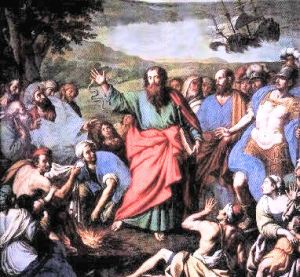 From a murderer to a god – this is the estimation of Paul by some islanders in our reading for today from Acts 28. Paul and his shipmates have just washed up on the shore of Malta after being shipwrecked by a storm (cf. Acts 27:27-44). Once safely ashore, Paul and his companion Luke recount their experience with the indigenous people thusly:
The islanders showed us unusual kindness. They built a fire and welcomed us all because it was raining and cold. Paul gathered a pile of brushwood and, as he put it on the fire, a viper, driven out by the heat, fastened itself on his hand. When the islanders saw the snake hanging from his hand, they said to each other, “This man must be a murderer; for though he escaped from the sea, Justice has not allowed him to live.” But Paul shook the snake off into the fire and suffered no ill effects. The people expected him to swell up or suddenly fall dead, but after waiting a long time and seeing nothing unusual happen to him, they changed their minds and said he was a god. (verses 2-6)
That’s quite a shift in these islanders’ evaluation of this man from Tarsus! And it makes Paul quite a sorry god. For any man who can at one moment be a common murderer and at the next moment be divine is not much of a deity.
The islanders at Malta, it seems, are fair-weather fans of all things divine. When a man is doing poorly, they treat him as a dissolute thug. When he is doing well, however, they are right there to cheer him on and even hail him as supernatural. It all depends on the fortuitous state of the man’s life as to whether or not he is called “god.”
We, of course, are much more enlightened about and faithful to the divine than were those superstitious islander brutes at Malta. Or are we? May I suggest that we, like those islanders, are all too often fair-weather fans of divinity? At a happy moment we may praise God for his marvelous work in our lives. But then again, in the midst of a hard trial, we may curse God for sabotaging our plans. At a time of need, we may call out to God in desperation. But then again, in a season of seeming self-sufficiency, we may all but forget that God even exists. We too are fair-weather fans of divinity.
Thankfully, even though we act as fair-weather fans of God, God never acts as a fair-weather fan of us! No, God is not a fair-weather, but a faithful fan of his people. Moses describes God’s faithfulness like this: “Know therefore that the LORD your God is God, the faithful God who keeps covenant and steadfast love with those who love him and keep his commandments, to a thousand generations” (Deuteronomy 7:9). Steadfast love indeed! After all, God has shown love to those who have rejected him, disobeyed him, cheated on him, and even disbelieved in his very existence. Yes, our God is not anything if not steadfast. Indeed, he is so steadfast that he even sent his Son, knowing that we, as sad fair-weather fans of divinity, would kill him.
The islanders took a man and made him a god in Paul. The proclamation of the Scriptures is that there is a God who made himself man in Jesus as testimony to God’s steadfast love. Do you trust him in good times and bad? Do you praise him – not only when he saves you, but when the snake of life bites you? Hold steadfastly to God. For he is holding steadfastly to you.
“Word for Today” – Acts 27 – www.concordialutheranchurch.com
 The earth revolves around the sun. Or so Nicolaus Copernicus taught us. His watershed work, On the Revolutions of the Celestial Spheres, published just before his death, offered history’s first attempt at a comprehensive heliocentric cosmology. I say a “comprehensive heliocentric cosmology” because as far back as the third century BC, Aristarchus of Samos proposed rudimentary elements of the same cosmological model. Copernicus’ theory, of course, was trumpeted shortly later by Galileo Galilei who, after making detailed observations of the so-called “movements” of stars and planets in the sky through his telescope, became convinced of the theory. Galileo, however, ran into a bit of trouble with the pope at this time, Urban VIII. Although it is important to note that oft repeated stories of Galileo being charged with heresy and tortured in some dungeon are patently false and are generally peddled by those wishing to clumsily create some monstrous antagonism between science and faith, Galileo and Pope Urban VIII did enter into a tendentious relationship that was never fully reconciled. For this pope, eager to demonstrate his fidelity to Scripture in the face of Protestant reformers who accused him of not taking Scripture seriously enough, insisted on a geocentric rather than a heliocentric view of the universe, a position shared at this time by both Protestants and Catholics as “biblical.”
Thankfully, now, we know better. The Bible’s words concerning the sun’s course (e.g., Psalm 19:4-6) are analogous to our terms “sunrise” and “sunset” and are meant to explain how things appear from our perspective, not how they work cosmologically. For cosmologically, we now know that the earth does indeed orbit around the sun.
Although many of us may say we believe the earth revolves around the sun, I’m not so sure that we act as if that’s true – at least not practically. For many of us act as though the earth revolves around us. Our needs, our wants, our questions, and our concerns are to set the agenda for others’ lives. It may sound audacious, but this is the way many people live, or at least want to live – with the world, and those in it, revolving around them.
In our reading for today from Acts 27, Paul, under the watchful eye of a Roman centurion, embarks on a journey from Caesarea to Rome so that he may appeal to Caesar against a group of Jews who are calling for his execution. While at port on the island of Crete, Paul warns those traveling with him, “Men, I can see that our voyage is going to be disastrous and bring great loss to ship and cargo, and to our own lives also” (verse 10). Sure enough, Paul’s premonition proves prophetic: “Before very long, a wind of hurricane force, called the ‘northeaster,’ swept down from the island” (verse 18). While the others on the ship fear for their lives, Paul offers these words of comfort:
Men, you should have taken my advice not to sail from Crete; then you would have spared yourselves this damage and loss. But now I urge you to keep up your courage, because not one of you will be lost; only the ship will be destroyed. Last night an angel of the God whose I am and whom I serve stood beside me and said, “Do not be afraid, Paul. You must stand trial before Caesar; and God has graciously given you the lives of all who sail with you.” So keep up your courage, men, for I have faith in God that it will happen just as he told me. (verses 21-25)
Paul explains to his travel companions that even though the ship will not be spared, all of them will indeed be saved. Why? Because God desires that Paul stands trial before Caesar. Thus, God will save Paul’s life and, by extension, everyone else’s.
What an audacious claim for Paul to make – that the lives of his shipmates would be spared because God desires that Paul make it to Rome! Martin Luther explains thusly: “For the sake of Paul alone, a ship is saved and 276 men who were with him in the ship” (AE 6:217). It almost sounds as though Paul believes the salvation of his companions from certain death on that ship is thanks to God’s desire to save him from certain death on that ship. Paul is promoting a Pauline-centric view of his companions’ salvation! For God, thanks to one man, is saving many.
The picture of the one man Paul being the reason for the salvation of his companions is a picture of the salvation we have in Christ. For because of the one man Christ, we receive salvation, not from a ship, but from sin, death, and the devil. Our salvation is Christocentric. It revolves around Christ.
Copernicus and Galileo were right. The sun does not revolve around the earth. Nor does the earth – even figuratively – revolve around a person. But salvation does revolve around Christ. And even though we cannot observe that with a telescope, we can trust it with our hearts. I hope you do.
“Word for Today” – Acts 26 – www.concordialutheranchurch.com
 “What would it take for us to close this deal…today?” the Toyota salesperson asked me with a clear edge of determination in his voice. I, however, was just as determined to stand my ground as he was. I fired back: “If you want to close this deal today, then don’t try to convince me to close this deal today.”
I have never been affable to high-pressure sales tactics. Especially in an auto showroom, I live by the moniker, “If they push me hard, I’ll just push them back harder.” More than once, I have defiantly walked out of a salesperson’s office, even after hours of negotiations and paperwork, announcing that I was not happy with the deal. Indeed, I am quite cynical toward vehicle shopping and dealers and salespeople. Such was the case when I was shopping for a new car for my wife. At first, the Toyota salesman was genial, easy going, and helpful. He almost had me persuaded. But as time went on, he began to turn up the pressure and I began to grow suspicious. He finally tried to pressure me into buying then and there. I bought Melody a Honda the next week.
In our reading for today from Acts 26, Paul is once again making his case for following Christ. In Acts 24, he makes it before Felix. In Acts 25, he stands before Festus. Now it is King Agrippa II’s turn to hear Paul’s presentation of the gospel. As in Acts 22, when Paul stands before an angry mob of Jews, Paul once again shares his personal testimony – how he encountered Christ on the road to Damascus (cf. verse 15-23). But Paul knows that this will not be enough to convince Agrippa of the centrality and supremacy of Christ. He needs something more.
The Talmud tells us that King Agrippa’s mother, Cypros, who was the wife of King Agrippa I, took a keen interest in Jewish theology and learning: “The king is guided by the queen, and the queen is guided by Gamaliel” (b Pesahim 88b). Gamaliel, of course, was a preeminent Jewish rabbi of the first century, teaching none other than Paul himself (cf. Acts 22:3). Thus, Agrippa’s mother was influenced by Gamaliel and, in turn, influenced Agrippa himself and made him sympathetic to Jewish theology and learning. Agrippa too, it seems, was at least curious about the God of Israel. Thus, when Paul is making his case for Christ as God’s Messiah, he ends by asking Agrippa: “King Agrippa, do you believe the prophets? I know you do” (verse 27). Paul’s line of reasoning is this: If he can just get Agrippa to confess his belief in the Scriptures, then he can convince Agrippa from the Scriptures that Jesus is the fulfillment of the Scriptures! Paul is turning up the heat on Agrippa. “What would it take for you trust in Jesus…today?” This is what Paul is essentially asking Agrippa.
Agrippa, somewhat taken aback by Paul’s high-pressure evangelistic tactics, pushes back and threatens to walk off the lot. “Do you think that in such a short time you can persuade me to become a Christian?” he asks (verse 28). Agrippa’s statement here is notoriously difficult to translate from its original Greek. It may be either a question, as in the NIV, or a statement: “In a moment, you will persuade me to become a Christian.” The King James Version translates Agrippa’s words tendentially: “Almost thou persuadest me to be a Christian.” Whatever the translation, it seems as though Agrippa has come very close to believing the gospel, but is not there yet. Agrippa is having second thoughts. Agrippa is not quite ready to trust Christ. “Almost thou persuadest me to become a Christian,” he says.
In the late 1800’s a Baptist preacher named Pastor Brundage preached what is perhaps the most famous sermon ever given on Agrippa’s words. He warned his congregation, “He who is almost persuaded is almost saved, and to be almost saved is to be entirely lost.” “Almost” is never enough to enter into the Kingdom of God. Faith in Christ as God’s Son and your Savior must be had. To almost believe in Christ is to be entirely lost. And unlike buying a vehicle, you can’t go find a savior somewhere else, for Christ, and Christ alone, is the Savior of all.
“Almost thou persuadest me to become a Christian,” says Agrippa to Paul. And Paul responds with the heart of a pastor: “Short time or long – I pray God that not only you but all who are listening to me today may become what I am, except for these chains” (verse 29). Paul does not want Agrippa to be lost. He does not want anyone to be lost. And neither should we. We should never be content with an “almost.”
So today, with whom can you share Christ? For whom do you need to pray that the Holy Spirit would move them from the “almost” which leads to hell to the faith which leads to salvation? May we never be “almost persuaded” to Christ. Instead, as Paul writes in Romans, may be “fully persuaded that God has power to do what he had promised.” For such faith is “credited to us as righteousness” (Romans 4:21-22).
“Word for Today” – Acts 25 – www.concordialutheranchurch.com
 The other day, I called a bank concerning a loan I have with them. I had a question about the fees that accompany electronic payments over their website. When I first called, the phone bank operator, apparently befuddled by my question, answered, “I’ll need to check with my manager on your question.” After several minutes on hold, she finally returned to the line: “I’m sorry, you’ll need to talk to our electronic transaction department about your question.” She then proceeded to give me the number. So I called them. This phone bank operator too had to check with her manager about my question. And then came her reply, “I’m sorry, but this is a question for our loan department. Here’s the number.” After a half an hour of being sent around to different departments and waiting for various phone bank operators to “check with their managers” about my question, I never did get a clear answer. It was a frustrating experience.
Whether its an operator at a bank with a tough question, a waiter at a restaurant with a disgruntled patron, or a politician in a sticky situation, many people have a tendency to “pass the buck” – to defer to someone higher up the organizational ladder to make a hard decision or give a hard answer that they don’t care to make or give. And yet, as we all know, the buck has to stop somewhere. Indeed, Harry Truman, pictured above, proudly displayed this famous placard in his Oval Office: “The Buck Stops Here.” And indeed it’s true. For once a question, problem, or concern got to the president’s desk, there was no one “higher up” to whom to defer. The buck had to stop with President Truman.
In our reading for today from Acts 25, Paul is in Caesarea in prison, where he has been languishing for some two years now, because the procurator of this area, Antonius Felix, in a nod to Paul’s Jewish dissenters who were also Felix’s constituents, has refused to free him. But now a new ruler is on the throne: Porcius Festus.
With this new ruler, Paul’s enemies take the opportunity to once again present their so-called “charges” against him in the hopes of getting him transferred to stand trial in Jerusalem so that they can ambush and kill him while he is on his way (verse 4). Paul, aware of his enemies’ malicious intent, defends himself before Festus: “I have not done any wrong to the Jews, as you yourself know very well…I appeal to Caesar” (verses 10-11)! Paul, with these words, is appealing to be sent “up the ladder.” He wants to talk to Festus’ manager. And Festus, at a loss at how to deal with such a case, happily obliges. As he later tells his friend King Agrippa:
When Paul’s accusers got up to speak, they did not charge him with any of the crimes I had expected. Instead, they had some points of dispute with him about their own religion and about a dead man named Jesus who Paul claimed was alive. I was at a loss how to investigate such matters; so I asked if he would be willing to go to Jerusalem and stand trial there on these charges. When Paul made his appeal to be held over for the Emperor’s decision, I ordered him held until I could send him to Caesar. (verses 18-20)
Notably, the Greek word that Festus uses for “send” in verse 20 when he speaks of sending Paul to Caesar is anapempo, meaning not only “send,” but “send up.” In other words, Festus is happy to pass the buck up the ladder as it concerns Paul’s case. He does not want to investigate some points of dispute “about a dead man named Jesus who Paul claimed was alive.”
As much as Festus may have tried to send Paul and his message of Jesus’ death and resurrection up the ladder to Caesar, the fact is, you can’t pass the buck when it comes to Jesus. No, each person must grapple with what Christ’s work for him or her self. As CS Lewis famously said, “When Christ died, he died for you individually just as much as if you had been the only man in the world” (Mere Christianity, IV:3). If Christ died for you as if you are the only person in the world, that means there is no one else to whom you can pass off Christ’s death and say disparagingly, “You deal with this.” No, the buck stops with you because Christ has confronted you with his crucifixion and resurrection. Why has he confronted you? Because he loves you. My prayer for you is that, by faith, you receive his love and trust his salvation.


 Pastor Zach's Blog