Posts filed under ‘Word for Today’
“Word for Today” – 1 Timothy 1 – www.concordialutheranchurch.com
 This past Tuesday, I went to lunch at Taco Cabana with a buddy of mine. When it comes to fast food, I have two favorite restaurants: Whataburger and Taco Cabana. The problem is that although I dearly love the Whataburger with jalapenos as well as the giant Cabana bowl of queso, they don’t love me back. Because for a few years now, I’ve suffered from a weak stomach. Thus, whenever I eat there, Tums quickly become my intimate post-meal friends.
Of course, I can eat at these restaurants with minimal ill effects as long as I eat reasonably small portions. Ashamedly, however, my eyes usually prove to be bigger than my stomach and I wind up overeating and then paying the painful consequences. And this is what happened on Tuesday. I felt sick all afternoon. The food was good, but for me, it was too much of a good thing.
Too much of a good thing. This is an insightful maxim that accuses all too many of us. For we all fall prey to the allure of over-indulgence. Food is a good thing. But too much of it can cause all sorts of disastrous health problems. Money is a good thing. But too much of it, if not managed wisely and humbly, can breed greed. Sleep is a good thing. But too much of it can make you feel groggy and hinder productivity. In just about every area of life, a good thing can quickly turn harmful if over-used or misused.
As we begin reading through 1 Timothy, Paul opens in chapter 1 by warning Timothy to guard against those who would fall into the trap of obsessing over too much of a good thing: “As I urged you when I went into Macedonia, stay there in Ephesus so that you may command certain men not to teach false doctrines any longer nor to devote themselves to myths and endless genealogies. These promote controversies rather than God’s work – which is faith” (verses 3-4). The Greek root word for “controversies” is zetesis. In the ancient world, this was a technical term for philosophical investigation. This term described philosophers who would discuss what may have at first glance appeared to be minutia, but, in reality, pressed toward significant and profound answers concerning important matters. Indeed, this is the term that is used in Acts 15:1-2 during a weighty theological debate over circumcision: “Some men came down from Judea to Antioch and were teaching the brothers: ‘Unless you are circumcised, according to the custom taught by Moses, you cannot be saved.’ This brought Paul and Barnabas into sharp dispute and debate with them.” The Greek word for “debate” is zetesis. The upshot of this zetesis was the critical pronouncement that circumcision was not necessary for salvation because “it is through the grace of our Lord Jesus that we are saved” (Acts 15:11). In this instance, zetesis was a good thing. But as the old saying goes, too much of a good thing…
This brings us back to 1 Timothy 1. Apparently, there were some in Timothy’s church who “devoted themselves to myths and endless genealogies.” A myth is not necessarily a bad thing. For these often serve as pleasant children’s tales. Neither is genealogical research bad. Knowing one’s roots can be an eye-opening experience. But notice that these people “devoted” themselves to these things. That is, they obsessed over them and thereby caused controversies, or zetesis. Interestingly, when Paul writes about these controversies, he calls them not just zetesis, but adds a prefix and calls them exzetesis. We use this prefix even in English: excursive, excoriate, extreme, excessive. This prefix, in many instances, marks too much of a good thing.
“Moderation is better than muscle” (Proverbs 16:32). So says the wise man Solomon. And Solomon was a man who knew well the dangers of exzetesis. For he was a man with much fame, much power, and much money. And, tellingly, he used it irresponsibly and excessively at times. And it cost him dearly. So today, enjoy God’s good gifts. But remember to enjoy them in a good way – in the way that God intended them and not for sinful exzetesis. For the gifts of God, used in the way God intended them, bring exceeding joy. And that’s an ex that we can indulge in. Because that’s an ex that’s from God.
“Word for Today” – Galatians 6 – www.concordialutheranchurch.com
 Maybe you did this when you were in junior high as well. During my pre-pubescent years, reputation and status became increasingly important to me and my peers. This means that we would, often in very awkward and sometimes comical ways, regularly boast to each other concerning achievements and accomplishments which had little or no basis in reality. I can remember one time when I was fighting with a friend of mine over whose father made more money – mine or his. After some verbal sparring that began in the $50,000 a year range, our fathers’ respective salaries quickly skyrocketed well into the six and even seven figure stratosphere, well beyond the limits of what we both knew our fathers actually made. Finally, after several rounds of bickering over paternal salaries, I said to my friend, “Well I live in a mansion! What do you live in?” To which my friend replied, “You don’t live in a mansion! I’ve been over to your house before.” Apparently, I had gotten so caught up in the heat of the moment that I forgot that my friend knew where I really lived. So much for my attempt to impress my friend with affluence I didn’t have.
In our reading for today from Galatians 6, Paul warns the Christians at Galatia against some religious folks “who want to make a good impression outwardly and are trying to compel you to be circumcised” (verse 12). The Greek word for “make a good impression” is euprosopeo, meaning literally “to give a good face.” These religious folks, it seems, were trying to “save face,” as it were, among their Jewish colleagues for whom circumcision was a mandatory rite, meant to mark one off as a person of God. They feared persecution from these Jews (cf. verse 12) and so tried to compel as many Galatian Christians as possible to become circumcised. Whatever success they had, they then quickly boasted about in an attempt to further galvanize their Jewish friends.
Paul, however, is not impressed by these religious folks’ attempt to bolster their status and reputation among the Jews by boasting in the number of circumcisions they can claim. “May I never boast,” Paul exclaims, “except in the cross of our Lord Jesus Christ” (verse 14). Paul feels no need to try to euprosopeo with anyone. He will not boast in how much money his father makes. And he will not boast in how many people he has circumcised. Instead, he boasts in Christ and Christ alone.
It is all too easy, whether in puberty or as an adult, to seek to impress others by our affluence, accolades, and accomplishments. But in the end, all of these supposedly “boast-worthy” resume-builders are worthless. As Paul says concerning circumcision, “Neither circumcision nor uncircumcision means anything” (verse 15). For “what is highly valued among men is detestable in God’s sight” (Luke 16:15). As Christians, we are called to boast not in what we do, but in a bloodied, bruised, and beaten Savior, so seemingly unimpressive and even appalling to the world, yet precious to God. Indeed, Jesus’ work on the cross is altogether salvific and sanctifying.
So today, when you’re tempted to boast in yourself, no matter how little or how slyly, instead, lift high the cross of Christ. After all, in the eternal scheme of things, Christ’s work is much more impressive than any work we could ever hope to do. So if we’re going to boast in something, we might as well boast in something really good. We might as well boast in the best. And so, we boast in Christ.
“Word for Today” – Galatians 5 – www.concordialutheranchurch.com
 It seems that, over the years, local and state governments, along with their federal counterpart, have managed to draft laws which legislate just about every conceivable scenario, occasion, and behavior. Indeed, many of these laws sound quite silly and esoteric. For example, in Blythe, California, you are not allowed to wear cowboy boots unless you already own at least two cows. In Kentucky, it is illegal to dye a duckling blue and sell it unless more than six are for sale at once. In Massachusetts, it is unlawful for mourners to eat more than three sandwiches at a wake. Even in our great state of Texas, a recently passed anticrime law requires criminals 24 hours notice, either in writing or orally, explaining to their victims the nature of the crime to be committed. Remember that if you’re planning to commit a crime this week. Government bureaucracy at its most humorous.
In our reading for today from Galatians 5, Paul pens some of the most famous and beloved words in all Scripture: “But the fruit of the Spirit is love, joy, peace, patience, kindness, goodness, faithfulness and self control” (verses 22-23). With these words, Paul outlines a list of virtues, fueled by and founded on Christ’s Spirit, that ought to be displayed in the life of every Christian. But he then continues with these marvelous words: “Against such things there is no law.” In other words, in a world that seems so overly legislated and regulated and moderated, there are still a few things that you are free to do and be. There are still a few things that aren’t illegal. And these things are the things of the Spirit.
Sadly, even in spite of Paul’s declaration of freedom which liberates us to unreservedly live out the fruit of the Spirit, some still try to temper these virtues. “It’s okay to be loving,” someone might say, “but there are limits to love. I mean, love fades. And some people hurt you so much, you just can’t love them anymore.” To which Paul would respond, “No! You’re allowed to love even the most unlovable among us. Against love, there is no law.” Others might say, “I consider myself to be a pretty patient person, but my patience still eventually runs out. After all, the line at the Whataburger drive-thru at 5:30 pm will try anyone’s patience!” To which Paul would respond, “It’s okay to be patient even when the line is long and the service is slow. And it’s okay to be courteous to your servers too. Against patience, there is no law.” Still others might say, “I’m all about being self-controlled, but I don’t want to come off as some sort of up-tight religious fanatic. I need to let my hair down every once in a while and ‘live a little.’ Sure, my actions may be a little on the risqué side, but everyone loses control from time to time. It’s just part of life.” To which Paul would once more respond, “Truthfully, you’re allowed to practice self-control even when you’re ‘living a little.’ Just because you drink doesn’t mean you have to get drunk. Just because you share a dance doesn’t mean you have to take it farther. Against self-control, there is no law.”
Paul opens Galatians 5 with these words: “It is for freedom that Christ has set us free. Stand firm, then, and do not let yourselves be burdened again by a yoke of slavery” (verse 1). All too often, we exchange our freedom in Christ for a burden of sinfulness. But Paul reminds us that it doesn’t have to be this way. We are free to be full of the Spirit’s fruit. We are free to let go of our sinful past. We are free to live by the Spirit. In a world full of laws, against those things, there is no law. So today, celebrate your freedom and say “no” to the law of sin and “yes” to the fruit of Christ’s Spirit.
“Word for Today” – Galatians 4 – www.concordialutheranchurch.com
 In the state of Oregon where I grew up, there was a rite of passage into manhood that every young teenage boy looked forward to and hoped for and dreamed of – the day he would turn 15 and be able to get a state issued, small, rectangular piece of plastic with his picture on it, otherwise known a Learner’s Permit. I’ll never forget how excited I was when I was finally able to get one. As the DMV employee took my picture, I beamed with pride and joy. For I would finally be able to put the keys into the ignition of our family car, stick my foot on the gas pedal, and cruise down the road effortlessly and carefreely with the windows rolled down, the radio turned up, and the wind blowing through my hair. Or so, that’s what I thought.
My parents did not seem quite as thrilled as I was at the prospect that I was now driving. And thus, the first time I got behind the wheel did not quite match with my envisioned expectations. For there was no carefree attitude, no windows rolled down, no radio turned up, and no wind blowing through my hair. In fact, there wasn’t even a road. Instead, there was just an empty parking lot. “Make sure you’re in neutral,” my dad instructed, “and press down on the clutch. Now, while you’re on the clutch, shift into first, and then slowly release the clutch while you’re pressing down on the gas.” So that’s what I did. And the car lurched forward. And then stalled. So much for my long awaited rite of passage into manhood.
Just as there are certain rites of passage into adulthood in our society, there were rites of passage into adulthood even in first century society. For example, in ancient Rome, usually at age 14, a young man would celebrate his Liberalia, a festival held annually on March 17 celebrating the passage of Roman boys into manhood. At this festival, a young man would discard his childhood toga, which was decorated with a purple border to mark him as a youth, and exchange it for a toga virilis, or a pure white toga, that marked him as an adult and a legal citizen of Rome. Before this time, a Roman boy, even though he may have been the eventual heir of his father’s estate, had the same status as a common slave. He could make no decisions and he had no freedom.
It is probably this festival of Liberalia that Paul has in mind when he writes these words in our reading for today from Galatians 4: “What I am saying is that as long as the heir is a child, he is no different from a slave, although he owns the whole estate. He is subject to guardians and trustees until the time set by his father. So also, when we were children, we were in slavery to the basic principles of the world” (verses 1-3). In these verses, Paul draws upon the tradition of the Liberalia to illustrate our spiritual state before faith in Christ. To paraphrase: “Before trusting in Christ, we were just like children before their Liberalia. No rights. No say. No freedom. Indeed, we were slaves to sin and the waywardness of the world. We wore not a toga of purple, but rags stained with sin to mark us as spiritually childish” (cf. Isaiah 64:6). But then came the Liberalia of Christ: “But when the time had fully come, God sent his Son, born of a woman, born under the law, that we might receive the full rights of sons” (verses 4-5). “Christ and his cross is our Liberalia,” Paul says. Christ moves us from spiritual childhood to spiritual adulthood. He liberates us from our slavery to Satan and leads us to freedom in the gospel. He exchanges our toga stained with sin for the pure white toga of his righteousness (cf. Revelation 7:9). Christ and his cross is our rite of passage. But not just into adulthood. Instead, he is our very rite of passage into salvation.
So today, don your white toga of Christ and celebrate. You’re all grown up now.
“Word for Today” – Galatians 3 – www.concordialutheranchurch.com
 One of the great concerns looming on the American political landscape these days are the endless bailout packages relentlessly being pushed through Washington DC. A bailout for the subprime mortgage lenders. A bailout for Wall Street. A bailout for the automakers. Many Americans, in the face of such astronomical government spending, are suffering from what has been popularly deemed as “bailout fatigue,” both because they are exhausted by the expenditures of countless dollars and because many are not so sure that even these huge injections of capital into ailing industries will actually accomplish its stated goal of stimulus. Indeed, one of the most pointed questions concerning these bailout packages was posed last month by Representative Gresham Barrett from South Carolina to Timothy Geithner, Secretary of the Treasury, when he asked, “The $64 trillion question is, ‘What’s the backup plan?’ I mean, if everything fails, what do we do?” Geithner’s response was clear and unequivocal: “Congressman, this plan will work.” In other words, there’s no need for a plan b because Geithner’s plan a is so sure and sturdy.
When reading the Bible, many people assume that the Old Testament and the New Testament represent God’s plan a and plan b respectively. In the Old Testament, we meet a man named Moses who “lays down the law,” so to speak, with the Ten Commandments and other such pedagogical guidance. Tragically, however, the ancient Israelites break these laws and so require salvation from their transgressions. Enter the New Testament and God’s plan b of Jesus who comes not with the law of God, but with the grace of God to forgive us our sins. Such is the view of many Christians.
As popular as this view might be among many of the faithful, we learn in our reading for today from Galatians 3 that it’s incorrect. The Old Testament was not God’s plan a the New Testament is not God’s plan b. Instead, throughout the ages, there has been only one plan: Jesus. Indeed, Paul says that Abraham, who lived in the Old Testament and 430 years before Moses received the law from God, knew of only one divine plan. And this divine plan was the plan of Jesus: “The promises were spoken to Abraham and to his seed. The Scripture does not say ‘and to seeds,’ meaning many people, but ‘and to your seed,’ meaning one person, who is Christ” (verse 16). Paul, quoting Genesis 12:7, insists that God planned to save the world through Jesus and his grace all along. He never planned to save us through a laundry list of laws.
What, then, is the purpose of Moses and the law? Paul says, “It was added because of transgressions until the Seed to whom the promise referred had come…So the law was put in charge to lead us to Christ that we might be justified by faith” (verses 19, 24). The purpose of the law was simply to point us to God’s singular plan of Christ and the salvation to be found in him and him alone.
Why is this important? For two reasons. First, it reminds us that our salvation is not of our own doing. It is not due to our own morality, integrity, intelligence, or decency. Our salvation is wholly the work of Christ. Second, it reminds us that we need never fear whether or not God’s plan of salvation will work. After all, it’s not as if God tried to save us through the law of Moses, but then that didn’t work and so now he’s trying to save us through the cross of Christ, and if that doesn’t work, maybe he’ll try something else. No. God’s plan has always and only been Jesus for the forgiveness of our sins and the salvation of our souls. “But,” we may ask, “What’s the backup plan? I mean, if Jesus fails, what do we do?” To which our heavenly Father responds, “This plan will work.” Indeed, this plan already has worked. For Christ has already conquered sin, death, and Satan. And he’s surer and sturdier than even a bailout package.
“Word for Today” – Galatians 2 – www.concordialutheranchurch.com
 When I was in high school I had a friend named Max. Especially my freshman year, Max and I were inseparable. We would hang out together after school. We would walk down the street to the coffee shop during lunch and buy the strongest espresso drinks on the menu so that our hands would be trembling all afternoon. And, of course, we got into our fair share of trouble. But beneath the veneer of typical adolescent lighthearted fun and foolishness, Max and I were fundamentally different people. For I was a Christian while Max was not.
Over the course of our time together in high school, I tried to share my faith with Max countless times. I told him about the difference that Jesus had made in my life. I invited him to church with me. But all of it was to no avail. Max just wasn’t interested. “To be real honest with you, Zach,” Max told me one time, “I think faith is for weak people who just need something to believe in.”
“Faith is for weak people who just need something to believe in.” A lot of people feel this way. The world-renowned Oxford professor and Darwinian atheist Richard Dawkins once said, “Faith is the great cop-out, the great excuse to evade the need to think and evaluate evidence. Faith is belief in spite of, even perhaps because of, the lack of evidence.” No need for faith, says Dawkins. It’s simply for the feeble and faint minded. With all due respect, however, I would beg to differ with this preeminent Oxford scholar. For I would say that, whether we recognize it or not, we all live by faith.
“I believe I’ll have the Caesar salad.” “I believe it’s time for a vacation.” “I believe I need to run to by the grocery store on the way home.” These are sentences that many of us have muttered at one time or another. And their openings, “I believe,” are indicators that we are all people who live by faith. We believe that when we order the Caesar salad, that’s what we will receive. We believe that when we schedule a vacation, we’ll be able to take it. And we believe that when we run an errand to the grocery store, the store will be open for us to make a purchase. We live by faith. For when we make each of these statements, we don’t know for sure that they will come to pass. Indeed, sometimes they do not come to pass. The waiter messes up our order and brings us the garden salad rather than the Caesar salad. Our vacation plans get postponed by a family emergency. The grocery store does not have an item we are looking for. And we walk away disappointed because our faith has been dashed. Nevertheless, we believe anyway. Why? Because we have a reasonable expectation that what we believe is true and will happen.
This, in fact, is one of the ways in which I would define faith: A reasonable expectation that what we believe is true and will happen. I think that all too often, too many people conceive of faith as something that is “other-worldly.” Something that is needed to get a person in good with God so that they can go to heaven when they die. But faith is much more profound and encompassing than that. That’s part of the reason I appreciate Paul’s words in our reading for today from Galatians 2: “The life I live in the body, I live by faith in the Son of God, who loved me and gave himself for me” (verse 20). Notice that for Paul, faith is not something that is otherworldly, ethereal, and detached from his everyday life; instead, it is something that is part and parcel of his very earthly being. It’s essential to the “life he lives in the body.” And so Paul says, “The life I live in the body, I live by faith…” But then, Paul adds an all-important preposition: “in.” You see, it’s not just that Paul has faith, it’s that Paul has faith in something. Paul has faith in someone. He has faith “in the Son of God, who loved me and gave himself for me.” This is where Paul’s faith rests. And this is why all of us, whether we’re willing to admit it or not, are creatures of faith. Because we all have reasonable expectations in someone or something. Richard Dawkins has a reasonable expectation in his atheistic and naturalistic view of the universe as a correct one. I, along with Paul, have a reasonable expectation in the Son of God who loved me and gave himself for me. The question is not, “Do you have faith?” Rather, it’s, “What do you have faith in?” I’m placing “Jesus” at the end of my “in.” How about you?
“Word for Today” – Galatians 1 – www.concordialutheranchurch.com
 My wife, Melody, grew up at Concordia. As a little girl, she went to school here. As a middle schooler, she was confirmed here. As a high schooler, she was part of the youth group. And then, upon graduating from college, she taught here for five years. But then she met a guy. A pastor who was working in Corpus Christi, actually. And she married him and moved down to the Gulf Coast to be with him. But now she – and he – are back. And I am so glad we are. It is a privilege and a blessing to be a pastor at Concordia.
A while back, I was having a conversation with a friend of mine who asked how I “landed” my job at Concordia. I explained that I didn’t land my job. After all, it wasn’t as if I went looking for it. I simply received a phone call asking if I might be interested in working at Concordia and things proceeded from there. “But why did they call you?” my friend pressed. It was then that I explained the warm rapport that my wife has had with this congregation and how the Lord used that long standing relationship in his providence to call us both to San Antonio. “Oh,” my friend replied with a twinge of incredulity in his voice, “So it was all in who you knew.” “I don’t think of it like that,” I demurred. “Instead, I believe the Lord used relationships we already had to accomplish his will for our lives.” But there was no redirecting my friend’s cynicism. He was convinced that course of my life was driven by a kind of crass “good-ole-boy” system with little or no guidance from the hand of God.
Sadly, this mentality is all too common. “It’s not what you know, it’s who you know,” the old pessimistic proverb protests. And it is this kind of mindset that Paul encounters in our reading for today from Galatians 1. Paul writes, “I want you to know, brothers, that the gospel I preached is not something that man made up. I did not receive it from any man, nor was I taught it; rather, I received it by revelation from Jesus Christ” (verse 11-12). Apparently, the veracity and authenticity of Paul’s preaching and ministry were being called into question by some outside the Galatian Christian church. “He doesn’t really know what he’s talking about,” the claims must have went. “He just hung out with Peter, James, and John, learned some stuff from them and then leveraged his connections to strike it big on the preaching circuit.”
But Paul vigorously defends himself against these kinds of assailments: “I did not consult any man, nor did I go up to Jerusalem to see those who were apostles before I was, but I went immediately into Arabia and later returned to Damascus” (verses 16-17). Paul’s ministry, he insists, is not based merely on knowing the right people. Rather, it’s founded on the call and will of God, as Paul himself proudly proclaims in the very first verse of his letter to the Galatians: “Paul, an apostle – sent not from men nor by man, but by Jesus Christ and God the Father, who raised him from the dead” (verse 1). Indeed, as Paul freely admits, his ministry could not be based on his “connections” because the “connections” to his past are actually quite shady: “I persecuted the church of God and tried to destroy it” (verse 13). Thus, it’s not as though Paul was a rising star in the church before his ministry breakout. No, he was an enemy of it.
This, then, is one of the cardinal doctrines of ministry: It is not a person’s connections which makes a minister, it is the Lord. And this is good news for every one of us. Because this means that every one of us, regardless of our background or connectedness, can minister to and serve others in the name of Jesus. And this ministry can be as simple as offering someone a friendly “God bless you” when they appear forlorn or as involved as heading up a large ministry organization. But that’s up to the Lord, not to us. And thank God it is. Because although we are connected to only a relatively few number of people, God is connected to each and every one of us. And God wants to use his connection to you to deploy you in his ministry. Will you listen for his call today?
“Word for Today” – John 21 – www.concordialutheranchurch.com
 On Palm Sunday, Concordia presented its annual Passion Pageant. As usual, it was spectacular, moving, and a terrific way to begin a time of reflection over the course of Holy Week. One of the highlights of the pageant came at the very end. Christ had risen from the dead and the choir was singing their final song, “Let All Heaven Rejoice.” The music ended, the stage lights went down, and the crowd erupted in a standing ovation. But just when everyone thought the pageant had ended…it hadn’t. The music cued back up and the choir went into another round of “Let All Heaven Rejoice,” this time with the congregation clapping and boisterously singing along.
In musical parlance, the choir finished their presentation with a coda. The word “coda” comes from the Latin cauda, meaning “tail.” And this is a good way to understand a coda. The music sounds like it has ended. The last chord sounds like it has been struck. The last note sounds like it has been sung. But then follows the tail, usually to the delight of the audience. The coda, it seems, is a wonderful way to heighten the dramatic effect of a presentation’s finale.
Many biblical scholars believe that our reading for today from John 21 serves as a kind of “coda” to John’s gospel. John ends his previous chapter thusly: “Jesus did many other miraculous signs in the presence of his disciples, which are not recorded in this book. But these are written that you may believe that Jesus is the Christ, the Son of God, and that by believing you may have life in his name” (20:30-31). That sounds like the end, right? After all, what more is there to tell? Christ has risen (20:10-16). Thomas has made his magnificent declaration of faith, calling Jesus “my Lord and my God” (verse 28). What more can there be to tell than this? The music should end. The lights should go down. And the audience should applaud.
Well, as it turns out, there’s a coda. For John continues with another chapter: “Afterward Jesus appeared again to his disciples, by the Sea of Tiberias” (verse 1). I especially love the disciples to whom Jesus appears: “Simon Peter, Thomas (called Didymus), Nathanael from Cana in Galilee, and the sons of Zebedee” (verse 2). Let’s see. Simon Peter, the one who denied Jesus (cf. John 18:15-18, 25-27). Thomas, the one who refused to believe in the resurrection unless he could empirically verify it (cf. John 20:24-28). Nathanael, who was incredulous toward Jesus’ backwater pedigree (cf. John 1:45-46). And the sons of Zebedee who demanded places of privilege in heaven (cf. Mark 10:35-37). Not exactly an all-star lineup of disciples.
Peter’s mention in this list of renegade of disciples is especially notable since he is still reeling from his devastating denial of Jesus some days earlier. And so is his encounter with Jesus.
After an early morning of fishing, Jesus invites his disciples to share some breakfast with him: “When the disciples landed, they saw a fire of burning coals there with fish on it, and some bread” (verse 9). And it is around these burning coals that Jesus asks Peter three times, “Simon son of John, do you love me?” (cf. verses 15-17) in order to reinstate Peter to discipleship after his dark denials. Interestingly, John makes this note as to where Peter first denies Jesus: “Now the servants and officers had made a charcoal fire, because it was cold, and they were standing and warming themselves. Peter also was with them, standing and warming himself” (John 18:18). Where does Peter deny Jesus? Around a charcoal fire. Where does Jesus reinstate Peter to discipleship? Around a charcoal fire. And it is here that we begin to see the true significance of John’s coda.
With John’s words at the end of chapter 20, it seems as though his gospel has come to and end. Everything has been resolved…except for Peter’s denial. And perhaps we would not have even noticed be it not for John’s coda. But Peter would have most certainly noticed. For Peter would have been left without hope. Peter would have been left forever marred, mired, and mitigated by his grave sin. But then comes the coda. And with the coda comes forgiveness and restoration. And the applause can now begin. For everything has been resolved. And John’s gospel has truly ended.
There’s a promise in John’s coda, you know. For perhaps you feel as though you’re living between chapters 20 and 21. It seems as though everyone else’s worries, problems, and concerns have been taken care of. Everyone else’s but yours. And you wonder why the music has ended, the lights have gone down, and audience has erupted in applause at the amazing way in which God has done everything well while you’re left crouched in the shadows of your pain crying and lonely. The promise of God is simply this: God has a coda for you. Chapter 21 is coming. The play has not ended yet. Like Peter, you too can and will receive healing and restoration. So hold your applause. The coda is yet to come.
“Word for Today” – John 20 – www.concordialutheranchurch.com
 At the turn of the millennium, a crush of reality home redecorating shows flooded the airwaves of both network and cable television. “Clean House,” “Extreme Makeover: Home Edition,” and “Trading Spaces” were just a few. Out of the three shows just mentioned, “Trading Spaces” always struck me as the most risky. The premise of the program is relatively simple. In each episode, two sets of neighbors get to redecorate a room in each other’s home with the help of a team of designers. Each team has no say over what happens in its own home, but is allowed to decorate its neighbor’s house with a fair amount liberty. Hence, the name “Trading Spaces.” I hope these folks knew – and trusted – their friends well.
Our reading for today from John 20 is most certainly the culmination of his gospel. Here is the story of resurrection. John’s account, however, is unique from those in the synoptics. Mary Magdalene is presented as the first witness to the empty tomb. But unlike the other accounts, there are no angels to greet her (cf. Matthew 28:2, Mark 6:5, Luke 24:4). This is probably because Mary’s venture to the tomb in John’s gospel took place “while it was still dark” (verse 1) while her foray into the tomb in the synoptics took place “just after sunrise” (Mark 16:2). But not to worry, Mary will return in John’s gospel in just a bit after light has dawned to be greeted by the angels of the other gospels. But for now, she finds nothing. No sign of Jesus. No hint of what might have happened. She is only bewildered and befuddled. So she hurries to Peter and John and announces, “They have taken the Lord out of the tomb, and we don’t know where they have put him” (verse 2)! Simon and John go to see for themselves, but, after a bit of sleuthing, they wind up just as perplexed. And so, “the disciples went back to their homes” (verse 10). They give up trying to solve the mystery of their missing Messiah.
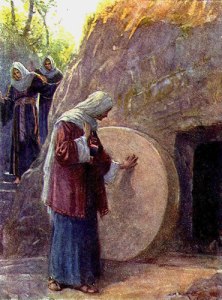
The disciples leave. But Mary stays: “Mary stood outside the tomb crying,” verse 11 says. Now, cue the angels: “As she wept, she bent over to look into the tomb and saw two angels in white, seated where Jesus’ body had been” (verses 11-12). This is fascinating to me. Mary has already looked inside the tomb. She’s already observed the vacant cavern. She’s already noted the rolled away stone. She’s already surveyed the laundered linen resting where Jesus once lay. And yet, she bends over to take a second look. Why? She’s already seen what she needed to see.
I suppose we will never know why Mary bent over a second time to peer inside the empty tomb, but I’m sure glad she did. Because when she did, she saw the angels. And when she did, she heard their resurrection message. And when she did, she saw that there was not just an empty tomb, but a risen Messiah.
The Greek word for “bent over” is parakupto. And this is quite a rare word. In fact, it is used only four other times in the entire New Testament, two of those times being in the accounts of the resurrection. One of the times when it is used away from the empty tomb comes in 1 Peter 1:10-12: “Concerning this salvation, the prophets, who spoke of the grace that was to come to you, searched intently and with the greatest care, trying to find out the time and circumstances to which the Spirit of Christ in them was pointing when he predicted the sufferings of Christ and the glories that would follow. It was revealed to them that they were not serving themselves but you, when they spoke of the things that have now been told you by those who have preached the gospel to you by the Holy Spirit sent from heaven. Even angels long to look into these things.” This final phrase, concerning that which angels “long to look into,” uses the word parakupto. In other words, Peter is saying that the angels at the empty tomb, if they would have had their choice, would have “traded spaces” with Mary. They would have chosen her vantage point, bent over outside the tomb, bewildering and befuddling as it might have been. Mary, Peter says, got to see what the angels were longing to look into: the wondrous glories of Christ in his resurrection. And this is exactly what she sees. For as soon as she turns away from the angels, she turns into Jesus. And Jesus says to her, “Mary.” And she responds, “Rabboni” (verse 16)! She now sees the resurrected Christ.
This, then, is one of the many glories of Easter: that we have a vantage point of Christ that any angel would be happy to “trade spaces” with us for. Indeed, as lowly as our earthly vantage point of Christ may sometimes seem to us, Scripture would remind us that, from heaven’s vantage point, we maintain a most privileged position to watch God’s superior salvation unfold. We have the best seats in the house, as it were. For we live on the back side of the tomb. And, trusting in this tomb, we trade our space in eternal death for a space in eternal life. So, this Easter, bend over and, by faith, peer inside the empty tomb. For Christ is risen!
“Word for Today” – John 19 – www.concordialutheranchurch.com
 The other day, I was walking back from the cafeteria on our Concordia campus talking to one of our staff members. We were joking around about my propensity to be a “control freak.” And it’s true. As much as I hate to admit it, I do have a problem with power. I like to know what’s going on, when it’s going on, and exactly how it’s going on. I want to leave nothing to chance. And leaving nothing to chance can sometimes mean leaving everything to me. Sadly, or perhaps happily depending on your point of view, even when I’m ruling the roost, things do not always go according to plan. Mistakes happen. Directions veer off course. Things fall through the cracks. And it is at these moments, often through my gritted teeth and clinched fists, that I realize that no matter how much I may try to direct things, I am not always really in charge. I just like to think I am.
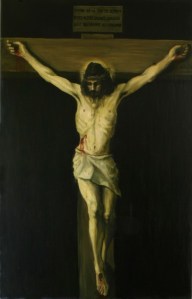
In our reading for Good Friday from John 19, Jesus’ moment of deepest sorrow, deepest agony, and deepest anguish has come. For Pilate, in the face of escalating acrimony from an unruly mob, has handed Jesus over to be crucified. And when Pilate does this, John records: “So the soldiers took charge of Jesus” (verse 16). And so, John tells us, Roman soldiers are now in charge of the Son of God. They are directing the course. They are making the plans. They are calling the shots. Who’s in charge? Roman soldiers are. Or so they like to think.
It’s quite striking to me that the actions of the soldiers, after “taking charge” of Jesus, are anything but according to their plans and directions and courses. First, the soldiers, after nailing Jesus to the cross, decide that they will cast lots to decide who gets Jesus’ last piece of clothing, which is finally nothing but a pair of underwear. Jesus, it seems, upon his crucifixion, does not even have control over the way he dresses. But though the soldiers believe they have control over Jesus’ wardrobe, John tells us that their control is only illusory: “This happened that the scripture might be fulfilled which said, ‘They divided my garments among them and cast lots for my clothing’” (verse 24). The soldiers, even if unwittingly, are not “in charge;” instead, they are only fulfilling a biblical prophecy from Psalm 22. And so John continues, “So this is what the soldiers did.” Scripture, not soldiers, is “in charge” of the events at the cross.
Then, in verses 32-34, when the soldiers arrive at the cross to break Jesus’ legs in order to expedite his death, they find him already, and seemingly prematurely, deceased. And so, “One of the soldiers pierced Jesus’ side with a spear, bringing a sudden flow of blood and water” (verse 34). Why did this unnamed soldier do this? Because he is “in charge” and desires to demonstrate, with ghastly gruesomeness, his unilateral authority over death and life? Hardly. According to John, this soldier is once again at the mercy of biblical prophecy: “These things happened so that the scripture would be fulfilled: ‘Not one of his bones will be broken,’ and, as another scripture says, ‘They will look on the one they have pierced’” (verses 36-37). And we find, once again, that Scripture is calling the shots, directing the course, and fulfilling its own plans. The soldiers are not, nor have they ever been, “in charge.” They only think they are.
As John highlights so eloquently, the cross, among many other things, is an attack on our presumption that we are “in charge.” The cross shows us that we are not in charge of our own mortality, for it reminds us that we will all die. The cross shows us that we are not in charge of our own righteousness, for the very reason that we are in need of the cross is because we are “slaves to sin” (Romans 6:20) and unable to stop sinning. And, most significantly, the cross shows us that we are not in charge of God’s grace. We do not deserve it nor can we earn or coerce it. It is completely and wholly a gift from God, apart from our control or domestication. We are not in charge, no matter how much we might like to think we are.
So, on this Good Friday, stop gritting your teeth and clinching your fists when things do not go according to plan and instead cling to the cross. For this is the very place we meet the one who not only thinks he’s in charge, he really is. Jesus, even though he looks weak and wounded, sick and sore, is the one with real power. And in a world where so many things are out of our control, why wouldn’t we want to trust in the one who really is?


 Pastor Zach's Blog