Posts filed under ‘Word for Today’
“Word for Today” – Romans 11 – www.concordialutheranchurch.com
 One evening last week, while Melody and I were having supper with a wonderful couple from our congregation, the wife offered to show me pictures of her trip to the Holy Land. “They’ll probably bore you,” she warned. I am happy to report, however, that she was sorely mistaken. Seeing her albums full of pictures of such famous biblical places like the Sea of Galilee, the Pool of Siloam, Cana, and even Jesus’ empty garden tomb made my heart sing and my spirit soar. For there is something about seeing pictures from Israel and the very places where Jesus walked that makes the Bible come alive in a whole new way.
Most certainly, the Holy Land in general, and Israel specifically, holds a special and prime place in the history of God’s people. And yet, in today’s reading from Romans 11, Paul reminds us that one does not have to live in Israel or be related to Abraham to be a child of God. For “salvation has come to the Gentiles” (verse 11). Salvation is offered to all, not just to some.
Throughout Romans 11, Paul repeatedly affirms this fact that salvation has come for both Jews and Gentiles alike. Paul’s words, however, have caused countless conflicts amongst theologians and laypeople alike. The crux of the controversy comes in verse 26, where Paul writes, “And so all Israel will be saved, as it is written: ‘The deliverer will come from Zion; he will turn godlessness away from Jacob.’” The question of this verse is: What does Paul mean, exactly, when he writes, “And so all Israel will be saved”? And the interpretations are legion. Augustine believed this phrase meant Elijah and Enoch would one day return and covert the entire Jewish nation. Where Elijah and Enoch are to be found in this passage, I don’t know. But nevertheless, this idea of a mass Jewish conversion to Christianity took hold and, by the Middle Ages, it became a fixed doctrine in the Roman Catholic Church.
Other theologians, however, have taken a different posture toward this verse. No less than Justin Martyr, Tertullian, Origen, Martin Luther, and John Calvin have asserted that “Israel” here refers not to an ethnic nation of Jews, but to the church of God, Jew and Gentile alike, saved by Jesus Christ (cf. Galatians 6:15-16). As John Calvin writes in his Commentary on Romans: “Many understand this [passage to speak] of the Jewish people, as though Paul had said, that religion would again be restored among them as before: but I extend the word Israel to all the people of God.” Thus, when Paul writes, “All Israel will be saved,” he means, “The true church of God, which is the new Israel, will be saved.”
Although finally, as Paul himself says, the notion that “all Israel will be saved” remains a bit of a “mystery” (verse 25), I prefer the latter interpretation of this verse to the former. I won’t get into the nuances of why I prefer the latter interpretation here, but suffice it to say that this interpretation carries with it a beautiful promise: That from Abraham to Moses to David to the prophets, God has never given up on his people. His desire is that “all will be saved” (cf. 1 Timothy 2:3-4), a desire that is reiterated here when, with great glee and celebration, Paul proclaims: “God will get his ‘all.’ If not in ‘all’ humanity, then at least in ‘all Israel.’ All Israel will be saved!”
What does this mean for us? Simply this: Israel’s story is our story too. Abraham, Moses, David, as well as the prophets are our ancestors. We come from a rich and storied history of people of great faith and now, we get to add our stories to the history of Israel. For we, as believers in Christ, are part of “all Israel.” And even when passages like this confuse theologians and divide scholars, we can rejoice in this marvelous promise: The Bible’s story is our story. And this means that the Bible’s God is our God. And our God has come to us in Christ with salvation. Thus, to encounter God and see Israel, you don’t need a trip to the Holy Land, you just need to look in the mirror. For you are Israel too.
“Word for Today” – Romans 10 – www.concordialutheranchurch.com
 Today, I get to travel downtown for jury duty. Although I appreciate the opportunity to do my civic duty, I must confess that the tediously slow pace at which many of our government offices operate tries my patience. The stories of government offices operating at a snail’s speed, of course, are legion. The sixteen weeks it takes fro the IRS to mail a tax return check. The oppressively long lines at the Post Office. And can a person talk about slow service without making reference to the horror stories that come out of the DMV, or DPS offices as the case may be, when getting a driver’s license?
I asked a friend how long he thought my time at the courthouse would last. “Plan to be there all day,” he replied. “But I’m supposed to report for duty at 8 am!” I protested. “How could it possibly take all day just to see if I’m selected to sit on a jury?” “Plan to be there all day,” came my friend’s reply once more. Slow service strikes again.
In our reading for today from Romans 10, Paul ends his remarks with a quotation from Isaiah 65:2: “All day long I have held out my hands to a disobedient and obstinate people” (verse 21). It seems as though even God himself is the victim of slow service from time to time. For God has been reaching out to his people with his grace, his love, his mercy, and his salvation all day long. And yet, his “disobedient and obstinate” and people refuse to trust and serve him.
Of course, the length of the “day” that God has been holding out his hand to his people is much greater than any time that could be spent at the IRS, Post Office, DPS, or County Courthouse combined. For God has been holding out his gracious hand ever since sin entered the world with Adam and Eve. That’s one long “day.” God calls to Adam, “Where are you” (Genesis 3:9)? But Adam refuses to come and find forgiveness for his sin in the hand of the Lord. Later, he holds out his hand to the children of Israel when he rescues them from slavery in Egypt “with a mighty hand and an outstretched arm” (Deuteronomy 5:15). But the children of Israel grumble against God and refuse to be guided by his strong arm. Even when God sends his Son Jesus Christ, the ultimate expression of his hand of grace, people do not receive him. Instead, they crucify him and drive nails through – what else? – his hands. Over and over and over again, people reject the very hand of God.
And yet, God continues to hold out his hand. In fact, I love the old King James Version translation of this passage: “All day long I have stretched forth my hands unto a disobedient and gainsaying people.” God, it seems, has a long arm – a long arm that he has “stretched forth” across heaven to earth in the person and work of Jesus. The question is, are you going to keep God’s long arm at arm’s length or are you going to trust in his long arm for your salvation? If you refuse the long arm of God’s salvation, you will still have to contend with God’s long arm, but it will be the long arm of God’s law and condemnation. So instead, trust in God’s long arm of grace to take care of all your needs, your worries, your cares, and, most importantly, your sins. Because God is stretching forth his long arm for you.
“Word for Today” – Romans 9 – www.concordialutheranchurch.com
 Teaching kids is always an interesting experience. As part of my training to become a pastor, I had to do a year internship at a congregation of my seminary’s choosing. And I had the pleasure of winding up in a church outside of Chicago of which I have very pleasant memories.
One of my duties at this congregation was to teach sixth grade religion at the school which was part of the church. Junior high school students always seem to have the most interesting questions about God: “If God knew that Adam and Eve were going to sin and eat his forbidden fruit, why did God put the fruit there in the first place?” Or how about, “If Adam and Eve were the first two people on earth, and they had kids, where did their grandkids come from?” Then there is the more troublesome, “If God is so good, why is there evil in the world?” And who can forget the perennial, “Can God make a rock so big he can’t move it?”
These questions are, of course, to a greater or lesser extent, unanswerable. Yes, we can answer these questions in a limited way, but to give a comprehensive answer to any of these questions surely treads toward heady ignorance at best and unabashed arrogance at worst. The unanswerable nature of these questions, however, has not stopped countless Christians from asking them.
Unanswerable questions about God and the divine realm are nothing new. No less than Roman Catholic luminaries Duns Scotus and Thomas Aquinas spent time pondering such questions as this popularly paraphrased brain buster: “How many angels can dance on the head of a pin?” I tremble to think how much time people have spent quarreling over such a question. Interestingly, the word “dunce” is derived from Duns Scotus’ name, a tribute the pointlessness of such debates.
In my younger years, I would become very unsettled when I wasn’t able to answer someone’s questions about God even if they were, for all technical purposes, unanswerable. These days, however, I have grown much more comfortable knowing what I don’t know and, yes, even what I can’t know. Much of my comfort stems from the fact that I’m in good company.
In our reading for today from Romans 9, Paul picks up on one of the most controversial and convoluted doctrines of Christianity: predestination. Paul makes troubling and brain teasing statements such as these: “Jacob I loved, Esau I hated” (verse 13). “Therefore God has mercy on whom he wants to have mercy, and he hardens whom he wants to harden” (verse 18). These troubling statements, although they’ve been well expounded by countless theologians over the years, albeit in different and sometimes disparate ways, still leave many with questions and objections.
As it is in our day, so it was in Paul’s day. For even Paul himself had trouble sorting out all the different nuances of this difficult doctrine. Even Paul himself knew that some questions concerning this doctrine were, by their very nature, unanswerable. Paul freely admits this when he writes, “What if God, choosing to show his wrath and make his power known, bore with great patience the objects of his wrath – prepared for destruction? What if he did this to make the riches of his glory known to the objects of his mercy, whom he prepared in advance for his glory – even us, whom he also called” (verses 22-24). The key phrase of this passage comes in its first two words: “What if…” Paul is basically saying, “I’m not sure exactly why God chooses some for salvation and not others, but what if it’s like this? Or what if it’s like this?” Even Paul does not have all the answers to that which rests in the mysterious depths of God’s will.
At the same time there are things that Paul freely admits he does not and cannot know, he also proudly proclaims what he does know. And Paul knows this: “Even us, whom God also called” (verse 24). In the midst of uncertainty of why God chooses some and not others with his predestinating will, Paul says, “This much I know. I have been chosen by God. I have been called by God. I have been saved by God. And not only I, but us. You too have been chosen by God.” And this, I pray, is something that that you know and believe with absolute certainty: God has chosen you to be his child.
You see, predestination is a doctrine which was never meant to reside in the theoretical and philosophical realms of why God does what he does. Instead, it is a doctrine which is meant to proclaim the good news that God, by his grace, has chosen you. No unanswerable question about it. And even if I can’t know everything about God, I’m thankful that I can know that I have been chosen by God. Because that is the message of my salvation…and yours too.
“Word for Today” – Romans 8 – www.concordialutheranchurch.com
 Perhaps no other comic strip is so ingrained in the collective consciousness and imagination of our American culture as is “Peanuts.” Even with its creator, Charles Schultz, being deceased for some nine years now, his dog Snoopy, along with the rest of his congenial cast of characters, live on in reruns of the famous strip that continue to delight the youngest to the oldest of us.
The central and original character of the “Peanuts” strip, of course, is Charlie Brown. The best way that I have heard Charlie Brown described is as a “lovable loser.” Sure, he is kind and endearing, but he is also quite naïve, much to the amusement of his friends who persistently leverage his gullibility for their benefit. Often, after Charlie Brown has been taken advantage of by a friend, or even after he has simply been hit by one of his legendary strings of bad luck, he will let out his famous *SIGH*. Such a *SIGH* is an indicator that Charlie Brown has come to the end of his rope. He’s ready to throw in the towel. He’s going to call it a day. For he has lost the drive, desire, and hope that things can or will get better. Very simply, he’s given up.
In our reading for today from Romans 8, Paul writes, “We know that the whole creation has been groaning as in the pains of childbirth right up to the present time” (verse 22). The Greek word used here for “groaning” is stenazo, which carries with it a sense of “sighing” or that which is a “heavy burden” (cf. Hebrews 13:17). Stenazo, then, is that which happens when someone comes to the end of their rope. When someone is ready to throw in the towel. When someone is ready to call it a day. And all of creation, Paul reminds us, stenazos. For all of creation suffers pain. Earthquakes. Hurricanes. Droughts. Famines. Tsunamis. These are enough to bring anyone to their knees in despair. And that is why not only does creation itself groan, we, as the crowning glory of God’s creation, groan as well: “We ourselves, who have the firstfruits of the Spirit, groan inwardly” (verse 23). We let out a collective *SIGH* at the pain and sorrow that wrecks our world and pierces our hearts. Such is the grim picture that Paul paints in Romans 8.
From where can we find relief from such a bleak outlook on our world and on our lives? Paul continues, “In the same way, the Spirit helps us in our weakness” (verse 26). That is, the Spirit helps us when we stenazo. He does this when he “intercedes for us with groans that words cannot express” (verse 26). How does the Spirit relieve us when we stenazo? He joins in. He does not remain distant and aloof. Rather, he takes on our pain, our despair, and our misery and intercedes for us so that we need not bear it alone. And then, something miraculous happens. We find out that he have a little more rope left. We discover that we’re still holding on, even if it’s only by a tentative thread, to the towel. We realize that we have the strength to fight another day. For God has intervened in the midst of our sorrow, misery, and despair. God has seen our stenazo and he has come to help.
This is why Paul can write, “And we know that in all things God works for the good of those who love him, who have been called according to his purpose” (verse 28). Many people mistakenly take this verse to mean that even when something seemingly bad happens, it’s not really bad, because it’s for God good purposes. But this is far from Paul’s point here. Indeed, it is precisely because there are really bad things that happen to us – things that cause us to stenazo – that we need this verse. For this verse promises that even when really bad things happen, God will conquer these bad things with his goodness. I love the way the philosopher and theologian Dallas Willard paraphrases this verse: “For those who love God, nothing irredeemable can happen to you.” In other words, God can take your truly terrible stenazos and conquer them with his redemptive righteousness. He can take your mourning at the malevolence of this world and turn it into rejoicing at his goodness, etched into the fabric of the cosmos.
Charlie Brown’s *SIGH* would usually come at the end of a “Peanuts” comic strip. For after ole Charlie would be the victim of his friends’ antics, he would then let out a *SIGH* in surrender. The end. This is not how it is, however, with our *SIGHS*. For even the bitterest stenazo does not mark the end of the strip of our life. As Paul writes, “The creation waits in eager expectation” (verse 19). That is, even while creation is presently stenazoing, it’s expecting something more. It’s waiting for something more. It’s waiting for redemption. And so, we look forward to the Day when “there will be no more death or mourning or crying or pain” (Revelation 21:3). We look forward to the Day of Redemption.
“Word for Today” – Romans 7 – www.concordialutheranchurch.com
 One of the most marvelous days of my life was when I married my true love, Melody. I can still remember the morning with crystal clarity. The music, the guests, me with my knocking knees and sweaty tuxedo, and, of course, my beautiful bride, adorned in a dress that took my breath away. And then came the moment when I spoke that sacred vow to my beloved mate: “I, Zach, in the presence of God and these witnesses, take you, Melody, to be my wife, to have and to hold from this day forward, for better, for worse, for richer, for poorer, in sickness and in health, to love and to cherish, ‘til death do us part.”
Out of all the lines in this vow, it’s the final line that still takes my breath away: “‘Til death do us part.” For it is in this line that we find the true strength of the wedded promise. We declare, “No matter what happens, we will not be parted. Only death can break our marriage bond.”
Paul alludes to this strong marriage bond in our reading for today from Romans 7 when he writes, “By law, a married woman is bound to her husband as long as he is alive, but if her husband dies, she is released from the law of marriage” (verse 2). Paul says, “The bond of marriage stands until one spouse dies. ‘Til death do us part.” Paul continues, however, by talking about something even bigger, deeper, and more profound than marriage: “So, my brothers, you also died to the law through the body of Christ” (verse 4). Paul’s analogy is this: Just as a wife is parted from her husband when he dies, so also are we parted from the law when we die. What law is Paul speaking of here? The law which accuses us of our sin and convicts us of our guilt. But now, death has done us part from this law which would consign us to hell. But death has done something else too: “So, my brothers, you also died to the law through the body of Christ, that you might belong to another, to him who was raised from the dead” (verse 4).
Death, Paul says, at the same time it estranges us from the law, also unites us to Christ! For this death does not merely kill us off, it also promises new life. This death asks us to die to ourselves, our sinful nature, and a law which would condemn us so that we can rise into a newer, better, fuller life in Christ. As Paul writes elsewhere, “Count yourselves dead to sin but alive to God in Christ Jesus” (Romans 6:1). Thus, to the law we say, “Death has done us part! You no longer have privilege to condemn me to hell!” But to Christ we say, “Death has done us…together! For I have died to all the sin which has separated me from God and have arisen as his redeemed child.”
In this world, nothing parts us as finally and completely as does death. It parts us from our friends. It parts us from our loved ones. It parts us from our marriages. It even, to look on a brighter side, parts us from our worries, our cares, our ailments, our wounds, and our bills. Death parts us from everything…except Christ. For in Christ we can exclaim, “‘Til death do us…together!” And death will indeed do us together. For upon our deaths, we have the hope of being together with Christ in heaven. This, then, is Christ’s vow to us: “‘Til death do us together.” Praise be to God for Christ’s strong vow!
“Word for Today” – Romans 6 – www.concordialutheranchurch.com
 In 1848, the wife of an Anglican clergyman from Ireland, Cecil Frances Alexander, penned these now famous words concerning the wonder of God’s creation:
All things bright and beautiful,
All creatures great and small,
All things wise and wonderful,
The Lord God made them all!
These words constitute what has proven to be one of history’s most beloved Christian hymns. Perhaps you have even sung these words before.
The portrait that Alexander paints of God’s glorious creation throughout this hymn is stirring. She speaks of “each little flower that opens” and “the purple headed mountains.” Indeed, the imagery is so rich that you almost feel as if you’re the one gazing with wonder on what she describes.
As much as I appreciate hymns which celebrate God’s creation, I have always found them to be a little disingenuous. All thingsbright and beautiful? Really? Honestly, I can think of several things that I would call neither bright nor beautiful. Take fire ants, for instance.
During my college years, I worked at a country radio station in Austin. One evening, as I was pulling the night shift, I decided to step out for a breath of fresh air when my foot, which was protected by no more than a flip flop, landed right in the center of a massive fire ant mound. The burning bites began instantaneously. I quickly searched for relief. Thankfully, there was a fountain at the entrance to the radio station. And so, I flung off my flip flop and doused my foot in the fountain’s cooling water, all the while screaming, “Die fire ants! Die!” The hymn may call fire ants “bright and beautiful,” but I prefer my fire ants “cold and dead.”
Unfortunately, as I learned that evening, fire ants are quite hearty creatures. They just wouldn’t die. Their stings continued even with my foot in the fountain. I finally had to carefully search my foot while it remained submerged in the water and ruthlessly pry everylast fire ant I could find from my now red and swollen skin.
In our reading for today from Romans 6, Paul writes these glorious words: “For we know that since Christ was raised from the dead, he cannot die again; death no longer has mastery over him” (verse 9). Some 2,000 years ago, Paul says, Satan consorted with the evil entities of this world to make an attempt on the life of Christ. They accused him, arrested him, mocked him, beat him, and finally murdered him on a cross. And they thought they had the Savior just the way they preferred him: not “bright and beautiful,” but “cold and dead.” But three days later, much to the surprise and chagrin of Satan and his minions, they discovered that Jesus was heartier than they ever imagined. For Jesus could not and would not stay dead. And now, upon his resurrection, Paul reminds us, “He cannot die again.” For he has conquered death.
But that’s not all. Because the Savior’s incredulity toward death marks our lives as well: “Now if we died with Christ, we also believe that we will live with him as well” (verse 8). In other words, just as Christ cannot die again, we, at our own resurrections on the Last Day,will also not die again. Indeed, not even a suffocating dip in a fountain can rob us of this life. In fact, drowning water is actually the very vehicle which God uses to give us a resurrected life: “We were therefore buried with Christ through baptism into death in order that, just as Christ was raised from the dead through the glory of the Father, we too may live a new life” (verse 4).
So today, celebrate the Savior who just can’t seem to stay dead. And hold out hope that he will keep us from staying dead too. For he, in the midst of a broken world in which so much is dark and ugly, is truly “bright and beautiful.”
“Word for Today” – Romans 5 – www.concordialutheranchurch.com
 In 1992, one of the most memorable series of television commercials of all time hit the airwaves. These commercials featured children singing, playing, smiling, and drinking a well-known sports drink, all the while gazing with awe and wonder at a six foot six giant of a man who wore a jersey with the number twenty three emblazoned on it: Michael Jordan. The song that these children sang to this prince of basketball was simple, yet catchy: “I want to be like Mike.” And the tag of the commercial was unapologetically straightforward: “Be like Mike. Drink Gatorade.”
Growing up, we all have people we want to “be like.” And in many ways, this is perfectly healthy and normal. For we all need mentors who inspire our hearts and motivate us to reach new heights. However, sometimes the drive to be like someone can turn dangerous and sinister. Take, for instance, history’s first sin. Satan comes to Adam and Eve with this allurement: “When you eat of the fruit of this tree, your eyes will be opened, and you will be like God, knowing the difference between good and evil” (Genesis 3:5). Satan asks, “You want to be like God? Don’t drink Gatorade; instead, eat this fruit in spite of God’s prohibition” (cf. Genesis 2:17). So Adam and Eve eat of the forbidden fruit. And sin comes into the world.
Although we are perfectly free to try to “be like” many people, the one person we are not free to try to “be like” is God. Yes, we are called to imitate God’s moral character, but we are strictly prohibited from seeking to usurp God’s authority or claim for ourselves his essence and nature. For God is utterly unique. No mortal is like him. As the Psalmist rhetorically asks: “Who is like the LORD our God, enthroned on high” (Psalm 113:5)? The understood answer, of course, is “no one.” No one can “be like” the Lord.
In our reading for today from Romans 5, Paul revisits and reminds us of the devastating effects wreaked by those who would try to be like God: “Sin entered the world through one man, and death through sin, and in this way death came to all men, because all sinned” (verse 12). Paul says that it is not just Adam who sinned and tried to be like God, rather, we all have sinned and tried to be like God. How have we done this? Whenever we have broken God’s ways to go our own ways, for then we assume that we know better than God. Whenever we have belligerently sought to control our own destiny rather than leaving our destiny in the Divine’s hands, for then we assume that we assume that our power over the future is greater than God’s. Any time we try to usurp God’s authority, we try to be like God. Indeed, we are trying to be beyond God, more powerful and wise than he, which, of course, is utter silliness and lunacy.
It is into the context of this supercilious desire to be beyond God that Paul writes, “Adam was a pattern of the one to come” (verse 14). The “one to come,” of course, is Jesus Christ. Thus, for people who would try to be like God, God decides that he will take on human flesh and be like us. This is why Paul calls Adam a “pattern.” God looks at Adam, and all of us sinful, broken people, and uses us as a “pattern” for his work in Christ. It is in Christ that God decides to be like us. As Paul writes elsewhere, “Christ was found in appearance as a man” (Philippians 2:8).
Unlike us, however, God does not decide that he will be like us out of his own selfish ambition or so that he can control or condemn us; instead, he decides that he will be like us so that he can love and save us. Paul says as much when he writes, “God’s grace…came by the grace of the one man, Jesus Christ” (verse 15).
Thus, the call of Romans 5 is to stop trying to be like God and start being ourselves: creatures so precious in God’s sight that even God himself would be like us so that he can save us. And who would want to be anything else but that?
“Word for Today” – Romans 4 – www.concordialutheranchurch.com
 To study to become a pastor, I went to seminary in St. Louis. And over the course of my educational career, beginning in grade school and stretching all the way through seminary, I always looked forward to my academic breaks with a sense of eager anticipation. This was especially true in seminary, because I was a long way from my home in Austin. And I can still remember, the first day of every extended break, waking up at 3:30 am, hopping in my truck, and hitting the road for a thirteen and half hour trek home.
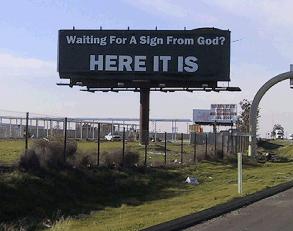
Because I drove this route from St. Louis to Austin many times, I became quite familiar with it. I had appointed stops and would even buy the same snack foods every time I made my journey. I also noticed that things seem to change slower in the country, even if that country has an interstate racing through it, than in the city. This was especially true of billboards. There was one billboard in Missouri on I-44 which, over my four years in seminary, never changed. It read, “Waiting for a sign from God? Here it is.”
More than one person, especially in a time of trial or crisis of faith, has asked God for a sign. Disappointingly, I have heard far fewer stories about how God did deliver a sign than stories of how he didn’t. Indeed, many of us intuitively know that it is dangerous for us to ask for some heavenly omen because, more often than not, we’ll be disappointed.
The animated cartoon character Homer Simpson, who, although not a particularly astute theologian, is funnily folksy, once offered this prayer: “Dear Lord, the gods have been good to me. For the first time in my life, everything is absolutely perfect just the way it is. So here’s the deal. You freeze everything the way it is, and I won’t ask for anything more. If that is okay, please give me absolutely no sign. Okay, deal. In gratitude, I present you this offering of cookies and milk. If you want me to eat them for you, give me no sign. Thy will be done.” Although we would never pray such a crass prayer as this, this is the way many of us by default operate: God is not in the business of giving signs.
In our reading for today from Romans 4, Paul argues that a person is made righteous not by what he does, but by faith in Christ’s salvific work alone. Indeed, Paul says that even those before Christ were justified by their faith and not by their works. For instance, Abraham: “What then shall we say that Abraham, our forefather, discovered in this matter? If, in fact, Abraham was justified by works, he had something to boast about – but not before God. What does the Scripture say? ‘Abraham believed God, and it was credited to him as righteousness’” (verses 1-3). Abraham’s faith, Paul says, not his good works, made him righteous in God’s sight.
In order to bolster his argument, Paul continues by noting that Abraham was declared righteous by God before he himself had done anything righteous. Thus, Abraham’s righteousness could not have come from anything he had done: “Under what circumstances was Abraham’s righteousness credited? Was it after he was circumcised, or before? It was not after, but before” (verse 10)!
In first century Jewish society, circumcision was the ultimate “sign” that a person was a child of God. As Paul says, “Abraham received the sign of circumcision” (verse 11). But now, in Romans 4, Paul is arguing for a new sign that a person is a child of God. And this is a sign that is not done by human hands as some righteous work, as is circumcision, this is a sign that is effected by God himself: the sign of faith. This is why Paul writes, “Abraham is the father of all who believe but have not been circumcised, in order that righteousness might be credited to them” (verse 11). Paul says, in order to be a righteous child of God, the sign you really need is faith in Jesus Christ.
So perhaps it isn’t such a bad thing to ask for a sign from God after all. But this sign will probably not come in an experience that rends the heavens or in a voice that rumbles into your soul. It probably won’t even come in large words plastered on a billboard along some country boulevard. No, the sign from God that you most need is a sign that you already have: faith in your heart. Thank God for that most precious sign today.
“Word for Today” – Romans 3 – www.concordialutheranchurch.com
 In 1954, Stanford social psychologist Leon Festinger published a paper titled, “A Theory of Social Comparison Processes.” In this paper, Festinger hypothesized that “there exists, in the human organism, a drive to evaluate his opinions and abilities.” This evaluation is accomplished by “comparison respectively with the opinions and abilities of others.” This evaluation can involve both “upward comparison,” where a person evaluates themselves against someone who is more advanced in a particular area than they are, and “downward comparison,” where a person evaluates themselves against someone of a perceived lower status than they are.
Interestingly, in the moral realm, most people tend to engage in “downward comparison.” “At least I’m not as bad as her,” a person might say. “I would never do what he did,” another might opine. We engage in this kind of “downward comparison” because it allows us to feel secure in our own moral righteousness rather than suffering guilt that inevitably results from our immoral sinfulness.
Our reading for today from Romans 3 leaves no room for the kind of “downward comparison” that many of us like to engage in. Rather, it brings out, with stinging clarity, the depths of our immorality: “There is no one who does good, not even one. Their throats are open graves; their tongues practice deceit. The poison of vipers is on their lips. Their mouths are full of cursing and bitterness. Their feet are swift to shed blood” (verses 12-15).
The language that Paul uses here is gripping. He begins with the depravity of human throats, tongues, lips, and mouths. He then drops to our feet. The implication is this: From our head to our toes, we are sinful, we are not good, we are unrighteous, we are wicked, and we are depraved. And no amount of “downward comparison” can rescue us from our plight.
Happily, Paul does not leave us in this sorry state of sin. For he continues:
But now a righteousness from God, apart from law, has been made known, to which the Law and the Prophets testify. This righteousness from God comes through faith in Jesus Christ to all who believe. There is no difference, for all have sinned and fall short of the glory of God, and are justified freely by his grace through the redemption that came by Christ Jesus. God presented him as a sacrifice of atonement, through faith in his blood. (verses 21-24)
True righteousness, Paul maintains, does not come from comparing ourselves to others who are morally “inferior” to us, but from faith in Jesus Christ. True righteousness is “apart from the law.” That is, it is apart from what we do and connected only to what Christ has done.
Thus, there is no room for boasting by comparing our morality to the morality of another. As Paul writes, “Where, then, is boasting? It is excluded. On what principle? O n that of observing the law? No, but on that of faith. For we maintain that a man is justified by faith apart from observing the law” (verses 27-28). The upshot, then, is this: no one is better than anyone else. For the ground is level at the foot of the cross.
With this in mind, today, when you are tempted to engage in “downward comparison” and compare your extraordinary performance to the lesser performance of another, can you pause and instead celebrate what you share in common: the righteousness that comes from Christ? Although this may be humbling, for you can no longer engage in comparisons that allow you superiority over another, it is also liberating, for you no longer have to fret over someone who is “better” than you. For our superior righteousness comes not from ourselves, it comes from Christ. And I think I’d rather have his righteousness than mine anyway.
“Word for Today” – Romans 2 – www.concordialutheranchurch.com
 The other day, I was having a conversation with a friend about the merits of Kindle, an electronic unit from Amazon.com on which you can purchase, download, and read books. “I don’t know if I could ever read a whole book on a computer screen,” I told my friend. “It doesn’t look like a computer screen, though,” my friend informed me. “It’s designed to be easy on the eyes.” “I still don’t know,” I responded skeptically. “Well,” my friend finally said, “I think it’s pretty cool. Although I don’t do a whole lot of reading.”
As much as it frustrates me, because I love to read, I, like my friend, don’t read as regularly as I’d like to. Commitments, appointments, and the affairs of daily life cut, sometimes deeply, into my reading time. That is why today’s text from Romans 2 is of special interest to me:
Indeed, when Gentiles, who do not have the law, do by nature things required by the law, they are a law for themselves, even though they do not have the law, since they show that the requirements of the law are written on their hearts, their consciences also bearing witness, and their thoughts now accusing, now even defending them. (verses 14-15)
Paul here speaks to those who have not had a chance to catch up on their reading. In the first century, it was the Jewish people who were the keepers of the written law of God. And they were fervently devoted to reading it, parsing it, and memorizing it. Indeed, an ancient rabbi would have the entire Old Testament memorized. The Gentiles, on the other hand, were not familiar with the Word of God. For they lived in a pagan context in which there were no readily available Bibles. Thus, any Gentile convert to a nascent first century Christianity had some reading to catch up on – the whole of God’s written revelation!
Paul, however, in these verses, says that even those who do not read Scripture have some knowledge of what it says: “Even though they do not have the law…the requirements of the law are written on their hearts.” In theological parlance, we call this “natural law.” That is, even someone who has never read the Bible still has a basic “moral compass,” as it were, because God has etched his laws into each and every human heart. That is why, for instance, societies, whether Christian or not, consider murder to be wicked. It is part of God’s natural law. The first century Jewish philosopher Philo states it thusly:
The world is in harmony with the law, and the law with the world, and the man who observes the law is constituted thereby a loyal citizen of the world, regulating his doings by the purpose and will of nature. (On the Creation, 3)
In other words, Philo maintains that there is an unwritten inexorable order to this world, by which people are encouraged to live and by which we judge. And that unwritten inexorable standard is natural law. C.S. Lewis states similarly:
Everyone has heard people quarrelling. Sometimes it sounds funny and sometimes it sounds merely unpleasant; but however it sounds, I believe we can learn something very important from listening to the kind of things they say…[For in quarrels, a man is often] appealing to some kind of standard of behavior which expects the other man to know about…It looks, in fact, very much as if both parties had in mind some kind of law or rule of fair play or decent behavior or morality or whatever you like to call it, about which they really agreed…Now this law or rule about right in wrong [is] called the law of nature. (C.S. Lewis, The Case for Christianity, 3-4)
Standards that are not written, but simply known, agreed upon, and assumed. These are the standards of natural law.
Evil, therefore, has no excuse. One cannot say, “I didn’t know it wasn’t okay not to murder.” Or, likewise, “I didn’t know I had to tell the truth.” Yes, you did know. Even if you’re not much of a reader. Thus, we all stand convicted by the law of God. For what we do not know from the pages of Scripture we know from the guilt which riddles our hearts.
It is for this reason that Paul writes the book of Romans. For Paul knows that Jews and Gentiles alike stand condemned under God’s written and natural law. But Paul wants to free them from this condemnation and bring them into salvation in Jesus Christ. As Paul later writes, “There is now no condemnation for those who are in Christ Jesus, because through Christ Jesus the law of the Spirit of life set me free from the law [whether written or unwritten] of sin and death” (Romans 8:1-2).
This, then, is why we should read: for although we can know God’s law apart from reading the Scriptures, we cannot know Jesus apart from reading the Scriptures. Without the Scriptural gospel, we stand condemned. What’s written on our hearts can lead us only to despair and not hope, only to guilt and not joy, only to slavery and not freedom. So perhaps it’s time for us all to do a little more reading of and a little bit more listening to the gospel. For it is in the gospel that we find hope and healing from Jesus. And that’s something I love to read all about. I hope you do too.


 Pastor Zach's Blog