Posts filed under ‘Word for Today’
“Word for Today” – Matthew 5 – www.concordialutheranchurch.com
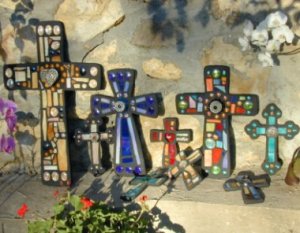 Many Christians seem to have a special affection for trinkets and keepsakes which remind them of their faith. In our own house, for instance, we have a wall full of crosses which points us to Christ’s suffering and death for our salvation. My wife Melody was the one who began the collection. After finding out that she (and by marriage, I) collected crosses, we received crosses for every conceivable holiday: Christmas, Easter, birthdays. I think we even received a cross for Valentine’s Day once. We now have so many crosses that we can’t fit them all on our appointed “cross wall.” So, if you’re looking for a gift for Melody and I, please don’t buy us a cross!
Besides crosses, there’s other Christian memorabilia as well like posters, statuettes, and plaques with every conceivable Bible verse etched into them. And this is where our reading for today from Matthew 5 comes in. Matthew 5-7 constitutes the most famous sermon in history: Jesus’ Sermon on the Mount. And snippets of Jesus’ indelible words can be found on Christian merchandise everywhere. “You are the light of the world” (Matthew 5:14). “Our Father who art in heaven” (Matthew 6:9). “Seek ye first the kingdom of God” (Matthew 6:33). And, of course, “Ask and it will given to you” (Matthew 7:7).
Another set of words that can regularly be found on countless Christian items are the words which Jesus uses to open his Sermon on the Mount, popularly known as the beatitudes: “Blessed are the poor in spirit, for theirs is the kingdom of heaven. Blessed are those who mourn, for they will be comforted. Blessed are the meek, for they will inherit the earth” (verses 3-5). These are words that have brought comfort and strength to more than one faint soul. For these are words for those who are downtrodden, weary, encumbered, and embittered by the woes and persecutions of this world. And we love these words. After all, who doesn’t want to receive the kingdom of heaven when they feel poor in spirit? And who doesn’t want to be comforted when they mourn? And receiving the whole earth just for being meek sounds like a pretty good deal to me.
But as many times as I have seen the words from these Beatitudes emblazoned on Christian mementos, the one beatitude I have never seen on these items is Jesus’ final beatitude: “Blessed are you when people insult you, persecute you and falsely say all kinds of evil against you because of me. Rejoice and be glad, because great is your reward in heaven, for in the same way they persecuted the prophets who were before you” (verses 11-12). The rub in this beatitude seems to be one word: “when.” “Blessed are you,” Jesus says, “when people insult you, persecute you and falsely say all kinds of evil against you because of me.” What? I can see being persecuted and then being blessed by God after my suffering because I endured it so nobly. I can even see myself being blessed by God in spite of my suffering as he pours “silver linings” into my dark and dreary days. But being blessed when I suffer? That almost sounds like the suffering is the blessing! And that’s exactly right.
Now, to be clear, it’s not that suffering is good in and of itself, it’s that it’s a blessing when it’s used and redeemed by God to strengthen our faith and form our character. And make no mistake about it: God does indeed use suffering to do just that. As the apostle Paul reminds us: “We also rejoice in our sufferings, because we know that suffering produces perseverance; perseverance, character; and character, hope” (Romans 5:3-4). The school of suffering, it seems, can teach us things we can’t learn anywhere else. Things like perseverance, character, and even hope. And so, if you are suffering, I would never be so naïve to say that you should be obnoxiously cheery in the face of pain, but I would say, “Blessed are you.” For you truly are.
One of the most notable Christian “sufferers” of the 19th century was Charles Haddon Spurgeon, a great preacher from London. Although he achieved world-wide fame, he also had his vehement detractors who took every opportunity to besmirch his name and try to ruin his ministry. In her memoires, Mrs. Spurgeon writes about her husband’s suffering at the hands of his enemies:
My heart alternately sorrowed over him and flamed with indignation against his detractors. For a long time I wondered how I could set continual comfort before his eyes, till, at last, I hit upon the expedient of having the following verses printed in large Old English type and enclosed in a pretty Oxford frame: “Blessed are ye when men shall revile you and persecute you and shall say all manner of evil against you falsely for My sake. Rejoice and be exceeding glad: for great is your reward in Heaven: for so persecuted they the prophets which were before you.” The text was hung up in our own room and was read over by the dear preacher every morning…fulfilling its purpose most blessedly, for it strengthened his heart and enabled him to buckle on the invisible armor, whereby he could calmly walk among men, unruffled by their calumnies, and concerned only for their best and highest interests.
I guess someone put the words of Jesus’ final beatitude on a plaque after all.
This, my dear friends, is the blessing in suffering: it strengthens our hearts and enables us to buckle on the armor of Christ so that we may carry on with our duties for the sake of the gospel. And so, when we suffer, “Blessed are we.”
“Word for Today” – Matthew 4 – www.concordialutheranchurch.com
 The story goes that two high school football players were taking a biology test. Only a couple of hours after they had finished, they were called into the principal’s office. With a serious face and somber tone, the principal said to the boys, “I have reason to believe that the two of you cheated on your biology test earlier this afternoon.” Not surprisingly, they both adamantly denied any such wrongdoing. So the principal systematically laid out his case. “You both got questions 8, 14, and 15 wrong,” he began. “Yeah, but I’m sure other kids got those questions wrong too,” they protested. “They were hard questions! It’s just a coincidence.” “Yes,” the principal continued, “but neither one got the answer to question 20 correct. In fact, you, John, just wrote ‘I don’t know’ as your answer to that question.” “Well,” John retorted, “I didn’t know! That’s not cheating! That’s just an honest answer.” “Yes,” the principal pressed, “but you, Peter, in response to the same question, wrote, ‘I don’t know either.’”
Tests. They’re something not many of us like to take. And sometimes, in a moment of weakness, we may even engage in dishonesty in an attempt to pass one. In fact, according to a survey in U.S. News and World Report, 80% of so-called “high-achieving” high school students admitted to cheating, along with 75% of college students. Moreover, a 2006 study conducted by Claremont Graduate University found that 61% of all tenth graders reported being affected by a clinical psychological condition known as “test anxiety,” which often leads to cheating. It seems tests are almost universally feared.
Our reading for today from Matthew 4 begins: “Then Jesus was led by the Spirit into the deserted to be tempted by the devil” (verse 1). Quite honestly, this verse has always bothered me. Why would the Spirit lead Jesus to a place where the devil can tempt him with all sorts of wicked sin and desire? Does not the Bible say, “God tempts no one” (James 1:13)? Yes, but Christ’s “temptation” by the devil is only half of this story.
The Greek word for “tempt” is peirazo, which can not only mean “tempting,” a word that has negative connotations of leading people into sin, it can also mean “testing,” which is something that God himself does with those he loves. An example of such testing is offered by the author of Hebrews: “By faith Abraham, when God tested him, offered Isaac as a sacrifice. He who had received the promises was about to sacrifice his one and only son, even though God had said to him, ‘It is through Isaac that your offspring will be reckoned’” (Hebrews 11:17-18). Abraham is peirazo-d by God when God says to him, “Take your son, your only son, Isaac, whom you love, and go to the region of Moriah. Sacrifice him there as a burnt offering on one of the mountains I will tell you about” (Genesis 22:2). God wants to see if Abraham will follow his every command, even when his command seems shatteringly devastating and oppressive. Gloriously, Abraham passes God’s test, and God spares Isaac’s life. This, then, is what the Spirit is doing with Jesus: he is leading him into the desert to be “tested.”
But there is a double entendre in Matthew’s use of peirazo. Because although the Spirit may be using Jesus’ trial in the desert as a test, Satan wants to twist it into a temptation. For Jesus has been fasting for forty days and is now hungry (cf. verse 2). And it is then that Satan arrives to see if he can use Jesus’ test in hunger to tempt him into vice: “If you are the Son of God, tell these stones to become bread” (verse 3). In other words, “Let me take your test in hunger,” Satan says, “and turn it into an opportunity for sin – to fill your grumbling stomach in a way that would dishonor God.” To put it another way, Satan’s desire is that Jesus gets an “F” on the Spirit’s test. But Jesus, although willing to endure the Spirit’s holy test, will not put up with Satan’s sinister temptations. “Away from me, Satan!” Jesus shouts (verse 10). And Jesus passes the Spirit’s test. For he rejects the way of sin and walks in the way of righteousness.
James writes, “Consider it pure joy, my brothers, whenever you face trials of many kinds, because you know that the testing of your faith develops perseverance” (James 1:2-3). God, James says, tests his people, even as he tested his Son. But he does not test us in the hope that we will fail. Nor does he test us out of a sadistic desire that we will suffer and stumble. No, God tests us for our good. He tests us so that we may persevere in life and in faith.
So today, live your life knowing that this is a test. But it’s a test that, by God’s grace, you can surely pass. No test anxiety necessary.
“Word for Today” – Matthew 3 – www.concordialutheranchurch.com
 We have AMB, Equity One, and Public Storage. Europe, on the other hand, has Land Securities. Land Securities is the largest real estate investment trust in Europe, specializing in commercial property holdings. Their annual revenue is nearly incomprehensible: £1,561 million in 2008. And unless you follow the financial markets closely, you’ve probably never heard of them. Admittedly, I had never heard of them before I decided to write this blog. What moved me to write about a company which was formerly unknown to me?
Land Securities traces its origins to 1944 when Harold Samuel purchased what was then Land Securities Investment Trust Limited, which owned three houses in Kensington as well as some government stock. It was under Samuel’s leadership that the group went from a meager real estate company to the powerhouse holdings company that it is today. What was Samuel’s secret to such startling success? In Samuel’s own words, it was, “Location, location, location!” For it was Harold Samuel who coined this now oft used real estate cliché that is quoted by everyone from multi-national investment trust CEOs to local real estate agents.
In our reading for today from Matthew 3, we meet a prophet named John the Baptist who, as Matthew informs us, is Jesus’ foretold predecessor, paving the way for his ministry. Indeed, Matthew even quotes words from the prophet Isaiah to substantiate his claim concerning John’s pedigree: “A voice of one calling in the desert: ‘Prepare the way for the Lord’” (verse 3). This is a direct quote of Isaiah 40:3: “A voice of one calling: ‘In the desert prepare the way for the Lord.’” Wait just a second. There’s a shift, albeit a subtle one, between these two quotes. Did you catch it? The colon has shifted places. In Matthew’s version of the quote, it’s after the word “desert.” But in Isaiah’s words, it’s after the word “calling.” And where this little colon goes makes a surprisingly huge difference.
Many ancient Jews believed that the colon belonged after the word “calling.” Thus, the following phrase, “in the desert,” described the location of where one was to prepare the way for the Lord. Indeed, there was a whole group of first century Jews called the Essenes who lived in the wilderness at Qumran precisely because they thought the only suitable place to “prepare the way for the Lord” was “in the desert.” Matthew, however, maintains that the colon doesn’t belong after the word “calling,” where the Essenes would place it; instead, it belongs after the word “desert.” In other words, the phrase “in the desert” doesn’t describe the location of where we are to prepare for the Lord, it describes the location of the “voice” who will announce the Lord’s coming. And that voice is the voice of John.
Why is this important? Because the placement of this one little colon radically alters how we prepare for the Lord. Matthew’s argument is this: “The first rule of real estate does not apply to the coming of the Lord! For the Lord is not just coming to one specific location, location, location! You can prepare for the Lord’s coming anywhere: in the country; in the city; at your home; at your workplace.” Every place is a place that you can prepare for God. For, as Scripture promises, God “is not far from each one of us” (Acts 17:27). Or, as John himself says, “The kingdom of heaven is near” (verse 2).
So today, whatever your location, location, location may be, remember that the rules of real estate do not apply to your relationship with God. He is only a prayer, a cry, and a call away.
“Word for Today” – Matthew 2 – www.concordialutheranchurch.com
 My wife Melody loves her birthday. She loves to talk about her birthday, she loves to celebrate her birthday, and she loves to drop me little hints as to what she might like for her birthday. I, on the other hand, am not nearly so fond of my big day. I would just assume have a nice quiet evening at home rather than a rowdy party, and a simple meal with my wife rather than a mountain of gifts. Because I very much prefer a low-key and private birthday celebration, I have often stood astonished at Melody’s desire for a high-energy and public birthday party. I have asked her more than once, “What’s the big deal about birthdays?” To which she has repeatedly replied, “Your birthday is the day God brought you into the world. And that’s a big deal! It’s your special day, so we need to celebrate!”
“It’s your special day.” This is Melody’s credo concerning birthdays.
Our reading for today from Matthew 2 begins thusly: “After Jesus was born in Bethlehem in Judea, during the time of King Herod…” (verse 1). In Greek, the phrase “during the time of King Herod” is en hemeras Herodou, meaning literally, “In the days of Herod.” Herod, it seems, didn’t just have a special day, he had special days. Every day was like his birthday.
Indeed it was. For history records Herod as a hopelessly ruthless, maniacally egotistical, and incurably narcissistic ruler. His monetary wealth surpassed not only that of Caesar, but that of the collective Roman Empire. He built himself a palace, the remains of which can still be seen today, in which he literally raised the elevation of a hill so that his mountaintop mansion would appear more imposing to those who dwelt below. He also constructed a city around his private fortress that, in the words of the first century Jewish historian Josephus, was “second to none.” What would he call such a brazen display of his so-called majesty? He modestly named it the Herodium, of course. As he lay on his deathbed, Herod was so concerned that no one would mourn his passing (a justifiable concern due to his merciless brutality) that he ordered the dignitaries of Judea be locked inside the Hippodrome in Jericho and slaughtered upon his death so that there would be weeping and mourning when he died, even if it wasn’t for him. These were the days of King Herod.
“In the days of King Herod, Magi from the east came to Jerusalem and asked, ‘Where is the one who has been born king of the Jews? We saw his star in the east and have come to worship him’” (verses 1-2). Matthew begins with the “days of King Herod,” but he ends with the star of the King of Jews. For the days of King Herod are being swallowed up by the dawning of the day of a new King. For the star that these Magi have seen is a “Morning Star” (Revelation 22:16). A new day is on its way. And this new day is not a day of hopeless ruthlessness, maniacal egotism, and incurable narcissism; instead, this new day is a day of gentle compassion, contagious humility, and salvific selflessness. For this new day is the new “day of the Lord Jesus” (2 Corinthians 1:14).
Perhaps you sometimes feel as though you live in the days of King Herod. Maybe you are victim of your boss’s ego. Maybe you look longingly at the palaces others live in while you are barely making ends’ meat. Maybe you simply live in fear of all the violence and callousness that seems to permeate today’s headlines. If this is you, then this is your promise: Jesus, the Morning Star, is rising for you. The days of King Herod in all of their sinfulness and brokenness are waning while the new Day of the Lord Jesus is rushing to culminate history and bring salvation. And that day will be bigger and better than even a birthday. I hope it comes soon. Because even though I don’t always enjoy a large celebration for my birthday, I’m sure I’ll be up for a huge party for the Day of the Lord Jesus. After all, that’s a day truly worth celebrating…no matter what kind of a birthday boy or girl you are.
“Word for Today” – Matthew 1 – www.concordialutheranchurch.com
 The other day, as I was on my way to work, I was listening to the WOAI morning show where the question of the day was, “At your child’s college graduation, do you stay for the complete ceremony, or do you quietly leave after their name is read?” Caller after caller voiced their opinions on both sides of the issue. Some insisted that you should stay for the whole ceremony out of deference to your child’s classmates while others admitted that they intentionally find excuses to excuse themselves from such a long-winded ceremony. Whatever the opinion expressed, however, one thing was for certain: None of the callers really enjoyed sitting through long litanies of names rattled off at most college graduations. Sure, some insisted that a person should stay through the entire ceremony for the sake of politeness, but no one stood elated at the prospect listening to unfamiliar name after unfamiliar name just so they could hear the one name of the person whom they loved.
Oftentimes, whenever we encounter a biblical genealogy, the lengthy list of names contained therein strikes us to be a bit like the innumerable inventories of names announced at college graduations To use the old King James language: “And Zabad begat Ephlal, and Ephlal begat Obed, and Obed begat Jehu, and Jehu begat Azariah, and Azariah begat Helez, and Helez begat Eleasah, and Eleasah begat Sisamai, and Sisamai begat Shallum, and Shallum begat Jekamiah, and Jekamiah begat Elishama” (1 Chronicles 2:37-41).
Now for a brief time of personal confession. Did you read the above genealogy carefully and studiously? Did you ponder over each name, perhaps even looking up a few of the names in a Bible dictionary to learn more about them? Or, did you just skim over the names in bored indifference? How about in our reading for today from Matthew 1? Did you read each name carefully or did you just skip Matthew’s opening verses to get to the interesting part where Jesus is born?
I know it can be tempting to breeze through biblical genealogies. Admittedly, I myself have far too often paid little attention to these lengthy lists of names. And yet, these genealogies are much more intriguing, interesting, and invaluable than they might first appear. For behind each name lies a life who is part of God’s unfolding story of salvation. Take, for instance, a sampling of the names which appear in Matthew’s genealogy. Tamar (verse 3), a woman who pretended to be a prostitute so that she could coax her father-in-law into sleeping with her. King David (verse 6), a murderer as well as an adulterer. Solomon (verse 6), a son of David, who worshipped false and abhorrent gods. Or how about Jeconiah (verse 12), a king who did such terrible evil in the eyes of the Lord that God cursed his family line. These are the names that Matthew marshals to record the family history of none other than “Jesus, who is called Christ” (verse 16).
Hmmm. Perhaps Matthew should have done some selective editing and left a few of these less savory characters out of the family tree of the Savior of the world. After all, this kind of a sordid genealogical reckoning doesn’t exactly speak well of Jesus’ pedigree. But this is exactly Matthew’s point. For Matthew is seeking to remind his reader exactly why we need a Savior. We need a Savior because of Tamar and because of David and because of Solomon and because of Jeconiah…and because of you and me.
The Greek word for “genealogy” is genesis, meaning “origin” or “beginning.” Perhaps you are better familiar with this word as the namesake for the first book of the Bible: Genesis. This book’s name actually describes its contents. It is a history of the origin of humanity and of Israel. But now in Matthew’s gospel, this word has returned, not to describe a garden named Eden, but a person named Jesus. For Jesus is bringing about a new Genesis – a new beginning. A new beginning that is marked not by transgression and folly, but one that is marked by righteousness and compassion. In a very real sense, Jesus is redoing Genesis. Except that Jesus, unlike us, actually gets Genesis right. He does not sin as do Adam and Eve.
This, then, is sequence of Matthew’s genealogy: He begins with the old Genesis and with all of the sinfulness and brokenness that marks its people. But he ends with the new Genesis – “Jesus, who is called the Christ.” And the new Genesis does everything well. That’s the point of all those boring names. For all those boring names point us to Jesus. Then again, now that you know some of the raucous stories behind those names, perhaps they aren’t so boring after all.
“Word for Today” – Romans 16 – www.concordialutheranchurch.com
 Sometimes, I’m not as quick at returning phone calls as I should be. Last Friday, a good friend of mine called. This past Monday, I was finally able to return his call. After apologizing for taking three days to call him back, I reflexively asked, “So what’s up? Is something wrong?” This buddy of mine is in ministry at a church in Dallas and many times our conversations turn to the challenges of church work. Thus, I assumed that he had called me because he was facing some difficulty that he wanted some counsel on. I assumed incorrectly. “I didn’t call you for anything in particular,” he responded, “I just wanted to say hello.”
Although I’m ashamed to admit it, I hardly ever call anyone “just to say hello.” For my phone calls are usually made with some goal in mind: a task to complete; a deadline to meet; a question that I need answered. But my buddy called me “just to say hello.” And perhaps, even in the midst of our hurried lives and crowded calendars, this is a practice that many of us would do well to recapture.
In our reading for today from Romans 16, Paul rips off the lengthiest list of “hellos” of any of his letters. This is probably because Paul had not yet visited the church at Rome when we wrote Romans, so his greetings were extensive because he was not able to offer them in person. What is especially fascinating, however, is that Paul’s practice of offering “holy hellos” was not common in the ancient world. Primitive church scholar Hans Windisch, who taught at Leipzig, Leiden, Kiel, and Halle before his untimely death in 1935, writes, “In letters of the pre-Christian period, greetings are not too common and there are no long series of greetings.” Thus, even in the first century, it seems people had little time to pick up the phone “just to say hello.” Indeed, normally, “hellos” were reserved only for those of high status, such as priests, rulers, and rabbis, as the ancient Jewish historian Josephus informs us: “Alexander, when he saw…the high priest in purple and scarlet clothing, with his mitre on his head, having the golden plate whereon the name of God was engraved, he approached by himself, and adored that name, and first greeted the high priest” (Antiquities, 11.331). Alexander the Great, a man himself worthy of a great greeting, extends a greeting to the high priest of Israel. Such are the kinds of people for whom “hellos” were reserved. For common folk rarely offered “hellos” and never received them.
Paul, however, describes a different tact when it comes to the kinds of “hellos” that Christians should proffer. This tact is perhaps most clearly expressed in verse 23: “Erastus, who is the city’s director of public works, and our brother Quartus send you their greetings.” Erastus was well known in the ancient world as a prominent politician from Corinth. Indeed, a Latin inscription near the Corinthian theatre reads, “Erastus, commissioner of public works, bore the expense of this pavement.” Erastus, it seems, was quite wealthy and donated much of his massive fortune to the betterment of his hometown. Here was a man whom many would have greeted and who would have greeted other dignitaries because of his status. But then there is Quartus. And we know much less about Quartus because he was nothing but a lowly slave. And yet, Quartus too greets the Roman church. And it can only be assumed that the Roman church returns the favor.
For Christians, then, “hellos” became something not reserved only for the elite, but for everyone, whether they be powerful politicians or supine serfs. So today, I offer you this challenge: In a world where, much like in the first century, we all too often only say “hello” to those from whom we need something or to those whom we consider important, call someone today “just to say hello.” Call someone with no favors to ask, no networking to do, and no hidden agenda in mind. Call someone simply to check up on them. For sometimes a simple “hello” from a concerned soul is what a person needs more than anything else. And, if you would, share this challenge with others as well. For together, we can make today a day of “hellos” that are meant not only to accomplish tasks, but to touch hearts. And in the end, that’s more important anyway.
“Word for Today” – Romans 15 – www.concordialutheranchurch.com
 During my final year of college, I had the privilege of taking what many considered to be the “holy grail” of course offerings: I took a course in civics. I know what you’re thinking: “Civics? That doesn’t sound very exciting!” And you’re right. It wasn’t. No, what made this course such a thrill for me wasn’t the content of the course itself, but the way in which this course was offered. Because for fourth year college students, it was offered as an independent study course. In other words, I could study the material on my own, visit with my professor every once in a while, and then take the tests. And as long as I did well on the tests, I passed the course. I’ll leave it to your imagination as to how much I actually studied for my civics course, but I will say this: It wasn’t one of my most studious academic moments.
Thankfully, by the time I got to seminary, I had gained a deeper appreciation for the value of education as I once again did some independent study. And I loved the freedom that independent study afforded me. The freedom to read books that I wanted to read and study theologians that I wanted to study and pursue topics that I wanted to pursue. I also cherished the one on one meetings with my advisor as I was able to share with him all that I was learning and he was able to point me in new directions so that I could investigate new things. I perhaps learned more during my times of independent of study in seminary than I did during any of my formal classes.
One of the greatest values I see in our “Word for Today” Bible reading program is that it allows us, as we read through the New Testament in a year, to do a little bit of independent study. For as we read the Bible, day in and day out, and pause to ponder, pray, and try to better understand the message of Scripture, we do so outside of a classroom setting and a formalized curriculum. And I believe there is great value in that. For all too often, the only Scripture we take in is that which we hear when we’re sitting in a pew on a Sunday morning. And although we do indeed need such times of guided teaching, we also need times of independent study.
In our reading for today from Romans 15, Paul extols the value of such independent study: “I myself am convinced, my brothers, that you yourselves are full of goodness, complete in knowledge and competent to instruct one another. I have written you quite boldly on some points, as if to remind you of them again, because of the grace God gave me” (verses 14-15). Paul, in these verses, says, “I have taught you, I have trained you, I have written you – quite boldly on some doctrines – and now it’s time for some independent study. Now it’s time for you to instruct one another. You have all the tools in the bag you need to continue your studies in Scripture. So get to it.”
The other day as I was perusing the website blog for our “Word for Today” readings, I noticed that one of our Concordia members had posted a question he had about a passage of Scripture. Wonderfully, rather than waiting for a pastor to respond (because admittedly, we can sometimes be a little slow in our responses), another one of our members responded to his question. He began, “I’ll add my two cents worth.” And that’s exactly to the point of this program. To read, to study, and then to add “your two cents worth.” For I myself am convinced, dear brothers and sisters, that you yourselves are full of goodness, complete in knowledge, and competent to instruct one another. So keep up your independent study. And keep instructing one another. And remember that even when you study Scripture “independently,” you never study Scripture alone. For the Holy Spirit is there with you to guide you into all truth. Praise be to God for that great gift.
“Word for Today” – Romans 14 – www.concordialutheranchurch.com
 Last week, I had the pleasure of leading our final Men’s Bible Breakfast before we adjourned for the summer. The guys decided that they wanted to have an “Ask the Pastor” session in which they could ask me anything they happened to have on their minds. They finally decided this format would be more appealing if it was billed as “Stump the Pastor.” Thanks a lot, guys!
Although the fellas were gracious and spared me their hardest curve ball questions, otherwise they would have surely flummoxed me, there was one question from this final session that especially struck me: “Is cremation okay?”
My reflexive reaction to this question was to respond with another question: “Why do you ask?” Because the answer to this question has more to do with the intentions behind a person’s desire to be cremated than with the act of cremation itself. For with the advent of the Enlightenment and its accompanying scientific ethos, there are some who, in an act of defiance, want to be cremated solely so that God can not raise their bodies from the dead on the Last Day, which, of course, in their minds is nothing but a superstitious and non-rational belief anyway. Others, however, are cremated simply because of financial or familial concerns. To those in the former group, I would say a decision to cremate would be sinful. Not because cremation itself is sinful, but because the intentions behind it are. On the other hand, to those in the latter group, I would straightforwardly sanction cremation. For those in this group have no ill intent lurking behind their decision.
According to Scriptural theology, our intentions matter just as much as our actions. Indeed, this is what we find in today’s reading from Romans 14. Paul writes, “Accept him whose faith is weak, without passing judgment on disputable matters. One man’s faith allows him to eat everything, but another man, whose faith is weak, eats only vegetables. The man who eats everything must not look down on him who does not, and the man who does not eat everything must not condemn the man who does, for God has accepted him” (verses 1-3). Paul says, “Whatever your view on eating clean and unclean foods may be (cf. Leviticus 11), you should not pass judgment on each other. If some of you follow certain dietary restrictions, fine. If others of you do not, fine.”
Now, contrast this posture toward clean and unclean foods with Paul’s words to the Colossians: “Therefore do not let anyone judge you by what you eat or drink…Since you died with Christ to the basic principles of this world, why, as though you still belonged to it, do you submit to its rules: ‘Do not handle! Do not taste! Do not touch!’? These are all destined to perish with use, because they are based on human commands and teachings” (Colossian 2:16, 20-22). Paul addresses this same issue of clean and unclean foods with the Colossians, but with a very different result. To the Romans he says, “Do whatever you feel is best. You are free to refrain from or to partake of so-called unclean foods.” To the Colossians, however, he says, “Don’t you dare distinguish between clean and unclean foods! If you do, you will desecrate the gospel and acquiesce to sinful human teaching.” The question is: Why would Paul take two such widely disparate stances on the same issue? The answer has to do with human intention.
In the case of the Colossians, those who maintained a distinction between clean and unclean foods did so because they thought they could curry favor from God by their legalistic observances. Paul flatly condemns such bald self-righteousness. In the case of the Romans, however, the issue of clean and unclean foods appears to be more complicated. For there were some in this church, it seems, who refrained from eating unclean foods because they were unsure to what extent the Levitical ceremonial laws had been abrogated by Christ and to eat these foods would have left them with a heavy conscience. Among these Christians, to refrain from eating unclean foods was not an attempt to diminish or supplement Jesus’ all-sufficient work on the cross, it was simply an effort to be faithful to Scripture as they best understood it. Toward such people, Paul encourages patience and love as they gain a better understanding of the radical freedom we enjoy in Christ.
One issue; two different sets of intentions. And it’s the intentions that make all the difference. Those at Colossae had an intention of self-righteousness. Those at Rome intended simply to be true to their consciences. And in light of these widely differing intentions, Paul offers widely differing responses.
Intentions matter. So today, consider not only what you do, but why you do it. Do you give only in the hope of receiving, or out of selfless love for another person? Do you help only to receive a pat on the back, or because Christ came as a servant to us? Intentions matter just as much as actions. So don’t only do right, think right as well.
“Word for Today” – Romans 13 – www.concordialutheranchurch.com
 When I was in high school, I was befriended by a Jehovah’s Witness. She, of course, was all too happy to try to “convert” me to the doctrine of the Watchtower Bible and Tract Society of Pennsylvania. One of the hallmark doctrines of Jehovah’s Witnesses is that although Christ may have had a special relationship to his heavenly Father, he was not the God of heaven and earth, incarnate in human flesh. Troublingly, the Witnesses even have their own skewed translation of the Bible, the New World Translation, which polemically mistranslates passages that clearly declare the divinity of Christ. For instance, the New World Translation renders John 1:1: “In the beginning the Word was, and the Word was with God, and the Word was a god.” Compare this to the New International Version which translates: “In the beginning was the Word, and the Word was with God, and the Word was God.”
When my friend first showed me her “translation” which calls Jesus “a god” rather than “the God,” I was horrified. And although I did not know Greek at the time, I quickly began researching the original Greek grammar behind the English translations of this passage and I stumbled across something called Colwell’s Rule. This rule was first formulated in 1933 by E.C. Colwell in an article he published for the Journal of Biblical Literature. In it, he states: “In sentences in which the copula is expressed, a definite predicate nominative has the article when it follows the verb; it does not have the article when it precedes the verb.” Don’t know what that means? That’s okay, neither did I. But I did know that this made the translation of Jesus as “a god” very tenuous and unlikely. And I did know that Jesus was no second-rate divinity. He was and is the one, true God.
And so, I told my friend about Colwell’s Law. I also gave her a veritable plethora of resources refuting the theology of Jehovah’s Witnesses. And I made an appeal to her to believe in the Bible rather than in a centralized, and somewhat enigmatic, Watchtower society. My friend, however, remained un-persuaded. She told me, “Well, I guess you’ll just have your beliefs and I’ll have mine.”
I was shocked. She refused to agree with me when it came to Christ’s divinity! I was at a loss. After all, my study was impeccable. My linguistic theory was unimpeachable. My logic was irrefutable. How could she not agree with me?
I have since learned that there are many people who do not agree with me, no matter how persuasive I may think I am. I will often joke with my wife Melody and tell her, “You know, this world would be a much better place if everyone just agreed with me.” But everyone does not agree with me. And this is where our reading for today from Romans 13 comes into play.
“Let no debt remain outstanding, except the continuing debt to love one another, for he who loves his fellowman has fulfilled the law” (verse 8). According to the apostle Paul, love is the order of the day. But notice who we are supposed to love: our “fellowman.” The Greek word for “fellowman” is heteros, meaning “different.” In other words, Paul is encouraging us to love not only those who think as we do, believe as we do, dress as we do, and act as we do, but to love those even who are different from us. He is encouraging us to love even those who do not agree with us – even when we have impeccable study, unimpeachable linguistic theory, and irrefutable logic. We are to love everyone.
Is there anyone who is different from you or disagrees with you whom you have failed to love the way you should? If so, now is the time to repent of your unloving heart and reflect God’s love toward that person. Mind you, loving someone different from you does not necessarily mean that you accept their positions or actions, especially if they’re sinful or false, as are those of the Jehovah’s Witnesses, but it does mean that you treat others the way Christ would treat them: with care, concern, and compassion. After all, love – true love – has a way of bridging divides, breaking barriers, and binding up brokenness. And that’s something that we all need…no matter how heteros we might be from each other.
“Word for Today” – Romans 12 – www.concordialutheranchurch.com
 During the season of Lent, there is an ancient Christian tradition which instructs the faithful to sacrifice some luxury that they enjoy in memory of Christ, who sacrificed his very body on the cross for the forgiveness of our sins. In Roman Catholicism, this sacrifice has been loosely standardized: Catholics do not eat meat on Fridays. This, of course, has cleared the way for sumptuous fish fries and good fellowship. Among other branches of Christendom, sacrifice is still often encouraged, but it is usually left up to the individual to decide exactly what he or she would like to sacrifice.
Now, for my confession: I have never been particularly good at sacrificing, at least that which is most valuable to me. Although I may be perfectly happy to sacrifice something which I would consider nominal such as a few dollars to purchase a meal for someone or a couple of minutes to chat with someone about a theological question they might have, this past Wednesday, when I was asked to sacrifice a whole day to serve the State of Texas on jury duty, I was not terribly happy. For overall, my time is precious to me, especially that time which I spend in ministry. And asking me to make this kind of a sacrifice toward something that I am not heavily invested in was difficult indeed.
No matter how much of an aversion I might have toward making certain sacrifices, this is precisely what I am called to do according to our reading for today from Romans 12: “Therefore, I urge you, brothers, in view of God’s mercy, to offer your bodies as living sacrifices, holy and pleasing to God – this is your spiritual act of worship” (verse 1). Paul reminds us that we, as Christians, in light of God’s mercy, are called to make sacrifices, and even be sacrifices, for Christ has sacrificed himself for us on the cross. In the balance of the chapter, then, Paul delineates what sacrifices we are to make.
First, we are to sacrifice our ego: “Do not think of yourself more highly than you ought, but rather think of yourself with sober judgment, in accordance with the measure of faith God has given you” (verse 3). Rather than expending our efforts and our energy on boosting our image and our influence, we are to humbly reckon ourselves not according to our accomplishments, but according to the faith which God has given us – a faith which sees the sinfulness and brokenness which resides in our hearts. We are to be humble rather than haughty.
Second, we are to sacrifice our inclination toward vengeance: “Do not repay anyone evil for evil…Do not take revenge, my friends, but leave room for God’s wrath” (verses 17, 19). In other words, when someone else wrongs us, sins against us, hurts us, or betrays us, rather than exacting revenge and executing retaliation, we are to forgive even as Christ has forgiven us. We are to be merciful rather than judgmental.
These sacrifices, of course, are only two instances in a whole life of sacrifice which we are called to live out as Christians. But notice that when we make such sacrifices, we are “living sacrifices.” In other words, the sacrifices which we make won’t kill us. So often, when we are called to sacrifice something for the Kingdom, we dramatically and hyperbolically act as if making such a sacrifice will surely mean our demise. But as my mother used to remind me when she called upon me to “sacrifice” my taste buds on a meal that I did not want to eat: “Just try one bite. That’s all I’m asking. After all, it won’t kill you.” And indeed, it never did. And neither did my day at jury duty. I’m still alive and kicking to write this blog. And even if we are called to sacrifice our lives as martyrs for the sake of the gospel, we are still “living sacrifices,” for the very message of the gospel which we have given our lives for is that not even death can mute God’s eternal life.


 Pastor Zach's Blog