Posts filed under ‘Word for Today’
“Word for Today” – Matthew 25 – www.concordialutheranchurch.com
 A couple of weeks ago, I was having a conversation with a friend when, all of a sudden, what seemed to me to be out of the clear blue sky, they said to me, “Zach, I want you to know that I really appreciated last Tuesday.” Immediately, my mind sprang into action. “Last Tuesday. Last Tuesday? What did I do last Tuesday?” Although I tried to hide that puzzled stare that I’m sure emerged all over my face, my friend quickly figured out that I was lost. “The funeral that you attended last Tuesday. It really meant a lot to the family and it really meant a lot to me.”
I have to admit, at that moment, I was more than a little embarrassed. It humiliated me that I would so quickly forget about an event as significant as a funeral. But it wasn’t for lack of care and concern that I forgot about it. It was simply because I didn’t consider my attendance at that funeral to be that big of a deal. I was there, not because I felt I had to be, but because I wanted to remember the deceased and lift up his family in prayer. Honestly, I never imagined the family would notice or care whether or not I was there. But I was wrong. Because they did notice. And they did care. And they appreciated it more than I ever thought they would.
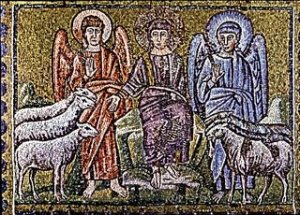
In our reading for today from Matthew 25, Jesus offers one of the most famous and memorable descriptions of his second coming: “When the Son of Man comes in his glory, and all the angels with him, he will sit on his throne in heavenly glory. All the nations will be gathered before him, and he will separate the people one from another as a shepherd separates the sheep from the goats” (verses 31-32). The sheep, of course, are those who are commended and brought to salvation. The goats, conversely, are those who are condemned and sent to damnation.
I have always found Jesus’ commendation of the sheep to be especially fascinating:
“Come, you who are blessed by my Father; take your inheritance, the kingdom prepared for you since the creation of the world. For I was hungry and you gave me something to eat, I was thirsty and you gave me something to drink, I was a stranger and you invited me in, I needed clothes and you clothed me, I was sick and you looked after me, I was in prison and you came to visit me.” Then the righteous will answer him, “Lord, when did we see you hungry and feed you, or thirsty and give you something to drink? When did we see you a stranger and invite you in, or needing clothes and clothe you? When did we see you sick or in prison and go to visit you?” The King will reply, “I tell you the truth, whatever you did for one of the least of these brothers of mine, you did for me.” (verses 34-40)
Did you catch what the sheep say to Jesus? They say, “We did what again? You were hungry and we fed you? You were in need of clothes and we clothed you? You were sick and we looked after you? You were in prison and we went and visited you? We don’t remember any of that!”
It seems as though the Last Day will, in some ways, echo my funereal forgetfulness. Because to us, so much of what we do just isn’t that big of a deal. So often, just as Jesus instructs, we are so forgetful that our right hand doesn’t even remember what our left hand is doing (cf. Matthew 6:3). But to Jesus remembers. And Jesus cares. Because to Jesus, what we do for others, we also do for him. And to Jesus, that is a big deal.
So today, recall something charitable, something gracious, perhaps even something life-altering you have done for another person and didn’t even think about it until you were later reminded. And if you can’t think of anything, that’s okay. That just means you’re doing great. You’re not supposed to remember the good things you do anyway. But don’t worry, you’ll be reminded eventually. For Jesus will remind you. And Jesus will thank you. What a glorious day that will be.
“Word for Today” – Matthew 24 – www.concordialutheranchurch.com
 It was not a pleasant experience. At the tender age of nine, my mother left me home alone for the first time. She had a couple of errands to run and figured now would be as good a time as any to teach me some independence. After all, she was only going to be gone for half an hour. I, however, was mortified at the prospect of having to spend a full thirty minutes alone in our big, creaky, creepy house. Nevertheless, my mother drove off and left me behind. I immediately dashed into my room and shut the door, petrified by the thought of burglars, which I was certain were lurking right outside the front door. Fifteen minutes passed. Then twenty. Then twenty-five. Then thirty minutes. And mom wasn’t home yet! Finally, after a full thirty-four minutes, I couldn’t take it anymore. I emerged from my room, dashed to the kitchen, and called my dad at work. “Dad,” I said misty-eyed, “Mom said she was going to be gone half an hour and she’s already been gone thirty-four minutes!” My mother came home three minutes later.
Although at age nine I was already having preteen moments of rebellion, trying to assert my independence, I still was not ready to be too independent. I still wanted to have someone around to protect me at all times. I still did not want to be left behind by my mother.
My sentiment as a child echoes the sentiment of many when it comes to the way the end times are talked about in popular Christian movies and literature. On the final day of 1995, a novel by Tim LaHaye and Jerry Jenkins hit bookshelves everywhere and changed the way millions viewed that last days of history. The novel’s title was Left Behind. The plot line tracks the life of an airplane pilot and his family after they are “left behind” following a rapture of the faithful. The moral of the story is self-evident: The end of history will be a dark, scary, tumultuous time. You don’t want to live through it. So make sure you believe in Jesus and don’t get left behind.
This may come as a shock to many, especially in light of my reticence even to be left behind at home by my mother as a child, but I actually want to be left behind. Not in the way that Tim LaHaye and Jerry Jenkins talk about it, but in the way that our text for today from Matthew 24 talks about it. Jesus says, “As it was in the days of Noah, so it will be at the coming of the Son of Man. For in the days before the flood, people were eating and drinking, marrying and giving in marriage, up to the day Noah entered the ark; and they knew nothing about what would happen until the flood came and took them all away. That is how it will be at the coming of the Son of Man. Two men will be in the field; one will be taken and the other left. Two women will be grinding with a hand mill; one will be taken and the other left” (verses 37-41).
These words from Jesus are often marshaled to teach a rapture near the end of time. There will be groups of people, the doctrine goes, and some will be taken to be with the Lord, while others will be “left behind” to suffer the pain and misery and agony of the earth’s final days.
Now, before you accuse me of losing my mind, wanting to endure such misery, it is first worth asking, “Is this what Jesus actually teaches here? Does Jesus really teach a rapture where some are taken to be with him while others are left behind?” Notice the analogy that Jesus draws in these verses. He begins with the days of Noah. He says in verse 39 that a “flood came and took them all away.” In other words, in Jesus’ analogy, it is bad to be “taken away.” Because being “taken away” means suffering judgment and death. Conversely, then, it is good to be “left behind.” Because being “left behind” means surviving judgment thanks to God’s strong salvation. Thus, when Jesus speaks of two people, one being taken while the other is left behind, he wants us to be the ones who are left behind! Because being “left behind” means being “left behind” with Jesus! Indeed, this is tone that Jesus sets from the very beginning of this chapter: “See that no one leads you astray. For many will come in my name, saying, ‘I am the Christ,’ and they will lead many astray” (verses 4-5). Jesus says, “Don’t get led astray and taken away by all the false christs and false doctrines and false messiahs out there. Instead, stay behind with me! For I am your only hope for salvation.” Peter reminds us likewise: “Be on guard so that you will not be carried away by the errors of these wicked people and lose your own secure footing” (2 Peter 3:17).
So today, declare your intention to be “left behind.” Not as a result of some rapture where you have to suffer some terrible tribulation, but declare your intention to be left behind from the leadings of sin, lies, and wickedness. For when those leave you behind, you are left standing with Jesus. And he’s a guy I’m happy to be left behind with any day.
“Word for Today” – Matthew 23 – www.concordialutheranchurch.com
 A couple of years ago now, Melody and I got to know a precious little girl, less than a year old, who was dying from cancer. Her story is tragic. At only three months old, doctors discovered a tumor in her brain. Because of its size and because of her age, the tumor was declared inoperable. After batteries of tests, series of treatments, and more hospital stays as an infant than many people experience in their whole lives, this little sweetheart passed away at the tender age of one. Her family, and her friends, were grief-stricken.
I can still remember Melody telling me, shortly after her funeral, “All of this just kills me. It kills me that she never got to experience the fullness of life. It kills me that her parents are now left with a huge void in their hearts. It kills me that God would allow this to happen. All of this just kills me.”
Perhaps you can relate to Melody’s sentiment. For we all experience suffering, injustice, and tragedy that “just kills us.” Indeed, this is the case in our reading for today from Matthew 23. For the past several chapters of Matthew’s gospel, tensions between Jesus and the religious leaders have been rising. And they now reach a boiling point as Jesus denounces the wickedness of these super-spiritual hypocrites: “Woe to you, teachers of the law and Pharisees, you hypocrites” (verse 13)! The Greek word for “woe” is ouai, an interjection which expresses not so much denunciation as it does grief (cf. verses 37-39). In other words, Jesus, as he looks at the religious leaders and all of their vanity and duplicity and spiritual blindness, is not only angry, he is grief-stricken. And so, in what must have sounded like a visceral wail, he cries out, “Ouai! This is a terrible situation! This is a sad situation!” Or, to use my wife’s words, “This just kills me!”
And indeed it finally did. For just a few chapters later we learn: “Then the chief priests and the elders of the people assembled in the palace of the high priest, whose name was Caiaphas, and they plotted to arrest Jesus in some sly way and kill him” (Matthew 26:3-4). Jesus’ ouai toward the religious leaders moves them to plot his death on a cross.
In many ways, I would say that we live in a culture which does not know how to ouai. We do not know how to express our grief. After all, how many times have you, in the midst of some personal tragedy or trial, tried to “put on a happy face” to cover your sadness? Perhaps it is time that we take a lesson from Christ: It is okay to express our grief. It is okay, from time to time, to say, “Woe is me!” Not in some self-pitying way or in a way that seeks to get others to feel sorry for us, but in an honest, godly way. As Jesus says, “Blessed are those who mourn” (Matthew 5:4).
So today, is there an ouai you need to share with a fellow brother or sister in Christ? Is there a sorrow you need to get honest about? Is there an evil that breaks your heart? Today can be the day you share that ouai. And remember that, even as you ouai, no matter how painful it may be, Jesus doesn’t just say, “Blessed are those who mourn,” he also includes a promise: “For they will be comforted” (Matthew 5:4). No ouai lasts forever. For Christ is there to comfort us in our woes.
“Word for Today” – Matthew 22 – www.concordialutheranchurch.com
 This past week at Concordia, we were blessed to have over 1300 children on our campus for our “Crocodile Dock” Vacation Bible School. The good times, the big smiles, and the memorable moments were priceless. Children from all over San Antonio and even beyond learned about God’s love for them in Jesus Christ. And not only did we have hundreds of children descending on our campus, we had hundreds of volunteers watching out for these hundreds of children. 668 to be precise. It was a truly great week!
Because we had so many people on campus all at once, we put our highest priority on safety. To that end, we vigorously enforced our hard and fast VBS rule from years past: no nametag, no access. Everyone – and I do mean everyone – had to have a nametag to get in to certain events or do certain things. Even a guest who just wanted to check things out had to be properly registered and accounted for.
In our reading for today from Matthew 22, we read of a monarch who prepares a wedding banquet for his son. He excitedly puts together his guest list, makes his preparations, and then the big day arrives – the day of the feast. But this king’s guests respond not only with apathy to his invitations, they respond with hostility and seize the king’s servants, who would have delivered the invitations, and even kill them (cf. verse 6).
In this day, to refuse the invitation of a king would have been a heinous offense. Indeed, it was incumbent upon any subject to attend such an event. As the second century BC Jewish book Sirach informs us, “When an influential person invites you…do not be forward, or you may be rebuffed; do not stand aloof, or you will be forgotten” (Sirach 13:9-10). A person was never to “stand aloof” of a king’s invitation. But these invitees do exactly that.
Understandably, this king, furious with rage, invites indiscriminately those he knows will come to his feast. He instructs his servants: “‘The wedding banquet is ready, but those I invited did not deserve to come. Go to the street corners and invite to the banquet anyone you find.’ So the servants went out into the streets and gathered all the people they could find, both good and bad, and the wedding hall was filled with guests” (verses 8-10). I’ve always loved this line from verse 10 about the kinds of guests who are now invited to this feast: they are both “good and bad.” In other words, the social standing, the ritual purity, and the rigor with which these guests pursue their righteousness makes no difference to this king. Everyone is invited.
But, like our VBS, even though everyone is invited, if you’re going to be on the campus of this king, you have to have a proper name tag, or, in this case, a proper wedding garment: “But when the king came in to see the guests, he noticed a man there who was not wearing wedding clothes. ‘Friend,’ he asked, ‘how did you get in here without wedding clothes?’ The man was speechless. Then the king told the attendants, ‘Tie him hand and foot, and throw him outside, into the darkness, where there will be weeping and gnashing of teeth’” (verses 11-13).
In the ancient world, kings would often provide clothing for feasts and other events such as this one so that guests could be properly dressed (cf. Genesis 45:22, Esther 6:8-9). This most certainly would have been the case in this instance since the king invited the poor from the streets (cf. verse 9). Thus, this man who is rebuffed by the king had the clothes he needed from the king, he simply refused to put them on.
This parable, of course, is a parable about our Sovereign King, God Almighty, and the invitation which he extends to us is to attend the wedding feast of his Son, Jesus Christ. As John writes, “Blessed are those who are invited to the wedding supper of the Lamb” (Revelation 17:9)! And just like in Jesus’ parable, our God even gives us the proper clothes to wear: “Fine linen, bright and clean, was given her to wear. (Fine linen stands for the righteous acts of the saints)” (Revelation 17:8). The question is: Will we receive the invitation and the clothing, or will we reject them? If we reject them, the consequences are devastating. For we will be thrown off of God’s heavenly campus and incur God’s eternal wrath. But for those who receive the invitation and the gift of God’s robe of righteousness, we can count on good times, big smiles, and memorable moments in the eternal kingdom of God. And it will be priceless. I can’t wait.
“Word for Today” – Matthew 21 – www.concordialutheranchurch.com
 Like most children, in my room growing up, I had a large box full of toys. And like most children, although I loved to play with my toys, I did not like to put away my toys. But inevitably, as the day drew to a close, it would come time for me to get ready for bed and clean up my room. And so my father would say to me, “Okay Zachary, it’s time to put away your toys and get ready for bed.” “Yes, dad,” I’d respond, and then return immediately to playing. After five minutes, my father would return to check on me, only to find me still playing joyfully and contently, with no hint of progress toward tidying up. “I thought I told you to clean up your room and get ready for bed,” my dad would say with his best stern tone. “I was going to get ready for bed in just a second,” I would retort. “But I told you to start cleaning up five minutes ago!” my dad would counter. “Stop disobeying and start cleaning!” “I’m not disobeying,” I would protest, “I was going to clean up in just a few minutes.” And then would come one of my father’s legendary proverbs: “Delayed obedience is the same as disobedience. When I told you to start cleaning up, I meant now.”
I’ve honestly lost count of how many times I heard my father say that growing up. But this memorable maxim always reminds me of a parable that Jesus tells in Matthew 21: “What do you think? There was a man who had two sons. He went to the first and said, ‘Son, go and work today in the vineyard. ‘I will not,’ he answered, but later he changed his mind and went. Then the father went to the other son and said the same thing. He answered, ‘I will, sir,’ but he did not go” (verses 28-30). My father would cringe at both of these sons’ responses. One disobeys his father outright by saying he will do something and then does not follow through while the other son delays obedience by baldly telling his father, “I will not obey you,” although he later changes his mind. My father would say of both these boys, “They are both disobedient. For one breaks his word and the other delays obedience. And delayed obedience is the same as disobedience.”
In order to understand the full brunt of Jesus’ words, a tradition from the Aggadah, a compendium of ancient rabbinic homilies, proves helpful. The ancient rabbis taught that when God first gave the Ten Commandments, he offered them to all the nations on earth. He appeared to the Edomites, Moabites, and Ishmaelites. But, upon hearing the injunctions against murder, theft, and adultery, they rejected God’s offer, complaining that such restrictions would unduly inhibit with their licentious living. It was Israel alone who accepted God’s Ten Commandments. For the ancient Jews, then, this tradition became a source of great pride and even arrogance. After all, they were the ones who said “yes” to God’s rules! They were the ones who saluted the Lord and said, “We will obey!” But in the parable of these two sons, Jesus exposes the truth of Israel’s hollow acceptance of God’s commandments.
Jesus’ words were meant to directly challenge Israel’s supposed willingness to obey. They may have said “yes” to God’s Ten Commandments while other nations said “no,” but they certainly didn’t follow through on their verbal pledge. The other nations, however, while initially refusing God’s ways, were now repenting and turning to God through Jesus Christ. And although delayed obedience is the same as disobedience, delayed obedience is not irreversible disobedience. For our God, even when we disobey him initially, sometimes grievously, always gives us another chance to do things right the next time. Thus, Jesus says, “I tell you the truth, the tax collectors and the prostitutes are entering the kingdom of God ahead of you, [O Israel]. For John came to you to show you the way of righteousness, and you did not believe him, but the tax collectors and the prostitutes did. And even after you saw this, you did not repent and believe him” (verses 31-32). Tax collectors and prostitutes disobeyed God for a long time. But when they met Jesus, they repented. And Jesus welcomed them. And now the question is, “How about you?”
As sinners, we all disobey God. It is part of our very nature. However, our disobedience needs never to be irrevocable. For our Lord extends his hand, again and again, and perpetually makes to us his offer of grace: “You’ve delayed your obedience thus far, but you can still repent and begin again. Now you can walk with me.” Will you listen to his voice?
“Word for Today” – Matthew 20 – www.concordialutheranchurch.com
 One of my fondest memories from college, seminary, and even as I was serving a congregation in Corpus Christi was working as a DJ at local country radio stations. I love country music! And I loved working as a DJ, especially because of the “hook-ups” I received to so many country concerts when they came to town. Nowhere is old cliché, “It’s not what you know, but who you know,” truer than in the radio business. Because of who I knew in the industry, I got to attend more free concerts than I can remember as well as meet some of country music’s biggest stars. A picture of my wife Melody, Dierks Bentley, and myself is still proudly displayed in our house.
Knowing the right people at the right times for the right things is something which many people covet. After all, knowing people in the radio industry can get you a free concert. Knowing the manager at a restaurant can get you a free meal. And knowing the right person at the University of Texas can get you a great seat at Longhorn football game. Too bad I don’t know one of those people!
In our reading for today from Matthew 20, the mother of two disciples comes to Jesus, figuring that their relationship with him is going to get them the hook-up. But this hook-up not a hook-up for concert tickets, a free meal, or even good seats at a football game; rather, this hook-up is one that will, at least hopefully, get them the best seats in the kingdom of God: “Then the mother of Zebedee’s sons came to Jesus with her sons and, kneeling down, asked a favor of him. ‘What is it you want?’ he asked. She said, ‘Grant that one of these two sons of mine may sit at your right and the other at your left in your kingdom’” (verses 21-22).
It’s important to note that the “sons” which are referred to here are James and John (cf. Matthew 4:21) and their mother’s name is Salome (cf. Mark 15:40, 16:1) who, in all likelihood, is the sister of Mary, Jesus’ mother (cf. John 19:25, Matthew 27:56). In other words, this request for the best seats in the kingdom of God is made by none other than Jesus’ aunt on behalf of Jesus’ cousins. And these two cousins, it seems, are hoping that their familial relationship to Jesus will get them a special spot ruling and reigning with the Savior. After all, blood is thicker than water, right? And you have to take care of your family, don’t you?
At least in one unsuspected sense, Jesus’ does offer his cousins the best “seats” in his kingdom: “‘Can you drink the cup I am going to drink?’ ‘We can,’ they answered” (verse 22). Jesus’ seat, he says, is actually a cup. And that cup, of course, is actually a cross. For this is why Jesus concludes his conversation with his disciples: “The Son of Man did not come to be served, but to serve, and to give his life as a ransom for many” (verse 28). The hook-up with radio directors, restaurant managers, and UT insiders gets us concert tickets, free meals, and seats on the fifty-yard line. The hook up with Christ gets us a cross. Indeed, this is what Jesus himself promises: “If they persecuted me, they will persecute you also” (John 15:20).
So why would anyone ever want to be associated with Jesus if an association with him only gets us a cross? Because the cross is a polyvalent place. Yes, it is a place of great suffering, sorrow, and shock, but it is also the place of our forgiveness, salvation, and eternal life. What seems at first to be the worst, most uncomfortable seat in the house turns out to be the best, most glorious seat in God’s kingdom. And Jesus, through the cross, invites us to sit with him. Yes, sitting with Jesus sometimes involves pain. But sitting with Jesus always ends in glory. So take a seat with Christ. He’s saved one just for you.
“Word for Today” – Matthew 19 – www.concordialutheranchurch.com
 One of the requisite courses at the college I attended was biology. Every student had to take it regardless of whether their major had anything to do with science. Mine didn’t. I was a communication major, partly because I was never very good at science. Nevertheless, as a freshman, I found myself in Dr. Pierson’s basic biology class.
I’ll never forget my first day. “This class will probably be the hardest class many of you have ever taken,” Dr. Pierson began. “There will be nightly reading assignments of 100 pages or more, you’ll have to keep a log, and take copious notes. Then there will be labs to do and projects to complete. You can plan on spending about 20 hours a week on this class.” “20 hours a week?” I thought to myself. “I don’t have 20 hours a week! I have more important things to do. Things like hanging out with friends and playing video games and watching SportsCenter!” And so I did what any self-respecting 18 year old college freshman would do in this kind of situation: I dropped the class. After all, the class was just going to be too hard to swallow.
In our reading for today from Matthew 19, we encounter some teachings from Jesus that are about as difficult to swallow as a freshmen biology class that requires 20 hours a week of coursework. First, Jesus offers a class on divorce: “I tell you that anyone who divorces his wife, except for marital unfaithfulness, and marries another woman, commits adultery” (verse 9).
Jesus’ statement here concerning the stipulations for divorce would have been quite controversial. For there were two main rabbinical schools of theology in that day, the Hillel school and the Shammai school, and each held widely disparate views on when it was a appropriate for a man to divorce his wife. The Hillel school said divorce was acceptable for basically any and every reason: “Even is she spoiled a dish, a husband may divorce his wife.” Rabbi Aquiba taught: “Even if he found someone else prettier than she, a husband may divorce his wife” (Mishnah Gittin 9:10). The Shammai school, however, took a much more reserved approach toward divorce: “A man should divorce his wife only because he has found grounds for it in unchastity” (Mishnah Gittin 9:10). Because of the lax posture of the Hillel school toward divorce, it was more popular among the people. But Jesus sides with the Shammai school, being the tougher, but biblically faithful, stance. Thus, Jesus offers a hard course on divorce.
But Jesus isn’t done yet. For only a few verses later, a rich young man comes to him with a question: “Teacher, what good thing must I do to get eternal life” (verse 16)? Jesus’ response is stinging: “Go, sell your possessions and give to the poor, and you will have treasure in heaven. Then come, follow me” (verse 21). This rich young man is to sell everything he has worked so hard for – his house, his jewelry, his status, prestige, his power – all to follow Jesus. Tragically, this level of coursework proves to be too hard for this man, and so he drops Jesus’ course: “When the young man heard this, he went away sad, because he had great wealth” (verse 22).
Interestingly, tucked in between these two hard courses from Jesus on divorce and wealth, we find these words: “Then little children were brought to Jesus for him to place his hands on them and pray for them. But the disciples rebuked those who brought them. Jesus said, ‘Let the little children come to me, and do not hinder them, for the kingdom of heaven belongs to such as these.’ When he had placed his hands on them, he went on from there” (verse 13-15). Isn’t it fascinating that while adults are having a hard time with Jesus’ teaching, little children are able to pile right into the kingdom of heaven? How is it that the kindergartners of Jesus’ day can readily receive and believe Jesus’ teachings while the PhD’s of his day cannot?
Generally speaking, the basic teachings of Jesus are not hard to understand. They do not require a graduate level degree to decipher. They are, however, hard to accept. As his disciples say after Jesus’ has taught on his impending suffering and death: “This is a hard teaching. Who can accept it” (John 6:60)? Why are Jesus’ teachings so hard to accept? Because they call upon us to believe that God’s ways are better than our ways, even when we would prefer the ease and logic of our ways. They call upon us to trust in God, even when it’s hard.
Today, ask yourself, “Are there any teachings of Jesus that, although I may understand them, I’ve had a hard time accepting? Are there any classes from Christ that really rub me the wrong way?” If so, take some time to pray and ask God’s Spirit lead you not only to understand Jesus’ teaching, but to accept it and live by it. And be a kindergartner for Christ!
“Word for Today” – Matthew 18 – www.concordialutheranchurch.com
 It happens in families, marriages, friendships, and even in the workplace. You do something that inadvertently offends another person. And naturally, you have no idea that you have offended them because you did it inadvertently. But to the one you have offended, what you have done is grossly odious and nearly unforgivable. And you can tell that this person is now acting differently toward you. They are distant, detached, and disconnected. And so you begin sleuthing to find out what went wrong. It begins with a simple question: “Hey, is everything alright? Are you okay? What’s wrong?” And then comes the one-word answer, ubiquitous to situations like this: “Nothing.” But you know, just by their posture, their tone, and the way they refuse to make eye contact with you, that something’s wrong. And so you repeat your question, this time more emphatically: “Are you sure nothing’s wrong?” But the offended person belligerently sticks to their guns: “Nothing’s wrong!” They may even add, “I don’t want to talk about it.”
It seems that a common way of addressing conflict is simply not to address it. Answers such as “Nothing” and “I don’t want to talk about it” are meant to shut down conversations that could lead to forgiveness and reconciliation between an offender and an offended before they even begin. Granted, sometimes we all need “a little space” and “some breathing room” to process our pain. But far too often, these elusive and downright false answers of “Nothing” and “I don’t want to talk about it” are not so much requests for time to emotionally reflect as they are efforts at retaliating against a person who has offended us. We figure if we just cut them out of our life, we’ll hurt them like they hurt us.
In our reading for today from Matthew 18, Jesus shows us a different way to confront conflict: “If your brother sins against you, go and show him his fault, just between the two of you” (verse 15). I like the way the ESV translates this same verse: “If your brother sins against you, go and tell him his fault, between you and him alone.” Did you catch that? “Go and tell him his fault.” In other words, have a conversation with him. Don’t just vindictively give him icy looks and cold shoulders in retaliation for some sin that is unbeknownst to him. For a conversation needs to be had, even if not right away.
The final goal of having such a conversation, even if it’s difficult or awkward, is so that “you can win your brother over” (verse 15). Indeed, this is why Jesus spends the balance of this chapter talking about forgiveness and its primacy in the Christian life. The desire in having a conversation with someone who has offended you should be to forgive them for their offense and, if possible, to reconcile and restore your relationship with them. But first, you have to talk to them.
I have a four-year-old nephew named Nicholas who, like all little boys, has moments of shyness. One night, we had him and his brother Noah over for supper when Nicholas jumped up from the table and headed off to play. Melody, not pleased by his lack of manners, summoned him back to the table and asked him, “Nicholas, what do you say?” For at their house, they need to ask, “May I be excused please?” before they’re allowed to leave the table. But rather than asking that appropriate question when he was summoned back to our table, he just stood there, turning beet read. So Melody asked again, “Nicholas, what do you say?” But again, Nicholas continued to stand there in stunned silence. Finally, Melody looked at Nicholas straight in the eyes and said, “Nicholas! Use your words! What do you say?” Finally the response came: “May I be excused please?”
The reminder that Melody gave to my four-year-old nephew is a reminder that we all need from time to time: “Use your words!” When someone offends us, sins against us, or hurts our feelings, rather than estranging ourselves from them or telling them, “Nothing’s wrong,” we need to “use our words” and confront the situation head-on. For this is Jesus prescription for forgiveness.
So today, is there anyone you need to “use your words” with? If so, have a conversation with them. Try to reconcile with them. Extend forgiveness to them. For it’s only through forgiveness that the answer to the question, “What’s wrong?” can truly be, “Nothing.” And that’s an answer that’s freeing, beautiful, and wonderful to give…when we really mean it.
“Word for Today” – Matthew 17 – www.concordialutheranchurch.com
 One of the tremendous blessings of working at a church like Concordia is the incredibly generous spirit of its members. More than once, a member has offered to help me with something only to refuse to accept payment for their services. Then there have been the meals I have shared with members. After some delicious food and delightful conversation, the check will arrive. And almost immediately, the person across the table from me will snatch it up. And as much as I might protest, my lunch companion will insist that he pay. After some bantering back and forth, he usually wins. Although I have been known to wrestle a check away from a member if they’ve tried to pay for my meal one too many times!
I have often pondered what moves so many of our beloved members to so much generosity. For I have seen much munificence lavished upon the depressed, the needy, and the bereaved, as well as on many others, by our wonderful members. I believe our text for today from Matthew 17 gives us a clue as to the source of such bigheartedness.
In the first century, every Jewish male between the ages of 20 and 50 was required to pay an annual “two-drachma tax” (verse 24) in support of the temple and its administrative costs. This tax was first levied in Exodus 30:13 as a half-shekel tax, prescribed by God, to support the running of the tabernacle. A half-shekel tax to a two-drachma tax – it seems inflation was a problem even back then.
Jesus seizes on this tax and uses it as an object lesson for his disciples: “‘From whom do the kings of the earth collect duty and taxes?’ Jesus asks. ‘From their own sons or from others?’ ‘From others,’ Peter answers. ‘Then the sons are exempt,’ Jesus says to him” (verses 25-26). The sons are exempt from having to pay taxes. Why? Because the king, although he may be willing to levy a tax on his people, has a special affection for his son. And his son’s exemption from paying the tax is one of the ways he expresses that affection. Thus, Jesus, as God’s Son, is exempt from paying the temple tax. For this tax was originally levied by his heavenly Father. And the Father loves the Son.
Whether it has come in the form of someone helping me and then refusing payment or someone buying me a meal, I have lost count of how many times I have been “exempt” from paying a “tax” on something. Why? Because the person paying for me wanted to express their affection for me as their brother or sister in Christ. And I deeply appreciate it.
So today, in light of all this, I offer you this challenge: Who can you treat as a son or a daughter in the faith, as a brother or a sister in Christ, exempting them from paying a tax on something? In other words, toward whom can you be generous today? Maybe you can treat a friend to lunch. Maybe you can pay for the person in front of you at the drive-thru window. Maybe you can donate some needed items to a family with a newborn. Maybe you can help a friend in need with their utility bills. The options are infinite, but the affect that your generosity can have on another person is singularly unique. So “exempt” someone today from a “tax” and show them how much you love them. After all, your soul has been “exempted” from the “tax” of hell and eternal punishment by Jesus. Why? Because you, indeed we, are his sons and daughters. And so, out of his love, he has exempted us. Now reflect that exemption to others.
“Word for Today” – Matthew 16 – www.concordialutheranchurch.com
 I live in a gated community. Or so I like to say. Actually, I live in a gated apartment complex. Gates are things which apartments and communities alike like to boast about. When I first perused the brochure for my complex, one of the amenities proudly touted was, “Gated for your safety and convenience.” Of course, sometimes, the gate to my apartment complex gets stuck wide open, leaving the complex completely vulnerable. Other times, I pull into my complex only to find someone idling in the front parking lot, waiting for a tenet to open the gate so that they can get in. I have been followed through the gate many a time. Indeed, sometimes, the person even darts out in front of truck and gets in before I do. Perhaps the gate isn’t as secure as it seems.
In our text for today from Matthew 16, Jesus leads his disciples into the region of “Caesarea Philippi” (verse 13). Caesarea Philippi was named so by Philip the Tetrarch, ruler of that region and one of Herod the Great’s sons, who modestly renamed this region from Paneas to a name in honor of himself and Caesar Augustus. This city had a long and sordid history or paganism and debauchery. It was originally the center of Baal worship, the deplorable Canaanite fertility god. The site later became the religious center for Pan, a Greek god whose worship included cultic prostitution between humans and goats. Caesarea Philippi was especially notable because it stood at the base of a cliff where spring water flowed from the mouth of a cave set in the bottom of the cliff. Common pagan belief held that fertility gods, such as Pan, would ride the river in and out of the cave, which the pagans believed to be the opening to the underworld. Thus, to the pagan mind, Caesarea Philippi was located at the very gates to the underworld, known by its proper name as Hades.
It is at this spot that Jesus says to his disciples and especially to Peter, “On this rock I will build my church, and the gates of Hades will not overcome it” (verse 18). Jesus says, “Hades has a gate. And Hades thinks its gate offers it protection. Protection of its paganism. Protection of its sin and debauchery. Protection of its death and despondency and despair. But Hades is not as protected as it might think it is. Because right at the gates of Hades, I’m building my church. I’m building my agent of truth. I’m building my agent of righteousness and holiness. I’m building my agent of life and hope and joy. And thousands of Christians are idling in Hades’ parking lot, just waiting for its gates to crack open, even if just a little, so they can storm its gates and bring my message of life into a world full of death!” This is Jesus’ commission to his disciples, spoken right at the gates of Hades.
We live in a world full of gates, both literal and figurative. Gates of economics separate the rich from the poor. Gates of customs separate one culture from another. Gates of correctional facilities separate the law-breakers from the law-abiders. We live in a world full of gates. But Jesus’ invitation to us is to break down those gates with his gospel! Look for those times when the gates which separate crack open, and then rush in to share the message of Christ with people who are stuck behind the gates of sin and death. And make no mistake about it, these gates do indeed crack open. Sometimes they crack open during a backyard barbeque when you can have a spiritual conversation with an unbeliever. Sometimes they crack open during a tragedy when you can bring comfort into the midst of pain. Sometimes they even crack open at the loss of a loved one when you can inject hope into a seemingly hopeless end. The gates of Hades are cracking. They cracked open at the cracking open of Jesus’ tomb and they have been cracking open ever since at the sight of Jesus’ church. So today, walk through those cracked gates. For those gates, no matter how strong they might seem, are no match for Jesus and his followers.


 Pastor Zach's Blog