Posts filed under ‘Theological Questions’
A Pastoral Statement on Israel
 On May 19, 2011, President Obama delivered a speech in which he called for Israel and Palestine to return to their 1967 borders with “mutually agreed swaps, so that secure and recognized borders are established for both states.” The reaction to the president’s proposal was swift and fierce. Benjamin Netanyahu, the prime minister of Israel, declared, “The viability of a Palestinian state cannot come at the expense of Israel’s existence.”[1]
Because of the long-standing and good relationship between the United States and Israel, many are wondering, “What is our obligation to Israel? Should we support a return to the greatly diminished Israeli borders of 1967 or should we demand the greatest amount of land possible for this democracy? What should our position and policy be?”
People are asking these questions not only out of political concern, but out of theological concern as well. Because God promised to Abraham, Isaac, and Jacob, “I will give your descendants all this land I promised them, and it will be their inheritance forever” (Exodus 32:13), the question naturally arises: Does this land still belong, by divine right, to the Jews? And if so, should we, as the United States, support Israel over the Palestinians in an effort to respect God’s promise to the descendants of Abraham, Isaac, and Jacob?
Because this question is multifaceted, several things need to be addressed. First, it is important to note that there is a difference between an “Israelite” and a “Jew.” In Scripture, the term “Israelite” refers to an Old Testament believer who worships Yahweh, the God of Israel and the Creator of the heavens and the earth, and who trusts in His promise to send a Messiah (cf. Isaiah 7:14, 9:6, Micah 5:2, Zechariah 11:12-13). The term “Jew,” on the other hand, refers to a person of either a certain race or of a certain faith or both. There are Jews who are of the Jewish race, but are secular, while there are also Jews who are not of the Jewish race, but who practice the Jewish faith. There are even Jews who are the Jewish race and trust in Christ as their Savior! Thus, to equate ancient Israelites who had a specific and clear faith commitment to modern-day Jews who may or may not have a particular religious commitment perhaps misses the point from a Biblical view.
The distinction between Israelites and Jews becomes all the more important when one realizes that God makes His promise to Abraham and his descendants in light of Abraham’s faith and not of his race (cf. Genesis 15:6, Romans 4:3). Faith, not race, appropriates the promises of God to the people of God. Consider the following verses:
- Abraham…is the father of all who believe. (Romans 4:11)
- Through the gospel the Gentiles are heirs together with Israel, members together of one body, and sharers together in the promise in Christ Jesus. (Ephesians 3:6)
- You are all sons of God through faith in Christ Jesus, for all of you who were baptized into Christ have clothed yourselves with Christ. There is neither Jew nor Greek, slave nor free, male nor female, for you are all one in Christ Jesus. If you belong to Christ, then you are Abraham’s seed, and heirs according to the promise. (Galatians 3:26-29)
Again and again, the apostle Paul makes the same point: It is by faith in Christ that one becomes a child of Abraham. Just because one is a genetic descendant of Abraham does not mean he is an heir to God’s promises. Indeed, when Abraham’s descendants prove faithless in the Old Testament, they are exiled from the land of Israel (cf. Jeremiah 3:6-10, 2 Kings 17:3-23, 25:8-21). In the New Testament too, faithlessness is judged harshly. Consider these verses:
- John said to the crowds coming out to be baptized by him, “You brood of vipers! Who warned you to flee from the coming wrath? Produce fruit in keeping with repentance. And do not begin to say to yourselves, ‘We have Abraham as our father.’ For I tell you that out of these stones God can raise up children for Abraham.” (Luke 3:7-8)
- Not all who are descended from Israel are Israel. Nor because they are his descendants are they all Abraham’s children. On the contrary, “It is through Isaac that your offspring will be reckoned.” In other words, it is not the natural children who are God’s children, but it is the children of the promise who are regarded as Abraham’s offspring. (Romans 9:6-8)
Abraham’s true children are those who trust in God’s promise of a Messiah, fulfilled in Christ. Thus, modern day biological Jews, if they do not trust in Christ, cannot be said to be heirs to God’s promises.
But what about the land which God promised to Abraham and his descendants? Is this the property of today’s Jewish people? It is important to keep two things in mind as we seek to answer this question. First, Israel, the modern-day democracy, is not the same as Israel, the ancient theocracy. Israel, the ancient theocracy, is portrayed by the Biblical authors as ruled by God Himself. This is why, for instance, King David is anointed by the prophet Samuel (cf. 1 Samuel 16:1-13) rather than elected by Israel’s general population. Conversely, in Israel, the modern-day democracy, officials are elected by the people and not anointed by the prophets or trumpeted as divinely appointed leaders. Thus, ancient Israel and modern-day Israel are not the same.
Second, it has already been noted that, apart from faith in Christ, the promises of God cannot be appropriated to human beings. Thus, for those who do not trust in Christ, the promises of God – including the land of Israel – are not theirs. But what about those Jews who do believe in Christ? Does this land of Israel still belong to them by divine right?
Ultimately, all land belongs not to people or to a people group, but to God: “The earth is the LORD’s, and everything in it, the world, and all who live in it” (Psalm 24:1). God, in turn, entrusts His world to His people to steward faithfully. Indeed, this theological truth is stated explicitly in the commission God gives to the Old Testament Israelites: “When the LORD your God brings you into the land He swore to your fathers, to Abraham, Isaac and Jacob, to give you – a land with large, flourishing cities you did not build, houses filled with all kinds of good things you did not provide, wells you did not dig, and vineyards and olive groves you did not plant – then when you eat and are satisfied, be careful that you do not forget the LORD, who brought you out of Egypt, out of the land of slavery” (Deuteronomy 6:10-12). From the outset, God warns His people not to forget that it is He who entrusts the land of Canaan to the Israelites. God expects His people to steward this land well and according to His commands. If the Israelites do not, God warns, “I testify against you today that you will surely be destroyed. Like the nations the LORD destroyed before you, so you will be destroyed for not obeying the LORD your God” (Deuteronomy 8:19-20). Notice that if the Israelites fail to follow God, He will destroy them “like the nations the LORD destroyed before.” What sets Israel apart is its faith, not its land. Without faith, Israel is just like all other faithless nations.
Finally, we must remember that the land God promised to Abraham was only a foreshadowing of an even greater land to come. The preacher of Hebrews explains: “By faith Abraham, when called to go to a place he would later receive as his inheritance, obeyed and went, even though he did not know where he was going. By faith he made his home in the promised land like a stranger in a foreign country; he lived in tents, as did Isaac and Jacob, who were heirs with him of the same promise. For he was looking forward to the city with foundations, whose architect and builder is God” (Hebrews 11:8-10). Indeed, all of God’s Old Testament faithful “were longing for a better country – a heavenly one” (Hebrews 11:16). Earthly Israel was only a shadow of a greater heavenly Israel. Thus, in the New Testament, Jesus does not make promises concerning the land of Israel. Instead, He makes promises of a heavenly Kingdom (cf. Matthew 5:3, 10, 6:33, Luke 22:29). This is why, in Revelation, John sees “the Holy City, the new Jerusalem, coming down out of heaven from God, prepared as a bride beautifully dressed for her husband” (Revelation 21:2). The earthly land of Israel, then, cannot be said to belong, by divine right, to biological Jews, or even to those Jews who trust in Christ. For Christ did not come to bestow an earthly kingdom. Indeed, Christ never drove out the Romans from Israel, contrary to first century expectations (cf. John 18:36), and, when a Samaritan woman asks Jesus where people are to worship, whether that be on Mount Gerizim according to Samaritan expectations or on Mount Zion according to Jewish expectations, Jesus responds, “Believe me, woman, a time is coming when you will worship the Father neither on this mountain nor in Jerusalem…A time is coming and has now come when the true worshipers will worship the Father in spirit and truth, for they are the kind of worshipers the Father seeks” (John 4:21, 23). The earthly land of Israel was only a foreshadowing of a much greater heavenly inheritance, which is ours through faith in Christ.
So what does all this mean for the United States’ position on the nation of Israel? Theologically, we are under no specific divine mandate to support any particular borders for the nation of Israel. Politically, there may indeed be good reasons to support expanded borders for Israel such as the fact that this nation is one of our close allies and is a thriving, lively democracy in a part of the world which is largely devoid of such governments. The democratic freedom Israel enjoys and promotes is a foundational value of our American union. And as such, our citizens generally desire to see the cause of freedom spread far and wide. For these reasons, many Christians and Americans can and do support Israel.
[1] Matt Spetalnick, “Obama and Netanyahu face tense meeting on Mideast,” Yahoo! News (May 20, 2011).
A Christian Response to the Death of Osama bin Laden
 Concordia’s Senior Pastor, Bill Tucker, has written a letter to the congregation concerning the death of Osama bin Laden and how the Christian should respond to such an event. My prayer is that it is helpful to you as you ponder what this event means not only in the life of our nation, but in your life as a Christian.
My Beloved Concordia Family,
The death of Osama bin Laden was reported on Sunday evening, May 1, 2011. As news of his demise spread, people responded in different ways. Some responded with jubilation, happy to see an enemy of our country destroyed. Others felt sorrow: Bin Laden’s death reopened painful scars from the events of 9/11 and losses suffered in our War on Terror. Still others responded with concern: For the evil in this world, ultimately, will not be defeated by human action, but by Christ alone. Perhaps you, like me, have experienced some of each.
As I have been sorting through my own personal response, there have been many from our beloved family of faith doing the same. How should a Christian respond to the death of Osama bin Laden? Hopefully this brief note, with some guidance from God’s Word, will be helpful in your contemplation of that same question.
From the Bible we learn that death, even the death of the wicked, is not pleasing to God, nor is it part of His design. The prophet Ezekiel states it well: “Do I take any pleasure in the death of the wicked? declares the Sovereign LORD. Rather, am I not pleased when they turn from their ways and live?” (Ezekiel 18:23) God’s preference is always that the wicked – even Osama bin Laden – repent and be forgiven. This does not mean, however, that God won’t execute His judgment on those who refuse to repent. In the very next verse, Ezekiel continues, “But if a righteous man turns from his righteousness and commits sin and does the same detestable things the wicked man does, will he live? None of the righteous things he has done will be remembered. Because of the unfaithfulness he is guilty of and because of the sins he has committed, he will die.” (Ezekiel 18:24) The apostle Paul affirms, “The wages of sin is death.” (Romans 6:23) God punishes evil.
We also know that God uses earthly governments to execute His judgment. Paul writes, “Everyone must submit himself to the governing authorities, for there is no authority except that which God has established…He is God’s servant to do you good. But if you do wrong, be afraid, for he does not bear the sword for nothing. He [the governmental authority] is God’s servant, an agent of wrath to bring punishment on the wrongdoer.” (Romans 13:1, 4) We can conclude, in circumstances like this, God uses governments and militaries to bring judgment on criminals. We remain thankful for our troops and their service on behalf of our nation and respect their God-given vocation as governmental officials.
Finally, as Christians, our response to the death of the wicked should mirror God’s Word. The wise man of Proverbs wrote: “Do not gloat when your enemy falls; when he stumbles, do not let your heart rejoice.” (Proverbs 24:17) These words lead us to respond to this news without reckless jubilation, but with measured sobriety. We thank God for His judgment on wickedness. At the same time, we keep our hearts and minds humble, so we do not slip into arrogance and sin.
In these times, it seems certain there will be more terrorist plots. We must pray for these evil efforts to be confounded, for evil men to be brought to justice, and for peace and security to be reestablished. However, when we pray for peace, it is with the knowledge that our hope comes from the Lord.
Abraham Lincoln, in his second inaugural address, describes the Christian’s hope for peace, even in the midst of war, like this: “With malice toward none, with charity for all, with firmness in the right as God gives us to see the right, let us strive on to finish the work we are in, to bind up the nation’s wounds, to care for him who shall have borne the battle and for his widow and his orphan, to do all which may achieve and cherish a just and lasting peace among ourselves and with all nations.” May this be the prayer of us all.
God Bless You!

Bill Tucker
Senior Pastor
Some Thoughts On Rob Bell’s “Love Wins”
 I was curious, so I checked. It’s number one in Amazon’s “Religion and Spirituality” section and number three in Amazon’s overall list of the top 100 books. To say Rob Bell’s newest opus, Love Wins, has made a splash is like saying our recent recession was an economic hiccup. Both are understated. Because of its meteoric rise to the top of national book sales, the pastors at Concordia feel it is important to address what Rob teaches in this book. Here is what you need to know upfront: Concordia’s pastors do not believe that Love Wins presents true biblical or Christ-centered doctrine. In fact, we believe it presents false doctrine that is dangerous and confusing, leading people away from Christ rather than toward Him. If this is all you want or need to know, there is no need to read the balance of this blog. If you want to know why we believe this book presents false doctrine, read on.
The blogs and reviews of Rob’s new book are legion, and so my goal in this blog is not to try to break through the cacophony of clamor surrounding the book’s release. That’s a far too ambitious – and, I might add, unrealistic – goal. But neither do I intend my review to simply be another voice added to the many shouts either celebrating or decrying Rob’s book. Instead, my review is more of a personal sort. I am a pastor. And already, I am receiving questions from people I know and love about Rob’s book. And I am concerned. I am concerned about Rob. I remember him in his earlier years. To this day, I have never heard a finer sermon on Leviticus 16 than the one he preached. And the picture he painted of Ephesus, the Roman emperor Domitian, and John’s Revelation still grips me – and gives me hope – every time I think about it. In fact, I still have a copy of that sermon…on cassette tape! I’m having a hard time understanding what happened to Rob theologically. I am concerned about him. But I am also concerned about the people with whom I am talking. The people who are questioning. The people who are confused. The people who are wondering, “Is this book true?” If this is you, then I mean this blog for you. And though my words may be pointed, they are not meant to be vicious. Rather, they are written in love and a concern for the truth, for “love rejoices with the truth” (1 Corinthians 13:6). And I believe that, finally, the truth will carry the day. For I, like Rob Bell, believe that love wins.
Deconstructing theology is dangerous business. And yet, it’s something people – especially so-called “postmodern” thinkers – love to do. After all, it’s fun to pile on top of certain theological presuppositions and assertions and expose the discontinuities in them, especially if these presuppositions and assertions are widely regarded as traditional and orthodox. And it is this is this deconstructionist method that Rob employs in Love Wins. Consider this quote:
Millions have been taught that if they don’t believe, if they don’t accept in the right way, that is, the way the person telling them the gospel does, and they were hit by a car and died later that same day, God would have no choice but to punish them forever in conscious torment in hell. God would, in essence, become a fundamentally different being to them in that moment of death, a different being to them forever. A loving heavenly father who will go to extraordinary lengths to have a relationship with them would, in the blink of an eye, become a cruel, mean, vicious tormenter who would ensure that they had no escape from an endless future of agony.
If there was an earthly father who was like that, we would call the authorities. If there was an actual human dad who was that volatile, we could contact child protective services immediately.
If God can switch gears like that, switch entire modes of being that quickly, that raises a thousand questions about whether a being like this could ever be trusted, let alone be good. (pages 173-174)
The logic seems, well, logical enough. If God loves us and wants salvation for us, how could He abandon his pursuit of us upon our deaths and consign us to eternal torment? That’s not a loving God! Therefore, goes Rob’s argument, God must allow people the opportunity to repent (though he never uses the word) even, perhaps, after death. Or at least that’s what he tantalizingly infers!
But let’s apply Rob’s same deconstructionist enterprise to his own argument. Rob solves the difficulty of the God who pursues us in the life and judges us in the next by appealing to God’s generous love – a love generous enough to allow for our free will, now on earth and then in eternity:
To reject God’s grace, to turn from God’s love, to resist God’s telling, will lead to misery. It is a form of punishment, all on its own.
This is an important distinction, because in talking about what God is like, we cannot avoid the realities of God’s very essence, which is love. It can be resisted and rejected and denied and avoided, and that will bring another reality. Now and then.
We are that free. (page 176)
So, Rob says I am free – free to “trust God’s retelling of my story” (page 173), as he puts it, and free to reject it. And not only am I free to trust and reject now on earth, but “now and then,” even into eternity. On the one hand, this is quite an enticing prospect because it allows me to trust in God’s retelling of my story even after I die. So if I mess it up here, I need not worry. I get another shot at trusting God on the flipside. It is important to note that Rob’s concern here is fundamentally a therapeutic utilitarianism. The kind of God who would do something as psychologically stressful as consigning people to an eternal hell simply won’t work! Indeed, Rob states this explicitly: “This is the problem with some Gods – you don’t know if they’re good, so why tell others a story that isn’t working for you” (page 181)? The problem is that Rob’s version of God and the gospel doesn’t work either! After all, what happens if I mess up on the flipside? What happens if I trust God’s retelling of my story in this age, but then use the generous freedom that Rob claims love requires to reject God’s retelling of my story in the age to come? Do I slip the surly bonds of heaven and wind up in a hell of my own making? And what if I trust in God’s retelling again? Is it back to heavenly bliss? And then what if I reject it…again? And then trust it…again? Am I stuck in a vicious volley between heaven and hell for all eternity? That certainly doesn’t sound very “heavenly.” In fact, that sounds like what I struggle with right now! That sounds like Paul’s exposition on every Christian’s age old struggle: “I do not understand my own actions. For I do not do what I want, but I do the very thing I hate” (Romans 7:15). Where’s the hope in that?
The freedom that love brings is only good if it is exercised with the sovereign prerogative that God has. In other words, love without God’s sovereign prerogative is impotent. It cannot do what it desires. It cannot, to use Rob’s book title, “win.” And indeed, love that allows this kind of freedom isn’t even really love. For it simply allows us to do what we please. Who actually loves like this – even here, even now? Love demands that when you see a child chasing his ball onto the interstate, you curb his freedom and tug him back. Love demands that heaven is an age when we are not only free to live with God, but have also been tugged, or, more biblically, “chosen” by God (cf. Ephesians 1:3-14). Love and freedom are not synonymous nor are they inextricable concomitants of each other. That is why God does away with people who persistently demand their freedom. For they cannot demand their freedom to God without demanding their freedom from God. These are the people who go to hell.
To allow me the eternal freedom to trust or reject God’s retelling of my story is only to allow me the eternal opportunity to make myself unspeakably miserable. And I’m not sure that’s a good opportunity. Because I already know what I’d choose…again and again and again. For I’m not truly free. I’m a slave to sin. And so I will always choose wrongly. As the Reformers put it, “We are unable to stop sinning.” I will always fall for the illusion that freedom from God presents rather than the joy that freedom in Christ brings. This is why God coopted my slavery to sin and set me free, only to make me a slave again, this time to righteousness – not out of some sort of sinister divinely wrought determinism, but for the sake of Christ: “Having been set free from sin, you have become slaves of righteousness” (Romans 6:18). This is the good news – that God does not leave things up to us. No, He loves us far too much to do that. And so He conquers sin, death, and the devil, and gives us His righteousness, apart from and in spite of our terrible choices.
Whatever so-called “problems” and questions Rob Bell may try to solve and answer in his book, he only succeeds in creating more problems and begging more questions. Not only that, but he finally replaces the good news with something that is neither good, for it leaves us in an eternal state of struggling against our own wills, nor is it news, for this struggle is much older than any twenty-four news cycle. So, whatever supposed “problems” my “traditional” story of the gospel may have (which I am not convinced there are problems, just paradoxes), this I know: When it comes to a love that is broad enough to allow me my own, dangerous freedom, “the good news is better than that” (page 191).
Cosmology and Philosophy
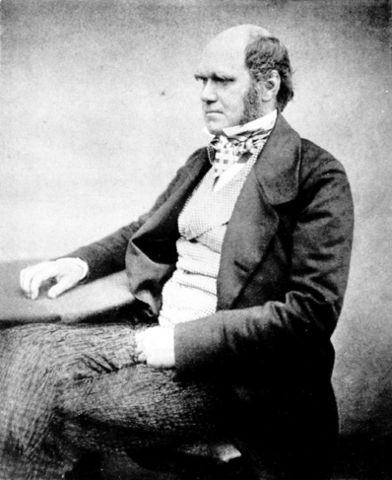 Your philosophy is an inextricable concomitant of your cosmology. Charles Darwin knew this all too well. Most people are at least passingly familiar with Darwin’s seminal work, The Origin of Species. In it, he proffers a framework for understanding the origins of human life – and all life – using his mechanism of evolution by natural selection. In his own words, here is Darwin’s theory in a nutshell:
As many more individuals of each species are born than can possibly survive, and as, consequently, there is a frequently recurring struggle for existence, it follows that any being, if it vary however slightly in any manner profitable to itself, under the complex and sometimes varying conditions of life, will have a better chance of surviving, and thus be naturally selected. From the strong principle of inheritance, any selected variety will tend to propagate its new and modified form. (Origin of Species, p. 29)
Darwin begins with the assumption that life, at its root, is a struggle for survival. He then concludes that those who win the struggle for survival carry on while those who lose the struggle do not. This is natural selection. Moreover, those who win the struggle for survival propagate more of their kind and develop “modified” characteristics which further benefit them in their struggle. This is evolution. Over time – indeed, over lots and lots of time – these beneficial characteristics continue to evolve so radically that whole new species arise from common ancestors while other, weaker species die out. This, then, is the origin of species. This is the origin of our species. We are the product of the cold hand of evolution by natural selection. This is Darwin’s cosmology, that is, his view of the laws of the world and, by extension, the cosmos.
But how you view things cosmologically inevitably informs how you view things philosophically. That is why, after publishing The Origin of Species, Darwin published The Descent of Man, a philosophical take on his cosmological theory. Thus, Darwin lamented according to the presuppositions of his cosmological theory of evolution:
We civilized men do our utmost to check the process of elimination; we build asylums for the imbecile, the maimed, and the sick; we institute poor-laws; and our medical men exert their utmost skill to save the life of every one to the last moment. There is reason to believe that vaccination has preserved thousands, who from a weak constitution would formerly have succumbed to small-pox. Thus, the weak members of civilized societies propagate their kind. No one who has attended to the breeding of domestic animals will doubt that this must be highly injurious to the race of man. It is surprising how soon a want of care, or care wrongly directed, leads to the degeneration of a domestic race; but excepting in the case of man himself, hardly any one so ignorant as to allow his worst animals to breed. (Descent of Man, p. 168)
Darwin laments that humans work against evolutionary progress through wrongheaded ignorant attempts to save and care for those which natural selection would eliminate. If evolution by natural selection is the incontrovertible law of the forward progress of life, then to work against it by tending to the weak and sick is to take life backwards rather than forwards.
Most people, of course, are not nearly so bold connecting cosmological evolution to philosophical evolution as was Darwin. Allowing our sick and maimed to die in the name of natural selection would appall the vast majority us. And yet, Darwin is simply teasing out the philosophical inevitabilities of his cosmological presuppositions. He is being perfectly consistent. Why aren’t we?
The fact of the matter is, the way one views the universe informs and, finally, dictates the morals and ethics one holds. Darwinian evolution, if it is perceived to be the engine behind the improvement of life, cannot be meddled with by the likes of so-called “do-gooders” who are not really doing good at all. For such people are slowing evolution’s forward march by caring for the lesser evolved among us.
Christianity, of course, has a very different view of humanity’s place and value. According to Christianity, human beings are not merely the products of an inexorable evolutionary march, eventually to be displaced as the kings of the cosmos by a better and higher form of life thanks to natural selection. Rather, we are specially created by God “in His own image” (Genesis 1:27) to be the caretakers of His creation (cf. Genesis 1:28-31). Thus, we can, and are even bound, not by some unfathomably lengthy evolutionary progress, but by the intentions of our Creator. And one of His intentions for us is “to love mercy” (Micah 6:8). So, we are merciful to each other. We care for those who cannot care for themselves.
Your philosophy is an inextricable concomitant of your cosmology. So what is your cosmology? One that is driven by evolution by natural selection? Or one that rejoices in the merciful, creative hand of our God? How you answer that question makes all the difference in how you view your life…and the lives of others.
Help! I’ve Lost My Faith!
 Just in time for the stress of the holidays, Concordia Lutheran Church has published a new pamphlet titled, “Help! I’ve Lost My Faith!” In a world and in times where Christianity and Christians are regularly attacked and maligned, our faith can sometimes get shaken. So I invite you to check out this pamphlet and tell me what you think. It’s available for download by clicking here. Here’s a taste of what’s in it:
Every Christian experiences a time when he or she wonders, “Have I lost my faith?” Sometimes, it’s a habitual sin that a person is sure has completely destroyed his relationship with God. Sometimes, it’s a grave tragedy that compels a person to ask. “If God exists, why didn’t He stop this?” Sometimes, it’s a feeling of betrayal which leads one to exclaim, “I can’t believe God would do this to me!” And amidst such pain, frustration, confusion, and bitterness, we can be left wondering, “Has God abandoned me? Have I abandoned Him? Have I lost my faith?”
An Atheist Confronts Death
 I recently learned that Christopher Hitchens, noted atheist and author of God Is Not Great: How Religion Poisons Everything, has been stricken by cancer. In an article for Vanity Fair, Hitchens makes what I consider to be some astonishing statements. First, he is so bold as to personify death: “I have been taunting the Reaper into taking a free scythe in my direction and have now succumbed to something so predictable and banal that it bores even me.” Death has a face in Hitchens’ mind – and a grim face at that. Death is a Reaper. Actually, death is the Reaper with a capital “R.” No longer is death merely a force of nature. It is a sinister character. I, hopefully not surprisingly, would agree. Death is sinister because death is sinful – the result of a fallen and broken creation. Of course, Hitchens continues by calling this character “predictable and banal,” which I suppose it is, for we all die, but it doesn’t make it any less grim.
Hitchens’ second astonishing statement comes at the end of his article:
I am quietly resolved to resist bodily as best I can, even if only passively, and to seek the most advanced advice. My heart and blood pressure and many other registers are now strong again: indeed, it occurs to me that if I didn’t have such a stout constitution I might have led a much healthier life thus far. Against me is the blind, emotionless alien, cheered on by some who have long wished me ill. But on the side of my continued life is a group of brilliant and selfless physicians plus an astonishing number of prayer groups.
This statement did more than astonished me, it blew me away. First, as far as I can tell, the “blind, emotionless alien” to which Hitchens refers is the cycle of life and death, standardized and ruled, according to many atheists, by evolutionary theory and natural selection. It is what another atheist luminary Richard Dawkins called, “the blind watchmaker.” And yes, if true, this cycle is blind and emotionless. Indeed, it is more than emotionless, it is merciless. It cares not about our lives and our fears and our hopes and our dreams. But curiously, Hitchens continues by noting that this “blind, emotionless alien” is “cheered on by some who have wished me ill.” How something “emotionless” can be moved by “cheers” of encouragement, I do not know. But I do know that it is morally base to cheer on the death of another. Theologically, death is a result of sin. To cheer on death, then, is to cheer on sin. Death may be inevitable and sometimes, as in cases of war or capital punishment, sanctioned and permitted according to the governing authorities and the concerns of justice, but it is not cheer-worthy. Blessedly, however, Hitchens continues by noting that on the side of his life “is a group of brilliant and selfless physicians plus an astonishing number of prayer groups.” It almost sounds as if Hitchens is admitting that “selfless physicians,” “selfless” being a moral designation foreign to committed evolutionary atheism, and “prayer groups” have some sort of power to cheat death. Is Hitchens admitting that prayer works? If so, how does he think it works? And why does he think it works?
I myself believe that prayer does work, but only because of the One to whom we pray. For the One to whom we pray has power over death. As the apostle Paul writes, “‘Where, O death, is your victory? Where, O death, is your sting?’ The sting of death is sin, and the power of sin is the law. But thanks be to God! He gives us the victory through our Lord Jesus Christ” (1 Corinthians 15:55-57). Jesus conquers death and brings life. There’s an empty grave to prove it. And it is in that spirit that I pray that Christopher Hitchens’ grave stays empty for a good time longer in this present age – and on the Last Day. Christ has the power to make it so. I pray that Hitchens learns to trust that.

Letting Jesus Pick And Choose
 One of the joys I have as a pastor is being able to think through theological questions with the great folks here at Concordia. And the great folks here at Concordia aren’t afraid to ask. From questions about Christ’s work on the cross to questions about suffering to questions about heaven to questions about Hebrew and Greek, I’ve received plenty of terrific queries which have been a joy – and many times a challenge – for me to answer.
From time to time, I not only like to answer people’s questions in a meeting at my office, or on the phone, or in an email, but also on my blog, especially if it is a question that I commonly receive. And that is what I thought I’d do with this often asked question: “How does the Old Testament relate to the New Testament? If both testaments are God’s inspired Word, then why do we insist on following some of the Old Testament’s laws like the Ten Commandments while at the same time disregarding its ceremonial and sacrificial stipulations?” This is a good, and very complex, question!
It is true that, on the surface, it can almost seem like Christians sometimes pick and choose which Old Testament laws they would like to follow. The one about honoring your father and mother (cf. Exodus 20:12)? Yeah, we ought to keep that one around – especially if we have children. The one about sprinkling a bird’s blood over a house after it has been cleansed from mildew (cf. Leviticus 14:33-57)? We usually take a pass on that one.
So why do we follow some laws and not others? Classically, a distinction has been made between those laws which are moral and those which are ceremonial. Moral laws stand through both testaments. Thus, honoring fathers and mothers, as a moral mandate, continues to hold sway over our thoughts, words, and deeds, as do all of the Ten Commandments. Ceremonial laws, however, with all of their sacrifices and rituals, have been abrogated by Christ. As the preacher of Hebrews writes: “When [Jesus] had offered for all time one sacrifice for sins, He sat down at the right hand of God…And where [sins] have been forgiven, there is no longer any sacrifice for sin” (Hebrews 10:12, 18). Following Jesus’ sacrifice, no more sacrifices are needed. Therefore, to insist on following the Old Testament sacrificial stipulations is an affront to and a debasement of the sacrifice of Christ on the cross.
Finally, the reason we do not follow every Old Testament stipulation is because of the way we read our Bible. We read every page, even the ones with all of the strange rules and regulations, through the lens of what Christ has taught, done, and fulfilled. As Jesus Himself says, “These are the Scriptures that testify about Me” (John 5:39). Martin Luther echoes this sentiment when he writes: “I have often said that whoever would study well the Bible, especially the spiritual significance of the histories, should refer everything to the Lord Christ” (What Luther Says 207). Thus, we interpret and follow the Scriptures of the Old Testament the way that Christ follows and interprets the Scriptures of the Old Testament. No Old Testament Scripture, then, is to be read apart from God’s revelation in Christ.
Ben Witherington III, professor of New Testament at Asbury Theological Seminary, has perhaps written the finest, most succinct statement as to how the Old Testament relates to the New Testament that I have found: “Jesus, as God’s Wisdom come in person, acts with sovereign freedom when it comes to the law. Sometimes He intensifies its demands, sometimes He sets aside its demands, sometimes He affirms its demands, sometimes He offers a new teaching that can in some cases supplement and in others supplant previous teaching” (The Indelible Image, vol.1, 32). This is precisely right. As Paul writes, “Christ is the end of the law” (Romans 10:4). The Greek word for “end” is telos, meaning “goal.” Thus, the Old Testament laws find their goal in how Christ arbitrates, abrogates, interprets, and fulfills them. You cannot read the Old Testament correctly if you do not read it with Jesus in mind.
So why do we not offer sacrifices to God when our homes are filled with mildew? Because Christ has offered the perfect and final sacrifice for all time. Why do we still continue to honor our parents? Because Christ has taught us to do so (cf. Mark 7:9-13). We let Jesus pick and choose which laws we continue to follow and which laws have been abrogated by His work on the cross. Reading the Old Testament is as simple as listening to Jesus.
Want to learn more? Go to
www.ConcordiaLutheranChurch.com
and check out audio and video resources from Pastor Tucker’s
messages or Pastor Zach’s ABC’s!
Paying the Preacher – 1 Corinthians 9:3-14
 It has become an all too well known story. A renowned pastor with a gigantic ministry has more money in his personal coffers than Fort Knox hides in its vault. A local news organization comes in to investigate the pastor’s lifestyle and what is revealed shocks believers and appalls non-believers: private jets, sprawling mansions, excessive luxuries. And the pastor at the center of it all seems to spend more time fleecing his flock than shepherding them into the green pastures of God’s Word.
With such scandalous abuses littering the history of the modern American Christian Church, it is no surprise that many people look at their pastor’s paycheck with at least a little bit of suspicion. “What’s really going on financially behind the scenes?” someone may wonder. Indeed, recently, I received a question from someone concerning 1 Corinthians 9, where Paul argues that those who preach the gospel should be duly compensated for their labor. The apostle writes:
This is my defense to those who sit in judgment on me. Don’t we have the right to food and drink? Don’t we have the right to take a believing wife along with us, as do the other apostles and the Lord’s brothers and Cephas? Or is it only I and Barnabas who must work for a living? Who serves as a soldier at his own expense? Who plants a vineyard and does not eat of its grapes? Who tends a flock and does not drink of the milk? Do I say this merely from a human point of view? Doesn’t the Law say the same thing? For it is written in the Law of Moses: “Do not muzzle an ox while it is treading out the grain.” Is it about oxen that God is concerned? Surely he says this for us, doesn’t he? Yes, this was written for us, because when the plowman plows and the thresher threshes, they ought to do so in the hope of sharing in the harvest. If we have sown spiritual seed among you, is it too much if we reap a material harvest from you? If others have this right of support from you, shouldn’t we have it all the more? But we did not use this right. On the contrary, we put up with anything rather than hinder the gospel of Christ. Don’t you know that those who work in the temple get their food from the temple, and those who serve at the altar share in what is offered on the altar? In the same way, the Lord has commanded that those who preach the gospel should receive their living from the gospel. (1 Corinthians 9:3-14)
A few things are especially notable in Paul’s arguments in these verses. First, in verse 3, Paul makes a “defense” of his ministry. The Greek word for “defense” is apologia, a technical term for a legal defense in a court of law. Thus, there are some who are questioning the very validity of Paul’s ministry. Interestingly, however, his antagonist’s accusations seem to flow not from the fact that he’s being compensated to preach the gospel, but from the fact that he’s not being compensated! Paul frankly admits that though he has a right to receive remuneration for his preaching, he “did not use this right” (verse 12). The argument of his detractors, then, is this: “You only get what you pay for! And you’re not paying Paul anything! Thus, you’re not getting good preaching! So you should turn to us! Our preaching is better that Paul’s because we’ll charge you for it!” This, of course, is the reasoning of a charlatan. Compensation or lack thereof does not make the message of the gospel any more or less true. The gospel is the gospel, regardless of remuneration.
With this in mind, Paul continues by explaining that his free preaching of the gospel does not mean that all pastors should not be compensated for their work. Paul quotes Deuteronomy 25:4 to prove his point: “Do not muzzle an ox while it is treading out the grain” (verse 9). In ancient Israel, an ox, while he pulled a sledge around a threshing floor to separate the kernels of grain from their husks, would remain un-muzzled so he could eat some the grain while he was threshing it. Thus, just as ox eats his grain as payment for his labor, so should a pastor be compensated for his labor. Indeed, Paul concludes: “The Lord has commanded that those who preach the gospel should receive their living from the gospel” (verse 14).
So what does all this mean? Well, on the one hand, Paul warns against those pastors who have a sense of entitlement because of their preaching of the gospel. A pastor should never say, “My preaching is great and therefore I deserve an exorbitant paycheck,” as those who were disparaging Paul’s ministry were saying. On the other hand, Paul clearly says that a congregation should faithfully support its pastors. Indeed, one of the things for which I consistently thank God is the way in which my beloved Concordia supports me as a pastor – and not only me, but all of the pastors here. I praise God for the faithfulness and generosity of Concordia’s members. And it is my intention and prayer, by the Spirit’s power, to serve Christ’s Church well and faithfully all the days of my life.
I am one who makes my living from preaching the gospel. And preaching the gospel is a weighty task. But it’s also a blessed privilege. I am thrilled beyond words that I get to do it.
Do you have a theological question you would like Zach to answer on his blog? Email him at
zachm@concordia-satx.com.
On Prayer – Matthew 6:5-13
 Prayer. Most people do it. Few feel completely comfortable with it. After all, there are certain nagging questions which perennially plague those who pray. “Will God hear my prayer?” “What if I’m not comfortable praying with or in front of others?” “How do I pray, anyway?”
Recently, I received a question concerning Jesus’ teaching on prayer. Because there are many questions pertaining to prayer, I thought it might be helpful to answer the above questions in light of what Jesus teaches in Matthew 6:
And when you pray, do not be like the hypocrites, for they love to pray standing in the synagogues and on the street corners to be seen by men. I tell you the truth, they have received their reward in full. But when you pray, go into your room, close the door and pray to your Father, who is unseen. Then your Father, who sees what is done in secret, will reward you. And when you pray, do not keep on babbling like pagans, for they think they will be heard because of their many words. Do not be like them, for your Father knows what you need before you ask him. This, then, is how you should pray: “Our Father in heaven, hallowed be your name, your kingdom come, your will be done on earth as it is in heaven. Give us today our daily bread. Forgive us our debts, as we also have forgiven our debtors. And lead us not into temptation, but deliver us from the evil one.” (Matthew 6:5-13)
With Jesus’ words fresh in our minds, then, here are the most common questions I receive pertaining to prayer.
Question 1: Will God hear my prayer?
Yes! Jesus says that when you pray, “your Father…will reward you” (verse 6). For your heavenly Father to reward you, he must first hear you. And he does!
Notably, there are two different types of rewards talked about in Matthew 6. The first is the reward received by hypocrites who pray to impress men rather than to be heard by God. In verse 5, the Greek word for their “reward” is misthis, a word denoting a compensation or payment. Thus, these hypocrites earn their reward from men because their impressive, long, flowery, public prayers.
The reward which comes from our heavenly Father, however, is of a different sort. The word for “reward” in verse 6 is apodidomi, a word which simply means, “gift.” A reward from God is not earned by the merit of our prayer, but freely given by God’s grace. God wants to give his “good gifts to those who ask him” (Matthew 7:11). God hears your prayers…and he responds! He may not respond with a temporal gift, but he always gives his eternal gifts of forgiveness of sins, life, and salvation to those who ask him.
Question 2: What if I’m not comfortable praying with or in front of others?
Jesus commends those who pray “in secret” (verse 6). Thus, it is certainly okay to pray silently and by yourself. If you’re not comfortable praying with or in front of others, that’s okay. Just continue to offer personal and silent prayers to your heavenly Father.
However, as wonderful as personal praying is, we are also called to learn how to “confess your sins to each other and pray for each other so that you may be healed” (James 5:16). It is important to learn how to pray with and for others. When you do pray for others, your prayers do not need to be eloquent or long. A simple, and yes, even bumbling, prayer is heard by God like any other. And blessedly, it also boosts the spirit of the person for whom you are praying. If you’ve never prayed with someone, try it with a trusted friend!
Question 3: How do I pray, anyway?
Jesus offers guidance both in how we are and how we are not to pray. First, he explains how we are not to pray: “And when you pray, do not keep on babbling like pagans, for they think they will be heard because of their many words.” (Matthew 6:7). They key to understanding Jesus’ guidance here is the phrase, “like pagans.” The pagans of Jesus’ day offered repetitive prayers to false gods, thinking they could coerce these gods with incantations, getting them to do what they wanted. An example of this comes in Acts 19:34: “They all shouted in unison for about two hours: ‘Great is Artemis of the Ephesians!’” The true God cannot be coerced by such a sterile formulaic cry. It’s not that prayers can’t be long, it’s that God won’t hear a prayer simply because it’s verbose. Rather, he’ll hear a prayer – whether it be a prayer of many or few words – because it’s prayed in Jesus’ name.
This leads us to how we are to pray. Jesus gives us gracious guidance in this regard when he says, “This, then, is how you should pray” (Matthew 6:9) and then launches into what is popularly known as the Lord’s Prayer. The Greek word for “this” is houtos, a word meaning everything from “exactly” to “in such a manner.” In other words, Jesus, when he tells his disciples, “This…is how you should pray,” seems to be giving his followers precise instructions on prayer as well as more general parameters. Thus, we ought to both pray the Lord’s Prayer and pray like the Lord’s Prayer. When all else fails, when the words just won’t come, pray the Lord’s Prayer! After all, it was given to us by none other than our Lord himself.
But do not only pray Lord’s Prayer word for word, also use it to guide your praying. When you pray, do you approach God as your loving heavenly Father? Do you pray for his will to be done? Do pray for your needs? Do you seek God’s forgiveness of sin and protection from the evil one? These requests ought to mark our prayers because we are encouraged to make these requests by Jesus.
Finally, prayer is a precious gift from God which out to be used regularly. It is no wonder that the apostle Paul writes, “Pray continually” (1 Thessalonians 5:17). The Greek word for “continually” is adialeiptos, a word used outside the New Testament to describe chronic coughs. Thus, prayer for the Christian should be as natural as coughing is for a cold patient. So pray today…many times. Your Father will gladly hear and help.
Do you have a theological question you would like Zach to answer on his blog? Email him at
zachm@concordia-satx.com.
On Baptism, Babies, and Salvation…
 I received the following question recently concerning the Lutheran Church’s stance on the baptism of babies. Because this is a perennial question, I thought it might be helpful to post my answer on my blog. I hope it is a blessing to you.
Question: Would you please explain the baptism of babies? Do you think this is a salvation experience? If so, why?
There are really two parts to this question. The first has to do with the baptism of babies and whether or not such an action is appropriate. I would say it certainly is. Biblically, the “household references” which surround baptism are pertinent to understanding the baptism of infants. A few examples will suffice:
Acts 15:14-15 The Lord opened Lydia’s heart to respond to Paul’s message. When she and the members of her household were baptized, she invited us to her home.
Acts 16:31, 33 “Believe in the Lord Jesus, and you will be saved – you and your household”…At that hour of the night the jailer took them and washed their wounds; then immediately he and all his family were baptized.
1 Corinthians 1:16 “I also baptized the household of Stephanas; beyond that, I don’t remember if I baptized anyone else.”
This is just a sampling of the “household references” which surround baptism. This term “household” refers not only to adults, but also to children. Again, we do well to consider just a few biblical and historical references of households which include children:
1 Samuel 22:16, 18-19 And the king said, “You shall surely die, Ahimelech, you and all your father’s house.” Then the king said to Doeg, “You turn and strike the priests.” And Doeg the Edomite turned and struck down the priests, and he killed on that day eighty-five persons who wore the linen ephod. And Nob, the city of the priests, he put to the sword; both man and woman, child and infant, ox, donkey and sheep, he put to the sword.
This reference is significant because the “father’s house” in verse 16 is explicitly connected to those who are children and infants in verse 19.
Genesis 17:12 For the generations to come every male among you who is eight days old must be circumcised, including those born in your household or bought with money from a foreigner – those who are not your offspring.
Again, this reference is significant because eight-day old infants are considered to be part of one’s household.
Epistle to the Smyrnaeans 13:1 “Greetings to the families of my brothers, along with their wives and children.”
This greeting, written by the church father Ignatius around the turn of the second century, simply and logically notes that households include children.
The weight of the above evidence suggests that when a “household” was baptized, children too were included.
Now, on the second part of the question: “Even if children were baptized in the early church, what’s the point? Is baptism a salvation experience?” Again, the answer to this question is unequivocally, “Yes.” The witness of Scripture is clear:
Acts 2:37-39 “Repent and be baptized, every one of you, in the name of Jesus Christ for the forgiveness of your sins. And you will receive the gift of the Holy Spirit. The promise is for you and your children and for all who are far off – for all whom the Lord our God will call.”
Note here that baptism is connected to forgiveness of sins and the reception of the Holy Spirit, both marks of salvation. Not only that, but “children” are specifically mentioned, once again emphasizing the importance of baptizing even our youngest.
1 Peter 3:18-22 For Christ died for sins once for all, the righteous for the unrighteous, to bring you to God. He was put to death in the body but made alive by the Spirit, through whom also he went and preached to the spirits in prison who disobeyed long ago when God waited patiently in the days of Noah while the ark was being built. In it only a few people, eight in all, were saved through water, and this water symbolizes baptism that now saves you also – not the removal of dirt from the body but the pledge of a good conscience toward God. It saves you by the resurrection of Jesus Christ, who has gone into heaven and is at God’s right hand – with angels, authorities and powers in submission to him.
A couple of things are notable about this passage. First, Peter explicitly connects baptism to salvation. There can be no doubt as to baptism’s salvific work. Second, in verse 21, Peter maintains that the water of water of Noah’s flood “symbolizes” the water of baptism. The Greek word for “symbolizes” is antitypos, meaning a “copy” or “knock-off” the original (see Hebrews 9:24 where the earthly temple is an antitypos of the heavenly one). Peter is arguing, then, that the water of Noah’s flood was only a knock off of the water that God was already anticipating in baptism. Baptism is bigger than the flood! Thus, baptism is clearly fundamental to God’s will and work in history and in our lives.
Whenever baptism is hailed as a “salvation experience,” the inevitable objection arises: “But I thought Jesus saved! How can you say that splashing some water on someone will save them?” Martin Luther addresses this objection when he writes:
Certainly not just water, but the Word of God in and with the water does these [salvific] things, along with the faith which trusts this Word of God in the water. For without God’s Word the water is plain water and no baptism. But with the Word of God it is a baptism, that is, a life-giving water, rich in grace, and a washing of the new birth in the Holy Spirit. (SC Baptism 3)
Luther reminds us that Baptism is no good if God does not show up. Baptism does not save us without Jesus. Rather, through baptism, Jesus comes to us and saves us. He declares us to be his children, even as the Father announced Jesus to be his beloved Son when he was baptized (cf. Matthew 3:13-17).
Baptism, then, is no magic trick where water is sprinkled on a baby and that water somehow saves them. Nor is baptism to be used as an insurance policy against hell, where a parent brings their child to be baptized and then never brings them to worship or teaches them the tenets of the faith, believing that, by some mysterious, inherent, undefined virtue in a baptism performed years ago, their child will be saved. God’s Word and baptism must go hand in hand, as Jesus himself teaches: “Therefore go and make disciples of all nations, baptizing them in the name of the Father and of the Son and of the Holy Spirit, and teaching them to obey everything I have commanded you” (Matthew 28:19-20). Baptism and the teaching of God’s Word go together. For it is there that we meet Jesus. And it is there that Jesus saves us.
And so, we continue to baptize. And we continue to share God’s Word. And God continues to work to save people like you and me. And so we thank God, who has given us baptism and his Word through which we can meet him and meet with him.
Do you have a theological question you would like Zach to answer on his blog? Email him at
zachm@concordia-satx.com.


 Pastor Zach's Blog