Posts filed under ‘Devotional Thoughts’
Resurrection! It’s Not Just for Jesus

One of my favorite parts of Holy Week is the music. Last night in Maundy Thursday worship, we sang of Christ’s body and blood, given for us sinners to eat and drink. I’ve been singing the words to this hymn this morning:
God’s Word proclaims and we believe
That in this Supper we receive
Christ’s very body, as He said,
His very blood for sinners shed.
Today, as we reflect upon the cross of Christ, we will sing another of my favorite songs:
Mighty, awesome, wonderful,
Is the holy cross.
Where the Lamb laid down His life
To lift us from the fall.
Mighty is the power of the cross.
And then, on Easter, will come this powerful anthem:
I know that my Redeemer lives;
What comfort this sweet sentence gives!
He lives, He lives, who once was dead;
He lives, my ever-living head.
The words of this final song, of course, are taken from the book of Job where, even after Job has lost everything, he declares his faith in God and his desire for an advocate to plead his case to God: “I know that my Redeemer lives, and at the last He will stand upon the earth. And after my skin has been thus destroyed, yet in my flesh I shall see God, whom I shall see for myself, and my eyes shall behold, and not another. My heart faints within me” (Job 19:25-27)! These words have long been taken by Christians as a foreshadowing of Christ’s resurrection. Hence, the reason we sing these words on Easter! Interestingly, however, it’s not just Christians who have found hints of a resurrection in Job’s story, the ancient Jews did too.
In the third century BC, a Greek translation of the Old Testament was commissioned. Because of the rampant Hellenization of the ancient world, many Jews could no longer read Hebrew, the language in which the Old Testament was originally written, and so this work of translating the Bible into Greek was undertaken so that people could read the Bible in their language. The Septuagintal translation of Job is especially interesting because whoever translated it seems to have a love for resurrection! Consider these passages:
- Job 14:14: Hebrew – “If a man dies, shall he live again?” Greek – “If a man dies, he shall live!”
- Job 19:26: Hebrew – “After my skin has been thus destroyed…” Greek – “And to resurrect my skin upon the earth that endures these sufferings…”
- Job 42:17: The Greek Septuagint adds a line to this verse not in the Hebrew text: “It is written of Job that he will rise again with those whom the Lord will raise.”
Clearly, the translator of Job believed in the resurrection! Thus, the book of Job not only foretells Jesus’ resurrection in that famous line from Job 19, it foretells the resurrection of Job and all the faithful as well. For because Christ has risen, we will rise! In the words of the prophet Daniel: “Many of those who sleep in the dust of the earth shall awake, some to everlasting life, and some to shame and everlasting contempt” (Daniel 12:2). For those who trust in Christ, we will be raised to everlasting life. Because Christ has risen, we will rise. The translator of Job knew and believed this. I hope you do too. For if you know and believe that your Redeemer lives, you can know and believe that you will live…forever.
Holy Week Sorrow and Celebration
 Right now in my personal devotions, I am reading through the book of Lamentations, a sorrowful song written by the prophet Jeremiah, which describes Israel’s defeat and exile at the hands of the Babylonians in 586 BC. Some of the language Jeremiah uses to describe Israel’s demise is grotesque and gut wrenching:
- The tongue of the nursing infant sticks to the roof of its mouth for thirst. (Lamentations 4:4)
- Their skin has shriveled on their bones; it has become dry as wood. (Lamentations 4:8)
- The hands of compassionate women have boiled their own children; they became their food during the destruction of the daughter of my people. (Lamentations 4:10)
Clearly, this is a tragic, despairing time. Indeed, even for a professional prophet such as Jeremiah, who has seen much sin and tragedy, the despair of the exile seems overwhelming. And Jeremiah places the blame for this despair squarely at the feet of God.
In chapter 3, Jeremiah laments his plight:
I am the man who has seen affliction under the rod of His wrath; He has driven and brought me into darkness without any light; surely against me He turns His hand again and again the whole day long. He has made my flesh and my skin waste away; He has broken my bones; He has besieged and enveloped me with bitterness and tribulation; He has made me dwell in darkness like the dead of long ago. He has walled me about so that I cannot escape; He has made my chains heavy; though I call and cry for help, He shuts out my prayer; He has blocked my ways with blocks of stones; He has made my paths crooked. He is a bear lying in wait for me, a lion in hiding; He turned aside my steps and tore me to pieces; He has made me desolate; He bent His bow and set me as a target for His arrow. He drove into my kidneys the arrows of his quiver; I have become the laughingstock of all peoples, the object of their taunts all day long. He has filled me with bitterness; He has sated me with wormwood. He has made my teeth grind on gravel, and made me cower in ashes. (Lamentations 3:1-16)
Notice the pronoun Jeremiah employs again and again to describe who is responsible for his misery: “He.” “He” has brought Jeremiah misery, trouble, pain, and despair. It’s “His” fault that Jeremiah’s plight is what it is. Who is this “He”? None other than God, of course. God has afflicted Jeremiah in the most miserable of ways.
And yet, even in his misery, Jeremiah has not lost all hope: “But this I call to mind, and therefore I have hope: The steadfast love of the LORD never ceases; His mercies never come to an end; they are new every morning; great is Your faithfulness” (Lamentations 3:21-23). Jeremiah believes that finally, ultimately, God’s steadfast love will prevail. Indeed, it’s interesting the way Jeremiah describes this steadfast love just verses later: “Though He cause grief, He will have compassion according to the abundance of His steadfast love; for He does not willingly afflict or grieve the children of men” (Lamentations 3:32-33). Though God does afflict and grieve people because of their sin, Jeremiah says, He does not willingly do so. God’s will is not to pour out His hot wrath, but His steadfast love. The Hebrew word for “willingly” is milibo, a word meaning, “from His heart.” Thus, Jeremiah is saying that from God’s heart does not come affliction. Rather, from God’s heart comes His steadfast love. God’s will is wrapped in love.
Luther describes God’s wrath at sin and God’s will of love by making a distinction between the “alien” and the “proper” work of God:
We must know what is meant by the work of God. It is nothing else but to create righteousness, peace, mercy, truth, patience, kindness, joy, and health, inasmuch as the righteous, truthful, peaceful, kind, joyful, healthy, patient, merciful cannot do otherwise than act according to His nature. Therefore God creates righteous, peaceful, patient, merciful, truthful, kind, joyful, wise, healthy men…But He cannot come to this His proper work unless He undertakes a work that is alien and contrary to Himself…Therefore, since He can make just only those who are not just, He is compelled to perform an alien work in order to make them sinners, before He performs His proper work of justification. Thus He says, “I kill and I make alive; I wound and I heal.” (AE 51:18-19)
God must judge us before He can justify us, Luther says. His alien and His proper work go hand in hand. Thus, both God’s alien work of judgment and God’s proper work of love are needed in Jeremiah’s life. And both God’s alien work of judgment and God’s proper work of love are needed in our lives too. But lest we forget, through faith in Christ, God’s proper work prevails!
The alien and the proper work of God meet most clearly in the death and resurrection of Christ, which we remember during this Holy Week. Luther explains:
God’s alien work is the suffering of Christ and sufferings in Christ, the crucifixion of the old man and the mortification of Adam. God’s proper work, however, is the resurrection of Christ, justification in the Spirit, and the vivification of the new man, as Romans 4:25 says: “Christ died for our sins and was raised for our justification.” (AE 51:19)
God judges His Son on the cross, killing Him for the sins of the world. This was not something He delighted in doing – it was alien to Him – but it was necessary. For Christ’s crucifixion satisfied God’s righteous wrath at sinners…sinners like you and me (cf. Romans 3:25-26). And with God’s wrath satisfied through Christ’s suffering and death on the cross, God could now move to His proper work: Giving to His children His steadfast love which never ceases.
This Holy Week, spend some time meditating on both the alien and the proper work of God. For both are needed. But finally, one prevails! For God’s work does not end in an alien way. Rather, it ends in its proper way. It ends in our salvation through faith in Christ. Praise be to God!
Where You Begin and Where You End
 I have often said, when teaching in various settings, “Where you begin is where you end.” This is my axiomatic, though admittedly somewhat simplistic, way of expressing the truth that all of us come to a situation, a problem, or a challenge with our own preconceived notions and biases. These preconceived notions and biases, in turn, inevitably color the conclusions we draw and the solutions we formulate. This is especially true when it comes to working with the text of Scripture. If you approach the Bible with a stance of pessimism and incredulity, what you find will be appropriately pessimistic and incredulous. Conversely, if you approach the Bible with a stance of awe and a desire to “give the Bible the benefit of the doubt,” as it were, the conclusions you draw will strengthen your faith soothe your troubled soul. It is no secret that I am in the latter camp of how I approach Holy Scripture. In light of my ABC yesterday on the doctrine of the inspiration of Scripture, I thought that this quote from Ben Witherington III, given at the Greer-Heard Forum last Saturday at New Orleans Baptist Seminary, offered some keen insight into why I am in this latter camp:
I don’t believe in “justification by doubt.” I don’t believe that philosophical skepticism is the same thing as critical thinking, and I also don’t think that the sort of historiography that is undergirded by such a prioris can help us very much with the question are the Gospels reliable, truthful witnesses when it comes to the historical Jesus. In fact, if you want to actually get at the truth of something, you have to enter into dialogue with that source giving it the benefit of the doubt, allowing it to have its say, and while one doesn’t put one’s critically thinking cap aside, if you do not approach the material with an open mind and a willingness to learn from it, you won’t get at the truth of the matter, not even the historical truth of the matter. You can’t possibly analyze the actual nature of a raging fire, by pouring cold water on it, and then picking over the ashes and charcoal thereafter.
Luther on Romans 12
 This morning’s text in worship is Romans 12. Paul opens this chapter, “Therefore, I urge you, brothers, in view of God’s mercy, to offer your bodies as living sacrifices, holy and pleasing to God – this is your spiritual act of worship.” Luther offers some great context on this verse – what comes before it and what follows it – in his commentary on Romans:
In the preceding chapters, the apostle laid “the true foundation which is Christ” (1 Corinthians 3:11), or “the first rock,” upon which the wise man builds (Matthew 7:24), and he destroyed the false foundation, namely, man’s self-righteousness and merits, which are as “the sand” upon which the foolish man builds (Matthew 7:26). Here now he proceeds to “build upon this foundation gold, silver, and previous stones” (1 Corinthians 3:12). Good works, which are the building, must above all have a sure and dependable foundation on which the heart can purpose to stand and to rely forever, so that, even in the case that the site may not yet have been built upon, the site is ready to do so. The moralists do the opposite of this with their good works. They seek to put their trust in their conscience and, when they have performed many good works, they think they have done enough for themselves, so that they can feel secure. This is nothing else than to build on the sand and to reject Christ. The apostle tries hard to prevent this; this is the purpose of all his letters. To say, as is commonly done, that “sand” means the riches of the world is a superficial and weak exegesis. For Christ speaks here of the people who build (i.e., who do good) and not of misers and worldlings who rather destroy themselves than build up anything.
Hence, it is good works that the apostle calls “sand.” And it is upon this foundation that these people try to build their righteousness in order to obtain a dwelling place for the conscience and peace of mind. But, as a matter of fact, only Christ is this foundation – and before all good works. For even before we think of doing enough or building up, He has given us the foundation as a free gift, namely, a quiet conscience and a trusting heart. Has there ever been a builder stupid enough to lay also the foundation? Do not the builders look for the foundation that is already laid in the earth or do they not accept what is offered to them? So then, just as the earth offers us a foundation without our effort, so Christ offers Himself without us as our righteousness, peace, and security of conscience in order that from then on we can continually build upon Him in doing good. (WA 56)
Being Interrupted: A Lesson from Augustine
 I am most definitely a “Type A” personality. I like to plan, organize, and execute – preferably in a deliberate, linear, and flawless manner. Yet, as anyone who has walked this earth for more than a second knows, life does not always proceed in a deliberate and linear manner. And it certainly does not proceed flawlessly! Interruptions, accidents, and personal catastrophes make life an adventure in which you never know what the next chapter will bring.
Perhaps it is my penchant for planning that makes me appreciate so much this quote from Augustine (pictured above):
But I am annoyed because of the demands that are thrust on me…arriving unannounced, from here, there, and everywhere. They interrupt and hold up all other things that we have so neatly lined up in order. They never seem to stop. (Peter Robert Lamont Brown, Augustine of Hippo: A Biography, 468)
I can honestly say that I know how Augustine feels. For when I get things “neatly lined up in order” and am then “interrupted,” I get “annoyed.”
But should I get annoyed? I suppose a little bit of a human annoyance is inevitable. And yet, I can’t help but remember the attitude of my Lord when He got interrupted:
Then Jesus took His disciples with Him and they withdrew by themselves to a town called Bethsaida, but the crowds learned about it and followed Him. He welcomed them and spoke to them about the kingdom of God, and healed those who needed healing. (Luke 9:10-11)
Jesus desires to withdraw His disciples to get a little bit of rest and relaxation with His disciples. But then, He gets interrupted. Crowds, eager to hear Him teach and have their ills healed, follow Him so that He cannot get a moment’s rest. They arrive “unannounced from here, there, and everywhere.” They interrupt Him.
How does Jesus respond to this crowd’s insensitive interruption? He welcomes them (cf. verse 11). The Greek word for “welcomed” is apadechomai, meaning, “to accept,” or “to receive.” Interestingly, this word is sometimes used to describe the forgiveness of sins (e.g. Genesis 50:17 LXX). Thus, Jesus welcomes the crowd, and in His welcome, there is forgiveness. And this too is our hope: That in Christ, we are welcomed in spite of sin because we are forgiven of our sin.
Augustine pens his candid admission of being annoyed by interruptions as he is trying to write his greatest work, The City of God. And so it is understandable that, while working on such a weighty tome, he would be annoyed by the delays. After all, his task is vital! But so are his interruptions. For a man named Vincentius Victor is interrupting Augustine, questioning him on his view of man’s soul. And a man’s soul is a big deal – not only as the subject of theological debate, but in the eyes of God. And so, Augustine takes a break from his work on The City of God to answer Victor.
Like Jesus, do we welcome those who interrupt us? Yes, what we are working on at the time may be important, but the interruption may be just as important. Moreover, how do we respond to interruptions? With annoyance in our hearts or with the welcoming spirit of our Lord? Although interruptions are bound to annoy us, especially if you’re a “Type A” personality like me, it is worth it to see some interruptions not simply as glitches in your plans, but as divine appointments for your soul. So welcome an interruption today! After all, the interruption may just be the most important – and even the best – part of your day.
Homosexuality, Hatred, and the Gospel
 With both interest and sadness, I have been following the slew of recent student suicides by young men who were reportedly the targets of anti-homosexual bullying. The most widely reported of these was Tyler Clementi, a promising eighteen year old freshman at Rutgers University who jumped off the George Washington bridge after his roommate secretly streamed his sexual encounter with another male. Other recent suicides include those of Justin Aaberg and Billy Lucas, both fifteen. As these tragic stories have trickled through our news cycles, one word to describe the motive of the bullies who drove these young men to despair has been brandished about again and again: homophobia. Consider, for instance, the headline that ran in the Huffington Post yesterday: “Homophobia: The Plague That Is Killing Our Youth.”
It seems as though “homophobia” is a word that is used to describe just about every conceivable form of opposition toward homosexuality. When New York gubernatorial candidate Carl Paladino spoke to a group of Jewish children about being “brainwashed into thinking homosexuality is an equally valid and successful option” and then followed his comment up by saying, “It isn’t,” his competitor, Andrew Cuomo, accused him of “stunning homophobia.” The PBS newsmagazine show “Frontline” has a special titled, “Assault On Gay America,” complete with a web-based “Homophobia Questionnaire” that includes such statements as “Homosexuality is immoral” and “Homosexuality is acceptable to me” and then asks you to rate whether you “strongly agree” or “strongly disagree” with these statements. Last week, the Christian Science Monitor ran an article titled, “Homophobia Hurts Straight Men, Too,” which equated homophobia with “intolerance.”
The stories of young men who have been driven to despair and suicide by anti-homosexual bullying are tragic. But I am not sure that we help their cause, nor adequately impugn their attackers, by simply decrying the problem of “homophobia.” I know how the argument goes: Anti-homosexual bullying is really the product of deep-seeded anxiety concerning a person’s own sexual desires. But in most cases, this connection is empirically indemonstrable. It is merely an ad hominem accusation. Moreover, taking a moral or ethical stance against homosexual activity cannot be mechanically dubbed as “homophobic.” For, in many of these instances, the driver of such a stance is not one of fear, but one of concern for the effects of homosexual activity on individuals and on society.
Perhaps it is time to trade the epithet “homophobia” for a more accurate, and really more damning, driver behind those who bully homosexuals: hatred. Bullying another person for whatever reason can be driven by nothing less than a ghastly arrogance that disdainfully looks down on others who it considers “different” or “lesser” in order to build itself up.
Blessedly, Christians are uniquely poised to address such hatred, for our Lord has told us: “By this all men will know that you are My disciples, if you love one another” (John 13:35). Christians are called to love others. What does this mean? In the case of those engaged in homosexual lifestyles, it means loving them in a way that “does not delight in evil, but rejoices with the truth” (1 Corinthians 13:6). And the truth is that homosexual activity is immoral (cf. Leviticus 18:22) and unnatural (cf. Romans 1:26-27). This needs to be said! But it does not need to be said in a way that belittles, badgers, or bullies another person. Rather, it needs to be said out of a love that is simply honest enough to offer a biblical assessment of sin coupled with an affirmation of God’s love for sinners: “But God demonstrates His own love for us in this: While we were still sinners, Christ died for us” (Romans 5:8). In the case of those who demonstrate hatred toward homosexuals by bullying them, showing love means, once more, addressing their sin in a way that “does not delight in evil, but rejoices with the truth.” And the truth is, those who hate are “in darkness” (1 John 2:9) and are murderers (cf. 1 John 3:15). And yet, this biblical assessment of sin must, once again, be coupled with an affirmation of God’s love for sinners.
As I have read these recent news stories concerning the suicides of these young, homosexual men, I have noticed that they sound a note of deep ethical concern – and appropriately so – concerning the plight of the victims of these hoary anti-homosexual attacks. Conspicuously absent, however, is any concern for the attackers. Do they not need our love too? For if we hate those who hate homosexuals, have we not fallen prey to their same sin of hatred? This is the point that the news stories which cover these tragedies seem to consistently miss.
As Christians, we are called to be concerned not only for the victims, but also for the attackers. This is our call by the gospel. The gospel calls us, as Christians, to confront sin – all sin – and to love people – all people. It calls us to confront even the sin that the world sanctions and to love even the people that the world hates. And it calls us to show people the way of eternal life. And in a world that has seen far too many suicides recently, I can’t imagine a more precious promise than life.
Will the Real Jesus Please Stand Up?
 One of my favorite lines from the movie “Talladega Nights” comes when Ricky Bobby says a prayer. He opens, “Dear eight pound, six ounce, newborn baby Jesus, in your golden, fleece diapers, with your curled-up, fat, balled-up little fists pawin’ at the air…” At such a sappy, sentimental, and wholly inaccurate conception of Jesus, Ricky’s friend Chip is mortified. He says, “He was a man! He had a beard!” Ricky responds, “I like the baby version the best, do you hear me?”
Ricky’s response to Chip, though humorous, is all too seriously indicative of the way many people treat Jesus. Jesus is fine with the world, as long as the world is allowed to make Him over in its own image, rather than the people of the world being made in His image. The precedent set in Genesis is reversed: “So God created man in His own image, in the image of God He created him; male and female He created them” (Genesis 1:27). But we want none of this. So we change the text to read, “So we will have god in our own image and on our own terms. A macho god, a feminist god, a baby god, a senile, grandfatherly god, we will make him and make him over.” This, of course, is rank heresy. But it is widely palatable and even widely peddled. After all, who doesn’t want a god who always agrees with them? As Anne Lamott quips, “You can safely assume that you’ve created God in your own image when it turns out that God hates all the same people you do.”
But the real God has a funny way of resisting the efforts of those who want to make Him over. Just ask the Israelites what happened to their golden calf. It is with this in mind that I found this quote from Michael Horton to be especially salient:
The Gentiles love wisdom, so show them a Jesus who is smarter at solving the conundrums of daily living and the church will throng with supporters. Paul says that his Jewish contemporaries love signs and wonders. So tell people that Jesus can help them have their best life now, or bring in the kingdom of glory, or drive out the Romans and prove their integrity before the pagans, and Jesus will be laureled with praise. Give them some moral wisdom from your own faith tradition that might help them be better parents and spouses, and they might listen – as long as your provide suggestions and not commands on the basis of which God will judge on the last day. But proclaim Christ as the Suffering Servant who laid down His life and took it back up again, and everybody wonders who changed the subject. But the church exists in order to change the subject from us and our deeds to God and His deeds of salvation. (Michael Horton, Christless Christianity, 141)
Now certainly, the Scriptures give us much fine and even transcendent guidance on how to live our lives. Indeed, the Scriptures are replete with ethical concerns. But the Scriptures to do not stop at and with mere ethics. No, the Scriptures find their goal in Christ. And the Church’s job is to proclaim Christ, God’s Son, as He wants to be proclaimed: as the Savior of the world. For finally, He will be proclaimed as no one less and in no other way. And finally, we can be saved by no one less and in no other way. Praise be to God for that. Praise be to the real God, that is.

Good Friday
 On this Good Friday, the words of the prophet Isaiah are especially striking to me:
He had no beauty or majesty to attract us to Him, nothing in His appearance that we should desire Him. He was despised and rejected by men, a man of sorrows, and familiar with suffering. Like one from whom men hide their faces He was despised, and we esteemed Him not. (Isaiah 53:2-3)
It is important to remember that before Good Friday was “good,” it was ugly. As Isaiah explains, Jesus, in His hours on the cross, because the most ugly, hideous, depraved, grotesque creature this world has ever known – so ugly, in fact, that people hid their faces in repulsion. For Jesus, in His hours on the cross, bore the sins of the world. Martin Luther explains:
God sent His Son into the world, heaped all the sins of all men upon Him, and said to Him: “Be Peter the denier; Paul the persecutor, blasphemer, and assaulter; David the adulterer; the sinner who ate the apple in Paradise; the thief on the cross. In short, be the person of all men, the one who has committed the sins of all men. And see to it that You pay and make satisfaction for them.” Now the Law comes and says: “I find Him a sinner, who takes upon Himself the sins of all men. I do not see any other sins than those in Him. Therefore let Him die on the cross!” And so it attacks Him and kills Him. (AE 26, Galatians 3:13)
History’s most infamous sins were heaped upon the head of Christ. What an ugly Friday this so-called “Good Friday” must have been! What an ugly Christ the people gathered around the cross must have beheld! Indeed, at the cross, it looked as though the ugliness of sin had overtaken the very beauty of God. But then, all the ugly sins of humanity encountered something for which they never bargained. Again, Luther explains:
The sins of the entire world, past, present, and future, attack Christ, try to damn Him, and do in fact damn Him. But because in the same Person, who is the highest, the greatest, and the only sinner, there is also eternal and invincible righteousness, therefore these two converge: the highest, the greatest, and the only sin; and the highest, the greatest, and the only righteousness. Here one of them must yield and be conquered, since they come together and collide with such a powerful impact. (AE 26, Galatians 3:13)
One of these – either man’s sinfulness or God’s righteousness – must yield and be conquered. So which one yields? Which one is conquered?
It is here that we find what’s “good” in Good Friday. For on the cross, a truly bloody battle was waged between righteousness and sinfulness. And righteousness won. This is the good news of Good Friday.
As you gaze upon the ugliness of cross today, remember that God’s beautiful righteousness is hiding there. And righteousness won. And not only did righteousness win, but righteousness is now given to you and me by God’s grace on account of our faith. And this makes this Friday a very good Friday indeed!
Holy Week
 The ABC network is currently airing a series called “Flash Forward.” The series kicks off portraying a global phenomenon that causes people to lose consciousness for 137 seconds, during which they see visions of what will take place six months into their futures. Some people see visions of better lives while others see visions of tragedies, heartaches, and betrayals. There are some who see nothing at all – and they fear that this means that they will die within six months.
Though it wasn’t a flash forward full of the kind of science fiction intrigue that marks the ABC series, Jesus has a “flash forward” of his own, rooted in his omniscience as the Son of God. Over the course of his ministry, Jesus is fully aware that he has come to die. Consider Jesus’ words to his disciples: “We are going up to Jerusalem, and everything that is written by the prophets about the Son of Man will be fulfilled. He will be handed over to the Gentiles. They will mock him, insult him, spit on him, flog him and kill him. On the third day he will rise again” (Luke 18:31-33). Jesus knows precisely what will happen to him. He even knows precisely where it will happen to him – at Jerusalem.
You can imagine how Jesus must have felt, then, at the beginning of this week – a week that the Church has traditionally called Holy Week. Yesterday was Palm Sunday, they day on which Jesus is hailed as a king by an adoring throng. But notice how the story of Palm Sunday begins: “Jesus went on ahead, going up to Jerusalem” (Luke 19:28). Jesus is arriving at the city where he will soon be condemned to die. And he knows it! Yet, he rides into Jerusalem anyway. Indeed, Jesus is determined to make it to Jerusalem in spite of his impending doom. As Luke says: “When the days drew near for Jesus to be taken up, he set his face to go to Jerusalem” (Luke 9:51). This phrase “set his face” is idiomatic, describing strong willed determination, and echoes an Isaianic prophecy where God’s Messiah says, “I have set my face like a flint, and I know that I shall not be put to shame” (Isaiah 50:7).
Why would Jesus be so willing and even determined to go to the place of his death? According to his own admission, it is so that “everything that is written by the prophets about the Son of Man will be fulfilled” (Luke 18:31). In other words, Jesus is determined to orient his life around the Scriptures even when orienting his life around the Scriptures is difficult and even if it finally leads to his death. Jesus will follow what the Scriptures say to and about him so that he can fulfill what the Scriptures have for him.
In what ways do you orient your life around the Scriptures, even when doing so is hard? In what ways do you fall short? As we begin Holy Week, it is important to orient our hearts, souls, and lives around God’s Word not simply so that we can obey what God’s Word instructs, but so that we can believe what God’s Word promises – that God has sent his Son to forgive our sins. To that end, I would invite you this Holy Week to worship our Lord and to remember what he has done for you. You can do so by joining us in any one of our Holy Week services at Concordia:
- Maundy Thursday commemorates the institution of the Lord’s Supper. Services are at noon and 7 pm.
- Good Friday reflects on the price Jesus paid for the forgiveness of our sins. Services are at noon and 7 pm.
- Easter celebrates Jesus’ joyful resurrection from the dead and anticipates that we too will rise from death on the Last Day. Services are Saturday at 6 pm and Sunday at 6:30, 8, 9:30, and 11 am.
If you can’t make it to our services in person, you can also stream them live at www.ConcordiaLutheranChurch.com.
I would also encourage you, over the course of this week, to read the gospel accounts of Jesus’ death and resurrection. This will help you focus on God’s work of salvation in Christ. The accounts are found in Matthew 26:1-28:10, Mark 14:1-16:8, Luke 22:1-24:12, and John 18:1-20:18. You can also learn more about the history and theology of this week by downloading a free booklet on Holy Week, available here.
May Holy Week be a time of blessing for you as you fix your eyes on Christ and ponder again the wonder of how his death means your salvation!
Pondering Christ’s Passion
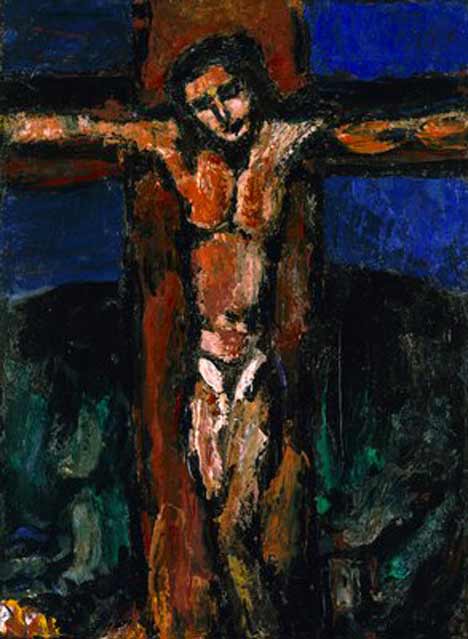 It is a traditional devotional practice during the season of Lent for Christians to take some time to reflect on Christ’s sacrifice for us on the cross. As we are in the midst of this special season, I thought it would be appropriate to share with you some selections from Martin Luther’s Meditation on Christ’s Passion from 1519. This meditation was one of Luther’s favorites. At one point he called it his “very best book.” Indeed, it is a brilliant reflection as Luther focuses with laser like clarity on Christ’s sacrifice.
As you read these words, I would encourage you to notice the way in which Luther draws a sharp distinction between God’s Law and God’s Gospel. God’s Law is expressed in a way that is harsh and inescapable. Luther’s expression and condemnation of our sinfulness might sound shocking, but it is certainly Scriptural. But Luther does not leave us in despair. With the heart of a pastor, he points us to the sacrifice of Christ and gloriously sets forth for us how it is all-sufficient for our sin.
And so I invite you to ponder now on Christ’s holy Passion. May this reflection be a blessing to you.
They contemplate Christ’s passion aright who view it with a terror-stricken heart and a despairing conscience. This terror must be felt as you witness the stern wrath and the unchanging earnestness with which God looks upon sin and sinners, so much so that he was unwilling to release sinners even for his only and dearest Son without his payment of the severest penalty for them. Thus he says in Isaiah 53:8, “I have chastised him for the transgressions of my people.” If the dearest child is punished thus, what will be the fate of sinners? It must be an inexpressible and unbearable earnestness that forces such a great and infinite person to suffer and die to appease it. And if you seriously consider that it is God’s very own Son, the eternal wisdom of the Father, who suffers, you will be terrified indeed. The more you think about it, the more intensely will you be frightened.
You must get this thought through your head and not doubt that you are the one who is torturing Christ thus, for your sins have surely wrought this. In Acts 2:36–37, St. Peter frightened the Jews like a peal of thunder when he said to all of them, “You crucified him.” Consequently three thousand alarmed and terrified Jews asked the apostles on that one day, “O dear brethren, what shall we do now?” Therefore, when you see the nails piercing Christ’s hands, you can be certain that it is your work. When you behold his crown of thorns, you may rest assured that these are your evil thoughts, etc.
We must give ourselves wholly to this matter, for the main benefit of Christ’s passion is that man sees into his own true self and that he be terrified and crushed by this. Unless we seek that knowledge, we do not derive much benefit from Christ’s passion.
After man has thus become aware of his sin and is terrified in his heart, he must watch that sin does not remain in his conscience, for this would lead to sheer despair. Just as our knowledge of sin flowed from Christ and was acknowledged by us, so we must pour this sin back on him and free our conscience of it. Therefore beware, lest you do as those perverse people who torture their hearts with their sins and strive to do the impossible, namely, get rid of their sins by running from one good work or penance to another, or by working their way out of this by means of indulgences. Unfortunately such false confidence in penance and pilgrimages is widespread.
You cast your sins from yourself and onto Christ when you firmly believe that his wounds and sufferings are your sins, to be borne and paid for by him, as we read in Isaiah 53:6, “The Lord has laid on him the iniquity of us all.” St. Peter says, “in his body has he borne our sins on the wood of the cross” (1 Peter 2:24). St. Paul says, “God has made him a sinner for us, so that through him we would be made just” (2 Corinthians 5:21). You must stake everything on these and similar verses. The more your conscience torments you, the more tenaciously must you cling to them. If you do not do that, but presume to still your conscience with your contrition and penance, you will never obtain peace of mind, but will have to despair in the end. If we allow sin to remain in our conscience and try to deal with it there, or if we look at sin in our heart, it will be much too strong for us and will live on forever. But if we behold it resting on Christ and see it overcome by his resurrection, and then boldly believe this, even it is dead and nullified. Sin cannot remain on Christ, since it is swallowed up by his resurrection. Now you see no wounds, no pain in him, and no sign of sin. Thus St. Paul declares that “Christ died for our sin and rose for our justification” (Romans 4:25). That is to say, in his suffering Christ makes our sin known and thus destroys it, but through his resurrection he justifies us and delivers us from all sin, if we believe this.
Luther’s Works: American Edition, Volume 42, pages 8-12


 Pastor Zach's Blog