Posts filed under ‘Devotional Thoughts’
More Than A Little
 I suffer from calorie creep. It’s amazing. If I wake up in the morning and commit to making wise food choices, staying away from sweets, and considering the calories of what I put in my mouth before those calories get there, I can usually keep the number of my calories down and the quality of my calories up. But if I don’t…
It only takes a little. “I’ll just have a little bit of ice cream for dessert,” I think to myself after lunch. But it’s amazing how much ice cream I can cram into even a little bowl. And by the time supper rolls around, a second bowl of ice cream begins to sound awfully enticing. The more junk food I eat, the more junk food I want. A little always turns into a lot.
“It’s just a little white lie.” “We were just kicking back a little.” “A little bit of fun never hurt anyone!” It’s amazing how many times I have heard these statements or statements like these as excuses for sin. How are they excuses? They’re excuses because they sanction sin by arguing that what they’re supporting is only “a little” sin. But a little always turns into a lot.
Solomon makes this precise point when he talks about the sin of laziness: “A little sleep, a little slumber, a little folding of the hands to rest – and poverty will come on you like a thief and scarcity like an armed man” (Proverbs 24:33-34). Solomon says that sin adds up faster than you think. And this means that sin can wreak havoc in your life quicker than you think.
When the apostle Paul is writing to the Galatians, he warns them against tolerating even a little sin with a metaphor: “A little yeast works through the whole batch of dough” (Galatians 5:9). Paul says that just like it only takes a little yeast to make bread rise, it only takes a little sin to make wickedness rise.
The other day, I came across some thoughts from the Archbishop Chaput, the current Archbishop of Canterbury, worth citing here:
We live in a culture where our marketers and entertainment media compulsively mislead us about the sustainability of youth; the indignity of old age; the avoidance of suffering; the denial of death; the nature of real beauty; the impermanence of every human love; the oppressiveness of children and family; the silliness of virtue; and the cynicism of religious faith. It’s a culture of fantasy, selfishness, sexual confusion and illness that we’ve brought upon ourselves …
As the historian Gertrude Himmelfarb observed more than a decade ago, “What was once stigmatized as deviant behavior is now tolerated and even sanctioned; what was once regarded as abnormal has been normalized.” But even more importantly, she added, “As deviancy is normalized, so what was once normal becomes deviant. The kind of family that has been regarded for centuries as natural and moral – the ‘bourgeois’ family as it is invidiously called – is now seen as pathological” and exclusionary, concealing the worst forms of psychic and physical oppression.
My point is this: Evil talks about tolerance only when it’s weak. When it gains the upper hand, its vanity always requires the destruction of the good and the innocent, because the example of good and innocent lives is an ongoing witness against it. So it always has been. So it always will be.[1]
His last paragraph is key. A little bit of evil will ask you to tolerate it so it can get itself in the door of your life. But once it gains access to your heart’s hallways, it will grow – gradually, perhaps, but inexorably. And what it asked for itself in the name of tolerance it will not give to goodness. For it has come to destroy goodness. It has come to destroy you. And that is why Jesus has come to destroy it.
Stand firm, then. For even a little sin is a little too much.
[1] Archbishop Charles J. Chaput, “A Thread for Weaving Joy,” Voices Online Edition, vol. XXVII, no. 1 (Lent – Eastertide 2012).
Oh, Those Good Ole Days
 Recently, the New York Times featured a sanguine article on the value of nostalgia. In a culture that tends to obsess over the “next big thing,” it turns out that “old small things” are worth remembering and celebrating. Journalist John Tierney explains:
Nostalgia has been shown to counteract loneliness, boredom and anxiety. It makes people more generous to strangers and more tolerant of outsiders. Couples feel closer and look happier when they’re sharing nostalgic memories. On cold days, or in cold rooms, people use nostalgia to literally feel warmer.[1]
Of course, nostalgia has not always been so appreciated:
Nostalgia was originally described as a “neurological disease of essentially demonic cause” by Johannes Hoffer, the Swiss doctor who coined the term in 1688. Military physicians speculated that its prevalence among Swiss mercenaries abroad was due to earlier damage to the soldiers’ ear drums and brain cells by the unremitting clanging of cowbells in the Alps.
Even now, many psychologists mistake a case of nostalgia – often brought on by a major life transition when people understandably pine for parts of their past – for depression.
Nostalgia, though often underappreciated in our world, held primacy of place in the lives of the ancient Israelites. In fact, one of the most common commands of the Old Testament is to be nostalgic – to remember:
- Remember that you were slaves in Egypt and that the LORD your God brought you out of there with a mighty hand and an outstretched arm. (Deuteronomy 5:15)
- Remember how the LORD your God led you all the way in the wilderness these forty years, to humble and test you in order to know what was in your heart, whether or not you would keep his commands. (Deuteronomy 8:2)
- Remember the wonders [the LORD] has done, His miracles, and the judgments He pronounced. (Psalm 105:5)
Over and over again, the LORD asks His people to remember what He has done for them. Why?
For the ancient Israelites, remembering was more than taking a nostalgic trip from the present to the past; remembering actually made the past into the present. Indeed, whenever the Jews celebrated the Passover, they recited the Haggadah, a Hebrew word meaning “telling.” The Haggadah recounted the mighty acts of the Lord the night He brought them out of their harsh slavery in Egypt. A key line in the Haggadah read:
In every generation, a person is obligated to regard himself as if he had left Egypt. It was not only our ancestors whom the Holy One, blessed be He, redeemed from Egypt; rather, He redeemed us, as it is stated: “He brought us out from there, so that He might bring us to the land He promised our fathers, and give it to us.”[2]
The Jews believed that when they remembered what God had done, they not only recalled God’s acts in the past, they became the beneficiaries of those acts in the present. One cannot help but think of the Haggadah that Jesus gave His disciples, also on a Passover night, when He said, “Do this in remembrance of Me” (Luke 22:19). When we partake of the Lord’s Supper, we do not just remember what Jesus did in the past, we receive the benefits of His very body and blood in the present.
For the Christian, nostalgia is a good thing because remembering is a good thing. But nostalgia is more than nostalgia when it reflects on what God has done in Christ. For what Christ has done in the past still blesses us – and saves us – in the present.
[1] John Tierney, “What Is Nostalgia Good For? Quite a Bit, Research Shows,” New York Times (7.8.2013).
[2] “Text of the Haggadah,” Eliyahu Touger, trans.
Righteous
 This weekend in worship and ABC, we learned about the doctrine of justification which teaches that our righteousness before God is not a product of ourselves and our works; rather, it is a free gift from God, given to us by the work of Christ on the cross. As the apostle Paul writes, “[We] are justified freely by [God’s] grace through the redemption that came by Christ Jesus” (Romans 3:24).
Throughout the history of the Church, some have tried to undercut this doctrine of God’s work with human works. The Pelagians, for instance, taught that by obeying God’s commands, people could gain favor in God’s sight. The Synergists taught that justification was not a gift of God’s righteousness exclusively, but a comingling of God’s righteousness with human righteousness. In the face of such unbiblical teachings, Martin Luther offers this important reflection on justification as God’s work and not as ours:
The world wants to win heaven from our Lord God by right, although He is causing the message to be proclaimed aloud throughout the world that He wants to give it to us for nothing. He says: “I want to be your God; out of grace and for nothing I want to save you … I will not let you win heaven from Me. Therefore make no other gods, do not invent things that you do for yourself … Do not begin with your good works; allow Me to have mercy on you.” It certainly is a shame that people must accuse us being unwilling to accept heaven for nothing, nay, of actually wanting to earn it and of proposing to give to God, to Him who desires to offer everything to us in plenty. Such fools are we: we want to give what we ought to take.[1]
We bring nothing to our righteous standing before God – no good work, no pious thought, no warm heart. Instead, God supplies any and all righteousness we need through His Son. This is the doctrine of justification. This is the promise of the gospel. And this is the cornerstone of our faith.
May we never seek to add our works to God’s work. After all, it is God’s work – and His work alone – that saves us.
[1] Martin Luther, What Luther Says, Ewald M. Plass, comp. (St. Louis: Concordia Publishing House, 1959), §2207.
Dodging Dating Disasters
 Recently, I was talking to a friend who is in the throws of the dating scene. Over the course of our conversation, it began to strike me just how complicated, frustrating, and frightening dating really can be. Her past few dates had not gone so well. And she was beginning to lose hope. “All the good ones are taken,” she said with a definite edge of resignation. “I’m just going to have to take what I can get.”
The more I pondered her statement, the more concerned I became. Her willingness to just “take what she can get” seemed to be nothing but a setup for a let down. After all, if her past few dates had ended poorly because she just settled for what she could get, how much worse would things go if she married someone just because he was all she thought she could get at the time?
Over the years, I have shared with people a taxonomy that helps them consider who to date and who not to date. The interesting thing about this taxonomy is that it is one we all use or have used, but we often use it only subconsciously. Pulling this taxonomy from our subconscious to our conscious, however, can help us identify our patterns of thinking and, hopefully, save us from dating disaster. So it is with this in mind that, if you are dating or would like to date, I would encourage you take a moment and create a three-column list.
Column 1: What I want.
In this column, simply write honestly what you would like in a companion. And don’t sugarcoat it. If you’re a lady who wants the guy who looks like a cross between The Rock and Vin Diesel, write that down. If you’re a guy who wants the girl with the perfect hourglass shape, write that down. Hopefully, you also have some more modest and meaningful desires for a companion as well – someone who has a good sense of humor, a deep intuition, or a knack for solving big problems.
Column 2: What I need.
In this column go the non-negotiables. The non-negotiables include items such as faithfulness, forgiveness, commitment, and, of course, a hearty trust in the Lord. Think long and hard about this column and try not to confuse what you actually need with what you think you need. For instance, you may think you need someone who meets some predetermined standard of outward beauty so that you will be intensely physically attracted to them. But though physical attraction is important, outward beauty inevitably changes and fades. Thus, striking outward beauty is not really needed – even if you think it is – because it cannot be kept.
Column 3: What I’ll settle for.
In this column go the compromises you are willing to make. And as I did in the first column of what you want, I would encourage honesty. Sadly, many people are willing to make compromises morally to try to make a dating relationship work, engaging in intimate acts that are rightly reserved for marriage. But, of course, not every compromise is immoral or embarrassing. Some compromises are neutral. For instance, if you want a person with a good sense of humor, but wind up dating someone who couldn’t deliver the punch line to a joke to save their life, that’s a compromise, but can your significant other’s lack of humor can also become endearing in its own right.
Now, think about each of your three columns and consider these questions:
- How does column three affect column one? Are there any things you want in a mate that you could live without? If so, this is good! This means that you know your wants are just that – wants – and not necessities.
- How does column one affect column three? Are there any wants on which you should be willing to at least consider a compromise, but you’re not, thereby treating a want from column one like a need from column two? If so, you are in a danger zone. For when you refuse to even think about compromising on a want, you are putting your desires ahead of another person. And this is selfishness, which leads only to relationship breakdown.
- How does column three affect column two? Are there any things you know you need on which you are willing to compromise? If so, you are in a danger zone. Compromising on things like integrity, faithfulness, or faith is a recipe for a relationship disaster and great emotional and spiritual harm.
- How does column one affect column two? Are there any things that you want in a relationship that are opposed to what you need? For instance, if you want someone with good looks, does this tempt you to become shallowly infatuated over how a person looks on the outside rather than being committed to who they are on the inside? If so, you are again in a danger zone. The righteous needs in column two should always trump the desired wants in column one.
As you can see, what matters most is column two. Columns one and three are both negotiable. This is why when I counsel those who are dating, I encourage them to give on columns one and three, but not on column two. For column two holds the keys to long-lasting relationships.
So if you’re dating, or getting ready to enter the dating scene, think on these things. Taking just a few moments to fill out these columns now can save you a lot of pain and heartache in the future because these columns can help you keep your priorities straight. And keeping your priorities straight can help keep your heart in tact.
The Bible Is All About ___________
 The Bible is all about __________.
How you fill in this blank makes a big difference in how you approach not only the Bible, but your life as a believer in Christ.
I have no doubt that most Christians would fill in the blank with “Christ.” After all, a respectably orthodox theology demands no other answer. “The Scriptures…testify about Me,” Jesus declares (John 5:39). But what we say about the Bible and what we want to know from the Bible are often two very different things.
I once had a lady who felt the need to give me some preaching advice following one of my sermons. “The problem with you,” she began, “is that you always end your sermons the same way: by talking about Jesus. I already know what Jesus did,” she continued. “I want to hear about what I need to do to live a better and successful life!” She expressed publicly the way a lot of people feel secretly. To learn about Jesus is fine and good, but what we really want is to learn about ourselves – how we can be successful.
Tullian Tchividjian, pastor of Coral Ridge Presbyterian Church, calls such a desire “reading the Bible narcissistically.” He explains:
We often read the Bible as if it were fundamentally about us: our improvement, our life, our triumph, our victory, our faith, our holiness, our godliness. We treat it like a book of timeless principles that will give us our best life now if we simply apply those principles. We treat it, in other words, like it’s a heaven-sent self-help manual…Even our devout Bible reading can become fuel for our own narcissistic self-improvement plans, the place we go for the help we need to “conquer today’s challenges and take control of our lives.”[1]
But this is not the purpose of the Good Book. The Bible is not about us being better. It’s about Jesus being perfect.
“But what about me?” someone may protest. “I have concerns I need answered! And they’re not just concerns about how I can go to heaven after I die, they’re concerns about how to deal with things while I’m still alive!”
This is where we can modify how we fill in the blank a little bit. Because the Bible is indeed all about Jesus. But Jesus came for us. Jesus lived for us. Jesus died for us. And Jesus rose for us. The Bible is all about Jesus who just happens to be for us.
Tchividjian continues:
The Bible is one long story of God meeting our rebellion with His rescue; our sin with His salvation; our failure with His favor; our guilt with His grace; our badness with His goodness.
The problem with the way so many people approach the Bible is that they skip over Jesus to get to themselves. The Bible is indeed about us, but it’s about us in light of Jesus. And it is when we read the Bible in light of Jesus that we discover that we are more deeply sinful than we ever thought, unable to improve our lives under our own power and will, and Jesus is more magnificently gracious than we ever imagined, able to save us from our sin and our selves. You see, Jesus is not only the key to reading the Bible correctly, He is the key to reading ourselves correctly – as sinners in need of a Savior. It is when we see Him as the center of the Scriptures that we find we need Him as the Savior of our lives.
[1] Tullian Tchividjian, “Reading The Bible Narcissistically,” The Gospel Coalition (6.10.2013).
The Law of Retaliation
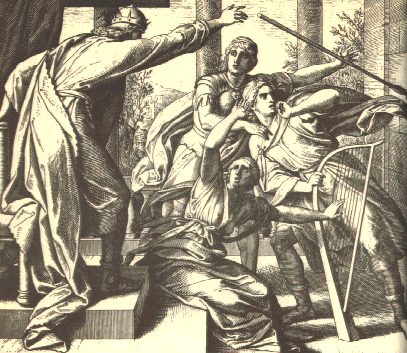
“Saul Tries to Kill David” by Julius Schnorr von Karolsfeld, 1850’s, Wikimedia Commons
This past weekend in worship and ABC, we discussed the importance of friendship. Every person needs a friend for encouragement, for challenge, and for consolation. In the words of Proverbs 17:17: “A friend loves at all times, and a brother is born for adversity.” For good times and for bad, everyone needs a friend.
Perhaps the most famous example of friendship in the Bible is that of David and Jonathan. These two guys far more than just bar buddies. 1 Samuel 18:1 describes their relationship like this: “The soul of Jonathan was knit to the soul of David.”
Though David and Jonathan’s friendship was strong, it was also fraught with peril. Jonathan’s dad, Saul, the king of Israel, hated David and wanted to kill him. But Jonathan was so deeply devoted to his friend that he went to bat for him, telling his father:
“Let not the king sin against his servant David, because he has not sinned against you, and because his deeds have brought good to you. For he took his life in his hand and he struck down the Philistine, and the LORD worked a great salvation for all Israel. You saw it, and rejoiced. Why then will you sin against innocent blood by killing David without cause?” (1 Samuel 19:4-5)
In my sermon, I talked about how Jonathan, in order to defend his friend, appeals to the lex talionis, a Latin phrase referring to the “law of retaliation.” This law is classically expressed in Leviticus 24:19-20: “If anyone injures his neighbor, as he has done it shall be done to him, fracture for fracture, eye for eye, tooth for tooth; whatever injury he has given a person shall be given to him.” This law, of course, is not meant to promote violence, but to contain it. The lex talionis stipulates that “the punishment must fit the crime.” If someone takes your eye, you can’t take his arm. The example I used in my sermon is, “If someone steals $100 from you, you can’t sue him for $1 million because of emotional pain and suffering.”
The way Jonathan uses the lex talionis in 1 Samuel 19 is especially fascinating. For rather than appealing to the lex talionis responsively to punish a crime, he appeals to it preemptively to prevent a crime. Jonathan’s essential argument to his father is this: “You can’t kill David! The law of retaliation says you can only hurt someone if he first hurts you! And David hasn’t hurt you!”
I have gained a deep appreciation for Jonathan’s argument to his father because Jonathan essentially turns the lex talionis into a catch 22. You can hurt someone, but only if he hurts you first. Someone else can hurt you, but only if you hurt him first. This means no one can hurt anyone because no one can make the first move to hurt someone because, by sheer chronological necessity, there would be no prior just cause for such an injury, thus breaking the lex talionis! Far more than regulating violence, the lex talionis prevents it.
This use of the lex talionis is nicely in line with Jesus’ commentary on the rule: “You have heard that it was said, ‘An eye for an eye and a tooth for a tooth.’ But I say to you, Do not resist the one who is evil. But if anyone slaps you on the right cheek, turn to him the other also” (Matthew 5:38-39). Jesus essentially says, “Even if you are unjustly wounded, never give anyone a reason to use the lex talionis on you. Self-control, even in the midst of terrible adversity, is paramount. If you don’t hurt someone else, then that other person has no ground on which to stand if he hurts you.”
What tensions and quarrels do you have with others? The best way to end them is to refuse to give the person with whom you are in conflict any reason to retaliate. Your cool and collected response to someone who is angry may just be what diffuses a fight, ends a conflict, and restores a friendship.
Remembering the Lost
 Today, we remember those who sacrificed their lives in service to their country. Memorial Day is always a day full of mixed emotions. On the one hand, we celebrate the bravery, valor, and commitment of these soldiers who were willing to suffer all – even death – to serve our nation. On the other hand, as with any loss of life, we mourn. And we should. After all, in the words of the apostle Paul, death is not only an enemy, but the enemy (cf. 1 Corinthians 15:26). We want death to be defeated. We do not want it to defeat us. But even as we mourn the loss of those we love, we can take heart in the promise of the Gospel that death’s defeat of us is only partial and temporary. It is partial because death destroys only our bodies and not our souls. And it is only temporary because when Jesus returns, He will raise our bodies to live with Him forever.
On this Memorial Day, as we remember our fallen, I would point you to some words from one of our nation’s founding fathers, John Hancock:
I hereby call upon ministers and people of every denomination, to…devoutly and sincerely offer to almighty God, the gratitude of our hearts, for all His goodness towards us; more especially in that He has been pleased to continue to us so a great a measure of health, to cause the earth plentifully to yield her increase so that we are supplied with the necessaries and the comforts of life, to prosper our merchandise and fishery, and, above all, not only to continue to us the enjoyment of our civil rights and liberties, but the great and most important blessing, the gospel of Jesus Christ. And together with our cordial acknowledgments, I do earnestly recommend, that we may join the penitent confession of our sins, and implore the further continuance of the divine protection, and blessings of heaven upon this people; especially that He would be graciously pleased to direct, and prosper the administration of the federal government, and of this, and the other states in the Union, to afford Him further smiles on our agriculture and fisheries, commerce and manufactures, to prosper our university and all seminaries of learning, to bless the virtuously struggling for the rights of men…and to afford his almighty aid to all people, who are established in the world; that all may bow to the scepter of our Lord Jesus Christ, and the whole earth be filled with His glory.[1]
A few things are notable about Hancock’s words here. First, as Hancock would guide us, it is important that we always remember to give thanks. We are called by our Lord, even when times are trying and tenuous, to give thanks to Him for His blessings to us, His presence with us, and, most importantly, His gospel for us. No amount of sin or tragedy can circumvent the good and sturdy promises of almighty God – even the tragedy of losing a loved one in battle. For this, we can be thankful.
Second, Hancock encourages all of us to acknowledge our sinfulness. After all, the sinfulness and brokenness of this world is the reason there are wars. History is littered with tyrants who, rife with evil intent, needed to be defeated in battle so they could not carry out – or, in most instances, continue to carry out – their wicked agendas. When we confess our sins, we do so with the knowledge that the whole earth is broken by sin and needs healing. We also acknowledge that even if we can curb and contain evil thanks to the valiant efforts of our brave troops, we cannot finally defeat it. This can only be done by Christ.
Third, Hancock desires that we pray for the safety and protection of our troops. On a day when we remember lives that have been lost, it is most certainly appropriate to pray that no more will be lost.
Finally, Hancock points us toward the Christian’s hope that, on the Last Day, “all may bow to the scepter of our Lord Jesus Christ, and the whole earth be filled with His glory.” One day, wars will cease. One day, tyrants will be no more. One day, nations will not take up arms against nations. Because one day, all will bow to Jesus and the whole earth will be filled with His glory.
As we remember those who have died waiting and longing for this day, may we ourselves pray that it would come soon so that we may be reunited with those we have lost and celebrate the final defeat of evil in the presence of our Savior.
[1] John Hancock, “Proclamation – Thanksgiving Day – 1791, Massachusetts.”
Luther on Christ’s Resurrection…And Ours
 On this Easter Monday, I thought I would share with you some words from a series of seventeen sermons preached by Martin Luther in 1533 on 1 Corinthians 15. In this chapter, the apostle Paul speaks of the resurrection of Christ and the hope and assurance that it gives us that we too will be raised on the Last Day:
Because Christ is risen and gives us His resurrection against our sin, death, and hell, we must advance to where we also learn to say: “O death, where is thy sting?” [1 Corinthians 15:55] although we at present see only the reverse, namely, that we have nothing but the perishable hanging about our neck, that we lead a wretched filthy life, that we are subject to all sorts of distress and danger, and that nothing but death awaits us in the end.
But the faith that clings to Christ is able to engender far different thoughts. It can envisage a new existence. It can form an image and gain sight of a condition where this perishable, wretched form is erased entirely and replaced by a pure and celestial essence. For since faith is certain of this doctrine that Christ’s resurrection is our resurrection, it must follow that this resurrection is just as effective in us as it was for Him – except that He is a different person, namely, true God. And faith must bring it about that this body’s frail and mortal being is discarded and removed and a different, immortal being is put on, with a body that can no longer be touched by filth, sickness, mishap, misery, or death but is perfectly pure, healthy, strong, and beautiful…
God did not create man that he should sin and die, but that he should live. But the devil inflicted so much shameful filth and so many blemishes on nature that man must bear so much sickness, stench, and misfortune about his neck because he sinned. But now that sin is removed through Christ, we shall be rid of all of that too. All will be pure, and nothing that is evil or loathsome will be felt any longer on earth. (AE 28:202-203)
Luther’s final words beautifully summarize the hope of Easter: “All will be pure, and nothing that is evil or loathsome will be felt any longer on the earth.” Because Christ is risen, the evils of sin and death will be destroyed. Or, in the words of the poet John Donne, because of Easter, “death, thou shalt die!”
Christ is risen! And this means you will too.
Clothing the Naked

“The Taking of Christ” by Caravaggio, 1602
It must have been a terrifying ordeal. The man who twelve men had followed, loved, learned from, and staked their lives on was being arrested by an angry mob, led by a man who used to be among their ranks: Judas. Mark depicts the scene like this:
Judas, one of the Twelve, appeared. With him was a crowd armed with swords and clubs, sent from the chief priests, the teachers of the law, and the elders. Now the betrayer had arranged a signal with them: “The one I kiss is the man; arrest him and lead him away under guard.” Going at once to Jesus, Judas said, “Rabbi!” and kissed Him. The men seized Jesus and arrested Him. Then one of those standing near drew his sword and struck the servant of the high priest, cutting off his ear. “Am I leading a rebellion,” said Jesus, “that you have come out with swords and clubs to capture Me? Every day I was with you, teaching in the temple courts, and you did not arrest Me. But the Scriptures must be fulfilled.” Then everyone deserted Him and fled. A young man, wearing nothing but a linen garment, was following Jesus. When they seized him, he fled naked, leaving his garment behind. (Mark 14:43-52)
This final detail about this young man who flees naked is unique to Mark’s Gospel, leading many scholars to believe that it may have been Mark himself who, overcome with fear, fled the scene. But what is recorded here is more than an incidental historical detail. What is recorded here is a tragic historical pattern:
Then the man and his wife heard the sound of the LORD God as He was walking in the garden in the cool of the day, and they hid from the LORD God among the trees of the garden. But the LORD God called to the man, “Where are you?” He answered, “I heard You in the garden, and I was afraid because I was naked; so I hid.” (Genesis 3:8-10)
Mark wasn’t the first to flee the Lord naked and afraid. Adam did too.
In the Bible, nakedness is often used as a symbol of shameful sin:
- “Your nakedness will be exposed and your shame uncovered. I will take vengeance; I will spare no one.” (Isaiah 47:3)
- Jerusalem has sinned greatly and so has become unclean. All who honored her despise her, for they have seen her nakedness; she herself groans and turns away. (Lamentations 1:8)
- “I am against you,” declares the LORD Almighty. “I will lift your skirts over your face. I will show the nations your nakedness and the kingdoms your shame.” (Nahum 3:5)
Sin and nakedness go hand in hand. But the promise of Scripture is that when sin leaves us shamefully naked, Jesus clothes us with His righteousness: “I delight greatly in the Lord; my soul rejoices in my God. For He has clothed me with garments of salvation and arrayed me in a robe of His righteousness” (Isaiah 61:10). Even as we flee from the horror of the cross naked in sin, Jesus draws us back to His cross, covering our nakedness with His atoning blood. The death on a cross that once caused everyone to flee now beckons all to its promise of salvation. During this Holy Week, this is what we remember. And this is what we believe.
Sharing the Gospel…Even When It’s Hard
 How far would you go to share the gospel? Paul’s words in 1 Corinthians 9 constitute a rallying cry to “pull out all the stops,” as it were, to get the gospel to those who need to hear it:
Though I am free and belong to no man, I make myself a slave to everyone, to win as many as possible. To the Jews I became like a Jew, to win the Jews. To those under the law I became like one under the law (though I myself am not under the law), so as to win those under the law. To those not having the law I became like one not having the law (though I am not free from God’s law but am under Christ’s law), so as to win those not having the law. To the weak I became weak, to win the weak. I have become all things to all men so that by all possible means I might save some. I do all this for the sake of the gospel, that I may share in its blessings. (1 Corinthians 9:19-23)
Paul’s call to “become all things to all men…for the sake of the gospel” has been a topic of many a conversation about what is involved in showing and sharing God’s love to a world that is hostile to the exclusive claims of Christ. Though many things could be said about proclaiming the gospel in a world like this, there is one thing in particular that I would focus on in this post: Proclaiming the gospel to a world adverse to its message often involves pain.
Proclaiming the gospel involves much more than just being familiar enough with the culture around you to speak the gospel in a way that is intelligible to that culture, it involves enduring persecution from that culture when it takes umbrage with the gospel’s message. This was certainly the case with Paul. Paul writes, “To the Jews I became like a Jew, to win the Jews” (verse 20). To become like a Jew was no easy task for Paul, especially since his Jewish comrades considered his message of a crucified Messiah blasphemous. And the punishment for speaking blasphemy was nothing less than a beating. This is why Paul writes in 2 Corinthians 11:24: “Five times I received from the Jews the forty lashes minus one.” Interestingly, a compendium of Jewish rabbinical teaching called the Mishnah considers lashes to be only a secondary punishment for blasphemy. The primary punishment was that of being cut off from the Jewish people. The rabbis wrote, “All those who are liable to extirpation who have been flogged are exempt form their liability to extirpation” (Mishnah Makkot 3:15). The primary punishment for blasphemy, then, was that of being excommunicated from the Jewish community, but if a person could not stand the thought of excommunication, he could instead choose to be lashed. Paul chose the lashes over the shunning. But why? It certainly wasn’t because he took any particular pride in being a Jew by birth. Paul says of his Jewish pedigree: “I consider everything a loss compared to the surpassing greatness of knowing Christ Jesus my Lord, for whose sake I have lost all things. I consider them rubbish, that I may gain Christ” (Philippians 1:8). Paul chose the lashes because he could not stand the thought of being excommunicated by his Jewish comrades. After all, such excommunication would spell the end of his efforts “to win the Jews” (verse 20). Paul was so desperate to share the gospel with his Jewish community, he was willing to be beaten within inches of his death to do so.
The apostle Peter writes, “To this you were called, because Christ suffered for you, leaving you an example, that you should follow in His steps” (1 Peter 2:21). Sometimes, becoming “all things to all men…for the sake of the gospel” means suffering for the sake of the gospel. By the Spirit’s enabling, may we be prepared to face adversity and pain to share and spread God’s message and power of salvation!


 Pastor Zach's Blog