Posts filed under ‘Devotional Thoughts’
Truly God, Truly Man
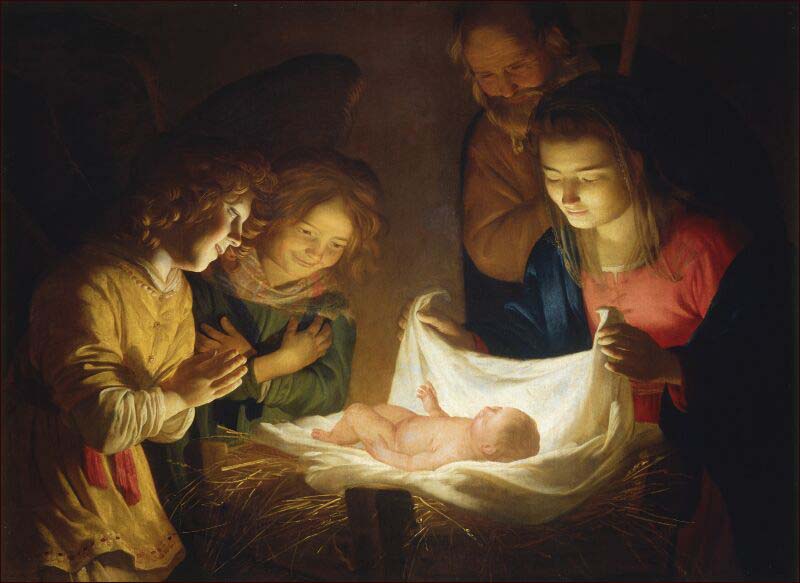
“The Adoration of the Shepherds” by Gerard van Honthorst, 1622.
During the Christmas season, it is important to focus not only on the birth of Christ, but on the person of Christ. That is, it is important for us to remember not only that Jesus was born, but who Jesus was born as. For it is not the simple fact of Jesus’ birth that gives the Christmas story significance. After all, people are born all the time. But Jesus’ identity as it is revealed in the Christmas story makes Jesus’ birth significant even 2,000 years later.
In Matthew’s Gospel, we get a clue concerning Jesus’ identity beginning with Mathew’s opening line: “A record of the genealogy of Jesus Christ the son of David, the son of Abraham” (Matthew 1:1). From here, Matthew goes on to give an extensive genealogy of Jesus’ family tree, going all the way back to Abraham. The genealogy in Luke’s Gospel goes back even farther – all the way to Adam (cf. Luke 3:23-38). These two genealogies, it should be noted, are quite different from each other, making Jesus’ family tree look quite disparate. Indeed, over the years, scholars have debated the differences between the Matthew and Luke’s genealogies of Jesus. Most often, scholars have conjectured that Matthew presents the royal genealogy of Jesus through Joseph, his stepfather, while Luke presents the biological genealogy of Jesus through Mary, His mother. What is often left out of such discussions and debates, however, is that there is actually a third Christmas genealogy that all too regularly goes unnoticed.
Where is this third genealogy? Beginning in Matthew 1:18: “This is how the birth of Jesus Christ came about: His mother Mary was pledged to be married to Joseph, but before they came together, she was found to be with child through the Holy Spirit.” The Greek word for “birth” is genesis, from which we get our English word “genealogy” In fact, this is the same word Matthew uses in 1:1 when he introduces his “genealogy [in Greek, genesis] of Jesus Christ the son of David, the son of Abraham.” Thus, in just one chapter, Matthew presents two genealogies.
So how are to understand these two genealogies? In Matthew’s first genealogy, we read of Jesus’ human origin. He is the son of David and the son of Abraham. In Matthew’s second genealogy, we read about Jesus’ divine origin. He is of the Holy Spirit. Thus, Jesus is truly man, the son of Abraham and David; but He is also truly God, conceived by the Holy Spirit and born of the virgin Mary.
Ultimately, Jesus’ status as truly man and truly God is what gives the Christmas story its significance. For as a man, Jesus can identify with us men – our weakness, struggles, and trials. But as God, Jesus can save us from our sin.
Truly man. Truly God. All of this wrapped in a manger. What an incredible story! And what a terrific reason to say, “Merry Christmas.”
Righteousness from God

“Crucifixion of Jesus of Nazareth” by Marco Palmezzano, ca. 1490
Credit: Wikipedia
Because the gospel is the crux of our Christian faith, we can never ponder it, speak of it, or write about it too much. This is why I was delighted to stumble across this passage from Ezekiel while reading devotionally a few days ago:
The righteousness of the righteous man will not save him when he disobeys, and the wickedness of the wicked man will not cause him to fall when he turns from it. The righteous man, if he sins, will not be allowed to live because of his former righteousness. If I tell the righteous man that he will surely live, but then he trusts in his righteousness and does evil, none of the righteous things he has done will be remembered; he will die for the evil he has done. (Ezekiel 33:12-13)
What a beautiful explanation of the gospel and what kind of righteousness saves. Ezekiel is clear: you cannot be saved by your own righteousness! Indeed, even if you act righteously, just one evil act erases all memory of your righteousness. As James writes: “For whoever keeps the whole law and yet stumbles at just one point is guilty of breaking all of it” (James 2:10). To receive salvation, you need another kind of righteousness that is not your own. You need a righteousness that comes from God. The apostle Paul brings clarity to what kind of righteousness this is: “But now a righteousness from God, apart from law, has been made known, to which the Law and the Prophets testify. This righteousness from God comes through faith in Jesus Christ to all who believe” (Romans 3:21-22).
Besides reminding us that our own righteousness does not and cannot save us, Ezekiel’s words also remind us that the gospel is not confined to the New Testament. In both Testaments, the message of the gospel is consistent: it is God’s righteousness, not our own, that saves us. As God promises through the prophet Isaiah, “I am bringing My righteousness near, it is not far away; and My salvation will not be delayed.”
Happy Thanksgiving!

“Freedom from Want” by Norman Rockwell, 1943.
Credit: arthistory.about.com
It’s been all over Facebook. People are posting all the reasons they are thankful. My wife has joined in the Facebook thankfulness fun. As a teacher, she’s organizing her thankfulness thoughts alphabetically – using each letter of the alphabet to call to mind something for which she is thankful. I wonder what she’ll post about when she gets to “Z”?
As we head into another Thanksgiving holiday this week, I want to share with you, as I did last year, some of my favorite thoughts on thankfulness from Abraham Lincoln:
The year that is drawing towards its close, has been filled with the blessings of fruitful fields and healthful skies. To these bounties, which are so constantly enjoyed that we are prone to forget the source from which they come, others have been added, which are of so extraordinary a nature, that they cannot fail to penetrate and soften even the heart which is habitually insensible to the ever watchful providence of Almighty God. In the midst of a civil war of unequaled magnitude and severity, which has sometimes seemed to foreign States to invite and to provoke their aggression, peace has been preserved with all nations, order has been maintained, the laws have been respected and obeyed, and harmony has prevailed everywhere except in the theatre of military conflict … Needful diversions of wealth and of strength from the fields of peaceful industry to the national defense have not arrested the plough, the shuttle or the ship; the axe has enlarged the borders of our settlements, and the mines, as well of iron and coal as of the precious metals, have yielded even more abundantly than heretofore. Population has steadily increased, notwithstanding the waste that has been made in the camp, the siege and the battlefield; and the country, rejoicing in the consciousness of augmented strength and vigor, is permitted to expect continuance of years with large increase of freedom. No human counsel hath devised nor hath any mortal hand worked out these great things. They are the gracious gifts of the Most High God, who, while dealing with us in anger for our sins, hath nevertheless remembered mercy.[1]
These words are from Lincoln’s Thanksgiving Day proclamation of 1863 and, like so many of the posts I’ve seen on Facebook, offer a myriad of reasons to be thankful. But what I appreciate so much about Lincoln’s thoughts on thankfulness – and the reason I share these words again – is that his thankfulness reaches its pinnacle not as he is talking about fruitful fields and healthful skies, or the abundant yields of plough, shuttle, ship, axe, and mines, or the population increase among the states. Rather, President Lincoln’s thankfulness reaches its pinnacle when he speaks of “the Most High God, who, while dealing with us in anger for our sins, hath nevertheless remembered mercy.” In other words, Lincoln is most thankful for what God does through Jesus Christ.
This Thanksgiving, we certainly have many things for which we can be thankful. But as we give thanks for many things, may we never forget to heartily celebrate and give thanks for the most important thing: God’s Son, Jesus Christ. He is the One who gives us reason not only to be thankful for temporal blessings now, but promises us that we will be thankful in eternal dwellings later.
[1] Abraham Lincoln, “Proclamation of Thanksgiving” (10.3.1863).
Sightseeing in Ghana
 I’m not in San Antonio anymore, that’s for sure. Instead, I am halfway across the world in Ghana, Africa with a team of my fellow Concordians and, together, we are hosting an eye clinic. There are many people in this region of Ghana in desperate need of glasses. We have the special privilege and pleasure of providing people here with the glasses they need in order to see. In the process, we also get to point people to the One in whom they can see God Himself – Jesus Christ – by sharing the gospel.
As I’ve been working as a part of this vision clinic, I’ve been pondering one of my favorite stories in Scripture:
As [Jesus] went along, He saw a man blind from birth. His disciples asked Him, “Rabbi, who sinned, this man or his parents, that he was born blind?” “Neither this man nor his parents sinned,” said Jesus, “but this happened so that the work of God might be displayed in his life.” (John 9:1-3)
In the ancient world – and especially among the ancient Jews – it was generally presumed that if you faced a trial, a trouble, or an ailment, it was because you had committed some heinous sin to deserve that trial, trouble, or ailment. Your sin and your trouble were intimately and inexorably interwoven in ancient thinking. For instance, Rabbi Ammi wrote, “There is no death without sin, and there is no suffering without iniquity.” If you were suffering, the rabbis taught, it was because you had done something wrong. In fact, some rabbis taught that not only could a person be punished for his own sin, but a child could be punished for his parents’ sin. Some rabbis believed, for example, that the untimely death of a child was the direct result of his mother’s dalliance in idolatry while he was still in the womb! Such was the close correlation between sin and tragedy.
Thus, it is really no surprise that, one day, as Jesus and His disciples are walking around and see a man born blind, the disciples ask: “Rabbi, who sinned, this man or his parents, that he was born blind” (John 9:2)? Jesus’ disciples know the teaching of their Jewish rabbis well. They know a man cannot be born blind unless there is some sin to warrant such blindness.
But what the rabbis assumed about the connection between sin and trouble isn’t what a rabbi named Jesus knows about this blind man’s plight. This is why, instead of pointing to a specific sin committed by this man which had resulted in his blindness, Jesus explains to His disciples: “Neither this man nor his parents sinned, but this happened so that the work of God might be displayed in his life” (John 9:3). This suffering is not the result of this sin or that sin. Rather, God is up to something in this suffering: He is using it to display His work.
The Greek word for “display” is phanero’o, from the word phos meaning, “light.” God, it seems, desires to bring this man darkened by blindness into the light of seeing. But God’s desire centers not only on the light of physical seeing, but on the light of spiritual seeing as well. In other words, Jesus, through His eventual healing of this man born blind, desires to bring this man not only into the light of the sun, but into the light of faith. And this is exactly what happens in the end: “Do you believe in the Son of Man?” Jesus asks. “Lord, I believe,” the man responds (John 9:35, 38). When this man confesses his faith in Christ, he is brought into the light not only physically through the recovering of his sight, but spiritually through his trust in Christ.
All this week in Ghana, our goal is to help people see in two ways – spiritually and physically. I covet your prayers that eyes would be opened – not only by the glasses we share, but by the truth of the Gospel we proclaim!
Jesus – More Than Just God
 Was Jesus really human?
These days, this question does not get asked a lot. Rather, people wonder whether or not Jesus was God. And time and time again, people come to the conclusion that Jesus is not, was not, and, indeed, could not have been God. Take, for instance, Reza Aslan, author of the bestseller Zealot: The Life and Times of Jesus of Nazareth. In an interview with NPR about his book, Reza summarizes his position on Jesus’ divinity:
If you’re asking if whether Jesus expected to be seen as God made flesh, as the living embodiment, the incarnation of God, then the answer to that is absolutely no. Such a thing did not exist in Judaism. In the 5,000-year history of Jewish thought, the notion of a God-man is completely anathema to everything Judaism stands for. The idea that Jesus could’ve conceived of Himself — or that even His followers could’ve conceived of Him — as divine, contradicts everything that has ever been said about Judaism as a religion.[1]
There’s no way, Reza says, Jesus’ followers could have considered Him to be divine. He was only a man who led a failed revolution as a failed run-of-the-mill Messiah.
In my studies for a class I’m teaching on Galatians, I came across some terrific commentary from the second-century church father Tertullian on Galatians 4:4-5. The apostle Paul writes in these verses: “But when the time had fully come, God sent His Son, born of a woman, born under law, to redeem those under law, that we might receive the full rights of sons.” Tertullian comments on Paul’s phrase “born of a woman”:
To what shifts you resort, in your attempt to rob the syllable “of” of its proper force as a preposition, and to substitute another for it in a sense not found throughout the Holy Scriptures! You say that He was born through a virgin, not of a virgin, and in a womb, not of a womb.[2]
In Tertullian’s day, there were people trying to rob Jesus not of His divinity, but of His humanity. A group of called the Docetists considered everything corporeal to be evil while holding anything non-corporeal to be good. They thus denied that the non-corporeal God of the universe would ever dare to take on corporeal human flesh. This group taught that though Jesus may have been born “through” Mary, he was not born “of” Mary. In other words, He did not take on human flesh as a genuine offspring of a genuine human mother. Rather, He merely passed through Mary as an immaterial God and received nothing concrete from her. Indeed, the Docetists taught that though Jesus may have appeared to be a physical being, He was not. In fact, the very name “Docetist” comes from the Greek word meaning, “to appear.” Jesus, then, was simply an apparition – divine, yes, but certainly not a corporeal human.
Tertullian has no time for such teaching concerning Christ. He says that Docetists “murder truth”[3] and vigorously makes the case for Christ’s humanity. Thus, the problem in the early Church was not that some denied Jesus’ divinity, but that many denied His humanity! Reza has the problem exactly backwards.
Ultimately, to deny Jesus’ humanity or His divinity is to deny Him. Paul is crystal clear concerning the person of Christ: He is God’s Son and He is born of a woman. He is both God and man. Any other or lesser confession of Christ simply will not do.
[1] “Christ In Context: ‘Zealot’ Explores The Life Of Jesus,” NPR (7.15.2013).
[2] Tertullian, On the Flesh of Christ 20.
[3] Tertullian, On the Flesh of Christ 5.
Waiting To Be Adopted

15-year-old Davion Only with his caseworker
Credit: Tampa Bay Times
It’s heartwarming and heartbreaking all at the same time. 15-year-old Davion Only attended St. Mark Missionary Baptist Church in St. Petersburg, Florida on a recent Sunday with a request: “Somebody, anybody, please adopt me.” Lane DeGregory of the Tampa Bay Times sets the scene of this boy’s dark past:
Davion Navar Henry Only loves all of his names. He has memorized the meaning of each one: beloved, brown, ruler of the home, the one and only.
But he has never had a home or felt beloved. His name is the last thing his parents gave him.
He was born while his mom was in jail. He can’t count all of the places he has lived.
In June, Davion sat at a library computer, unfolded his birth certificate and, for the first time, searched for his mother’s name. Up came her mug shot: 6-foot-1, 270 pounds – tall, big and dark, like him. Petty theft, cocaine.
Next he saw the obituary: La-Dwina Ilene “Big Dust” McCloud, 55, of Clearwater, died June 5, 2013. Just a few weeks before.[1]
It’s hard to imagine how this young man’s childhood could have been more heart-rending.
By Davion’s own admission, he has had rage problems in the past. His caseworker once took him to a picnic hosted by an organization devoted to helping foster kids find permanent homes, but he lashed out – throwing chairs and pushing people away. But the death of his mother changed him:
When he learned his birth mother was dead, everything changed. He had to let go of the hope that she would come get him. Abandon his anger. Now he didn’t have anyone else to blame.
“He decided he wanted to control his behavior and show everyone who he could be,” [his caseworker] said.
So someone would want him.
The only thing more heartbreaking than the story of Davion’s past is that state of Davion’s present, encapsulated in this one line: “So someone would want him.”
There’s a reason the Bible often uses adoption as a descriptor for the Gospel. Paul writes, “But when the fullness of time had come, God sent forth His Son, born of woman, born under the law, to redeem those who were under the law, so that we might receive adoption as sons” (Galatians 4:4-6). Elsewhere in his writings, Paul makes it clear that God’s adoption of us as His children is in no way based on our desirability. Quite the contrary. Paul minces no words explaining just how undesirable we are: “None is righteous, no, not one; no one understands; no one seeks for God. All have turned aside; together they have become worthless; no one does good, not even one” (Romans 3:10-12). Our adoption as God’s children is not based on our desirability, but on His grace.
The Gospel, then, is this: We do not have to wait for someone to want us. For we know that someone does want us – so much, in fact, that He’s willing to die for us.
Lane DeGregory’s article ends with this postscript: “At publication time, two couples had asked about Davion, but no one had come forward to adopt him.” Praise be to God that when we are slow to adopt, our Lord is not. He signed the papers for us 2,000 years ago.
[1] Lane DeGregory, “An orphan goes to church and asks someone, anyone to adopt him,” The Tampa Bay Times (10.15.2013).
You Don’t Want To Be Number One

“Moses with the Tablets of the Law” by Rembrandt, 1659
Credit: Wikipedia
Idolatry is rampant in our society. And this is no surprise. After all, people have loved to worship, serve, and trust in gods of their own making for millennia now. From money to sex to power to education to an obsession with whatever rights we think we’re supposed to have, we have no shortage of gods on hand and in our hearts. And idolatry begins when we are young.
I remember a chapel service I conducted for a childcare center at the church I used to serve. I was talking to the kids about the First Commandment, which I paraphrased like this: “God is number one.” It was with this paraphrase that I heard a little two year old voice pipe up from the back of the room: “No!” the voice protested, “I’m number one!” I was taken aback. So I tried to clarify: “You are special and important,” I said, “But God is number one. He’s number one over everything.” The voice, however, wasn’t buying it. “No! I’m number one!” it fired back.
By the end of my chapel message, it was almost comical. Whenever I said, “God is number one,” this little voice would respond, “No! I’m number one!” It seems the idolatrous desire to take God’s place is ingrained in us from the earliest of years.
Martin Luther comments on the First Commandment:
Now this is the work of the First Commandment, which enjoins, “Thou shalt have no other gods.” This means, “Since I alone am God, thou shalt place all thy confidence, trust, and faith in Me alone and in no one else.”[1]
I love how Luther describes the spirit of the First Commandment not in terms of obedience, but in terms of faith. In the First Commandment, Luther explains, God invites us to trust in Him rather than in the idols we make for ourselves. Why? Because the idols we make for ourselves take from us, hurt us, and condemn us. The true God, however, gives to us, blesses us, and saves us. Idols pain us. The true God comforts us.
The pain of idolatry becomes especially acute when the idols we make for ourselves happen to be ourselves. When we are our own gods, we are inevitably left disparaging and hating ourselves, for we fail ourselves and find that we are not the kinds of gods we need ourselves to be.
The First Commandment, then, is not just a dictate, but a promise – a promise that we do not have to worry about running everything as number one gods. The real God already has that number one spot – and all the responsibility and peril that comes with it – covered. So don’t just obey the First Commandment, have faith in the One who issues it. For it is only by faith that this commandment is kept.
[1] Martin Luther, Luther’s Works, vol. 44, J. J. Pelikan, H. C. Oswald & H. T. Lehmann, eds. (Philadelphia: Fortress Press, 1966), 30.
The Value of Patience

Credit: baycitizen.org
I am not a patient person. I wish I was, but I’m not sure I really have the patience to learn patience.
The other day I had to go to the DMV to get a registration sticker for my truck. I had renewed my registration online some two months earlier, but my registration sticker never came. When I called inquiring about my vehicle registration, they informed me that the sticker must have gotten lost in the mail and that it was my responsibility to drive to a DMV office and purchase a replacement sticker.
So that’s what I did.
When I arrived, I found two lines. One line took care of vehicle registration renewals and the other line took care of everything else. I was hoping I could wait in the registration renewal line, but because I was not renewing my registration and instead getting a replacement sticker, I had to wait in the other line. Did I mention that the other line was longer and moving much slower?
After over an hour waiting in line, I finally got my sticker. It took less than a minute. Needless to say, I walked out with less than a smile on my face.
I am not a patient person. God, however, is patient. The Bible regularly celebrates God’s patience: “The LORD is compassionate and gracious, slow to anger, abounding in love” (Psalm 103:8). Rather than getting upset easily and quickly, God’s patient love prevails.
For all of God’s patience, it is important to note that even His patience does not last forever. When Israel rebels against God for centuries in wickedness, God warns: “You have rejected me … You keep on backsliding. So I will reach out and destroy you; I am tired of holding back” (Jeremiah 15:6). God will only tolerate unrepentant sin for so long. Such sin will eventually lead to divine judgment. Thus, although we are called to trust God’s patience, we should not try God’s patience.
I got frustrated because I had to wait an hour to get my vehicle registration sticker at the DMV. God has been waiting thousands of years so more and more people might repent and trust in Him. And if God is can wait that long for us, maybe I can wait a little longer for others.
Weary from Work

Credit: http://www.celalteber.com
It’s that time of year again. You know, the time of year when school begins, extracurricular activities increase, social events get scheduled, and work projects pile up. This time of year is difficult and wearisome for many – from parents right down to their kids. When the calendar fills up, it can be easy to throw your hands up in resignation. How does one navigate the wiles of overwhelming obligations?
It must be understood that becoming weary from a sometimes heavy workload is simply part of living in a sinful, fallen, broken world. This is why, after the first man Adam eats of the fruit of the tree of which God has warned, “You shall not eat” (cf. Genesis 2:16-17), God says to Adam:
Cursed is the ground because of you; through painful toil you will eat of it all the days of your life. It will produce thorns and thistles for you, and you will eat the plants of the field. By the sweat of your brow you will eat your food until you return to the ground, since from it you were taken; for dust you are and to dust you will return. (Genesis 3:17-19)
When sin enters the world, Adam’s work gets hard. He must earn his wages by the sweat of his brown and be nicked and pricked by thorns and thistles. And he cannot escape this. He must simply deal with this.
So where, then, is the hope for those weary from work? The hope is in Jesus. There’s a reason Jesus contrasts His work with our work in the world by saying:
Come to Me, all you who are weary and burdened, and I will give you rest. Take my yoke upon you and learn from Me, for I am gentle and humble in heart, and you will find rest for your souls. For My yoke is easy and My burden is light. (Matthew 11:28-30)
Jesus says this because He knows whereas the brokenness of this world’s work can drain us, the glory of His work can fill us. Jesus’ work on our behalf on the cross and our labor under His name for the sake of His Kingdom can bring contentment and joy like no other work can.
Finally, we can take comfort in the promise that the wearisome work of this world will not go on forever. The prophet Isaiah speaks of a time when “instead of the thornbush will grow the pine tree, and instead of briers the myrtle will grow” (Isaiah 55:13). Rather than the thorns and thistles of Genesis 3, Isaiah reminds us that in eternity we will enjoy lush pines and myrtles. In other words, the pain of this world’s work will be wiped away in favor of work that bring joy, peace, and fulfillment. Work lasts forever. Wearying work, however, does not.
So if you feel overwrought by your work right now, take heart that you will one day feel overjoyed by serving God in glory.
Casting Stones

Credit: Ciro Miguel via Flickr
From the department of the inane but entertaining, the real estate site Movoto.com recently published its list of America’s most sinful cities. Surprisingly, the city famed for its profligate sinfulness, Las Vegas, didn’t make the list. An article in The Street explains how the list was compiled:
The study analyzed 95 of the nation’s 100 most-populous communities…to see how often locals commit the Catholic Church’s seven major sins: Envy, Gluttony, Greed, Lust, Pride, Sloth and Wrath…
[They then matched] each behavior on the church’s 1,400-year-old list of sins with a modern-day measure of immorality.
For instance, [they] gauged Wrath by looking at the FBI’s annual report on each U.S. city’s violent-crime rate – the number of murders, robberies, aggravated assaults, rapes and non-negligent manslaughter cases reported each year per 1,000 residents.[1]
Here’s what the study found.
Coming in at number five is Milwaukee. According to CDC obesity rates, Milwaukee falls prey to the sin of gluttony. Spot number four belongs to Pittsburgh, which struggles with pride. In this city, there is one cosmetic surgeon for every 3,170 residents. Minneapolis garnered spot number three. Over 30% of Minneapolis’s residents are inactive, making this city super slothful. Place number two belongs to Orlando, which, like Minneapolis, struggles with sloth. And spot number one belongs to – drumroll, please – St. Louis! Movoto found “the Gateway to the West places number two for Wrath and Envy, with 20 violent crimes and 65 property incidents per year for every 1,000 St. Louis residents.” If it’s banal carnality you want, St. Louis is the place to go.
Of course, it’s hard to take a study like this too seriously. But I have to admit, I breathed a sigh of relief when my town of San Antonio didn’t make the list. Then again, I used to live in St. Louis. I went to seminary there. So I guess that means, according to this article, I once lived in a den of iniquities.
What makes a study like this one so comical for Christians is that we know that sin defies such simplistic statistical quantification and comparison. This is the apostle Paul’s point when he writes, “There is no difference, for all have sinned and fall short of the glory of God” (Romans 3:22-23). There is no difference, Paul says, between one sin and another in God’s eyes. Every sin leads to death. Every sin leads to damnation. Before God and apart from Christ, sin is sin. Period.
This is why, when an angry mob of religious leaders seek to have a woman caught in adultery stoned for her sin, Jesus disarms this mob’s self-righteous pretenses by saying, “If any one of you is without sin, let him be the first to throw a stone at her” (John 8:7). Underlying this statement is an assumption that we have no right to use our own self-styled righteousness as a benchmark against which we can measure and condemn other people’s sinfulness. The only benchmark that may be used to distinguish righteousness from sinfulness is God’s. Everything else is just casting stones.
So, although I won’t cast stones at my old seminary town, I will eat concrete if I ever return for a visit. And if that previous line doesn’t make any sense to you, just click here.
[1] Jerry Kronenberg, “5 Most Sinful Cities in America,” The Street (7.17.13).


 Pastor Zach's Blog