Posts filed under ‘Devotional Thoughts’
Finding Our Place: Navigating Unionism and Sectarianism
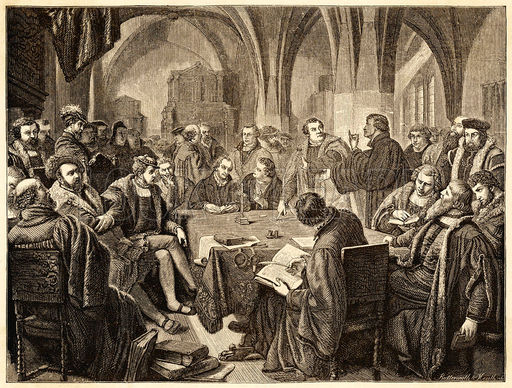 Last week, I was answering some questions for a friend who is studying to become a pastor. His professor had given him two questions for me to answer as part of assignment. One of the questions really struck me: Where do you think Lutheranism fits within the wider Christian community?
This is an important question. After all, for some, it is not evident that Lutheranism does fit within the wider Christian community – at least in a way that encourages engagement with and learning from that community. Last week, I watched with an aching heart as some of my Lutheran brothers in ministry harshly and sometimes sarcastically criticized some of my other Lutheran brothers for engaging with and learning from people outside of my Lutheran community. These criticisms reminded me of how important questions about where Lutherans fit in the Church with a capital “C” really are.
In order to explore these questions, I think it’s important to note the Lutheran identity at its best is a confessional Lutheran identity. The word “confessional” is rooted in the Greek word homologeo, which means, “to say the same thing.” To be a confessional Lutheran, then, means to say the same thing as Jesus and His Word. It means to be devoted to a clear and accurate declaration and explanation of the gospel and sacred Scripture, which, I should point out, can be found in our community’s confessional documents.
When engaging the Christian community at large, this devotion to the gospel and Scripture means two things. First, it means that Lutherans eschew unionism. Unionists are those who conceal differences between Christian communities and pretend that all – or most all – Christians say the same thing about Jesus and His Word. At the same time confessional Lutheranism guards against unionism, however, it also stands against sectarianism. In other words, though Lutherans do not paper over differences between their confession of faith the confessions of other Christian communities, they also celebrate and affirm areas of agreement. Thus, Lutherans are very much a part of the wider Christian community, for they share many of the same theological commitments.
The most famous historical test case for the kind of confessional Lutheranism that abjures both unionism and sectarianism came in 1529 when Martin Luther and Huldrych Zwingli met at Marburg to discuss areas of agreement and disagreement between their two reforming movements. At Marburg, they discovered they agreed on fourteen articles of faith spanning from the nature of the Trinity to justification by faith to the role of governing authorities. But they could not agree on one point: the character of Christ’s presence in the Lord’s Supper. The dispute was formally summarized like this:
We all believe and hold concerning the Supper of our dear Lord Jesus Christ that both kinds should be used according to the institution by Christ; also that the mass is not a work with which one can secure grace for someone else, whether he is dead or alive; also that the Sacrament of the Altar is a sacrament of the true body and blood of Jesus Christ and that the spiritual partaking of the same body and blood is especially necessary for every Christian. Similarly, that the use of the sacrament, like the word, has been given and ordained by God Almighty in order that weak consciences may thereby be excited to faith by the Holy Spirit. And although at this time, we have not reached an agreement as to whether the true body and blood of Christ are bodily present in the bread and wine, nevertheless, each side should show Christian love to the other side insofar as conscience will permit, and both sides should diligently pray to Almighty God that through His Spirit He might confirm us in the right understanding. Amen.[1]
This is a masterful statement. Luther and Zwingli carefully avoid unionism by clearly, winsomely, concernedly, and lovingly explaining where they disagree, but are also in no way sectarian, for they commit themselves to “show Christian love” and “diligently pray to Almighty God that through His Spirit He might confirm us in the right understanding.” In other words, they unreservedly confess their positions while humbly asking the Lord to show them if and where they could be out of step with His Word. Here is confessional Lutheranism at its finest.
In a culture where truth is often either relegated to relativity or regarded as unimportant, confessional Lutheranism has not only much to say, but a time-tested strategy to offer. The ability to stand up for truth against error while also standing with the truth wherever it can be found is sorely needed not only in the Church, but in our world. So, as a confessional Lutheran, I will continue to be honest about areas of disagreement. But I will also never forget to look for areas of agreement. Finally, I will pray that those areas of agreement would continue to increase among others and myself until we all agree with Jesus. For agreeing with Him is what matters most.
__________________________________
[1] Martin Luther, Luther’s Works, vol. 38, J. J. Pelikan, H. C. Oswald & H. T. Lehmann, eds. (Philadelphia: Fortress Press, 1971), 88–89.
It’s Time For A Change

Credit: Mateusz Stachowski
Periodically, I receive email solicitations encouraging me to “take a stand.” I need to “take a stand” against abortion. I need to “take a stand” against sexual immorality. I need to “take a stand” against poverty. There is a whole myriad of things against which I need to “take a stand.”
Now, on the one hand, it is important to stand for truth in a world full of lies. The apostle Paul makes this clear enough when he writes of the armor of God: “Stand firm then, with the belt of truth buckled around your waist” (Ephesians 6:14). Indeed, I have written about the importance taking a stand elsewhere. On the other hand, if all we’re doing is standing against sin in our world, we are falling woefully short of our calling as Christians.
When Martin Luther sparked a reformation of the Church by posting 95 theses for discussion to a church door in Wittenberg, Germany in 1517, his first thesis described the heart and soul of what it means to be – and for that matter, to become – a Christian: “When our Lord and Master, Jesus Christ, said ‘Repent,’ He called for the entire life of believers to be one of repentance.”[1] The Christian life, Luther asserted, is grounded in repentance.
In Greek, the word “repentance” is metanoia, which is made up of two parts. The prefix meta means “to change” and the noun nous refers to the mind. To repent, then, means “to change your mind.” For instance, if a husband wants to divorce his wife because he is no longer happy in his marriage, for him to repent would mean that he stop thinking his marriage is all about his happiness and instead see it as a reflection of the commitment that Christ has to His bride, the Church. Repentance requires a shift in one’s worldview. It asks a person to stop thinking the way he used to think.
When Christ launched His ministry, He launched it with a message of repentance: “Repent, for the kingdom of heaven has come near” (Matthew 4:17). Christ’s desire was not just to take a stand against sin, but to change people’s minds about sin. He wanted people who looked at infants as disposable entities who could be left outside to die – which many in the ancient world did – to change their minds and believe that every life is precious to God. He wanted people who believed it was fine to sleep around – as many in Jesus’ day did – to change their minds and instead be faithful and tender to their spouses. He wanted people who looked past the impoverished – as the rich man in Jesus’ story about the beggar Lazarus did – to change their minds and offer what they could in Jesus’ name.
I have heard many a discussion about the sins that beset our culture and how the Church should respond to these sins. Sadly, more often than not, people want the Church only to “take a stand” while ignoring the fact that, first and foremost, the Church is to help “make a change.” The Church is to call people to repentance.
How can the Church do this? By making two shifts.
First, we must stop looking at people who are far from God as merely evil and start looking at them as lost. Looking at people who are far from God as merely “evil” incites our indignation. Seeing them as “lost” arouses our compassion.
I heard a story last week at a conference I was attending about a man who was at the deathbed of his brother. His brother was a recalcitrant non-believer. He refused to trust in Jesus, even as he was drawing his final gasping breaths. As this man stood by his brother’s bedside, trying to comfort him, the thought passed through his mind: “This is the last time my brother will ever experience any comfort. After this, it will only be eternal separation from Christ.” If that doesn’t break your heart, I don’t know what will.
There are millions of people headed for the same destiny as this man’s brother. How can we only get angry at them as evil without caring for them as lost?
Second, we must stop playing only defense when it comes to evil and start playing offense. I get the impression that some people think if we could just outlaw certain evils, our problems would be solved. But legislation against evil only defensively curbs it. It doesn’t offensively change people’s mind about the fundamental nature of right and wrong. This is why legislation passed in one Congress is so easily reversed by the next Congress. As Christians, our legislative efforts need to take a backseat to our desire to understand and empathize with how our culture thinks so we can winsomely respond to what our culture thinks. If you need a good place to start learning how to do this, I would recommend reading The Reason for God by Timothy Keller. I would also add that changing people’s minds takes time. Sometimes, it takes lots of time. So be patient! A mind changed is worth the wait.
“Taking a stand” may reveal the sin in our world. However, “making a change” – repentance – conquers the sin in our world because it leads people to Christ. And I’d much rather win against sin instead of just complaining about sin.
____________________________
[1] Martin Luther, “Disputation on the Power and Efficacy of Indulgences,” (October 31, 1517).
The Limits of Human Freedom
 We, in America, like freedom. We talk about it. We write about it. We even sing about it. Anyone who has ever attended a sporting event where our national anthem was sung has heard in soaring melody how we live in “the land of the free and the home of the brave.”
We, in America, like freedom. And we will fight, protest, and lobby to protect the freedoms most near and dear to our hearts. Some fight, protest, and lobby to protect the freedom of religion – to practice their beliefs as they choose. Others fight, protest, and lobby for the freedom to keep and bear arms. Still others fight, protest, and lobby for the freedom to marry whoever they want – even if whoever they want is of the same gender.
Perhaps it is our love of freedom that makes the doctrine of predestination so offensive to so many. Jesus summarizes predestination thusly: “You did not choose Me, but I chose you and appointed you so that you might go and bear fruit – fruit that will last” (John 15:16). The doctrine of predestination, then, is simply this: it is God, not us, who is in charge of our salvation. When it comes to our salvation, we are not free!
This is where the hackles of our freedom-loving hearts can get raised. Indeed, the most common objection that I hear whenever I teach on predestination is, “But what about our free wills? Doesn’t predestination mean that God turns us into automatons – unable to accept or reject Him?”
I have addressed this question many times and in many ways. But to address it this time, I would turn your attention the midcentury American sociologist Philip Rieff who, I believe, writes about the limits of our free wills – and the goodness of these limits – in a poignant and powerful way. Rieff writes:
There is no feeling more desperate than that of being free to choose, and yet without the specific compulsion of being chosen. After all, one does not really choose; one is chosen. This is one way of stating the difference between gods and men. Gods choose; men are chosen. What men lose when they become as free as gods is precisely that sense of being chosen, which encourages them, in their gratitude, to take their subsequent choices seriously.[1]
To choose without first being chosen, Rieff explains, is a miserable manner of existence. After all, if there is no God who loves you enough to choose you, what does your choice of Him – or of anything else, for that matter – matter? Who would want to choose a God in their limited power who doesn’t care enough to first choose them out of His infinite power? This is why the apostle Paul speaks of predestination in such glowing terms:
Praise be to the God and Father of our Lord Jesus Christ, who has blessed us in the heavenly realms with every spiritual blessing in Christ. For He chose us in Him before the creation of the world to be holy and blameless in His sight. In love He predestined us to be adopted as His sons through Jesus Christ, in accordance with His pleasure and will – to the praise of His glorious grace, which He has freely given us in the One He loves. (Ephesians 1:3-7)
Paul is thrilled by the doctrine of predestination! For Paul knows that the only way he is free to make decisions worth making is when believes and sees that he himself is a decision that God thought was worth making in predestination. Paul’s limited free will is of no consequence if it cannot come under the tender loving care of God’s perfect free will.
So, do you long to be free? Do you fight, protest, and lobby to protect the freedoms that are near and dear to your heart? If you do, remember that your freedom of choice is only as good and meaningful as your bondage to Christ. Without being under Christ’s rule and reign, your freedom is futile. Under Christ’s rule and reign, however, your freedom is purposeful. And I don’t know about you, but I want my freedom to mean something.
_______________________
[1] Philip Rieff, The Triumph of the Therapeutic (Chicago: The University of Chicago Press, 1966), 93.
Decidophobia

Credit: thebeaconmag.com
I have a confession to make: I suffer from decidophobia.
Now, before you accuse me of making up words, this term is not my own. Walter Kaufmann, who served as a philosophy professor for over 30 years at Princeton, coined it. He explains decidophobia like this:
In the fateful decisions that mold our future, freedom becomes tangible; and they are objects of extreme dread. Every such decision involves norms, standards, goals. Treating these as given lessens this dread. The comparison and choice of goals and standards arouses the most intense decidophobia.[1]
Here’s what Kaufmann is saying: decisions form futures. Those who suffer from decidophobia worry that their decisions will tank their futures.
Now, to a certain extent, this is true. Foolish decisions can lead to bad futures. If one wracks up a lot of debt now, it leads to a lot of bills in the future. If one is having an affair now, it can lead to a heart-wrenching divorce in the future.
But there are other decisions – decisions that don’t always carry with them the ethical clarity that getting into a bottomless pit of debt or having an affair do. Decisions like, “What job should I take?” “What vehicle should I buy?” “What house should I live in?” I am trying to make a decision on the last of these three quandaries. And I have come down with a bad case of decidophobia.
As I have looked at neighborhoods and floor plans and features and storage space, I’ve become worried and concerned. Will I make the right decision? But here’s what I’ve come to realize: decisions like these, though not always easy, are not devastatingly determinative of my future. If a house does not have all the features I might like, it will still provide me with a roof over my head at the end of the day. If a job you take does not meet all your dreams and expectations, you will still have a paycheck at the end of your pay period. If a car you buy isn’t the one you’ve dreamed of since you were a teenager, it will still get you from point A to point B by the end of your trip.
I have long suspected that God gives us some decisions to make not to teach us about decisions themselves, but to teach us about the anxiety that so many of us feel when we are in the throws of a decision-making process. I read somewhere that we should “not worry about tomorrow, for tomorrow will worry about itself” (Matthew 6:34). Many of the decisions we make carry with them no biblical mandate. Any decision we make will be fine. Being free from worry, however, does carry with it a biblical mandate. That’s why it’s time to stop incessantly fretting. Decidophobia is sinful.
So what’s causing you decidophobia? Before you get your stomach tied in knots, remind yourself of Christ’s words in Matthew 6:34. These decisions are not worth your worry. You are in God’s care.
___________________________
[1] Walter Kaufmann, Without Guilt and Justice: From Decidophobia to Autonomy (New York: Peter H. Wyden, Inc., 1973), 3.
Practicing Patience
 The other day, I drove down to the Social Security office to apply to get a Social Security card for my daughter, Hope. Because she is adopted, she did not get one issued to her at the hospital. While I was on my way to visit my local friendly government agency, the skies opened up, thunder clapped, and rain poured down, slowing traffic to a crawl.
Now, usually, I hate being stuck in traffic. I’m always looking for a way to weave in and out of traffic and find that elusive lane that is going 40 miles per hour faster than all the other lanes. But not so on this day. It was raining so hard that, quite frankly, I was glad traffic was moving at a snail’s pace. I’d rather slosh down the road slowly and arrive safely at my destination than try to gun it and wind up in a wreck.
As I sat there contentedly in a sea of brake lights, my thoughts were drawn to the virtue of patience. After all, for once in my life, I actually felt patient. Here is what I realized in my moments spent reflecting: the virtue of patience leads to other virtues. It is what I call a “funnel virtue.” That is, if you practice patience, it will funnel you in to other important virtues.
For instance, take the virtue of responsibility. At the end of the day, my wife directs Hope to clean up her toys. But directing a one-year-old to clean up toys is never an easy – or a quick – task. Hope will drop a toy in her toy basket only to immediately pull it out again. But Melody knows it’s important to teach Hope responsibility. But to teach the virtue responsibility, Melody first needs to exercise the virtue of patience (which she does marvelously, by the way). Patience funnels into responsibility.
Or how about the virtue of joy? The disease of road rage is well documented. Drivers lose their minds because they feel the person in front of them is going too slow. But what would happen if they were patient? Perhaps they would rediscover the joy of a Sunday drive – motoring down the road more to take in the sights rater than to reach a destination. Patience could funnel into joy.
Then, of course, there is the virtue of love. There is perhaps no better expression of love than patience. This is why the very first virtue that Paul uses to describe love in 1 Corinthians 13:4 is, “Love is patient.” To be patient with someone teaches you to love someone because it forces you to put someone else’s pace and schedule above of and in front of your own.
Finally, patience also can serve as a funnel to fuller faith. Right now, we are in the process of buying a new home. I cannot tell you how many times I have prayed to God for an answer about something pertaining to this process…right now! God is answering my requests in some pretty miraculous ways, just not according to my schedule. And I am having to remember and re-learn that God really does have this all under control and I can trust Him to work things out. But here’s the key: the longer I have to wait on Him, the more I learn to trust Him. Patience funnels into faith.
As it turns out, when I got to the Social Security office, I was not able to get a card for Hope. The documentation requirements that I read in the Social Security brochure did not match the documentation requirements they had at the Social Security office. I left empty handed with an errand list of other government agencies I had to visit to get the required documents. I had wasted my time. And I found I was not nearly as patient on the way back from the Social Security office as I was on the way to the Social Security office.
Perhaps my patience funnel still has room to expand.
Four Lessons From The Spurs You Probably Already Know

Credit: Getty Images
This past week was a great one to be living in San Antonio. For the fifth time in franchise history, the San Antonio Spurs brought home the title of NBA National Champions. As much as I enjoyed watching Game 5 of the National Championship and seeing the Spurs come back from a 16-point deficit to win 104 to 87, the Spurs have a lot more going for them than just one big win in one big game. Their words and demeanor season after season offer some good, even if simple, lessons. Here are four that I’ve been thinking about.
A Lesson in Teamwork
The Spurs, as sportscasters, fans, and bystanders alike will tell you, are a team. But not just in the sense that they all happen to be wearing the same jersey. No, they play like a team. They act like a team. And they win like a team. Benjamin Morris noted that the Spurs “had nine different players take four or more field goal attempts per game throughout the playoffs, compared to just six for Miami.”[1] In San Antonio, everybody gets to play because, in San Antonio, everybody needs to play to bring home a win.
Playing as a team, of course, is needed not only on the court, but in the Christian life. To meet the challenges we face, everybody needs to play together. I think of the apostle Paul and all of his teammates, or, as he called them, “partners” (e.g., 2 Corinthians 8:23; Philippians 1:5; Philemon 1:7), in the gospel. With whom do you need to team up so you can share and show God’s love more effectively?
A Lesson in Humility
When Kawhi Leonard was named Most Valuable Player for the Finals, his shock was apparent – and endearing. I loved how he responded to his high honor: “Right now, it’s just surreal to me,” he said. “I have a great group of guys behind me.”[2] Kawhi knew he performed great in Game 5. But he also knew it wasn’t just about him. It was about them – all the Spurs behind him.
In a world where Facebook, Twitter, and Instagram are full of people shouting, “Look at me!” – to have a man point to the men behind him is impressive and important. This is true humility. Indeed, true humility is not about degrading yourself, but about lifting others up, which Leonard did beautifully. Who can you point to in humility?
A Lesson in Perseverance
Before they were the National Champion San Antonio Spurs of 2014, they were the team that let everything slip through their fingers in 2013. The front page of the San Antonio Express-News reflected last year’s heartbreak in its headline: “REDEMPTION!” But it took 362 days after a heartbreaking Game 6 loss to get that redemption. 362 long days. “A day didn’t go by when I didn’t think about Game 6,” said Coach Gregg Popovich. “For the group to have the fortitude to get back to this spot speaks volumes.”[3] The Spurs took a fall, yes, but they turned that fall into fuel for fortitude. In the words of Tim Duncan, “What happened last year definitely helped our drive … We could have reacted in different ways. We reacted the right way.”
Where you in your life do you need to persevere? Where do you need to take things that go wrong and learn from them so you can do right?
A Lesson in Inclusion
Scott Cacciola of The New York Times recently published an article hailing the Spurs as “The United Nations of the Hardwood”:
The Spurs, as has been well established, have developed an international flair under Coach Gregg Popovich. Eight players on the current roster were born outside the United States. Loosely translated, that means the Spurs use at least four languages – English, Spanish, French and Italian – to communicate among themselves.
Manu Ginobili, an Argentine, is the team’s one-man version of the United Nations, capable of conversing in Spanish with his Brazilian teammate Tiago Splitter and in Italian with Marco Belinelli, who was born outside Bologna. (Ginobili speaks in English with everybody else.)
Boris Diaw, who is from France, converses en français with Tony Parker, who was born in Belgium but grew up in France. Both players also know some Italian, enough to eavesdrop on conversations between Ginobili and Belinelli.
Even the two team’s two Australians, Patty Mills and Aron Baynes, have their own dialect.
“We’ll hear them and be like, ‘Whoa!’” the assistant coach Chad Forcier said.
Tim Duncan, who is from the United States Virgin Islands, is considered an international player by the NBA.[4]
During the championship ceremony, many of these players wrapped themselves in the flags of their home countries.
The inclusion of so many men from so many places, all together on one team, makes me smile. It reminds me of the promise that anyone from any “nation, tribe, people and language” (Revelation 7:9) can be included as one redeemed by the Lamb through faith. And the more, the merrier. That’s why one of my prayers is that heaven is chocked full. I’d hate to see one empty corner where a person could have been. So would the Lord. He wants as many people included in His Kingdom as possible. Who can you pray for to be included in eternity’s celebration?
In reality, these lessons are pretty simple and straightforward. Indeed, I suspect you have probably already learned these lessons somewhere along the way. Nothing in this blog is probably news to you. But lessons don’t have to be esoteric and unknown to be profound and helpful. They just have to be true. And these lessons most certainly are. That’s why I thought we could all use a little reminder.
So congratulations, Spurs. And thanks for the lessons. They’re great.
________________________________
[1] Benjamin Morris, “The Spurs Were an Outlier of Unselfishness,” FiveThirtyEight (6.17.2014).
[2] Associated Press, “Kawhi Leonard named Finals MVP,” ESPN (6.16.2014).
[3] Jeff McDonald, “High five! Spurs dethrone Heat for fifth NBA championship,” San Antonio Express-News (6.15.2014)
[4] Scott Cacciola, “The United Nations of the Hardwood,” The New York Times (6.15.2014).
Wisdom That’s Not So Wise

Credit: wired.com
It was G.K. Chesterton who said, “It is always easy to let the age have its head; the difficult thing is to keep one’s own. It is always easy to be a modernist; as it is easy to be a snob.”[1] There just seems to be something about one’s own age the dupes those living in it into thinking they are living in the best age – they are living at the pinnacle of human achievement, intelligence, and insight, unsurpassed by anything that has come before it, or, for that matter, anything that will come after it.
Case in point: Albert Schweitzer, in his seminal work The Quest of the Historical Jesus, opens by touting his credentials:
When, at some future day, our period of civilization shall lie, closed and completed, before the eyes of later generations, German theology will stand out as great, a unique phenomenon in the mental and spiritual life of our time. For nowhere save in the German temperament can there be found in the same perfection the living complex of conditions and factors – of philosophic though, critical acumen, historical insight, and religious feeling – without which no deep philosophy is possible.[2]
At least Schweitzer doesn’t have a confidence problem.
The ironic thing about Schweitzer’s opening paragraph is that on the back of this very book is this review: “Schweitzer’s … proposals no longer command endorsement.” In other words, Schweitzer, who thought his age was so wise that the people, and specifically the Germans, in it could in no way be mistaken, were, in fact, mistaken. Perhaps his German pedigree wasn’t as intellectually impenetrable as he thought it was.
Whether or not we are as unabashedly arrogant as Schweitzer, we all, to one extent or another, use our age as the measuring rod for all ages. We project the sensibilities of our age back onto the past and even forward into the future.
Greg Miller of Wired Science recently published a pithy little post, “Here’s How People 100 Years Ago Thought We’d Be Living Today.”[3] Ed Fries, the former vice president of game publishing at Microsoft, shared with Miller a fascinating cache of vintage European postcards that offer a glimpse of how the people of yesteryear thought we would be living in our years. For instance, there is one postcard featuring a prop plane with a spotlight and luggage attached to the top of the cabin ushering a group of tourists to the moon for “just another weekend trip.” The year, according to the postcard, is 2012. Are any rockets needed? No. And the people on the aircraft seem to be blissfully unconcerned with the fact that their cabin is not pressurized. Another postcard features a videophone, projecting its picture onto a wall, just like the movies of the early 1900’s did. Apparently, those at the turn of the 20th century simply could not envision the hand-held screens we enjoy today. Perhaps most comically, the people in all of these postcards are decked out in their early 1900’s wears. As Miller wryly notes, though everything else underwent radical evolutions, “fashion stayed frozen in time.”
For all the fanciful things these postcards envision, they are embarrassingly transparent products of their time. No one would mistake these as accurate or modern depictions of our age. The people of the early 1900’s, it seems, were stuck in the early 1900’s.
We would do well to remember that just like the people of the early 1900’s were stuck in the early 1900’s, the people of the early 2000’s are, well, stuck in the early 2000’s. We too are products of our time. Not that this is all bad. Our age has much too offer. But our age cannot lead us to disparage other ages – especially past ages. For the wisdom of the past that we discount as foolishness in the present may just be the wisdom of our present that will be discounted as foolishness in the future. In other words, we should take the wisdom of our age with a grain of salt.
One of the wonderful things about Scripture is that it self-consciously bucks the human tendency to jump on the bandwagon of whatever zeitgeist happens to be popular at any given moment. Indeed, it sees past learning as key to present wisdom. As the apostle Paul says, “For everything that was written in the past was written to teach us, so that through endurance and the encouragement of the Scriptures we might have hope” (Romans 15:4). This is why, according to one count, the Old Testament is cited in the New Testament some 263 times.[4] Wisdom, according to Scripture, cannot be confined to just one age. It needs many ages.
When you look at your present, then, don’t assume that your day is the greatest day and your generation the greatest generation. Or, to use the words of Moses, “Remember the days of old; consider the generations long past” (Deuteronomy 32:7). Wisdom is not just when you are. It was before you. And it will continue after you. Wise, therefore, is the person whose memory and vision is long.
______________________
[1] G.K. Chesterton, Orthodoxy (New York: Dodd, Mead & Co., 1908).
[2] Albert Schweitzer, The Quest of the Historical Jesus (Mineola: Dover Publications, Inc., 1911), 1.
[3] Greg Miller, “Here’s How People 100 Years Ago Thought We’d Be Living Today,” wired.com (5.28.2014).
[4] “New Testament Citations of the Old Testament,” crossway.org (3.17.2006).
We’ve Only Just Begun
 As a kid, I remember a song my mom used to play from the 70’s by the Carpenters called “We’ve Only Just Begun.” The song is about a couple’s wedding day and imagines all the things still to come in their relationship. “We’ve only just begun to live,” the song muses.
The message of this golden oldie is a message I often share with the soon-to-be-wedded couples I counsel. “The wedding day is a big day,” I will say, “but it is only one day. Don’t just plan for your wedding day. Plan for all the days that come after your wedding day. After all, when you walk down that aisle and make your vows, you’ve only just begun.”
Yesterday, we celebrated the resurrection of Christ. The apostle Paul summarizes Christ’s resurrection thusly:
For what I received I passed on to you as of first importance: that Christ died for our sins according to the Scriptures, that He was buried, that He was raised on the third day according to the Scriptures. (1 Corinthians 15:3-4)
For Paul, Christ’s death for our sins and resurrection three days later is “of first importance.” The Greek word for this phrase is protos, from which we get our word “prototype.” A prototype, of course, is a first run of a product or procedure meant to be a test for what comes after it. And this is precisely what Christ’s resurrection is. For, according to Paul, Christ’s resurrection – glorious as it is – is only the beginning. Paul explains:
Christ has indeed been raised from the dead, the firstfruits of those who have fallen asleep. For since death came through a man, the resurrection of the dead comes also through a man. For as in Adam all die, so in Christ all will be made alive. (1 Corinthians 15:20-22)
Paul argues that in Christ’s resurrection on Easter Day, God was doing a test run for our resurrections on the Last Day. As glorious as Easter is, then, it is only a foretaste of what is to come. It is only a prototype for the big roll out of resurrection and life that will burst forth at Christ’s return. God has “only just begun” to raise people from death. An even bigger Easter is still on its way – an Easter when we will not only shout, “Christ has risen,” but, “We have risen!”
Not Just Any Old Crucifixion

“Calvary” by Josse Lieferinxe, c. 1500
In the ancient world, crucifixions were a dime a dozen. Hardly a day passed without one. Consider these statistics:
- 519 BC: Darius I, king of Persia, crucifies 3,000 of the leading citizens of Babylon.
- 332 BC: Alexander the Great crucifies 2,000 people after invading the city of Tyre.
- 100 BC: Alexander Jannaeus, king of Judea, crucifies 800 Pharisees.
- 71 BC: A great uprising of slaves against the Roman Empire, led by the great gladiator Spartacus, leads to the crucifixion of 6,000 of his followers along a stretch of highway from Capua to Rome, totaling 120 miles.
- 4 BC: Varus, governor of Syria, crucifies 2,000 Jewish rebels who were leading a Messianic revolt.
- AD 70: The Roman general Titus sweeps into the city of Jerusalem, sacks it, and begins crucifying 500 people a day he runs out of wood to make crosses.
Crucifixions happened all the time. In fact, according to one estimate, as many as 30,000 people were crucified just in Israel by Jesus’ day.[1]
This Friday is Good Friday – a day when we commemorate a crucifixion. But with crucifixions being so commonplace in the ancient world, it’s worth it to ask: Why do we commemorate one particular crucifixion? Why don’t we commemorate the many crucifixions of the citizens of Babylon, or of Spartacus’ followers, or of the Jews under Titus’ reign of terror? Why do we commemorate only one crucifixion – Jesus’ crucifixion?
The Mishnah, an ancient compendium of Jewish rabbinical teaching, explains that if a criminal was condemned to execution, which would have included crucifixion, he was to say, “Let my death be atonement for all of my transgressions.”[2] The idea was that if a person’s crimes were so heinous that he was deserving of death, only death could save him from those crimes. Crucifixion, then, was connected not only to punitive punishment, but also to personal atonement.
Jesus’ crucifixion, however, was different. Rather than making recompense for His own sins by His death, Jesus asks for forgiveness for others’ sins: “Father, forgive them, for they do not know what they are doing” (Luke 23:34). And rather than seeking atonement for Himself by His execution, the apostle John says Jesus makes atonement for the world: “[Christ] is the atoning sacrifice for our sins, and not only for ours but also for the sins of the whole world” (1 John 2:2).
This is why we commemorate Jesus’ crucifixion. For we remember not only that Jesus was crucified, but why Jesus was crucified. He was crucified not for His own sins, but for ours. Jesus’ crucifixion did what no other crucifixion could do. It saved us. And that’s worth remembering…and celebrating. And that’s why this Friday is not just any Friday, but a Good Friday.
______________________________
[1] John MacArthur, The MacArthur New Testament Commentary: Matthew 24-28 (Chicago: The Moody Bible Institute, 1989), Matthew 27:27-37.
[2] m. Sanhedrin 6.2.
“Look at me!”
 This past weekend in ABC, I talked about how far too many of us live by the narcissistic credo, “Look at me.” What children will say to their parents at the pool right before they do a flip or a dive is the same thing we want, albeit we may not say so in so many words. Instead, it is our actions – sometimes wild and dramatic; other times passive, yet aggressive – that cry out for people to notice. And oftentimes, our actions produce their desired effect. Oftentimes, people look at us, even if for all the wrong reasons.
Sadly, having others “look at me” is a desire that not only resides in the hearts of people in the world out there; it is a desire that resides in my heart. I want people to take note of who I am and what I do. Whether it’s a Bible study that I lead or a sermon that I preach or a blog that I post, I can quickly become all too curious to know what people think of what I have said or written and if people care. And if they don’t think highly of what I’ve said or written, or if they don’t care, I can easily become hurt. After all, just like so many others, I like to be remembered and recognized. I want people to “look at me.”
One of the most puzzling motifs in the Gospels is what a scholar named William Wrede deemed “the Messianic secret.” The Messianic secret describes those times when, after a particularly profound and revealing utterance or after some miraculous feat, Jesus warns His disciples not to share His identity or actions with anyone else. For instance, after Peter claims Jesus to be “the Christ,” that is, the Messiah, Jesus warns the disciples “not to tell anyone about Him” (Mark 8:29-30).
Wrede claims that, historically, Jesus did not believe Himself to be and did not speak of Himself as the Messiah. Later Christians came to this conclusion quite apart from what Jesus actually said and did. According to Wrede, the Gospel writers made up these Messianic “secrets” and inserted them into the Gospels as an apologetic to argue for Jesus’ Messianic identity.
Not surprisingly, orthodox Christians take a different view of these secretive statements. We believe these statements were not later glosses to create for Jesus a Messianic identity He never claimed, but genuine statements by Jesus concerning who He is and what He had come to do.
But why would He want to keep His grand identity a secret? The general consensus is that Jesus knew many people would misunderstand what it means for Him to be the Messiah, for many of the Jews of that day had visions of the Messiah as a political revolutionary dancing in their heads. Jesus, of course, was no such Christ. He had not come to overthrow a government, but to usher in a Kingdom.
Beyond this, Jesus’ secretive statements also seem to reflect the fulfillment of prophecy. One of the marks of the Messiah, according to Isaiah, is His humility. The Messiah will not clamor to pronounce before the world His identity and power: “He will not shout or cry out, or raise His voice in the streets” (Isaiah 42:2). In other words, the Messiah will not come to this world announcing, “Look at me!”
In a world where we struggle with the desire to be noticed, there is a lesson to be learned from the Messianic secret. Jesus eschewed notice, and yet there has never been anyone more noticeable than Him. His noticeability came through His humility.
Perhaps our noticeability should come the same way. Perhaps rather than shouting “Look at me,” we should practice a gentle humility.


 Pastor Zach's Blog