Posts filed under ‘Devotional Thoughts’
What I Write, How I Write It, and Why

Credit: zen / Foter / CC BY-NC-SA
I write my message on issues. I craft my message on hunches. I hope with my message to make a difference.
These past few weeks have presented me with no shortage of blog-worthy issues to write about. Bruce Jenner became Caitlyn Jenner. The Supreme Court legalized same-sex marriage nationwide. On the heels of a horrific racist shooting in Charleston, a fight erupted over whether and how to display the Confederate flag. And a secret video of a Planned Parenthood executive talking casually about abortion and the sale of aborted fetal tissue was posted on YouTube. It’s been a busy few weeks.
As I’ve been thinking about the crush of big stories that have occupied my thoughts, something struck me regarding two of the stories about which I had written. When writing about the Supreme Court’s ruling on same-sex marriage, my tone was gentle and measured – concerned about ethics, but much more focused on people. When writing about Planned Parenthood, my tone was considerably more straightforward and even somewhat brash. Why?
I write my message on issues. I craft my message on hunches. I hope with my message to make a difference. I just had a hunch that the legalization of same-sex marriage needed to be handled more delicately and interpersonally than the revelation that Planned Parenthood is allegedly selling aborted organs for possible profit. So I crafted my message accordingly.
Ontologically, of course, what advocates of same-sex marriage and Planned Parenthood promote is very similar. Both tout what one author has referred to as “erotic liberty” – that is, freedom to have sex with whom you want, when you want, and how you want without having to consider or confront the natural and reasonable entailments sex brings with it. Sexual desire and autonomy, in this view, cannot be impeded by gender or pregnancy.
But even though these two issues share a great deal in common ontologically, they are perceived in very different ways epistemologically in our broader culture. In other words, the nature of these things in and of themselves may be quite similar, but how people think and talk about these things is very different.
When it comes to same-sex marriage, there is a tension between what people know and what they believe. Most people know that Christianity places certain ethical restrictions on sexual expression. But many cannot bring themselves to believe that these ethical restrictions are reasonable or loving. In a world where it is increasingly difficult – and, I would add, unnecessary and unreasonable – not to have friends, relatives, coworkers, or, at the very least, acquaintances who are in same-sex relationships, believing that such relationships deserve anything less than a full-throated endorsement is a hard pill for many to swallow. After all, so many of these relationships seem healthy and loving. So even if many know what Christianity teaches about sexual intimacy, they have a hard time believing it’s right.
Likewise, when it comes to Planned Parenthood and abortion, there is also a tension between what people know and what people believe. In this instance, however, the tension is inverted. The problem is not so much with what people intuitively believe as it is with what people intellectually know. Most people – regardless of their political sensibilities – can’t help but be viscerally repulsed by Planned Parenthood executives who talk casually about a “‘less crunchy’ technique to get more whole specimens” of aborted organs for medical research and how, when performing an abortion, you have be “cognizant of where you put your graspers, you try to intentionally go above and below the thorax … I’m going to basically crush below, I’m gonna crush above, and I’m gonna see if I can get it all intact.” It is hard to escape a nagging belief that this is not an outright assault against human dignity and life. This is why, when I address abortion, I quickly strip away sterile terms like “dilation,” “curettage,” “aspiration,” “evacuation,” and “Intrauterine Cranial Decompression” to write in frank and sometimes startling terms about what abortion really is: the ending of life in utero. Intuitively, people already believe this. I want people to intellectually know, however, just how grave the situation really is with Planned Parenthood.
In the case of same-sex marriage, people often know what Christianity says about sexual ethics, they just have a hard time believing it. When it comes to Planned Parenthood’s practices, there are a great number of people, including those who publicly support abortion, who believe what Planned Parenthood has done is wrong. They just don’t always know how to express their concerns in ethically rigorous ways.
It is this distinction between knowing and believing that shapes how I have written over these past few weeks. When I write about same-sex marriage, I know I am diving into deeply held and tender beliefs about love. So I address these beliefs tenderly. When I write about Planned Parenthood, I know I am up against a whole host of euphemisms meant to obscure what people actually know about abortion. So I cut through the euphemisms with candor. In the first instance, I’m trying to persuade people to believe a little bit differently. In the second instance, I’m trying to bring attention to something I think people need to know more about.
When we address today’s cultural issues as Christians, it is important to ask ourselves: What are we trying to do? Are we trying to change a belief? Are we trying to share important knowledge? And how do the ways in which we address broad concerns actually make things better?
Though my approach to addressing society’s issues du jour is by no means exhaustive or comprehensive, I hope it proves helpful – at least in a limited way. Frankly, it is born out of a concern that, all too often, when addressing cultural controversies, many of us who are Christians wind up doing little more than beating our chests in self-righteous indignation at our culture’s ills. The problem is, even if this makes us feel better, it does nothing to make our world better. Our world needs gentle persuasion when it believes wrongly. It needs frank facts when it lacks knowledge. But most of all, it needs people who are devoted not only to being right about issues, but to doing good for our world. This is why Jesus, during His earthly ministry, wasn’t just right in what He said, He was righteous in how He said it. And thanks to Him, the world has never been the same.
May Jesus’ legacy be evident in our lives.
On Edge…About Everything
 Last Wednesday morning was an unexpectedly frenzied one. Within the scope of a few hours, all United Airlines planes were grounded, the website for the Wall Street Journal went dark, and trading at the New York Stock Exchange grinded to a screeching halt. The problem in each instance? Computer glitches.
It didn’t take long for people to begin to fear that we under some sort of cyber attack. Lester Holt, anchor of NBC Nightly News, opened the newscast that night with an honest acknowledgement of the anxiety so many were feeling:
A lot of us got that uneasy feeling today when within hours of each other separate computer outages grounded all United Airlines flights and halted trading on the New York Stock Exchange.
Uneasy feeling, indeed. What happened was so startling, it got the attention of Homeland Security.
In the end, it was discovered that United’s problems stemmed from “a failed computer network router that disrupted its reservation system.” Trading on the New York Stock Exchange went down because of a “botched software upgrade” the night before. As for the Wall Street Journal, though no definitive explanation has been offered for its problems, some are speculating that the trouble at the Stock Exchange drove people to the Wall Street Journal for updates, which, in turn, crashed the website. Cyber terrorism had nothing to do with anything. We had no need to fear. But we did.
Fear is plentiful these days. It doesn’t take much to make us apprehensive. Sadly, fear is just as prevalent – if not more so – in the Church as it is in wider society. I have talked to Christians who are wringing their hands over what could very well be an erosion of our religious liberty. I have talked to Christians who are terrified by what is happening oversees – and, for that matter, close to home – with ISIS. I have talked to Christians who are anxious about our nation’s economic path. I have talked to Christians who are frightened by just about everything.
For Christians who are full of fear, this description of who we are as the Church from Pope Benedict XVI strikes me as timely:
Is the Church not simply the continuation of God’s deliberate plunge into human wretchedness? Is she not simply the continuation of Jesus’ habit of sitting at table with sinners, of His mingling with the misery of sin to the point where He actually seems to sink under its weight? Is there not revealed in the unholy holiness of the Church, as opposed to man’s expectations of purity, God’s true holiness, which is love – love which does not keep its distance in a sort of aristocratic, untouchable purity but mixes with the filth of the world, in order thus to overcome it?[1]
This is an impressively clear, cogent, and, I should affirm, broadly, even if not comprehensively, correct ecclesiological statement from the former leader of the Roman Catholic Church. The Church, Benedict reminds us, is incarnational in her character and missional in her charter. She goes to places no one else would dare to darken – filthy places, impoverished places, wicked places, sinful places. As the Church ministers in sinful places like these, she, like Jesus, in the words of the former pope, can “actually seem to sink under [sin’s] weight.” But, of course, when Jesus sank, He didn’t sink for long. Three days is all sin got of Him. So it is with Christ’s Church. “The gates of Hades will not overcome it” (Matthew 16:18), Jesus promises. Sin may attack the Church, but it will not overcome her.
When we, as the Church, become afraid of the sinfulness in our world, we stop acting as the Church should for our world. We become so scared of sinners because of what they might to do to us that we forget to love sinners as Christ has loved us. The fearfulness of the faithful, it turns out, can be just as dangerous to the Church as the sinfulness of the world, for it stymies the Church in her mission.
In 1931, Swedish theologian Gustaf Aulén published Christus Victor where he wrote of how Christ “fights against and triumphs over the evil powers of the world, the ‘tyrants’ under which mankind is in bondage and suffering.”[2] To this day, his book is a standard-bearer for discussions about Christ’s work and accomplishments on the cross. But we must always remember that Christ’s victory is also our victory. Christus Victor is the promise of Ecclesia Victor.
Do not, then, be afraid. Instead, be the Church. The world needs us.
______________________________
[1] Pope Benedict XVI, Introduction to Christianity, Second Edition (San Francisco: Ignatius Press, 2004), 342.
[2] Gustav Aulén, Christus Victor: An Historical Study of the Three Main Types of the Idea of Atonement, A.G. Hebert, trans. (Eugene: Wipf & Stock, 2003), 4.
True Confessions
 I love to read all sorts of things. Theological tomes. Biographies. Histories. The Bible. I love to read op-ed pieces in newspapers and long form journalism – an art form I am concerned is all too quickly disappearing – in newsmagazines.
I love to read. But I don’t always like what I read about.
Case in point. This past week, I was scrolling through my newsfeed when up popped a story about a pastor who had to resign from his church because of serious ongoing turpitude. I wish I could say I’m surprised. But I’m not. I’m not surprised because I’ve seen far too many of these kinds of stories for them to shock me. I’m not surprised because I know the human heart can be a dark place, leading people to do dark things. I’m not surprised because I know my heart can be a dark place, leading me to do dark things. I’m not surprised. But I am heartbroken. I am heartbroken when I think about the pain, regret, and fear this brother in Christ must be experiencing. I am heartbroken by how his story is being talked about on social media. An Internet mob has predictably descended on Facebook pages, Twitter feeds, and comment walls to attack and destroy this man in a sickening display of schadenfreude. This man is in my prayers and, if I can be so bold, he should be in yours.
It is out of my heartbreak that I want to sound a warning not only to my brother pastors, but also to all Christians: Satan hates you and is out to destroy you. This is why Revelation 9:11 calls Satan “the Destroyer.” Satan wants to destroy you along with all the people you love and all the people who love you. Indeed, the sin of this pastor has not only compromised his security and livelihood, it has also deeply wounded his congregation – exposing them to ridicule in the hot spotlight of a nationally trending news story – as well as, I’m sure, emotionally devastating his family.
A few years back, in The Asbury Journal, David Werner asked an important question: “How is your doing?” He asked this question in the spirit of John Wesley, who took great care always to connect “how one was doing internally (in one’s soul) … to what one did, or how one lived out the Christian life externally (in one’s actions).”[1] In other words, Wesley wanted Christians to seriously consider how well their actions comported with their words and worldview.
So, let me ask you: How is your doing? Are there any “doings” that you are hiding? Is there a sin that remains secret? Now is the time to confess it, repent of it, and receive forgiveness for it. Now is the time to share it with a pastor, a counselor, or a trusted friend in Christ so you can be held appropriately accountable for it and, ultimately, be absolved of it.
The apostle Peter exhorts us to two important “doings” when he writes, “Be self-controlled and alert” (1 Peter 5:8). Both parts of Peter’s admonition are critical. If you cannot control yourself, your ability to help and lead others will be inevitably compromised and, in some instances, discredited and destroyed. And if you are not continually vigilant, watching out for Satan’s tricks and traps, he will use your slumber toward righteousness to take you down before you even know what hit you. Being self-controlled and alert is key.
But even more important than Peter’s admonition is Peter’s invitation in the verse prior: “Cast all your anxiety on God because He cares for you” (1 Peter 5:7). Sin tells a sinister, but enticing, lie. It promises you that if you fall to it, it will release you from your anxiety. “Imbibing too much alcohol can help you lighten up and have fun,” whispers sin. “Misusing God’s gift of sex can give you a much needed thrill in a hard knocks world,” says sin. But, in the end, sin never helps your anxiety. Instead, it only adds to your anxiety pain, hurt, brokenness, and guilt.
Peter reminds us that only God can take our anxiety because only God has taken care of our anxiety by taking care of our sin on the cross of His Son, Jesus Christ. So lay your anxiety – and your sin – on Him. In the words of the old hymn:
I lay my sins on Jesus,
The spotless Lamb of God;
He bears them all, and frees us
From the accursed load.
I bring my guilt to Jesus,
To wash my crimson stains
White in His blood most precious,
Till not a spot remains.
There is a chance that this man who has had to resign from his church will not serve again as a pastor. But even if his vocation as a pastor has passed, his vocations as a husband and as a father still stand. My prayer is that, out of his pain, this man serves in these callings from God repentantly, patiently, and lovingly and that he finds his comfort in what God has called him: His forgiven child.
My prayer is that you find your comfort there too.
_______________________________
[1] David Werner, “John Wesley’s Question: ‘How is Your Doing?’” The Asbury Journal 65, no. 2 (2010): 68.
The Greatest Show On Earth
 This past weekend at the church where I serve, we presented our annual Palm Sunday pageant depicting the birth, life, death, and resurrection of Jesus Christ. It is a lot of work for all involved, but I always come out of the pageant with a deep sense of satisfaction and awe, for I have the privilege of working with amazing people who have amazing gifts and know how to use them in amazing ways. I am deeply thankful for the people with whom I get to work. They are a blessing to me.
In one way, our pageant can be characterized as a spectacle. It has moving music featuring a live orchestra and choir, well-choreographed lights, lots of actors, and a graphic enough depiction of Christ’s death that we make available an alternative worship service for small children who may be unsettled by what they see. But, of course, it isn’t the spectacle of our Palm Sunday pageant that makes it valuable and powerful. It’s the message. There is simply no better message than the gospel message – that Christ was crucified for sinners. Our prayer is that this message – as it is presented in the pageant – leads hearts to repentance and faith, even as God has promised in His Word.
In Luke’s account of Jesus’ crucifixion, there is an interesting reaction to His death from the bystanders: “All the crowds that had assembled for this spectacle, when they saw what had taken place, returned home beating their breasts” (Luke 23:48). The word for “spectacle” in Greek is theoria, related to our English word “theatre.” This is a most appropriate word because crucifixions were indeed gory theatre. If someone was an enemy of the Roman State, the governing officials, though they could have executed such a person in other, more efficient and less gruesome ways, chose crucifixion. Why? Because crucifixion served as a public, humiliating spectacle. In fact, most criminals were crucified naked so as to shamefully expose them. Jesus is no exception. His crucifixion is meant to be theatre. It is meant to be spectacle. It is meant to be theoria, just as Luke says.
But in the middle of this spectacle, something unexpected happens.
When the crowds see the darkness that covers the land, when they hear the news that the curtain of Jerusalem’s temple has been torn in two, when they hear Jesus commend Himself into His Father’s hands, and when they are startled by the testimony of one of Jesus’ executioners saying, “Certainly this man was innocent” (cf. Luke 23:44-47), they “return home beating their breasts.” In Jewish piety, this is a sign of repentance (e.g., Luke 18:13). What begins as theatre and spectacle becomes a life-changing event that testifies to the truth of Jesus’ identity and to the promise of God’s salvation.
At many churches this Holy Week, there will be a certain amount of spectacle. There will be Maundy Thursday services that conclude dramatically with a reading of Psalm 22 and a stripping of the church’s altar to remind us of Christ’s humiliation on the cross. There will be moving Good Friday Tenebrae services that turn sanctuaries black with darkness to remind worshipers of the darkness of sin and of Jesus’ death. And, of course, there will be energetic Easter services, complete with Easter lilies, rafter-shaking music, and the historic, thrilling Easter greeting, “Christ is risen!” to which the congregation will respond, “He is risen indeed! Alleluia!” Yes, there will be plenty of spectacle this week. And this, I would note, is great. I love the spectacle of this time of year.
My prayer, however, is that even as spectacle may be an inevitable and helpful part of Holy Week, we remember that it is not all of Holy Week. For the spectacle is meant to point to something better – and to Someone greater. The spectacle is meant to point us to the cross – and to the One who died on it. And Jesus is more than a spectacle. He is your Savior. That’s what those bystanders at Jesus’ cross discovered as they beat their breasts. And that’s what we are called to believe.
Following Jesus Day By Day
 I’ve watched the scenario play out again and again. A young Christian man is climbing the ladder of success. But then something snaps. The trappings of success begin to strangle his heart. And he decides to give it all up. His job. His house. His source of income. Traditional means of supporting his family. He gives it all up and announces, “I am going to stop trying to manage, control, and plan for everything my life and just follow Jesus one day at a time.”
Now, on the one hand, I respect and admire this deeply. This kind of decision brings into crystal clarity the trappings of an affluent life. The truth is, we don’t need the stuff we have. And when we treat it like we do need it, we break the First Commandment. We turn the stuff we have into an idol we trust.
In his book Radical, David Platt paints a picture of an Asian house church that haunts me:
Despite its size, sixty believers have crammed into it. They are all ages from precious little girls to seventy-year-old men. They are sitting either on the floor or on small stools, lined shoulder to should, huddled together their Bibles in their laps. The roof is low, and one light bulb dangles from the middle of the ceiling as the sole source of illumination.
No sound system.
No band.
No guitar.
No entertainment.
No cushioned chairs.
No heated or air-conditioned building.
Nothing but the people of God and the Word of God.
And strangely, that’s enough.
God’s Word is enough for millions of believers who gather in house churches just like this one. His Word is enough for millions of other believers who huddle in African jungles, South American rain forests, and Middle Easter cities.
But is His Word enough for us?[1]
I sure do hope His Word is enough for us. Because if it’s not, the Church has lost her foundation, her purpose, her uniqueness, and her hope. God’s Word must be enough.
I say all this so that you do not misunderstand what I am about to write.
I have no inherent problem with people who want to follow Jesus day by day with nothing but the shirts on their backs. I am concerned, however, that the impetus for following Jesus in this way is sometimes based on a misreading of what Jesus actually says. When it comes to trusting Jesus day by day, Jesus explains:
Therefore I tell you, do not worry about your life, what you will eat or drink; or about your body, what you will wear. Is not life more important than food, and the body more important than clothes? Look at the birds of the air; they do not sow or reap or store away in barns, and yet your heavenly Father feeds them. Are you not much more valuable than they? Who of you by worrying can add a single hour to his life? And why do you worry about clothes? See how the lilies of the field grow. They do not labor or spin. Yet I tell you that not even Solomon in all his splendor was dressed like one of these. If that is how God clothes the grass of the field, which is here today and tomorrow is thrown into the fire, will He not much more clothe you, O you of little faith? So do not worry, saying, “What shall we eat?” or “What shall we drink?” or “What shall we wear?” For the pagans run after all these things, and your heavenly Father knows that you need them. (Matthew 6:25-32)
Jesus is clear. We need not worry about tomorrow. Tomorrow will take care of itself.
There is a difference, however, between worrying about tomorrow and planning for tomorrow. One is discouraged. The other is encouraged. Jesus tells a story about ten virgins who bring oil lamps waiting for a groom to show up for a wedding party. But five of the ten did bring enough oil for their lamps. Do you know what Jesus calls those five? “Foolish” (Matthew 25:3). Why? Because they did not plan. The book of Proverbs includes admonitions to plan (Proverbs 21:5; 24:27; 27:23-27) and God Himself plans (Jeremiah 29:11-13). Jesus’ ministry is intricately planned as can be seen from His passion predictions (Matthew 16:21; 17:22-23; 20:17-19; Mark 8:31; 9:31; 10:32-34; Luke 9:18-22, 9:44, 18:31-33) and His training of the disciples for the mission of the Church (Matthew 4:19). Thus, not worrying about tomorrow does not preclude planning for tomorrow.
So, to my friends who have jettisoned plans to follow Jesus day by day, I say, “Blessed are you.” But remember that a time may come when planning, once again, becomes salutary. And if you’re worried that your plans may somehow be out of step with God’s will, you do not need to be afraid. After all, “Many are the plans in a man’s heart, but it is the LORD’s purpose that prevails” (Proverbs 19:21).
If your plans go awry, the Lord will get you back on track. He has promised to. You can plan on it.
_____________________________________
[1] David Platt, Radical: Taking Back Your Faith From the American Dream (Colorado Spring: Multnomah Books, 2010), 26.
2015: It’s Going To Be A Great Year
 As we begin a new year, it is useful to take a moment to reflect on our lives – where we are, where we have been, and where we are going. Reflecting is important not only for the realms of finances, family, or fitness, but also for the realm of faith. For above all, we must realize and recognize who we are in relationship to our Creator. The British theologian N.T. Wright has written a set of five questions every Christian must answer – or, perhaps more accurately, simply remember the answer already given – in order to appropriately and insightfully take stock of his or her life. I relay these questions – and their answers – so that you may remember who you are in God’s sight.[1]
Who are we?
We must never forget that, as the apostle Paul writes, we are “in Christ” (1 Corinthians 15:22). This means our identity and purpose must always and only be founded and grounded not in the things, titles, or accolades of this world, but in the cross of our crucified Savior. This is certainly where the apostle’s identity is found: “May I never boast except in the cross of our Lord Jesus Christ” (Galatians 6:14). If we find our identities in anyone or anything else other than Christ and His cross, we are called to repent and turn back to Him.
Where are we?
N.T. Wright reminds us that we are “in the good creation of the good God.” Sometimes we can forget, especially when life becomes dark and difficult, that when God created the world, He created it “good” (Genesis 1:25). Yes, not all is right with creation. Yes, there is pain, suffering, and tragedy – none of which were part of God’s dream and design. But try as it might, evil cannot utterly destroy the goodness of God’s creation. Indeed, God promises to restore the complete goodness of His creation on the Last Day: “Creation itself will be liberated from its bondage to decay and brought into the glorious freedom of the children of God” (Romans 8:21). For all of its brokenness, we are still in a good place. Thus, we ought to celebrate and appreciate the home in which God has given us in His creation.
What’s wrong?
In a word, sin is what’s wrong. Indeed, this is why God’s good world appears so marred and messed up. Each of us is born into sin generally. Because of Adam and Eve, the effects of sin plague us all. This is called “original sin.” But each of us also commits sins individually and personally. We transgress God’s laws and do not do what we are commanded to do. This is called “actual sin.” Another answer to the question of what is wrong, then, is that we are what’s wrong. We are the ones who make God’s good world a mess through our injustice and iniquity.
What’s the solution?
In a word, Jesus is the solution. Jesus is God’s remedy to sin and redemption from sin. The apostle Peter writes, “Christ died for sins once for all, the righteous for the unrighteous, to bring you to God” (1 Peter 3:18). It is important to note that not only is Jesus God’s solution to sin, Jesus is God’s only solution to sin: “Salvation is found in no one else, for there is no other name under heaven given to men by which we must be saved” (Acts 4:12). This means that all other attempts to deal with sin – be they moralistic or legalistic or liberalistic or relativistic – will ultimately fail. If Christ is not your Forgiver and Redeemer, your sin has not been solved. Period.
What time is it?
In the Scriptural view, time is not marked by the days on a calendar, but by the acts of our God. In other words, what matters about the new year is not that we have transitioned from 2014 to 2015, but what God has done for us in the past and will continue to do for us into the future. N.T. Wright explains cogently the time in which we live: “We live between resurrection and resurrection, that of Jesus and that of ourselves; between the victory over death at Easter and the final victory when Jesus ‘appears’ again.” What ultimately makes 2015 so special, then, is that we are another year closer to the coming of Christ and the salvation of our souls. And that sure and certain hope makes this year a year worth celebrating!
_______________________
[1] The questions and quotes in this blog can be found in N.T. Wright, The Resurrection of the Son of God (Minneapolis: Fortress Press, 2003), 275.
Everyday Thankfulness
 It was truly a mountaintop moment. I’ll never forget seeing her rush down Concordia’s breezeway in her stunning white dress, bursting through the back doors of the worship center, and coming toward me. The day I married Melody was a day I will always cherish. But, as seems to be the way of life, you must eventually leave the mountaintop moments of life and tread into the valley of reality.
The valley of reality struck less than a week after our wedding. By then, the ceremony was ancient history, the reception had long passed, and we had returned from our brief honeymoon to the apartment we were living in at the time, littered with wedding gifts – lots of wedding gifts. Mixers, crock pots, flatware, bed linens, personal effects, and hundreds of dollars of gift cards to Target. “Okay,” Melody announced, a towering stack of cards in her hand, “It’s time to put this stuff away, but as we do, we need to write a thank you card for each of these gifts!” Each of these gifts? But there were hundreds of them! Nevertheless, gift after gift, I wrote these thank you notes, even though my hand got cramped and my tongue got dry from licking all those envelopes. I must confess that that more notes I wrote, the briefer my expressions of gratitude became. I appreciated the gifts, but the overwhelming task of writing hundreds of cards led to the underwhelming nature of my notes of thankfulness.
Sadly, like my thank you cards, many modern day expressions of gratitude are underwhelming. We do not respond adequately to, or even bother to notice, the many things for which we have to be thankful. This is what makes some words from the famed poet Ralph Waldo Emerson in a sermon he delivered on Thanksgiving Day of 1830 so striking to me: “At first, brethren, consider whether each of us has not had some reason to acknowledge the special favor of God Himself.”[1] Emerson is calling on us to reflect on our lives and find some gift from God for which we might be thankful. This kind of a call from a pastor to his people at Thanksgiving is common. And yet, the reason Emerson offers as to why we should give thanks is striking: “Twelve months are past.”
Did I hear that right? We ought to be thankful to God simply because a year has passed from one Thanksgiving to the next? Sure enough, Emerson’s first reason for thankfulness is the simple gift of time. Perhaps the simple gift of time was especially poignant to Emerson because his beloved wife Ellen lie sick in bed during this period with tuberculosis. She would die from the disease the following February. God’s gift of time with his wife, then, became suddenly precious to Emerson.
The text on which Emerson based his sermon for that Thanksgiving Day was from the Psalms: “Give thanks to the LORD, for He is good; His love endures forever” (Psalm 107:1). The Psalmist, like Emerson, references time. Except the Psalmist does not call us to give thanks for twelve months; rather, the Psalmist calls us to give thanks for “forever.” For long after our lives have passed from this earth, we will have an eternity with a God who loves us. And that should be enough to move any heart to thankfulness.
As we celebrate another Thanksgiving this week, do not let your expressions of gratitude wallow in mediocrity. Instead, make them hearty and overwhelming. For God’s gifts are hearty and overwhelming. And if you need something for which to be thankful, consider this: twelve months have passed. Not only that: eternity awaits. Give thanks to the LORD for this!
___________________________
[1] Ralph Waldo Emerson, The Complete Sermons of Ralph Waldo Emerson, vol. 3 (Columbia, Missouri: University of Missouri Press, 1991), 46.
You’re A Saint!
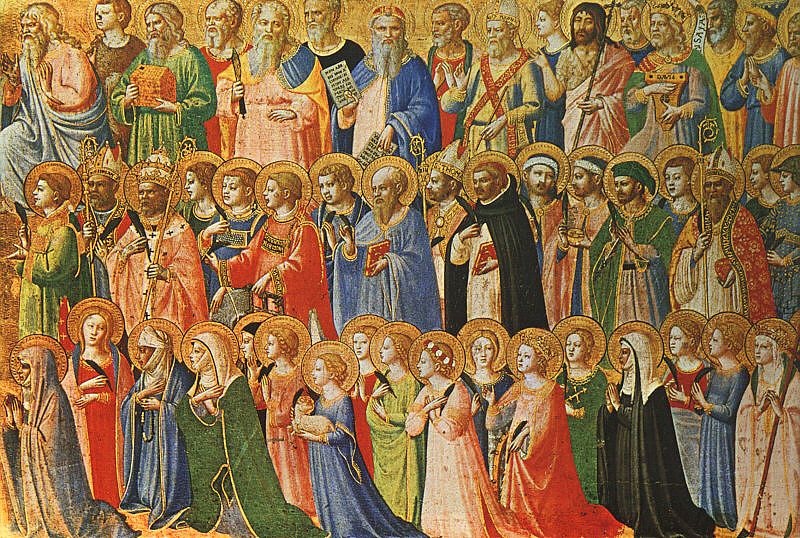
“The Forerunners of Christ with Saints and Martyrs” by Fra Angelico (1423)
This past Friday, Melody and I dressed up our daughter Hope as an owl and, with great anticipation of the delight we were about to see in her eyes, took her out trick-or-treating. It was a fun evening. She was grinning ear to ear. But as much fun as we had during our Friday evening excursions, the day after held an especially poignant place in my heart. Saturday, according to Church tradition, was All Saints’ Day, a day on which we both remember those saints in Christ who have gone before us and celebrate how we have been made saints through Christ’s death and resurrection. When I think about all the saints who have gone to be with the Lord in glory this past year, my heart can’t help but be warmed even while my eyes get a little misty. It’s a special time of remembrance.
A traditional prayer for All Saints’ Day encapsulates the meaning of this day well:
O almighty God, by whom we are graciously knit together as one communion and fellowship in the mystical body of Jesus Christ, our Lord, grant us so to follow Your blessed saints in all virtuous and godly living that we may come to those unspeakable joys which You have prepared for those who sincerely love You; through our Lord Jesus Christ, Your Son, who lives and reigns with You and the Holy Spirit, one God, now and forever. Amen!
I love this prayer for two reasons. First, it appropriately reminds us that there is much to learn from the saints who have gone before us. Their ways of “virtuous and godly living” ought to be celebrated by us and their insights into God’s Word and Christ’s gospel ought to be studied by us. There is much to be said for remembering – and practicing – the ways of the saints of old. At the same time, we must understand that we do not become saints by remembering and practicing the holy ways of these historic Christians. Rather, we become “sainted” by being “knit together as one communion and fellowship in the mystical body of Jesus Christ.” Everyone who is a member of Christ’s body is properly called a saint, even as the apostle Paul says to the church at Corinth: “To the church of God that is in Corinth, to those sanctified by Christ Jesus, called to be saints together with all those who in every place call upon the name of our Lord Jesus Christ, both their Lord and ours” (1 Corinthians 1:2). How are we made saints? We are sanctified and called by Christ. Who are the saints? They are everyone, everywhere who calls on the name of Jesus.
It is this definition of sainthood that the Church has believed and confessed for millennia, for example, in the Apostles’ Creed when we say, “I believe in the communion of saints.”
This phrase, “the communion of saints,” carries with it two meanings. On the one hand, this phrase refers to all Christians from all times in all places, both in heaven and on earth. Nicetas, a fourth century Serbian bishop, explains:
What is the Church but the congregation of all saints? Patriarchs, prophets, apostles, martyrs, all the just who have been, are, or shall be, are one Church because sanctified by one faith and life, marked by one Spirit, they constitute one body. Believe, then, that in this one Church you will attain the communion of saints.[1]
On the other hand, the Greek word for “saints” in the New Testament can be either masculine, referring to people, or neuter, referring to things. Thus, “the communion of saints” can be taken to mean “the communion of sainted, or holy, things.” This is the way that Peter Abelard, the great twelfth century French theologian, understood this phrase. In this case, the phrase, “the communion of sainted things,” was understood to mean the holy things of God: His Word, baptism, and the Lord’s Supper. The Lutheran confessors incorporate both understandings of “the communion of saints” when they write, “The Church is the congregation of saints [sainted people], in which the Gospel is rightly taught and the Sacraments are rightly administered [sainted things].”[2] Thus, the Church is made up of the sainted people of God gathered around the sainted things of God!
But there is even more to this phrase, “the communion of saints.” The Greek word for “communion” in the Creed is koinonia, a term that, even in secular Greek, describes not primarily communion with other human beings, but communion with God. For example, the first century Greek philosopher Epictetus wrote of the noble man in his “poor mortal body thinking of his fellowship (koinonia) with Zeus.”[3] Even in the pagan mind, man desires to have koinonia with god, albeit with a false god. This word koinonia was subsequently commandeered by Christians to describe communion with the true God: “God is faithful, by whom you were called into the fellowship (koinonia) of His Son, Jesus Christ our Lord” (1 Corinthians 1:9). We have koinonia with Christ. The phrase, “communion of saints,” therefore, refers not only to the communion we, as Christians, have with each other, but to the communion we have with Christ.
Finally, then, to say, “I believe in the communion of saints” is to say, “I believe that I have communion with Christ and with others who are in Christ. I believe that Christ meets me by His Word and holy gifts, cleanses me by His blood, and sanctifies me by His Holy Spirit.” But saying all this is a mouthful. So we simply say, “I believe in the communion of saints.” It’s a simple phrase that means so much. For it describes not only who we are, but who we are with. We’re with Jesus. And being with Jesus makes me feel like – well – a saint.
____________________
[1] Nicetas in Charles Augustus Briggs, The Fundamental Christian Faith (New York: Charles Scribner’s Sons, 1913), 193-194.
Where’s Your Advantage?
 A few months ago, I reworked my retirement portfolio. Though I pray it will be a long time before I have to draw anything from it, there were some changes I wanted to make now because I know they will be to my advantage later. And I always like gaining an advantage.
As time goes by, I have been traveling on business more and more. One of the things I have been doing recently is joining a bunch of rewards programs because they offer so many advantages. I get airline miles for one trip from another trip. I get points for free nights whenever I stay enough nights at a hotel chain. I get occasional discounts and supreme customer service because I rent a lot of cars. These reward programs come with a lot of advantages. And I always like gaining an advantage.
The other night at the elders meeting at my church, I shared some words from the apostle Paul: “What advantage, then, is there in being a Jew, or what value is there in circumcision? Much in every way! First of all, they have been entrusted with the very words of God” (Romans 3:1-2).
If you were to ask a Jew in the first century what advantage he had, he would probably quickly respond by saying he was a son of Abraham (cf. John 8:33). He might also brag a bit about his devotion and virtue (cf. Romans 2:17-20). But when Paul speaks of a Jew’s advantage, he has something different in mind. “First of all,” Paul writes, “they have been entrusted with the very words of God.” What gives a Jew an advantage is not his pedigree as a son of Abraham or his piety as a squeaky-clean rule-follower, but God’s self-disclosure in His Word. What gives a Jew a spiritual advantage is, very simply, the Bible.
Of course, this advantage is not just for the Jew. It is for anyone and everyone who calls on the Lord. The Bible can give us an advantage in marriage as we look to God’s Word to enrich our relationships with our spouses. The Bible can give us an advantage in work as we understand our labor as God’s calling. Most importantly, the Bible can give us an advantage with God as it reveals to us God’s Son who died for our salvation. The Bible is our supreme advantage because it shows us Christ’s advantageous work on our behalf.
It is no secret that most people love to have an advantage, whether that advantage be on the field, or in the office, or in an investment portfolio. Some people will even go so far as to take advantage of someone else in order to gain an advantage for themselves. Paul’s question of us, however, is: Where’s your advantage? Paul says that our first advantage should always and only be God’s Word. Indeed, when Paul writes, “First of all, [you] have been entrusted with the very words of God,” we assume that, because Paul writes about the Bible as our first advantage, there will also be a second, and perhaps even a third, advantage. But Paul never names another advantage. After all, with an advantage like God’s Word, what other advantage could we possibly need – or want?
So please, take advantage of the advantage of God’s Word. After all, airline miles expire. Hotel points have blackout dates. Rental car companies tack on hidden fees. But God’s Word endures forever. And there’s just no better advantage than that.
The Pursuit of Perfection

Credit: nsunews.nova.edu
Somehow, I knew just by the title of the article that “Confessions of a Mormon housewife” was not going be particularly titillating reading. And sure enough, I was right. This Mormon housewife’s confession was that when she became sick, and when ladies from her ward came to visit her, she “started to become insecure with [her] appearance and the state of [her] home.”[1] Jill Strassburg, the housewife in question, explains:
When they would come visit me, they were completely “put together,” and I began to think that they were perfect.
So I stopped answering my door. I didn’t want them to see me sick or see that the house wasn’t cleaned up. The thoughts I was having made me feel like I was, somehow, less of a woman.
I was beginning to realize that I was living in a culture of attaining perfection. And I started to wonder, why do so many Mormon women strive for perfection?
On the one hand, when I read Jill’s confession of worry over the cleanliness of her home, I think of Johann von Staupitz’s admonition to Martin Luther. Exasperated by Luther’s overwhelming guilty conscience and never-ending confessions, Staupitz eventually quips:
Look here, brother Martin. If you’re going to confess so much, why don’t you go do something worth confessing? Kill your mother or father! Commit adultery! Quit coming in here with such peccadillos![2]
Worry, although definitely a sin according to Jesus in Matthew 6:25, is also a societally safe sin. No one has ever been jailed or shunned for worry.
On the other hand, the nature of her sin aside, Jill’s question haunts me: “I started to wonder, why do so many Mormon women strive for perfection?”
This is a profound question. But Jill’s answer leaves me puzzled. She writes: “While I’m not a historian, scholar or official representative for the LDS church, I think this obsession with perfection is rooted in the church’s historical values and traditions.” She goes on to talk about how Mormon women “followed traditional roles of womanhood” and how the church still promotes “traditional values.” But traditional gender roles and values are not the same thing as perfection. A person can be traditional without aspiring to or feeling pressured to be perfect.
I can’t help but think that the true culprit of the Mormon quest for perfection is theological. Indeed, foundational to Mormonism’s doctrine of salvation is a striving for perfection. Consider this from the Book of Mormon:
Yea, come unto Christ, and be perfected in Him, and deny yourselves of all ungodliness; and if ye shall deny yourselves of all ungodliness, and love God with all your might, mind and strength, then is His grace sufficient for you, that by His grace ye may be perfect in Christ.[3]
According to the Book of Mormon, God has grace for a person unto salvation, but only after he has denied all ungodliness and loved God with everything in him. In other words, God has grace for you, but only if you’re perfect – or at least pretty close to it.
How do you know when you’ve denied enough ungodliness and loved God to such an extent that God’s grace will be sufficient for you? Herein lies Mormonism’s existential crisis that results in its relentless pursuit of perfection. Mormons cannot know whether or not they will be good enough to merit God’s grace. They can only wish and hope.
Jill finally admits:
We all know that perfection is unattainable, but we should still strive to be the best we can be every day. If we could actually be perfect, there would be nothing to work toward. There wouldn’t be anything left to gain from this life that we live.
Jill knows she can’t be perfect. But in her mind, that doesn’t mean she shouldn’t try.
Holy Scripture paints quite a different picture from the Book of Mormon of what it means to pursue perfection: “When perfection comes, the imperfect disappears” (1 Corinthians 13:10). Paul says perfection is not something to be pursued, but a promise that will pursue us and come to us on the Last Day. Indeed, more than that, perfection is a person who will pursue us and come to us on the Last Day when Jesus comes for us on the Last Day. This is why, finally, I’m not really interested in attaining some depersonalized virtue of perfection. I’m much more interested in Jesus. In my mind, being forgiven by a perfect Savior is much better – and a lot less stressful – than trying to be a perfect person.
I pray Jill comes to the same realization.
_________________________________
[1] Jill Strasburg, “Confessions of a Mormon housewife,” CNN (10.2.2014).
[2] Gerald R. McDermott, The Great Theologians: A Brief Guide (Downer’s Grove: InterVarsity Press, 2010), 83.


 Pastor Zach's Blog