Posts filed under ‘Devotional Thoughts’
Blessed Are Those Who Mourn
 The women on that first Easter went to the tomb to mourn. They went to mourn the loss of their friend. They went to mourn the loss of, for one of the women, a family member. They went to mourn the loss of hope. Of course, when they arrived the tomb, they got something they had never bargained for. They were greeted by a glorious being with an unlikely message: “Do not be afraid, for I know that you are looking for Jesus, who was crucified. He is not here; He has risen, just as He said” (Matthew 28:5-6).
It was on Easter morning that these women, to use the words of the prophet Jeremiah, had their “mourning [turned] into gladness” and received “comfort and joy instead of sorrow” (Jeremiah 31:13).
Mourning may not be pleasant, but it is needed. In many ways, I would argue that we don’t mourn enough. At funerals, rather than addressing the reality of death, people will often try to dull the pain of a loss by casting the service in terms of a celebration of the person who has died. A eulogist will say something like, “This person wouldn’t have wanted us to be sad!” Mourning, which is nothing other than the natural and inescapable response to something as heinous as death, is dismissed, downplayed, and depressed in favor of a skin-deep smile.
To make matters worse, when we are not mourning something as intense as the loss of a loved one, we can wind up jettisoning mourning altogether. We not only try to moderate our mourning, we can replace our mourning with something different entirely.
There is plenty that should command our mournfulness. Greed, corruption, malfeasance, and general godlessness should pain us all. Sadly, rather than mourning these things, we often trade mourning for grumbling. This seems especially true in the political arena. We grumble about health care. We grumble about immigration. We grumble about political constituencies that are not our political constituencies. But replacing mourning with grumbling is dangerous.
The ancient Israelites were experts at grumbling. Exodus 16:2 says, “In the desert the whole community grumbled against Moses and Aaron.” Numbers 14:2 repeats the same refrain: “All the Israelites grumbled against Moses and Aaron, and the whole assembly said to them, ‘If only we had died in Egypt! Or in this wilderness!’” The ancient Israelites were experts at grumbling. But their grumbling carried with it consequences. The Psalmist recounts the story of Israel during her wandering in the wilderness and says: “They grumbled in their tents and did not obey the LORD. So He swore to them with uplifted hand that He would make them fall in the wilderness” (Psalm 106:25-26). The apostle Paul admonishes his readers to “not grumble, as some of [the Israelites] did – and were killed by the destroying angel” (1 Corinthians 10:10). Clearly, God has little time or tolerance for grumbling. Why? Because grumbling leads nowhere good. It leads to rebellion. The Israelites grumbled about God and then built a golden calf in rebellion against God. It leads to revenge. Cain grumbled about his brother Abel’s sacrifice to God right before he killed his brother. Grumbling leads to sin. James puts it quite succinctly when he writes, “Don’t grumble against one another, brothers and sisters, or you will be judged” (James 5:9).
There is plenty for us, in our day, to mourn. But sincere mourning over sin is quite different from self-righteous grumbling against sinners. One perpetuates sin by doing little more than whining about it. The other fights sin by asking the Lord to rescue us from it.
In a world filled with grumbling, may we remember how to mourn. And may we also believe Christ’s promise: “Blessed are those who mourn, for they will be comforted” (Matthew 5:4). Mourning, Jesus says, is blessed. Grumbling, Scripture warns, is condemned. Let’s make sure we’re doing what God blesses rather than falling prey to what He condemns.
Pain, Suffering, and Morality
 I’ve been doing a fair amount of thinking lately on suffering and its effect on faith. In one way, I can’t help but believe and even assert that there is every reason to question God in the face of great suffering. Elie Wiesel’s gut-wrenching account of his time in a Nazi concentration camp comes to mind not only as a natural response to pain and suffering, but as a needed one:
Never shall I forget that night, the first night in camp, that turned my life into one long night seven times sealed. Never shall I forget that smoke. Never shall I forget the small faces of the children whose bodies I saw transformed into smoke under a silent sky. Never shall I forget these flames that consumed my faith forever.[1]
Elie’s description of his first night in a concentration camp should arouse in us nothing other than horror, grief, and sympathy. Although I don’t know precisely how I would react to such an experience, I would be naïve to think that Elie’s reaction could never be my reaction. The scene is just too jarring. The brutality is just too disgusting. The deaths are just too agonizing. I too could question God.
And yet…
Some did not respond to the concentration camps the way Elie Wiesel did. One survivor of the camps, Alex Seidenfeld, in an interview with the Associated Press, said simply, “We stayed alive. We survived. How could this have happened without the almighty?”[2]
Elie looked at all those who died and asked, “How can God be?” Alex looked at all those who survived and asked, “How can God not be?” Elie looked at all those who died and angrily shouted, “God didn’t stop this!” Alex looked at all those who survived and declared, “But God did save some of us from this!”
The question of where God is in the face of suffering is really a question of God’s role in the midst of suffering. Is God’s role to stop us from suffering or to save us through suffering? In one sense, it is both. But the first role, at least according to Scripture, doesn’t find its full expression until later, at the end of days.
Ultimately, I would argue that, even if God does not stop all suffering, it is difficult to surmise from the existence of suffering that God does not exist. C.S. Lewis famously explains why:
My argument against God was that the universe seemed so cruel and unjust. But how had I gotten this idea of just and unjust? A man does not call a line crooked unless he has some idea of a straight line. What was I comparing this universe with when I called it unjust? … Of course I could have given up my idea of justice by saying it was nothing but a private idea of my own. But if I did that, then my argument against God collapsed too – for the argument depended on saying that the world was really unjust, not simply that it did not happen to please my private fancies. Thus in the very act of trying to prove that God did not exist – in other words, that the whole of reality was senseless – I found I was forced to assume that one part of reality – namely my idea of justice – was full of sense.[3]
C.S. Lewis puts his finger on the reality that the problem we have with suffering is that we believe and perceive that it is, in some sense, wrong. It is unjust. But if we reject God, we lose the privilege of saying that anything is wrong or unjust because, without God and His ordering of the universe, standards of organized morality disappear into the ether of a universe that coalesced around the free-for-all of chance. This world and all that is in it, to borrow a phrase from the famous atheist philosopher Bertrand Russell, is nothing more than “the outcome of accidental collocations of atoms.”[4] In this view, suffering exists in the same way that a ball that lands on black 22 on a roulette wheel exists. It just happens to happen sometimes. There is nothing more to be said about it, at least not morally.
Arguing against a moral God in light of what is perceived to be immoral suffering, then, is an argument that collapses on itself. You can’t argue against God using a framework that has its basis in God. Either suffering just is, or it is somehow just wrong. To question how there can be a good God who allows bad things assumes that, even if implicitly, there is a God and that, in some regard, He is not playing by His own rules, or at least by what we perceive to be His rules. If this is the case, it may be fair to ask Him, “Why?” But, as a Christian, I would propose that it might be even better to ask Him for help. From what I hear, even if God doesn’t always stop suffering, He is quite adept at blessing people in suffering.
_____________________
[1] Elie Wiesel, Night (New York: Hill and Wang, 2006), 33.
[2] Aron Heller, “Observant survivors keep the faith after Holocaust,” The World Post (1.26.2016).
[3] C.S. Lewis, Mere Christianity (New York: Harper Collins Publishers, 1980), 38
[4] Bertrand Russell, “A Free Man’s Worship,” The Collected Papers of Bertrand Russell, vol. 12 (London: Routledge, 1985).
Faith and Morality
 On this blog, I have written at length on moral issues. I believe, quite firmly, that morality has a helpful role to play in the public square and, therefore, moral questions should be discussed and debated and moral standards should be regarded as useful and necessary for and in society. For all my support public morality, however, there is a part of public morality that I find terrifying. Here’s what I mean.
There can be little doubt that the experiment of societal moral relativism has failed. Throwing off the shackles of a transcendent and traditional morality for a culturally conditioned and convenient one that ultimately assumes that there is only amorality never got us Thomas Hobbes’ Epicurean dream. It just left us Adolf Hitler’s Third Reich nightmare. Leviathan, it turns out, wasn’t nearly as competent to do its job as Hobbes thought.
Moral relativism, then, can be quite deadly. It does no society any good because, by definition, it is utterly individualistic. And individuals, left to their own devices, seem to come up with awfully immoral relative moralities. A traditional and transcendent morality is needed to order society in such a way that we do not (A) wind up killing each other, and (B) actually do some things that are helpful for each other. For these reasons, as well as for many others, public morality is needed.
But at the same time a traditional and transcendent public morality is needed, it is also terrifying.
Once a month, I teach a Bible study at a local business. This year, I am working through the book of James when, a while back, I came to these famous words:
What good is it, my brothers, if a man claims to have faith but has no deeds? Can such faith save him? Suppose a brother or sister is without clothes and daily food. If one of you says to him, “Go, I wish you well; keep warm and well fed,” but does nothing about his physical needs, what good is it? In the same way, faith by itself, if it is not accompanied by action, is dead. (James 2:14-17)
As a Lutheran, James’ trumpeting of moral works as important to faith can sometimes arouse in me an almost allergic reaction! As an avid reader of all things Pauline, I know that works do not help faith. Indeed, I know that works can actually be in opposition to faith:
[We] know that a person is not justified by the works of the law, but by faith in Jesus Christ. So we, too, have put our faith in Christ Jesus that we may be justified by faith in Christ and not by the works of the law, because by the works of the law no one will be justified. (Galatians 2:16)
“Faith” and “works,” Paul says, do not mix when it comes to salvation.
Of course, James’ point is not that works somehow help faith when it comes to salvation, but that faith results in works that flow from salvation. A saving faith, James argues, is inevitably an active faith. Indeed, James would go so far to argue that a saving faith that is not an active faith is not even faith. To quote his brother’s words: “By their fruit you will recognize them” (Matthew 7:16). A faith that does not result in moral works does not exist. Such a faith is a myth that belongs on the shelf with unicorns, leprechauns, and that time your mom told you that if you swallow your gum, it will stay in your stomach for seven years.
This is why, at the same time I believe public morality is needed, I am also terrified by it. A faith without moral works is impossible. James says so. Christians should not be frightened, therefore, to declare moral works as “necessary” to faith. What is frightening, however, is that the inverse does not hold true. Moral works may be necessary to faith, but faith is not necessary for moral works. One can be very moral and still be very damned. And herein lies the good and the bad of public morality. Public morality helps others. It may even help you. But it doesn’t help you before God. Only faith can help you before the Almighty.
Even as I continue to argue for the merits of public morality if for no other reason than that I’m not a big fan of the Third Reich, I will continue to serve proudly as a pastor to point people toward faith in Jesus Christ. I like morality that comes from faith a lot better than morality that is divorced from faith. The second morality may be nice for society, but the first receives a “well done” in eternity.
Wrong and Wrong-er

Credit: Huffington Post
Recently, I read a blog by a well known pastor who expressed concern over the lack of civility in this year’s presidential election cycle. In his blog, he singled out one candidate who caused him particular concern. Although I do not think it is always inappropriate to discuss a particular candidate in a blog (I myself have done so), I do believe that a pastor should enter into such discussions with more than a fair share of fear and finesse. Political figures are notoriously hard to critique in a way that leads people to listen to and engage with the critique because these figures tend to engender reflexive emotions long before they inspire extended thought. Such was the case with this pastor’s blog. There were many commenters who were appreciative of this pastor’s words. Others were deeply offended and even furious that a pastor would critique, even if gently, a presidential candidate. Some argued that it is never appropriate for a pastor to critique political candidates. Others, like this commenter, argued against this pastor’s critique like this:
Cute hit piece on [my candidate]. Now lets talk about letting [another candidate] in the White House … who wouldnt know the truth if [this other candidate] saw it.
This is a fascinating argument because it basically runs like this: “My candidate may not be all that great, but this other candidate is worse! Therefore, I will support my candidate and will attack anyone who tries to point out a concern with my candidate, even if the concern is legitimate.” In other words, this commenter is trying to excuse bad behavior from her candidate by pointing out what is – at least in her mind – worse behavior from another candidate.
It’s not just angry social media commenters who makes these kinds of arguments. Professional pundits do as well. Consider this from John O’Sullivan of National Review:
[One candidate] tells falsehoods loosely and spontaneously in a sort of stream-of-consciousness lying to boost his prospects, win over doubters, crush opponents, and save his face. Details can be found all over the Internet. Most of them strike me as trivial. But none of the [leading candidates] have been exactly models of truth-telling in this campaign. So the relevant question then becomes “Compared with whom?” Let’s compare [this candidate’s] boastful and evasive untruths with the very different lies of [another candidate] on various immigration bills he has tried to sell.[1]
Mr. O’Sullivan explicitly and unashamedly justifies one candidate’s lies by pointing to another candidate’s lies. Since when did lying become okay at all? How does the fact that presidential candidates lie make anything better? Did Mr. O’Sullivan ever stop to think that it might be best – rather than excusing a preferred political candidate for his bad behavior by pointing to some other bad behavior – to argue and ask for better behavior?
These kinds of arguments, it should be pointed out, are not only the stuff of election year politics. They are also the arguments of nearly everyone who desperately wants to excuse some bad behavior. “Yes, I may have stolen that dress, but it’s not like I’m Bernie Madoff!” “Yes, I may have had an emotional affair, but that’s completely different from a physical affair!” “Yes, I may be a drunkard, but at least I’m not a self-righteous religious person!”
Whenever I hear these kinds of arguments, I’m led to ask: so what? What do these kinds of arguments accomplish? What do they prove? Does pointing out someone else’s wrong somehow make you right? My mother used to tell me, “Two wrongs don’t make a right.” Do two wrongs of perceived unequal wrongness somehow make one wrong right?
The answer to the above question, of course, is, “No.” One cannot right a wrong by comparing it to another wrong-er wrong. All such a comparison does is inevitably lower all moral standards because it points only to that which is below it rather than aspiring to that which is above it. And when a comparison only looks down, where else is there to go but down? Thus, this comparison inevitably drags those who make it down into deeper immorality rather than spurring them on to a more carefully considered higher ethic.
It is impossible to make a wrong right by comparing it to something else that is wrong. This is why, when He wanted to make us right with Him, God didn’t just send someone who wasn’t quite as bad as we were, He sent someone who was truly good because He was fully perfect. Our Savior raised the bar of morality all the way to perfection and then gave us His perfection by being raised on a tree for our salvation. From His perfect morality comes not only a way of salvation apart from our merits, but a way for daily living that is to declare His merits.
So whether we are a candidate for President of the United States or an everyday citizen working a job and raising a family, let’s look to Christ’s standard of morality rather than wallowing around in the mud of someone else’s immorality. Let’s aspire to that. Let’s hold each other to that – not because we can ever attain that by our own merits, but because we should actually want that. To settle for anything less is just plain wrong.
________________________
[1] John O’Sullivan, “The Rise of the Undocumented Republicans,” National Review (2.26.2016).
Some Thoughts on Thankfulness
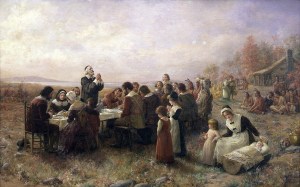
Jennie Augusta Brownscombe,
The First Thanksgiving at Plymouth, 1914
Thanksgiving holds a special place in my heart. In many ways, it is an overwhelming holiday for me because I quickly realize, if I take even just a moment to reflect, that I have so many things for which to be thankful. I am thankful for my wife. I am thankful for my daughter. I am thankful for the son I have on the way. I am thankful for my home. I am thankful for my extended family. I am thankful for what is always my favorite meal of the year on Thanksgiving Day. I am thankful for Christ and Him crucified. I am thankful for blessings too numerous to count.
Thanksgiving is a uniquely American holiday. From the first Thanksgiving celebration with the Puritans and Native Americans at Plymouth in 1621 to the likes of presidents such as George Washington and Abraham Lincoln, who both wrote moving proclamations calling Americans to days of national Thanksgiving, to Franklin Roosevelt, who formalized Thanksgiving Day as the fourth Thursday in November, Americans have always found plenty of reasons to be thankful.
But Thanksgiving, at its heart, is much more than a national holiday. It is a theological necessity. We are commanded by Scripture to “give thanks” (1 Thessalonians 5:18). Indeed, it must be very difficult to celebrate Thanksgiving apart from faith. For, without faith, who does one give thanks to? Certainly, one can be thankful to others for what they have done. But the gifts of nature and beauty and joy and the cosmos come from no man. And without a theological framework, they come from nowhere. And so there is no one to whom an unbeliever can say “thank you” for these things. As it turns out, thanksgiving, at least for the things greater than humans can give, is an inescapably theological exercise.
One of the things I deeply desire for my family is that we would share together a sense of thankful wonderment. We, as a family, are blessed beyond measure. My wife and I have jobs that are fulfilling, even when they are challenging. We are part of a church that we love. We can provide for our family in ways that many cannot. And our life together is marked by a general peace and contentment. God has given us much. But, as Jesus says, “Unto whomsoever much is given, of him shall be much required” (Luke 12:48). We have a responsibility to recognize just how much we have been given, to steward it well, and to, above all, be thankful for it and be thankful to the One who gives it.
I have often mused that the difference between being blessed and being spoiled is thankfulness. A person is blessed when he has been given much and he knows it. So he thanks God for it. A person is spoiled when he has been given much and he fails to see it. So he grumbles for more. To borrow a distinction from G.K. Chesterton: there is a world difference between taking things for granted and receiving things with gratitude.[1] Spoiled people take things for granted. Blessed people receive God’s gifts with gratitude.
This is not to say that there are no reasons to lament. But there is a difference between lamenting and grumbling. Grumbling looks at God’s blessings and says, “That’s not enough.” Lament looks at the sinfulness and brokenness of our world and says, honestly and candidly, “There’s something wrong.” This is why the same Psalter that sings, “Give thanks to the LORD, for He is good; His love endures forever” (Psalm 107:1), also cries, “My God, my God, why have You forsaken me? Why are You so far from saving me, so far from the words of my groaning” (Psalm 22:1)? Christopher Wright explains it well when he writes, “Lament is not only allowed in the Bible; it is modeled in abundance. God seems to want to give us as many words with which to fill out our complaint forms as to write our thank-you notes.”[2] So to those who are facing a tragedy, a trial, or a temptation this holiday season, know that your lament is just as holy as your thanksgiving. For both lament and thanksgiving turn to God in faith rather than turning in on oneself in greed, as does grumbling. Lament and thanksgiving can comingle.
As I slowly eat my way through what are now my Thanksgiving leftovers, my prayer is that I see more and more of the things for which I have to be thankful. I am thankful for much, but I also miss much. Dear God, may I see what I have missed. To borrow some more wisdom from G.K. Chesterton: “Children are grateful when Santa Claus puts in their stockings gifts of toys or sweets. Could I not be grateful to [have] in my stockings the gift of two miraculous legs?”[3] Legs to go in my socks. There’s something for which I have not yet said “thank you.” I wonder what else I’m missing.
__________________
[1] See G.K. Chesterton, Irish Impressions (New York: John Lane Company, 1920), 24.
[2] Christopher J.H. Wright, The God I Don’t Understand: Reflections on Tough Questions of Faith (Grand Rapids: Zondervan, 2008), 51.
[3] G.K. Chesterton, Orthodoxy (New York: John Lane Company, 1919), 98.
Happy Thanksgiving!
 In what has become a bit of Thanksgiving tradition on this blog, I want to share with you a portion of Abraham Lincoln’s Proclamation of Thanksgiving from 1863. I will have some additional thoughts on thankfulness in my regular post on Monday. Stay tuned! For now, here’s President Lincoln:
The year that is drawing towards its close, has been filled with the blessings of fruitful fields and healthful skies. To these bounties, which are so constantly enjoyed that we are prone to forget the source from which they come, others have been added, which are of so extraordinary a nature, that they cannot fail to penetrate and soften even the heart which is habitually insensible to the ever watchful providence of Almighty God. In the midst of a civil war of unequaled magnitude and severity, which has sometimes seemed to foreign States to invite and to provoke their aggression, peace has been preserved with all nations, order has been maintained, the laws have been respected and obeyed, and harmony has prevailed everywhere except in the theatre of military conflict … Needful diversions of wealth and of strength from the fields of peaceful industry to the national defense have not arrested the plough, the shuttle or the ship; the axe has enlarged the borders of our settlements, and the mines, as well of iron and coal as of the precious metals, have yielded even more abundantly than heretofore. Population has steadily increased, notwithstanding the waste that has been made in the camp, the siege and the battlefield; and the country, rejoicing in the consciousness of augmented strength and vigor, is permitted to expect continuance of years with large increase of freedom. No human counsel hath devised nor hath any mortal hand worked out these great things. They are the gracious gifts of the Most High God, who, while dealing with us in anger for our sins, hath nevertheless remembered mercy.[1]
This Thanksgiving, we have many things for which to be thankful. But as we give thanks for these many things, may we never forget to heartily celebrate and give thanks for, to use the words of Lincoln, “the Most High God, who, while dealing with us in anger for our sins, hath nevertheless remembered mercy.” God’s mercy is the reason that we have not only temporal blessings, but eternal forgiveness, life, and salvation. And for these, we should be thankful.
Happy Thanksgiving.
_______________________
[1] Abraham Lincoln, “Proclamation of Thanksgiving” (10.3.1863).
Reverse-Engineering Your Life
 The other night, I, along with three other pastors, had the pleasure of meeting with a group of seminary students for an informal discussion about life and ministry. I cherished my time with these guys. Even though we were with them for only a short time, it quickly became apparent that they are theologically curious and nuanced and have a deep passion to serve in Christ’s Church as pastors. I am excited to see what the future holds for these men.
Our discussion took on an informal Q&A feel, with seminary students asking any questions they wanted. One question particularly struck me: “What goals do you have for ministry and how do you work backwards from those goals to develop a plan to reach those goals?” This is a great question. It’s a question of reverse-engineering. You start with the end in mind and work back from that to get to that. But this question also took me aback a little bit. Because I do have goals. And I have done my share of reverse-engineering to try to reach these goals. But my goals are not particularly inspiring, captivating, or scintillating. I simply want to love Jesus, love my family, and be a faithful pastor.
I used to have other goals. More exciting goals. Once upon a time, I wanted to build and pastor the largest congregation in my church body. Once upon a time, I wanted to become a renowned and respected spokesperson for orthodox Lutheranism. After all, it seems like on the broader stage of Christian dialogue, Lutherans are all but missing in action. Once upon a time, I wanted to be an esteemed public scholar to whom people would turn for insight. Once upon a time, I wanted to be a pastor who would change the world. Now, I just want to be a person who finishes life well.
As I ultimately wound up telling the student, long before you worry about reverse engineering your goals for ministry, you need to begin by reverse engineering your goals for life and, specifically, for your family. After all, if you change the world as a pastor but forsake your family as a husband or father, you have failed miserably because prior to your vocation as a pastor is your vocation as a husband and father.
The New York Times recently published an article on the state of today’s family. Its title sums up its mood: “Stressed, Tired, Rushed: A Portrait of the Modern Family.” Clair Miller, writing for the Times, explains:
Working parents say they feel stressed, tired, rushed and short on quality time with their children, friends, partners or hobbies, according to a new Pew Research Center survey …
Fifty-six percent of all working parents say the balancing act is difficult, and those who do are more likely to say that parenting is tiring and stressful, and less likely to find it always enjoyable and rewarding. For example, half of those who said the work-family balance was not difficult said parenting was enjoyable all the time, compared with 36 percent of those who said balance was difficult.
This is sad, but it is also not surprising. As workplace demands continue to rise and the line between company time and personal time continues to blur, time to invest in family inevitably suffers.
Being a pastor carries with it many demands, which are often difficult – and, quite honestly, sometimes impossible – to juggle well. There is no doubt about it. But this is why, long before you sketch out goals for ministry, you do need to set out goals for your marriage and your family. Goals of time together as a family. Goals of date nights with your spouse. Goals of daily expressions of love and affection. Before you worry about what is outside your home, tend to who is inside your home.
Jesus once asked, “What good is it for a man to gain the whole world, yet forfeit his soul” (Mark 8:36)? It may behoove us to ask similarly: What good is it if a man changes the world, yet forfeits those closest to him? This question good not only for pastors, it’s good for everyone.
I hope you’re asking it. The people closest to you will thank you if you are.
The Best of Times and the Worst of Times

Jean Duplessis-Bertaux | Depiction of the storming of the Tuileries Palace during the French Revolution
“It was the best of times, it was the worst of times, it was the age of wisdom, it was the age of foolishness, it was the epoch of belief, it was the epoch of incredulity, it was the season of Light, it was the season of Darkness, it was the spring of hope, it was the winter of despair…”[1]
So begins Charles Dickens’ A Tale of Two Cities. Though the story is set during the French Revolution, its opening line strikes a universal tone. Life comes mixed with good and bad, wisdom and foolishness, faith and doubt, light and darkness, hope and despair. This is true even of Jesus’ life. For example, in Mark 7, Jesus heals a blind man:
Some people brought to [Jesus] a man who was deaf and could hardly talk, and they begged Him to place His hand on the man. After He took him aside, away from the crowd, Jesus put His fingers into the man’s ears. Then He spit and touched the man’s tongue. He looked up to heaven and with a deep sigh said to him, “Ephphatha!” (which means, “Be opened!”). At this, the man’s ears were opened, his tongue was loosened and he began to speak plainly. (Mark 7:32-35)
On its surface, this story looks like one that should be marked only by joy. After all, a blind and mute man gets healed! But right before Jesus heals this man, He looks up to heaven and lets out “a deep sigh” (Mark 7:34). The Greek word for this sigh is stenazo, which denotes a groan of sorrow (e.g., Romans 8:23). Why would Jesus groan in sorrow right as He is getting ready to do something as joyful as a healing?
Like Charles Dickens, Jesus knows that even when it’s the best of times, it’s also the worst of times. He knows that even as He is getting ready to do something great, evil is not far off. Indeed, Jesus knows that He will soon face the horror of the cross. And so He lets out a groan.
The Old Testament prophets spoke of a Messiah who would come and do many miraculous things, including that of making the deaf hear and the mute speak:
Your God will come, He will come with vengeance; with divine retribution He will come to save you. Then will the eyes of the blind be opened and the ears of the deaf unstopped. Then will the lame leap like a deer, and the mute tongue shout for joy. (Isaiah 35:4-6)
Notice even in this prophecy that the best of times and worst of times are comingled. On the one hand, the Messiah will open the eyes of the blind and unstop the ears of the deaf. This is good. On the other hand, the Messiah will come with “vengeance” and “divine retribution.” This sounds bad. But it also seems strange. Isaiah says, “With divine retribution [God] will come to save you.” Just how does God intend to use His retribution for our salvation? Isn’t His retribution supposed to lead to condemnation?
Timothy Keller notes that, when Jesus came, retribution and salvation were not so much in tension with each other as they were complimentary to each other, for Jesus “didn’t come to bring divine retribution; He came to bear it.”[2] On the cross, Jesus took the retribution our sins deserve so we could receive the salvation we could never earn. This is how divine retribution can lead to our salvation.
In A Tale of Two Cities, a kind of dualism runs through its opening salvo. There is good and bad, hopefulness and despair, and the reader does not know which one will ultimately prevail – or if either will prevail. In the case of Christ, though good and bad, hopefulness and despair are real and are in tension with each other, there is no doubt which will finally carry the day. Jesus may have groaned. But He still healed. And Jesus may bear divine retribution on a bloodied cross, but He still brings salvation out of an empty tomb. In Christ, the tension of Dickens is resolved. And that’s why we can have hope.
______________________________
[1] Charles Dickens, A Tale of Two Cities (Mineola, NY: Dover Publications, 1999), 1.
[2] Timothy Keller, King’s Cross (New York: Dutton, 2011), 94
The Problem with Pep Rallies

Credit: Mark J. Terrill, AP
It’s still thirteen and a half months away, but with the way it’s being covered – and with the ratings that CNN scored last week when it hosted the second of the Republican primary presidential debates – you’d think the presidential election of 2016 was right around the corner.
As we rush headlong into another presidential election cycle, we see all the typical trappings of what have become nothing short of political and journalistic rituals. We have a conservative action group that has launched a set of attack ads against Republican frontrunner Donald Trump. On the Democratic side, controversy has boiled over concerning the relative dearth of Democratic primary debates as compared to the number of Republican primary debates and how this favors Democratic frontrunner Hillary Clinton. As for the media, they are busy fact checking everything every candidate says. And then there are the rallies – the never ending rallies in every state and in what seems to be every American city.
Rallies, of course, are great when a politician wants to solidify his or her base of supporters. Rallies also incite and excite a candidate’s supporters to vote. Rallies, in a democratic election system like ours, are necessities.
Unfortunately, in our culture, we have taken what works well during an election cycle and have applied it, without much critical thought, to many different areas of life, including in our use of social media. Many of the posts I see on social media are meant to rally people who agree with one point of view by belittling and demeaning those who hold a differing point of view. Such posts follow a predictable pattern. First, an article, a meme, or even an out and out diatribe is posted that espouses the utter rightness of one point of view while attacking those who hold an opposing point of view as nothing less than reprobates. Second, people “pile on,” as it were, by posting comments. Third, anyone who dares to disagree with the view expressed in the initial post by posting a critical comment is harangued and attacked. Finally, nothing changes. People who agree with the sentiment expressed in the initial post still agree. And people who disagree still disagree.
We need a better way.
When posting on social media, it is time for us to start asking ourselves a question: in this post, am I trying to rally people or persuade them? The goal of persuasion is, in its strictest sense, to change someone’s mind on a particular position. In a broader sense, persuasion can also seek to engender empathy from someone who disagrees with a particular position. Even if someone does not agree with me on a particular position, I still deeply appreciate it when they at least understand why I think what I think, just as, I assume, other people appreciate it when I understand why they think what they think.
The trouble with persuading people is that it is much more difficult than rallying them. Rallying people usually only needs a stake in the ground and a line in the sand. Persuading people often needs tortured, lengthy nuanced arguments about a particular position. Rallying people can make a person feel good because, when others express agreement with a particular point, the rallier is quickly assured that he or she is not alone. Persuading people can often feel much lonelier because it does not provide a common enemy against whom you and those who agree with you can join forces, but it also does not provide the kind of toleration and capitulation that your opponents might ultimately desire. Rallying people can be done in minutes. After all, social media posts can go viral in nearly no time at all. Persuading people takes relationship building, trust, and, usually, hours, months, and even years worth of conversations. And even then, sometimes, people remain unpersuaded.
All this is to say that I can see the appeal of rallying people around a particular position. And, at times, rallies are necessary and desirable – especially in the face of a heinous evil that will not be persuaded, so it must be defeated. The problem is, as a long-range strategy, rallying doesn’t solve much. It may engender excitement and incite anger. It may get out a vote to defeat an opponent. But it doesn’t change a heart.
We, as Christians, believe there are certain things the world needs to believe. We want the world to be persuaded to believe these things. Thus, particularly as we post on issues that have to do with our faith, we need to eschew the easy way of the rally and instead choose the harder way of persuasion. After all, eternal truth is at stake. And, in many instances, so are people’s souls.
So think before you post. As Christians, we don’t want to just lambast those who might disagree with us, we want to show, with nuanced and thoughtful compassion, why people can, and should, agree with Christ. After all, Christ has persuaded us. Why would we want to do anything less than persuade others?
A Little Lesson on Divine Providence

Credit: SeniorLiving.org
Last week, in my personal devotions, I read through Numbers 26, which recounts a census taken near the end of Israel’s 40 year wandering through the wilderness. Here’s a taste of the bean counting:
The descendants of Gad by their clans were: through Zephon, the Zephonite clan; through Haggi, the Haggite clan; through Shuni, the Shunite clan; through Ozni, the Oznite clan; through Eri, the Erite clan; through Arodi, the Arodite clan; through Areli, the Arelite clan. These were the clans of Gad; those numbered were 40,500. Er and Onan were sons of Judah, but they died in Canaan. The descendants of Judah by their clans were: through Shelah, the Shelanite clan; through Perez, the Perezite clan; through Zerah, the Zerahite clan. The descendants of Perez were: through Hezron, the Hezronite clan; through Hamul, the Hamulite clan. These were the clans of Judah; those numbered were 76,500. (Numbers 26:15-22)
I won’t blame you if you found yourself skimming over these verses. Biblical censuses and genealogies are items we tend to skip so we can get to the good stuff. Names we don’t know and numbers we don’t care about can quickly lull us to sleep. But as snooze inducing as these stilted sections of Scripture might sometimes feel, my commitment to the inspiration and inerrancy of the Bible still calls me to see God’s merciful hand at work. And God’s merciful hand is indeed at work in Numbers 26.
Numbers 26 represents the second census in this book. The first one is in Numbers 1, near the beginning of Israel’s wilderness wanderings. From Numbers 1 to Numbers 26, approximately 38 years have passed. These years, it should be noted, have not been particularly pleasant ones. There has been grumbling (Numbers 11:1-6; 14:1-4), dissension among Israel’s leaders (Numbers 12), a refusal to enter the land God had promised to Israel (Numbers 13), defeats in battle (Numbers 14:40-45), rebellions (Numbers 16), and plagues (Numbers 21:4-9; 25). This is in addition to the natural and normal difficulties that come with camping out in a desert for decades on end. Yet, by the time all is said and done, the population of Israel between the first census in Numbers 1 and this census in Numbers 26 has remained remarkably stable. The population has decreased by only .3 percent. It turns out that for all the hardship Israel experienced and for all the sin they committed, God, out of His providence, took good care of His people. They endured even when, by all accounts, they should not have.
As remarkable as God’s providential care for Israel over 40 years of wandering in the wilderness was, it pales in comparison to God’s providential care for His Church. Through persecutions, hostilities, scandals, and political and intellectual assaults, the Church has not only endured, it has grown. As this map elegantly visualizes, what began as a band of twelve now claims nearly a third of the world’s population. Forget a .3 percent decrease. How about an 18.3 billion percent increase?
I realize that in our day and age, the remarkable story of Christ’s Church can sometimes be hard to recognize and remember. I was talking to a friend just the other day who wanted to know what we, as Christians, needed to do to beat back the encroachment of secularism. I understand his concern. If you’re not at least a little unsettled by the state and trajectory of our culture, you’re not paying attention. Still, I think secularism has a lot more to worry about than Christianity. After all, secularism can’t claim the history, the increase, or, for that matter, the truth that Christianity can.
In Luke 4, Jesus is preaching in His hometown of Nazareth. His text for the day is from the prophet Isaiah:
The Spirit of the Sovereign LORD is on Me, because the LORD has anointed Me to preach good news to the poor. He has sent Me to bind up the brokenhearted, to proclaim freedom for the captives and release from darkness for the prisoners, to proclaim the year of the LORD’s favor. (Isaiah 61:1-2)
The Jews of Jesus’ day understood Isaiah’s words eschatologically. The believed God would set right what was wrong with the world on the Last Day. This is why, immediately after Isaiah talks about “the year of the LORD’s favor,” he speaks of “the day of vengeance of our God” (Isaiah 61:2). Judgment Day, Isaiah says, is coming. But Jesus, when He preached on these words, interpreted them in a way no one expected. After reading from Isaiah, Jesus announces, “Today this scripture is fulfilled in your hearing” (Luke 4:21). Huh? How could this be? Judgment Day had not yet come. The world had not yet been set right. The poor had not been made rich. Broken hearts remained. Israel was still under captivity to the Romans. Prisons were still open. And the Lord’s favor, though it may have been touted by the Jewish religious leaders as a theological truism, still felt distant as a practical reality. How could Jesus say Isaiah’s words had been fulfilled right then and there? Because Jesus knew the census numbers from Numbers 1 and Numbers 26. Jesus knew that God was taking care of His people even when life felt like a wilderness wandering. Jesus took the long view of history and saw God’s fingerprints all over it. Jesus knew God’s providence. And Jesus knew the setbacks and sin of this world are no match for the promises of God.
May we know what Jesus knew. After all, what Jesus knew not only gives perspective when the world feels tempestuous and hostile, it gives hope.


 Pastor Zach's Blog