Posts filed under ‘Devotional Thoughts’
An Honest Hypocrite Is Still a Hypocrite

Credit: Jonathan Rolande
Last January, four researchers from Yale University published a paper titled, “Why Do We Hate Hypocrites? Evidence for a Theory of False Signaling.” In it, the researchers note that hypocrisy occupies a special spot of scorn in our society:
Consider the hypocrite – someone who condemns the moral failings of other people but behaves badly him- or herself. Many commentators have remarked on the “peculiarly repulsive” nature of hypocrisy … What makes hypocrites especially bad is that they both commit a transgression and condemn it. But why is this combination so objectionable?
This final line is the question the researchers attempt to answer in their paper. They theorize that hypocrites are uniquely despised because:
They dishonestly signal their moral goodness – that is, their condemnation of immoral behavior signals that they are morally upright, but they fail to act in accordance with these signals.
At issue here is what is popularly referred to as “virtue signaling.” Though this phrase can be defined in different ways, some of which see virtue signaling as inherently and irreducibly hypocritical, the phrase, at least at its most basic level, denotes the public condemnation of a particular practice or position, which is something that most, if not all, people do – at least from time to time. So, for instance, on this blog, I have publicly written about the dangers of racism. People would assume, since I have written against racism, that I would expend at least some effort to root out racism in my own life. If it turned out, however, that I harbored a disdain for a particular race, or if I wantonly turned a deaf ear or a blind eye to the plight of a particular race, people would rightly call me a hypocrite because even though I am publicly promoting one standard of behavior, I am privately living out another.
The Yale researchers continue by explaining that hypocrisy is more dangerous and misleading than what they refer to as “direct lying,” because direct liars do not engage in the moral condemnation of a practice of position. They simply lie about what they have done, usually to avoid getting into some sort of trouble. Hypocrites, on the other hand, go out of their way, often without prompting, to condemn the things they secretly do to make themselves look better than they really are.
The researchers found that, broadly speaking, much of our revulsion toward hypocrisy is excised when people are honestly hypocritical – that is, when they “voluntarily [disclose] their transgressions, which offsets the negative evaluation of their hypocrisy.” Just saying you’re a hypocrite, apparently, is enough to make many people comfortable with your hypocrisy.
Certainly, hypocrisy is roundly condemned in the Scriptures generally and by Jesus specifically. In Matthew 23, for instance, Jesus offers a series of seven woes. To whom are His woes directed? They are directed to hypocrites! Christians and non-Christians alike agree that hypocrisy is bad. What is most interesting about this study is not its assertion that hypocrisy is bad, but its revelation about how hypocrisy is addressed and rectified in our society. Culturally, these researchers note that much of the sting of hypocrisy is salved if one is merely an honest hypocrite. If a person simply says he doesn’t practice what he preaches, our society turns a sympathetic ear. The difficulty with this approach, however, is that an honest hypocrite is still a hypocrite. Hypocrisy needs more than an admission. It needs a solution.
Christianity says that the admission of a sin like hypocrisy is only the first step in dealing with that sin. In his Small Catechism, Martin Luther explains that to address sin, one must not only admit, or confess, his sins, he must receive forgiveness from them. In other words, a hypocrite must see his hypocrisy as an actual sin that needs to be forgiven rather than as a mere embarrassment that only needs to be acknowledged. In short, a hypocrite must see his hypocrisy as something that is actually bad. This is why the bridge between confession and forgiveness is repentance, for repentance sees sins not just as embarrassments to be enumerated, but as spiritual dangers to be grieved.
Admitting sin does not solve sin. Only Jesus’ forgiveness does that. Our hypocrisy, then, needs more than a confession. Confession only reveals who we are. Jesus, however, changes who we are, which means that Jesus can change us hypocrites.
And really, who wants to be a hypocrite?
A Tale of Three Kings

Growing up, one of my favorite yuletide carols was “We Three Kings of Orient Are.” The lilting melody and encomium to the “star of wonder” and its “perfect light” captured my imagination. So you can imagine my disappointment when I learned that, at least from a historical perspective, this beloved song is probably all wrong. The men who came to visit Jesus from far away were not kings, they were astrologers. They also were probably not from the Orient, but instead from Babylon. And although we assume that there were three of them because of the number of gifts they brought, we do not know this for sure. There could have been more or fewer.
Even if the the song is wrong about the astrologers who come to visit Jesus, the Christmas story nevertheless does involve three kings. The first is a king who sits on a throne in Rome. His name is Caesar Augustus. He received the name Augustus as an honorary title from the Roman senate thanks to, according to his own account, his “virtue, mercy, justice, and piety.”[1] What a king Augustus must have been.
At the first waterfall of the Nile River, there is an inscription lauding Augustus that reads:
The emperor, ruler of oceans and continents, the divine father among men, who bears the same name as his heavenly father – Liberator, the marvelous star of the Greek world, shining with the brilliance of the great heavenly Savior.[2]
As it turns out, Caesar Augustus was hailed not only as a king, but as a divinity. And it is this king who lifts his finger to issue a decree for a census that sends the whole world, including a couple of peasants from Nazareth, scrambling:
And it came to pass in those days that a decree went out from Caesar Augustus that all the world should be registered. So all went to be registered, everyone to his own city. Joseph also went up from Galilee, out of the city of Nazareth, into Judea, to the city of David, which is called Bethlehem, because he was of the house and lineage of David, to be registered with Mary, his betrothed wife, who was with child. (Luke 2:1, 3-5)
The second king of the Christmas story is local ruler named Herod the Great. He too received a prestigious title from the Roman senate: “the king of the Jews.” Though his title was more baronial than Caesar’s supernatural titles, he was also proud of his position and fiercely sought to protect it regardless of the cost. He became exceedingly paranoid that those around him were jockeying for his throne so, one by one, he had them executed. First it was his brother-in-law, Aristobulus III, who Herod ordered drown. Then it was another brother-in-law, Kostobar. He even executed two of his own sons, Alexander and Aristobulus, accusing them of high treason. Herod’s murderous rampages became so infamous that Caesar Augustus is said to have once remarked, “I’d rather be Herod’s pig than Herod’s son.”
Considering Herod’s insecurities, it is no surprise that when a group of astrologers from a faraway land come to Herod and ask him, “Where is the one who has been born king of the Jews?” (Matthew 2:2), Herod impulsively and impetuously gives “orders to kill all the boys in Bethlehem and its vicinity who were two years old and under, in accordance with the time he had learned from the Magi” (Matthew 2:16).
This leads us to the third king in the Christmas story – the newborn king about which the Magi ask. When Jesus was born, He certainly didn’t look like a king. And yet, He inaugurated a kingdom that endures to this day, as a walk inside one of what are literally millions of churches will indicate.
Whether or not you believe Him to be an eternal king, Jesus is someone with whom everyone must grapple. Caesar Augustus grapples with Jesus by means of indifference. He didn’t know anything of Jesus and didn’t care to. He was, after all, a much more important figure than some impoverished infant sleeping in straw in Bethlehem. But what Caesar couldn’t have imagined is that it wouldn’t be his kingship that would eventually be celebrated with a worldwide holiday, it would be Jesus’ birth. It would not be Jesus who would become Caesars’ footnote in history, it would be Caesar who became Jesus’ footnote. We would nary talk about Caesar Augustus this time of year – or any time of year – were it not for Jesus. Caesar’s indifference falls in the face of Jesus’ kingdom.
Herod the Great grapples with Jesus in a different manner – by that of hostility. He hates Jesus and seeks to have Him killed. But not only does he fail, he fails miserably. Joseph takes his family and escapes to Egypt before Herod’s executioners can get to the child. Herod fails to end Jesus’ life as a child even as Pontius Pilate ultimately fails to finish Him off as an adult, as the story of Easter so gloriously reveals. Herod’s hostility, then, falls in the face of Jesus’ kingdom.
Though two millennia have passed, the reactions to Jesus’ kingship have not changed. Many people treat the celebration of Christmas – at least the part that involves Jesus’ birth – with a mild indifference, a distant secondary feature of a holiday that primarily consists of the niceties of parties, decorations, and, of course, plenty of presents. Others treat the story of the nativity with outright hostility – incensed that a holiday that has such blatantly Christian overtones would still be embraced and thought of as Christian by what should be an enlightened secular West. But Christmas marches on. And the fact that it does says something about Jesus’ kingdom. It does not and will not fail or fall because of our responses to it. Either it will endure for us and be a solace of salvation, or it will endure in spite of us and become an edict of execration. Which way will it endure for you? That’s the question of Christmas.
I hope you have an answer.
_______________________________
[1] Caesar Augustus, The Deeds of the Divine Augustus, Thomas Bushnell, trans., par. 34.
[2] Ethelbert Stauffer, Christ and the Caesars (Eugene: Wipf and Stock, 1952), 99.
Comfort in Stormy Times: Reflections on Hurricane Matthew

The people of Florida are picking up the pieces. Along with the people of Georgia. And the people of the Carolinas. And the people of Cuba. And the people of Haiti. As Hurricane Matthew churned its way through the Caribbean and up the east coast, it left a path of destruction in its wake. In Florida, mandatory evacuations were issued before the storm. Grocery store shelves were stripped bare. Gas stations were pumped dry.
It could have been worse. They eye of Hurricane Matthew skirted much of the eastern seaboard, sparing these regions from what could have been even greater damage. But even if things were not as bad as they could have been, this storm was still a whopper. For a brief time, Hurricane Matthew reached Category 5 status, making it the first storm to reach a hurricane’s most powerful potential since Hurricane Felix in 2007.
Whenever a natural disaster of this magnitude strikes, it presents a unique set of struggles and questions. When we suffer a man-made disaster in a shooting or in an accident or even in a terrorist attack, we can point to the source of the calamity and explain that the person who created the catastrophe is unstable or incompetent or even evil. When a hurricane strikes however, there is no one from whom we can demand a mea culpa, save nature and nature’s God. And such a mea culpa is tough to come by.
So how are we to process this disaster? Here are a few things to keep in mind.
We cannot control everything.
In an election year such as this one, it is easy to live under the illusion that we wield a great amount of power and authority. We do, after all, have a say – even if it is a small one – in who the leader of the free world should be. But for every bit of control we think we have, there are so many things that simply fall outside our hands. Hurricanes are one of these things. We can forecast them, but we cannot steer them. They strike where they may. They strike with the energy that water temperatures give to them. The smallness of our power when compared to the scope of something like the weather should lead us to marvel at the bigness of God’s creation. There is still so much we cannot tame.
We can help others.
Though we do not have power over all things, this does not mean that we can help in some things – like in hurricane relief. My congregation, Concordia Lutheran in San Antonio, has set up a relief fund to help those in Haiti. We are exploring opportunities to help those in other areas as well. You can donate by clicking here. Part of our calling as Christians is to be a neighbor to those in need. Being neighborly need not be constrained by proximity, nationality, economy, or any other earthly barrier. To help others is to love Christ! Rolling up our sleeves by opening up our pocketbooks is a great way to get involved.
There is someone who is in control.
In a world that seems shaky, it is important that we remind ourselves that just because we are not in control does not mean that everything is out of control. Christian theologians will often describe God as omnipotent, a word that means “all power.” In other words, God has all control. When a storm like Matthew strikes, it serves us well to consider the many instances in Scripture that remind us that God, quite literally, guides the weather. In the case of His disciples, Jesus saves them from a storm on the Sea of Galilee by calming it with just a word. In the case of Jonah, God saves him with a storm that forces some sailors he is with to toss him overboard so God can send a giant fish to take the prophet where he needs to be. In the words of the Psalmist, God can also save people through storms as they seek refuge in Him: “God is our refuge and strength, an ever-present help in trouble. Therefore we will not fear, though the earth give way and the mountains fall into the heart of the sea” (Psalm 46:1-2). God, then, does not use storms in the same way in every instance. Sometimes, He saves us from storms as weather patterns change. Other times, he saves us with storms as these trials turn us toward Him. Still other times, He gives us strength to make it through storms, even if they hit us straight on.
Ultimately, it is important to remember that no matter what storms – whether they be literal or figurative – this world may bring, we have assurance in them because of Christ. When Christ was on the cross, the Gospel writers tell us that “darkness came over all the land” (Matthew 27:45). In other words, it stormed. But what looked like a storm of death became a storm that gave way to life three days later. Jesus overcame the storm of the cross so that we would never be lost to the storms caused by sin. For even if a storm takes lives, as did Hurricane Matthew, we can be assured that those who die in Christ go to a place where there is “a sea of glass, clear as crystal” (Revelation 4:6). In other words, in heaven, the weather is a flat calm. There, every storm has been conquered by Christ.
With the extent of the damage from Hurricane Matthew just now becoming clear, there is still a lot – economically, emotionally, and theologically – to sort through. But this much is clear: God does not abandon us in storms like these. He is there. And He cares.
At God’s Core: Service

Credit: Christ Washing the Feet of the Apostles by Meister des Hausbuches, 1475
A while back, I was having a conversation with a friend who was going through a difficult time. He was struggling relationally, vocationally, and financially. And yet, throughout his struggles, he had managed to keep a remarkably clear head about what was most important. “No matter how bad things may get,” he told me, “I still want to find ways to help and serve others. It helps me take the focus off my own pain and remember just how important other people really are.”
I could not agree more. This is wise insight from a good friend. Serving others is a surprisingly great salve for a troubled soul.
In Philippians 2, the apostle Paul writes about the difficult times Jesus endured – specifically, His most difficult time of dying on a cross. Paul also explains that as Jesus endured these times, He did so with the heart of a servant:
Have this mind among yourselves, which is yours in Christ Jesus, who, though He was in the form of God, did not count equality with God a thing to be grasped, but emptied Himself, by taking the form of a servant, being born in the likeness of men. (Philippians 2:5-7)
The Greek behind this passage is interesting and worth a moment of our reflection. The passage above is taken from the ESV, which notes that though Jesus was God, He became a servant. The ESV translates Jesus’ servanthood concessively. That is, the ESV makes it sound like Jesus’ divinity and His servanthood are somehow logically antithetical to each other, or, at the very least, in tension with each other. Jesus is God and has all the power, perks, and privileges that go along with being God, and even though He could have retained all those power, perks, and privileges when He came to this earth, He conceded them to become a servant.
The actual grammar behind this passage, however, is more ambiguous. The word for “though” in Greek is hyparkon, a participial form of the verb “to be,” which, at the same time it can be translated concessively as the word “though” as the ESV does, it can just as easily and legitimately be translated causally as the word “because”: “Jesus, because He was in the form of God…emptied Himself, by taking the form of a servant.”
If I had to choose between a concessive or a causal translation of hyparkon, I would opt for the causal translation. Here’s why.
To translate hyparkon concessively makes it sound like somehow the nature of God and the nature of a servant are at odds with each other. But what if God is, in His very nature, a servant? What if, as John Ortberg says, “When Jesus came in the form of a servant, He was not disguising who God is, He was revealing who God is”?[1] What if the grandeur of God and the servanthood of Christ don’t conflict with each other, but correspond to each other? What if Jesus not only explaining His mission, but revealing God’s nature when he said, “The Son of Man did not come to be served, but to serve, and to give His life as a ransom for many” (Matthew 20:28)?
Sometimes, we can be tempted to treat service as a bother, a burden, or, worse yet, as something that is beneath us. But being a servant should never conflict with who we are. It should reveal who we are. Jesus was a servant not in spite of who He was as God, but because of who He was as God. God is a servant at heart and so it only makes sense that Jesus would comes as a servant! Likewise, we should be servants not in spite of who we are as business people, managers, or people who can command respect, but because of who we are as God’s children.
This is what my friend understood when he talked to me. He wanted his service not to be incidental to his life, but core in his life. May we want the same.
_________________________
[1] John Ortberg, The Life You’ve Always Wanted (Grand Rapids: Zondervan, 2002), 115.
Is Being Christian the Same as Being Religious?

Last week, as I was going for my morning run, listening to music, a song with this lyric started playing on my Pandora station:
I still hate religion. Why you think I’m a Christian?
I’ve heard this distinction between religion and Christianity used before used by pastors, pew sitters, and Christian artists alike. This Christian artist explained the distinction between religion and Christianity as he continued:
The peace between God’s been broke for my sinning.
Religion is man using his good deeds tryin’ to close the distance.
But we could never reach Him,
Only Jesus came to get His men.
Religion, according to this artist’s definition, is people trying to reach God by their works. Christianity, on the other hand, is God reaching people in Christ.
Now, it is most certainly true that trying to reach God by means of your own works – regardless of your religious affiliation – is a futile effort. And it is true that the hallmark of the Christian faith is that rather than waiting for us to reach up to Him, God has reached down to us in the person and work of Jesus Christ. Still, exegetically, this kind of distinction between religion and Christianity troubles me because religion is not so widely panned in the Bible like it is in this song. If you ask the brother of Jesus what he thinks of religion, he will tell you:
Religion that God our Father accepts as pure and faultless is this: to look after orphans and widows in their distress and to keep oneself from being polluted by the world. (James 1:27)
If you ask the apostle Paul about the importance of religion, he will explain:
If a widow has children or grandchildren, these should learn first of all to put their religion into practice by caring for their own family and so repaying their parents and grandparents, for this is pleasing to God. (1 Timothy 5:4)
In both instances, religion is cast in a positive light. Religion, at least according to Scripture, is not always bad.
But my concern with the distinction often drawn between religion and Christianity is not only exegetical. It is also missional.
If a non-believer asks a Christian whether or not he is religious and he responds by saying something like, “No, I’m not religious; I’m a Christian,” he is really doing little more than pulling a bait and switch in his witness. Here’s why.
For most people, the word “religion” carries with it particular connotations. People who attend worship services are religious. People who read holy books are religious. People who pray regularly are religious. And Christians do – or at least should be doing – all these things. So for a Christian to claim that he is not religious sounds like little more than a verbal sleight of hand to an unbeliever. To say that you are not religious because you are a Christian probably sounds to someone who is not a Christian like a distinction without much of a difference.
Rather than quibbling over whether or not Christianity is a religion, perhaps it’s time for us to explain to people who are not religious why we are religious in the way that we are. After all, Christianity, even as a religion, is utterly unique. Most other religions are generally concerned with making people better by means of their own efforts. Christianity, by distinction, is concerned with making people righteous by the merits of Christ’s death and resurrection. The difference in Christianity is not found in whether or not it can be classified as a religion. The difference in Christianity is found in what it confesses about God and His Son, Jesus Christ. This is what we ought to be emphasizing.
Allow me to offer one additional thought on the uniqueness of Christianity. Jesus was clear that people would know who His followers were not because of some semantic game that distinguishes Christianity from religion, but because of their love (John 13:35). Unfortunately, whether they are called “religious” or “Christian,” people who claim to follow Jesus are not always known for their love. They’re known for their self-righteousness. They’re known for their hypocrisy. They’re known for their raging fury at our secularized culture. If this is what believers in Christ are known for, it matters little whether people think we are “religious” or “Christian.” People’s opinion of us, no matter which word is used, will remain negative.
In some instances, a person’s opinion of Christianity may be negative simply because he doesn’t like Christ and His teaching. Jesus Himself taught us to expect hatred from others when He said to His disciples, “If the world hates you, keep in mind that it hated Me first” (John 15:18). Sometimes, we are hated through no fault of our own. But let’s do everything we can to ensure that a person’s opinion of Christianity is negative because of Christ and not because we are acting foolishly, selfishly, arrogantly, and sinfully. Let’s do everything we can to instead be known for our love. Because then, whether people think of us as “religious” or “Christian,” they will ultimately move past us altogether and look to Christ Himself. And that’s the goal. He’s the goal.
The goal is not a game with words. The goal is to point people to the Word.
A Little Lesson in Humility
 Humility is hard. If you don’t believe me, just consider whether you became reflexively defensive the last time someone questioned one of your beliefs, decisions, or values. Consider whether you asked yourself, without anxiousness or annoyance, “What can I learn from this person? How can I love them rather than seeking to justify myself before them?” More often than not, we are far quicker to defend ourselves than we are to humble ourselves. We are far quicker to protect our pride than we are to sacrifice our egos.
Jesus was never proud. Instead, “He humbled Himself by becoming obedient to death – even death on a cross (Philippians 2:8)! Indeed, one of my favorite lessons from Jesus in humility comes in when He is invited to a party at the home of a prominent Pharisee. When Jesus notices that, at dinner, the party guests are all clamoring to grab the best seats at the table, He says:
When someone invites you to a wedding feast, do not take the place of honor, for a person more distinguished than you may have been invited. If so, the host who invited both of you will come and say to you, “Give this person your seat.” Then, humiliated, you will have to take the least important place. But when you are invited, take the lowest place, so that when your host comes, he will say to you, “Friend, move up to a better place.” Then you will be honored in the presence of all the other guests. For all those who exalt themselves will be humbled, and those who humble themselves will be exalted. (Luke 14:8-11)
Jesus uses a dinner table to illustrate just how deeply pride has sunk its roots into the human heart. Even at the dinner table, we’ll position ourselves closest to those we perceive as most important so others will perceive us as more important.
Author Michelle Fields tells an interesting story about the presidency of Thomas Jefferson. In Great Britain, the country from which President Jefferson emigrated, formal dinners were always hosted around rectangular tables. But as president, Jefferson always insisted on hosting his dinners around round tables. Fields explains his logic:
He didn’t like the rectangular tables used at royal functions, which would seat guests according to their rank and status. Jefferson figured that, at a round table, no one could sit at the head and no one could mistake him for a king. He believed that “when brought together in society, all are perfectly equal, whether foreign or domestic, titled or untitled, in or out of office.”[1]
President Jefferson did not want people clamoring for places of pride around the dinner table. So he rounded his tables.
Part of the reason pride is so cunning is that it’s not just those who clamor for a high seat at the table who can fall prey to pride, it’s even those who willingly take a low seat at the table in an act of self-debasement who can struggle with pride. Why? Because both of an arrogant view of one’s self that takes a high seat and a pitiable view of one’s self that takes a low seat are focused on the self. They are both fundamentally narcissistic, which is the very definition of what it means to be proud.
Humility is focused not on the self, but on God and on others. As C.S. Lewis explains it, “Humility…turns [a] man’s attention away from self to [God], and to the man’s neighbours.”[2] Thus, humility is interested neither in a position of honor at a table nor in a position of debasement at a table because it is too concerned with everyone else around the table. Humility doesn’t care where it sits as long as it can serve others.
What rectangle tables do you have in your life that need to be rounded? Where do you clamor for a seat, whether that seat be high or low, at your job, in your church, in your home, or in your self-perception? Rather than worrying about which seat should be your seat, humility invites you to look at people in other seats – and love them.
___________________________
[1] Michelle Fields, “A Country Steeped in Humility,” National Review (6.21.2016).
[2] C.S. Lewis, The Complete C.S. Lewis Signature Classics (New York: Harper One, 2007), 224.
When Disagreements Arise

Credit: LCMS / Michael Scheurmann
A week ago, the church body of which I am a part, the Lutheran Church – Missouri Synod, held its triennial convention. As with every denomination, mine has its share of disagreements and squabbles, many of which were on display at this convention. At issue was everything from the way ecclesiastical supervision is practiced when a pastor is accused of teaching falsely to whether certain congregations can continue to be served in Word and Sacrament ministry by someone who is not an ordained pastor.
As I listened to these debates, I was reminded of how the earliest Lutherans dealt with differences among themselves and with other Christian bodies.
The Augsburg Confession is a statement of confessional standards for Lutherans worldwide. In it, differences with the Roman Catholic Church, as well as with other nascent Protestant bodies, are outlined. But before the drafters of the Augsburg Confession enumerated their differences with other Christians, they began with some points of agreement. They opened their confession with a restatement of the three ecumenical creeds of the Church – the Apostles’ Creed, the Nicene Creed, and the Athanasian Creed. This was intentional, for the confessors wanted all those who read the Augsburg Confession to understand that its drafters did not stand outside the historic Christian faith; they stood squarely and solidly in it. From there, the confessors went on to elaborate on their agreement with the historic Christian teaching on the nature of God:
Our churches teach with common consent that the decree of the Council of Nicaea about the unity of the divine essence and the three persons is true. It is to be believed without doubt. God is one divine essence who is eternal, without a body, without parts, of infinite power, wisdom, and goodness…Yet there are three persons, the Father, the Son, and the Holy Spirit.[1]
The confessors began their confession of faith with a point on which all Christians could agree. Indeed, when the Roman Catholic Church responded to the Augsburg Confession, for all the things over which they registered their disagreement, when it came to the Lutherans’ confession of the Trinity, the Catholics wrote simply, “This is to be accepted.”[2]
The confessors, of course, did not only speak of where they agreed with Rome. They had plenty to say about where they disagreed. But where they began, I believe, is informative for us as we seek to address disagreements among ourselves. Celebrating our agreements first is often the best way to find resolutions to our disagreements later.
One of the things I have long appreciated about the American Evangelical movement of the last several decades is that it has been able to engage many different church bodies – from Lutherans to Methodists to Presbyterians to Baptists to non-denominational congregations – by appealing to what these bodies share in common while still being honest about where they differ. The National Association of Evangelicals, for instance, espouses a Statement of Faith that has broad resonance with nearly any confessional, Christ-centered, Bible-based church body. Its statement of faith includes a recognition of the Bible as God’s Word, the two natures in Christ, the return of Christ, and the necessity of the Spirit’s work in an individual’s salvation. In crafting confessional statements like these, the Evangelical movement has been able to highlight and celebrate just how much Christians across the world hold in common.
My church body can sometimes – and sometimes unfairly – be known more for where it disagrees with itself rather than being known for what it confesses together with a unified voice. We can sometimes be thought of more as sectarian than as confessional. This is why when disagreements do arise among us and become hot, as they inevitably will, I pray that we would return to and remind ourselves of all that we hold in common, for there is a lot. I also pray that, as Lutheran Christians, we would seek to find places where we can work together with other Christians on the basis of what we share even as we continue to rigorously and truthfully litigate our differences. Indeed, one of the highlights of this past convention was an address from Ryan T. Anderson, a Catholic intellectual, on the challenges Christians face with regard to human sexuality and religious liberty. It was a joy to see people from two theological traditions that are generally at odds with each other in Lutheranism and Catholicism come together to think through some of the important ethical and philosophical issues of our day.
Why do I so adamantly pray that we would be known for our unity rather than for our division? Because this, finally, is not a prayer that originated with me. It originated with Jesus. And to pray for anything less would be to crucify other Christians for their differences with us rather than to extol Christ crucified for us (1 Corinthians 1:10-13). To pray for anything less would be to diminish, or even to deny, the amazing unity that Christ has given His Church.
Again, do not misunderstand me: I am not saying that we should never tend to and seek to reconcile differences, but I am saying that we should be intentionally and continually thankful for where Christ has given us unity in spite of ourselves. And He has given us plenty.
Let’s not neglect that gift.
__________________________
[1] Concordia: The Lutheran Confessions, Second Edition, Paul T. McCain, ed. (St. Louis: Concordia Publishing House, 2006), 31 (AC I 1-3).
[2] “The Confutation of the Augsburg Confession,” Sources and Contexts of the Book of Concord, Robert Kolb, James A. Nestingen, eds. (Minneapolis: Fortress Press, 2001), 107 (Confutation I).
Of Quibbles and Quarrels

Last week, I had the privilege of having dinner with a well-known Christian author. I talked to him about his career, what inspired him to get into writing, and what he’s thinking about these days. I also talked to him about his most popular book, which was published several years ago. In it, he addresses some of the challenging questions the Church needs to answer as our society continues to drift into a morally post-Christian morass. As we were talking about his book and the challenges he raises in it, he shared that he had received plenty of hate mail when his book was first published, accusing him of everything from heresy to being a tool of the devil himself. I couldn’t help but grimace. I myself do not agree with everything this author has written, but I hardly think of him as a heretic or a spawn of Satan. I simply process some of the challenges the Church is facing a little differently than he does.
Sadly, the ways we address differences in our society have become increasingly polemicized as our ability to have civil, thoughtful, and helpful conversations has become progressively nominalized. This is especially true in politics, as any comments section on a political article or political Facebook post will indicate. But it is also true in other areas that span from philosophy to morality to theology. We are no longer able to respond measuredly to someone with whom we disagree.
It is useful to remember that there is a difference between a quibble and a quarrel. A quibble is a point of concern that needs to be addressed. A quarrel is spawned by a dangerous and damaging falsity that demands a repudiation. People who are willing to quibble, rather than quarrel, with us are important because they serve to sharpen our thinking and hone our worldview. Solomon explains the value of quibbling with a metaphor: “As iron sharpens iron, so one person sharpens another” (Proverbs 27:17). Quibbling can, at times, seem to be little more than nitpicking. But when it is received graciously, it can be invaluably helpful.
The problem is that too many people are too quick to take quibbles and turn them into quarrels. Among some Christians, for instance, heresy is no longer defined by teachings that fly in the face of the ecumenical creeds, but by whether a person uses a version of the Bible that is not King James or by whether a person believes that it’s okay for a congregation to be even selectively purpose-driven. In these instances, we would do well to remember the words the apostle Paul: “Avoid foolish controversies and genealogies and arguments and quarrels about the law, because these are unprofitable and useless” (Titus 3:9). In other words, don’t take quibbles and turn them into quarrels.
In the case of the author with whom I had dinner, most of the quarrels about his book centered around his critiques of the Church, in which he can seem to imply, at times, a decrease in the Church’s value. Frankly, I too am concerned by any argument that would somehow diminish the Church. The Church is, after all, the Bride of Christ. I still don’t think, however, that this author is a spawn of Satan. I also know, if the fruit of his career is any indication, that he loves the Church and seeks to serve the Church with everything in him, even as he critiques it. Indeed, his love for the Church is probably why he critiques it. So perhaps a robust discussion of the nuances of his ecclesiology is needed before we launch into accusations of heresy.
Ultimately, making a quarrel out of a quibble robs us of the opportunity sharpen each other because we’re too busy bludgeoning each other. So if you aspire to serve the Lord, keep these words in mind: “The Lord’s servant must not be quarrelsome but must be kind to everyone, able to teach, not resentful” (2 Timothy 2:24).
The next time you disagree with someone, there’s a verse to remember – and practice.
The Price of Mercy
 If I was David, I would have been tempted to say, “The devil made me do it.”
When “Satan rises up against Israel and incites David to take a census of Israel” (1 Chronicles 21:1), David can’t resist the opportunity to figure out just how big and powerful his empire really is. David, it seems, has become more prone to glorifying his nation than he is to glorifying his God. But the Lord is not pleased. So “He punishes Israel” (1 Chronicles 21:7).
David may be easily conned by folly, but, in this instance, he is also a man of quick repentance: “I have sinned greatly by doing this. Now, I beg you, take away the guilt of your servant. I have done a very foolish thing” (1 Chronicles 21:8). God answers by giving David three options for punishment. Israel can (1) endure three years of famine; (2) endure three months of attacks from surrounding enemies; or (3) suffer three days of attacks by the Lord Himself against Israel. David chooses option three, citing this reasoning: “Let me fall into the hands of the LORD, for His mercy is very great; but do not let me fall into human hands” (1 Chronicles 21:13).
God gets to work. In a flash, 70,000 people die. David’s census numbers must be amended. God then sends His angel to destroy Jerusalem, but “as the angel was doing so, the LORD saw it and relented concerning the disaster and said to the angel who was destroying the people, ‘Enough! Withdraw your hand’” (1 Chronicles 21:15). It is at this point that it becomes clear that what David has said about God is true of God: His mercy really is very great. Three days would have been more than enough time for God to destroy everything. But instead, God preserves most things.
David, however, is not convinced that God’s tour of destruction has ended. So he cries out to God, “Was it not I who ordered the fighting men to be counted? I, the shepherd, have sinned and done wrong. These are but sheep. What have they done? LORD my God, let Your hand fall on me and my family, but do not let this plague remain on Your people” (1 Chronicles 21:17). To a God who David has just called “merciful,” David offers his blood. David may say God is merciful, but he doesn’t really seem to trust in His mercy.
But God does have mercy – even for David. Indeed, God, mercifully, does not ask for David’s blood. But He does ask for an altar and a sacrifice: “Then the angel of the LORD ordered Gad to tell David to go up and build an altar to the LORD on the threshing floor of Araunah the Jebusite” (1 Chronicles 21:18). So David goes to Araunah who offers both his land and all the materials needed as a gift to David so he can make his offering. But David refuses Araunah’s gift: “No, I insist on paying the full price. I will not take for the LORD what is yours, or sacrifice a burnt offering that costs me nothing” (1 Chronicles 21:24). David deems it unacceptable to offer to God a sacrifice that costs him nothing.
But why?
Abraham didn’t seem to have any problem offering God a sacrifice that cost him nothing when, in place of his son Isaac, he offered a ram caught in the thicket – a ram that God Himself provided. And the very sacrifice to end all sacrifices – the sacrifice of God’s Son – cost humanity nothing even as it cost God everything. The best sacrifices, it seems, are the ones that come as gifts.
God acts mercifully toward David when He tells him to go the field of a man who will offer everything David needs to make a sacrifice, but David can’t quite bring himself to receive the gift. He’d rather pay. David may call God merciful, but again, he doesn’t really seem ready to rejoice in His mercy.
It is true that sacrifices can be costly for those who offer them. Indeed, sometimes, sacrifices should be costly for those who offer them. Such sacrifices can stretch us and help us grow in our faith. But sacrifices can also come as free gifts. And it’s not wise to despise a gift.
How often do we, like David, confess God to be merciful as a matter of doctrinal truth, but then refuse the very mercy that God tries to give? We’d rather pay.
God received David’s sacrifice, even though David did not receive Araunah’s gift: “The LORD answered David with fire from heaven on the altar of burnt offering” (1 Chronicles 21:26). But I can’t help but wonder what would have happened if rather than saying to Araunah, “Let me pay!” David simply said, “Thank you.” I can’t help but wonder if God would have been pleased with David’s sacrifice just the same.
The apostle Paul writes, “I urge you, brothers and sisters, in view of God’s mercy, to offer your bodies as a living sacrifice, holy and pleasing to God – this is your true and proper worship” (Romans 12:1). A holy and pleasing sacrifice does not require a payment from us. Rather, a holy and pleasing sacrifice can simply flow from the mercy of God.
So the next time God is merciful to you (which should be in no time at all), remember to receive His mercy. You don’t need to pay. You can just say, “Thank you.”
Ministry Myth: Jesus Always Addressed Felt Needs
 A while back, I was in a meeting with church leaders from across the country who are devoted to bringing Christ’s gospel to all nations. In our discussions, one of these leaders pointed out that, as important as church programs and friendly atmospheres may be for engaging people who don’t know Christ, ultimately, what reaches people is the preaching of the gospel. “It is the Word of God,” he said, “that touches and transforms hearts.” To this, another person replied, “Yes, the gospel is important. But we can’t start with the gospel because the gospel alone won’t reach people. We need to begin with people’s felt needs. Jesus always began with people’s felt needs.”
Well, yes He did…except when He didn’t.
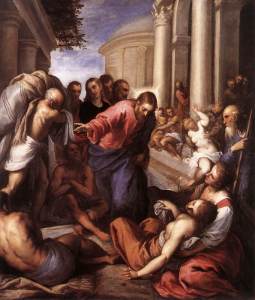
Like the time a paralytic’s friends brought him to Jesus. Jesus saw that they had faith enough to bring their friend to Him for healing. But He did not respond to their felt need for healing – at least not right away. Instead, He said, “Son, your sins are forgiven” (Mark 2:5). Jesus dealt with this man’s deeper need – his need for forgiveness – before He dealt with this man’s felt need – his need to be healed from his paralysis.
Or how about the time one of Jesus’ dearest friends – a man named Lazarus – fell ill? His sisters, Mary and Martha, begged Jesus to hurry over and heal him. But Jesus did not meet their need. Instead, He intentionally let His dear friend die. Why? So that Jesus could address humanity’s deeper need – the need to be rescued from death – which far outweighs the felt need of being temporarily healed from a frustrating ailment. This is why Jesus says to Martha, “I am the resurrection and the life. The one who believes in Me will live, even though they die; and whoever lives by believing in Me will never die” (John 11:25-26).
Don’t get me wrong. I am not saying that Jesus never began by addressing people’s felt needs. After all, He fed a crowd of 5,000 by miraculously multiplying loaves of bread before declaring Himself to be the bread of life (cf. John 6:1-35). He began with a felt need for physical food before He moved to a deeper need for heavenly food. Jesus does sometimes initiate an engagement by addressing people’s felt needs. However, Jesus does not always begin this way. Indeed, sometimes, He flat out denies people’s felt needs as He challenges them with their deeper needs.
The problem with felt needs is that, often, felt needs are not helpful needs. Sometimes, felt needs can even be sinfully selfish needs. Jesus has little interest in meeting our felt needs for riches, for ease, and even for happiness. Thus, for us to begin and base our ministries on what people think they need, and then to try to meet those needs before we share Jesus, can devolve, if we are not careful, into merely enabling sin.
I have learned over the years that Jesus has a funny way of resisting the easy ministry models we like to apply to Him. To those who say that Jesus always begins by addressing people’s felt needs so they will be open to the gospel, I must say, “I think you’re wrong.” But then again, to those who say that Jesus never begins by addressing people’s felt needs as a foray to share the gospel, I also must say, “I think you’re wrong.” Jesus does both.
We should too.
Perhaps we would do well to learn to pray a slightly modified version of Reinhold Niebuhr’s famous, though contested, Serenity Prayer as we seek to faithfully reach the world with the gospel: “God, grant me the tenderness to address people’s felt needs at certain times, the boldness to challenge them with their deepest needs at other times, and the wisdom to know when to do which.”
That’s my prayer as I seek to reach out with the gospel. Will you join me in praying the same?


 Pastor Zach's Blog