Posts filed under ‘Devotional Thoughts’
Thanksgiving Lessons From Lincoln

Credit: Luminary PhotoProject / Flickr
I have made it a tradition of sorts to read one of Abraham Lincoln’s Thanksgiving proclamations each year during this time. His proclamations are not only extraordinarily well-crafted pieces of oratory statecraft, they are also genuinely theologically rich. In his Thanksgiving Proclamation of 1863, Mr. Lincoln recounts the blessings God has bestowed on this nation and then declares:
No human counsel hath devised nor hath any mortal hand worked out these great things. They are the gracious gifts of the Most High God, who, while dealing with us in anger for our sins, hath nevertheless remembered mercy.
President Lincoln beseeches the nation to give thanks on its knees, humbly recognizing that anything it has is not due to some inherent civic merit or to some twisted theology of a manifest destiny (a concept Mr. Lincoln resolutely opposed), but to the unmerited mercy of God. In other words, the president recognized that rather than judging this nation as its sins deserved in wrath, God instead blessed this nation apart from its sins out of grace. And for this, Mr. Lincoln was thankful.
What struck me the most about President Lincoln’s Thanksgiving Proclamation as I read it this year was how the president believed divine mercy should lead to concrete action. Mr. Lincoln concludes his proclamation thusly:
I recommend to them that while offering up the ascriptions justly due to God for such singular deliverances and blessings they do also, with humble penitence for our national perverseness and disobedience, commend to His tender care all those who have become widows, orphans, mourners, or sufferers in the lamentable civil strife in which we are unavoidably engaged, and fervently implore the interposition of the Almighty hand to heal the wounds of the nation and to restore it, as soon as may be consistent with the divine purposes, to the full enjoyment of peace, harmony, tranquility, and union.
In view of God’s mercy, the president invites the American people to three things: repentance, remembrance, and restoration. He invites the American people to repent of their sins, both in the North and in the South, understanding that any snooty swagger of self-righteousness can never receive mercy from God because it does not understand the need for the grace of God. He also invites the American people to a remembrance of those who are suffering – those who have become widows, orphans, and mourners in the strife of the Civil War. He finally calls the American people to restoration – to be healed from a wound of division that runs so deep that it has led Americans to take up arms against Americans.
As I reflect on the wisdom in President Lincoln’s proclamation, the words of the teacher in Ecclesiastes come to mind: “What has been will be again, what has been done will be done again; there is nothing new under the sun” (Ecclesiastes 1:9). Today, as in Mr. Lincoln’s day, examples of delusional self-righteousness abound – both among the secular and the spiritual – which close us off to appreciating and receiving God’s mercy. Today, as in Mr. Lincoln’s day, widows, orphans, and mourners still live among us, often unnoticed and sometimes even ill-regarded, suffering silently and in desperate need of our help. Today, as in Mr. Lincoln’s day, America still suffers from a wound of division, which some, almost masochistically, delight in ripping open farther and cutting into deeper for their own cynical political purposes. The problems that plagued our nation in 1863 still plague our nation today in 2017. Our problems persist. But so too does the mercy of God.
154 years later, we are still extravagantly blessed with bounty. 154 years later, our republic has not dissolved, even as it has frayed. 154 years later, God still is not treating us as our sins deserve. Our sinful rebellion, it seems, cannot thwart the tenacious grace of God. And for that, on this Thanksgiving, I am thankful.
The Reformation of the Church
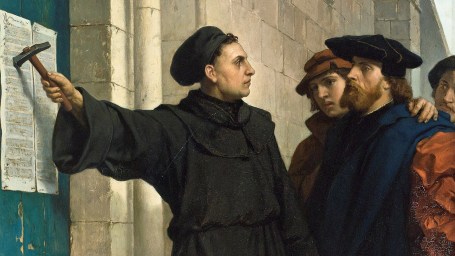
Credit: Ferdinand Pauwels, 1872
Tomorrow, many corners of the Christian Church will mark the 500th anniversary of the Reformation. And though the Reformation of the Church was larger than any one event and any one man, the beginning of this grand theological and historical watershed is traditionally traced to October 31, 1517, when an Augustinian monk named Martin Luther posted 95 theses to the door of the castle church in Wittenberg, Germany, outlining his grievances against some of the abuses that were rampant in the Roman Catholic Church of his day.
At the heart of Luther’s protest was the Church’s sale of indulgences. Indeed, in his 95 theses, Luther uses the word “indulgence” some 45 times! An indulgence was a partial remission of punishment for sin, issued by the Church, and could be used either to lessen a person’s future penalties in purgatory, or to shorten a deceased loved one’s current intermediate period in purgatory. Indulgences took both the form of personal good works, such as pilgrimages and acts of devotion, as well as the form of a payment to the Church by which, it was said, one could have some of the good works of one of the Church’s canonized saints imputed to him to counterbalance his sin.
In Luther’s day, a preacher named Johann Tetzel shamelessly peddled the second type of indulgence, claiming that paying for an indulgence could breezily and easily excuse a sin for which one would otherwise have to suffer terribly in purgatory. With clownish flamboyance, he declared:
Consider, that for each and every mortal sin it is necessary to undergo seven years of penitence after confession and contrition, either in this life or in purgatory.
How many mortal sins are committed in a day, how many in a week, how many in a month, how many in a year, how many in the whole extent of life! They are well-nigh numberless, and those that commit them must needs suffer endless punishment in the burning pains of purgatory.
But with these confessional letters you will be able at any time in life to obtain full indulgence for all penalties imposed upon you …
Are you not willing, then, for the fourth part of a florin, to obtain these letters, by virtue of which you may bring, not your money, but your divine and immortal soul, safe and sound into the land of paradise?
According to Tetzel, one sin buys a person seven years of suffering in purgatory. If a person commits only one sin a day, which, according to Tetzel himself, who invites his hearers to ponder “how many mortal sins are committed in a day,” is an unrealistic underestimation, this would mean that, for one year’s worth of sins, a person would spend 2,555 years in purgatory. If a person lived to be 75, they would have to endure 191,625 years of suffering in purgatory. But, Tetzel continues, “for the fourth part of a florin,” one can purchase an indulgence letter, which allows the bearer to “obtain full indulgence for all penalties imposed on you.” A florin was an Italian gold coin worth around $144 in today’s currency. A fourth of a florin, then, would be worth around $36. Thus, Tetzel’s message was this: for $36, your sins can be taken care of, and you can enter effortlessly into paradise. What a deal!
The problem with Tetzel’s deal, of course, is that, ultimately, he cheapened both the penalty and the payment for sin. As harrowing as 191,625 years in purgatory may sound, the true penalty for sin is even more terrifying, for it is not a finite time in purgatory, but an infinite eternity in hell. And the true payment for sin that rescues us from this eternity in hell is certainly more than a measly $36. The true payment for sin is nothing short of priceless. As God says through the prophet Isaiah, “Without money you will be redeemed” (Isaiah 52:3). The true payment for sin is nothing less than the priceless blood of Christ.
The truth Luther rediscovered is that the penalty for sin is much steeper and the payment for sin is much deeper than an indulgence preacher like Johann Tetzel ever let on. And this is the truth that launched a reformation of the Church.
Tetzel passed away in 1519, only two short years after the Reformation began. By this time his ministry had been discredited, and he had been accused of fathering an illegitimate child. When Luther heard that Tetzel was near death, he wrote his old theological sparring partner a kind note, begging him “not to be troubled, for the matter did not begin on his account, but the child had quite a different father.”
Luther was known for preaching grace as a theologian. It turns out that, for all his protestations against and sometimes harsh critiques of the Catholic Church of his day, at times, he was also gracious as a person. And grace is better than any indulgence. This was Luther’s message – and, most importantly, this is the gospel message. And that’s a message worth celebrating, which is why the Reformation is worth celebrating, even 500 years later.
“Indulgences are in truth the most insignificant graces when compared with the grace of God and the piety of the cross.” (Martin Luther)
Herod, John the Baptist, and Sharing Our Faith
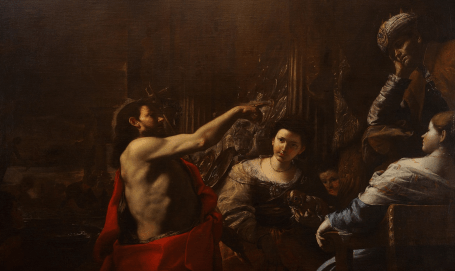
St. John the Baptist before Herod, by Mattia Pretti (1665)
In Mark 6, we are treated to a fascinating flashback. The chapter opens with Jesus teaching and then quickly turns to Him sending out His twelve disciples to preach, drive out demons, and anoint the sick. The chapter then shifts again, this time to a ruler named Herod Antipas. Herod Antipas was one of the sons of Herod the Great, the ruler who tried to kill Jesus when He was just a toddler because he considered the lad a threat to his throne. Herod Antipas, however, was not so hostile toward Jesus as he was curious about Him, especially when he heard a rumor that Jesus was “John the Baptist…raised from the dead” (Mark 6:14). Cue Mark’s flashback.
In his flashback, Mark recounts how John the Baptist died. It turns out that Herod Antipas had thrown John in prison because he had preached against Herod’s marriage to his sister-in-law, Herodias. But it was not just Herod who was upset with John. It was also his new wife, Herodias. In fact, Mark says that she “nursed a grudge against John and wanted to kill him” (Mark 6:19). And one day, she saw her opportunity. When Herod was throwing a party, Herodias’s daughter came and danced for Herod and his inebriated guests. Herod was so pleased by her performance that he offered this girl anything she wanted, including up to half his kingdom. Prompted by her mother, the girl asked Herod for John the Baptist’s head on a platter. Interestingly enough, Herod, instead of being delighted that he would finally be able to get rid of this man who had preached against his marriage, was devastated. Mark 6:26 explains that “the king was greatly distressed.” The Greek word used for “distressed” is perilupos, a word that Jesus Himself uses the night before He goes to the cross when He says to His disciples in the Garden of Gethsemane, “My soul is overwhelmed with sorrow to the point of death” (Mark 14:34). The Greek word used for “sorrow” is again perilupos. Clearly, Herod was deeply grieved, even to the point of death, by this girl’s request. But why?
As it turns out, Herod had what might be called a “love-hate relationship” with John. Mark describes their relationship like this: “Herod feared John and protected him, knowing him to be a righteous and holy man. When Herod heard John, he was greatly puzzled; yet he liked to listen to him” (Mark 6:20). The same man who threw John in prison also protected him, because he knew there was something different about him. He knew he had a righteousness and holiness that went beyond anything he had ever encountered before. Moreover, he liked to listen to John, even though he had a hard time understanding what he was talking about and, obviously, did not always heed what he said. Herod, even as he was offended by John, was also attracted to John.
Herod’s relationship with John can serve as a model for what the world’s relationship with us, as Christians, can look like. When people watch you, do they see a righteousness and a holiness beyond anything they have ever encountered before because, instead of your righteousness and holiness being merely meritocratic, it is Christocentric? And when you speak about your faith to others, even if they are puzzled by what you have to say, do you leave them wanting to hear more?
Just as Herodias hated John, there will be some who hate us simply because we are Christians. But there will also be others who are intrigued by us. May we never forget to engage these people, model Christ for these people, and speak the gospel to these people. For what they are puzzled by today may just be the very thing they believe in tomorrow.
Saving Marriage from the Heartbreak Hotel

Credit: Viator.com
It seems as though declining marriage rates are not just changing our society sociologically, but are stressing the wedding capital of the world, Las Vegas, economically. In an article for Bloomberg, Jeanna Smialek explains how:
Roland August has officiated at thousands of weddings in Las Vegas, the self-proclaimed capital of “I do.”
But these days August – who often presides dressed as Elvis Presley – has a rare vantage point from which to observe the nation’s long shift toward “I don’t.” …
The wedding chapels where August works have seen business dwindle, he said, and Vegas is pushing to reverse the decline in an industry that generates as much as $3 billion in economic activity annually. In 2015 the surrounding county introduced a $14 surcharge on marriage licenses to pay for marketing, and local business leaders helped start a Wedding Chamber of Commerce last year.
A drop in weddings, it seems, amounts to a drop in revenue for a city that is known as being flush with cash. Of course, this is all part of a broader nationwide trend. The Pew Research Center reports that, whereas 72% of adults 18 years of age or older were married in 1960, now, only 50% are. But, if the graph published by Bloomberg is any indication, the nationwide decline in marriage has hit Nevada especially hard.

In one way, none of this is particularly surprising. For all the fun and levity, which are not bad things in and of themselves, that I’m sure Mr. August brings to the weddings he performs, vows taken without things like spiritual guidance from a pastor or other religious mentor, serious prior consideration of all the things marriage entails, a commitment to make marriage alone the sacred space for sex, and, often, even a baseline of sobriety do little more than to cheapen and make a mockery out of the whole institution. And when something becomes cheap, it inevitably becomes expendable. After all, if Britney Spears can drunkenly marry her childhood friend in Las Vegas and then have their marriage annulled 55 hours later, one has to wonder: why bother with marriage in the first place?
They key to reversing the decline in marriage and the denigration of marriage is not to try to repristinate the marriage-saturated days of 1960, hoping that, somehow, marriage rates will soar again if we just yell enough at the cultural forces that have damaged the institution. No, the key to a deeper appreciation of and desire for marriage is to consider what marriage is really meant to reflect. So here are three things that we can say, as Christians, marriage reflects.
Marriage reflects community in Christ.
One of the great mysteries of Christian teaching is that of the Trinity – that God is one, yet, at the same time, He is also three persons: Father, Son, and Holy Spirit. Thus, God is in community, in some sense, with Himself. For centuries, professional theologians and Sunday School teachers alike have tried to explain this mystery in a way that is comprehensible. My Sunday School teacher, for instance, mused that the Trinity is like an apple. There is the peel, the flesh, and the core. These are three parts, and yet they are all part of one apple. The problem with this illustration, however, is that God is indivisible. He cannot be divided like an apple. He is not made up of three parts, but actually is three persons.
Thankfully, the Bible presents us with its own object lesson to help us understand the Trinity. What is this object lesson? Marriage. When marriage is given by God, He explains that it is meant to be when “a man leaves his father and mother and is united to his wife, and they become one flesh” (Genesis 2:24). In marriage, there are two persons, and yet they are one flesh, even as in God, there are three persons, yet He is one God. Moreover, throughout this life, a husband and wife ought to be indivisible, as is God. This is why Jesus says divorce is so damaging – not only because it hurts the people involved, but because it tarnishes the very reflection of God! Thus, community in marriage, even if it is broken by sin, is meant to reflect the perfect community of the Trinity.
Marriage reflects the sacrifice of Christ.
As anyone who has been married for any amount of time will tell you, marriage requires sacrifice. It requires laying down your own wants, needs, and desires for the sake of another. The apostle Paul eloquently explains the sacrificial nature of marriage when he writes:
Husbands, love your wives, just as Christ loved the church and gave Himself up for her to make her holy, cleansing her by the washing with water through the word, and to present her to Himself as a radiant church, without stain or wrinkle or any other blemish, but holy and blameless. (Ephesians 5:25-27)
Paul notes that the sacrifice a husband makes for his wife ought to reflect the sacrifice that Christ made for His church, even if that sacrifice includes laying down his very life, as it did for Christ. Thus, at the same time marriage gives a community that reflects the Trinity, it also eats away at our proclivity toward selfishness. Marriage is fundamentally centered not on yourself, but on your spouse, even as God is fundamentally centered on us and on our salvation.
Marriage reflects eternity with Christ.
The best marriage is not the one you celebrate once a year on your anniversary. The best marriage is the one that is still to come:
I heard what sounded like the roar of a great multitude in heaven shouting: “Hallelujah! For our Lord God Almighty reigns. Let us rejoice and be glad and give Him glory! For the wedding of the Lamb has come, and His bride has made herself ready.” (Revelation 19:1, 6-7)
When the apostle John gets a window into eternity, he sees that every wedding on earth between a husband and wife is ultimately meant to reflect a perfect wedding in heaven between Christ and His people. Marriage in this age, then, however wonderful it can be, is not an end in and of itself. It is a sign pointing to something even greater. This is why Jesus, when He is questioned by the religious leaders about marriage in eternity, says, “At the resurrection people will neither marry nor be given in marriage” (Matthew 22:30). Marriage between people till death do them part is meant to point to perfect communion with God where death no longer reigns. Marriage, then, at the same time it fills a longing, should also create a longing. It should create a longing for a deeper community that not even your spouse can meet. It should create a longing for a deeper community that only Christ can fill in His wedding feast.
This is what marriage is meant to reflect. It cannot be reduced, then, to a Vegas jag, or, for that matter, a well-planned out and exorbitantly expensive ceremony and reception. These things are not necessarily bad on their own terms, but if they become the things of marriage, they reduce marriage to something that is entertaining, cheap, and contrived. But marriage cannot stand if it is this. Marriage must stand as a gift from God that gives you community, costs you your very self, and points you to the One who gave Himself for you so that, on the Last Day, He can walk you down His eternal aisle.
No neon or Elvis costumes needed.
Pointing Fingers

At the end of his epistles, the apostle Paul often includes a section of personal greetings to people in the congregation to whom he is writing. At the end of Romans, for instance, Paul includes a lengthy list of greetings:
I commend to you our sister Phoebe, a deacon of the church in Cenchreae. I ask you to receive her in the Lord in a way worthy of his people and to give her any help she may need from you, for she has been the benefactor of many people, including me. Greet Priscilla and Aquila, my co-workers in Christ Jesus. They risked their lives for me. Not only I but all the churches of the Gentiles are grateful to them. Greet also the church that meets at their house. Greet my dear friend Epenetus, who was the first convert to Christ in the province of Asia. Greet Mary, who worked very hard for you. Greet Andronicus and Junia, my fellow Jews who have been in prison with me. They are outstanding among the apostles, and they were in Christ before I was. Greet Ampliatus, my dear friend in the Lord. Greet Urbanus, our co-worker in Christ, and my dear friend Stachys. Greet Apelles, whose fidelity to Christ has stood the test. Greet those who belong to the household of Aristobulus. Greet Herodion, my fellow Jew. Greet those in the household of Narcissus who are in the Lord. Greet Tryphena and Tryphosa, those women who work hard in the Lord. Greet my dear friend Persis, another woman who has worked very hard in the Lord. Greet Rufus, chosen in the Lord, and his mother, who has been a mother to me, too. Greet Asyncritus, Phlegon, Hermes, Patrobas, Hermas and the other brothers and sisters with them. Greet Philologus, Julia, Nereus and his sister, and Olympas and all the Lord’s people who are with them. (Romans 16:1-15)
I would guess that, as you began to read through the list of names above, your eyes quickly skipped to the end of the paragraph. After all, a list of names isn’t exactly riveting reading. But take a moment to go back and note how Paul describes the people on his list. He describes Phoebe as a faithful supporter of his ministry. He lauds Priscilla and Aquila as ones who risked their lives for him. He calls Andronicus and Junia “outstanding.” He celebrates Persis his as “dear friend.” He fawns over Rufus’ mother as his surrogate mother. Paul, it turns out, has a lot of good things to point to in lot of good people.
In both the church and in broader culture, we seem to be much more comfortable pointing at people in order to criticize them rather than pointing to people in order to celebrate them. I am part of a church body that, sadly, can spend so much time pointing at people with whom we have theological disagreements that we can fail to point to people with whom we share a common faith, even if our confession of that faith differs at certain points. In broader culture, one needs to look no further than our nation’s capital to see a whole political system that trafficks in pointing fingers at other people. Republicans point at Democrats. Democrats point at Republicans. Sometimes, it seems as though the only ones people actually point to in Washington are themselves.
As Christians, we must never be scared to point at something that is wrong. Wrongness, after all, needs to be corrected so it can give way to righteousness. But let us never become so proficient in pointing at what is wrong that we forget to point to all that is good. People in differing ecclesiastical factions still have plenty of good things to point to among each other. People in opposing political parties still have plenty of good things to point to on the other side of the aisle.
Perhaps it is time for us, like Paul, to make a list of good things and people to point to. Pointing at people can quickly dissolve into arrogance as we pontificate on how someone else is wrong. But pointing to people can keep us humble and give someone else a much-needed boost of confidence as we put the spotlight on what they are doing right. Not only that, but pointing to others is supremely godly, for it mirrors the character of Jesus, who relentlessly pointed not to Himself, but to His Father.
So, who can you point to this week? Who can you give a glowing review to? Who can you celebrate on Facebook? Who can you, even if you disagree with them on some things, rejoice in as a fellow-traveler in Christ?
Now is the time to begin a list of people to point to. You just might be surprised at how quickly that list becomes really, really long.
In Praise of Fathers

Just in time for Father’s Day this Sunday comes a new study detailing the impact fathers have on their daughters’ behavior patterns. In an online article published in Developmental Psychology, researchers from the Universities of Utah and Albany “compared the outcomes of older and younger full biological sisters who experienced the divorce or separation of their parents while growing up, and thus spent differing amounts of time living with their fathers.” They found that “when fathering was high quality…older sisters were less likely to affiliate with sexually risky peers during adolescence compared to their younger sisters” because they had more time with their fathers pre-divorce than did their younger siblings post-divorce.
This research is sobering, but it is not particularly surprising. The profoundly formative effect fathers have on their children has been well-documented. This study serves as both an encouragement for fathers and a challenge to fathers. It serves as an encouragement for fathers because it is a yet another reminder that they matter – greatly. In a culture that has enclaves that can, at times, belittle, disparage, and minimize the roles men play in families and in society, this study reminds us of the blessing of dads. It reminds us that fathers, by how they treat their daughters when they are little, can shape their daughters’ expectations and views of men as they grow up. But this study also presents a challenge to fathers. In an age when far too many men make children but do not raise them, this study is a clarifying indictment of the steep price that a man’s absence can incur on his children. This must change.
In a society that obsesses over personal autonomy and choice, fatherhood is a countercultural sacrifice and call. Fatherhood compels men to sacrifice many of their freedoms and hobbies for the sake of loving, providing for, and raising their children. And whether the call of fatherhood comes expectedly or unexpectedly, it should and must be answered wholeheartedly, regardless of whether or not a man feels he’s ready to be a dad.
Many men I know are quite competitive. They have a desire to beat those who are strong by being even stronger themselves. Fatherhood, instead of pushing men to be stronger than the strong, invites men to be tender with the vulnerable – their children. Fatherhood calls for a strength that does not conquer, but loves. And this is the highest strength of all. Which is why fathers are worth celebrating.
No-Win Situations

George Jones once sang a song called “Sometimes You Just Can’t Win.” I imagine Jesus felt much the same way when He uttered one of the tersest parables of His ministry:
To what, then, can I compare the people of this generation? What are they like? They are like children sitting in the marketplace and calling out to each other: “We played the pipe for you, and you did not dance; we sang a dirge, and you did not cry.” For John the Baptist came neither eating bread nor drinking wine, and you say, “He has a demon.” The Son of Man came eating and drinking, and you say, “Here is a glutton and a drunkard, a friend of tax collectors and sinners.” (Luke 7:31-34)
It seems no matter what message the kingdom of God was offering, the people of Jesus’ day were determined to reject it. When John came preaching a message of somber repentance from sins, the people thought him to be mad. When Jesus came and welcomed sinners and preached to them the gospel of grace, the people thought Him to be licentious. Sometimes, you just can’t win.
A while back, my son Hayden was a little under the weather. He was also teething. So when I held him, he cried And when I put him down, he cried. When I sat down with him, he cried. And when I stood up with him, he cried. At that time, I just couldn’t win.
I have been a pastor long enough to watch quite a few people put themselves in what I call “no-win situations.” Sometimes it’s a financial no-win situation. “There is no way I have enough money to live on!” a person will say. Sometimes it’s a relational no-win situation. “There is no way I can ever forgive this person for what they have done to me!” another person will say. And when I suggest some ways that someone can, in fact, navigate toward a winning solution, I will hear a whole litany of why there is no way to fix the problem. Sometimes, a person just won’t let himself win.
When Jesus invites us to Himself, He invites out of the no-win situations of our sin and into the comforts, promises, and delights of His grace. Like John the Baptist came before Jesus, there is an element of repentance that comes before forgiveness – sorrow that comes before joy. But whether it is in dirge or in dance, we are invited out of our sin and into Christ’s arms. The question is: will we be like the people of Jesus’ generation, refusing both to participate in repentance and to receive God’s forgiveness?
The apostle Paul writes that his desire is to “press on toward the goal to win the prize for which God has called me heavenward in Christ Jesus” (Philippians 3:14). Paul has a desire to win what matters most. But he also knows that his win will come not by his effort, but by his loss:
Whatever were gains to me I now consider loss for the sake of Christ. What is more, I consider everything a loss because of the surpassing worth of knowing Christ Jesus my Lord, for whose sake I have lost all things. I consider them garbage, that I may gain Christ, and be found in Him, not having a righteousness of my own that comes from the law, but that which is through faith in Christ – the righteousness that comes from God on the basis of faith. (Philippians 3:7-9)
Paul’s win is the righteousness of Christ that leads to everlasting life. This is the win to which Jesus invited the people of His day in Luke 7. And this is still the win to which Jesus invites us. And there’s no win that’s better than this win.
The Search for Meaning

In his 1946 classic, Man’s Search for Meaning, Victor Frankl candidly and insightfully reflects on his time as a concentration camp prisoner in Auschwitz and how he struggled to find bright spots of meaning what felt like a deeply dark vacant evil. In one particularly moving passage, Frankl describes how he found meaning by thinking about his wife as he was forced into hard and humiliating work:
We stumbled on in the darkness, over big stones and through large puddles, along the one road leading from the camp. The accompanying guards kept shouting at us and driving us with the butts of their rifles. Anyone with very sore feet supported himself on his neighbor’s arm. Hardly a word was spoken; the icy wind did not encourage talk. Hiding his mouth behind his upturned collar, the man marching next to me whispered suddenly: “If our wives could see us now! I do hope they are better off in their camps and don’t know what is happening to us.”
That brought thoughts of my own wife to mind. And as we stumbled on for miles, slipping on icy spots, supporting each other time and again, dragging one another up and onward, nothing was said, but we both knew: each of us was thinking of his wife. Occasionally I looked at the sky, where the stars were fading and the pink light of the morning was beginning to spread behind a dark bank of clouds. But my mind clung to my wife’s image, imagining it with an uncanny acuteness. I heard her answering me, saw her smile, her frank and encouraging look. Real or not, her look was then more luminous than the sun which was beginning to rise.[1]
As Frankl thought about the woman he loves, he found meaning for life in that love. He writes, “Love is the ultimate and the highest goal to which man can aspire.”
The human desire for meaning, it seems, is a desire that is nearly impossible to extinguish, even when it is confronted with the horrors of a concentration camp. Whether consciously or subconsciously, everyone lives for something. Some people live for riches. Others live for fame. Still others live for pleasure. Some wiser and more mature souls find meaning in, if you will excuse the somewhat circular logic, more meaningful things. For example, I was talking to a single mom some time ago who lives for her kids. She works long hours and she has gone back to school so she can better provide for her two daughters. She finds her meaning in motherhood.
What is particularly fascinating to me about this mother’s search for meaning is that she is, by her own admission, not a Christian. “Religion,” she admits, “is just not my thing.”
I have known this mom for quite a while and, on the one hand, I am proud of how far she’s come. There was a time, not too long ago, when she reveled in a shallow hedonism – drinking, carousing, and doing drugs. All that has ended. She has fled those demons. On the other hand, however, I can’t help but notice that, as admirable as her investment into motherhood is, she has only kicked her search for ultimate meaning down the curb a bit. Here’s what I mean.
If my friend finds her meaning for life in being a mother, what happens if her kids rebel against her and ultimately reject her? Will she lose her source of meaning because they have pulled away from her? Or, what happens if she falls back into her old habits of substance abuse and fast living? Will she lose her source of meaning because she will not have been the mother she could have been? Or, less dramatically, what happens when her kids grow up and move away? When she no longer has little children to nurture, what will provide her with meaning and purpose?
It is in light of questions like these that Christianity’s answer to man’s search for meaning becomes critical. For Christianity asserts that man can only find ultimate meaning in God and in the hope of an eternity with Him. To use the formulation in the opening salvo of the Westminster Catechism: “Man’s chief end is to glorify God, and to enjoy Him forever.” This is where man finds his ultimate meaning.
The problem with finding ultimate meaning in anything other than God is that no other source of meaning lasts. Every other source of meaning only kicks the search for meaning down the curb, for every other source of meaning eventually fades and expires, which compels another search for another source of meaning. Only God ends such searches permanently.
It is not until my friend finds her ultimate meaning in Christ that her search for meaning will find its final answer. There are greater sources of meaning and lesser sources of meaning to be sure. But there is only one eternal source of meaning. I pray that she, along with others like her, discovers this eternal source. For when she does, she will find that this eternal source leads to eternal life.
____________________________________
[1] Victor Frankl, Man’s Search for Meaning (Boston: Beacon Press, 2006), 36-37.
Death Is Dying

Even as we celebrated Easter yesterday, it was difficult not to be burdened by the death we see around us every day. This past Sunday, 44 worshipers lost their lives at St. George Church in Tanta and St. Mark’s Cathedral in Alexandria, both in Egypt, when ISIS suicide bombers detonated themselves in the middle of these churches’ Palm Sunday worship services. Closer to home, in San Bernardino, a man signed himself into an elementary school at the front desk and then proceeded to walk into the classroom where his estranged wife was teaching and fatally shoot her while also wounding two students, one of whom later died from the injuries he sustained. After his shooting spree, he took his own life. Then, of course, earlier this month, there were the sarin gas attacks by the Assad regime against his own people in northwestern Syria. Death is all around us.
And this is why I am so glad we get to celebrate Easter.
The story of Easter is a story of many things. It is a story of joy, as the people close to Jesus realize the man who they thought was dead has risen. It is a story of fear, as the women who come to the tomb that first Easter morning encounter angelic beings who startle and scare them with their fantastic message. But it is also a story of subversion. It is a story of subverting all those who prefer death to life.
N.T. Wright explains the subversive nature of Easter well:
Who…was it who didn’t want the dead to be raised? Not simply the intellectually timid or the rationalists. It was, and is, those in power, the social and intellectual tyrants and bullies; the Caesars who would be threatened by a Lord of the world who had defeated the tyrant’s last weapon, death itself; the Herods who would be horrified at the postmortem validation of the true King of the Jews.[1]
In a world where terrorist attacks, school shootings, and chemical bombings instill fear into all who see and hear about them, the resurrection of Jesus reminds us that, in the words of the prophet, “no weapon forged against [us] will prevail” (Isaiah 54:17), even if these weapons kill us, for “the one who raised the Lord Jesus from the dead will also raise us” (2 Corinthians 4:14). A tyrant may kill us. But God will raise us. This is Easter’s promise. And this is why it is so good to celebrate Easter at a time like this. For Easter reminds us that even if this world full of death, we need not fear. Christ has risen. And because He has risen, we will rise.
Take that, death.
___________________________________
[1] N.T. Wright, Surprised by Hope (New York: HarperOne, 2008), 75.
God and Country in Order

In his book, Destroyer of the gods, Larry Hurtado writes about why the Christian claim that there is only one God was especially offensive to those in the ancient Roman world. His analysis is worth quoting at length:
In the eyes of ancient pagans, the Jews’ refusal to worship any deity but their own, though often deemed bizarre and objectionable, was basically regarded as one, rather distinctive, example of national peculiarities…
The early Christian circles such as those addressed by Paul…could not claim any traditional ethnic privilege to justify their refusal to worship the gods. For, prior to their Christian conversion, these individuals, no doubt, had taken part in the worship of the traditional gods, likely as readily as other pagans of the time among their families, friends, and wider circles of their acquaintances…
Of course, a pagan might choose to convert fully to Judaism as a proselyte, which meant becoming a Jew and ceasing to be a member of his or her own ancestral people. By such a drastic act, proselytes effectively changed their ethnic status and so could thereafter try to justify a refusal to participate in worshipping the pagan gods as expressive of their new ethnic membership and religious identity. But this was not the move that Paul’s pagan converts made…
Indeed, Paul was at pains to emphasize that his pagan converts must not become Jewish proselytes. For Paul saw his mission to “Gentiles” as bringing to fulfillment biblical prophecies that the nations of the world would forsake idols and, as Gentiles, would renounce their idolatry and embrace the one true God. That is, unlike Jewish proselytes, Paul’s pagan converts did not change their ethnic identity.[1]
Categories of ethnicity and faith were not clearly delineated in the ancient world. Instead, they were broadly interchangeable. To be a part of the Jewish nation was to adhere to the Jewish faith. To be a Roman Gentile was to be a worshiper of the Roman gods. There was no concept of religious freedom like we know it today – where a person can worship and live out their convictions freely quite apart from their nationality. Thus, part of what made Christianity so offensive to the ancient pagans was that it began to decouple a presumed synonymy between ethnicity and faith. A person’s ethnicity, in the Christian conception, no longer informed ipso facto a person’s faith. A person could be a Roman Gentile and a Christian monotheist.
Not only did Christianity decouple ethnicity from faith, it actually claimed that a person’s ethnicity was subservient to faith! Again, to quote Hurtado:
Paul writes, “There is no longer Jew or Greek, there is no longer slave or free, there is no longer male or female; for all of you are one in Christ Jesus” (Galatians 3:28)…Whether you were Jew or Greek, slave or free, male or female, this was now to be secondary to your status “in Christ”…Irrespective of their particular ethnic, social, or biological categories, therefore, all believers were now to take on a new and supervening identity in Christ.[2]
According to Paul, Christ comes before clan.
Like the ancient Romans, we too have a tendency to couple our ethnicity with our faith, or, to put it in another, more recognizable, way, to couple our country with our God. When this happens, however, it is almost always our God who winds up serving our country. When it appears particularly expedient or reassuring in the midst of a dangerous and changing world, we can be all too willing to sacrifice fidelity to our faith for the prosperity of our nation. Hurtado offers us an important reminder: though we may retain our ethnicities and citizenships and still be Christians, ethnicities and citizenships are subservient to faith. Faith cannot be sacrificed for the sake of the State. Furthermore, as we are learning our increasingly secularized society, faith is often at odds with the goals of the State. Everything from the legal enshrinement of the sexual revolution to the often raucous and raunchy rhetoric of our most recent presidential campaign demonstrates this. So let’s makes sure we keep the State and our faith straight. Faith comes first. After all, the God of our faith will continue to stand, long after the State has fallen.
_______________________
[1] Larry Hurtado, Destroyer of the gods (Waco: Baylor University Press, 2016), 53, 55.
[2] Ibid., 55-56.


 Pastor Zach's Blog