Posts filed under ‘Current Trends’
San Antonio’s Anti-Discrimination Ordinance
 Recently, there has been a lot of debate and discussion concerning a proposed amendment to San Antonio’s anti-discrimination ordinance on which the City Council will soon vote. You can read about the debate here. Because this ordinance has certain theological implications, Concordia’s senior pastor, Bill Tucker, has prepared a letter outlining some of the facets and possible effects of this ordinance. I would encourage you to take a moment to read his letter below.
Dear Concordia Family,
The apostle Paul writes, “I urge, then, first of all, that requests, prayers, intercession and thanksgiving be made for everyone – for kings and all those in authority” (1 Timothy 2:1-2a). This is a time for us as a congregation to be in prayer for those in authority – specifically, for those in authority on our San Antonio City Council.
San Antonio’s Anti-Discrimination Ordinance
Our City Council is currently considering amending its anti-discrimination ordinance to include a prohibition against discrimination on the basis of, among other things, “sexual orientation” and “gender identity.” The ordinance defines discrimination as demonstrating “a bias, by word or deed, against any person, group of persons, or organization on the basis of race, color, religion, national origin, sex, sexual orientation, gender identity, veteran status, age or disability.” Many Jews, Muslims, and Christians have long considered homosexual activity, same-sex marriage, and transgender lifestyles to be “sinful.” Such a designation may now be considered discriminatory according to the definition of bias given in this ordinance. Thus, an ordinance meant to prohibit discrimination may set up a de facto form of discrimination against some people of faith because it may preclude people with certain religious beliefs from serving the City.
How Will This Ordinance Affect You?
- Bias: Pastors or other people of faith who discuss whether or not certain behaviors are “sinful” may be considered to be engaging in discrimination according to the definition of “bias” given in this ordinance. Such accusations of discrimination may affect both our ability to speak God’s truth in love and our freedoms of speech, religion, and association.
- Public Accommodations: If you are a business owner who has rental property, restaurants, hotels, or theatres, you may be compelled by this ordinance to violate your conscience and not operate the business according to your religious convictions.
- Appointments and Contracts with the City: A person may not be appointed to a position with the City if he or she is perceived to have a bias against those of a homosexual or transgender orientation and can be removed from office even if previously appointed. A person may also be precluded from contracting with the City if that person is perceived to have a bias against any group named in the ordinance.
Actions to Consider
- Pray for our City Council and consider what your response might be.
- Several local faith-based organizations have expressed concerns about the amended ordinance. You can read their concerns at sahumanrightscoalition.com.
- If you would like to learn more about the Bible’s teaching on homosexuality and same-sex marriage, read “A Pastoral Statement on President Obama’s Endorsement of Same-Sex Marriage.”
- If you would like to contact your Council member or Mayor, go to sanantonio.gov for a list of districts, Council members, and contact information.
Finally, I encourage you to remember how Paul concludes his statement to Timothy on praying for those in authority: “I urge, then, first of all, that requests, prayers, intercession and thanksgiving be made for everyone – for kings and all those in authority, that we may live peaceful and quiet lives in all godliness and holiness” (1 Timothy 2:1-2). Paul’s call to prayer is meant not only to affect our City officials; it is meant to affect us. It is meant to move us toward peace in times of tribulation and form in us a humble godliness, shaped by love, as a holy witness to a world filled with sin. It is meant, in a phrase, to lead us to “shine like stars.” May we, at Concordia, be people who do exactly this.
God bless you,

Bill Tucker
Senior Pastor
Concordia Lutheran Church
Love That Lasts Past One Night
 Over the past few weeks, the New York Times has published a couple of articles of special interest to Christians. The first is by Kate Taylor and chronicles the seedy underbelly of the college hook up culture. The picture she paints is dark and disturbing:
At 11 on a weeknight earlier this year, her work finished, a slim, pretty junior at the University of Pennsylvania did what she often does when she has a little free time. She texted her regular hookup — the guy she is sleeping with but not dating. What was he up to? He texted back: Come over. So she did. They watched a little TV, had sex and went to sleep.
Nationwide, nearly 3 in 10 seniors say they have never hooked up in college.[1]
Take a moment to ponder the significance of this statistic. It’s not that three in ten college seniors have hooked up, it’s that three in ten college senior have not hooked up. This means by the time a college graduate walks across the stage to receive a diploma, there’s a 70% chance he or she has engaged in casual, illicit sexual activity. This is nothing less than ghastly.
Now, contrast this with a New York Times article by Ross Douthat on college campuses as one of the last non-virtual bastions at which to meet a lifelong mate. He begins his column by citing a 2012 study:
From about 1960 to 1990 … neighborhood and church had a roughly steady influence over how heterosexual couples met, with about 10% of heterosexual couples meeting as neighbors and about 7% meeting in or through houses of worship. After 2000, neighborhood and church went in to steep decline along with most of the other traditional ways of meeting romantic partners.[2]
It seems the dating strongholds that have traditionally set people on the path to marriage are in steep decline. This trend does not hold true, however, for college campuses: “College has also dipped since 2000 as a place to meet, but only modestly,” Douthat notes. What, then, is the upshot of these statistics? Douthat concludes:
It seems fair to assume that there are still a lot of people who would prefer to meet their future spouse the old fashioned way — through initial flesh-and-blood encounters embedded in a larger pre-existing social network. If that’s your preference, the university campus is one of the few flesh-and-blood arenas that seems to be holding its own as a place to form lasting attachments. So for those Americans who do attend college, the case for taking advantage of its denser-than-average social landscape might actually get stronger as the non-virtual alternatives decline.
So there you have it. On the one hand, college campuses can be hotbeds of squalid sexual hookups – places where people make out at night and walk out the next morning. On the other hand, college campuses remain ideal environments for meeting, dating, and, eventually, marrying.
The apostle Paul issues a sobering warning about the effects of sexual immorality, saying that God gives over people “in the sinful desires of their hearts to sexual impurity for the degrading of their bodies with one another” (Romans 3:24). When reading such a warning, I can’t help but think of an especially telling story from Kate Taylor’s article:
For many Penn students, their initiation into the sexual culture takes place at fraternity parties during New Student Orientation, a five-day period before classes start in the fall, which, along with Spring Fling in April, is known as the biggest partying time of the year.
“You go in, and they take you down to a dark basement,” Haley, a blond, pink-cheeked senior, recalled of her first frat parties in freshman year. “There’s girls dancing in the middle, and there’s guys lurking on the sides and then coming and basically pressing … up against you and trying to dance.”
Dancing like that felt good but dirty, and like a number of girls, Haley said she had to be drunk in order to enjoy it. Women said universally that hookups could not exist without alcohol, because they were for the most part too uncomfortable to pair off with men they did not know well without being drunk.
The first line of the last paragraph haunts me: “Dancing like that felt good but dirty.” Another word for “dirty,” of course, is “degrading,” the very thing which Paul says is the result of sexual immorality.
So often we read Paul’s words in Romans 1 as a condemnation of those whose sexual ethics differ from those of Christianity. But Paul’s words are much more than a condemnation. They are a sad statement of reality. And even the New York Times knows it. Sexual immorality is dirty. Sexual immorality is degrading. Perhaps C.S. Lewis puts it best when he writes specifically of females trapped in sexually promiscuous lifestyles: “I have no sympathy with moralists who frown at the increasing crudity of female provocativeness. These signs of desperate competition fill me with pity.”[3] Like Lewis, may we pity those who are so desperate, they willingly degrade themselves sexually. Such degradation is truly heartbreaking.
The choice is clear. At college, a student can either degrade him or herself in sexual recklessness, or take advantage of a university’s social landscape to form friendships and, by God’s grace, a lifelong marriage relationship.
My prayer is that more and more people would choose chastity – not only because it gives glory to God, but because it really is better for His creations. It really is better for you. You don’t need to degrade yourself. For you have One who was degraded for you on a cross.
[1] Kate Taylor, “Sex on Campus: She Can Play That Game, Too,” New York Times (7.12.2013).
[2] Ross Douthat, “The Dating World of Tomorrow,” New York Times (7.19.2013).
[3] C.S. Lewis, C.S. Lewis: Readings for Meditation and Reflection, Walter Hooper, ed. (New York: Harper Collins, 1992), 88
Where Human Justice Cannot Tread: The Case of Trayvon Martin & George Zimmerman

Credit: The Associated Press
We will never know for sure what happened.
Well, we will never know for sure all that happened. There are a few things we do know. We do know that on the night of February 26, 2012 in Sanford, Florida, an altercation took place between Trayvon Martin and George Zimmerman. We do know that this altercation left Trayvon Martin dead of a single gunshot wound, fired at intermediate range. We do know that George Zimmerman was the shooter. And we do know that on Saturday, July 13, Zimmerman was found “not guilty” of both the charges of second-degree murder and of manslaughter.
As the trial of George Zimmerman unfolded before a nation of breathless spectators, it became clear to many pundits and reporters – regardless of how these pundits and reporters hoped this case would turn out – that the prosecution was in trouble. Consider this from ABC News:
Prosecutors started strong with a powerful, concise opening statement from Assistant State Attorney John Guy, in contrast to the silly knock-knock joke and seemingly disorganized and meandering defense argument …
But then something happened that many would have thought improbable as this case received wall to wall coverage leading up to Zimmerman’s arrest.
What the state hoped would be proof that Zimmerman initiated the altercation and that he, not Martin, was on top as they grappled on the ground, did not appear to proceed as planned …
With each witness there were either facts that we now know are not true (like hearing three shots, when there was only one) or indications that their memories have somehow become clearer since the incident itself.[1]
The prosecution’s witnesses, in their testimonies of what happened that night, gave conflicting and confusing accounts. Coupled with the fact that the burden to prove that Zimmerman shot Martin in something other than self-defense rested on the prosecution, the prospects for a conviction were grim for the state. Again, ABC News summarized the prosecution’s problem well:
Prosecutors still have to prove beyond a reasonable doubt that Zimmerman did not “reasonably believe” he was “in imminent danger of death or great bodily harm” during their altercation. That is a heavy burden to bear.
It turns out, as the verdict this past Saturday revealed, that it was a burden too heavy to bear.
Along with the wide range of human emotions that a trial such as this one elicits, this trial has also exposed the limits of human justice. The jury found George Zimmerman “not guilty.” This does not necessarily mean that Zimmerman committed no crime. It simply means that, in the opinions of the jurors, there was not enough evidence to demonstrate beyond a reasonable doubt that he was guilty of a crime. The jurors’ verdict does not pretend or presume to rule on George Zimmerman’s guilt or innocence as a matter of fact. It simply says that Zimmerman will not be incarcerated as a matter of the law.
The justice of our God is much more comprehensive and, as strange as it sounds, just than the justice of our courts. For our God is concerned with infinite transcendent justice rather than with limited legal justice. Indeed, our God is passionate about justice. God shouts in Amos 5:24: “But let justice roll on like a river, righteousness like a never-failing stream!” Where human justice falls short, God’s justice does not.
Ultimately, regardless of the verdict, the justice rendered in that Florida courtroom can only be provisionary and incomplete. Even if George Zimmerman had been found guilty, his incarceration would not have undone the painful problem of death, which is finally what this case – and every murder case – is all about. But the painful problem of death cannot be solved in any courtroom; it can only be solved on a cross. Only Jesus can bring justice to death by conquering it with His life – a life that will finally and fully be revealed on the Last Day.
So while a Florida court has ruled, we are still waiting for Jesus to rule – or, to put it more clearly, to reign – when He returns on the Last Day. And, blessedly, the justice He will bring on that day will be far better than the justice we have in these days. For His justice does much more than merely rule on tragedies; His justice fixes them.
[1] Dan Abrams, “George Zimmerman’s Prosecution Woes: Analysis,” ABC News (7.1.2013).
The Downfall of DOMA
 The headline was welcomed with both cheers and tears: “Supreme Court strikes down Defense of Marriage Act.”[1] For some, this ruling was a welcomed vindication – and indication that the argument for same-sex marriage had not only won the day in the Supreme Court, but in the court of public opinion. Others were saddened and even embittered. Former Arkansas Governor and presidential candidate Mike Huckabee tweeted: “My thoughts on the SCOTUS ruling that determined that same sex marriage is okay: ‘Jesus wept.’”[2]
So how is a Christian to respond to this ruling? There are two things I believe that are paramount to any Christian’s response.
The first is humility. Responding with bravado – either for or against this ruling – is not helpful. Whether it be the raucous celebrations of many of this ruling’s supporters or the vitriolic denouncements of many of this ruling’s detractors, anything less than a humble and gentle spirit leads to combat rather than conversation. And as I have written elsewhere, simply trying to win against each other rather than listening to each other means that no matter who supposedly “wins,” everybody loses.[3]
The second thing needed is honesty. Christians need not compromise moral conviction when it comes to human sexuality. We simply must hold to our convictions humbly rather than haughtily. The biblical moral vision for human sexuality is clear: sexual intimacy is to be reserved for a husband and wife in the lifelong covenant of marriage (cf. Genesis 2:24-25). Deviations from this – be they fornication, adultery, or homosexuality – are prohibited by Holy Writ. It’s okay to say this. It’s okay to stand up for this. It’s okay to make a moral pronouncement on marriage.
Indeed, as I have thought through the court’s ruling on DOMA, I find Justice Kennedy’s majority opinion to have far reaching moral implications:
The avowed purpose and practical effect of the law here in question are to impose a disadvantage, a separate status, and so a stigma upon all who enter into same-sex marriages made lawful by the unquestioned authority of the States.
The history of DOMA’s enactment and its own text demonstrate that interference with the equal dignity of same-sex marriages, a dignity conferred by the States in the exercise of their sovereign power, was more than an incidental effect of the federal statute. It was its essence. The House Report announced its conclusion that “it is both appropriate and necessary for Congress to do what it can to defend the institution of traditional heterosexual marriage. … H. R. 3396 is appropriately entitled the ‘Defense of Marriage Act.’ The effort to redefine ‘marriage’ to extend to homosexual couples is a truly radical proposal that would fundamentally alter the institution of marriage.”… The House concluded that DOMA expresses “both moral disapproval of homosexuality, and a moral conviction that heterosexuality better comports with traditional (especially Judeo-Christian) morality.” … The stated purpose of the law was to promote an “interest in protecting the traditional moral teachings reflected in heterosexual-only marriage laws.”[4]
In Justice Kennedy’s opinion, DOMA was drafted and passed into law with the express purpose of interfering “with the dignity of same-sex marriages.” How does he know this? Because DOMA demonstrates “both moral disapproval of homosexuality, and a moral conviction that heterosexuality better comports with traditional (especially Judeo-Christian) morality.” In other words, Justice Kennedy claims that the Judeo-Christian morality in which DOMA is grounded diminishes the dignity of same-sex marriages. Such a diminishment cannot be tolerated. It is, in a word, illegal. This is why DOMA must be overturned.
The duty of the Supreme Court justices is to render legal decisions. But every legal decision carries with it an indissoluble moral component. In this instance, this legal decision’s moral component is in the declaration that a law based on the Judeo-Christian sexual moral standard is discriminatory and illegal. Such a pronouncement replaces the Judeo-Christian sexual moral standard with a sexual moral standard of its own – one that is open to same-sex marriage while still, interestingly enough, discriminating against other forms of marriage (e.g., polygamy). Thus, what Justice Kennedy and the Supreme Court majority have done is issued not only a legal opinion, but a moral valuation.
Laws are irreducibly moral. Laws against murder or perjury or theft inevitably promote some vision of what morality is and means. Thus, even the justices of the Supreme Court cannot render a strictly amoral legal verdict on whether or not to federally recognize same-sex marriages. What they declare on this issue will always, in some way, involve judgments of and on morality. The question we must ask ourselves is, “Is the morality of the Supreme Court majority the right morality?”
Justice Kennedy has given his answer. What’s yours?
[1] Pete Williams & Erin McClam, “Supreme Court strikes down Defense of Marriage Act, paves way for gay marriage to resume in California,” NBCNews.com (6.26.2013).
[2] Mike Huckabee, twitter.com/govmikehuckabee (6.26.2013).
[3] Zach McIntosh, “The State Of Our Public Debate: Same-Sex Marriage As A Test Case,” zachmcintosh.com (4.8.2013).
[4] United States v. Windsor, 570 U. S. 1 (2013).
Tornadoes and Satan
 Crises have a strange way of calling people to faith. In a day and age where many are bemoaning that our nation is becoming increasingly secular, the devastating EF 5 tornado that struck Moore, Oklahoma on May 20 gave rise to an abundance of prayers and cries to God. Ed Stetzer paints the scene well in his article for USA Today, which is worth quoting at length:
Times of grief reaffirm our identity as a religious nation. Shortly after the horrific news of the tornado devastation in Oklahoma, “#PrayforOklahoma” quickly rose to the top of Twitter’s trending list as millions shared their prayers for the people who lost loved ones and had their homes destroyed.
In times of prosperity, far removed from tragedies, many people in our culture reject expressions of faith. In the moments of hopelessness, however, the desire to reach out to a higher power is an instinctive reflex.
Some may say, “But that’s Oklahoma – it’s the Bible Belt.” Yet, after the Sandy Hook tragedy, I was struck by the comment made by Connecticut Gov. Dan Malloy referencing our collective religious heritage:
“In the coming days, we will rely upon that which we have been taught and that which we inherently believe: that there is faith for a reason, and that faith is God’s gift to all of us.”
Many are embarrassed by this national identity – until it is time to grieve. Then, politicians, celebrities and reporters can unashamedly say they are praying for those affected. News networks will show church bells ringing in memory of those lost. Nightly news shows feel the need to broadcast excerpts from sermons delivered by pastors in the area. Journalists interview religious leaders about how God can help us through.
And yes, that is where the discussion often begins. We consider why this would happen. Some people representing faith groups may speak quickly (and unwisely), assuming they can connect the dots between something in our culture and the most recent tragedy.
Others simply ask the question, “How could God allow this to happen?”[1]
Tragedies of the sort that struck Moore, no matter how supposedly “secularized” our nation has become, call forth faith. And, as Stetzer duly notes, they also call forth questions. Most often, tragedies like the one in Moore call forth the question that Stetzer poses: “How could God allow this to happen?” But in the wake of the tragedy at Moore, I received another question that, though less common, is certainly worthy of a moment of our reflection: “Can Satan cause a tornado?” When a tragedy strikes, most people wonder about God’s power to prevent tragedies and His ultimate purpose in allowing them. But it is also worth asking what kind of prerogative Satan has to wreak havoc in our world.
Satan does seem to have some power to cause trouble in our world. One needs to look no farther than the story of Job. In nearly an instant, Job’s life goes from riches to rags. A quick sequence of four calamities, instigated by Satan himself, robs Job of nearly everything he has. The fourth of these calamities is especially instructive for our purposes: “Yet another messenger came and said, ‘Your sons and daughters were feasting and drinking wine at the oldest brother’s house, when suddenly a mighty wind swept in from the desert and struck the four corners of the house. It collapsed on them and they are dead, and I am the only one who has escaped to tell you’” (Job 1:18-19)! Notice that it is a windstorm that Satan sends to destroy Job’s family. Satan, it seems, does seem to have limited power to incite natural disasters.
It is important to note that, as the story of Job clearly delineates, Satan incites calamities on a person not because a person is somehow particularly sinful or deserving of such calamities, for Job was “was blameless and upright; he feared God and shunned evil” (Job 1:1). No, Satan incites calamities out of depraved delight – he enjoys watching people suffer.
Certainly we cannot know, nor should we speculate on, the transcendental cause of Moore’s devastating tornado. The most we can say is that natural disasters are part of living in a sinful, fallen world and Satan takes cynical delight in the effects of sin on our world.
But there is hope. For even if Satan can incite calamities, his ability to do so is severely – and blessedly – limited. Jesus describes Satan as a “strong man” whose fate is sealed: “How can anyone enter a strong man’s house and carry off his possessions unless he first ties up the strong man” (Matthew 12:29)? Satan may be a strong man. But Jesus is the stronger man. And He came to tie up Satan by defeating his favorite calamity – death – on the cross.
Ultimately, then, no matter what the spiritual causes of the natural disasters that plague our world may be, in this we can take consolation: no matter how much strength sin and Satan may have for ill, Jesus is stronger. He’s so strong, in fact, that “even the wind and the waves obey Him” (Matthew 8:27). He has things under control. And He holds Moore’s victims in His heart and hands. May we hold them in our prayers.
[1] Ed Stetzer, “We still cry out to God when tragedy strikes: Column,” USA Today (5.22.2013).
Our Leadership Lacuna
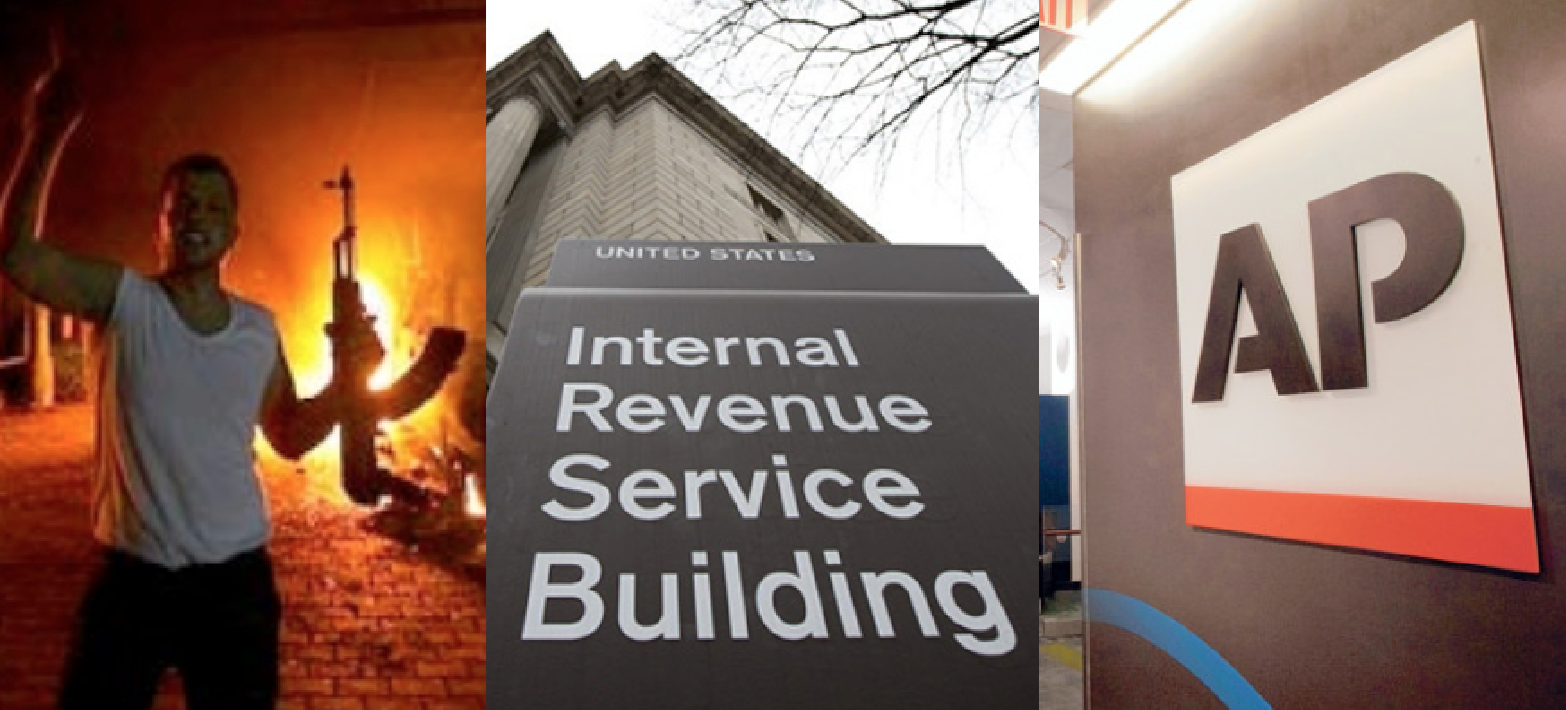 The headlines speak for themselves. “Exclusive: Benghazi Talking Points Underwent 12 Revisions, Scrubbed of Terror Reference.”[1] “IRS Admits To Targeting Conservative Groups Over Tax Status.”[2] “Gov’t Obtains Wide AP Phone Records In Probe.”[3] It has not been a good week for our nation’s leaders. And there has been much shock and dismay expressed from people of all political persuasions and stripes. And yet, no matter how large these scandals may loom, there remains a subtle subtext that underscores these immense ignominies. To quote the words of the great George Strait in summary of this subtext: “I’ve come to expect it from you.” This, sadly, is the kind of behavior that we expect from our leaders. It may be scandalous, but it isn’t all that surprising.
So how does the general public respond to these salacious, but unsurprising, scandals? Consider this from TIME’s Zeke Miller and Michael Crowley in response to the AP phone records story:
Conservatives are not often fierce defenders of the media. But Monday’s news that the Justice Department obtained phone records for several Associated Press reporters as part of a national security leak probe raised a furor on the right, causing numerous Republicans to harshly criticize the Obama administration. While some may have genuine concerns about First Amendment protections, the right’s response also spotlighted an emerging Republican critique of Barack Obama as a Big Brother-style tyrant in charge of a power-abusing surveillance state…
Conservatives are now in the odd position of implicitly defending the media’s rights against the imperative of national security secrecy, a cause that didn’t interest them much when the FBI sought media phone records during the Bush years.[4]
Miller and Crowley’s argument runs like this: Republicans defended their own when President Bush went after media phone records, so Democrats may do the same with President Obama. After all, every president and politician bends the rules and compromises on ethics. We simply have to accept this and then back the horse of our own political persuasion while also working to discredit the opposition. After all, that’s the formula for winning elections. One need look no farther than the recent victory of Mark Sanford, just sworn in as South Carolina’s newest Republican congressman, even though a few years earlier he engaged in an illicit affair with an Argentinian woman, insisting that she was his “soul mate,” all while serving as South Carolina’s governor.
Hopefully, a Christian can see right through this kind of shameful political jockeying. As my mother used to tell me, “Two wrongs don’t make a right.” You can’t justify your group’s bad behavior by pointing to the bad behavior of another group.
So then, how should the Christian react and respond when corruption and scandal among our rock our nation’s leaders? First, no matter what our political persuasion, we can honestly, but also compassionately, call these types of scandals what they are: sinful. Second, rather than buying into the talking points, spin rooms, and damage control strategies, we can honestly, but also compassionately, call for repentance from our leaders. The best way to deal with sin is not to minimize or excuse it, but to confess it! Finally, even if our leaders in Washington are not the kind of leaders our nation and world needs, we can be the kind of leaders our nation and world needs. We can lead in our sphere of influence with integrity and character and with repentance when we falter and fail. We can seek to lead the way King David sought to lead Israel: “And David shepherded them with integrity of heart; with skillful hands he led them” (Psalm 78:72).
Even though we cannot control how our leaders lead us, we can control the way we lead others – and ourselves. With God’s help, may we diligently guard the quality and character of our leadership. Our world needs all the faithful leaders it can get.
[1] Jonathan Karl, “Exclusive: Benghazi Talking Points Underwent 12 Revisions, Scrubbed of Terror Reference,” ABC News (5.10.2013).
[2] Zeke J Miller & Alex Altman, “IRS Admits To Targeting Conservative Groups Over Tax Status,” TIME Magazine (5.10.2013).
[3] Mark Sherman, “Gov’t Obtains Wide AP Phone Records In Probe,” The Associated Press (5.13.2013).
[4] Zeke Miller & Michael Crowley, “The New GOP Case Against Obama: He’s Cheney!” TIME Magazine (5.14.2013).
Jason Collins’ Big Announcement
 There have been plenty of splashy and flashy headlines sprawled across newspapers, news stations, and news websites concerning NBA free agent Jason Collins over these past several days, but I prefer the simplicity of CNN: “NBA’s Jason Collins comes out as gay.”[1] The reactions to Jason Collins’ revelation, as expected, have been wide and diverse. The Huffington Post reports that President Obama called Collins to tell him “he was impressed by his courage.”[2] Sports analyst Chris Broussard sparked a firestorm when, speaking on ESPN’s “Outside the Lines,” he said, “I’m a Christian. I don’t agree with homosexuality…I think it’s a sin, as I think all sex outside of marriage between a man and a woman is.”[3] Finally, the Human Rights Campaign likened the effects Collins’ “coming out” to that of Jackie Robinson being the first African American to play baseball in the modern era. HRC President Chad Griffin released this statement:
Jason Collins’ commitment to living openly is a monumental step forward toward greater equality and he immediately becomes a role model for youth all across this country. His actions today tell LGBT young people that what will define our success in life is our character and dedication, not our sexual orientation. At a moment when millions are reflecting on the life and legacy of Jackie Robinson, Jason Collins is a hero for our own times.[4]
So what is a Christian to make of all this? Chris Broussard summarizes the orthodox Christian position quite well when he says, “I think [homosexuality is] a sin, as I think all sex outside of marriage between a man and a woman is.” The second part of Broussard’s statement is key. As we watch the story of Jason Collins’ “coming out,” we must see it as only a piece of a bigger puzzle. For decades, sexual immorality has been rampant in professional sports. One can’t help but think of the offer AshleyMadison.com put on the table shortly after Tim Tebow joined the New York Jets. Noel Biderman, the founder of Ashley Madison, offered one million dollars to anyone who could produce evidence that the backup quarterback was not, in fact, a virgin. Biderman said, “Sports and sex (and of course, infidelity) go hand in hand…If Mr. Tebow is indeed abstaining from adult relationships, I would encourage him to find a nice lady or two and enjoy his youth and fame as much as possible.”[5] His assertion that “sports and sex (and of course, infidelity) go hand in hand” is, sadly, true. Story after story could be enumerated of professional athletes behaving badly – engaging in everything from infidelity to rape to premarital sex which has become so culturally accepted, it is no longer disconcerting enough to raise even an eyebrow much less make a headline. Thus, Chris Broussard’s embrace of an openly homosexual lifestyle is only one instance in a long parade of what the Bible would deem sexual immorality.
In a culture that has such radically different sexual mores from that of the Christian ethos, there are a couple of things Christians should keep in mind. First, we should remember that, no matter how winsomely and well Christian sexual standards are explained or packaged, there will be many who will reject and ridicule them. This has to do with the foolishness of the Scripture and of the gospel itself to those who do not trust Jesus. As the apostle Paul says, “For the message of the cross is foolishness to those who are perishing, but to us who are being saved it is the power of God” (1 Corinthians 1:18). The Scriptural reservation for sex between a husband and wife is simply unintelligible to many in our society.
Second, even if the world considers God’s wisdom foolish, this does not mean that we should not share God’s wisdom with our world. Christians can and must speak to the issues of our day. After all, if we truly believe that God’s way is the best way, and if we truly love our neighbors as Jesus commands, how can we not share God’s desire for them out love for them?
Finally, as we share God’s Word – and especially as we share God’s Word concerning human sexuality – we must do so with an attitude of humility rather than with a spirit of arrogance. Jesus makes it clear that all struggle with sexual brokenness: “You have heard that it was said, ‘Do not commit adultery.’ But I tell you that anyone who looks at a woman lustfully has already committed adultery with her in his heart” (Matthew 5:27-28). Jesus’ standard for sexual purity is one that none of us have kept. When we speak to others about sexual purity, therefore, we must do so as fellow strugglers rather than as self-righteous sermonizers.
In a culture that celebrates and sanctions sexual sin, we are called to hold out a message of hopeful purity. By God’s grace, may we hold out that message with the clarity, conviction, and compassion that it deserves.
[1] Joe Sterling and Steve Almasy, “NBA’s Jason Collins comes out as gay,” CNN (4.30.2013).
[2] Sam Stein and Amanda Terkel, “Obama Calls Jason Collins, ‘Impressed By His Courage’ In Coming Out,” The Huffington Post (4.29.2013).
[3] Scott Collins, “ESPN’s Chris Broussard sparks uproar with Jason Collins remarks,” LA Times (4.29.2013.)
[4] HRC Staff, “Jason Collins Changes the Face of Sports Forever By Coming Out,” Human Rights Campaign (4.29.2013).
[5] Danny Cox, “Jets quarterback Tim Tebow’s virginity worth a reported $1 million dollars,” Examiner.com (4.24.2012).
Searching for Scapegoats
 As investigators continue to probe Dzhokhar Tsarnaev concerning his role in the Boston Marathon bombing, his motive, though not fully understood, nevertheless seems to be driven at least in part by an al Qaeda agenda. Consider this from NBC News:
It is as slickly designed as any magazine you would find at the supermarket checkout line, or in the seat pocket in front of you on an airplane. It even has snappy cover headlines – teasing articles like “Make a Bomb in the Kitchen of Your Mom.”
And now Inspire, the recruitment magazine of al Qaeda in the Arabian Peninsula, probably has its next cover story: It allegedly helped inspire the two brothers accused of bombing the Boston Marathon.
Dzhokhar Tsarnaev, the hospitalized suspect in the marathon attack, has told federal investigators that the brothers got information on building bombs from Inspire, law enforcement officials told NBC News.[1]
Before Dzhokhar and his brother Tamerlan were identified by the FBI as the suspects in this bombing, confusion – and, I should add, speculation – as to who could have done such a thing abounded. There was the damaging gaffe from the New York Post which published a cover featuring two young men who, according to the Post, were sought by “the Feds” when, in fact, they were not suspects in the bombing.[2] And then there were those who speculated – and even hoped – that the bomber would either be or not be a certain race, religion, or political persuasion.
Two articles, published before the Tsarnaev brothers were identified, are of special interest in this regard. The first article appeared in The Guardian carrying the headline, “US Muslims ‘holding their breath’ as Boston investigators hunt for bomber.”[3] The article opened:
US Muslims are “holding their breath” as the investigation into the Boston Marathon attacks develops, amid fears of increased racial profiling and attacks if an Islamic link is confirmed, according to advocate groups.
The second article was by David Sirota, writing for Salon, and was titled, “Let’s hope the Boston Marathon bomber is a white American.”[4] Sirota, who I should point out is himself a white American, offers the rational for his demographic hope thusly:
If the bomber ends up being a white anti-government extremist, white privilege will likely mean the attack is portrayed as just an isolated incident – one that has no bearing on any larger policy debates. Put another way, white privilege will work to not only insulate whites from collective blame, but also to insulate the political debate from any fallout from the attack.
It will probably be much different if the bomber ends up being a Muslim and/or a foreigner from the developing world. As we know from our own history, when those kind of individuals break laws in such a high-profile way, America often cites them as both proof that entire demographic groups must be targeted, and that therefore a more systemic response is warranted. At that point, it’s easy to imagine conservatives citing Boston as a reason to block immigration reform defense spending cuts and the Afghan War withdrawal and to further expand surveillance and other encroachments on civil liberties.
Interestingly, both of these articles share this in common: they both hoped the bomber was not a Muslim. But Sirota’s article takes it one step farther. He wants the bomber to be “a white anti-government extremist.” The Guardian’s article has only a negative hope for who the bomber is not. Sirota, on the other hand, holds out a positive hope for who the bomber is.
I can sympathize with the sentiments of those interviewed for The Guardian’s article. After all, I cringe whenever I hear another Christian merely say something wrongheaded, hypocritical, or bombastic. To have someone who claims to follow Christ plant and detonate a bomb in the midst of a crowd of marathon onlookers would break my heart. After all, such a tragedy would harm the Christian witness and put up a Satanic barrier that could very well be a powerful preventive against people coming to the truth. I can only imagine the stress, anguish, and embarrassment that some in the Muslim community must be feeling right now. And when these feelings are coupled with the potential of reckless retaliation against mosques and Muslim religious leaders, my guess would be that many in the Muslim community are also feeling fear. Thus, those in the Muslim community deserve our prayers for their protection against such retaliatory attacks as well as our prayers that they continue to be afforded the basic human dignity implicit to the imago Dei. Whether or not a person is a Christian, everyone should be afforded a basic amount of dignity and respect, for we are all creations of the Almighty. A tragedy like this can make a certain people group feel as though they have lost even this basic modicum of dignity and respect.
I have a much harder time understanding the sentiments of Sirota’s article. Hoping that a particular person or people group has committed a heinous crime is beyond me. As a Christian, the prayer is never that a particular person or people group would sin, but that a particular person or people group would be guarded from sin. The words of Jesus come to mind: “Lead us not into temptation” (Matthew 6:13).
The fundamental problem with Sirota’s argument is this: he is trying to identify a scapegoat that will most readily suit his own political machinations and interests. The message of Christianity is that a scapegoat, not for politics, but for sin has already been provided – Jesus. Thus, rather than trying to lay blame at the feet of a particular person for the sake of a political agenda, we can lay blame on the cross of Christ where it will be taken away. For Christ not only takes the blame for human sin by His death, He conquers it by His resurrection. And so, when sin rears its ugly head as it did in Boston, which would you rather have: someone you can blame or someone who can save?
I know what my answer is.
[1] Erin McClam, “Slick al Qaeda online magazine aims to train a generation of killers,” NBC News (3.23.2013).
[2] See “NY Post claims these are the two men police are looking for in Boston bombings – but one is a local teen who’s in shock,” The Blaze (4.18.2013)
[3] Karen McVeigh, “US Muslims ‘holding their breath’ as Boston investigators hunt for bomber,” The Guardian (4.17.2013).
[4] David Sirota, “Let’s hope the Boston Marathon bomber is a white American,” Salon (4.16.2013)
A Week of Tragedies
 What a week it’s been. Monday the headline was carnage at the Boston Marathon as a pair of terrorists planted and detonated two bombs, though they planted more, at the race’s finish line. Three lost their lives. More than 170 were injured. I awoke Wednesday morning to the news that the tiny town of West, Texas, north of Waco, erupted in a fireball in an explosion in a fertilizer plant. Dozens lost their lives because of this tragic accident.
On the heels of so much tragedy and loss of life, two questions inevitably arise, both consisting of just one word: “How?” and “Why?”
“How did these two terrorists manage to plant numerous bombs at the finish line of a major race in seemingly plain sight with so many law enforcement officials standing by for any sign of trouble?” “How did a small blaze at a fertilizer plant get so out of control in a literal split second?” Investigators specialize in answering these “How?” questions. Already, expansive and detailed investigations have been launched to try to figure out how these tragedies happened.
The “Why?” questions are a little tougher to answer. “Why would someone premeditatedly work to cause so much pain and anguish in the bodies, hearts, and lives of so many?” “Why would God allow any of this to happen?”
Though we have partial answers to our perennial “Why?” questions, our answers are inevitably incomplete because of our finite perspective. But there are some things we can know and say in tragic times like these nonetheless.
First, we must say that tragedies like these are spawned because of sin. The attacks in Boston are an example of the darkest corners of human depravity on display. Two individuals took it upon themselves to actively break God’s law and our nation’s laws in order to coldly calculate a catastrophe. The fertilizer plant explosion in West is an example of creation’s sinful brokenness. Because we live in a world that has gone wrong (cf. Genesis 3:17-19, Luke 13:1-5), wrong things happen.
Second, we can also say that tragedies like these testify to God’s patience, albeit in a strange and backwards way. After all, God is under no particular compulsion to allow this sinful world to continue on. But He does. Why? Because He loves the people He has made and wants to give them as much time as possible to repent of their sinful state and turn toward Him. As the apostle Peter reminds us, “Bear in mind that our Lord’s patience means salvation” (2 Peter 3:15).
In the days ahead, steps will no doubt be taken to try to assure that the tragedies of this week will not be repeated. This is good! We ought to learn from tragedies like these for the sake of everyone’s safety and wellbeing. But no matter how many steps we might take to try to guard against similar situations in the future, no human being can root out the underlying cause of all such situations: sin. Though we might be able to prevent a particular tragedy from happening again, we cannot take out tragedy’s foundation of sin. Only Jesus can do this. Only Jesus can conquer the wickedness of this world and restore His creation and His people back to the way He originally dreamed and designed them: perfect.
The Big Picture
 I have often made the point, when teaching various Bible classes, that, in Christianity, theology and anthropology are inextricably intertwined. You can’t really understand anthropology if you don’t understand theology and you can’t really understand theology if you don’t understand anthropology.
Here’s why. Theology without anthropology undermines the gospel. After all, the heart of the gospel is what God has done for us! He sent Jesus to die and rise for us! Without understanding the anthropological “for us” of the gospel, we are left with a system of theology that is more akin to Deism than it is to Christianity. For without the gospel’s anthropological association, God is left distant and detached from the creation He formed. Conversely, anthropology without theology also undermines the gospel. It is theology, after all, that tells us who we are anthropologically and why we need Jesus. And the verdict on who we are anthropologically is not good:
“There is no one righteous, not even one; there is no one who understands, no one who seeks God. All have turned away, they have together become worthless; there is no one who does good, not even one.” (Romans 3:10-12)
Apart from an understanding of God’s verdict on us as sinners, we are all too readily tempted to think of ourselves as better, nobler, and loftier than we really are. Thus, in order to truly understand the peril of our sinful state, we must understand what the Bible says theologically about our brokenness anthropologically.
I bring all of this up because I have been doing some thinking lately about the anthropological side of Christianity. And what I have come to realize is that while Christian authors, pastors, and leaders will spend a lot of time addressing the anthropological side of Christianity on a micro scale, sometimes, macro anthropological concerns can get marginalized.
Here’s what I mean. The Christian arena is replete with resources on marriage, addiction, finances, relationships and other personal, or micro, concerns. And these resources are needed and, I would add, popular! What is less popular in our day, however, are resources that address macro anthropological issues of cultural trends, power structures, injustice, and societally systemic sins as well as their broad historical and philosophic foundations. Part of the reason I would guess these resources are less popular is because addressing macro anthropological issues is an inevitably more complex, convoluted, and academic exercise than addressing micro anthropological issues due to the sheer size and the extended historical timelines of these macro anthropological issues. Furthermore, because it is the micro anthropological concerns that most directly and immediately affect us, it is easy to look at what only directly affects us right now than consider the broader concerns of our world over time.
But Christianity calls us to consider both ourselves and our world. For Christianity, among other things, is a worldview. And without understanding Christianity’s anthropological entailments on a macro scale and their insights into how we, knowingly or unknowingly, are shaped by the history, philosophy, and culture to which we are heirs and of which we are a part, we will inevitably have trouble, and ultimately be unsuccessful, in addressing and resolving our own micro concerns. This is why so much of the language of the Bible is cosmic. For God’s final promise is not only that He will only fix our personal problems, but that He will redeem our world. In the words of the apostle John:
Then I saw a new heaven and a new earth, for the first heaven and the first earth had passed away, and there was no longer any sea. I saw the Holy City, the new Jerusalem, coming down out of heaven from God, prepared as a bride beautifully dressed for her husband. And I heard a loud voice from the throne saying, “Now the dwelling of God is with men, and he will live with them. They will be his people, and God himself will be with them and be their God. He will wipe every tear from their eyes. There will be no more death or mourning or crying or pain, for the old order of things has passed away.” He who was seated on the throne said, “I am making everything new!” (Revelation 21:1-5)
Make no mistake about it: God cares about the micro. He cares about your tears and your pain and your worries and your regrets. But He will fix your micro concerns in His macro way: He will make everything new. So perhaps we should spend a little more time thinking about “everything” that God will make new and a little less time thinking only about our micro concerns.


 Pastor Zach's Blog