Posts filed under ‘Current Trends’
When Cultures Clash
 Three weeks ago on this blog, I shared a quote from The Gospel Coalition’s Trevin Wax that I think brilliantly summarizes a radical shift in our culture:
A generation ago, a person’s religious observance was a public matter, a defining characteristic of one’s identity, while a person’s sexual activity was something private. Today, this situation is reversed. A person’s sexual behavior is now considered a defining characteristic of identity, a public matter to be affirmed (even subsidized) by others, while religious observance is private and personal, relegated to places of worship and not able to infringe upon or impact the public square.
The culture clash today is less about the role of religion in business or politics, and more about which vision of humanity best leads to flourishing and should therefore be enshrined in or favored by law.[1]
Sex has become a – if not the – defining characteristic for many in our society. I recently read an article about a professor who, in a women’s studies course, asked the class to write down the moment they realized they were gay, straight, bisexual, or queer.[2] For many, one’s sexual awakening has become their road to Emmaus. It is nothing less than their conversion experience. I grew up Baptist, and the question I was often asked was, “When did you ask Jesus into your heart?” Now the question is, “When did you have your sexual awakening?” Sexuality is what gives many their meaning, purpose, and identity.
As I wrote three weeks ago, as a Christian, I cannot define myself in the way so many in our society have chosen to define themselves. I must define myself by Christ and His Gospel. I am, however, well aware that when I define myself in this way, I offend a whole host of societal sensibilities, especially as they pertain to sexuality.
As I’ve been pondering this clash of values, I’ve come to realize that Jesus faced much the same situation. First century society was rife with sexual standards that were radically different from His. Take for instance, the emperor of Rome during Jesus’ day, Tiberius Caesar, who, according to the Roman historian Suetonius, enjoyed watching group sex.[3] This type of sexual licentiousness is, thankfully, offensive to many in our day, but, sadly, nevertheless acceptable and practiced among some. So how did Jesus respond to sexual ethics that contradicted His own?
First, Jesus was ethically rigorous. Jesus didn’t compromise His sexual standards in an effort win allies or appear tolerant. I think of Jesus’ clash with the religious leaders over divorce. In a world where many religious teachers taught that it was acceptable for a man “to divorce his wife for any and every reason,” Jesus responds, “I tell you that anyone who divorces his wife, except for marital unfaithfulness, and marries another woman commits adultery” (Matthew 19:3, 9). This sexual standard was so rigorous that Jesus’ own disciples exclaimed, “If this is the situation between a husband and wife, it is better not to marry” (Matthew 19:10).
It was William Ralph Inge, Dean of St. Paul’s Cathedral in London, who famously quipped: “Whoever marries the spirit of this age will find himself a widower in the next.”[4] Jesus was not interested in conforming to the sexual spirit of His age. We should not be interested in conforming either.
But there is another side to Jesus’ engagement with the sexual spirit of His society. For at the same time that Jesus was ethically rigorous, He was also relationally generous. In other words, even if people were in lifestyles He could not condone, He did not shun them. He loved them. I think of the woman at the well in John 4. Or the woman caught in adultery in John 8. Or the woman who anoints Jesus with perfume in Luke 7. Jesus cared deeply for these people. We should too – even if they do not share our ethical commitments.
A faithful Christian response to the sexual standards of our society, then, demands that we answer two questions. First, where do we stand? Have we compromised biblical sexual standards to kowtow to the spirit of our age? If so, no less than the living Lord commands that we hold the line. But second, who are our friends? Do we generously befriend those who do not think or live like we do? If our friends are only those who share our ethical commitments, we have traded Jesus’ love for quarantined law. And that helps no one.
As Christians, we need both ethical standards and relational grace. I hope you have both. You should. Jesus has given you both. After all, how do you think He befriended you?
_____________________________
[1] Trevin Wax, “The Supreme Court Agrees With Hobby Lobby, But Your Neighbor Probably Doesn’t,” The Gospel Coalition (6.30.2014).
[2] W. Blue, “When Did You Know You Were Gay?” Psychology Today (7.15.2014).
[3] Suetonius, Life of Tiberius 43.
[4] Tony Lane, Exploring Christian Doctrine: A Guide to What Christians Believe (Downers Grove, IL: InterVarsity Press, 2014), 48.
Processing Another Malaysia Airlines Tragedy
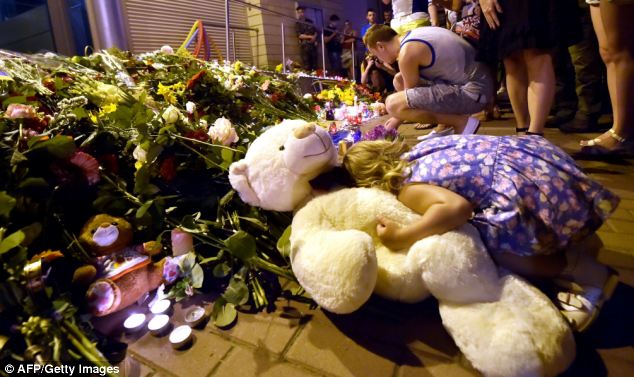
Credit: AFP/Getty Images
“Following are images from the scene – warning: GRAPHIC.”[1]
This is the caption that greeted me as I was reading through headlines about the crash of Malaysia Airlines passenger flight MH17, shot down by a surface-to-air missile while flying over Ukraine. The crash scene is gut-wrenchingly sad – dozens of pictures of smoldering wreckage, many of these with portions blurred out to cover up the gruesome sights of human remains. It’s no surprise, then, that before I scrolled through images from the scene posted by Business Insider, they included the above warning.
Regardless of whether this missile strike was an accidental shooting down of an airliner that was thought to be a military transport jet or an intentional targeting of civilians, the precipitating cause in this crisis, according to experts, is Russia’s conflict with Ukraine. The New York Times editorial board posted an excellent opinion piece, calling on Russian President Vladimir Putin to put a stop to not only tragedies like these, but to end a war of his own making against Ukraine:
Growing casualties on the ground, a major escalation of American sanctions against Russia, a military plane shot down and now the appalling destruction of a Malaysian jetliner with 298 people on board, shot by a surface-to-air missile. The Ukrainian conflict has gone on far too long, and it has become far too dangerous.
There is one man who can stop it – President Vladimir Putin of Russia, by telling the Russian-backed separatists in eastern Ukraine to end their insurgency and by stopping the flow of money and heavy weaponry to those groups. But for all his mollifying words and gestures, Mr. Putin has only continued to stoke the flames by failing to shut down those pipelines, failing to support a cease-fire and avoiding serious, internationally mediated negotiations.[2]
Mr. Putin is so obsessed with getting to Ukraine, it seems, that even the tragic loss of a civilian airliner is not too large a price to pay to pacify his Macbethian-style political and empire-building ambitions. But the pictures from this airliner crash are rallying the world into sharp disagreement with the Russian president. This must stop.
Of all the grueling pictures I have seen from this story, the one I posted at the beginning of this blog has perhaps touched my heart most deeply. There was no warning caption of graphic content posted above this image, but there should have been. For far more tragic than smoldering wreckage are the shattered lives of those who have lost loved ones. A girl’s grief is far more explicit than a flaming fuselage.
My parents used to warn me, “Power corrupts.” After following this story, I wish that was all power could do. For whether from the halls of the Kremlin or from an open plane dotted by missiles, in this instance, power didn’t just corrupt. It killed. Is it any wonder that, as Christians, we rejoice in the promise that “all authority in heaven and on earth” has been given to Jesus (Matthew 28:18)? After all, He seems to be the only one who knows how to use it – at least perfectly. For He uses His power not to kill, but to make alive (cf. John 10:10).
May Jesus’ perfect use of power be a comfort and consolation to those who have lost loved ones in this depraved display of aggression.
________________________
[1] Michael B. Kelley, “More Than 300 People Killed As Passenger Plane Shot Down In East Ukraine,” Business Insider (7.17.2014).
[2] The Editorial Board, “Vladimir Putin Can Stop This War,” The New York Times (7.17.2014).
It’s Not About The Supreme Court Ruling

Credit: Wikipedia
There was the ruling. And then there was the reaction to the ruling. When the Supreme Court ruled in favor of the arts and crafts chain Hobby Lobby, saying it did not have to pay for certain types of birth control as mandated by the Affordable Care Act because it considered them abortifacients which violated the theological beliefs of the company’s owners, the reaction was swift and fierce – from both sides. Mark Goldfeder, senior fellow at the Center for the Study of Law and Religion at Emory University, announced:
Here is what the decision means: People have First Amendment rights, and even if the corporations themselves are not entitled to Free Exercise exemptions, the people behind the corporate veil, the business owners themselves, certainly are.
On the other side, Judy Waxman, vice president of health and reproductive rights at the National Women’s Law Center, lamented:
We think it’s a bitter pill to swallow for women, and that the decision is saying that bosses know best and their religious beliefs can trump very basic health-care coverage. It’s especially harmful to women, but beyond this, down the line, there will be other cases, other challenges, that could have an even broader effect.[1]
Of course, along with these measured responses, there were also the less measured responses of the Twitterverse, like one post advocating arson: “#HobbyLobby are scum of the earth. Burn every single one down, build a homeless shelter there instead.”[2] Then, there was another very humble post from a person who agreed with SCOTUS’s ruling: “Ha. Ha. It’s The. Law.”[3]
What fascinates me about all these responses – whether they be sophisticated or sleazy – is how little they have to do with the actual legal ins and outs of this case and how much they reflect the radically disparate worldviews of our society. I have found no better synopsis of the clash of worldviews in this case than this from Trevin Wax:
A generation ago, a person’s religious observance was a public matter, a defining characteristic of one’s identity, while a person’s sexual activity was something private. Today, this situation is reversed. A person’s sexual behavior is now considered a defining characteristic of identity, a public matter to be affirmed (even subsidized) by others, while religious observance is private and personal, relegated to places of worship and not able to infringe upon or impact the public square.
The culture clash today is less about the role of religion in business or politics, and more about which vision of humanity best leads to flourishing and should therefore be enshrined in or favored by law.[4]
This is exactly right. Different people value different things. For some, their faith is their defining characteristic. Thus, they have a strong desire to practice their faith in every area and aspect of their lives, including their business dealings. For others, some other thing – like their sexuality – is their defining characteristic. And anything perceived as an affront to their sexual identity is worthy of unrestrained caustic choler.
As a Christian, I really have no choice when it comes to how I will define myself: my life must be defined by Christ. In the words of the apostle Paul, “It is no longer I who live, but Christ who lives in me” (Galatians 2:20). So what does this mean for my interactions with those who define themselves by other things? A few things come to mind.
First, I must love those with differing worldviews. As Ed Stetzer so pointedly says in his article on the Hobby Lobby ruling, “You can’t hate a people and reach a people at the same time.”[5] People who live outside a Christian worldview are not to be destroyed or oppressed in a political or judicial power grab, but loved through a winsome witness.
Second, I must realize that my worldview is no longer a privileged majority worldview in our society. Indeed, many people are not at all concerned that a Christian may be legislatively or legally forced to do something that goes against his conscience. Again, Ed Stetzer writes, “Most Americans are not as passionate about the religious liberty issue (when connected to contraception, even abortifacient contraception) as most evangelicals and conservative Catholics.” Trevin Wax reveals that “a record number of Americans (1 in 3) said the first amendment [which grants religious liberty] goes too far in the freedom it promises.” This is just a reality.
Third, I must make the case – through both a rigorous intellectual defense and a gentle, quiet lifestyle – why my worldview should be seriously considered and why it does indeed lead to true human flourishing. It is important to note that this case cannot be made quickly. Indeed, it cannot even be made by just my life or in just my lifetime. No, this is a case the whole Church must make. And blessedly, the Church has been making it for millennia. For instance, the Church made its case here. And here. And here. And here. This is why I doubt any Supreme Court ruling – be it in favor of or against religious liberty – will kill the Church’s case. For this is the case and cause of Christ.
Let’s keep making it.
______________________________
[1] Ashby Jones, “Legal Experts, Advocates React to Supreme Court’s Hobby Lobby Ruling,” The Wall Street Journal (6.30.2014).
[2] Costa Koutsoutis, @costa_kout, 6.30.2014
[3] Harriet Baldwin, @HarrietBaldwin, 6.30.2014
[4] Trevin Wax, The Supreme Court Agrees With Hobby Lobby, But Your Neighbor Probably Doesn’t,” The Gospel Coalition (6.30.2014).
[5] Ed Stetzer, “Hobby Lobby Wins: Where Do We Go from Here?” The Exchange (6.30.2014).
Why I Don’t Read The Bible Literally (But I Do Take It Seriously)
 It never ceases to amaze me how misunderstood the orthodox Christian belief concerning Holy Scripture is. Even The New York Times can’t seem to figure it out. Take Charles Blow, an op-ed columnist for the Times, who stands stunned at the views of many Americans on the Bible. With a mixture of disbelief and disdain, he reports:
One Gallup report issued last week found that 42 percent of Americans believe “God created humans in their present form 10,000 years ago.”
Even among people who said that they were “very familiar” with the theory of evolution, a third still believed that God created humans in their present form 10,000 years ago.
It’s not clear what the respondents meant by being “very familiar” – did they fully understand the science upon which evolution’s based, or was their understanding something short of that, as in, very familiar with it as being antithetical to creationist concepts?
Whatever the case, on this issue as well as many others in America, the truth is not the light.[1]
Blow goes on to cite people’s opinions on the Bible itself according to this same Gallup pole:
Nearly a third of Americans continue to believe that the Bible “is the actual word of God and is to be taken literally, word for word.”
Furthermore, nearly half believe that it is “the inspired word of God but not everything in it should be taken literally.”
About a fifth of Americans said they believe the Bible is “an ancient book of fables, legends, history, and moral precepts recorded by man.”
The questions Gallup asks concerning the nature and character of the Bible frustrate me. Gallup wants to know, “Do you believe the Bible is the actual word of God and is to be taken literally, word for word?” Personally, I would have to answer “yes” and “no.” Do I believe the Bible is “the actual word of God”? Yes. Do I believe it is to be “taken literally, word for word”? No. But this is not because I want to discredit the Bible’s veracity, authority, or inerrancy. Rather, this is because I follow the Bible’s lead when it interprets itself non-literally in some places. The Bible is full of metaphors, symbols, and other figures of speech as even an elementary reading of it will uncover. One need look no farther than “The LORD is my shepherd” (Psalm 23) to find a metaphor – and a beautiful metaphor, I would add – of Scripture. Thus, I would find myself more at ease with Gallup’s second position: “The Bible is the inspired word of God but not everything in it should be taken literally.”
Blow, however, summarily dismisses this second position:
I am curious which parts would get a pass from most of these respondents and which wouldn’t. Would the origins of the world fall into the literal camp? What about the rules – all or some – in books like Deuteronomy?
Perhaps Blow has not yet discovered the difference between reading something literally and reading something contextually. Just because I don’t practice, for instance, the sacrifices outlined in Deuteronomy doesn’t mean I don’t understand them literally. It just means that I read them in light of Hebrews 10:10: “We have been made holy through the sacrifice of the body of Jesus Christ once for all.” Christ’s sacrifice for sin put an end to all those Old Testament sacrifices for sin. For me to try to follow those laws would be like me taking a ticket for an Elvis concert, going to the venue listed thereon, and expecting a concert usher to let me in! Though I may read the ticket “literally,” that ticket’s time is past. So it is with the Old Testament sacrificial system. Its time too is past because it has been fulfilled by Christ. But that isn’t me reading the Bible non-literally. That’s just me reading the Bible contextually.
I suspect part of the reason Blow disparages option two when it comes to reading and interpreting the Bible is because, for him, only option three, which says the Bible is “an ancient book of fables, legends, history, and moral precepts recorded by man,” is viable. He writes:
I don’t seek to deny anyone the right to believe as he or she chooses. I have at points in my own life been quite religious, and my own children have complicated views about religion. As my oldest son once told me, “I’d hate to live in a world where a God couldn’t exist.”
That is his choice, as it is every individual’s choice, and I respect it.
What worries me is that some Americans seem to live in a world where facts can’t exist.
Facts such as the idea that the world is ancient, and that all living things evolved and some – like dinosaurs – became extinct. Facts like the proven warming of the world. Facts like the very real possibility that such warming could cause a catastrophic sea-level rise.
Ah yes, facts. Facts like the Bohr model of the atom or the rallying cry of biogenetics: “Ontogeny recapitulates phylogeny.” Oh, wait. Those “facts” turned out to be not quite as factual as we once thought. Contrary to Blow, I’m not so sure that a great uprising of people who want facts to not exist is the problem. The problem is there are people who disagree with him on what the fullness of the facts are and how the data that form the facts should be interpreted. Now, I’m not saying these other people are correct on the facts. I’m just saying these other people with other thoughts on what the facts are that contradict Blow’s thoughts on what the facts are not necessarily rejecting facts themselves.
Blow says he is “both shocked and fascinated by Americans’ religious literalism.” I don’t think he even understands what “religious literalism” is. Nor do I think he understands that many serious people of faith understand and trust the Bible theologically, morally, and historically without always reading it literally. No wonder he’s so shocked and fascinated. He simply doesn’t understand. Then again, I’m not so sure he wants to.
__________________________
[1] Charles Blow, “Religious Constriction,” The New York Times (6.8.2014).
A Deal With The Devil: How We Got Sergeant Bowe Bergdahl

Credit: Getty Images
One of my favorite movie lines comes at the end of “The American President.” After being excoriated by his opponent, Senator Bob Rumson, President Andrew Shepherd storms into the Press Briefing Room to deliver an apologetic for his presidency and his personal life with the cameras rolling. One of the things he says in this press conference that has long stuck with me is, “America isn’t easy.”
I couldn’t agree more. In twenty-first century America, we face tough challenges. We have to navigate complex issues. America isn’t easy.
The latest example of this truism comes to us courtesy the case of Army Sergeant Bowe Bergdahl. He was captured by the Taliban in 2009. On May 31 of this year, he was released. If this was all there was to this story, this would be a story of unambiguous triumph and joy. But the devil, as they say, is in the details. And the details here are sketchy, conflicting, and disturbing.
First, there is the detail of how Sergeant Bergdahl was captured. He claims it’s because he fell behind on a patrol and the Taliban swept in and abducted him. The Taliban claims he was captured drunk and wandering off base. According to an investigation by the Pentagon, Bergdahl may have deserted his unit – walking away from his post, which led to his capture. In an email dated June 27, 2009, Bergdahl expressed a rising dissatisfaction with his military service: “I am ashamed to be an american. And the title of US soldier is just the lie of fools.”[1] If Sergeant Bergdahl’s claims concerning his capture are true, this is a tragedy. If the Taliban’s claims are true, Bergdahl was foolish. But if the Pentagon’s story pans out, this is a story of one man’s faithlessness toward his brothers-in-arms. How all this began matters.
Then, there is the detail of what Sergeant Bergdahl’s release cost. Our government brokered a deal with the Taliban that released five Guantanamo Bay detainees in exchange for Bergdahl’s freedom. Before this deal, no fewer than five soldiers died on missions to rescue Bergdahl – all this for a man who may have despised many of the very people who were trying to rescue him. What Sergeant Bergdahl’s release cost matters.
So, what is the appropriate response to this sordid affair? At this point, I think it’s best to say there is no appropriate response – not because there is no appropriate response period, but because we do not have enough facts to formulate the kind of comprehensive response that this story demands and deserves. Thus, I am not so interested in deconstructing the details of this story itself, but I do want to address some of the ethical questions it raises. People want to know: “Was it right to sacrifice five lives and release five criminals for the freedom of a man who could have been a deserter?” “What price should we be willing to pay for the civic freedom of one person?” And, of course, “Is it ever right for the U.S. to negotiate with terrorists?”
In one sense, the saga of Sergeant Bergdahl is parabolic for the limits of human ethical decisions. Here, we have both good and bad comingled. Freeing a Prisoner of War – that’s good. Sacrificing the lives of at least five soldiers and releasing five hardened criminals – that’s bad. We did something bad to get something good. How do you reconcile that?
Such ethical angst is perhaps best encapsulated by Bruce Hoffman, director of Georgetown University’s Center for Security Studies, in an interview with USA Today. Commenting on our government’s deal with the Taliban, he notes that though the United States’ official stance is that we do not negotiate with terrorists, this is
…repeated as mantra more than fact. We have long negotiated with terrorists. Virtually every other country in the world has negotiated with terrorists despite pledges never to … We should be tough on terrorists, but not on our fellow countrymen who are their captives, which means having to make a deal with the devil when there is no alternative.[2]
Hoffman is right. We made a deal with the devil. And granted, out of this deal, some good has come: a soldier has been reunited with with his family. But whether or not any other good comes out of this deal remains to be seen. Questions concerning Bergdahl’s conduct still need to be asked and families who have lost loved ones in attempts to rescue this soldier still need to be comforted. This much I do know, however: deals with the devil are never as good as we think they are. There are always hidden costs and huge catches. In fact, as far as I can tell, only one deal with the devil has ever been truly successful. It’s the one where someone said: “Let’s make a deal. You can strike My heel. But I get to crush your head.”
May that divine deal help us navigate the moral complexities and save us from the moral compromises of our fallen deals.
___________________________
[1] Michael Hastings, “America’s Last Prisoner of War,” Rolling Stone (6.7.2012).
[2] Alan Gomez, “Is it ever right to negotiate with terrorists?” USA Today (6.2.2014).
“Don’t Ask, Don’t Tell” Lives!
 Apparently, “Don’t ask, don’t tell” didn’t die in our Armed Forces, it just moved to our marriages. Recently, Redbook published a part-confessional, part-apologetic exposé titled, “How Affairs Make My Marriage Stronger.” The author, who, not surprisingly, chose to remain anonymous, opens salaciously:
It’s a Wednesday night, and my boyfriend and I are drinking wine and making out in the back booth of a dimly lit bar. It feels like nothing else in the world exists…until my phone vibrates.
“It’s my husband. The kids are in bed,” I say, then put my phone in my purse and pull my boyfriend toward me. I spend half a second staring at the diamond on my engagement ring before hiding my hand from my sight line. It’s not a secret that I’m married, but it’s also not something I want to think about right now.
Am I a horrible person? Without context, I know I sound horrible. But in my marriage, having affairs works. My husband and I don’t talk about it. But I’m certain our don’t-ask-don’t-tell rule is what has allowed our marriage to last as long as it has.
Notice that I didn’t say we’re in an open marriage – we’re not. An open marriage is transparent, with agreed-upon rules and an understanding of what both parties will and will not do with others. My marriage is opaque.[1]
What a sham of a marriage – full of affairs and cover-ups. It should be a soap opera. Instead, it’s real life.
What I find most striking about this apologetic for adultery is how kitschy it is – even according to the author’s own admission. In a telling line, she concedes, “The more I think about it, the less okay I am with our lifestyle, so I’ve become pretty good at shutting down that part of my brain.” If there ever was a line that affirmed the inescapably reality of natural, moral law, this is it! No matter what she may claim about she and her husband’s affairs, she can’t escape the feeling that something isn’t right. As the apostle Paul explains: “The requirements of the law are written on [people’s] hearts, their consciences also bearing witness, and their thoughts now accusing, now even defending them” (Romans 2:15).
As much moral ire as this article raises in me, it raises even more sympathetic pain. It’s hard to listen to this woman divulge her deeply held fears without having my heart broken:
Truth be told, I do worry that Dave might fall in love with someone else. That’s why when I see his secret smiles or notice him spending tons of time texting, I step it up on my end, asking him to be home on a certain night and initiating sex. I remind him how much I love him and how much our marriage means to me.
What’s the title of this article again? “How Affairs Make My Marriage Stronger”? What a lie. So let’s try some truth:
I take you to be my wedded beloved, to have and to hold from this day forward, for better, for worse, for richer, for poorer, in sickness and in health, to love and to cherish, till death us do part, according to God’s holy will; and I pledge to you my faithfulness.
You took the vow. You made the promise. So keep it. You’ll be better for it. Your heart will be filled with it. And you’ll please God by it.
_______________________
[1] Anonymous, as told to Anna Davies, “How Affairs Make My Marriage Stronger,” Redbook (5.18.2014).
#Blessed

Credit: socialmediaexaminer.com
I don’t know how many times I’ve received the prayer request. But it’s definitely more times than I can remember. “Pray that God will bless my…” and then fill in the blank. “Finances.” “Job Search.” “Move.” “Golf Game.” “Baby Shower.” And the list could go on and on.
Now, on the one hand, I have no particular problem with these kinds of prayer requests per se. Indeed, when people come to me with these kinds of prayers, I gladly oblige. But on the other hand, even though we pray to be blessed, I’m not so sure we always understand what it truly entails to be blessed, at least not biblically.
The other day, I came across an article by Jessica Bennett of The New York Times chronicling all the blessings she has stumbled across on social media. She opens:
Here are a few of the ways that God has touched my social network over the past few months:
S(he) helped a friend get accepted into graduate school. (She was “blessed” to be there.)
S(he) made it possible for a yoga instructor’s Caribbean spa retreat. (“Blessed to be teaching in paradise,” she wrote.)
S(he) helped a new mom outfit her infant in a tiny designer frock. (“A year of patiently waiting and it finally fits! Feeling blessed.”)
S(he) graced a colleague with at least 57 Facebook wall postings about her birthday. (“So blessed for all the love,” she wrote, to approximately 900 of her closest friends.)
God has, in fact, recently blessed my network with dazzling job promotions, coveted speaking gigs, the most wonderful fiancés ever, front row seats at Fashion Week, and nominations for many a “30 under 30” list. And, blessings aren’t limited to the little people, either. S(he) blessed Macklemore with a wardrobe designer (thanks for the heads up, Instagram!) and Jamie Lynn Spears with an engagement ring (“#blessed #blessed #blessed!” she wrote on Twitter). S(he)’s been known to bless Kanye West and Kim Kardashian with exotic getaways and expensive bottles of Champagne, overlooking sunsets of biblical proportion (naturally).[1]
Apparently, Bennett has a lot of extraordinarily “blessed” friends. She even tells the story of a girl who posted a picture of her posterior on Facebook with the caption, “Blessed.” Really?
The theology behind the kind of blessing Bennett outlines is shallow at best and likely heretical in actuality. The so-called “god” who bestows these social media blessings is ill-defined and vacuous, as Bennett intimates with her references to “god” as “s(he),” and the blessings from this divine turn out to be quite petty. Frocks that fit, birthday wishes on Facebook, and financial windfalls all qualify to be part of the “blessed” life.
All this leads Bennett to suspect that these “blessings” are really nothing more than people cynically
… invoking holiness as a way to brag about [their] life … Calling something “blessed,” has become the go-to term for those who want to boast about an accomplishment while pretending to be humble, fish for a compliment, acknowledge a success (without sounding too conceited), or purposely elicit envy.
That sounds about right. “Blessed” is just a word people use to thinly disguise a brag.
True biblical blessing, of course, is quite different – and much messier. Jesus’ list of blessings sounds quite different from what you’ll find on Facebook:
Blessed are you who are poor, for yours is the kingdom of God. Blessed are you who hunger now, for you will be satisfied. Blessed are you who weep now, for you will laugh. Blessed are you when men hate you, when they exclude you and insult you and reject your name as evil, because of the Son of Man. (Luke 6:20-22)
Poverty, hunger, mourning, and persecution all qualify to be part of the blessed life. Why? Because true blessing involves much more than what happens to you in this life. It involves God’s promises for the next.
All this is not to say that the good gifts we receive in this life are not blessings. But such blessings must be received with a proper perspective – that they are blessings not just because we happen to like them, but because it is God who gives them. Indeed, one of the most interesting features of the Hebrew word for “blessing,” barak, is that it can be translated either as “bless” (e.g., Numbers 6:24) or as “curse” (e.g., Psalm 10:3), depending on context. What makes the difference between whether something is a blessing or a curse? Faith – a confidence that a blessing is defined not in terms of what something is, but in terms of who gives it. This is why when we are poor, hungry, mourning, and persecuted, we can still be blessed. Because we can still have the Lord. And there is no better blessing than Him.
Put that on Instagram.
__________________________
[1] Jessica Bennett, “They Feel ‘Blessed,’” The New York Times (5.2.2014).
1500-Year-Old Bible Discovered! Christianity Debunked! Not Exactly.
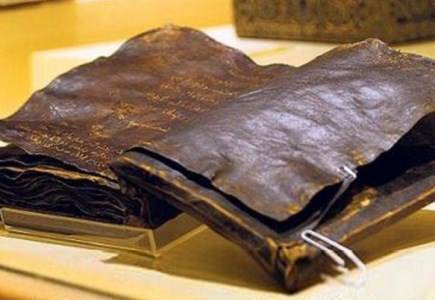 Here we go again.
I’ve been seeing it all over Facebook. The headline reads, “1,500 Year Old Bible Confirms That Jesus Christ Was Not Crucified – Vatican In Awe.” It seems startling. The only problem is, it’s not true. And, it’s nothing new. These kinds of articles that seek to undermine the veracity of the Bible have been being published for years now. Indeed, the discovery of this 1,500-year-old Bible is news that’s now better than two years old. But it’s just now hitting Facebook. And because many people are being confused by it, it’s worth a look.
The article opens:
Much to the dismay of the Vatican, an approximately 1,500 to 2,000 year old Bible was found in Turkey, in the Ethnography Museum of Ankara. Discovered and kept secret in the year 2000, the book contains the Gospel of Barnabas – a disciple of Christ – which shows that Jesus was not crucified, nor was He the Son of God, but a prophet. The book also calls apostle Paul “The Impostor.” The book also claims that Jesus ascended to heaven alive, and that Judas Iscariot was crucified in His place.[1]
Let’s separate some fact from fiction here.
“Much to the dismay of the Vatican…” The Vatican did, according to The Christian Post, make an “official request”[2] to see and study the Bible, but it was not out of dismay. Like any theological artifact, it piqued their curiosity. Many people desired to study this book.
“…an approximately 1,500 to 2,000 year old Bible…” Maybe. But probably not. There are reasons to believe this book is a forgery, probably written around AD 1500, which is, coincidentally enough, about a century after many scholars believe the Gospel of Barnabas itself was written.[3] Timothy Michael Law, a Junior Research Fellow at the Oxford Centre for Hebrew and Jewish Studies, has a nice blog on the antiquity of this Bible here.
“…the book contains the Gospel of Barnabas…” Again, maybe. But possibly not. We actually don’t know what the book contains because it has not been widely studied. The Christian Post quotes theology professor Ömer Faruk Harman who notes that people may be “disappointed to see that this copy … might have no relation with the content of the Gospel of Barnabas.”
“…which shows that Jesus was not crucified … and that Judas Iscariot was crucified in His place.” The Gospel of Barnabas does indeed purport that Judas Iscariot was crucified in Jesus’ place. But this is because this Gospel was written as an apologetic for Islam. Indeed, it prophesies the arrival of Muhammad, but, if the 15th century dating of this Gospel is correct, it does so about 800 years after Muhammad! In other words, its prophecies are really no prophecies at all, but polemical forgeries.
The line from this Facebook article that made me sigh the loudest is this one:
It is believed that, during the Council of Nicaea, the Catholic Church hand-picked the Gospels that form the Bible as we know it today; omitting the Gospel of Barnabas (among many others) in favor of the four canonical Gospels of Matthew, Mark, Luke, and John.
Ever since Dan Brown’s book The Da Vinci Code, this has been a canard that just won’t die. At no time during the Council of Nicaea did the Catholic Church hand-pick any Gospels. The four Gospels we have today were already widely accepted by the Church by the time of this council. If you want to read the canons issued by the Council of Nicaea for yourself, you can check them out here. None say anything about the Gospels. Indeed, none say anything about the canon of Scripture at all.
Ultimately, even if this Turkish Bible is indeed 1,500 years old and even if it does contain the Gospel of Barnabas, the Council of Nicaea was held in AD 325, which is still before the time of this Bible. Thus, part of the reason the Council of Nicaea never considered the Gospel of Barnabas during its meetings is because there was not yet a Gospel of Barnabas to consider!
It was David Hannum, criticizing P.T. Barnum, who said, “There’s a sucker born every minute.” Don’t be suckered by this Facebook article. The Bible as we have it still stands. And on it, your faith can still stand.
___________________________
[1] “1,500 Year Old Bible Confirms That Jesus Christ Was Not Crucified – Vatican In Awe,” Moorish Harem: Man’s Greatest Accomplishments (4.28.2014).
[2] Clara Morris, “Turkey’s 1500-Year-Old, $28M Bible Linked to Gospel of Barnabas?” The Christian Post (2.23.2012).
[3] See Jan Joosten, “The Gospel of Barnabas and the Diatessaron,” Harvard Theological Review 95, no. 1 (2002).
You’re not smart enough or good enough, even if people like you
 It was Stuart Smalley, played by Al Franken on Saturday Night Live, who said, “I’m good enough, I’m smart enough, and, doggone it, people like me!” As it turns out, many took Smalley’s credo to heart. And the results have been sadly predictable.
Case in point: the American Bible Society, in conjunction with the Barna Group, recently published its “State of the Bible” report for 2014. The report opens with plenty of punch:
Now there are just as many Americans skeptical of the Bible as there are engaged with the Bible. According to the fourth annual State of the Bible survey, 19 percent said that they were skeptical of the Bible. This number is up from 10 percent in 2011.
This trend is even more pronounced among the Millennial generation (who range in age from 18-29). According to the State of the Bible report, Millennials are
– Less likely to view the Bible as sacred literature (64 percent in comparison to 79 percent of adults),
– Less likely to believe the Bible contains everything a person needs to know to lead a meaningful life (35 percent in comparison to 50 percent of adults), and
– More likely to never read the Bible (39 percent compared in comparison to 26 percent of adults).[1]
It turns out that America’s latest generation is more suspicious of the Bible than any that has come before it.
Now, on the one hand, such suspicion requires solid biblical apologists – people who can argue for Scripture’s veracity, historicity, consistency, and even morality to a society that is increasingly questioning Scripture on all these fronts. Indeed, one factoid that came out of this report is that while 50 percent of all adults believe the Bible has too little influence on society, only 30 percent of Millennials believe this. This is, in part, because many Millennials no longer accept the basic premise that the Bible teaches right from wrong. Instead, many Millennials now believe the Bible promotes wrong rather than right – for instance, on topics like sexual ethics. Thus, they see the Bible as having a negative, rather than a positive, influence on society – one they would be happy to see continue to wane.
But there is more to this report than just what Millennials believe about the Bible. The statistic I found most telling from this report is this one: 19 percent of Millennials believe no literature is sacred compared to 13 percent of all adults who believe no literature is sacred. In other words, it’s not just that Millennials have a problem with the Bible in particular, it’s that they struggle with any literature that claims to be sacred in general.
It is here that we arrive at the core of this new generation’s struggle. For to claim a particular piece of literature is sacred is, at the same time, to say something about its authority. After all, something with a sacred, or divine, origin is, by definition, “above” me and can therefore make certain claims on me and demands from me. But this is something this current generation simply cannot endure. For to believe a book like the Bible has divine authority is to concede that if I disagree with the Bible, the Bible gets the right of way. But when I’ve been told, “I’m good enough, I’m smart enough, and, doggone it, people like me,” I cannot stand to have my goodness or moral intelligence questioned by some backward work from ancient antiquity. My modern, enlightened sensibilities cannot be wrong. I must be right. The only sacred literature left, then, is the moral script I’ve written for myself and carry around in myself – hence, the reason so many Millennials see not only the Bible as unsacred, but any religion’s holy book as unsacred.
So with all of this in mind, perhaps it’s worth it to do a little reflection on our assumption concerning the sapience and sacredness of our moral sensibilities. We have been told we are smart enough. But are we, really? Have we never made a wrong call, a tragic error, or a bumbling fumble? We have been told we are good enough. But are we, really? Have we never broken our own moral boundaries or changed them over time because of a shifting perspective, or, more cynically, because of coldly calculated expedience? A little bit of honest introspection is enough to remind us that what Stuart Smalley taught us is profoundly untrue. Indeed, it is downright silly. And it is supposed to be. That’s why it aired on Saturday Night Live.
So let’s stop looking to ourselves for truth and morality and start looking to something higher. Let’s take an honest look at the Bible. Who knows? We may find it’s smarter and better than even we are. And, doggone it, we might even learn to like that.
____________________________
[1] “State of the Bible 2014,” American Bible Society.
Beyond the Pale: What UK Hospitals Are Doing With Aborted Babies
 Moral standards are moving targets. Ask three people for their thoughts on a contentious moral or ethical issue and you’ll get four opinions. But there are some things so unequivocally horrifying – so undeniably mortifying – that they command universal and reflexive shock, outrage, and revulsion. Enter an exposé by London’s Telegraph newspaper on what’s heating some UK hospitals:
The bodies of thousands of aborted and miscarried babies were incinerated as clinical waste, with some even used to heat hospitals, an investigation has found.
Ten NHS trusts have admitted burning fetal remains alongside other rubbish while two others used the bodies in ‘waste-to-energy’ plants which generate power for heat.
Last night the Department of Health issued an instant ban on the practice which health minister Dr. Dan Poulter branded ‘totally unacceptable.’
At least 15,500 fetal remains were incinerated by 27 NHS trusts over the last two years alone …
One of the country’s leading hospitals, Addenbrooke’s in Cambridge, incinerated 797 babies below 13 weeks gestation at their own ‘waste to energy’ plant. The mothers were told the remains had been ‘cremated.’[1]
No matter how many times I read this article, it still makes me sick to my stomach. And I’m not the only one who finds this story nauseating, as the comments posted under the story indicate. One reader comments, “I think I am going to be sick.” Another writes, “The horror of it … what has our country become folks? This is just too much.” And still another existentially inquires, “Dear God, what have we become?”
Though much could be written about this story – and, I would add, I hope much is written about this because this is a story that needs to be thoroughly vetted – I want to offer two initial observations about this terrible, tragic report.
First, it must be admitted that here is an unabashed display of human depravity at it most dreadful depths. Just the thought of treating fetal remains so carelessly and callously should turn even the most hardened of stomachs. In Western society, we pride ourselves on making moral progress. We trumpet our advances on the frontier of human rights. A story like this one should give us a gut check. Moral progress is never far from moral regress. Indeed, even secular theorists are beginning to realize that humanity is not on an ever-improving, ever-increasing moral arc. Alan Dershowitz, one of the great secular thinkers of our time, admits as much in an interview with Albert Mohler when he says:
I think the 20th century is perhaps the most complicated, convoluted century in the history of the world perhaps because I lived in it, but it had the worst evil. Hitler’s evil and Stalin’s evil are unmatched in the magnitude in the world … On the other hand, it was the century in which we really ended discrimination based on race and based on gender. We made tremendous scientific progress … So I think the 20th century has really proved that progress doesn’t operate in a linear way … We don’t evolve morally, we don’t get better morally as time passes.[2]
Morally, we must be continually careful and endlessly vigilant. We will never become so good that we are no longer bad. To quote the caution of the apostle Paul: “If you think you are standing firm, be careful that you don’t fall” (1 Corinthians 10:12)!
The second observation I would offer on this story is that we are sadly deluded as a society if we decry the burning of fetuses on the one hand while supporting abortion on the other. There is a reason incinerating fetuses to heat hospitals has raised so many moral hackles. And it’s not because these fetuses are nothing more than “tissue.” Indeed, I find it quite telling that The Telegraph refers to these fetuses as “remains.” A quick perusal of a dictionary will find that the noun “remains” refers to “dead bodies,” or “corpses.” In other words, dead people. This is not just aborted tissue. These are aborted people. Aborted babies. But now these babies have passed. And to treat the dead in such an undignified manner as these UK hospitals have is unconscionable. The difference between the passing of these babies, however, and the passing of others who die in hospitals is that these babies have died intentionally at the hands of abortion doctors.
Yes, I am well aware of arguments for abortion that center on a woman’s right to do with her body as she pleases. But if she can do with her body as she wishes, I’m not sure why a hospital can’t do with its procedural remains as it wants. If it can throw away fluid drained from someone’s lungs in a biohazard bag, why can’t it burn a baby? Yes, I am aware that some may accuse me of making a fallacious “slippery slope” argument and they would counter-argue that you don’t need to ban abortion to decry the burning of fetal remains. But this counter-argument intimates that abortion is somehow a lesser evil than burning aborted corpses – an assumption I do not share. Indeed, I think abortion is a great and deep evil – but not just because I believe it deliberately ends the life of a child, but because I hate what abortions do to the women who suffer through them. Case in point: a recent study in The British Journal of Psychiatry shows that women who undergo abortions have an 81 percent higher risk of subsequent mental health problems.[3] Nevertheless, proponents of abortion could claim that one can support abortion without sliding all the way down the slope into the moral morass of these UK hospitals. But I would point out that we already have, in fact, slid all the way down this slope. The charred now non-remains of 15,500 babies testify to it. So perhaps it’s time to repent and, by the grace of God, start scaling the slope – and not just halfway up the slope, but all the way off the slope. Human depravity warns us that if we don’t, we’ll slide right back down again.
______________________
[1] Sarah Knapton, “Aborted babies incinerated to heat UK hospitals,” The Telegraph (3.24.2014).
[2] Albert Mohler, “Moral Reasoning in a Secular Age: A Conversation with Professor Alan Dershowitz,” albertmohler.com.
[3] Priscilla K. Coleman, “Abortion and mental health: quantitative synthesis and analysis of research published 1995–2009,” The British Journal of Psychology 199 (2011), 182.


 Pastor Zach's Blog