Posts filed under ‘Current Trends’
The Waning of Marriage
 Right now at the church where I serve, we are in a series on marriage called “We Do.” As I see it, this series is important not only because many marriages are in trouble and in need of help, but because many marriages are not even getting started in the first place. The precipitous decline of marriage in this country is well documented. Take, for instance, the recent alarm sounded by Robert J. Samuelson of The Washington Post:
In 1960, only 12 percent of adults ages 25 to 34 had never married; by the time they were 45 to 54, the never-married share had dropped to 5 percent. Now fast forward. In 2010, 47 percent of Americans 25 to 34 had never married.[1]
Marriage rates are in a free-fall. But Samuelson’s explanation as to why marriage rates are tumbling is especially fascinating to me:
The stranglehold that marriage had on middle-class thinking and behavior began to weaken in the 1960s with birth control pills, publication of Betty Friedan’s The Feminine Mystique — an assault on women’s traditional housecleaning and child-rearing roles — and the gradual liberalization of divorce laws.
The resulting expansion of personal choice has been breathtaking. Those liberalized divorce laws have freed millions of women and men from unsatisfying or abusive marriages. (From 1960 to 1980, the divorce rate rose nearly 150 percent; it has since reversed about half that gain.) Taboos against premarital sex and cohabitation have virtually vanished. So has the stigma of out-of-wedlock birth or, for married couples, of not having children. With more job opportunities, women flooded the labor market.
Samuelson connects the decline of marriage to the “expansion of personal choice.” In other words, the more choices a person has – from the choice of pre-marital sex to birth control to cohabitation to divorce – the lower the chance a person will choose to marry or, as the case may be, stay married.
Sadly, the “expansion of personal choice” does not insure against the unintended and often painful consequences of personal choice. Samuelson cites Isabell Sawhill, author of Generation Unbound: Drifting into Sex and Parenthood without Marriage:
“New choices for adults,” Sawhill writes, “have not generally been helpful to the well-being of children.” Single-parent families have exploded. In 1950, they were 7 percent of families with children under 18; by 2013, they were 31 percent. Nor was the shift isolated. The share was 27 percent for whites, 34 percent for Hispanics and 62 percent for African Americans. By harming children’s emotional and intellectual development, the expansion of adult choices may have reduced society’s collective welfare.
It is not (as Sawhill repeatedly says) that all single-parent households are bad or that all two-parent families are good. But the advantage lies with the approach that can provide children more financial support and personal attention. Two low-income paychecks, or two good listeners, are better than one. With a colleague, Sawhill simulated the effect today if the marriage rates of 1970 still prevailed. The result: The child poverty rate would drop by about 20 percent — a “huge effect” compared with most government programs.
Our emancipation from marriage comes with a price – a price born by the children of those who have emancipated themselves from marriage. A higher poverty rate is the price most easily measured, but other things, such as the lack of “two listening ears” Sawhill refers to, are also among the prices our children must pay.
I am well aware, of course, that there are certain situations where a person should not get married or cannot stay married. But these situations are far fewer and farther between than our culture makes them out to be.
At the heart of our marriage-phobia is the fact that marriage calls on us to think beyond ourselves, which is not easy when we have all the freedom in the world to make decisions for ourselves. It turns out that when we are given unrestrained freedom to make decisions, we make selfish ones.
But this is where the Church has much to offer. We do, after all, worship a Savior who not only thought beyond Himself, but lived beyond Himself and died by Himself so we could be a family in God.
Ultimately, as followers of Christ, our hope is for a marriage on the Last Day when it will be sung: “Hallelujah! For our Lord God Almighty reigns. Let us rejoice and be glad and give Him glory! For the wedding of the Lamb has come, and His bride has made herself ready” (Revelation 19:6-7).
If this is what we’re preparing and hoping for, we might as well get a little practice for our marriage on the Last Day by being married in this day. And that’s why marriage is good – even if it isn’t always easy.
____________________
[1] Robert J. Samuelson, “The family deficit,” The Washington Post (10.26.2014).
Rocking Your Vote
 Last Tuesday, I went to vote in the midterm elections. Even though news outlets and political pundits like to play the part of Chicken Little every time an election cycle hits, the line at the voting booth seemed much more reasonable and relaxed.
As I listen to the rhetoric that comes with each passing election, I can’t help but be concerned – not because acerbic political rhetoric is anything new – politicians have been tearing into each other for a long time – but because the rhetoric isn’t right.
The word “politics” comes from the word polis, the Greek word for “city.” Politics has to do with how we order our communities under a set of authorities. The great Greek philosopher Aristotle spoke of the goal of politics thusly: “It comes to be for the sake of living, but it remains in existence for the sake of living well.”[1] For Aristotle, politics was a way of doing what was best for a community by ordering the community under responsible and thoughtful authorities. The ultimate goal of politics, then, was to serve the common good. Sadly, I think many have lost sight of this goal.
In running for office, one Senate candidate said of his political opponent, “Let’s go out there and sock it to them!” The state chair of this candidate’s party went farther: “We need to crush it. We need to grab it, run with it, push their heads under over and over again until they cannot breathe anymore.”[2] Somehow, I am not sure this was the type of political goal Aristotle had in mind. Many of our politicians have become so obsessed with winning that they have forgotten their true call to work for the common good. Politicians are not be snooty sovereigns, but public servants.
As Christians in a democratic system, we have a unique privilege that is also a heavy burden. In Romans 13:1, we are called to submit ourselves to the governing authorities. But in our political system, as Micah Watson of The Gospel Coalition explains, “We are called to yield to authority, yet we also wield authority.”[3] We wield authority through our vote. My concern is that we, like the politicians for whom we are voting, have become far too concerned with using our authority to defeat and destroy the people and party with whom we disagree and have forgotten that a healthy political process is meant to have as its goal the common good. We have traded Aristotle for Machiavelli.
God has given humans limited and provisional authority in a host of different arenas (e.g., Genesis 1:26-28, Matthew 10:1, Titus 2:15). But because such authority is from God, we must use it only in accordance with God (Colossians 2:10). Jesus reminds us how we are not to use our authority:
You know that the rulers of the Gentiles lord it over them, and their high officials exercise authority over them. Not so with you. Instead, whoever wants to become great among you must be your servant, and whoever wants to be first must be your slave. (Matthew 20:25-27)
Jesus is clear. We are to use our authority to serve others, which means, when we cast our vote, we use our authority as “We the people” not to clobber our enemy, but to love and serve our community. When you vote, what do you have in mind?
____________________________
[1] Aristotle, Politics 1.2.1252b29-30.
[2] David A. Fahrenthold, Katie Zezima & Paul Kane, “Math is forbidding for Democrats in struggle for Senate,” The Washington Post (11.3.2014).
[3] Micah Watson, “Why Christians Should Vote,” The Gospel Coalition (11.3.2014).
Subpoenaing Sermons

Credit: houstonmatters.org
“Show us your sermons.” This was the message of the City of Houston to five area pastors. Last May, Houston’s City Council passed an equal rights ordinance prohibiting “any type of discrimination based on sex, race, color, ethnicity, national origin, age, familial status, marital status, military status, religion, disability, sexual orientation, genetic information, gender identity, or pregnancy”[1] among private and public employers. Almost immediately, those in faith communities and even in some businesses raised concerns. Will this limit a pastor’s ability to address issues such as same-sex marriage and gender identity in his sermons? Could a business be sued for refusing to allow a transgender person to use the restroom of the gender with which that person identifies, even if that identity does not match up with his or her assigned gender?
Opponents of the ordinance rallied and gathered some 500,000 signatures in an effort to repeal it, but the validity of the signatures was called into question and the ordinance was not repealed. This is when things got really contentious. As The Washington Post reports:
A group of Christians sued the city. In response, city attorneys issued subpoenas to five local pastors during the case’s discovery phase, though the five pastors were not involved in the lawsuit.
The subpoenas sought “all speeches, presentations, or sermons related to HERO, the Petition, Mayor Annise Parker, homosexuality, or gender identity prepared by, delivered by, revised by, or approved by you or in your possession,” according to the Houston Chronicle.[2]
The City subpoenaed sermons. And people were furious. Indeed, when several national news outlets picked up on this story, the City had to change course. Mayor Parker announced last Friday that the City would narrow the scope of the subpoena and City Attorney David Feldman admitted, “When I looked at [the subpoena] I felt it was overly broad, I would not have worded it that way myself … It’s unfortunate that it has been construed as some effort to infringe upon religious liberty.”[3]
So what are we to make of all this?
On the one hand, as Eugene Volokh of The Washington Post notes, the City, by all reasonable standards, overreached and needs to be called to account:
I don’t quite see how “all speeches, presentations, or sermons related to HERO, the Petition, Mayor Annise Parker, homosexuality, or gender identity prepared by, delivered by, revised by, or approved by you or in your possession” would be relevant to the litigation about the validity of the referendum petitions.
At the very least, the subpoena seems vastly overbroad. And the fact that it seeks the contents of religious speeches does counsel in favor of making the subpoena as narrow as possible (which would likewise be the case if it sought the contents of political speeches). I’m not sure what sort of legally relevant information might be contained in the subpoenaed sermons. But the subpoena ought to be narrowed to that legally relevant information, not to all things about homosexuality, gender identity, the mayor, or even the petition or the ordinance.[4]
On the other hand, if these pastors were indeed “using the pulpit to do political organizing … [by] encouraging congregation members to sign petitions and help gather signatures for equal rights ordinance foes,”[5] as the City Attorney suggests, even if such conduct is Constitutionally permissible, theologically, this kind of political posturing can compromise the integrity of the Office of the Ministry and can actually impugn the Church’s witness on the moral and ethical issues of our day. Charles Colson explains why:
Because it tempts one to water down the truth of the gospel, ideological alignment, whether on the left or the right, accelerates the church’s secularization. When the Church aligns itself politically, it gives priority to the compromises and temporal successes of the political world rather than its Christian confession of eternal truth.[6]
When pastors try to address concerns that are, at their heart, theological by using political means like petitions, theology can all too readily and quickly – even if unknowingly – get sacrificed on the altar of political expediency. We need to be careful we don’t compromise our witness for the sake of cynical political gain.
Make no mistake about it: I do not believe City of Houston officials should, in any way, shape, form, or fashion critique or try silence what pastors preach. Such actions are beyond their purview of their vocations. But as a Christian, I also believe that what the Church and her pastors have to say about human sexuality and gender identity is best said from the Word of God and not with a petition.
So, to the pastors who have been subpoenaed, I say: rather than looking at these subpoenas as infringements on your rights, consider them opportunities for ministry (cf. Ephesians 5:15-16). City Hall – even if the wording of the subpoena has now been changed – has invited you to send in your sermons. So do so! Inundate City Hall with the sermons from God’s Word – and not just with sermons where you happen to mention sex or gender. Send in as many of your sermons as you can. While you’re at it, include a charitable note indicating that you are praying for your leaders and praying that your sermons will be a blessing to them.
Remember, with God’s Word comes God’s promise: “My word that goes out from My mouth: It will not return to me empty, but will accomplish what I desire” (Isaiah 55:11). The preaching of God’s Word can do more than a petition could ever hope to accomplish. A petition can win a political war. God’s Word can change a human heart.
Which sounds better to you?
_______________________________
[1] City of Houston, Texas, Ordinance No. 2014-530.
[2] Sarah Pulliam Bailey, “Houston subpoenas pastors’ sermons in gay rights ordinance case,” The Washington Post (10.15.2014).
[3] “Houston Backtracks on Church Subpoenas,” ktrh.com (10.15.2014).
[4] Eugene Volokh, “Is it constitutional for a court to enforce a subpoena of ministers’ sermons?” The Washington Post (10.15.2014).
[5] Jacob Gershman, “Houston Mayor Says City’s Sermon Subpoenas Came as a Surprise,” The Wall Street Journal (10.15.2014).
[6] Charles Colson in Render Unto Caesar…and Unto God: A Lutheran View of Church and State, A Report of the Commission on Theology and Church Relations of the Lutheran Church – Missouri Synod (September 1995), 60.
Why “No” and “Yes” Won’t Cut It: Turning the Tide of Sexual Assault
 In the wake of a horrifying barrage of sexual assaults on college campuses, university administrators – and now whole state governments – are scrambling to turn the tide. The California legislature passed a law at the end of August requiring what is referred to as “affirmative consent.” The measure requires not only that a person not say “no” to a sexual encounter, but also that he or she offer “an affirmative, conscious and voluntary agreement to engage in sexual activity.”[1] In other words, a person must say “yes” to a sexual encounter. Interestingly, according to the legislation, this “yes” need not be verbal. It can also be communicated through actions. Or, if you prefer, it can even be communicated electronically. Just like everything else in our high tech world, if you want to make sure you’re having consensual sex, there’s an app for that. Of course, trying to discern what constitutes affirmative consent, even when you have an app, is no easy task. Emma Goldberg, a member Students Against Sexual Violence at Yale, admits: “It’s obviously quite difficult for administrators to adjudicate affirmative consent, and there is always room for improvement in enforcement of these policies.”[2]
Ultimately, the problem with affirmative consent laws such as the one California lawmakers have passed is not that it is too strong, but too weak. Feeble legislative attempts that require mere consent will not and cannot address the deep moral realities of human sexuality.
Robert Reilly, a senior fellow at the American Foreign Policy Council, recently published a book dealing with modern sexual ethics. In the introduction, he insightfully notes that differing views on sex are rooted in different conceptions of reality:
There are two fundamental views of reality. One is that things have a Nature that is teleologically ordered to ends that inhere in their essence and make them what they are. In other words, things have inbuilt purposes. The other is that things do not have a Nature with ends: things are nothing in themselves, but are only what we make them to be according to our wills and desires. Therefore, we can make everything, including ourselves, anything that we wish and that we have the power to do.[3]
This is a stunning analysis of the worldview that permeates and shapes our sexual ethics. In a myriad of ways, we have worked to separate sex from its natural – what Reilly would call “real” – ends. We defy sex’s procreative reality with abortion. We fight against sex’s emotionally intimate reality with our hookup culture. We have placed sex and its moral entailments squarely in the confines our wills. If we want to have sex, sex is moral. If we don’t want to have sex, sex is immoral.
The fact of the matter is this: our wills cannot provide an adequate moral framework and reality for human sexuality. The contrail of shattered families, wrecked finances, and broken hearts that our sexual wills have left strewn in our societal sky is proof positive of this. Furthermore, teleological reality has a funny way of continually smacking us squarely in the face, no matter how stridently we may try to escape it. Through sex, babies will continue to be conceived. Because of fleeting trysts, people will continue to be riddled by regret. Sex will continue to impress its reality on us, whether or not we want it to. Perhaps we ought to start living in that reality rather than seeking to escape it.
In a society where we pretend that our mere wills can determine the morality of sexuality, states and universities can do no better than to legislate a “yes” before sex, no matter how insufficient, impotent, and fraught with adjudicative hair splitting such legislation may be. But as Christians, we can affirm that God had purposes in mind when He created sex. Therefore, as the Church, we can call for sexual ethics to be in line with these purposes and not just with our desires. So for those on college campuses, I ask, for the sake of God’s will and your wellbeing, to consider waiting not just for someone to say “yes” before you have sex, but to say “I do.”
It’ll work out a lot better.
_____________________________
[1] Aaron Mendelson, “California passes ‘yes-means-yes’ campus sexual assault bill,” Reuters (8.29.2014).
[2] Richard Pérez-Peña and Ian Lovett, “California Law on Sexual Consent Pleases Many but Leaves Some Doubters,” The New York Times (9.29.2014).
[3] Robert R. Reilly, Making Gay Okay: How Rationalizing Homosexual Behavior Is Changing Everything (San Francisco: Ignatius Press, 2014), xi-xii.
Act Like Men: Sobering Lessons From Ray Rice and Janay Palmer
 We’ve known about it since last February. But last Monday, when TMZ released video of former Ravens running back Ray Rice hitting his then fiancée and now wife Janay Palmer in an elevator, knocking her unconscious, the flames of public outrage instantly erupted. The video was so shocking and the violence so brutal that, hours after the video was released, the Ravens terminated Rice and the NFL banned him indefinitely.
Much of the discussion surrounding the assault and the release of this video has centered on the NFL’s inept handling of this terrible tragedy. People want to know: Why was the NFL’s initial reaction to this domestic violence story so weak? Originally, Rice received only a paltry two-game suspension. Why did the NFL change its response once the video was released, considering the video gave us no new information? It just confirms what we already knew. New information indicates that the NFL did, in fact, have a copy of this video in their possession as early as last April. Why didn’t the NFL take swift and decisive action against Rice then?
These are important questions. But for the purposes of this blog, I want to focus on Rice himself. His brutal actions serve as clear cautions and teach us important lessons. Here are three of those lessons.
Lesson 1: Humans deserve dignity.
Time and time again, Scripture upholds the dignity every human being. The Psalmist writes:
What is man that You are mindful of him, the son of man that You care for him? You made him a little lower than the heavenly beings and crowned him with glory and honor. You made him ruler over the works of Your hands; You put everything under his feet: all flocks and herds, and the beasts of the field, the birds of the air, and the fish of the sea, all that swim the paths of the seas. (Psalm 8:4-8)
The Psalmist extols man as the crown of God’s creation. Though on earth, he is just a little lower than heavenly beings and is called to steward and rule God’s creation. Man has preeminent dignity in God’s created order.
Part of the reason what Ray Rice did to Janay Palmer is so appalling is because it robbed her of this dignity. To knock out your soon-to-be spouse and then to drag her out of an elevator is to treat her with contempt rather than, as Solomon says, a “crown” (Proverbs 12:4). Rice treated Palmer as someone less than human. And this is unacceptable.
Lesson 2: Humans need patience.
Though we do not know the specific circumstances that led to this incident, it is not a stretch to surmise that Rice punched Palmer because he was angry with her. Something had been said or done that sent him reeling.
What Rice needed was patience.
The apostle Paul famously extols patience as part of the fruit of the Spirit: “The fruit of the Spirit is love, joy, peace, patience, kindness, goodness, faithfulness, gentleness and self-control” (Galatians 5:22-23). The Greek word Paul uses for “patience” is makrothymia. This word is made up of two parts. Makros means “long” and thymos means “hot.” To be patient, then, means to take a long time to get hot. It means to keep your cool when everyone else is losing theirs.
Everyone gets frustrated. Everyone has disagreements. Everyone endures a pricked pride from time to time. What makes the difference in how these troubles turn out is how we react. Do we react in anger? Or do we take a long time to get hot?
Patience can protect your job and sustain your reputation. But most importantly, it can save your relationships. This is why, when Paul discusses how to love another person well, the very first thing he says is “Love is patient” (1 Corinthians 13:4).
Lesson 3: Humans value trust.
I have counseled with far too many battered women. Some have been hit many times. Others have been hit only once. Regardless of the number of times these women have been abused, one refrain remains consistent: “I don’t know if I can trust him anymore. I’m afraid he’ll do it again.”
Violence breaks trust. It breaks trusting communication because you never know if something you say will set the other off. It breaks trusting intimacy because the same hands that reach out to hold you once hit you. Violence cannot be quarantined and contained as merely “one problem” in an otherwise healthy relationship because it breaks trust in every area of a relationship. So men, let me say this as clearly as I can: Raising your hand at a lady, even just one time, is one time too many. Don’t even think about it. Go for a walk to cool off. Call a trusted friend or your pastor for counsel. Pray for strength to keep your cool. But do not raise your hand. Ever. No exceptions. No excuses.
Is there forgiveness from God for men who break this rule? Of course there is. Can breaking this rule end a man’s marriage and irreparably harm a precious daughter of God? You bet it can. So just don’t do it.
Coming to Dallas this November, and then to Chicago next May, is a Christian conference called “Act Like Men.” It’s based on Paul’s admonition to the Corinthians: “Be watchful, stand firm in the faith, act like men, be strong” (1 Corinthians 16:13). A man who hits a woman rejects Paul’s admonition. He does not act like a man. He acts like a brute.
So what does it mean to act like a man? It means simply this: to act like Christ. So whether you’re a famed NFL running back, an affluent businessman, or an unknown factory worker, it’s time to put down your hand and take up your cross.
Peace and Justice in the Face of ISIS

Credit: NBC News
First it was James Foley. Days later, it was Steven Sotloff. The beheading of two journalists by ISIS has certainly thrust the travesties of this terrorist organization to the forefront of our minds and our news cycle. But these are just ISIS’s latest crimes. At the beginning of August, some 50,000 Yazidis were forced to flee into the mountains of Iraq or face death at the hands of ISIS militants. ISIS also kidnapped hundreds Yazidi women, selling them as sex slaves for as little as $25. Last week, The New York Times profiled the gut-wrenching story of Iraqi soldier Ali Hussein Kadhim who was captured along with hundreds of other soldiers by ISIS militants. Christians too have been in ISIS’s crosshairs, being threatened with death if they do not convert to radical Islam or pay a tax.
Back home, President Obama is grappling with how to deal with a terrorist threat and crimes against humanity that are half a world away. And he’s been getting pressure from all sides. On one side, a coalition of religious conservatives has signed a petition calling for decisive military action:
It is imperative that the United States and the international community act immediately and decisively to stop the ISIS … genocide and prevent the further victimization of religious minorities. This goal cannot be achieved apart from the use of military force to degrade and disable ISIS … forces.[1]
On the other side, a group of Catholic and Protestant leaders has written a letter to President, urging caution and restraint:
While the dire plight of Iraqi civilians should compel the international community to respond in some way, U.S. military action is not the answer. Lethal weapons and airstrikes will not remove the threat to a just peace in Iraq. As difficult as it might be, in the face of this great challenge, we believe that the way to address the crisis is through long-term investments in supporting inclusive governance and diplomacy, nonviolent resistance, sustainable development, and community-level peace and reconciliation processes.[2]
This is a crisis no president wants to face. This crisis also presents an ethical dilemma no Christian finds easy to confront. On the one hand, my preference and prayer would be that ISIS repent of their crimes and peace be restored to Iraq. On the other hand, I am sober-minded enough to know that ISIS shows no signs of softening. When even the Taliban is concerned about ISIS’s extremism, things are not on the right track.
So how do we understand this problem theologically?
A curious feature of biblical theology is what scholars refer to as “proleptic eschatology.” In short, proleptic eschatology asserts that bits and pieces of what will happen on the Last Day show up in our days. For example, the apostle Paul claims that Christ’s resurrection is only “the firstfruits of those who have fallen asleep” (1 Corinthians 15:20). In other words, the resurrection of all flesh on the Last Day has shown up in the resurrection of Christ on Easter Sunday. Likewise, Jesus describes His return on the Last Day to judge the earth thusly: “At that time the sign of the Son of Man will appear in the sky, and all the nations of the earth will mourn. They will see the Son of Man coming on the clouds of the sky, with power and great glory” (Matthew 24:30). But before a cosmic judgment on the Last Day, Jesus describes a smaller judgment in the destruction of the temple at Jerusalem in His day: “I tell you the truth, not one stone here will be left on another; every one will be thrown down” (Matthew 24:2). Jesus’ words come to pass when the Roman general Titus decimates Jerusalem in A.D. 70. The judgment of the Last Day shows up in the destruction of Jerusalem in Jesus’ day.
It is this theology of proleptic eschatology that Paul has in mind when he exhorts his readers: “Do not take revenge, my friends, but leave room for God’s wrath, for it is written: ‘It is mine to avenge; I will repay,’ says the Lord” (Romans 12:19). Paul promises that even if we see miscarriages of justice in our day, God will avenge evil on the Last Day.
But that’s not the only day God will avenge evil.
Paul knows the evil of our day, if left unchecked until the Last Day, would yield unspeakable horrors. This is why Paul continues by explaining that bits and pieces of God’s judgment on the Last Day show up in our day through the actions of world governments: “[The governing authority] is God’s servant, an agent of wrath to bring punishment on the wrongdoer” (Romans 13:4). The judgment of God against sin on the Last Day shows up through world governments in our day.
This, then, brings us to the Christian’s ethical dilemma. Because, on the one hand, we are called to wait patiently until the Last Day for God’s perfect judgment and justice to be revealed. On the other hand, governing authorities – including our own governing authority – can be used by God as His agents to bring temporal justice to the criminal problems of our day. This is why two sets of Christians can write two very different letters to President Obama.
I, for one, am praying that perhaps ISIS will have a Jonah moment – that they, like when Jonah preached to Nineveh, will hear the warning of God’s judgment, repent, and be spared of His wrath. But I am also very aware that after the preaching of Jonah to Nineveh came the preaching of Nahum to Nineveh – and with the preaching of Nahum to Nineveh came God’s wrath against Nineveh.
The clock is ticking on ISIS. I pray for peace and reconciliation. But I also pray that justice against these terrorists will not tarry long. The spilled blood of thousands is crying out.
__________________________
[1] “A Plea on Behalf of Victims of ISIS/ISIL Barbarism in Iraq,” iraqrescue.org.
[2] “53 national religious groups, academics, ministers urge alternatives to U.S. military action in Iraq,” Mary Knoll Office for Global Concerns (8.27.2014).
Mark Driscoll’s Fruit Punch

Credit: Mars Hill Church
Jesus once explained how the world could recognize His disciples: “By their fruit you will recognize them” (Matthew 7:20). “Fruit,” of course, is what the apostle Paul describes as “love, joy, peace, patience, kindness, goodness, faithfulness, gentleness and self-control” (Galatians 5:22-23). Thus, if others want to know whether or not a person follows Jesus, they need only to look at how he acts.
Of course, there is a little more to it than just this. Because even people who follow Jesus do not always bear the kind of fruit Paul enumerates. Indeed, even Paul himself admits, “What I do is not the good I want to do; no, the evil I do not want to do – this I keep on doing” (Romans 7:19). Paul’s spiritual fruit is more like a fruit punch – a mix of good fruit and bad fruit, righteous fruit and sinful fruit.
This past week has been a tough one for Mars Hill Church of Seattle. Last Sunday, its pastor, Mark Driscoll, announced to the congregation that he will be taking at least six weeks away from the pulpit, explaining:
Storm clouds seem to be whirling around me more than ever in recent months and I have given much thought and sought much counsel as to why that is and what to do about it …
Some have challenged various aspects of my personality and leadership style, and while some of these challenges seem unfair, I have no problem admitting I am deserving of some of these criticisms based on my own past actions that I am sorry for …
I have requested a break for processing, healing, and growth for a minimum of six weeks while the leadership assigned by our bylaws conduct a thorough examination of accusations against me.[1]
Usually, when a pastor steps away from his pulpit because of some controversy or scandal, it makes no news. But Mars Hill Church is one of America’s most famous congregations. Thus, the controversy surrounding Driscoll has been very public – front page of The New York Times public, in fact. Two days before Driscoll announced his leave of absence, the Times published an exposé:
Mark Driscoll has long been an evangelical bad boy, a gifted orator and charismatic leader who built one of the nation’s most influential megachurches despite, or perhaps fueled by, a foul mouth, a sharp temper and frank talk about sex …
But now Mr. Driscoll’s empire appears to be imploding. He has been accused of creating a culture of fear at the church, of plagiarizing, of inappropriately using church funds and of consolidating power to such a degree that it has become difficult for anyone to challenge or even question him. A flood of former Mars Hill staff members and congregants have come forward, primarily on the Internet but also at a protest in front of the church, to share stories of what they describe as bullying or “spiritual abuse,” and 21 former pastors have filed a formal complaint in which they call for Mr. Driscoll’s removal as the church’s leader.
Mr. Driscoll is rapidly becoming a pariah in the world that once cheered him.[2]
When The New York Times says your empire is “imploding” and calls you a “pariah,” that’s not good. But this is what Mark Driscoll is now facing.
As I’ve been reading people’s comments on Driscoll’s absence from Mars Hill’s pulpit, it’s been fascinating to read both the comments of his fervent supporters as well as those of his vociferous detractors. On Mark Driscoll’s Facebook page, people came out with glowing messages of support and prayer:
BEST BIBLE TEACHER EVER! Love you pastor Mark, thanks for teaching me how to man up and love Jesus and my family! Your sermons helped me through one of the most difficult moments in my life. I thank God for your faithfulness in teaching his word and I can’t wait to see you come back and do more amazing things!
And this:
Pastor Mark, I got baptized a few years back with Mars Hill on Easter and my now husband got baptized this past Easter. What makes it even more amazing is that after he got baptized he turned and baptized his 9 year old son … You have changed us and my marriage is truly saved by the grace of God but we wouldn’t have gotten here if it wasn’t for your teachings.[3]
On a blog critical of Mark Driscoll, readers can be treated to comments like this:
Driscoll needs to step down for good, not for 6 weeks. The man is dangerous. He has fired high ranking members of his staff on the spot, and created a culture of spiritual abuse disguised as “church discipline.” He is mean, he has publicly insulted “effeminate worship leaders” and implied Ted Haggard’s homosexuality
was the result of “wives who let themselves go,” to name but a few of many highlights.
And this:
[Mark] has repeatedly found himself embroiled in accusations of abuse, stealing others intellectual property, fleecing his church to pay for his best seller status, fleecing his church with his fake global fund … He has lived more as a son of the devil than the son of GOD.[4]
There doesn’t seem to be a lot of middle ground when it comes to opinions about Mark Driscoll. Even his apology has gotten mixed reviews. Some people believe Driscoll has sincerely repented of his sin and is the best man to lead Mars Hill Church while others doubt Mark’s sincerity. One person commented, “I listened to Mark’s ‘apology’ and I didn’t see any repentance.”[5]
So what are we to make of all this?
In a sentence, I would say: Mark Driscoll has made fruit punch. Like the apostle Paul, Mark has born both good fruit and bad fruit, righteous fruit and sinful fruit. And whether or not you applaud or denounce him has to do with what fruit of his you are looking at. To only applaud his good fruit while ignoring his bad is to make an idol out of him. Only Jesus bears only good fruit. But to only denounce his bad fruit while overlooking his good is to stand in self-righteous condemnation of him. We must never forget that it’s not only Mark Driscoll who makes fruit punch. We do too.
So from one fruit-punch-making pastor to another I say, “Mark, I’m praying for you. And, I’m praying that the team of overseers who are reviewing the charges against you make a decision that is best for you, for Mars Hill, and for the glory of God’s Kingdom.” Then, for all Christians who make fruit punch – and we all do – I am also praying. I am praying that we would continue to be “transformed into [the Lord’s] likeness with ever-increasing glory” (2 Corinthians 3:18) until our fruit punch becomes the Spirit’s pure fruit in heaven.
_______________________________________
[1] Mark Driscoll, “An Update From Pastor Mark,” marshill.com (8.24.2014).
[2] Michael Paulson, “A Brash Style That Filled Pews, Until Followers Had Their Fill,” The New York Times (8.22.2014).
[4] Warren Throckmorton, “Announcement: Mark Driscoll Will Take At Least Six Weeks Off,” patheos.com (8.24.2014).
[5] Celeste Gracey, “Forgiving My Pastor, Mark Driscoll,” Christianity Today (August 2014).
On Michael Brown and Darren Wilson

Credit: Reuters
They are the protests that just won’t stop. The cries of activists in Ferguson, Missouri are loud and only seem to be getting louder. One cry in particular caught my attention. MSNBC’s Chris Hayes was reporting from Ferguson when protestors began to throw rocks at him. Some of them yelled, “Tell the true story!” But one man shouted what I think is perhaps the most profound insight into this whole, sordid affair I have heard to date. “This isn’t about Mike Brown no more,” he said. “It’s a civil rights movement. It’s about all people.”
I agree with the protestor. Though they are often conflated, what’s happening in Ferguson today can and should be distinguished from what happened in Ferguson on August 9. This is not about Michael Brown anymore. This is about – be they real or perceived – civil rights grievances.
On the one hand, this is not all bad. This tragedy has ignited some important national conversations. On the other hand, in these conversations, we have taken the very real pain of two very real families – the Brown family and the family of the officer who shot him, the Wilson family – and turned it into an expedient talking point for rallies, protests, and cable news brawls. But their pain deserves more than our marginal mentions. We need to do more. We need to go deeper. We need to take some time to empathize with these families.
Empathy is when you take the human experience and personalize it. In other words, you use what you know from the human experience in general to try to understand one human’s experience in particular. What has happened in this case is the exact opposite. We have taken the personal experiences of two families and de-personalized them, hoisting their pain on our petard.
Michael Brown and Darren Wilson have become emblems. Michael Brown has become an emblem of racial tensions that have plagued Ferguson for decades. Darren Wilson has become an emblem of mistreated law enforcement officials. But these men are much more than impersonal emblems. Michael Brown was a son with college aspirations. Darren Wilson is a man with a family at home.
In an effort at empathy, I’ve been pondering what questions these families must be asking themselves as they watch all this unfold. I’ve been thinking about the questions I would be asking if was in their situation.
As I’ve been thinking about Michael Brown’s parents, I’ve wondered if they’ve asked themselves:
- Did Officer Wilson really have to use deadly force to subdue our son? He has lots of ways to subdue suspects.
- It was broad daylight! How in the world did the officer not know our son was not pointing a weapon at him?
- Did Officer Wilson overreact because he was scared of a black man?
- What is a jury going to say about all this? Is justice going to be served?
As I’ve been thinking about Officer Wilson and his family, I’ve wondered if they’ve asked themselves:
- Why can’t people understand how difficult it is to make snap decisions as a police officer?
- Why do people always assume officers have the worst of intentions?
- Don’t the protestors realize that their threats scare our whole family?
- What is a jury going to say about all this? Is justice going to be served?
Of course, I don’t know for sure what questions they’re asking. And I would never claim to understand how these families are feeling. But empathy is not about claiming to know how somebody feels. It’s about caring how somebody feels. And we should care about and for these families.
To this end, I would ask you to pray for these families – both of these families – and for peace to be restored in Ferguson. Try to empathize with them – their pain, their fear, their confusion – and then pray that God would give them strength, comfort, and hope during this difficult time. Remember, these families are more than causes, they’re people. We cannot forget that.
Allow me to add one final note. Just because I seek to uphold the value of empathizing with the Brown and Wilson families doesn’t mean I don’t believe larger discussions around race are unimportant. But I pray we don’t have these conversations like it’s 1963. I pray we’ve grown since then. I pray our discussions are more civil, our thinking is more compassionate, and our hearts are more, well, empathetic toward those who have different experiences and perspectives. But for now, my prayers are with the Brown and Wilson families. I hope yours are too.
Robin Williams: 1951-2014

Credit: Ticketmaster
I first heard of Robin Williams’ untimely death thanks to Facebook. My wife Melody was scrolling through her newsfeed when she let out a gasp of disbelief and exclaimed, “Robin Williams died?!” My immediate thought was, “That’s fake.” Celebrity death hoaxes are common, after all. On Facebook alone, I’ve learned of the Rock’s death while filming Fast and Furious 7. I’ve read of Sylvester Stallone’s demise in a snowboarding accident. And I’ve heard that Miley Cyrus took her own life. Of course, none of these death stories are true. But I found out very quickly that Robin Williams’ death story was.
As the world began to grieve, the gruesome details began to emerge. The Marin County, California Police Department held a press conference in which they offered up details – perhaps, too many details – on Williams’ demise. Whatever the gory specifics might be, the overarching cause of death is tragically clear. Robin Williams died by suicide.
Suicide.
Just the word makes people shudder. And ponder. And question.
There are two questions that people often ask me whenever an individual – or, in the case of Robin Williams, a culture – is confronted by the harsh realities of suicide. The first is an explicitly Christian question while the second is more generally transcendent.
First, people ask me, “Can a person who commits suicide go to heaven?”
The short answer to this question is, simply, “yes.” From a theological perspective, all of us commit what I call “slow-motion suicide.” Scripture is clear that “the wages of sin is death” (Romans 6:23). Do we know this? Yes. Do we still sin intentionally and willingly? Yes. Thus, we’re killing ourselves with sin. The only difference between what we do to ourselves and what Robin Williams did last Sunday evening is the speed with which he did it. He took his life quickly. We take our lives bit-by-bit, sin-by-sin. If the person who takes his life in an instant can’t be saved, neither can the person who takes his life over decades. News of a suicide, then, is never an opportunity for judgment, but a call to introspection.
I should add that, when Jesus speaks of His forgiveness, He never singles out suicide as some sort of an unforgivable sin. Jesus declares, “I tell you the truth, all the sins and blasphemies of men will be forgiven them” (Mark 3:28). How many sins does the word “all” include? All of them. Even suicide. Thus, a person who takes his own life can be forgiven by Jesus and saved by Jesus just as well as any other sinner can. If you want to know more about suicide from a theological perspective, you can check out a blog I wrote a couple of years ago here.
Second, people ask me, “Why?” Why would a person who had so much going for him snuff out his life so recklessly?
The question of “why” has become especially acute in Robin Williams’ case because he left no note. Sadly, where facts are in short supply, gossip and speculation are plenty. I would point out, however, that even when a note is left, the question of “why” is still left unanswered. Even if a person writes of “having nothing left to live for,” or how “people will be better off without me,” those left behind still wonder: “Why didn’t he realize that he had so much to live for?” Or, “Why didn’t he realize what his death would do to us – how it would tear us apart?”
I have come to understand that the question of “why,” when it comes to suicide, has no answer – mainly because the suicidal person himself cannot answer the question. The darkness and confusion that surrounds a person when he takes his own life is so deep that genuine reasoning falters under the crushing weight of depression.
So where does all this leave us? Allow me to offer two parting thoughts.
First, a thought to those contemplating suicide: suicide is a lie of Satan. Satan entices people into suicide by making promises to “free you” or “fix you.” But he wants no such thing for you. He only wants to end you. This is why he seeks to either kill us slowly by enticing us into sin after sin or, if he can, he’ll be delighted to kill us quickly at the bottom of the barrel of a gun or by the brink of a blade. So, if you are contemplating suicide, remember: everything it promises is a lie. Get help from someone who will tell you the truth.
Second, a thought to those who have lost loved ones to suicide: life is the truth of our God. God is the master of snatching life out of the jaws of death. He did it with His Son. And He can do it with those who take their own lives. Indeed, on the Last Day, He will do it with all who trust in Him. Wherever Satan peddles his lies, God crushes them with His truth. And His truth is this: by faith in Christ, your loved one is not beyond hope. Suicidal sinners can be saved too.
I’m looking forward to seeing more than a few of them in heaven.
Serving Others In Jesus’ Name
Credit: CBS News
A state of emergency has been declared in Liberia. Guinea, Sierra Leone, and Nigeria have lost more than 930 people to the virus. Monrovia has set up a military blockade to keep people from regions known to have high instances of infections from entering the city.[1] And the World Health Organization is meeting to discuss whether or not to use experimental drugs to try to help those infected by the virus.[2]
All this over a virus called Ebola.
The problem is that there is no known cure for Ebola and, as President Sirleaf of Nigeria noted, “ignorance and poverty, as well as entrenched religious and cultural practices, continue to exacerbate the spread of the disease.”[3] Indeed, many people infected by the virus, rather than being quarantined at medical facilities to stem Ebola’s spread, remain at home and pass the virus on to their families.
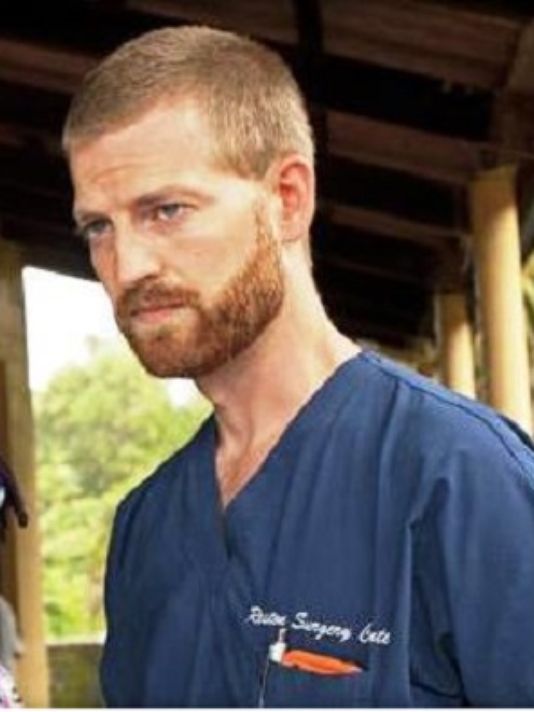
The fear surrounding this outbreak is intense. When Dr. Kent Brantly, a medical missionary who contracted the disease while treating patients in Liberia, was brought home for treatment here in the States, some questioned the wisdom of bringing a man infected by a dreaded disease into this country.[4] Others took their criticism farther, like political pundit Ann Coulter, who lambasted Dr. Brantly for going to Africa in the first place:
I wonder how the Ebola doctor feels now that his humanitarian trip has cost a Christian charity much more than any services he rendered.
What was the point?
Whatever good Dr. Kent Brantly did in Liberia has now been overwhelmed by the more than $2 million already paid by the Christian charities Samaritan’s Purse and SIM USA just to fly him and his nurse home in separate Gulfstream jets, specially equipped with medical tents, and to care for them at one of America’s premier hospitals …
Can’t anyone serve Christ in America anymore?[5]
I would point out to Ms. Coulter that there are, in fact, many people and organizations that do indeed serve Christ in America like, well, Samaritan’s Purse. You can learn more about their local relief efforts here. I would also point out that Christ’s commission is to make disciples of “all nations” (Matthew 28:19), which, by definition, includes nations other than our own. Finally, I would point out that the Christian Church has a long and storied history of reaching out to those in dire medical need. For instance, in the 160s, and again in the 260s, a series of plagues struck the Roman Empire. These plagues were so devastating that during one smallpox epidemic, a quarter to a third of the population died. When these plagues swept through, most people – scared of becoming infected – took the sick and threw them into the streets to die. But Christians, rather than casting the sick out, brought the sick in. Dionysius, the bishop of Alexandria during the second sweep of plagues, writes about how Christians responded to these outbreaks:
Most of our brother Christians showed unbounded love and loyalty; never sparing themselves and thinking only of one another. Heedless of danger, they took charge of the sick, attending to their every need and ministering to them in Christ, and with them departed this life serenely happy; for they were infected by others with the disease, drawing on themselves the sickness of their neighbors and cheerfully accepting their pains. Many, in nursing and caring for others, transferred their death to themselves and died in their stead.[6]
The Christians in Dionysius’ day, like Dr. Brantly in our day, cared for the sick – many of them dying because of their efforts. Dr. Brantly’s faithfulness is to be commended, not derided as Ann Coulter has done.
With this being said, all Christians need not travel to Liberia to respond faithfully to this worldwide health crisis. We can be faithful in our prayers that the spread of Ebola would be stemmed, and we can certainly join in prayer for Dr. Brantly and others like him. Finally, we can reach out in Christian love to the sick in our own communities, offering them our prayers and support.
When I think of Dr. Brantly’s efforts, I can’t help but believe he will hear some very pleasant words one day: “I was sick and you looked after Me” (Matthew 25:36). Let’s make it our goal to hear these words too.
__________________________________
[1] “Liberia declares state of emergency over Ebola virus,” BBC News (8.7.2014).
[2] Sydney Lupkin, “World Health Organization to Debate Ethics of Using Experimental Ebola Drug in Outbreak,” ABC News (8.6.2014).
[3] “Liberia declares state of emergency over Ebola virus,” BBC News (8.7.2014).
[4] Joel Achenbach, Brady Dennis, & Caelainn Hogan, “American doctor infected with Ebola returns to U.S.,” The Washington Post (8.2.2014).
[5] Ann Coulter, “Ebola Doc’s Condition Downgraded To ‘Idiotic,’” anncoulter.com (8.6.2014).
[6] Dionysius of Alexandria in Rodney Stark, The Rise of Christianity: How the Obscure, Marginal Jesus Movement Became the Dominant Religious Force in the Western World in a Few Centuries (San Francisco: Harper Collins, 1997), 82.


 Pastor Zach's Blog