Posts filed under ‘Current Trends’
In Response to ISIS

Credit: The Christian Post
The video was titled, “A Message Signed With Blood to the Nation of the Cross.” In it, 21 Egyptian Christians, dressed in orange jump suits, were gruesomely beheaded by ISIS militants along a beach in Tripoli. One of the final frames of the video zooms in on the waters of the Mediterranean, red with the blood of these martyrs.[1]
Christians aren’t the only targets of ISIS’ rage. Just last week, ISIS released images appearing to show gay men being thrown off buildings only to be stoned after they fell to the ground. A statement released by ISIS explained that the organization is “clamping down on sexual deviance.”[2]
The reaction to such savage killings has understandably been one of untempered ire. Egypt’s president pledged retaliation against ISIS for the slaughter of its Christians. Indeed, Muslims and Christians together are raising a unified chorus of disgust at ISIS’ actions. Andrea Zaki, vice president of the Protestant Churches of Egypt, noted, “With their blood [these martyrs] are unifying Egypt.”[3]
Though the slaughter of Egypt’s Christians has gotten more press than ISIS’ heinous injustices against gay people, both demand a response in addition to whatever political or military responses may be offered in the national and international arenas. Here are two responses that, I believe, are appropriate and important for a moment such as this.
First, we need an anthropological response. After all, whether we are Christian or Muslim, gay or straight, we are all human. Indeed, as Christians, we know and believe that we are all created in God’s image, which affords us not only a shared humanity, but a necessary dignity. This collective humanity and dignity, in turn, involves certain shared hopes and desires. We all desire safety. We all desire respect. We all desire love. When these shared desires are so violently violated, as ISIS has done, basic empathy leads to visceral revulsion. Thus, we can join the world in condemning these acts, if for no other reason than that we are all human.
Second, we also need a theological response. This response is especially urgent because far too many in the broadly secularized West have refused to admit that there are theological drivers behind ISIS’ actions. Writing for The Atlantic, Graeme Wood explains:
We are misled … by a well-intentioned but dishonest campaign to deny the Islamic State’s medieval religious nature … The reality is that the Islamic State is Islamic. Very Islamic. Yes, it has attracted psychopaths and adventure seekers, drawn largely from the disaffected populations of the Middle East and Europe. But the religion preached by its most ardent followers derives from coherent and even learned interpretations of Islam.
Virtually every major decision and law promulgated by the Islamic State adheres to what it calls, in its press and pronouncements, and on its billboards, license plates, stationery, and coins, “the Prophetic methodology,” which means following the prophecy and example of Muhammad, in punctilious detail. Muslims can reject the Islamic State; nearly all do. But pretending that it isn’t actually a religious, millenarian group, with theology that must be understood to be combatted, has already led the United States to underestimate it and back foolish schemes to counter it.[4]
I should point out that parts of Wood’s history of ISIS’ theological origins – especially his claim that ISIS’ theology is of a “medieval religious nature” – are questionable and, thankfully, have been appropriately critiqued. Nevertheless, his basic premise still stands. ISIS is acting in a way that is robustly and rigorously driven by a certain religious understanding. For ISIS, theology is no mere veneer to cover up some naked ambition for power. Theology is at the heart of who they are. Thus, it does us no good, for the sake of some self-imposed, naïve political de rigueur, to pretend that at least some of ISIS’ drivers are not theological.
This is where Christians are in a unique position to lend their voices to the challenges and crises presented by ISIS. For we can offer a better theology than ISIS’ theology. We can rebuke a theology that allows the slaughtering of people with whom they religiously and culturally disagree, as Jesus did with His disciples when they wanted to destroy the Samaritans because they were a people with whom the disciples religiously and culturally disagreed. And when a theology leaves room for stoning those who live outside of traditional sexual ethics, we can say with Jesus, “If any one of you is without sin, let him be the first to throw a stone” (John 8:7).
Blessedly, the parts of this “better theology” I outlined above are ones with which the majority of the Muslim world would agree – because even though this “better theology’s” origins are explicitly Christian, its implications are broadly ethical. And even if ISIS’ understanding of Islamic theology is real, it is certainly not catholic. Plenty – and, in fact, the vast majority – of Muslims share our higher ethical aspirations. Indeed, perhaps what was once a Judeo-Christian ethic can expand into a Judeo-Muslim-Christian ethic.
Ultimately, of course, although theology includes ethics, it is more than just ethical. It is finally soteriological. And this is good. Because this means that even as ISIS continues its campaign of terror, it cannot thwart the promise of God that the faithful who have died at ISIS’ hands are now safe under heaven’s altar. For this we can be thankful. And because of this we can continue to be hopeful.
______________________
[1] Leonardo Blair, “Heartbreaking: Egyptian Christians Were Calling for Jesus During Execution by ISIS in Libya,” The Christian Post (2.18.2015).
[2] Cassandra Vinograd, “ISIS Hurls Gay Men Off Buildings, Stones Them: Analysts,” NBC News (2.15.2015).
[3] Jayson Casper, “Libya’s 21 Christian Martyrs: ‘With Their Blood, They Are Unifying Egypt’” Christianity Today (2.18.2015)
[4] Graeme Wood, “What ISIS Really Wants,” The Atlantic (March 2015).
Why Brian Williams Is Just Like You (And Vice Versa)
 Six months. That’s how long NBC has suspended Brian Williams, the anchor and managing editor of NBC Nightly News, in response to inaccurate statements he made about riding in a Chinook helicopter that was hit by an RPG while reporting from Iraq in 2003.[1]
Before I proceed any farther with this story, a bit of disclosure: I like Brian Williams. I have been watching Brian, and before him Tom Brokaw, on NBC Nightly News for years. I suspect I’m not the only one.
But this blog is not so much about the misdeeds and subsequent suspension of Brian Williams as it is about the public response to the misdeeds and subsequent suspension of Brian Williams. Two primary responses to this debacle seem to have emerged.
The first is that of antipathy. On Twitter, whole hashtags are devoted to ripping Williams for his sloppy retelling of his time in Iraq. The crush of critics reveling in what can only be described as a psychotic schadenfreude is unnerving to newsmen such as Bill O’Reilly, who told Jimmy Kimmel: “Anybody who is enjoying the destruction of this man — you got to look at yourself. And there’s a lot of people who seem to be real happy his career is going down the drain. That disturbs me.”[2] I couldn’t agree more. The prophet Obadiah warns, “You should not look down on your brother in the day of his misfortune, nor rejoice over…people… in the day of their destruction, nor boast so much in the day of their trouble” (Obadiah 12). But this is exactly what some people are doing. They are filled with gleeful antipathy.
But this isn’t the only response to this sordid affair. There’s another, much more supportive response to the embattled reporter – that of sympathy. Some folks have rallied to Williams’ side, especially on the Facebook page for Nightly News. Again and again, supporters have commented, “Bring back Brian Williams!!!!!!” (Sometimes, their messages have included even more exclamation points). These people are willing to overlook Williams’ faux pas and offer their unreserved, untempered support. They feel bad for the news anchor and believe his actions should get a pass.
Honestly, I am not comfortable with either of these responses. The antipathy of some smacks of an arrogant judgmentalism while the sympathy of others seems to be little more than a sappy sentimentalism. As Christians, I believe the best thing we can offer Brian Williams – and others caught in similar transgressions – is our empathy.
Though the word “empathy” was coined only at the beginning of the twentieth century, it is an important and helpful term to describe the similarities between others and ourselves. When we understand how much we share in common with others, it helps us help others. This is part of what the preacher of Hebrews says constitutes the very heart of Jesus’ ministry: “We do not have a high priest who is unable to empathize with our weaknesses, but we have one who has been tempted in every way, just as we are – yet He did not sin” (Hebrews 4:15). Jesus, through His incarnation, empathizes with us. He puts Himself in our place and knows exactly how we feel. He then helps us accordingly.
So what does it mean to empathize with Brian Williams? It means we need to admit that we, like he, are prone to yarn spinning. It means we need to be willing to say, to borrow a mantra from the Charlie Hebdo tragedy, “Je suis Brian Williams.” Those who are highly antipathetic toward Brian Williams seem to have forgotten this. From their perch of righteous indignation, they throw stones, ignoring that their perch sits in a glass house. The apostle Paul’s words are especially apropos here: “You, therefore, have no excuse, you who pass judgment on someone else, for at whatever point you judge the other, you are condemning yourself, because you who pass judgment do the same things” (Romans 2:1).
But true empathy goes farther than just identifying with another person. True empathy leads to helping that person. How can we help Brian Williams? In the same way Jesus helps us. He calls us to repentance. This is where folks highly sympathetic to Brian Williams go wrong. In their zeal to support the anchor, they have minimized and rationalized his sin.
I find it hopeful that in a statement released by Steve Burke, CEO and President of NBC Universal, Mr. Burke indicated that Brian “shared his deep remorse with me and he is committed to winning back everyone’s trust.”[3] Remorse can be well and good, but not unless it is what Paul calls “Godly sorrow [that] brings repentance” (2 Corinthians 7:10). My prayer is that Brian Williams’ remorse is a Godly remorse.
Do you know what the best part of repentance for Brian Williams will be? At this point, Brian has no guarantee that his suspension will not ultimately become his termination. NBC has refused to guarantee his position. But even if NBC says, “You’re fired,” in repentance, Jesus says, “You’re forgiven.” And that’s better than any anchor chair. And that’s a promise good not only for a national news anchor, but for low-profile, everyday sinners like you and me.
_____________________________
[1] Roger Yu and Melanie Eversley, “NBC: Brian Williams suspended for six months,” USA Today (2.11.2015).
[2] “Bill O’Reilly says Brian Williams ‘made a mistake,’ not sure he will keep job,” Fox News (2.10.2015).
[3] Erik Wemple, “How can NBC News’s Brian Williams ‘win back everyone’s trust’ from the beach?” Washington Post (2.10.2015).
Why Fifty Shades of Grey is Black and White
 Coming to a theatre near you this Friday, just in time for Valentine’s Day: 110 minutes of expectation and titillation wrapped in the package of a movie based on a best-selling novel. E.L. James’ Fifty Shades of Grey has been widely panned by literary critics. Jesse Kornbluth, writing for the Huffington Post, admits, “As a reading experience, Fifty Shades of Grey is a sad joke, puny of plot, padded with conversations that are repeated five or six times and email exchanges that are neither romantic nor witty.”[1] A quick tour through a few of the novel’s more infamous lines quickly reveals just how bad the writing really is:
- His voice is warm and husky like dark melted chocolate fudge caramel…or something.
- My subconscious is furious, medusa-like in her anger, hair flying, her hands clenched around her face like Edvard Munch’s Scream.
- Finally, my medulla oblongata recalls its purpose. I breathe.[2]
If you think the line, “Finally, my medulla oblongata recalls its purpose, I breathe” makes for a good novel, in the timeless words of the professor from Waterboy, “There’s something wrong with your medulla oblongata.” I’ve never read either of these authors, but something tells me E.L. James makes Danielle Steele look downright Shakespearean. Something also tells me that when James was writing her novel, clicks on Thesaurus.com went through the roof. Yet, over 10 million copies of this stilted, silly prose have been sold worldwide.
In all honesty, though the awful writing really does bother me, there is a much more sinister side to Fifty Shades of Grey – something that deserves serious theological reflection. This novel unashamedly, unabashedly revels in its sexual depravity. It is a sick foray into all sorts of sexual sin. Some reviewers have gone so far as to call it “mommy porn.”[3] The overarching plot line explores the sexually abusive relationship between a wealthy 27-year old entrepreneur named Christian Grey and a 21-year old college senior named Ana Steele. Christian warns Ana that he is not “a hearts and flowers kind of guy” and introduces her to his room full of BDSM toys. It is their masochistic sexual encounters that form the meat of the novel. Indeed, reports indicate that in the 110-minute movie version, over 20 minutes are devoted to sex scenes.[4] And people have worked themselves into a flurry of anxious anticipation to see them.
Let me cut through the grey and be black and white for a moment: You should not go see this movie. You should not read the book. That’s the bottom line of this blog. You don’t need to encounter the explicit contents of this book and movie firsthand to know its implications are evil. Allow me to give you three reasons why I believe this.
1. Fifty Shades of Grey robs people – and especially women – of their dignity.
I myself do not know all the illicit details of the sexual encounters between Christian and Ana, nor do I care to. But I do know that BDSM – whether it be in a novel, in a movie, or in real life – is an affront to basic human dignity. Tying up another person and calling them all sorts of nasty names, as is common in these types of sexual encounters, cannot be anywhere near what God had in mind when He designed sex so “two [could] become one flesh” (Genesis 2:24). In fact, the description of the righteous woman in Proverbs 31 haunts me as I think about the relationship peddled by this book: “Strength and dignity are her clothing, and she laughs at the time to come” (Proverbs 31:25). Ana is robbed of both her strength and dignity in this story. May what is fiction never become what is reality.
One additional note on this topic: even if you are married and trust each other implicitly, BDSM still degrades the divine design for human sexuality. It simply does not square with what Paul writes concerning the marital relationship: “Husbands, love your wives and do not be harsh with them” (Colossians 3:19). Sex and marriage need tenderness.
2. Fifty Shades of Grey portrays people as little more than the sum of their desires.
Somehow, we have bought into this myth that if we do not indulge whatever sexual desires, fantasies, dreams, or fetishes we might have, we are not being true to ourselves. We are repressing ourselves. First, allow me to say a word about our feckless use of the word “repression.” Repression is when a person pushes something – usually a memory – out of their conscious awareness as a defense mechanism against the pain it causes. Repression often requires psychological help. Suppression, on the other hand, is when a person consciously chooses not to indulge a particular appetite. Repression is almost always dangerous. Suppression, on the other hand, can often be good. For example, I have often desired to try to take out the 72-ounce steak at the Big Texan Steak Ranch in Amarillo, but I have suppressed myself. Why? Because there is no way that would be good for me. I also sometimes desire to sleep in rather than to get up early to work out. But I suppress my sleep and get up. Why? Because I know working out is good for me.
Just because we desire something doesn’t make it good or good for us. This is why the apostle Peter warns: “Dear friends, I urge you, as aliens and strangers in the world, to abstain from sinful desires, which war against your soul” (1 Peter 2:11). You are more than the sum of your desires. And you are most true to yourself not when you’re following every whim and desire, but when you’re following Jesus.
3. Fifty Shades of Grey gives false hope for a happy ending.
Perhaps what disturbs me most about Fifty Shades of Grey is not its graphic descriptions of bizarre sexual encounters, but the arc of the broader plot line over the whole Fifty Shades trilogy. In volume two, Christian and Ana get married. By the end of volume three, the reader learns the couple has two children. Christian, it seems, has been tamed. And even though it’s left unspoken, the emotion of the ending is clear: “And they lived happily ever after.”
Here’s the problem with this ending: if the first part of the story is true, the last part cannot be. The Fifty Shades trilogy tells the story of light being born out of darkness. It tells the story of tender love emerging out of sadomasochism. In real life, however, this does not happen – at least not in the way Fifty Shades presents it. Evil does not wake up one morning and decide, “I’m going to birth something good.” No. Evil begets evil. If you don’t believe me, read up on the doctrine of original sin. The only way for good to emerge from evil is not by evil’s behest, but by evil’s demise. Jesus didn’t come and ask evil to be a little better. He came and nailed it to a cross. There’s where the hope for a “happily ever after” ending is. Not in some accidental stumbling of righteousness out of wickedness.
I hope this is enough – if you were thinking about seeing the movie or reading the book – to stop you. Researching the story and thinking through its repercussions is certainly enough for me. And I also hope this is enough – if you’re trapped in a real-life abusive relationship – for you to get the help you need to get out. You’re too fearfully and wonderfully made not to.
_______________________________
[1] Jesse Kornbluth, “‘Fifty Shades Of Grey’: Is The Hottest-Selling Book In America Really Just ‘S&M For Dummies?’” Huffington Post (3.12.2012)
[2] Brenton Dickieson, “50 Shades of Bad Writing,” A Pilgrim in Narnia (9.21.2012).
[3] Julie Bosman, “Discreetly Digital, Erotic Novel Sets American Women Abuzz,” The New York Times (3.9.2012).
[4] Jess Denham, “Fifty Shades of Grey movie banned in Malaysia for being ‘more like pornography than a film,’” The Independent (2.5.2015).
Humans: Never for Sale

Credit: texasgopvote.com
Shortly before the new year, The New York Times published a short, heartbreaking article featuring stories from U.S. sex trafficking victims. Though there were only two stories, these were all that was needed to shock and grieve their reader. I share one of the two here:
Now 32, Genesis was offered her first hit of crack cocaine by her mother when she was 13. By 18, she had a criminal record. She spent her teenage years in and out of strip clubs before becoming the property of a violent pimp. By 21, Genesis had lost a baby and become addicted to drugs.
For years under a violent trafficker, Genesis said she was never allowed to leave his house. The rooms were bugged, the bathroom had no doors. She said her pimp used to tie her and other women he trafficked to a weight bench, beat them and starve them …
“I didn’t know I was in hell,” she said. “I thought it was just life. Over those years I was held hostage, shot at, beaten with a pistol. And somewhere in my sick mind I thought this is how life is supposed to be.”[1]
If only Genesis’ story was unique. But it’s not. Sex trafficking is a much broader problem. Though it’s hard to track because so many victims of sex trafficking do not report their experiences, the Department of Justice estimates that as many as 300,000 children may become victims of sexual exploitation each year.[2] Even if the numbers are lower, one case of sex trafficking is one too many.
The sadness of human exploitation struck me in a new way as I was reading Revelation 18 in my devotions this past week. John is describing the fall of Babylon, a city symbolic of the world’s evil. John describes the decimation of this world’s systemic sin once and for all:
“Woe! Woe, O great city, O Babylon, city of power! In one hour your doom has come!” The merchants of the earth will weep and mourn over her because no one buys their cargoes any more – cargoes of gold, silver, precious stones and pearls; fine linen, purple, silk and scarlet cloth; every sort of citron wood, and articles of every kind made of ivory, costly wood, bronze, iron and marble; cargoes of cinnamon and spice, of incense, myrrh and frankincense, of wine and olive oil, of fine flour and wheat; cattle and sheep; horses and carriages; and bodies and souls of men. (Revelation 18:10-13)
John’s Babylon sold many things to enrich itself. But most tragically, it sold the “bodies and souls of men.”
John’s Babylon is not far from us. Every time a young lady is prostituted out to the darkest of men, “bodies and souls of men” are sold by pimps – just like in Babylon. Every time a woman performs simulated sex acts at a club for a gaggle of wide-eyed gawkers, “bodies and souls of men” are sold by the adult entertainment industry – just like in Babylon. Every time a person sits hidden behind a flickering computer screen, staring at erotic images of the most carnal of acts, “bodies and souls of men” are sold by the porn industry – just like in Babylon. Every time a scared woman is counseled and even cajoled to abort her baby even though everything inside of her is telling her not to, “bodies and souls of men” are sold by the abortion industry – just like in Babylon.
How sick.
As heart-rending as human trafficking may be, John promises that, mercifully, this sick industry will meet its end. The “bodies and souls of men” will not be sold forever. Babylon will fall. And when Babylon does fall, the merchants who made their money off the pain of people will grieve their destruction and cry, “Woe” (Revelation 18:19)! But those who have been oppressed and sold will celebrate their liberation and shout, “Rejoice” (Revelation 18:20)!
May that day of rejoicing come quickly.
If you need help out of being trafficked, click here.
_______________________
[1] The Associated Press, “Sex Trafficking Shelter Filled With Survivor Tales,” The New York Times (12.29.2014).
[2] William Adams, Colleen Owens, and Kevonne Small, “Effects of Federal Legislation on the Commercial Sexual Exploitation of Children,” Juvenile Justice Bulletin (July 2010).
Must Christianity Change or Die?

Credit: Rudy Tiben
Sometimes, it can feel as though the sky is falling and the bottom is dropping out all at the same time. It seems like I can go barely a day without reading a dire report on church attrition, especially among the younger generation. Between high school and turning 30, 43 percent of once-active young adults stop attending church.[1] As of 2012, almost one-third of young adults were unaffiliated with a religious institution.[2] In one survey, researchers found that nearly one-third of young adults left the Christian faith because of its “negative teachings” related to gays and lesbians.[3]
Such gloomy statistics lead to predictable calls to fix the Church by changing its teachings, lest the next generation, discontent with the Church’s antiquated morals, leave her altogether. Take, for instance, this call from popular Christian blogger Rachel Held Evans:
Young adults perceive evangelical Christianity to be too political, too exclusive, old-fashioned, unconcerned with social justice and hostile to lesbian, gay, bisexual and transgender people …
Young evangelicals often feel they have to choose between their intellectual integrity and their faith, between science and Christianity, between compassion and holiness …
The evangelical obsession with sex can make Christian living seem like little more than sticking to a list of rules, and … millennials long for faith communities in which they are safe asking tough questions and wrestling with doubt …
What millennials really want from the church is not a change in style but a change in substance.[4]
Evans’ last line is striking to me. In response to changing cultural norms, Evans maintains that the Church must change the substance of her message. In the words of the famed Episcopalian bishop John Shelby Spong, “Christianity must change or die.”[5] How must Christianity change? Evans offers some suggestions:
We want an end to the culture wars. We want a truce between science and faith. We want to be known for what we stand for, not what we are against.
We want to ask questions that don’t have predetermined answers.
We want churches that emphasize an allegiance to the kingdom of God over an allegiance to a single political party or a single nation.
We want our LGBT friends to feel truly welcome in our faith communities.
We want to be challenged to live lives of holiness, not only when it comes to sex, but also when it comes to living simply, caring for the poor and oppressed, pursuing reconciliation, engaging in creation care and becoming peacemakers.
Evans’ words here are fascinating – and confusing – to me because, understood one way, they are commendable, orthodox, and necessary. But understood another way, they are deeply troubling. For instance, if a “truce between science and faith” means understanding the respective spheres of each and welcoming scientific discovery while at the same time remaining faithful to Scripture’s narrative, I’m onboard. If, however, it means dumping the historicity of Scripture’s creation account, I’m troubled. If having “our LGBT friends feel truly welcome in our faith communities” means showing love, compassion, and going out of our way to listen and learn from the LGBT community, I’m more than all for it. If it means calling what is sinful, “just,” I’m troubled. Sadly, I can’t help but think that, all too often, it’s the latter understandings of these statements that are insinuated. Otherwise, it is feared, a whole generation of young people will leave the Church.
But is this really the case?
Take Rob Bell. Here is a man who has, at least in part, bought into Spong’s motto, “Christianity must change or die.” In his book, What We Talk About When We Talk About God, Bell asks candidly, “Can God keep up with the modern world?”[6] He fought to build a community – Mars Hill Church in Grand Rapids – that would lead the way in this new Christianity. Until he left. In an interview with Oprah, he says his Sunday mornings are now regularly filled with he and his 13-year-old son surfing.[7] Rob Bell was leading a changed church. But even a changed church wasn’t enough to keep Bell around. And he isn’t the only one.
For decades now, churches that have changed the substance of the Christian faith have not been gaining members, but losing members. And now, even as young people are leaving traditional churches, they are not joining these changed churches. They are leaving altogether.[8]
It would seem that if a church is willing to “get with the times,” so to speak, and embrace our culture’s zeitgeist, its pews should be filled to overflowing with the ranks of the enlightened, all breathing a collective sigh of relief that, finally, the offensive, narrow, bigoted Christianity of yesteryear has been relegated to the scrap heap of history. But this has not happened.
The problem with changing the faith of the Church – even the parts of the faith that are not particularly palpable to our modern ears – is that such changes inevitably displace Christianity’s eschatological hope with an evolutionary drum.
What do I mean?
Whether it’s the so-called “war” between science and faith, or the question of gay marriage, or the role of politics in faith, many Christians have simply traded one side of Rachel Held Evans’ despised culture war for the other. They desire to evolve beyond what they perceive as a restrictive, judgmental, intellectually archaic Christian faith. So they laugh at those who take Genesis’ creation account historically, or cry “bigotry” against those who express concern with gay marriage, or look down on those who argue for a more traditionally moral politics. These are old ways that must be done away with, they think.
But what happens is that they become so animated by grievances from the past and trying to right them right now that they forget about – or at least relegate to the background – any sort of ultimate hope for the future. They wind up fighting for a certain kind of culture rather than finding their hope in a different type of Kingdom. They become so obsessed with what’s next that they forget about what’s last.
When you dispel the Christian faith down to nothing more than a fight for this or that cause célèbre, more often than not, you end up with nothing – or at least with nothing that can’t be found elsewhere. And why would anyone go somewhere for something they can get anywhere? This is why changing Christianity’s substance doesn’t gain people; it only loses them.
So what course of action can a Christian take? In a world full of cultural convolution, Christianity’s answer is elegantly simple: “Stand firm in the faith … Do everything in love” (1 Corinthians 16:13-14). Don’t change the faith. Love others. That’s it. And really, who can improve on that? Some things don’t need to change.
_____________________
[1] Melissa Stefan, “Have 8 Million Millennials Really Given Up on Christianity?” Christianity Today (5.17.2013).
[2] Vern L. Bengtson, Families and Faith: How Religion is Passed Down Across Generations (New York: Oxford University Press, 2013), 148.
[3] “A Shifting Landscape: A Decade of Change in American Attitudes about Same-Sex Marriage and LGBT Issues,” Public Religion Research Institute (2.26.2014).
[4] Rachel Held Evans, “Why millennials are leaving the church,” cnn.com (7.27.2013).
[5] John Shelby Spong, Why Christianity Must Change Or Die (San Francisco: Harper Collins, 1999).
[6] Rob Bell, What We Talk About When We Talk About God (New York: Harper Collins, 2014), 8.
[7] “Super Soul Sunday: Oprah Goes Soul to Soul with Rob Bell,” Oprah.com.
[8] Rod Dreher, “The Dying (No, Really) Of Liberal Protestantism,” The American Conservative (7.25.2013).
Newsweek Takes On the Bible
 It’s frustrating, but sadly predictable. Just in time for a new year, Newsweek trots out an article full of old attacks on the Bible. Kurt Eichenwald, who became nationally known for chronicling a massive financial scandal at Prudential in 1995, has gotten into the business of faith, critiquing the Bible and its believers in a lengthy screed titled, “The Bible: So Misunderstood It’s a Sin.”[1]
The article has everything a pedantic diatribe against the Bible could ever hope to have, including a picture of picketers from Westboro “Baptist Church” (and yes, the quotation marks are intentional because they are neither Baptist nor are they a Church, at least in the theological sense of the terms) along with a cartoonish characterization of the average Christian in America:
They wave their Bibles at passersby, screaming their condemnations of homosexuals. They fall on their knees, worshipping at the base of granite monuments to the Ten Commandments while demanding prayer in school. They appeal to God to save America from their political opponents, mostly Democrats. They gather in football stadiums by the thousands to pray for the country’s salvation.
Granted, I am only speaking for myself, but I have never waved my Bible at anyone while screaming condemnations of gay people. I have never worshiped at the base of a granite monument to the Ten Commandments. I do have a congregation I love with whom I worship, however. I have never appealed to God to save America from my political opponents. Indeed, if you have followed this blog for any length of time, you know I can be somewhat skeptical of the political process in general, fearing that some expect out of politics what only Christ can give. I have also never gathered in a football stadium to pray for my country’s salvation, though I have cheered from my stadium seat as I watched my Texas Longhorns put a hurtin’ on some Aggies. Again, I know I am speaking only from my own experience, but I have a feeling I’m not alone. It’s easy to make Christians sound really bad when you misrepresent what the majority of Christians do and believe.
Such a gross mischaracterization of Christians aside, the preponderance of Eichenwald’s jeremiad is reserved for the Bible itself. Eichenwald opines:
No television preacher has ever read the Bible. Neither has any evangelical politician. Neither has the pope. Neither have I. And neither have you. At best, we’ve all read a bad translation – a translation of translations of translations of hand – copied copies of copies of copies of copies, and on and on, hundreds of times.
About 400 years passed between the writing of the first Christian manuscripts and their compilation into the New Testament. (That’s the same amount of time between the arrival of the Pilgrims on the Mayflower and today.) The first books of the Old Testament were written 1,000 years before that. In other words, some 1,500 years passed between the day the first biblical author put stick to clay and when the books that would become the New Testament were chosen.
I honestly have no idea where Eichenwald is getting his history. Modern translations of the Bible are not based “a translation of translations of translations.” Rather, they are based on the best available hand-written copies of Hebrew Old Testament and Greek New Testament initial biblical manuscripts. And Eichenwald’s 400 year time frame from the writing of the New Testament text to its compilation is laughable. The Codex Sinaiticus, for instance, is a copy of both the Old and New Testaments dating to around AD 340. Assuming the last New Testament book was written around AD 90, that gives us a 250 year – not a 400 year – period between writing and compilation. But the period is actually much shorter than this. The Muratorian Fragment is a list of New Testament books from around AD 170. So now the time period between writing and compilation is reduced to 80 years. But even this misrepresents the situation. Paul’s letters circulated as a collection among Christian churches from the second century onward and the church father Justin Martyr developed, also in the second century, an influential harmony of the four Gospels known as the Diatessaron, demonstrating that the early church read the Gospels and Paul’s letters as a collection from the very beginning. In other words, the Church has always held the books we have in the New Testament to be worthy of our consideration and study. It did not take 400 years to compile the Bible.
But Eichenwald isn’t done yet. He continues:
In the past 100 years or so, tens of thousands of manuscripts of the New Testament have been discovered, dating back centuries. And what biblical scholars now know is that later versions of the books differ significantly from earlier ones.
So Eichenwald would have us believe that we have radically different variations of the books now in our Bible hidden somewhere in a colossal cache of ancient manuscripts. What do these radically different variations entail? “Most of those discrepancies are little more than the handwritten equivalent of a typo.” I’m confused. Which is it? Do we have significantly different versions of biblical books or minor discrepancies that amount to nothing more than handwritten “typos”? Not only is Eichenwald wrong on his historical facts, he isn’t even internally consistent.
Eichenwald also has fun with how scholars have translated the Bible. He cites Philippians 2:6, which says, in the King James Version, that Christ was “in the form of God,” and notes:
The Greek word for form could simply mean Jesus was in the image of God. But the publishers of some Bibles decided to insert their beliefs into translations that had nothing to do with the Greek. The Living Bible, for example, says Jesus “was God” – even though modern translators pretty much just invented the words.
I find it hard to believe that a journalist for Newsweek knows more about Greek and how words should be translated than degreed biblical scholars who actually study this stuff for a living. And just for the record, the Greek word for what Eichenwald says should be translated as “image” is morphe, which comes into Latin as forma and into English as, what do you know, “form.” Contrary to Eichenwald, reputable Bible translators generally do not just decide “to insert their beliefs into translations.”
There’s plenty more in Eichenwald’s article that could be critiqued. If you want to read some trenchant responses, you can find them here, here, and here. Honestly, I find it hard to believe that a major publication like Newsweek would publish something that looks more like a two-bit sensationalistic hit piece on the Bible than an honest piece of investigative journalism. This whole article seems to me to be little more than clickbait.
That being said, let me conclude with a passage from this article with which I actually agree. Granted, it’s not a long passage. There’s plenty around it that’s not true. In fact, I can’t even cite Eichenwald’s whole sentence. But this much is true: “If [Christians] … believe all people are sinners, then salvation is found in belief in Christ and the Resurrection. For everyone. There are no exceptions in the Bible for sins that evangelicals really don’t like.” For all that is not true in this article, this much is: Christ came to save sinners – all sinners – through faith in Him. This means that no matter what your sin, Jesus came to save you.
And even in an article that’s really bad, that’s still good news.
_______________________
[1] Kurt Eichenwald, “The Bible: So Misunderstood It’s a Sin,” Newsweek (12.23.2014).
Tackling Terrorism

Credit: Christian Science Monitor
First it was a chocolatier in Australia. Then it was a school in Pakistan. Terrorist attacks have been headline news this past week.
When an Iranian refugee turned self-styled Muslim cleric named Man Haron Monis barricaded his way inside a Lindt Chocolate Café in Sydney, it took a police raid 16 hours after the siege began to free the hostages trapped inside. Three people, including Monis, died.
When Taliban fighters stormed a crowded school in Peshawar, they managed to kill 145 people over eight hours, 132 of them schoolchildren. Stories are emerging of kids being lined up and shot, or shot as they cowered under their desks. NBC News reports that one teacher was doused with gasoline and burned alive while students were forced to watch.
Once again, we are left grappling with grieving families and terrorized communities. And even though, in both of these instances, the attacks happened across time zones, countries, oceans, and continents, at least a little of the fear there nevertheless comes home to roost here.
This, of course, is exactly what these terrorist organizations want. CNN reports that ISIS is calling on their allies and sympathizers to carry out so called “lone-wolf” attacks in their homelands. They attacks do not have to be big, expensive, and well organized – as were the attacks of 9/11 – they simply have to be frightening. Fear, these criminals know, is a powerful thing.
Certainly, national governments need to put into place policies to try to prevent these attacks. Certainly, law enforcement officials need to have plans in place to deal swiftly and forcefully with any terrorist attack. And certainly, surveillance of and intelligence from terrorist groups and lone wolf sympathizers is needed so governments can know and foil terrorist plots them before they have a chance to carry them out.
But what about us? What about people who are normal, everyday citizens like us who are increasingly frightened that we could be in the wrong place at the wrong time and be mown down by a terrorist attack?
The fact of the matter is this: we cannot control what will happen to us in the future. We do not know whether or not we will fall victim to a terrorist attack. But we can confront and control the fear we feel right now.
The apostle John gives us a simple strategy for dealing with fear: “Perfect love drives out fear” (1 John 4:18). When a mad man or a despicable organization terrifies people with a dastardly deed, what is the best way for the rest of us to respond? By loving those people. Spontaneous tributes to the fallen that have arisen in the wake of these attacks indicate that, already, these communities are banding together to love each other through fear.
As of now, I have not seen any relief efforts that we in the states can participate in to express our love and support to the families of these victims in Australia and Pakistan. But with Christmas fast approaching, my guess is, you know at least one person who, though they may not be terrorized, is fearful in some way. Perhaps you know someone who has lost their spouse this year and is worried about how they will deal with their first Christmas apart from their loved one. Perhaps you know someone who is terminally ill and is facing the very real and understandable fears that come with knowingly being at the end of life. John’s words ring just as true in these cases as they do in cases of terror: “Perfect love drives out fear.”
So love who you can love. For in doing so, you bring peace where there is fear. And in a season when we remember some angels who announced “peace on earth to men” (Luke 2:14) thanks to a “God [who] so loved the world [that] He gave His one and only Son” (John 3:16) so we could “not be afraid” (John 14:27), this is most definitely an appropriate mission.
Sorting Through The Senate Intelligence Committee’s Report

Credit: Huffington Post
The allegations are shocking, but the committee is suspect. Last Tuesday, the Senate Intelligence Committee released portions of a report on the C.I.A.’s secret prison program and their use of enhanced interrogation techniques. Almost immediately, many panned it as a partisan hit on the C.I.A. Even former Democratic Senator Bob Kerrey found the report disconcerting, writing, “I do not need to read the report to know that the Democratic staff alone wrote it. The Republicans checked out early when they determined that their counterparts started out with the premise that the C.I.A. was guilty and then worked to prove it.”[1] Still, the report has raised grave concern over what exactly happened at those secret prisons and whether or not it amounted to torture. Republican Senator John McCain was deeply disturbed by the report, saying, “[The C.I.A.’s policies] stained our national honor, did much harm and little practical good … This question isn’t about our enemies; it’s about us. It’s about who we were, who we are and who we aspire to be … Our enemies act without conscience. We must not.”[2]
Certainly, there is still much from this report to sort out. Questions need to be asked like, “Why didn’t the Committee interview anyone involved with these prisons and instead rely solely on documents it received from the C.I.A.?” Or, “How is it that we are unable to conduct a bipartisan, even-handed investigation into anything – even into something as nationally critical and morally weighty as our use of enhanced interrogation techniques with enemy combatants?”
It is far beyond the pale of a post such as this one to answer any and every question that could be raised about this report and the contents therein. But a line from Senator Kerrey’s opinion piece, I believe, is worth our special consideration: “[The report] contains no recommendations. This is perhaps the most significant missed opportunity, because no one would claim the program was perfect or without its problems.” I could not agree more. To make the claims that this Committee’s report makes and then to offer no recommendations going forward is not only unhelpful; it is outright irresponsible. There is a very good chance that, once again, this country will be struck by a terror attack. If we fail to learn from what happened in our intelligence gathering efforts this time, we will not be able to improve on them for next time. We need to get our act together – both for our national security and for our ethical integrity. It is with this pressing need in mind that I offer three lessons I think we can learn from the Committee’s report.
Lesson 1: Count the cost.
There is much that can be disputed in the Intelligence Committee’s report. Some basic facts, however, do emerge. Prisoners were subjected to rectal feeding and rehydration as a way to try to obtain information.[3] Some 26 detainees in these prisons did not meet the government’s standards for detention.[4] One intellectually challenged person was held solely to get information out of one of his family members.[5] During a waterboarding session, a detainee became, according to the report, “completely unresponsive with bubbles rising through his open, full mouth.”[6] Another detainee who was doused with water and left partially unclothed died of hypothermia.[7]
Jesus, when speaking of what it takes to follow Him, uses an analogy that can be helpful in analyzing what happened during these interrogations:
Suppose one of you wants to build a tower. Will he not first sit down and estimate the cost to see if he has enough money to complete it? For if he lays the foundation and is not able to finish it, everyone who sees it will ridicule him, saying, “This fellow began to build and was not able to finish.” Or suppose a king is about to go to war against another king. Will he not first sit down and consider whether he is able with ten thousand men to oppose the one coming against him with twenty thousand? If he is not able, he will send a delegation while the other is still a long way off and will ask for terms of peace. (Luke 14:28-32)
When undertaking a building project or going to war, contractors and generals ask, “Will the money spent or the lives lost produce the outcome we need?” If not, we don’t do it.
Similarly, no matter how hard these questions may be, we must ask of our interrogation techniques: What did we gain and what did we lose? What intelligence did the interrogations gain for us? What ethics did they compromise in us? There are times when a good end might justify some rough, though never unjust, means. One needs to look no farther than the cross. In the divine economy, God determined the end goal of our salvation was well worth means of the sacrifice of His one and only Son. Yet, this cost was unique because, in this case, not only did the end justify the means, but the means, in a much more profound way, justified the end! This is why Paul can write, “We have now been justified by [Christ’s] blood” (Romans 5:1).
We need to interrogate these interrogations. If we don’t count the cost from this time, we will repeat this time’s errors next time.
Lesson 2: Accountability is key.
One of the most startling aspects of the Intelligence Committee’s report was the lack of oversight and accountability in these secret prisons. For example, the C.I.A. contracted with two psychologists to evaluate whether or not detainees could continue to endure the strain of enhanced interrogations. Shockingly, the only accountability for these psychologists was evaluations the psychologists conducted on themselves! Unsurprisingly, they gave themselves high marks for their work.[8] Similarly, The New York Times reports that President Bush was, for four years, kept in the dark on the kinds of tactics that were being used on detainees. Finally, in 2006, when President Bush was “told about one detainee being chained to the ceiling of his cell, clothed in a diaper and forced to urinate and defecate on himself, even a president known for his dead-or-alive swagger ‘expressed discomfort.’”[9]
When checks and balances are removed from any system, the system becomes ripe for foolish decisions at best and outright corruption at worst. The old saying, “Two heads are better than one” really is true. If there is no one to point out a blind spot or offer an alternative perspective, disaster is not far behind.
Lesson 3: Don’t make the exception the rule.
Senator McCain, while coming out against the interrogation techniques used in the C.I.A.’s secret prisons, also admitted:
I know in war good people can feel obliged for good reasons to do things they would normally object to and recoil from.
I understand the reasons that governed the decision to resort to these interrogation methods, and I know that those who approved them and those who used them were dedicated to securing justice for the victims of terrorist attacks and to protecting Americans from further harm. I know their responsibilities were grave and urgent, and the strain of their duty was onerous.
I respect their dedication and appreciate their dilemma.[10]
Senator McCain is right. The C.I.A. specifically and our government generally was faced with some excruciatingly difficult decisions and dilemmas after the September 11 attacks.
Yet, it amazes me how often we use the extraordinary circumstances of big headlines to excuse our behavior in the ordinary circumstances of everyday life. I do not know how many times I have taught on Jesus’ words in the Sermon on the Mount, “Do not resist an evil person. If someone strikes you on the right cheek, turn to him the other also” (Matthew 5:39), only to be asked, “But what if someone breaks into your house in the middle of the night and threatens to kill you and your family? Should you just turn the other cheek and let them do it?” Whenever I receive this question, I want to ask, “When was the last time this happened to you? Is this a weekly occurrence that you need a standard strategy for dealing with break ins and death threats?” The apostle Paul notes there are exceptional circumstances when we may not be able to turn the other cheek (cf. 2 Corinthians 11:19-21). But let’s not make the exception the rule. The fact of the matter is this: 99 times out of 100, we can turn the other cheek. What we do with our enemies every day is just as important as a debate over what the C.I.A. does with enemy combatants during extraordinary days. Let’s not lose our perspective.
Perhaps the analysis that has most gripped me during this debate is one by Jim Manzi for National Review Online. In 2009, long before the release of the Intelligence Committee’s report, Manzi wrote on the ethical dilemma of waterboarding:
I think that any thoughtful person who aggressively advocates for one position or the other surely asks himself in quiet moments: “Am I certain I’m right?” The waterboarding critic asks himself “Am I being naive?”; the waterboarding defender, “Am I losing my soul?”.[11]
I’ll be honest: it’s Manzi’s last question that haunts me most. After all, it’s the question Jesus asks.
___________________________
[1] Bob Kerrey, “Sen. Bob Kerrey: Partisan torture report fails America,” USA Today (12.10.2014).
[2] The Editorial Board, “C.I.A. torture stains American ideals: Our view,” USA Today (12.9.2014).
[3] Mark Mazzetti, “Panel Faults C.I.A. Over Brutality and Deceit in Terrorism Interrogations,” The New York Times (12.9.2014).
[4] Jeremy Ashkenas, et al., “7 Key Points From the C.I.A. Torture Report,” The New York Times (12.10.2014).
[5] Mark Mazzetti, “Panel Faults C.I.A. Over Brutality and Deceit in Terrorism Interrogations,” The New York Times (12.9.2014).
[7] Julie Tate, “The C.I.A.’s use of harsh interrogation,” The Washington Post (12.9.2014).
[8] Matt Spetalnick, “Report slams psychologists who devised Bush-era interrogation,” Reuters (12.9.2014).
[9] Peter Baker, “Bush Team Approved C.I.A. Tactics, but Was Kept in Dark on Details, Report Says,” The New York Times (12.9.2014).
[10] John McCain, “Floor Statement By Senator John McCain On Senate Intelligence Committee Report On C.I.A. Interrogation Methods,” mccain.senate.gov, (12.9.2014)
[11] Jim Manzi, “Against Waterboarding,” National Review Online (8.29.2009).
Mirror, Mirror On The Wall…
 A couple of weeks ago in Adult Bible Class, I talked about our society’s obsession with physical beauty. Though such obsession is often stereotyped as a female concern, males are increasingly sharing in our culture’s fixation on the physical. Take, for instance, this alarming report by Jeff Beckham for WIRED Magazine:
In a recent survey of 3,705 kids, 11 percent of teens in grades 9 through 12 reported having used synthetic human growth hormone without a prescription. That means that at any high school football game, it’s likely that at least two players on the field will have tried human growth hormone.[1]
In a world where playing well in high school football can mean “a financial scholarship to go to college … the pressures that are put on them to win by any means necessary” are enormous, says Travis Tygart, the CEO of the US Anti-Doping Agency, whom Beckham cites in his article.
But it’s not just success in sports that drives young men to use HGH. Beckham continues:
[A] survey, carried out by the Partnership for Drug-Free Kids and funded by a grant from the MetLife Foundation, found no statistically significant difference in the athletic involvement between synthetic HGH users and non-users …
Even for non-athletes, the spike in the reported use of HGH can be tied to societal pressure. A study in the January issue of JAMA Pediatrics found that nearly 18 percent of adolescent boys were highly concerned about their weight and physique. And boys were as likely to feel pressure to gain weight and muscle as to lose weight.
In other words, high school guys, just like their female counterparts, are becoming increasingly obsessed with their physical beauty. The study Beckham cites in JAMA Pediatrics also notes that at least 7.6% of young men are willing to engage in unhealthy behaviors in an attempt to attain what they perceive to be an ideal physique.[2] There is not much, it seems, that is too risky for young men when it comes to their attempts to look good.
Of course, something has to change. Our incessant obsession with how we look is not only an affront to the biblical and scientific reality that “beauty is fleeting,” (Proverbs 31:30), it also takes things that, at their best, can contribute to the health of our bodies – e.g., eating carefully and exercising – and twists them toward sadly unhealthy ends.
Who do you hold up as a standard of beauty for yourself? Who does your spouse hold up as his or her standard? How about your kids? If your standard is someone on the cover of a magazine or someone who takes the field for the NFL on a Sunday afternoon, it’s time to switch your standard. Your standard should be Scripture, which says, “Your beauty should not come from outward adornment … Instead, it should be that of your inner self, the unfading beauty of a gentle and quiet spirit, which is of great worth in God’s sight” (1 Peter 3:3-4). Beauty involves much more than how you look. It goes all the way down to who you are. So don’t just look good, be good. After all, being good will bless a lot more lives than just looking good. And, as a bonus, you’ll even be able to eat a cookie every once in a while without worrying about the calories. That sounds like a win-win to me.
___________________
[1] Jeff Beckham, “Growth Hormone Usage Rises Among Teens,” WIRED (12.4.2014).
[2] Alexis Conason, “Eating Disorders in Boys and Young Men,” Psychology Today (12.4.2014).
Scoring Points With Ferguson
Credit: The New York Times
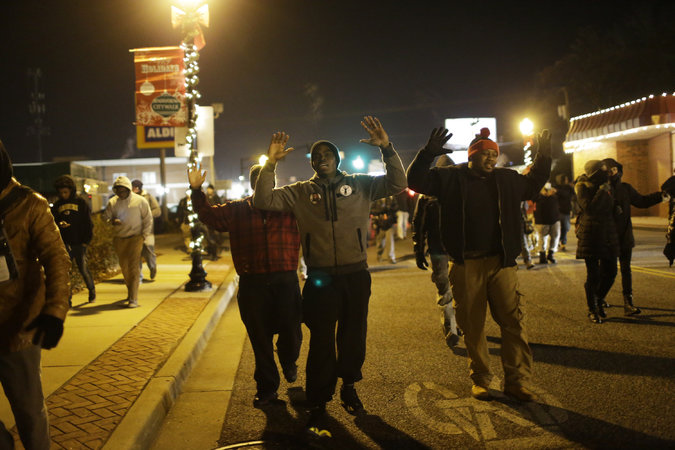
One week. That’s how long it’s been since a grand jury did not find enough probable cause to indict Officer Darren Wilson in the shooting death of Michael Brown. Following the grand jury’s decision, demonstrations were staged nationwide to protest the decision. Some were peaceful. Some were not. Some demonstrations were little more than thinly veiled excuses for looting rampages.
As I have been following this story over these past few months, I have been grieved by how the debate over Ferguson has unfolded. Everyone, it seems, has a particular point to make. Some are concerned for Officer Wilson. Why do so many refuse to believe a grand jury’s findings in spite of some pretty clear facts? Others are concerned with larger issues of racism. What has happened with Michael Brown, many say, is emblematic of the mistrust that the African-American community has with law enforcement, many times with good reason. Still others are concerned with widespread crime and violence within the African-American community. Generations of young black men have destroyed themselves through bad choices.
Here’s what bothers me about all of these points. They’re all, in some sense, legitimate. If Officer Wilson was only doing his best in a really bad situation, he should not be offered to protestors as a sacrificial lamb. The injustice of racism is not going to be solved or salved by more injustice against an officer. At the same time, we do have a problem with racism in this country. And we need to admit that. Indeed, it has choked me up to read personal stories of young black men describing what they have had to endure growing up. Take, for instance, this story. And this story isn’t from some bygone early 60’s era. Derek Minor was born in 1984. At the same time, widespread crime and violence within the African-American community – and in any community, for that matter – also needs to be addressed. Such sin is not always somebody else’s fault. Sometimes, the blame rests at our feet.
All of these points are, in some sense, legitimate. But all of them also have the potential, in some sense, to render themselves illegitimate. Here’s why. Far too often, when we try to make one of these particular points, we refuse to acknowledge that another person trying to make another one of these points actually has a point. Those who are trying to defend Officer Wilson can sometimes refuse to acknowledge larger issues of racism. Those who are concerned with the larger issue of racism can sometimes refuse to admit that Officer Wilson may have just been doing his job. Those who are concerned with problems within the black community can sometimes refuse to acknowledge that there may be things outside the black community that need to change as well. But when we become so obsessed with making our point that we fail to acknowledge someone else’s point, we damage the very point we’re trying to make.
So allow me to add my point to these many other points: We need to stop trying only to make our point and start listening to the points of others and acknowledge that others may, in fact, have a point. In other words, we need to start having constructive dialogue and stop trying to merely win a debate.
I’m wondering when and if and when we will ever be able to admit that situations such as these are much more nuanced and complex than a single point can ever make them. And I’m wondering if and when we will ever be able to stop making points and start having generative conversations. Because if we’re only interested in winning a point, we may just lose the truth.
Just look at Ferguson.


 Pastor Zach's Blog