Posts filed under ‘Current Trends’
What If Planned Parenthood Is Sincere?

Credit: AFP Photo/Mandel NGAN
Last week, Cecile Richards, president of Planned Parenthood, announced in a letter to the National Institutes of Health that the organization she heads will no longer be accepting reimbursements of any kind for its disbursements of fetal tissue:
Our Federation has decided, going forward, that any Planned Parenthood health center that is involved in donating tissue after an abortion for medical research will follow the model already in place at one of our two affiliates currently facilitating donations for fetal tissue research. That affiliate accepts no reimbursement for its reasonable expenses – even though reimbursement is fully permitted … Going forward, all of our health centers will follow the same policy, even if it means they will not recover reimbursements permitted.[1]
This new policy comes on the heels of a firestorm over whether or not Planned Parenthood has been illegally selling aborted baby parts for profit. A series of undercover videos published by the Center for Medical Progress appears to show Planned Parenthood officials admitting that they do, in fact, make money off the sale of fetal tissue, even if such profit is minimal. Profit from the sale of fetal tissue is a federal offense.
Upon the release of this new policy, abortion opponents were quick to react with cynicism, asking why, if Planned Parenthood has done nothing wrong as it has been claiming throughout this controversy, the organization would need to change their current policy at all. Bre Payton, writing for The Federalist, opines, “Despite its previous claims of innocence, Planned Parenthood’s announcement today suggests that the organization knew its activities were almost certainly illegal.”[2]
Ms. Payton may be right. It may be that Planned Parenthood knew that what it was doing was illegal and was simply gaming the system. But I’m not so sure. Planned Parenthood’s statement may actually be sincere.
If I was to be accused of some wrongdoing – let’s say, financial mismanagement – not only would I adamantly maintain my innocence if I believed I had done nothing wrong, I would take extra precautionary measures to guard against further accusations. So, using the example I cited above, I may institute an annual independent audit of my income and expenses and share the results with key people in my life to make sure I am held financially accountable. But this would not be an admission I had done something wrong. Rather, it would be an attempt to be above reproach in my finances so that all could see I was committed to doing right.
I have to at least entertain the possibility that Planned Parenthood is acting in this same way by refusing to take any sort of reimbursement for their disbursement of fetal tissue. They may simply be trying to be above approach in how they handle their fetal tissue. If this is the case, however, it terrifies me. Here’s why.
If Planned Parenthood really is simply trying to be above reproach in their fetal tissue disbursements, this means that they truly believe that what they have done is not illegal and, even more disturbingly, not immoral. In other words, it could be that some – indeed, even many – at Planned Parenthood believe that what they are doing by offering abortions and dispersing baby parts is good, needed, and right. What is happening is not flowing out of sinister conniving, but out of genuine conviction.
I used to think people knew somewhere deep-down that abortion was a moral blight on our modern culture. As I have written before, if abortion isn’t self-evidentially morally repulsive, then nothing is. I still believe that most people do know this somewhere within the deep recesses of their souls. But after watching #ShoutYourAbortion trend on Twitter, I have come to recognize that some people do not. Consider these tweets:
I’ve never wanted to have children, so I had an abortion. I’m thriving, without guilt, without shame, without apologies. #ShoutYourAbortion (@favianna, 9.21.2015)
I had an abortion in 2008, and it was the easiest decision I ever made. Long before I got pregnant I had decided that… (Birdy Eugenie-Clark, 9.21.2015)
These women could be lying about their experiences with abortion. But, then again, they could be telling the truth. They really could be okay with and even happy about their abortions.
Columnist Dennis Prager distinguishes between that which “feels good” and that which “does good.” These two things, he notes, are not always the same. Take, for instance, in the realm of parenting:
It feels good to give one’s children what they want, but it rarely does good. It feels good to build children’s self-esteem – giving them trophies for no achievement, for example – but when the self-esteem is unearned, it doesn’t do good. It feels good to provide one’s adult children with money and other material benefits when they should be providing for themselves, but it doesn’t do good. And it feels good to coddle children rather than discipline them. But, same deal: It’s not good for them.[3]
What is true in parenting is true also of abortion. For some people – at least as far as they will publicly admit – abortion may feel good. It may feel good because it relieves a person of the burden of having to raise an unwanted child. It may feel good because it allows a person to have sex without having to worry about its divinely designed procreative telos. It may feel good because it feels empowering. It is the ultimate way to declare, “No one will tell me what to do with my body! Not even nature and nature’s God!” The problem is that many people have made what feels good equivalent to what is good. This is why I am willing to entertain the sincerity of Planned Parenthood’s statement about the trafficking of fetal tissue even if I am not willing to entertain its objective morality. We may have genuinely come to a point in our society where people have bought into a modified version of the old adage my mother once warned me against: “If it feels good, do it!” We now say, “If it feels good, it is good!”
As Christians, we need to continually remember and proclaim that what is good objectively cannot be determined only by what feels good internally. Good needs an external regulator. Christians believe this external regulator is Scripture and, in a secondary way, God’s ordering of creation. Even if our culture flatly rejects the first regulator, they’re still left to grapple with the second. Every pregnancy, even if it ends in abortion, is proof of that.
I hope we’re there to help people grapple with what true good looks like – and to lead them to surrender. Otherwise, this letter from Planned Parenthood will only be the first in a series of sad, but sincere, attempts to be above reproach while engaging in what is morally repulsive. And that would be heartbreaking.
____________________________________
[1] Cecile Richards, “Planned Parenthood Opt-Out,” Planned Parenthood Federation of America (10.13.2015).
[2] Bre Payton, “Planned Parenthood: We’re Going To Stop Doing That Thing We Said Was Totally Legal,” The Federalist (10.13.2015).
[3] Dennis Prager, “Feeling Good vs. Doing Good,” National Review (10.22.2015).
Pope Francis and What’s Most Important

Credit: AFP Photo/Paul J. Richards
The New York Times may have called him “the spiritual leader of 1.2 billion Catholics,” but it seemed nearly impossible for journalists and pundits to filter Pope Francis’ visit to the United States, which wrapped up last night in Philadelphia, through anything but a political lens. After an obligatory nod to his spiritual status, the Times went on to report about the Pope’s address to a joint session of Congress:
While he checked boxes in calling for religious liberty and defending the family, the heart of his address, and the most time, was dedicated to aspects of Catholic teaching embraced by progressives, especially the overriding need to help the poor and destitute. He was at his most passionate in embracing immigration, alluding to his own family’s history of moving from Italy to Argentina, where he was born …
He also warned of the excesses of globalization, though in far more measured tones than he has in the past, when he used fiery language and the memorable phrase “dung of the devil” to describe unbridled capitalism.[1]
“Religious liberty.” “The excesses of globalization.” “Unbridled capitalism.” Though these things certainly have theological implications, as the First Article of the Apostles’ Creed would remind us, in our society, they are cast first and foremost as political concerns. Indeed, the Times ultimately concluded:
In the end, both sides could walk away citing parts of his message. But the liberal agenda items in his speech were explicit and clear while the conservative ones were more veiled.
Apparently, the real value of Francis’ speech, according to the Times, lies in how politicians will be able to leverage it and not in the theology that was contained in it.
Filtering theology through political policy is fraught with danger. In such a system, orthodox doctrine all too often gets sacrificed to Machiavellian expediency and a Savior who died gets turned into a political operative who just happens to hate all the same people we do.
On the one hand, Francis seemed to defy such bare politicization of the papacy, as Peter Johnson points out in his article for The Federalist, “10 Stories The Media Won’t Tell You About The Pope’s USA Visit.” Mr. Johnson explains how the Pope has taken on both liberal and conservative concerns – everything from climate change and immigration to government overreach and the dangers inherent in the Affordable Care Act. Such political schizophrenia is inherent in Christian ethics, which has the pesky habit of refusing to conform to both the liberal and conservative party platforms. Christianity can, at times, annoy both the left and the right.
On the other hand, it’s not too difficult to understand why the Pope’s address to Congress has been interpreted politically rather than theologically. After all, in a speech that lasted for nearly an hour before a joint session of Congress, the Pope, while covering a whole range of geopolitical and ethical issues, failed to mention Jesus – even once! This seems odd and, honestly, downright disturbing for the leader of a body of whom the apostle Paul noted is at its best when it resolves “to know nothing … except Jesus Christ and Him crucified” (1 Corinthians 2:2).
In one sense, the domination of the geopolitical and the ethical at the expense of the Christological in the Pope’s words is understandable both in terms of the ecclesiology and the soteriology of the Roman Catholic Church.
Ecclesiologically, popes have historically laid claim not only to spiritual authority, but to temporal power as well. Such power was crystalized in 800 on Christmas Day when Pope Leo III crowned Charlemagne as the emperor of Rome. A spiritual authority, on that day, crowned a political one. These days, though the Pope’s temporal power formally extends only as far as Vatican City – and even that authority is largely titular – the papacy’s interest in and influence over temporal affairs lingers. So it comes as no surprise that Francis would seek to shape geopolitical events. In some ways, I welcome such an effort. Our geopolitics needs all the sanctified wisdom it can get. But when geopolitical concerns drown out any mention of Christ in a major address from a man who claims to be the head of Christ’s Church, I begin to get a little nervous.
Soteriologically, Roman Catholicism’s view of righteousness and its relationship to salvation lends itself to Francis’ deep concern over ethical issues. As a Lutheran Christian, I will often speak of two kinds of righteousness. The first kind of righteousness is that which is imputed to me from God in Christ by faith. In the words of the apostle Paul:
But now a righteousness from God, apart from law, has been made known, to which the Law and the Prophets testify. This righteousness from God comes through faith in Jesus Christ to all who believe. (Romans 3:21-22)
Christ’s perfect righteousness is a righteousness that leads to my salvation quite apart from anything I have done or ever will do. This righteousness is not an ethical task, but a sheer gift, not based on my actions, but based on Christ’s action for me on the cross. The second kind of righteousness involves the good deeds that I do for my neighbor. I am called to love, serve, and help my neighbor, as Jesus explains forcefully in His Parable of the Good Samaritan. When I do these things, I am acting in the way of righteousness. But such a righteousness does not save me. It simply helps others.
In the Roman Catholic system of theology, these two kinds of righteousness are collapsed into one. The righteous acts we do for our neighbor are righteous acts that are also taken into account when we receive salvation from God. The Catechism of the Catholic Church makes this clear enough:
Since the initiative belongs to God in the order of grace, no one can merit the initial grace of forgiveness and justification, at the beginning of conversion. Moved by the Holy Spirit and by charity, we can then merit for ourselves and for others the graces needed for our sanctification, for the increase of grace and charity, and for the attainment of eternal life.[2]
The Catechism baldly asserts that my righteousness cooperates with Christ’s righteousness so that I may attain eternal life. All the good things of which the Pope spoke in his speech, then, pertain to salvation because our good works on these good things aid in our salvation. It’s no wonder, then, that Francis would be especially concerned with our good works, even as the good work of Christ went missing in his words to Congress.
For all the excitement Francis’ visit and words generated, I fear that we managed to overlook what is the most important business of the Church: to proclaim Christ’s forgiveness for sinners. This, to borrow a phrase from Paul, is “of first importance” (1 Corinthians 15:3). All of the things the Pope addressed in his speech to Congress are important and should be discussed, but they are not most important.
Mollie Hemmingway puts the situation well when she writes:
It’s wonderful that some people say that Francis makes them feel the church is more welcoming to them. But if it’s just making people feel more comfortable in their politics, instead of making them feel the comfort of absolution, communion and strengthening of faith, that’s not much to get excited about.[3]
This is most certainly true. We can get excited over and become passionate about geopolitical issues. We can strongly advocate for ethical issues. I do all the time on this very blog. But our deepest commitment must be to Jesus. Our first proclamation must be of Him. For long after the concerns of this age fade way – indeed, long after this visit from this Pope is forgotten – Jesus will remain. The best thing this Pope can do, then, is invite us to turn our attention – and our hearts – to Him.
__________________________________
[1] Peter Baker & Jim Yardley, “Pope Francis, in Congress, Pleads for Unity on World’s Woes,” The New York Times (9.24.2015).
[2] Catechism of the Catholic Church (Collegeville, MN: 1994), § 2010.
[3] Mollie Hemmingway, “The Pope Francis Effect: Enthusiasm, But To What End?” The Federalist (9.25.2015).
A County Clerk, Gay Marriage, and What’s Right
Credit: Ty Wright/Getty Images
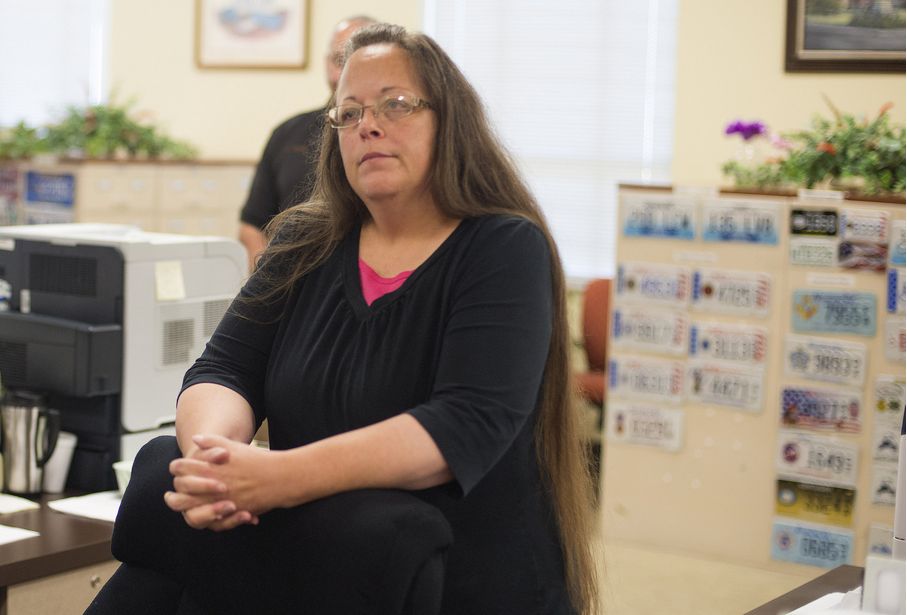
It’s not often a small town county clerk becomes a household name. But Kim Davis has managed to pull of just such a feat after going to jail last week for refusing to issue marriage licenses from her office. The Washington Post reports:
The Kentucky clerk drew headlines for refusing to issue marriage licenses to all couples, gay and straight, after the Supreme Court ruled earlier this summer that same-sex couples have the right to marry. An Apostolic Christian, Davis has said it would violate her faith to put her name on a marriage license for two people of the same sex.
She was sued by several gay couples and was ordered by [Judge] Bunning to begin issuing the licenses this week. When Davis defied the judge’s order, the couples asked for Davis to be held in contempt and fined.
But Bunning decided to jail Davis, saying fines would not be sufficient to compel compliance because Davis’s supporters could raise money on her behalf.
“The idea of natural law superseding this court’s authority would be a dangerous precedent indeed,” Bunning said.[1]
Not surprisingly, demonstrators, both in support and in protest of Mrs. Davis, gathered outside the courthouse where she was sentenced:
Ashley Hogue, a secretary from Ashland, held a sign outside the courthouse that read, “Kim Davis does not speak for my religious beliefs.”
“This is so ugly,” she said, wiping away tears. “I was unprepared for all the hate.”
Demonstrator Charles Ramey, a retired steelworker, downplayed the vitriol.
“We don’t hate these people,” he said, holding a sign that read, “Give God his rights.” “We wouldn’t tell them how to get saved if we hated them.”[2]
On the one hand, I am somewhat puzzled why Mrs. Davis, if she could not in good conscience carry out one of the duties for which state taxpayers are compensating her, did not simply resign her position. After all, for Mrs. Davis to refuse to issue marriage licenses not only to same-sex couples, but to all couples, and to make it incumbent on the clerks who work for her to follow suit hardly seems the best way to handle a personal religious objection, as Ryan T. Anderson, a senior research fellow at the Heritage Foundation, makes clear in this thoughtful article. Mrs. Davis explains her reasoning in the USA Today article: “‘If I left, resigned or chose to retire, I would have no voice for God’s word,’ calling herself a vessel that the Lord has chosen for this time and place.” Her explanation begs the question: would she really have no voice for God’s Word if she was not a county clerk? Couldn’t she be a witness for Christ in ways that involve less emotional, political, and rhetorical volatility than refusing to issue marriage licenses? And what does she do when she has to perform other duties that could – and perhaps should – violate her conscience, such as legally licensing divorces for couples who are not splitting for biblically appropriate reasons? I’m not sure I completely understand Mrs. Davis’ thinking.
On the other hand, I am also not unsympathetic to her plight. Here is a government worker who was thrown in jail because she, in her vocation, was seeking in some way to abide by what God’s Word says about sexual boundaries. A Christian theology of work says that no matter what we do, we ought to view ourselves as “working for the Lord, not for men” (Colossians 3:23). Mrs. Davis seems to be trying to put this theological truism into everyday practice. I should also note that she does not appear to have arrived at her practice of refusing to issue marriage licenses lightly. Her conversion to Christianity came on the heels of a history littered by broken marriages and broken hearts. Since her conversion, however, she has maintained a strong stance on biblically informed sexual standards.
This is one of those theologically, ethically, legally, and relationally thorny situations that seems to be increasingly common in our day and age. As Christians, how do we respond? Is Kim Davis right? Or should she resign if she cannot, in good conscience, issue marriage licenses?
In the book of Daniel, we meet a man who, like this county clerk, held a government job. Indeed, he held a very prominent government job. Under the reign of the Persian king Darius, this man Daniel “so distinguished himself among the administrators and the satraps by his exceptional qualities that the king planned to set him over the whole kingdom” (Daniel 6:3). Daniel’s upward mobility, it seems, was virtually limitless until, one day, as he went about carrying out his duties, the laws of the land changed in a way that violated his conscience:
The administrators and the satraps went as a group to the king and said: “O King Darius, live forever! The royal administrators, prefects, satraps, advisers and governors have all agreed that the king should issue an edict and enforce the decree that anyone who prays to any god or man during the next thirty days, except to you, O king, shall be thrown into the lions’ den. Now, O king, issue the decree and put it in writing so that it cannot be altered – in accordance with the laws of the Medes and Persians, which cannot be repealed.” So King Darius put the decree in writing. (Daniel 6:6-9)
As a worshiper of the God of Israel, Daniel could not, in good conscience, follow the king’s edict to pray only to the king – even though he was serving the king as a public official. So what does Daniel do?
Now when Daniel learned that the decree had been published, he went home to his upstairs room where the windows opened toward Jerusalem. Three times a day he got down on his knees and prayed, giving thanks to his God, just as he had done before. (Daniel 6:10)
I have sometimes wondered why Daniel didn’t try to negotiate some sort of compromise. Couldn’t he have stayed downstairs in a private room to pray to the true God rather than going upstairs and kneeling before an open window so everyone below would know exactly what he was doing? Couldn’t he have simply put off praying altogether in order to comply with the edict without committing idolatry against his God? After all, the edict was only in place for thirty days. In this instance, Daniel, according to his conscience, could do neither. He had to live out his faith, even if his faith was in conflict with his vocation as a public official and his status as a citizen of Persia.
You probably know the rest of the story. Daniel’s sentence was not just a jail cell, but a lions’ den. Daniel was willing to go to his death for his confession of faith. But, miraculously, “God sent His angel, and he shut the mouths of the lions” (Daniel 6:22).
It’s not difficult to draw parallels between Daniel’s story and Mrs. Davis’ story, save that we do not yet know how Mrs. Davis’ story will end. For us who are looking on, there are a couple of lessons I think we can take away from Daniel’s story. First, Daniel’s refusal to obey Darius’ edict had nothing to do with a political victory and everything to do with theological fidelity. I fear that, all too often, we can prioritize the politics of an issue like gay marriage specifically over a biblical theology of what marriage is generally. Any stand that we make must never be simply for the sake of winning a political battle, but for the sake of staying true to God’s Word. If people perceive that our theology is being leveraged merely as a means to political power, they have every right to be cynical of us and even angry at us. I’m fine if people, as I’m sure they did when Daniel was willing to be thrown to the lions, question our sanity, but we must never give people a reason to question our spiritual sincerity. Second, Daniel served and supported his governing authorities in every way he could until he couldn’t. This couldn’t have been easy for him. The Persians, after all, were pagans who shared none of Daniel’s theological commitments. But rather than fighting them, Daniel supported them in his work. He took a contrarian stand only when it was theologically necessary. I worry that, because of the deep suspicion and animosity that plagues our political system, we have become so devoted to fighting with each other on every front that we have lost our ability to take credible stands on the most important fronts. This is not to say that we can never be engaged in the political process – we do live in a democratic republic, after all – but it is to say that our governing authorities are first and foremost gifts from God to be supported by our prayers rather than political enemies to be bludgeoned by our anger.
As I think about Mrs. Davis’ predicament, I can appreciate her stand. My prayer for her, however, as she remains steadfast in her opposition to a Supreme Court ruling, is that she also proves stalwart in her commitment to love those with whom she disagrees. A strong stand may be good in the face of a morally untenable court decision. And she has decided to take one. But love – even when it’s love for the gay couple that comes walking through the door of the county clerk’s office – is absolutely necessary for Godly, gracious relationships. I hope she’s decided to give that.
______________________________
[1] James Higdon and Sandhya Somashekhar, “Kentucky clerk ordered to jail for refusing to issue gay marriage license,” The Washington Post (9.3.2015).
[2] Mike Wynn and Chris Kenning, “Ky. Clerk’s office will issue marriage licenses Friday – without the clerk,” USA Today (9.3.2015).
Colorado’s Pot Problem
 It’s really difficult to legalize something and discourage its use all at the same time. That’s what Colorado lawmakers are learning. In a state where marijuana is legal, lawmakers are faced with a dilemma: how do they uphold and support the legality of recreational marijuana use among adults while speaking out against its use among teens? Kristen Wyatt, in an article published in The Washington Post, outlines their strategy:
Marijuana isn’t evil, but teens aren’t ready for it: That’s the theme of a new effort by Colorado to educate youths about the newly legal drug.
Colorado launched a rebranding effort Thursday that seeks to keep people under 21 away from pot. The “What’s Next” campaign aims to send the message that marijuana can keep youths from achieving their full potential.
The campaign shows kids being active and reminds them that their brains aren’t fully developed until they’re 25. The ads say that pot use can make it harder for them to pass a test, land a job, or pass the exam for a driver’s license.[1]
Marijuana may be legal in Colorado, but that doesn’t mean it’s good for you – at least according to the public service ads produced for the “What’s Next” campaign:
One ad shows a teen girl working out on a basketball court and the tag line, “Don’t let marijuana get in the way of ambition.” Another ad shows a boy rocking out on a drum set with the tag line, “Don’t let marijuana get in the way of passion.”
Colorado’s anxiety over the teen use of a drug that, for adults, is legal presents us with an interesting ethical conundrum. Marijuana, except in very limited cases when prescribed by a physician, is demonstrably dangerous and, in many instances, is downright deadly. But, then again, cigarette smoking is irrefutably linked to cancer, alcohol consumption impairs a person’s ability to operate a vehicle and, over the years, can also cause liver damage, and the foods we eat on a daily basis are sometimes less than nutritionally sound. Yet, these things are legal nationwide. So is it really logically responsible, or politically feasible, to support the outlawing of recreational marijuana use in Colorado?
On the one hand, we need to recognize that the moral imperative to be responsible for what we take into our bodies is impossible to legislate comprehensively. Human wisdom must play a roll. For instance, having a glass of wine with supper, which has the potential of decreasing a person’s chance of developing heart disease, is very different from guzzling a case of beer on the beach. Or, as Morgan Spurlock learned, an occasional trip to McDonald’s with the kids for a Happy Meal and a toy is very different from eating only Super Sized meals from the Golden Arches for breakfast, lunch, and supper. Even a taste of what may soon be a legal Cuban cigar is very different from a person who smokes a pack of Camels a day. Calling people to moderation in everything, as Aristotle taught in his Doctrine of the Mean,[2] is much more helpful – and, I would add, much more practical and realistic – than trying to safeguard against all potential abuses of these things by dint of legislation and regulation.
On the other hand, it is a logical error to suppose that just because legislation and regulation can’t solve every issue that affects the care of the body means that it can’t be helpful in any issue that affects the safety of a person. This is, after all, the whole reason for the existence of the Food and Drug Administration, which works tirelessly to ensure that the food we eat for meals and the medicines we take for illnesses are safe. But marijuana is not safe, which is, perhaps, why, even though it’s legal in Colorado, it’s still outlawed federally.
When I am prescribed a drug for an illness, if the list of the drug’s side effects is lengthy while its benefits are minimal, I become leery of taking it and will further consult with my physician over it. There is no doubt that the problems with marijuana far outpace its benefits. Indeed, aside from acute medical cases, marijuana’s benefits can really only be defined in social terms. Marijuana is good for partying. And that’s about it.
It is this that leads us back to Colorado’s curious campaign to discourage teen marijuana use. The social capital associated with having, sharing, and using marijuana is deeply enticing to teenagers. After all, teenagers – at least many of them – love to party. So when Colorado makes marijuana as accessible as alcohol, does the state really think a slick public service campaign will stem the tide of teens using what is not only a dangerous drug in and of itself, but an addictive gateway drug that often leads to more serious substance abuse?
Moderation is good for many things, as Aristotle teaches. But in this instance, a little wisdom from Augustine may be in order as well. Augustine, though also a supporter of moderation, reminds us that, sometimes, complete abstinence is preferable to even perfect moderation.[3] When it comes to marijuana, we need learn how to choose between the options of abstinence and moderation wisely.
Something tells me Colorado chose poorly.
_______________________________________
[1] Kristen Wyatt, “Colorado rebrands anti-pot campaign for kids,” The Washington Post (8.20.2015).
[2] Aristotle, Nicomachean Ethics 1106a26-b28.
[3] Augustine, Of the Good of Marriage 25.
Ashley Madison, Morality, and Legality
 Sex sells. Or so the old advertising cliché tells us. But even if it’s cliché, it also happens to be true. And no company knows this truth better than Ashley Madison. They have built their business on appealing to those who want to cheat on their spouses. Their slogan, “Life is short; have an affair,” sums up their business model. They promise would-be cheaters the ability to discretely find each other online, meet up, and break their wedding vows, all the while hiding their infidelity from their spouses. But last month, the security of Ashley Madison’s secretive sex services was dealt a blow. The New York Times reports:
The company behind Ashley Madison, a popular online dating service marketed to people trying to cheat on their spouses, said on Monday that the site had been breached by hackers who may have obtained personal data about the service’s millions of members.
The group of hackers behind the attack, going by the name Impact Team, said they had stolen information on the 37 million members of Ashley Madison. To prevent the data from being released, the hackers said, the company needed to shut down the site entirely.[1]
This story is fascinating on many fronts. First, it is fascinating that the Times refers to Ashley Madison as “a popular online dating service.” Truthfully, it is nothing of the sort. Dating is not the same as hooking up. Ashley Madison is not particularly interested in promoting healthy, stable, long-term relationships. They are interested in helping people scratch their lustful itches.
Second, it is fascinating how Noel Biderman, the CEO of Avid Life Media, the parent company of Ashley Madison, is characterizing this breach of security: “Like us or not, this is still a criminal act.”[2] Mr. Biderman characterizes what has happened to his company only in legal terms. He does not say what the hackers did was wrong. He does not talk about the ethical problems that accompany invading someone’s privacy. He does not cast anything in terms of good or bad, right or wrong.
Of course, Mr. Biderman’s moral ambivalence at this security breach is inescapably necessary. After all, his whole company is devoted to encouraging and enabling that which is deeply immoral. Thus, his only recourse to denounce anything is legal. But when the technicalities of legality displace the standards of morality, humans are left with nothing but depravity. For humans will inevitably bend the law to satisfy and justify their own desires – even when those desires are categorically evil. Legislation cannot fix – and very often has trouble even restraining – human sinfulness.
Third, Mr. Biderman’s characterization of what has happened to his company in strictly legal terms aside, what has happened to Ashley Madison does represent a supreme moral irony. Ashley Madison is a company that has built its reputation and fortune on deceit – on providing people a way to cover up their sexual dalliances. Now, a group calling themselves the Impact Team, who some security experts have suggested may be a group of insiders, has deceived the masters of deceit by managing to hack into Ashley Madison’s most sensitive information. Deceit has been laid bare by deceit. And what the hackers will do with this information next is the source of great apprehension.
Whatever comes of the hacked data, this much is sure: Ashley Madison needs to change their slogan. They may tell you “life is short” so you can “have an affair,” but when your spouse catches you, the havoc you will have wreaked in your marriage won’t feel short. It’ll feel like an eternity. And that’s why you ought to think long and hard before you log on to Ashley Madison. Because if you do, you won’t. And that would be good.
___________________________________
[1] Dino Grandoni, “Ashley Madison, a Dating Website, Says Hackers May Have Data on Millions,” The New York Times (7.20.2015).
[2] Wilborn P. Nobles III, “After hackers expose cheaters, AshleyMadison hookup site offers ‘full delete’ option,” The Washington Post (7.20.2015).
The Strategy of Love

Credit: New York Times via The Associated Press
This has not been a good season for race relations in America. The latest round of racial tension began with a horrific racially motivated shooting at a Charleston church. This sparked a debate over displaying the Confederate flag at the South Carolina State House that became so fierce that a black man named Anthony Hervey who often dressed in Confederate regalia and waved the state flag of Mississippi, which contains the Confederate flag in its design, in an attempt to honor African-Americans who served with the Confederacy during the Civil War was allegedly run off the road by another vehicle full of people angry at his demonstrations. Then there was 43-year-old James Dubose, a black man, who was shot and killed by a white University of Cincinnati police officer after being pulled over for not having a front license plate on his vehicle. The officer is charged with murder. Although authorities do not yet know precisely what precipitated this shooting, the episode has certainly exacerbated race relations in that community.
Now, there are these dueling rallies between two self-identified racially distinctive groups at the State House in South Carolina. The New York Times reports that though there were some scuffles between the groups and some demonstrators were arrested, because the groups were on opposite ends of the State House and their contact with each other was minimal, thankfully, no major fights erupted.
Perhaps the point of contact that was most noteworthy in these demonstrations was not a point of contention between these two groups with each other, but a point of grace that an officer had with a Klan member.
Officer Leroy Smith is the Director of the South Carolina Department of Public Safety. He was at the State House the day of the demonstrations, working crowd control. In the midst of his duties, he spotted an elderly man who was part of the Klan rally, donning a t-shirt emblazoned with a swastika, who looked sickly and weak as he protested in the hot South Carolina sun. What did Officer Smith do? He took him by the arm and led him up the steps of the State Capitol into the air-conditioned building.
Did I mention Officer Smith was black?
Just days before, Officer Smith had watched as state troopers lowered the Confederate flag from its perch atop the capitol grounds for the final time. The symbolism of the moment sent chills up his spine. But lowering a flag that is widely associated with racial tension cannot kill hatred. It cannot kill suspicion. It cannot kill resentment. It cannot kill self-absorption. Indeed, all of these things were on display the day of the demonstrations. But then one man decided to show love.
The Klan did not volunteer the name of the man Officer Smith helped up the steps of the State House. But it doesn’t really matter. What matters is that this one scene – this one act – is what will be remembered out of an otherwise frightful day in Charleston. This one scene – this one act – is what wound up overshadowing all the expressions of dismay, distrust, and disunity.
Jesus said, “You have heard that it was said, ‘Love your neighbor and hate your enemy.’ But I tell you: Love your enemies and pray for those who persecute you” (Matthew 5:43-44). When we read these words, we can be tempted to relegate them to the realm of nice sentiment rather than practical reality. Enemies, our street smarts tell us, need to be defeated, not loved. But then one man decided to love someone who, by all accounts, was his enemy. And his love devastated the divisive strategies of literally thousands of protesters. Jesus’ strategy of love, it turns out, made a much stronger impression than any human strategy of malcontent.
What will be remembered the most from that day in Charleston is the love of an officer for a man who, morally, holds repugnant views. As Christians, what will be remembered of us? Will we be remembered for loving those who others – and, if we’re honest, we ourselves – would find it far easier to hate? If our lives are marked by anything other than Jesus’ strategy of love, it’s time to change our strategies. After all, Jesus’ strategy is better. And His strategy really does work. In fact, more than that, His strategy really can transform prejudices and people. Just ask Officer Smith.
What Planned Parenthood Wants You To Believe About Sex
 “Planned Parenthood.” “Selling.” “Aborted Baby Parts.” When a friend first texted me a link with these words in the URL, I knew I was in for a wild ride. The Center for Medical Progress, an anti-abortion group, released a video, recorded in 2014, of two of their operatives, posing as employees from a biotech firm, having a discussion over lunch with Deborah Nucatola, Planned Parenthood’s Senior Director of Medical Research. The Center for Medical Progress claims the video blows the whistle on the trafficking of aborted baby organs. Planned Parenthood disputes these claims. Eric Ferrero, Planned Parenthood’s Vice President of Communications, issued this statement:
In health care, patients sometimes want to donate tissue to scientific research that can help lead to medical breakthroughs, such as treatments and cures for serious diseases. Women at Planned Parenthood who have abortions are no different. At several of our health centers, we help patients who want to donate tissue for scientific research, and we do this just like every other high-quality health care provider does – with full, appropriate consent from patients and under the highest ethical and legal standards. There is no financial benefit for tissue donation for either the patient or for Planned Parenthood. In some instances, actual costs, such as the cost to transport tissue to leading research centers, are reimbursed, which is standard across the medical field.
In the video, however, Ms. Nucatola seems to contradict Mr. Ferrero’s statement when she explains:
I think every provider has had patients who want to donate their tissue, and they absolutely want to accommodate them. They just want to do it in a way that is not perceived as, “This clinic is selling tissue, this clinic is making money off of this.” I know in the Planned Parenthood world they’re very, very sensitive to that. And before an affiliate is gonna do that, they need to, obviously, they’re not – some might do it for free – but they want to come to a number that doesn’t look like they’re making money …
I think for affiliates, at the end of the day, they’re a non-profit, they just don’t want to – they want to break even. And if they can do a little better than break even, and do so in a way that seems reasonable, they’re happy to do that.
Ms. Nucatola’s slippery language is striking. She never asserts that Planned Parenthood is not, as a matter of fact, making money off organs from abortions, she just says Planned Parenthood doesn’t want it to “look like they’re making money.” She even admits, “If they can do a little better than break even … they’re happy to do that.” In other words, Planned Parenthood does make money off selling organs from aborted babies according to Ms. Nucatola, they just don’t make a lot of money off it.
It sounds like Planned Parenthood may be gaming federal law. 42 U.S. Code § 289g–2 states:
It shall be unlawful for any person to knowingly acquire, receive, or otherwise transfer any human fetal tissue for valuable consideration if the transfer affects interstate commerce … [which] does not include reasonable payments associated with the transportation, implantation, processing, preservation, quality control, or storage of human fetal tissue.
Selling fetal tissue for profit is illegal. Getting reimbursed for expenses associated with shipping and processing fetal tissue, however, is not. It seems as though Planned Parenthood will take any money they can claim as reasonable reimbursement for the costs of transporting and processing aborted organs, and if these monies are slightly more than what the actual costs are, so be it – as long as they’re not exorbitant enough to look like “profit.”
Planned Parenthood may not have gamed federal law as well as they thought, however. In the video, Ms. Nucatola links Planned Parenthood to an organization called StemExpress, a company that bills itself as providing “qualified research laboratories with human cells, fluids, blood and tissue products for the pursuit of disease protection and cure.” StemExpress also explains to potential allies that “by partnering with StemExpress, not only are you offering a way for your clients to participate in the unique opportunity to facilitate life-saving research, but you will also be contributing to the fiscal growth of your own clinic.” I’m not sure how “the fiscal growth of your own clinic” can be construed to be anything other than profit for your clinic. And considering the prices StemExpress charges for their fetal organs, if StemExpress does indeed share some portion of their proceeds with Planned Parenthood for the “fiscal growth” of their clinics, it seems awfully shady for them to claim they are not, at least indirectly, profiting, perhaps handsomely, off fetal tissue.
This is really bad. But it gets worse.
In the conversation, Ms. Nucatola also talks about intentional steps clinics will take during abortions to keep a baby’s organs in tact so they can be sold later:
You’re just kind of cognizant of where you put your graspers, you try to intentionally go above and below the thorax, so that, you know, we’ve been very good at getting heart, lung, liver, because we know that, so I’m not gonna crush that part, I’m going to basically crush below, I’m gonna crush above, and I’m gonna see if I can get it all intact. And with the calvarium, in general, some people will actually try to change the presentation so that it’s not vertex, because when it’s vertex presentation, you never have enough dilation at the beginning of the case, unless you have real, huge amount of dilation to deliver an intact calvarium. So if you do it starting from the breech presentation, there’s dilation that happens as the case goes on, and often, the last, you can evacuate an intact calvarium at the end.
This is all deeply disturbing. What is allegedly happening is not only potentially illegal; it is profoundly immoral. In what world is it okay to turn a baby breech so you can smash its legs, kill it, and then harvest its organs for profit? Is there any conceivable scenario where this is okay? Have we decided that a baby, growing in its mother’s womb, is so devoid of any rights and is so unable to be considered life in any meaningful way that it can be stripped of its dignity limb by limb – literally? This is self-evidentially morally repugnant. And if you can’t see that, we no longer need to have a conversation about abortion. We need to have a conversation about nihilism.
This is not to say Planned Parenthood doesn’t have its supporters, even if supporting the organization is a little untenable right now. Amanda Marcotte, writing for Slate Magazine, admits:
As someone who is squeamish, it was extremely difficult for me to listen to Nucatola talk about extracting liver, heart, and other parts to be donated to medical research. (I nearly fainted when a friend showed me the video of her knee operation once.) But people who work in medicine for a living do, in fact, become inured to the gore in a way that can seem strange to those of us who aren’t regularly exposed to it. She also thought she was speaking to people in her profession who would be similarly accustomed to this sort of thing.
Abortion is gross, no doubt about it. It becomes grosser the later in a pregnancy it gets. But so is heart surgery. So is childbirth, for that matter.
Behold, the fallacy of false equivalence. How one can equate the grossness of abortion to the grossness of heart surgery or birth is beyond me. Two of these things sustain life. One of these things, as more honest abortion supporters will admit, ends life. As any child who watches Sesame Street could tell you, “One of these things is not like the other.”
In researching for this blog, I went to Planned Parenthood’s website. I was greeted by a banner that said, “Worried? Had unprotected sex?” It is here that we find the real reason behind Planned Parenthood’s existence. This organization exists to promote sex-on-demand, divorced from any of the entailments that come with it like, in this instance, children. Sex with whom you want, when you want, and how you want is Planned Parenthood’s holy grail. And it is so sacred that they will kill for it – again, literally.
In other posts on this blog, I have painstakingly sought to not flippantly dismiss or diminish the desires and struggles people face when it comes to sexuality. I want to be as sensitive and empathetic as possible. These are, after all, confusing issues that deserve compassionate thought rather than self-righteous ire. But this is not about these issues. In fact, this is not about individuals and abortion. This is not about the woman who has suffered through the trauma of an abortion, though I grieve for you and, I am afraid, many times, with you. This is not about the woman who went too far and is now pregnant and scared and is contemplating an abortion, though I would encourage you to seek guidance and help from people committed to alternatives to abortion. You are in genuinely confusing and painful situations and have my concern, my compassion, and my prayers. This is not about you. This is about Planned Parenthood and their pack of twisted lies that unashamedly promotes the sacrifice of life for sex, which, I should point out, is the precise opposite of what sex is meant for and, by its very nature, is designed to do. Sex is not meant to take life. It’s meant to give it. This is not about personal sexual confusion. This is about an organization’s out and out corruption that has expressed itself again and again in the most macabre of ways – this time, in the sale of aborted organs.
At the risk of being offensive, I think it’s time for us to ask ourselves a few frank questions: Is indulging every sexual impulse in ways that transgress the sanctity of marriage and the security of family really our best strategy for intimacy? Is this really the legacy we want to leave our children, our children’s children, and so on? Is this really the evolutionary ethical curve we want to ride? Is it really beneficial for us to do what we want, when we want, and with whom we want and then use any means necessary to impede the entailments of our actions, even when impeding the entailments of our actions includes ending lives in utero? Is sexual self-control – even when it is difficult and involves some emotional pain – really that out of the question? Have we become that banal? Is Planned Parenthood’s view of human sexuality really the banner we want to wave and the worldview we want to adopt? And does it really take deceitful operatives from an anti-abortion organization secretly videotaping a conversation with Planned Parenthood’s Senior Director of Medical Research, which itself presents us with a whole other set of legal and ethical difficulties, to get us to ask these questions? Shouldn’t we be thinking about the weighty ethical implications and aberrations of abortion even when there’s not a titillating video making its rounds on the Internet?
Ms. Marcotte was right about this much in her article for Slate:
This latest attack on Planned Parenthood is not just about abortion, but about demonizing an organization that makes sex safer and easier, while making it possible for women to plan when they have children.
This is exactly what Planned Parenthood is all about. They’re all about “safe sex,” which, if we’re honest, is just a euphemism for what Ms. Marcotte refers to next: “easy sex” – sex without responsibility, commitment, or offspring. So really, Planned Parenthood is about easy sex – even when easy sex involves dismembering babies and selling their organs. So let me ask:
Is the easy sex worth it?
On Edge…About Everything
 Last Wednesday morning was an unexpectedly frenzied one. Within the scope of a few hours, all United Airlines planes were grounded, the website for the Wall Street Journal went dark, and trading at the New York Stock Exchange grinded to a screeching halt. The problem in each instance? Computer glitches.
It didn’t take long for people to begin to fear that we under some sort of cyber attack. Lester Holt, anchor of NBC Nightly News, opened the newscast that night with an honest acknowledgement of the anxiety so many were feeling:
A lot of us got that uneasy feeling today when within hours of each other separate computer outages grounded all United Airlines flights and halted trading on the New York Stock Exchange.
Uneasy feeling, indeed. What happened was so startling, it got the attention of Homeland Security.
In the end, it was discovered that United’s problems stemmed from “a failed computer network router that disrupted its reservation system.” Trading on the New York Stock Exchange went down because of a “botched software upgrade” the night before. As for the Wall Street Journal, though no definitive explanation has been offered for its problems, some are speculating that the trouble at the Stock Exchange drove people to the Wall Street Journal for updates, which, in turn, crashed the website. Cyber terrorism had nothing to do with anything. We had no need to fear. But we did.
Fear is plentiful these days. It doesn’t take much to make us apprehensive. Sadly, fear is just as prevalent – if not more so – in the Church as it is in wider society. I have talked to Christians who are wringing their hands over what could very well be an erosion of our religious liberty. I have talked to Christians who are terrified by what is happening oversees – and, for that matter, close to home – with ISIS. I have talked to Christians who are anxious about our nation’s economic path. I have talked to Christians who are frightened by just about everything.
For Christians who are full of fear, this description of who we are as the Church from Pope Benedict XVI strikes me as timely:
Is the Church not simply the continuation of God’s deliberate plunge into human wretchedness? Is she not simply the continuation of Jesus’ habit of sitting at table with sinners, of His mingling with the misery of sin to the point where He actually seems to sink under its weight? Is there not revealed in the unholy holiness of the Church, as opposed to man’s expectations of purity, God’s true holiness, which is love – love which does not keep its distance in a sort of aristocratic, untouchable purity but mixes with the filth of the world, in order thus to overcome it?[1]
This is an impressively clear, cogent, and, I should affirm, broadly, even if not comprehensively, correct ecclesiological statement from the former leader of the Roman Catholic Church. The Church, Benedict reminds us, is incarnational in her character and missional in her charter. She goes to places no one else would dare to darken – filthy places, impoverished places, wicked places, sinful places. As the Church ministers in sinful places like these, she, like Jesus, in the words of the former pope, can “actually seem to sink under [sin’s] weight.” But, of course, when Jesus sank, He didn’t sink for long. Three days is all sin got of Him. So it is with Christ’s Church. “The gates of Hades will not overcome it” (Matthew 16:18), Jesus promises. Sin may attack the Church, but it will not overcome her.
When we, as the Church, become afraid of the sinfulness in our world, we stop acting as the Church should for our world. We become so scared of sinners because of what they might to do to us that we forget to love sinners as Christ has loved us. The fearfulness of the faithful, it turns out, can be just as dangerous to the Church as the sinfulness of the world, for it stymies the Church in her mission.
In 1931, Swedish theologian Gustaf Aulén published Christus Victor where he wrote of how Christ “fights against and triumphs over the evil powers of the world, the ‘tyrants’ under which mankind is in bondage and suffering.”[2] To this day, his book is a standard-bearer for discussions about Christ’s work and accomplishments on the cross. But we must always remember that Christ’s victory is also our victory. Christus Victor is the promise of Ecclesia Victor.
Do not, then, be afraid. Instead, be the Church. The world needs us.
______________________________
[1] Pope Benedict XVI, Introduction to Christianity, Second Edition (San Francisco: Ignatius Press, 2004), 342.
[2] Gustav Aulén, Christus Victor: An Historical Study of the Three Main Types of the Idea of Atonement, A.G. Hebert, trans. (Eugene: Wipf & Stock, 2003), 4.
Obergefell v. Hodges
 When the Supreme Court ruled on Obergefell v. Hodges[1] a little over a week ago, the verdict was not a surprise, but the reaction was fierce. Facebook profiles and even the White House went rainbow. Crowds gathered to celebrate and shed tears of joy. Others were not nearly so jubilant. Jonathan Saenz, President of Texas Values, issued this statement:
This decision is the most egregious form of judicial activism of our time, overriding the votes of over 50 million voters, including millions in Texas. The freedom to democratically address society’s most fundamental institution is central to ordered liberty. The Court has taken that freedom from the people.
This decision has no basis in the text of the Constitution and will never be accepted by millions of Americans and Texans that understand that marriage, by nature and God’s design, can only be the union of a man and woman, husband and wife, mother and father. No decision by five judges can ever alter this fundamental truth.[2]
As Christians, it can be hard to know what to say or where to stand. The day the Supreme Court’s decision came down, I offered some initial reflections with the promise of more to come. These are those further reflections. Though these reflections will not address every concern, they will hopefully give us a way to begin to think theologically and pastorally about what has transpired and help us live together peacefully and in love.
What Scripture Says
As I said in my original blog on the Supreme Court’s decision, we need to remain committed to what Scripture says about all our relationships and, specifically, those that are deeply intimate in nature. But we also must remember that our understanding of Scripture can prove fallible. It is easy to fall prey to foolish and sloppy readings of what the Bible has to say on sexual ethics, making assumptions that are based more in our cultural biases than in careful exegetical study. As William Eskridge explains in an article for The New York Times:
Biblical support for slavery, segregation and anti-miscegenation laws rested upon broad and anachronistic readings of isolated Old Testament passages and the Letters of Paul, but without strong support from Jesus’ teachings in the Gospels … The current … view that God condemns “homosexual behavior” and same-sex marriages comes from the same kind of broad and anachronistic scriptural readings as prior support for segregation.[3]
Although Eskridge’s assumed contradiction between what Jesus taught and what the rest of the Bible has to say is problematic, he does have a point: we have not always gotten things right.
So how do we avoid misreading Scripture on gay marriage? To begin with, we must never handpick proof texts without context. Arguments made in this way against gay marriage are not only not persuasive theologically, they’re also not solid methodologically. A better hermeneutical case for traditional marriage can be made by looking at the sweep and scope of Scripture. Scripture begins (Genesis 2:24) and ends (Revelation 19:7) with the wedding of a bride and her groom. Jesus affirms both God’s creational and eschatological pattern for this staid institution as one that involves a husband and a wife (Matthew 19:4-6). Furthermore, when this pattern for marriage is abandoned, the results never seem to be good (e.g., Genesis 29:30; 1 Kings 11:1-4; Proverbs 6:32; 1 Corinthians 5:1-2).
The Bible does not seem to be nearly so concerned with condemning gay marriage specifically as it is with affirming God’s design for marriage generally – and not just because deviating from God’s design is morally wrong, though, in fact, it is, but because it is personally hurtful. Marriage has not only a moral design; it has a compassionate intent. This is why God institutes it as gracious gift (cf. Genesis 2:18). The biblical authors do not want people to miss out on God’s gracious gift by not receiving it as God intended it.
How We Say What Scripture Says
When speaking about same-sex marriage, we must stop embracing and employing over-the-top rhetoric. A pastor who threatens, even if figuratively, to immolate himself if the Supreme Court allows for nationwide gay marriage sounds, and perhaps is, insane. A preacher who drops the Supreme Court’s ruling to the ground while holding up the Bible in the middle of his sermon may garner some applause from the faithful, but such grandstanding does nothing to contribute to civil and important conversation.
I can’t help but wonder if the reason we are sometimes tempted by such silly stunts is because we live with a kind of Chicken Little apocalypticism. We really are afraid the sky is falling. But it is not.
Chief Justice John Roberts, in his dissenting opinion, writes:
The Court today not only overlooks our country’s entire history and tradition but actively repudiates it, preferring to live only in the heady days of the here and now. I agree with the majority that the “nature of injustice is that we may not always see it in our own times.” … As petitioners put it, “times can blind.” … But to blind yourself to history is both prideful and unwise.
This is well stated. As Justice Roberts notes, the ethical stances of yesteryear are by no means unimpeachable, but they are also not meant to be thoughtlessly discardable in an assumed inexorable evolutionary advancement toward ethical nirvana. C.S. Lewis would remind us that there is a “great cataract of nonsense that pours from the press and the microphone of [our] own age.”[4] In other words, we’re not as enlightened or as advanced as we think we are.
Thus, we need not fear. What is happening now does not mean the sky is falling. It simply means that history is marching – sometimes wisely and sometimes foolishly. Waiting and watching to see what comes of “the heady days of the here and now” is a much smarter – and, I would add, much less stressful – option than opining about the doom and gloom that lurks around the corner.
Religious Liberty and Pastoral Care
Sadly, the Supreme Court’s decision does raise real concerns over religious liberty. In the majority opinion, Justice Kennedy addresses these concerns, writing:
It must be emphasized that religions, and those who adhere to religious doctrines, may continue to advocate with utmost, sincere conviction that, by divine precepts, same-sex marriage should not be condoned. The First Amendment ensures that religious organizations and persons are given proper protection as they seek to teach the principles that are so fulfilling and so central to their lives and faiths, and to their own deep aspirations to continue the family structure they have long revered.
Justice Kennedy’s synopsis of the First Amendment is interesting – and troubling. He sees the First Amendment as protection to “teach the principles that are so fulfilling and so central to … lives and faiths.” This is well and good. But what happens when teaching faith translates into living faith? What happens when those living their faith intersect with others who do not share their faith? Does religious protection now extend only to what one says?
The dissenting justices are rightfully skeptical of the majority’s nod to and definition of religious liberty. Justice Thomas Roberts warns:
Religious liberty is about more than just the protection for “religious organizations and persons … as they seek to teach the principles that are so fulfilling and so central to their lives and faiths.” … Religious liberty is about freedom of action in matters of religion generally, and the scope of that liberty is directly correlated to the civil restraints placed upon religious practice.
It is not just paranoid, martyrly Christian activists who have concerns about the narrowing parameters for religious liberty; it is a sitting justice of the Supreme Court. So how are we to respond?
I would argue that the best way to respond to threats against religious liberty is not politically, but pastorally. This is not to say that Christians should never be involved in politics; it is only to say that politics must take the backseat to love. So rather than offering a political strategy, allow me to share a few pastoral thoughts.
What makes same-sex marriage an ethically thorny issue is that it simultaneously aches for something that deserves our compassion while also promoting something that calls for our repudiation. On the one hand, the desire to marry someone to whom you are attracted, whether that person is of the same or opposite sex, represents an ache for companionship. This is why, in the majority opinion, Justice Kennedy writes:
From their beginning to their most recent page, the annals of human history reveal the transcendent importance of marriage. The lifelong union of a man and a woman always has promised nobility and dignity to all persons, without regard to their station in life. Marriage is sacred to those who live by their religions and offers unique fulfillment to those who find meaning in the secular realm. Its dynamic allows two people to find a life that could not be found alone, for a marriage becomes greater than just the two persons. Rising from the most basic human needs, marriage is essential to our most profound hopes and aspirations.
Such an ache for companionship not only ought to be acknowledged, it ought to be affirmed by all Christians. God did, after all, create us as relational beings (cf. Genesis 2:18). Desire for companionship, regardless of whether you are gay or straight, is perfectly normal and natural.
At the same time the Bible affirms the human ache for companionship, however, it also puts boundaries on how such companionship is expressed erotically and, ultimately, maritally. Again and again, the Bible calls upon us to control our desires – erotic and otherwise (cf. James 1:14-15). Though such a call runs quite contrary to the spirit and sensibilities of our age, Christians must continually uphold this call in their speaking and living.
Tragically, many Christians have spent so much time proclaiming that people must control their desires that they have forgotten to empathize with them in their loneliness. People who are romantically attracted to the same sex have much deeper and more profound needs than just sex. They, like everyone, need love, which we must be prepared to show, lest we defy the command of Christ: “By this all men will know that you are My disciples, if you love one another” (John 13:35).
Ultimately, we must never forget that same-sex marriage involves people. Indeed, though nearly everyone knows the Supreme Court has now legalized nationwide same-sex marriage, few know the particulars of the plaintiff who brought the case. Jim Obergefell married John Arthur three months and 11 days before John died. Jim knew their marriage would not last long because, when they wed, John was in the dying throws of ALS. Jim brought a case to the Supreme Court because he wanted to be listed as the surviving spouse on John’s death certificate in Ohio, a state that heretofore did not allow for gay marriage. Their story, then, is not just about gay marriage. It’s also about sickness, sadness, and caregiving – all universal themes to the human experience. Even as we express concerns over same-sex marriages, we must also recognize that the people in them do things that are noble and hold values that we share.
Decrying same-sex marriage with protests, rallies, and votes will not change hearts. Love, however, just might. So let’s focus on what people actually need – not a vote against them, but love for them. In today’s milieu of broad and fierce political support for same-sex marriage, it is probably our only option. But that’s okay. Because it just so happens that it’s also our best option.
_________________________________
[1] Obergefell v. Hodges, 576 U.S. (2015).
[2] William Eskridge cited by David Walls, “Supreme Court’s Marriage Ruling Is Egregious Attack On Democracy, Will Never Be Accepted,” Texas Values (6.26.2015).
[3] William Eskridge, “It’s Not Gay Marriage vs. the Church Anymore,” The New York Times (4.25.2015).
[4] C.S. Lewis, “Learning in War-Time,” The Weight of Glory, Walter Hooper, ed. (San Francisco: HarperSanFrancisco, 2001), 59.
On Confederate Flags and Moral Clarity
 On the heels of a terrible tragedy has come a robust debate. When 21-year-old Dylann Roof walked into Emanuel African Methodist Episcopal Church in downtown Charleston for a Wednesday evening Bible study, 50 minutes later, he had shot eight people dead with a ninth victim who died later at the hospital. His stated reason for the rampage was horrifyingly racist. “You rape our women and you’re taking over our country,” he said to the African-American churchgoers, “and you have to go.”
As our nation has been processing its grief, it’s also been engaging in a debate over an old symbol connected to racism and slavery: the Confederate flag – specifically, the one that flies at the South Carolina State Capitol. In one way, I am still trying to wrap my head around how this debate was sparked by this tragedy. Although I would heartily agree that racism and slavery, in all their forms, are egregious, it seems that a debate over how to keep a firearm out of the hands of a man like Roof would be much more directly related to the tragedy at hand. In one way, I can’t help but wonder if we needed to find something over which to be morally outraged as a catharsis for our deep shock and grief. My psychologizing notwithstanding, this is still an interesting debate.
Sadly, as with so many of our debates, this one has quickly degenerated into cheap attacks. Take, for instance, this tweet from Vox’s David Roberts: “The American South has always been the most barbaric, backward region in any developed democracy. Can we admit that now?” Somehow, Roberts managed to connect a racist lunatic with a gun and a Civil War era symbol to a whole region of our country and its prevailing cultural sensibilities. Thankfully, CNN ran a much more nuanced piece on the history of the Confederate flag, which, it turns out, is not the Confederate flag at all, but the battle flag of General Robert E. Lee’s army unit. David Brooks of The New York Times provided us with a thoughtful biographical analysis of General Lee – both the good and the ugly.
I, for one, though I certainly see and would uphold the value in preserving the history of the Confederate flag, am not quite sure why this particular flag needs to fly outside the South Carolina State Capitol, especially when it is a reminder of terrible pain and division to so many. Preserving history is more the job of museums than it is of flagpoles outside capitol buildings.
But there is more here than just a debate over a flag. For out of this debate, a broader trend has once again emerged that deeply troubles me. Our cultural conversations have become so anemic and, in many instances, so vile that they are often of little to no value. Politically, sociologically, and morally, we have divided ourselves into traditional and progressive camps, loathe to admit that there is any worth, insight, or righteousness on the side to which we are opposed.
I happen to come from the generally progressive Pacific Northwest while finding myself much more at ease now living in the generally traditional state of Texas. This does not mean, however, that progressivism has nothing to teach me. I think of Senator Robert F. Kennedy’s speech at the University of Kansas in 1968:
Our Gross National Product, now, is over $800 billion dollars a year. But that Gross National Product – if we judge the United States of America by that – that Gross National Product counts air pollution and cigarette advertising, and ambulances to clear our highways of carnage. It counts special locks for our doors and the jails for the people who break them. It counts the destruction of the redwood and the loss of our natural wonder in chaotic sprawl. It counts napalm and counts nuclear warheads and armored cars for the police to fight the riots in our cities. It counts Whitman’s rifle and Speck’s knife, and the television programs which glorify violence in order to sell toys to our children. Yet the Gross National Product does not allow for the health of our children, the quality of their education, or the joy of their play. It does not include the beauty of our poetry or the strength of our marriages, the intelligence of our public debate or the integrity of our public officials. It measures neither our wit nor our courage, neither our wisdom nor our learning, neither our compassion nor our devotion to our country. It measures everything, in short, except that which makes life worthwhile.
Senator Kennedy may have been progressive, but it is hard to find sharper moral clarity than his. Traditionalists need to listen. Likewise, in what may come as a surprise to David Roberts, traditional culture – even when it’s from the South – has a lot that is good and outright charming. Chivalry, Southern manners, and a biblically informed, even if imperfectly so, moral compass are important to the thriving and future of any civilized society. Progressivism needs to take note.
As Christians, no matter what our general cultural sensibilities may be, we will always find ourselves as strangers in the midst of raging culture wars. After all, our first loyalty is not to the sensibilities or hobbyhorses of any particular culture, but to the truth of the Word of God. And God’s Word has a funny way of challenging every culture and every sinner.
Let’s remember that when we fight over flags – or over anything else, for that matter.


 Pastor Zach's Blog