Posts filed under ‘Current Trends’
The Pew View of the LCMS

Last year, the Pew Research Center released a landmark Religious Landscape Study that surveyed over 35,000 adults from across the nation about their religious beliefs. As a part of their research, Pew studied the church body of which I am a part, the Lutheran Church – Missouri Synod. Though I am well-aware of the risks associated with navel-gazing, I wanted to share a few thoughts on the section of Pew’s study that specifically pertains to my church body, because turning the mirror on oneself and seeing oneself for what one truly is – even when it is uncomfortable – can often be a helpful exercise.
Before we dig into the data, I should note that Pew’s survey of LCMS congregants has a 6-point margin of error, which, statistically, is significant. This does not mean, however, that this survey is not worth our time and attention. Even with a 6-point margin of error, the study’s findings are statistically substantial enough to be quite revealing. So on to the study.
I was surprised to see how well my demographic is represented in my church body. I had stereotypically assumed that my denomination was older than it actually turns out to be. According to Pew, 30 to 49 year olds, which is my demographic, comprise the largest segment of my church body at 32%. Generation X, which is my generation, comprises the second largest segment of my church body at 28% next to Baby Boomers, who are at 35%. Millennial representation is much lower at only 13%. Demographically, then, I am, in many ways, a typical member of an LCMS congregation. I am not, however, typical in every way – especially in my theological and moral beliefs. It is in these areas that the data becomes particularly interesting.
For example, when Pew asked LCMS people what they look to for guidance on right and wrong, while 41% answered “religion,” 45% answered “common sense.” In one way, this is not a surprise. In the face of the information onslaught of the digital age, we have become informational pluralists. We garner and glean our information and, by extension, our opinions, values, and beliefs, from a wide array of sources. The idea of a turning to a single, divinely-authored book as the first and final word on morality is simply untenable to most people. Indeed, when LCMS congregants were asked about their “frequency of participation in prayer, Scripture study or religious education groups” and about their “frequency of reading Scripture,” the largest percentage of respondents in both categories fell into the “Seldom/Never” tier. Thus, it is perfectly logical that more people would get their guidance on right and wrong from common sense than from religion and from the book on which the Christian religion is grounded, the Bible. After all, a majority of people don’t even study the Bible enough to have a nuanced understanding of what’s in it.
The Pew study also revealed that many LCMS congregants seem more unified around a politically conservative economic policy than they are around issues that pertain to traditional Christian morality. Politically, 52% of LCMS people identify as conservative over and against 33% who identify as moderate and 10% who identify as liberal. 72% prefer a smaller government with fewer services and 62% say that government aid programs do more harm than good. Morally, 46% of LCMS people believe abortion should be legal in all or most cases versus 51% who believe it should be illegal, and 56% believe homosexuality should be accepted with 45% favoring same-sex marriage. Compare this to 50% of people who identify as pro-choice nationwide and 55% who favor same-sex marriage nationwide. There is a gap between what LCMS people believe about hot button moral issues and what the general public believes, but this gap is not as wide as one might think. And, on both the issues of abortion and same-sex marriage, the LCMS is less unified than it is around conservative economic policy.
Theologically, I find it unsettling that our opinions on moral issues, which call for our Scriptural agreement, are so diverse while in areas where it’s okay and even desirable to be diverse, we are monolithic. Take, for instance, the racial makeup of the LCMS. 95% of LCMS congregants are white. This hardly seems to reflect the picture of the Church Triumphant with its people from “every nation, tribe, people and language” (Revelation 7:9). I understand that we cannot create this kind of Church by our own efforts and I also am well aware that the Church Militant, because it marches forth in a fallen world and because it does not reveal to us the universal Church, will always look different than the Church Triumphant. But let’s not use our inability to create the Church of Revelation 7:9 as an excuse to not desire it. After all, every member of the Church Triumphant starts out as a member of the Church Militant. So the Church Militant should look, at least in some way, like Church Triumphant.
When it comes to the moral and ethical issues that clearly divide not only our society, but also many in my church body, I would simply say that these are issues that demand our continued attention and discussion. And when discussing these issues, we must understand that just being a part of a church body does not guarantee, nor does it even make it likely, that a person will believe what the church body teaches. Frankly, in our current cultural configuration, the Church’s voice is just one voice – heard by most only once a week at best – among a steady stream of other voices that speak much more frequently and regularly into people’s lives. In order to gain a serious hearing among all these voices, it is important for the Church to speak charitably enough that people trust it and clearly enough that people know what the Bible teaches, even if they disagree.
Pew’s Religious Landscape Study has presented us with a challenge – and an opportunity. It has revealed some areas of moral, theological, and even demographic concern. My prayer is that we, as God’s people, rise to meet the challenge – not only for the sake of a church body, but for the sake of the world.
2015 In Review

This past week, I took some time to scroll through my blogs for 2015. It was, in some ways, an unsettling exercise. Consider these headlines:
- January: Transgender teen Leelah Alcorn takes her own life December 28, 2014. By January 2015, rallies are being held in her memory and in support of the transgender movement.
- February: The erotic movie “Fifty Shades of Grey” hits theatres, earning $570 million worldwide.
- March: The University of Oklahoma’s Sigma Alpha Epsilon chapter is shutdown after some of its members are caught on camera chanting offensive racial slurs.
- April: Rolling Stone retracts its cover article, detailing a gruesome gang rape of a woman at the University of Virginia, after it is discovered that the details of its story cannot be verified and may, in fact, be falsified.
- May: Pew Research publishes a poll chronicling the precipitous decline of people claiming to be religiously affiliated.
- June: Olympic decathlete Bruce Jenner comes out as transgender woman Caitlyn Jenner, nine worshipers are shot and killed by a racist gunman in Charleston, and the Supreme Court legalizes same-sex marriage in all 50 states.
- July: The Center for Medical Progress begins releasing undercover videos purporting to show Planned Parenthood officials offering to sell aborted fetal parts for profit.
- August: The website for Ashley Madison, which advertises itself as a service to help people have affairs, is hacked and the data of 37 million of its members is compromised.
- September: Kentucky County Clerk Kim Davis refuses to issue marriage licenses to same-sex couples and Pope Francis visits the United States.
- October: Fallout continues from the Planned Parenthood undercover videos.
- November: Students stage demonstrations on college campuses across America protesting what they perceive to be systemic campus racism and Paris is struck by a series of six coordinated terror attacks.
- December: A couple opens fire at a holiday party in San Bernardino, California killing 14 in an apparent act of terrorism.
Blogging can be a frustrating discipline because, at times, as my list above intimates, it can become flat-out depressing. It seems as though I’ve blogged on a never-ending succession of tragedies, controversies, and indignities this past year. And yet, as tough as these topics might be to tackle, I believe they are vital for us as Christians to understand and address.
A few themes have emerged as I’ve watched the headlines unfold in 2015. First, it seems as though we are obsessed with sex and oppressed by violence. Between “Fifty Shades of Grey,” the Ashley Madison scandal, and same-sex marriage, headlines relating to human sexuality and the sexual ethics have dominated. But so have headlines relating to violence. The acronym ISIS is now the stuff of household lore. Planned Parenthood’s gruesome harvesting of fetal parts sent shivers up the spines of many. Beatings and shootings with racist tinges dominate the headlines. As a child, I remember my parents criticizing many movies for having too much “sex and violence.” Was art imitating life back then or is life imitating art now?
A second theme that has emerged is a search for who we are as humans. I would be intellectually, emotionally, and relationally naïve if I did not recognize that same-sex marriage is about much more than sex. It is about the ability of people to define themselves as they see themselves. This is also the case with the transgender recrudescence. How internal desires correspond to a person’s biological ordering is key to understanding the existential angst that many people in the LGBT community experience.
Third, issues of race and religion have taken center stage this past year. From the racist chant by members of Sigma Alpha Epsilon to the shooting at the church in Charleston, racism is frustratingly alive and well. At the same time the LGBT community is trying to figure out who it is and arriving at some spiritually dangerous answers, we seem to have forgotten some of the older spiritually salutary lessons we had to learn about who we are as a nation of immigrants. And I would contend that this is true across the racial spectrum. Trumped up charges of racism in the form of the newly minted category of “microaggression” do not help, but neither do denials that racism is real and consequential. Religiously, we are learning quickly – both from Paris and San Bernardino – that bad theologies have terrible consequences. The theological drivers of groups like ISIS cannot be minimalized or rationalized. They must be confronted.
As I reflect on the stories I have covered, I have become convinced more than ever that our world is not just in need of good thinking, but theological thinking on the things that ail us. The problems we have encountered in 2015 are not just the results of some bad thinking that needs to be tuned up by an enlightened intelligentsia so we can march boldly into a utopian era. Rather, the problems we have encountered in 2015 are the results of nothing short of a deeply depraved sinfulness that needs to be confronted by the Word of God. And this is where we, as Christians, have something unique to offer our world. While the world is trying to solve its problems by political, intellectual, and social gerrymandering, we can be confronting and forgiving the sinners – even when those sinners are us – who create the problems. In my mind, that’s our greatest hope for a better world.
Human sin, sadly, will probably continue to give me plenty of reasons to write in 2016. But grace, thankfully, will give me even more reasons to rejoice. So let’s see where the year takes us.
Do Muslims and Christians Worship the Same God?

Dr. Larycia Hawkins
Last week on this blog, I discussed the danger of trading theological integrity for political expediency in the wake of Donald Trump’s proposed ban on all non-resident Muslims entering our country. As I explained, Mr. Trump’s claim that his ban is “not about religion,” though politically palatable, cannot be factually truthful. His ban, I argued, is necessarily about religion because it affects a whole group of thoroughgoingly religious people.
I also argued that it is important for us, as Christians, to have honest theological conversations with our Muslim friends. We may disagree on a great number of things, but at least we agree that theology matters. Categories like orthodoxy and heresy, truth and deity are important to us. In a culture that is far too dismissing of theology, Muslims and Christians should be enthusiastically engaging in theology.
This is what I argued for last week. And now this week, almost providentially, I have an opportunity to practice what I blog.
One of America’s premier evangelical institutions, Wheaton College, is embroiled in an imbroglio after one of its professors, Dr. Larycia Hawkins, claimed that Muslims and Christians worship the same God. Wheaton placed Dr. Hawkins on paid administrative leave, explaining in a press release:
As a Christian liberal arts institution, Wheaton College embodies a distinctive Protestant evangelical identity, represented in our Statement of Faith, which guides the leadership, faculty and students of Wheaton at the core of our institution’s identity. Upon entering into a contractual employment agreement, each of our faculty and staff members voluntarily commits to accept and model the Statement of Faith with integrity, compassion and theological clarity … Dr. Hawkins’ administrative leave resulted from theological statements that seemed inconsistent with Wheaton College’s doctrinal convictions.[1]
Dr. Hawkins’ assertion is well worth our time and attention because it is an example of precisely the kind of theological discussions I would argue Christians and Muslims ought to be having. Do Christians and Muslims worship the same God? Is Dr. Hawkins correct?
As a Christian, I would answer the question of a shared deity among Christians and Muslims in two ways: “No, but…” The answer “no” is necessary for theological honesty. The answer “but” is crucial to Christian hospitality. Let me briefly explain both answers.
“No”
It is very difficult to assert, at least in any way that demands a nuanced theology of divinity, that Muslims and Christians worship the same God. In defending her assertion on social media, Dr. Hawkins cited theologian Miroslav Volf, who, in an interview for Christianity Today, explained:
I think that Muslims and Christians who embrace the normative traditions of their faith refer to the same object, to the same Being, when they pray, when they worship, when they talk about God. The referent is the same …
God is one in both traditions. That’s very important. Two, God is merciful. Also, God is just. God’s oneness, God’s mercy, and God’s justice are significant commonalities. We have different understandings of each of these, but the overlaps are really impressive.[2]
Volf argues that Christians and Muslims worship the same God based on a list of divine attributes that happen to be the same between the two faiths. His list of divine attributes, however, strikes me as ad hoc. What about the Christian contention that God is one, yet also three persons? Muslims do not believe this (cf. Surah 4:171). What about God’s humanity? At the heart and soul of a Christian’s faith is the God-man Jesus Christ. Muslims flatly reject this (cf. Surah 10:68). What about God’s greatest attribute – that He is love (cf. 1 John 4:8)? Though one of the 99 names Muslims have for God is “the Loving One,” that God is love seems to be a bridge too far for Islamic theology.
Volf acknowledges such differences, but then moves quickly to downplay them:
There are significant differences that are the subject of strenuous debates. Some differences really are foundational to the faith, like the doctrine of the Trinity. At the same time, there’s this amazing overlap and similarity. We need to build on what is similar rather than simply bemoan what’s different.
Volf’s assertion that Muslims and Christians worship the same God in spite of significant differences in their respective conceptions of Him begs a question: where would Volf draw his line? When do differences in theology become profound enough for there to be a difference of divinities?
If somebody postulates the existence of more than one God, I would have to say we don’t worship the same God. If somebody says that God is basically one with the world, I would also have to say we don’t worship the same God.
Again, all of this seems very ad hoc to me. For Volf, the attributes of God’s oneness and His distinction from creation are vital. The attribute of God as three persons is not. Why? Simply because Volf says so?
Jesus is quite clear that, in order to be a true worshiper, a person must worship “in the Spirit and in truth” (John 4:23-24). It is quite difficult to worship “in the Spirit” while denying the Spirit’s personhood, as do Muslims, and it is impossible to worship “in truth” while denying at least parts of what Scripture says is true about God. It is important to note that the issue here is not whether a person has a complete understanding of God. Jesus affirms that a person can worship the true God while not having a complete understanding of Him when He says of the Samaritans, “You Samaritans worship what you do not know” (John 4:22). Worship does not require perfect knowledge. True worship does, however, require faith.
But the Scriptures are also very clear that if a person perverts what can be known about God from biblical revelation, he has moved from worship to idolatry. This is why the apostle Paul, when he was in Athens, was “greatly distressed to see that the city was full of idols” (Acts 17:16), but was also willing to engage the Athenians in a theological conversation around the altar the they had built “TO AN UKNOWN GOD” (Acts 17:23). The Athenians’ altar stemmed from ignorance. Their idols were built on false and dangerous ideas about divinity. The altar propelled Paul to further conversation. The idols incited his unapologetic condemnation.
Considering that Islam does not claim to be ignorant of God, but rather claims that God is widely different from whom Christians claim He is, it is difficult to see how either a Christian or a Muslim can honestly say that both faiths worship the same God. Just because two divinities share a short list of attributes does not mean they are the same God any more than a mother and a daughter who share some genes are the same person. This is why I must answer “No” to the question, “Do Christians and Muslims worship the same God?” If this is all I was to say, however, I would not be saying enough.
“But”
I firmly believe that Christians and Muslims do not worship the same God. This is not to say that I think Muslims have no knowledge of what I as a Christian would confess to be the true God or that the God of Muhammad does not reflect in certain ways the God of the Bible. In Romans 1, Paul reminds us that “since the creation of the world God’s invisible qualities – His eternal power and divine nature – have been clearly seen, being understood from what has been made” (Romans 1:20). It is no surprise, then, from a Christian standpoint, that the God of Muhammad would have attributes that are influenced and informed by the God of the Bible, for the God of the Bible is not only particularly revealed in Scripture, but generally, though not salvifically, knowable through creation.
Ultimately, even if someone believes that Christians and Muslims do indeed worship the same God, this still does not settle the question of what is true about God, how one is to approach God, and how one receives eternal life with God. The Quran, for instance, speaks of Jesus, but rejects His death for sinners (cf. Surah 4:157-158). The Bible makes Jesus’ death for sinners the very locus of His identity (cf. 1 Corinthians 2:2). Thus, when Muslims and Christians talk about Jesus, the question should not be, “Do the Bible and the Quran talk about the same Jesus?” Even if they do, this is finally of little consequence. A better question would be, “Does the Bible or the Quran authoritatively reveal the true Jesus?” After all, who Jesus is matters just as much as that He exists.
What is true of Jesus specifically is true of God generally. We need to be asking, “Does the Bible or the Quran authoritatively reveal the true God?” Who has the true and supreme revelation about God from God? As a Christian, my answer must be that the Bible has the true and supreme revelation about God from God. My guess is a Muslim would beg to differ. But this is why a willingness to have hospitable theological discussions is so important. And this is why, if a Muslim friend would like to offer his or her thoughtful and respective perspective on the God of Muhammad and the God of the Bible, I would love to hear it. Understanding may not always lead to agreement, but it does generally lead to charity. And that’s a virtue both our religions share.
_________________________
[1] “Wheaton College Statement Regarding Dr. Larycia Hawkins,” Wheaton College (12.16.2015).
[2] Mark Galli, “Do Muslims and Christians Worship the Same God?” Christianity Today (4.15.2011).
Donald Trump’s Sandbox

Credit: Huffington Post
I decided it would be best to wait for a while to write on what has become Donald Trump’s now infamous proposal that there should be “a total and complete shutdown of Muslims entering the United States until our country’s representatives can figure out what is going on” for a couple of reasons. First, the outrage, predictably, over Mr. Trump’s ban was fierce and fast and I wanted to allow some time for it to cool. Reacting to the hottest thing is not always the wisest thing. Second, I wanted to take some time to gather my thoughts on what has transpired. It is a tricky thing for a pastor to write about a politician and I never do so lightly. This is why I also feel compelled to state upfront, lest there be any confusion, that, though I do reference certain political realities, the primary purpose of this blog is not to analyze Mr. Trump’s politics or campaign. There are others who are far more adept at these types of analyses than I. I do believe, however, that Mr. Trump’s ban on Muslims has worldview and theological implications that are important for Christians to recognize and to address. Indeed, what fascinates me most about Mr. Trump’s ban is not so much what he proposed at first, but how he has continued to defend his proposal. In an interview on Live with Kelly and Michael, the presidential candidate argued, “It’s not about religion. This is about safety.”
Mr. Trump’s claim that his ban on non-resident Muslims entering the country is not about religion, though it may be in some sense politically palatable, cannot be factually truthful. He is, after all, singling out adherents of a religion – not citizens of a nation or members of a political party – in his ban. This is about religion because it affects a whole group of thoroughgoingly religious people.
There is no doubt, as we continue to deal with the fallout from the terror attacks in Paris and San Bernardino, that the threat of radical Islamist terrorism is real and that national security should be a top priority. But what often gets overshadowed in so many of our frenetic discussions concerning radical Islamist terrorism is Islam itself and the people who practice it devotedly on a daily basis. Islam, before it is anything else, is a religion with a developed theological system. It makes claims about what is true and what is false, what is orthodox and what is heretical. This is why I am sympathetic to the many Muslims who have claimed that the people who carry out terror attacks are not true Muslims. In the eyes of these Muslims, radical Islamist terrorists have said things and done things that have placed them so far outside the pale of orthodox Islamic theology that they cannot be called Muslim, at least in any theologically responsible sense. I would argue in like manner that what members of the Westboro Baptist Church have said and done has placed them so far outside of the pale of orthodox Christian theology that we cannot consider them to be Christian in any theologically responsible sense no matter what the marquis on their “church” may claim. But it is only through explicitly religious and theological analyses of these groups that we can arrive at such conclusions. Thus, a theological understanding of and, I would hasten to add, a theological repudiation of what has happened in these terrorist attacks is inescapable.
Though he probably does not realize it, Mr. Trump’s assertion that his ban on Muslims entering the country can be made without thinking through the religious implications could only be taken seriously in a secular liberal society like ours. In a recent column for The New York Times, Ross Douthat explains how secular liberalism views Islam:
Secular liberal Westerners … take a more benign view of Islam mostly because they assume that all religious ideas are arbitrary, that it doesn’t matter what Muhammad said or did because tomorrow’s Muslims can just reinterpret the Prophet’s life story and read the appropriate liberal values in …
Instead of a life-changing, obedience-demanding revelation of the Absolute, its modernized Islam would be Unitarianism with prayer rugs and Middle Eastern kitsch – one more sigil in the COEXIST bumper sticker, one more office in the multicultural student center, one more client group in the left-wing coalition.[1]
The secular liberal view of religion is one where orthodoxy always takes a back seat to pluralism and transcendent ethics must eventually bow the knee to today’s contingent truths. Theological claims must ultimately give way to political and cultural concerns. Whether knowingly or unknowingly, this is precisely what Donald Trump assumes when he claims his ban on Muslims is “not about religion.” He assumes the long-standing theological heritage of Islam can be quickly and easily ushered aside to make way for a security-driven ban on Muslims in the same way some progressives presume the theological distinctives of Islam can be breezily brushed off in favor of a Western-style spirituality that calls for no real doctrinal fidelity from its adherents. In Mr. Trump’s case, the politics of security have, excuse the pun, “trumped” any real discussion of theology. What other name can there be for this kind of prioritization but secular liberalism?
One need to look no further than to the middle part of the previous century to see what happens when secular liberalism gets what it wants. Mainstream Christian Protestantism now lies in ruins because it bartered away its classical theology for a bourgeois intellectuality acceptable to a politically-minded modernity.
Confessional Christians are in a unique position to discuss with Muslims potential solutions to the crisis posed by radical Islamist terrorists because, for all we disagree on, we at least agree that theology matters and ought to be taken seriously. It is a particular theology, after all, that, no matter how grotesquely perverted and morally repugnant it may be, drives, at least in part, the aspirations of ISIS. Such a theology needs to be confronted, deconstructed, and condemned, which, thankfully, is precisely what some Muslim theologians are doing. An appreciation for theology can also lead us to question whether or not a whole religious group should be summarily and indiscriminately dismissed with the wave of a hand and a flip explanation that a ban on this group is not about religion. If a group defines itself religiously, as do Muslims, it probably behooves us to respect, study, and take this group’s theology seriously.
Certainly, there would be challenges in any honest theological discussions between Christians and Muslims. I am no Islamic theologian, but as far as I can tell, Islamic theology does not conceive of an Augustinian distinction between a City of God and a City of Man like Christian theology does. It is this distinction, outlined for us beautifully in Romans 12 and 13, that has allowed Christians to work comfortably and conscientiously in all sorts of governmental systems, including in American democracy, because they understand that no matter what the system of government, the City of Man that is human government is ultimately, even if hiddenly, under God’s control. The Christian’s call, then, is not to try to create a Christian government, but to be the Christian Church. In Islamic theology, such a distinction between the City of God and the City of Man does not feature nearly so prominently, if, some might argue, at all. Mosque and government go hand in hand. Even so, many Muslim majority countries have figured out ways to create at least some distance between their religion and their rulers. In this way, then, Christians and Muslims have plenty to talk about, for we both struggle with how to live out our respective faiths in our societies, even if our theologies of how our religions relate to our rulers differ. Furthermore, we agree that traditional religious categories like orthodoxy, heresy, truth, revelation, prophecy, and deity are important, even if we disagree on how each of these categories, right down to the category of deity, should be filled. But at least we agree that questions about theology are more important and, ultimately, more enduring than questions of politics and power. This is more than can be said for some in the secular left.
I do not think that Mr. Trump has rigorously thought through the logical and theological inconsistencies of his statements about Muslims. I suspect he offered his ban to score political points with his base while also tweaking the milquetoast de rigueur of many of the political elites. I also have a feeling that Mr. Trump might take issue with me claiming that his ban on Muslims “is not about religion” actually shares with secular liberals an assumption about the nature and importance of theology. But even if he’s doing so naïvely, his comments betray that Mr. Trump is still playing in the secular liberals’ sandbox. And the consequences of such a foray, to use Mr. Trump’s own phrasing, are “yuge.”
_____________________________
[1] Ross Douthat, “The Islamic Dilemma,” The New York Times (12.12.2015).
Mizzou, Truth, and What Pleases Us

Credit: David Eulitt/Kansas City Star/TNS via Getty Images
Last month’s heavily publicized protests at the University of Missouri are tragic for several reasons. The racist slur that ignited them is tragic. The fumbled response of the University President is tragic. The threats from a member of Mizzou’s Department of Communication toward the media, calling for “some muscle” when an ESPN reporter was trying to cover the student protests, is tragic. But so is the response of the students. Their protests quickly spun out of control – moving from a specific instance of racism to outrage over everything from systemic racism to sexism to patriarchy. When others with differing viewpoints tried to engage Mizzou’s students on these important issues, the students blew up.
What happened at Mizzou has revealed just how incapable some college students are of having a conversation with someone with whom they disagree. Or, to put it a little less charitably, perhaps these students aren’t so much incapable as they are intransigent. It could be, I suppose, that they simply refuse to listen to viewpoints that differ from theirs. Indeed, the now famous student “safe spaces” are unapologetically touted as places of refuge where students can flee from any idea that triggers in them any sort of emotional distress. In fairness, it should be noted, as The Wall Street Journal rightly points out, that safe spaces are not just cloisters for the thin-skinned:
All of us seek “safety” from genuinely rancid views – how many of us would stay at a party where someone dominated the conversation with overtly racist bloviations? These students have merely overextended the bounds of the conclusively intolerable.[1]
It is true that there are some fools whose foolish viewpoints do not need to be answered according to their folly. The problem is not that students refuse to engage with a particularly rancid viewpoint. The problem is that some students refuse to engage with almost any viewpoint that does not mirror and mimic their own. Even a mildly disagreeable viewpoint, to some students, is an aggressively hostile and morally repugnant viewpoint.
Mizzou’s riots have brought to the forefront a hard reality. For many people, it no longer matters in any significant degree whether someone who has a viewpoint that opposes their viewpoint has a point. Categories like logic, truth, and prudence – particularly on moral and ethical issues – have been shuffled into the sunset as quaintly archaic interests. What matters most now is how someone’s viewpoint makes someone else feel. And if someone’s viewpoint makes someone else feel threatened, even if, according to the aforementioned categories, the point should be well taken, it is rejected out of hand. Philip Rieff proved to be quite prophetic when he wrote in 1966, “Religious man was born to be saved; psychological man is born to be pleased.”[2] What matters is not whether something is true. What matters is whether people are pleased by it.
It’s not just college students who have fallen prey to this therapeutic bias. In 2011, Susanna Dilliplane published an article in the Public Opinion Quarterly titled, “All the News You Want to Hear: The Impact of Partisan News Exposure on Political Participation,” where she laments how more and more Americans get their news only from outlets that share their own political views. It turns out that adults have their own “safe spaces” in the forms of cable news channels, Internet sites, and newspapers.
Even the media itself can fail to listen to viewpoints that differ from its editors. A recent article in The Economist asked, “Can porn be good for us?” Several contributors debated the question, almost all of whom accepted the premise that porn can indeed be good for us, a position which The Economist, if its own editorials are to be believed, seems to share. The debate was presented, at least implicitly, as closed. “Porn can be good for us.” But then The Economist posed the question to its readers. 80% disagreed with the newspaper. In one particularly tragic comment, a reader wrote:
Dear Madam,
Can porn be good for us? NO!! My husband has been trapped for forty years now. He stole “our” sex life used it all up for himself.[3]
The Economist thought the answer to its question was obvious. As it turned out, the editors spent too much time listening to themselves and not enough time listening to their readers. They got duped by their own sexually licentious safe space.
It’s time we begin to ask ourselves some hard questions. Have we become a people completely unwilling and unable to listen to those with whom we disagree? Have we become so impervious to arguments that threaten our worldviews that, even if they contain truth, we cannot concede that someone else who does not agree with us on many things may, in fact, have a point on at least one thing? Have we blithely rejected Patrick Henry’s famed statement – “For my part, whatever anguish of spirit it may cost, I am willing to know the whole truth; to know the worst, and to provide for it”[4] – preferring to believe lies that make us feel good instead of confronting truths that unsettle us? Have we become so proud that we can no longer consider and humbly admit that some of what we say and think may, in fact, be just plain wrong, or at least incomplete?
Whether we are students on a college campus or adults with a daily dose of news or a news outlet with a suspiciously stilted question for debate, we seem to have become much less interested in informing ourselves with rigorous analysis and much more prone to amusing ourselves with tendentious pontificating. I fear, however, that we may be doing a little more than, to borrow a book title from Neil Postman, “amusing ourselves to death.”[5]
___________________________
[1] John H. McWhorter, “Closed Minds on Campus,” The Wall Street Journal (11.27.2015).
[2] Philip Rieff, The Triumph of the Therapeutic: Uses of Faith After Freud (Chicago: The University of Chicago Press, 1987), 24-25.
[3] “Online Pornography: Can porn be good for us?” The Economist (11.17.2015-11.27.2015).
[4] Patrick Henry, “Give Me Liberty or Give Me Death!” (Richmond, VA: St. John’s Church, 3.23.1775).
[5] Neil Postman, Amusing Ourselves to Death: Public Discourse in the Age of Show Business (New York: Penguin Books, 1985).
San Bernardino and the Power of Prayer
 It all started at a holiday party. Syed Farook, who worked as an environmental specialist for the San Bernardino County health department, was celebrating the season with his coworkers when, at one point during the festivities, he left in a fit of anger. When he returned, he did so with his wife Tashfeen Malik, both of them clad in black tactical gear and heavily armed, and opened fire. By the time the hail of bullets had fallen silent, 14 were dead. 21 were injured. And the couple had left behind explosive devices, which, thankfully, they failed to be able to detonate. Officers pursued the pair and, following a shootout with at least 20 law enforcement officials, the couple was killed.
Police reports indicate that these attacks must have involved “some degree of planning” because of the military style in which they were carried out. Indeed, many experts now believe Farook was radicalized by Internet propaganda from Al Qaeda and meant this to be a terror attack.
Between what happened at Planned Parenthood in Colorado Springs two weeks ago and what happened in San Bernardino last week, it’s becoming difficult to make sense out of these mass shootings. One BBC reporter stated the insanity of all this succinctly: “Just another day in the United States of America … Another day of gunfire, panic and fear.”[1] This is most certainly – and sadly – true.
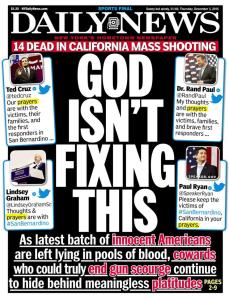
As has become the ritual in moments of tragedy and fear, politicians tweeted their “thoughts and prayers” for those of San Bernardino. The New York Daily News, however, was not all too happy with the “thoughts and prayers” of some Republican politicians, running this headline: “God Isn’t Fixing This: As latest batch of innocent Americans are left lying in pools of blood, cowards who could truly end gun scourge continue to hide behind meaningless platitudes.” Writing for the Daily News, Rich Schapiro explains the headline:
Prayers aren’t working.
White House hopefuls on the Democratic side of the aisle called for stricter gun laws in the wake of the shooting in San Bernardino that left at least 14 dead.
But after yet another mass shooting in America, GOP presidential contenders were conspicuously silent on the issue of gun control.
Instead, the Republicans were preaching about prayer.[2]
On its surface, and probably in its intention, this is a sensationalized political rant about Republicans and their stance on gun control and gun rights. But beyond the headline and behind the politics, a very troubling worldview emerges. In this regard, the Daily News headline is worth parsing.
“God Isn’t Fixing This”
How does the Daily News know this? How can the Daily News claim this? In Christian theology, sovereignty and eschatology go hand in hand. Sovereignty promises us that God has the power to wipe out evil and evildoers. Eschatology reminds us that God has a timeline, which He has not revealed to us, by which He will finally and fully defeat evil while redeeming and perfecting evildoers who put their faith in Christ. Christians, then, believe that God is fixing this, just not on the timeline that we might prefer.
Moreover, how does the Daily News account for the attacks that have been foiled? Like the one in Paris? Millions of people were praying for Paris in the wake of the highly coordinated terror attacks there. Did the prayers of the faithful work when a second terror plot never came to fruition in an attack? Or is the discovery of this terror plot simply to be chocked up to the work of law enforcement officials alone? If so, the Daily News has presented Christians with a lose-lose proposition: when terror attacks do happen, they prove that prayers do not work and God is not fixing things precisely because they have happened. When terror attacks do not happen, prayers still do not work and God is still not fixing things because a government just happened to get ahead of the attackers. Thus, the Daily News has already determined prayer does not work and God does not fix things, regardless of what does or does not happen.
If this is the case, then what does or does not happen cannot be marshaled, at least according to the rules of logic, as evidence for or against the efficacy of prayer and the activity of God because it has already been assumed that there is no correlation between prayer, divine activity, and terror attacks. What evidence does the Daily News offer, then, to back up its assertion that prayers are not working and God is not fixing this? None. We are simply to believe it because the Daily News wrote it.
“As latest batch of innocent Americans are left lying in pools of blood, cowards who could truly end gun scourge…”
If prayer does not work and God is not at work, what is the solution to these shootings? Politicians are. Politicians, the Daily News says, “could truly end gun scourge.” Really? What evidence is presented for this claim? Like with the effectiveness of prayer and the activity of God, none is. We are simply to believe it because a journalist wrote it. In point of fact, I’m fairly certain that California lawmakers have worked quite tirelessly to enact some of the strictest gun control legislation in the nation. Why didn’t it work? And if it did not work, what will?
The claim that politicians can end gun scourge is disingenuous and, quite frankly, ridiculous. Can we take steps to curb it? Of course. Can we enact legislation that addresses it? Absolutely. Can we actually end it? If we can, I would like to see that plan. And I would like to test that plan by seeing how many mass shootings and terror attacks we suffer after such a plan is enacted. The number should be, according to the Daily News headline, precisely zero. Call me a pessimist, but I have a feeling it wouldn’t be.
“…hide behind meaningless platitudes.”
On the one hand, I can understand how the phrase “thoughts and prayers” can become a meaningless platitude, especially when it is tweeted by millions. When a phrase is tossed around long enough and carelessly enough, it tends to become meaningless enough. On the other hand, if the Daily News thinks prayers themselves are meaningless platitudes, then it has made an explicitly theological claim, which, once again, it has not bothered to explain or defend. It simply assumes its view on prayer to be true and assumes its readers will uncritically agree.
As I wrote earlier, the editors of the Daily News more than likely meant this as little more than a sensationalized political rant. The very fact that they attack Republicans for tweeting out “thoughts and prayers” for those in San Bernardino without acknowledging that Democratic politicians have done the same smacks of partisan grandstanding. If they wanted to argue for tougher gun control laws, they could have done so without attacking Christian theologies of prayer and God’s activity. They could have been critical of Republican lawmakers – and even of their tweets as compared to their actions – without recklessly and baselessly announcing, “Prayers aren’t working.” But in my mind, what the Daily News probably did not intend to do with its headline, but what it nevertheless did do, matters much more than its political posturing. The Daily News essentially argues for a secular agnosticism. The Daily News asserts that God, if He does exist, will not help us. It also asserts that God, if He does exist, does not answer our prayers. Therefore, a spiritual answer to a national crisis is stupid and foolish. Only secular answers are realistic and effective. By the end of the article, it is difficult to walk away with anything other than this impression.
As a Christian, it probably comes as no surprise that I cannot accept the underlying premise of the Daily News headline. To offer only a secularly political solution to the spiritual evil of terror attacks makes no sense to me, in large part because it simply will not work. Gun control legislation is worth discussing. Politicians should be discussing it. And keeping firearms and explosive devices out of the hands of would-be terrorists and other mass murderers should be a top political and national security concern. But even our best efforts will, at least in part, fail. We can be prudent, but we cannot usher in perfection. To believe otherwise is to assume for ourselves a power that belongs only to God.
I also can’t help but wonder: even if a piece of gun control legislation could wipe out all terror attacks and gun violence, how do we help the community of San Bernardino heal in the wake of the attacks that have already taken place? Does God’s power play no role? How do we give those who have lost loved ones hope? Does God’s promise of salvation through faith in Christ mean nothing to those who grieve? Does the Daily News have a better idea than Christ for offering hope for something beyond this life? Or are the people of San Bernardino to be victimized twice – once by the bullets and bombs of terrorists and again by an acidic secular agnosticism that burns away at any worldview that espouses something beyond the days of this life?
The Atlantic, which, interestingly enough, used to be owned by the same man who now owns the Daily News, published the touching story of a text conversation between a daughter and her father that took place during the San Bernardino shooting:
“Pray for us,” a woman texted her father from inside the Inland Regional Center, while she and her colleagues hid from the gunfire. Outside the building, evacuated workers bowed their heads and held hands. They prayed.[3]
The writers at the Daily News may believe that only legislation will solve our problem with gun violence, but those who actually have a gun pointed to their heads still turn first to prayer. Maybe we should follow suit.
________________________
[1] The Editorial Board, “Another (mass shooting) day in the USA: Our view,” USA Today (12.2.2015).
[2] Rich Schapiro, “GOP presidential candidates offer prayers — not solutions on gun control — after San Bernardino massacre,” New York Daily News (12.3.2015).
[3] Emma Green, “Prayer Shaming After a Mass Shooting in San Bernardino,” The Atlantic (12.2.2015).
Why ISIS Cannot Win

Credit: Yann Caradec | Flickr
Of course, it didn’t take long for these attacks to ignite plenty of red-hot political and geopolitical wrangling. As it turns out, one of the ISIS terrorists allegedly masqueraded as a Syrian refugee to gain entry into France. This begs the question: should Western countries – including the United States – continue to grant asylum to these refugees when their ranks could be infiltrated by ISIS operatives? Then there is the question of how to address ISIS as an organization. French President Francois Hollande declared that “France is at war,” explaining, “Terrorism will not destroy France, because France will destroy it.”
All of this has spawned an understandable – and also predictable – reaction from many across this country and across the world: fear. Even children are afraid. The touching video that has gone viral showing a father allaying his son’s fears in the wake of the deadly attacks demonstrate just how pervasive the emotional devastation has become. People are scared. They want to know: are ISIS operatives planning an attack against this country? Just how powerful is ISIS? What can be done to prevent ISIS from attacking again? What will happen next?
I cannot answer what will happen next with ISIS. I wish I could. I wish I could say that all future ISIS attacks will be thwarted. That is certainly my prayer. But I cannot make it my prediction. But even though I cannot predict what is next for ISIS, I can be sure of what is last for ISIS. What’s last for ISIS is defeat. Of this I am confident.
I am confident of this for two reasons.
First, ISIS is a sectarian actor and sectarian actors, historically, tend not to thrive. ISIS doctrine requires that:
All Muslims must associate exclusively with fellow “true” Muslims and dissociate from anyone not fitting this narrow definition; failure to rule in accordance with God’s law constitutes unbelief; fighting the Islamic State is tantamount to apostasy; all Shi‘a Muslims are apostates deserving of death; and the Muslim Brotherhood and Hamas are traitors against Islam because they compromise with the non-caliphate political process (e.g., democracy).[1]
In short, ISIS believes that anyone who is not part of its cloistered caliphate is not only not a real Muslim, but not even worthy of life. This would be tantamount to Presbyterians wanting to destroy Baptists. This is the ultimate case study in sectarian insanity.
Certainly, Christianity has its own share of hate-filled sectarian groups. The Westboro Baptist Church comes to mind. Historically, Christian sects like the Encratites and the Docetists were rejected because of their abysmal doctrine. Considering ISIS endorses and outright enshrines ritual rape while the rest of the Muslim world stands steadfast on sexual purity, it is not difficult to see how ISIS is not only doctrinally aberrant even among Muslims, but humanitarianly repugnant. And doctrinally aberrant sects tend to collapse – or, at the very least, remain severely segregated – under the weight of their own idiosyncrasies and offensiveness. ISIS may be growing – for now – but sectarian doctrine and practice is not a recipe for longevity or continued growth.
Second, I do not think ISIS will last because of what I believe as a Christian. When Joshua is preparing to go to war against the kings of northern Canaan, God gives to him a curious command: “You are to hamstring their horses and burn their chariots” (Joshua 11:6). Strategically, this does not seem smart. Wouldn’t horses and chariots be helpful for future battles? Aren’t these the kinds of weapons that could benefit Israel’s national security?
God commands Joshua to destroy these tools of war to remind him that it is not he and Israel that will gain victories as they march into the Promised Land, but the Lord. He is the one who is fighting for Israel. No horses or chariots are needed.
ISIS fights with rifles, suicide bombs, and IED’s. But they cannot win, just like the people of Canaan could not win. Why? Because they are fighting the wrong battle using the wrong weapons. They are fighting for a false faith – even by most Muslim standards – with despicably deployed terrorizing weapons of war. As Christians, however, we fight for the true faith using divinely distributed saving weapons of war. ISIS may have a roadside bomb. But we have the sword of the Spirit (cf. Ephesians 6:17). And the sword of the Spirit trumps a terrorist’s bomb every time.
ISIS may manage to pull off some attacks here and there, but they will not last. Because they cannot last. God has promised otherwise.
And so, ISIS needs to be put on notice: there is coming a day when swords will be beaten into plowshares and spears will be forged into pruning hooks (cf. Isaiah 2:4). There is coming a day when your weapons will no longer terrorize nations because your weapons will no longer be around. But the Spirit’s sword will continue to stand.
So, as Christians, let’s stick with that weapon. And let’s find our comfort and confidence in that weapon. After all, it’s a guaranteed winner.
____________________________
[1] Joe Carter, “9 Things You Should Know About Islamic State,” The Gospel Coalition (11.14.2015).
How Starbucks (Didn’t) Steal Christmas

Credit: Starbucks
It was the coffee kerfuffle that wasn’t. When a story about Christian outrage over Starbucks’ plain red holiday cups began trending on social media, something about it seemed off to me. Sure, there was a video of a self-styled evangelist shoving a red Starbucks cup into the camera and shouting about how Starbucks employees are not allowed to say Merry Christmas and explaining in a Facebook post that “Starbucks REMOVED CHRISTMAS from their cups because they hate Jesus.” And sure, there were the stories about all the controversy it was igniting in the Twittersphere. But as I checked my own social media feeds, what I saw was not Christian outrage over the Starbucks’ minimalist holiday cups, but outrage over the fact that there was so much outrage over something as inane as a coffee cup. Outrage over outrage. Is it just me, or does this all seem, well, outrageous?
I have a funny feeling that the evangelist who opined his offense at Starbucks’ holiday cups on Facebook may have done so more for clicks and shares than out of earnest conviction. In my opinion, this is little more than a shoddily manufactured controversy. But even if I am right and this controversy is manufactured, I am grateful that commentary by Christians on the controversy has been largely thoughtful. Take this from Ed Stetzer:
Folks, we really need to calm down. If you’ve posted an outraged Facebook update, take it down.
Starbucks cups are red because of the Christmas season. Starbucks is not persecuting you. Starbucks may be attempting to respect those who don’t celebrate Christmas – and that’s OK. That’s their choice. They’re a business that exists to serve all customers without preference, regardless of what winter holidays they do or do not celebrate. If they choose to do that by means of a plain, red cup, that’s their call …
Here’s what I would say – this is the wrong fight and being done in the wrong way. And, it’s just making Christians look silly, like so many of these fake controversies do.
We have a better story to tell than one of faux outrage. So let’s tell it. It’s not the job of your barista to share the gospel. It’s your job to share the gospel.[1]
Ed Stetzer is exactly right. It’s ridiculous and embarrassing when a man trying to start a faux movement to protest red coffee cups gets more attention than the Church who has been charged to be an ongoing movement to spread the gospel.
Setting coffee cups aside for a moment, it is important to understand that this kind of unhelpful outrage has implications far beyond the clear-cut inanity of supposedly, but not really, offensive coffee cups. Far more serious ethical and cultural issues like abortion and same-sex marriage and stewardship of creation and treatment of the poor have ignited no small amount of outrage. And make no mistake about it: we, as Christians, should have plenty to say about these issues. But if we become so embroiled in outrage over these issues that we lose sight of the joy of sharing the gospel of Christ’s death for sinners, we have become lovers of issues rather than people. And when this happens, we lose sight of the gospel.
It is interesting to me that for all the well-documented differences between conservative and liberal Christians, they can both often fall into the same trap. Sure, more conservative-leaning Christians may beat the drum about issues like abortion and same-sex marriage (and they should) while more liberal-leaning may beat the drum about issues like stewardship of creation and treatment of the poor (and they also should). But in both instances, each side can easily wind up becoming so obsessed with current ethical and cultural issues that they lose sight of the evangelical and soteriological cross of Christ. In this regard, both sides, whether conservative or liberal, have traded Billy Graham for Walter Rauschenbusch. The soteriological gospel has been sacrificed to the social gospel.
It is this that takes us back to the Starbucks, ahem, brew-haha. The evangelist who posted his now viral Facebook tirade suggested that customers tell baristas their name is “Merry Christmas” so servers will be forced to write “Merry Christmas” on their holiday symbol-less cups. Besides the fact that I am pretty sure that this will do little to nothing to shift cultural sentiment concerning Christmas and what it represents, I am even surer that it adds nothing to the proclamation of Christ and Him crucified. Thankfully, most Christians already know this. That’s why they have rejected his strategy.
So let’s take this lesson from a bout of Starbucks silliness about what’s most important and use it to keep our priorities straight as we engage our world on much more pressing topics. Our witness to the world on these topics must never be only ethical and cultural. It must be first and foremost evangelical and soteriological. For without Christ and Him crucified, ethics and culture become nothing because they save no one.
Crux sola est nostra theologia.
________________________________
[1] Ed Stetzer, “When We Love Outrage More Than People: Starbucks Cups and You,” Christianity Today (11.9.2015).
Pray for Paris
 I first heard the news on the radio when I was driving home from work Friday night. Phrases like “breaking news” and “continuing coverage” caught my attention. As more and more details of the ghastly attacks trickled in from across the Atlantic, I knew it was going to be a long night for the people of Paris. 129 dead. 352 injured, 99 critically. And ISIS was claiming responsibility for the coordinated attacks that hit six targets at once. After opening fire on their victims, all but one of ISIS’s operatives blew themselves up when police approached, hoping to kill even more people with suicide bombings.
Considering these attacks came just days after ISIS was suspected of downing Metrojet Flight 9268 over northern Sinai as it was on its way from Sharm el-Sheikh to St. Petersburg, it is quickly becoming apparent that ISIS will stop at nothing to intimidate the world. As of now, their tactics are working. Many, many people are very, very scared.
As Christians, we know we are commanded to be not afraid. The words of Psalmist come to mind: “God is our refuge and strength, an ever-present help in trouble. Therefore we will not fear, though the earth give way and the mountains fall into the heart of the sea” (Psalm 46:1-2). Logically, we also know that fear does us little good at a time like this. It solves nothing. It changes nothing. It only paralyzes us and clouds our judgment. But at the same time we are called not to fear, we are also called to be in prayer. Indeed, the apostle Paul addresses both fear and prayer when he writes, “Do not be anxious about anything, but in everything, by prayer and petition, with thanksgiving, present your requests to God” (Philippians 4:6). At a time like this, when the world is fearing, we should be praying.
As this tragedy continues to unfold, allow me offer four things for which I think we can and should pray. My hope is that God will not only comfort you as you pray these petitions, but that He will use these petitions to help you process what has happened. After all, what has happened affects not only the city of Paris or the nation of France; it affects the world. Nous sommes tous les Parisiens.
On to the prayers.
Pray for Paris.
In one way, this goes without saying. And, thankfully, it is already happening. A quick check of my Twitter account shows #Prayers4Paris is trending. So pray for the grieving. Pray for the fearful. Pray for the people of a city who are trying to pick up the pieces of an illusion of safety that has just been shattered. Pray for Paris.
But let me take this a step farther. Because as Christians, to pray for Paris means to pray for all of Paris – even for those who support and sympathize with the attackers. Jesus admonishes us to pray not only for those with whom we share a kinship, but even for our enemies: “Pray for those who persecute you” (Matthew 5:44). So pray for ISIS operatives in Paris and, for that matter, all over the world. Pray, yes, that any further plots would be thwarted. But also pray that their hearts would be changed. A changed heart stops evil much better than even the most sophisticated international intelligence operation.
Pray for sobriety.
The shock and sadness of yesterday’s attacks will soon dissolve into political posturing and raw outrage. Rash responses will be given. Foolhardy decisions will be made. We need to stay away from all such impulsiveness.
If history is any indication, I am especially concerned that many will fall into what logicians refer to as the fallacy of composition. This fallacy asserts that if something is true for the part, it must also be true for the whole. So in this instance, if a few radical Muslims who are part of ISIS are terrorists, then it is reasonable to be wary of any Muslim because he or she might be a terrorist.
Don’t fall for – or propagate – this fallacy!
I have many friends who own firearms. They are, of course, very responsible and cautious with their weapons. But every time a mass shooting happens – in Roseburg, in Charleston, in Fort Hood, in Sandy Hook – many of them openly worry that the actions of a few deranged lunatics will affect all firearm owners. They worry that people will take the actions of a few and use it to stifle the whole. And so they lobby not only for their rights as firearm owners, but also for their character as people.
What firearm owners do for each other, Christians can and should do for Muslims. Let’s not lose our ability to think soberly and clearly not only about these attacks specifically, but about Muslims generally. The vast majority of Muslims are people who hold much in common, especially ethically, with Christians. They love their families. They despise promiscuity. And they support traditional values like honesty, hard work, and generosity. Let’s be willing to vouch for the character of Muslims. And let’s be willing to support and love them as people.
Pray for governments.
The French government, the U.S. government, and many other governments across the world have some difficult decisions to make. ISIS must be stopped. Thankfully, God has given governments the authority to do just this. The apostle Paul explains:
He who rebels against the [governing] authority is rebelling against what God has instituted, and those who do so will bring judgment on themselves. For rulers hold no terror for those who do right, but for those who do wrong. (Romans 13:2-3)
Paul says that those who rebel against good order arranged by good governments will bring judgment on themselves. For good governments will seek to avenge and deter – often with force – evil events. The terrorists, then, have every reason to be terrified.
As governments across the world try to discern how to respond to these attacks, pray that their responses would be decisive, measured, and Godly. In short, pray that world governments would act in ways that thwart evil while honoring God’s Word.
Pray, “Come, Lord Jesus.”
Ultimately, we know that governments, though they can do much to suppress evil, cannot stop evil. Only God can do that. In fact, shortly before Paul writes his words concerning government, he writes about God’s final judgment: “Do not take revenge, my friends, but leave room for God’s wrath, for it is written: ‘It is Mine to avenge; I will repay,’ says the Lord” (Romans 12:19). God’s vengeance is the only vengeance that gives victory.
When does God avenge evil? On the Last Day. Then and only then will evil be wiped out once and for all. Until then, attacks will happen. Lives will be lost. Evil will rear its head. And we will “groan inwardly as we wait eagerly for our adoption as sons, the redemption of our bodies” (Romans 8:23). Considering that none of this is pleasant or good, the final prayer of the Bible can be our prayer today: “Come, Lord Jesus” (Revelation 22:20). “Come and wipe out evil. Come and make everything – including those hurting in Paris – new.”
And He will.
Family Is Good, Even If It’s Not Good For You

Credit: Fran Jorgensen / Foter.com / CC BY
Boys are more sensitive than girls to disadvantage. Any disadvantage, like growing up in poverty, in a bad neighborhood or without a father, takes more of a toll on boys than on their sisters. That realization could be a starting point for educators, parents and policy makers who are trying to figure out how to help boys – particularly those from black, Latino and immigrant families.[1]
This, of course, is not to say that girls do not suffer when a family is not in tact. Sara McLanahan and Isabel Sawhill, writing for Princeton and Brookings, talk about the effects of broken families and children in general:
Marriage is on the decline. Men and women of the youngest generation are either marrying in their late twenties or not marrying at all. Childbearing has also been postponed, but not as much as marriage. The result is that a growing proportion of children are born to unmarried parents – roughly 40 percent in recent years, and over 50 percent for children born to women under 30 …
The consequences of this instability for children are not good. Research increasingly shows that family instability undermines parents’ investments in their children, affecting the children’s cognitive and social-emotional development in ways that constrain their life chances.[2]
Families are falling apart. And the results are not good.
Certainly there is a theological argument to be made for the necessity of the family. Adam, Eve, and their command from God to “be fruitful and increase in number” (Genesis 1:28) speaks to the divine origin and order of the family and points to it as a gift from God to humanity. But there is also a teleological argument to be made for the necessity of the family. For instance, an article in National Review notes, “Married parenthood was a stronger predictor of economic mobility than was a state’s racial composition or the share of its population that is college-educated.”[3] If you want your children to grow up to be economically secure tomorrow, offer them a healthy family structure today. This applies, of course, not only to future economic mobility, but to future emotional, relational, and vocational stability as well.
So if this is the case, why is there no rush to trade the cohabitation, permissive divorce laws, and broken families of today for the nuclear Leave It To Beaver-style families of yesterday? The answer is, once again, teleology. The teleological argument for the family that focuses on kids assumes that the primary goal of parents is to want what is best for their kids. And many times, even in broken families, parents do want what is best for their kids. I know many single parents, for instance, who will sacrifice in any way they can right now to try to give their children the best possible shot at stability later.
But sometimes, among some people, the teleology of personal desire and pleasure trumps the teleology of the thriving of children. “Even if a traditional family is better for my kids,” some may say, “I don’t want to be tied down by the traditional accouterments and commitments of marriage.” “Even if a traditional family is better for my kids,” others may say, “I don’t like the sexual restraints that traditional family structures demand.” Though I doubt many people would be so bold as to outright say such things (although some have), the enticement of the teleology of personal desire and pleasure is powerful, even if subconsciously.
So as we talk about why the traditional family structure is good and why it should be promoted and protected, we also need to ask the question, “Good for whom?” If we mean a traditional family structure is good for children, we could not be more correct. If we mean it is good for selfish desire and pleasure, we could not be more wrong. Having a family of your own, much like being in the family of Christ, is a lesson in dying to oneself (cf. Matthew 16:25). And though this is good transcendently, it’s not easy practically. Nor is it always desirable personally. This is why for some, the demands of a traditional family structure are simply a bridge too far. They will not sacrifice themselves for the sake of another. But for those who do, even if their traditional family structure has been broken through no fault of their own, allow me to say “thank you.” You have discovered what matters most in life: others. And because you have discovered that, who comes after you will be better because of you.
____________________________________
[1] Claire Cain Miller, “A Disadvantaged Start Hurts Boys More Than Girls,” The New York Times (10.22.2015).
[2] Sara McLanahan & Isabel Sawhill, “Marriage and Child Wellbeing Revisited: Introducing the Issue,” Marriage and Child Wellbeing Revisited 25, no. 2 (Fall 2015): 3-9.
[3] W. Bradford Wilcox, “Family Structure Matters – Science Proves It,” National Review (10.23.2015).


 Pastor Zach's Blog