Posts filed under ‘Current Trends’
Nice, Turkey, and Baton Rouge

Baton Rouge police block Airline Highway after a sniper kills three and wounds three officers. Credit: AP Photo/Max Becherer
In Genesis 3, Adam and Eve eat from the fruit of a tree about which God had said, “You must not eat…for when you eat from it you will certainly die” (Genesis 2:17). By Genesis 4, death has already had its way as Cain kills his brother Abel.
That didn’t take long.
The grim efficiency of death has loomed large over these past few days. First, word came from Nice, France last Thursday that 84 people had been killed when a terrorist drove a large, white paneled truck at high speeds into a crowd of revelers who were celebrating Bastille Day. Then, on Saturday, we learned that around 290 people were killed in a failed coup against the president of Turkey, Recep Tayyip Erdogan, who has now arrested over 6,000 people and has vowed to root out what he calls the “virus” that is plaguing his country. Then, yesterday, tragedy hit Baton Rouge as three police officers were killed and three others were injured when a sniper ambushed and shot at the officers who had responded to a report of trouble near the Hammond Aire Plaza shopping center.
Three stories of death in nearly as many days. And these come on the heels of another week before this last week that was also packed with three stories stories of death from Saint Paul, from Dallas, and, again, from Baton Rouge. Yes, death is grimly efficient.
These are terrible times. There was a time when weeks like these – with so many major stories of unrest and death – were nearly unthinkable. But in the summer of 2016, weeks like these are becoming all too predictable. Indeed, I can sometimes struggle with how to process all of these types of tragedies precisely because there are so many of these types of tragedies.
In processing this week’s worth of carnage, I would point to what I have already pointed to in the past. After the tragedies in Baton Rouge, Saint Paul, and Dallas, I pointed people to the importance of being empathetic with those who grieve, of receiving Christ’s peace in the midst of unrest, and, most importantly, of remembering that death does not have the last word. Christ does.
As I look back on this week of tragedies, all of these reminders still hold. And yet, I wish I didn’t have to remind people of these reminders – again.
Even though I feel a little overwhelmed by so much death in such a short period of time, I am not particularly surprised by it. After all, death, as Genesis 3 and 4 teach us, is indeed grimly efficient. It works fast and it works tenaciously. And it has no intention of giving up on its prey.
What is most striking to me about Abel’s death in Genesis 4 is that even though God condemned Adam and Eve to death because of their transgression against His command, it was their son, Abel, who first suffered under the fruit of their sin. It who their son, who, ostensibly, did nothing particularly wrong who dies. Indeed, the reason Abel’s brother Cain kills him is because he did something right. He made an offering that was pleasing to God. Cain became jealous of that offering and murdered him.
The first death in history, then, was that of an apparently innocent person. This is why, when God finds out what Cain has done to his brother, He is furious and asks Cain, “What have you done?” which, interestingly, is the same question God asks Eve when she eats from His forbidden fruit. God continues by answering His own question: “Listen! Your brother’s blood cries out to Me from the ground” (Genesis 4:10).
Ever since that moment, the blood that cries out to God has been getting deeper and deeper as death has been spreading farther and wider. Nice, Turkey, and Baton Rouge have now added their blood to Abel’s.
Finally, there is only one way to stem the flow of death and blood. The preacher of Hebrews explains:
You have come to God, the Judge of all, to the spirits of the righteous made perfect, to Jesus the mediator of a new covenant, and to the sprinkled blood that speaks a better word than the blood of Abel. (Hebrews 12:23-24)
Just like Abel, there was a man who was not only ostensibly innocent, He was actually innocent. Just like Abel, this was a man who did what was pleasing in God’s sight. And just like Abel, this was a man who had His blood spilled by those who were jealous of Him. But Jesus’ blood, the preacher of Hebrews says, is better than Abel’s blood. Why? Because Jesus’ blood did what Abel’s blood could not. Instead of just crying out, as did Abel’s blood, Jesus’ blood saved us. By His blood, Jesus solved the problem of Abel’s blood…and Nice’s blood…and Turkey’s blood…and Baton Rouge’s blood. For by His blood, Jesus said to death’s grim efficiency: “Your reign will end. My blood will overtake all the blood that cries with a blood that can save all.”
In a week that has seen far too much blood and far too many tears, Jesus’ blood is the blood that we need. For Jesus’ blood is the only blood that doesn’t wound our souls as we mourn loss; it mends our souls as we yearn for salvation.
More on Baton Rouge, Saint Paul, and Dallas

Credit: Dallas Morning News
Imagine you’re a police officer in Baton Rouge. You’ve been called to a convenience store where a 37-year-old man named Alton Sterling has been reported to have recently threatened another man with a gun. You approach Mr. Sterling and pin him to the ground when someone shouts, “He’s got a gun! Gun!” Fear takes over. Shots are fired. And Alton Sterling lies dead.
Now imagine you’re a police officer in Saint Paul, Minnesota. You pull over a vehicle that has a broken taillight. The man inside, Philando Castile, dutifully explains that he has a concealed carry permit and has a firearm in the vehicle. When Mr. Castile reaches for his license and registration, however, you think he’s reaching for his gun. Fear takes over. Four shots are fired. And Mr. Castile dies in front of his girlfriend and four-year-old daughter.
Finally, imagine you’re a 25-year-old black man named Micah Xavier Johnson who has watched other black men be shot and killed in altercations with the police under suspicious circumstances time and time again. You see protest after protest against these shootings by Black Lives Matter, but in your mind, these protests do not equate to real action. After the tragedies in Baton Rouge and St. Paul unfold, you seize on these moments to exact revenge. At a protest in Dallas, you, with anger coursing through your veins, aim your arsenal of firearms at twelve officers, killing five of them, only to finally be taken down yourself by law enforcement officials.
Are you still with me?
Now, let’s do a little math.
Fear + Anger = Eight People Dead
At this point, I need to include some caveats.
First, don’t misunderstand the intent of my thought experiment. I am not trying to exonerate bad behavior by asking us to imagine ourselves in each of these men’s shoes – by asking us to empathize with them. Empathy never tries to excuse sin, but it does try to understand people because, when we understand people better, we can understand what leads to a week like the one we just experienced better and, hopefully, take steps to prevent another week like this one from happening again – ever.
Second, the facts in all these cases are still unfolding. When 49 people were shot and killed by a terrorist at an Orlando nightclub, I offered an encouragement on this blog for people to patiently wait for the facts rather than jumping to conclusions about the shooter’s motives. The same caution applies here. It could be that one or both of these officers in Baton Rouge were animated by naked racial animus and shot and killed one or both of these men in cold blood. If this were the case, the equation above would still hold, albeit on the anger side rather than on the fear side. It could also be that, as more facts surface, one or both of these officers were not animated by fear, but by a legitimate concern for self-defense. Turning to Dallas, it could be that Mr. Johnson was clinically insane and not in his right mind when he carried out these horrific attacks. If this were the case, what he did still could not be excused, and his anger and hatred would still loom large, but it might be understood a little differently. Carefully sorting through the facts – and being patient enough to do so – is incredibly important in tragedies like these.
Third, I am not a law enforcement official. I know some law enforcement officials, and I have nothing but the utmost respect and love for them. Honestly, if I had to walk in their shoes, I’m not sure that the altercations with Mr. Sterling and Mr. Castile would have gone down any differently. I can imagine myself becoming very frightened very quickly. The fact that so many law enforcement officials keep their cool when tensions are high is a testimony to the character and competence of so many of these men and women.
Fourth, I am not a black man. I have heard enough stories of incipient and systemic racism against black men, however, that my heart breaks. I would not want to live under a cloud of such constant suspicion. I would not want to have to teach my son the lessons of what little slights, sideways glances, and clinched purses could mean. If I had to endure that day after day, I would be angry too. And if someone was to needlessly take the life of someone that I loved, I can’t say I wouldn’t be tempted to exact an eye for an eye. The fact that so many African-Americans keep their protests peaceful and focused on change rather than turning them into opportunities for revenge is a testimony to the character and compassion of so many of these men and women.
What has happened this week, then, is not an indictment of the masses, but the fruits of a few.
But…
Even though what happened this week was not by our hands, this is not to say it couldn’t have been by our hands. Remember the equation?
Fear + Anger = Eight People Dead
Have you let fear take over your heart any time this week? How about anger? Is anything from the way you manage money to the way you treat your family to the friends you avoid to the grudges you hold to the politics you have that is driven by fear or anger? The results of your fear and anger may not be eight dead, but are the results in any way good? Let’s adjust the equation a little bit.
Fear + Anger = Plenty That Is Not Good
Is this true of you?
Fear and anger are part of the human condition and are devastatingly etched into the annals of human history. One needs to look no further than the night before Jesus’ death. When Judas betrays Jesus into the hands of the religious leaders, Peter goes from being so angry at what is about to beset his Master that he cuts off the ear of a man in the mob that has come to arrest Jesus to being so fearful at what is transpiring with his Master that, just hours later, when a servant girl asks him if he knows Jesus, he denies his Savior and friend. Fear and anger coalesce into one necrotic night.
The truth is this: there’s plenty of fear and anger to go around – among the masses and, if we’re brutally honest, in our hearts. The equation holds true for us all.
So, on the heels of a terribly tragic week, let me conclude with two gentle reminders:
“Do not be afraid” (Luke 12:32).
And…
“Refrain from anger and turn from wrath” (Psalm 37:8).
Think on these things.
A Week of Tragedy: Baton Rouge, Saint Paul, and Dallas

This has been a terribly tragic week. Today, three cities are in mourning: Baton Rouge, Saint Paul, and now, overnight, Dallas.
In Baton Rouge, 37-year-old Alton Sterling was shot to death while being pinned to the ground by law enforcement officials. In Saint Paul, Philando Castile was shot and killed by an officer after being pulled over for a broken taillight. In both of these cases, there are questions over whether or not police officers used excessive force. Then, last night in Dallas, when protesters gathered to decry what happened in Baton Rouge and Saint Paul, five officers were shot and killed, with an additional seven officers shot and wounded, by a sniper who was enraged by the shootings in Baton Rouge and Saint Paul. It is the largest single loss of first responder lives since September 11, 2001.
As events continue to unfold, here are some things to keep in mind.
Grieve with those who grieve.
To all of the families who have lost loved ones this week in these tragedies, we should offer our condolences. We should hold them up in prayer. Losing loved ones are occasions for tears. Empathy should be the hallmark of every Christian because it so closely reflects the incarnation. In Christ, God came into our pain. He experienced our pain. He walked through our pain. This is why the preacher of Hebrews can say that, in Christ, “we do not have a high priest who is unable to empathize” (Hebrews 4:15). For us to withhold empathy denies us the opportunity to show the world who we are by our love. “Mourn with those who mourn” (Romans 12:15).
Receive Christ’s peace.
When a week spirals into tragedy like this one has, we can be tempted to respond either with fear or with anger, or with both. I’ll have more on these responses Monday on my blog. For right now, suffice it to say that these responses are not helpful. When the world is troubling, rather than responding with fear and anger, it is better to receive the peace that only Christ can give.
The night before Jesus goes to His death on a cross, He knows His disciples will respond both with anger (cf. John 18:10) and with fear (cf. John 18:15-18, 25-26). But Jesus wants His disciples to receive His peace. So He says to them, “Peace I leave with you; My peace I give you. I do not give to you as the world gives. Do not let your hearts be troubled and do not be afraid” (John 14:27). God’s peace is stronger than human tragedy.
Trust that tragedy does not have the last word.
It was Dr. Martin Luther King, echoing the words of the nineteenth century abolitionist Theodore Parker, who said, “The arc of the moral universe is long, but it bends toward justice.” How a moral arc can bend toward things like justice and righteousness and goodness can be tough to see after a week like this. Yet, what is good has not been lost.
Jesus tells the story of a widow who comes to a judge, begging him to grant her justice against someone who has wronged her. The judge, who apparently is not at all concerned with justice, continually diminishes and dismisses her concerns until he finally decides to grant her what she wants, simply because she won’t leave him alone. This widow’s quest for what is good overcomes this judge’s careless embrace of what is wrong. Jesus concludes His story by pointing to God: “Will not God bring about justice for His chosen ones, who cry out to Him day and night? Will He keep putting them off? I tell you, He will see that they get justice, and quickly” (Luke 18:7-8).
Jesus promises that in a world where plenty is wrong, God is a just judge who will eventually make things right. God will not put us off in our tears, in our hurt, and in our devastation. And although God’s conception of a justice that comes “quickly” may not fit our conception of a justice that comes “quickly,” we can rest assured that God’s final defeat of all that is wrong will have its say on the Last Day. Not only that, God’s defeat of all that is wrong has already had its say in Christ, who triumphed over sin and death by the cross (cf. Colossians 2:15). In a week that has been full of tragedy, this is something in which we can take deep comfort and by which we can hold out great hope.
Terrible tragedy will not have the final say. Jesus will.
Texas, Abortion, and the Terrible Triumph of the Human Will
Credit: Associated Press
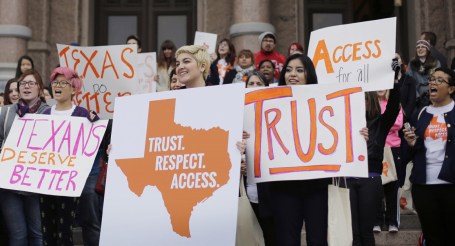
Along with the headline, there was an infographic with this caption: “The Supreme Court Drifts to the Left.” Sadly, this is the way the abortion debate is often now cast: conservative versus liberal, right versus left. But there is far more at stake in this case than just political or ideological points. What is at stake in this case is human lives.
Yes, the lives of the babies lost to abortion are at stake. But so are the lives of the women who suffer through the loss of a child to abortion. Abortion can change profoundly the lives of the women who endure it – and not necessarily for the better. Indeed, some studies have shown that women can suffer under a crushing weight of hidden hurt and regret after obtaining an abortion.
Yet, regardless of its mental, physical, emotional, and spiritual tolls, many in our society continue to fight for the widest possible access to abortion and, as the Supreme Court ruling symptomizes, raising any concerns about the way the abortion industry operates is regularly met with little more than scorn and skepticism. The right to abortion, in this view, is sovereign.
The problem, however, with making the right to abortion sovereign is that it makes physical reality subservient to the human will. The physical reality of life in utero becomes becomes dependent on a person’s choice. To borrow a quip from 2004 presidential candidate Wesley Clark: it means that “life begins with the mother’s decision.”
Except that it doesn’t. Life begins in spite of a person’s choice. But life, tragically, can be ended by a person’s choice. To try to make the physical reality of life subservient to the human will is to deny that physical reality really matters at all. But the denial of physical reality in light of human decision seems to be en vogue – not only with babies in wombs, but with people in their lives.
Several weeks ago on this blog, I wrote about the connection between transgenderism and Platonism. Just like Platonism sees that which is non-corporeal as more important and, in some sense, more real than the physical, transgenderism gives preference to a non-corporeal inner identification over a person’s physical biological sex. Sherif Girgis made a similar observation about the relationship of the physical to the internal in an article for First Things:
The body doesn’t matter…Since I am not my body, I might have been born in the wrong one. Because the real me is internal, my sexual identity is just what I sense it to be. The same goes for other valuable aspects of my identity. My essence is what I say and feel that it is…
On the old view, you could know important things about me unmediated, by knowing something about my body or our shared nature. And our interdependence as persons was as inescapable as our physical incompleteness and need: as male and female, infants and infirm. But if the real me lies within, only I know what I am. You have to take my word for it; I can learn nothing about myself from our communion. And if I emerge only when autonomy does – if I come into the world already thinking and feeling and choosing – it’s easy to overlook our interdependence. I feel free to strike out on my own, and to satisfy my desires less encumbered by others’ needs.[1]
Girgis’ final line is key. If we are fundamentally defined by our internal wills rather than by our physical bodies, our wills must be held as sovereign and defining. Anything and anyone that would encroach on our wills – even a baby growing inside of us – must be put it in its place.
In this way, everything from same-sex marriage to transgenderism to abortion is of one piece. It privileges the human will over everything else. I can choose who I want to marry without any regard for a created complementarianism. I can choose my gender quite apart from what are, in most cases, very clear biological markers. And I can choose to keep a baby inside of me or to rid myself of it.
I understand and am sensitive to the fact that, in each of these cases, there are strong stirrings that can lead to difficult decisions. The stirring of affection for someone of the same-sex can lead to a same-sex marriage. The stirring toward the lifestyles of the opposite gender can lead a person to live as transgender. And the stirring of fear over what it takes to raise a child can lead to an abortion. But even when these stirrings are strong, I think it is worth it to at least ask the question of whether or not it is wise to make human stirrings so defining that they can eclipse and even try to deny actual physical states of being.
According to the Supreme Court, the stirring of a person’s choice in pregnancy is defining. And if anything – even a raising of medical standards for abortion clinics in Texas – impedes that choice, choice must have its way. So it will. And with deadly results.
_________________________
[1] Sherif Girgis, “Obergefell and the New Gnosticism,” First Things (6.28.2016).
Breaking Down Brexit

It was a shocker of an outcome. British voters backed Brexit.
In a move that sent markets stumbling and the pound tumbling, Britons voted to leave the European Union 52% to 48%. The fallout from the exit was nearly immediate as David Cameron stepped down as Britain’s Prime Minister, saying:
I was absolutely clear about my belief that Britain is stronger, safer and better off inside the EU. I made clear the referendum was about this, and this alone, not the future of any single politician, including myself. But the British people made a different decision to take a different path. As such I think the country requires fresh leadership to take it in this direction.[1]
In support of Brexit was Boris Johnson, a member of Parliament and the former mayor of London, who explained:
In the end this question is about the people…it is about the very principles of our democracy…I think the electorate have searched in their hearts and answered as honestly as they can. They have decided that it is time to vote to take back control from an EU that has become too remote, too opaque and not accountable enough to the people it is meant to serve.[2]
Back here in the United States, the Obama administration had announced its support for Great Britain remaining in the EU and expressed disappointment at the vote while still pledging its ongoing support for the UK.
As with many things of this nature, there were probably good reasons for Great Britain to stay in the EU and good reasons for it to leave. On the one hand, fraternal cooperation between nations who support each other in their humanity and not just in their nationality is good. On the other hand, a governing body as large and as political as the EU is simply too inherently prone to corruption to exercise its power without problems and concerns.
Regardless of how you may personally feel about the Brexit vote, it is important that we, as Christians, pray for the British people. This much is certain: this vote has launched that country into turmoil. The price of gold has surged as jittery investors clamor to find safe financial havens. British millennials are also broadly upset with the vote, with one millennial tweeting, “A generation given everything…have voted to strip my generation’s future.”[3] According to one poll, 64% of Britons ages 25 to 29 wanted to stay in the EU. It was the older Britons who carried Brexit to victory. But even in the wake of victory, the United Kingdom is still divided.
Ultimately, Brexit can serve as a reminder that no human coalition or government, no matter how seemingly strong, is impenetrable or eternal. Every earthly kingdom eventually fails and falls. This is why our hope can never be in nations, international unions, or leaders. Our hope must finally be in the Lord.
After the Egyptians free the Israelites from the shackles of their slavery to them, and after God miraculously parts the Red Sea so the Israelites can escape the Egyptian army when the Egyptian Pharaoh changes his mind about releasing the Israelites, and after God causes the wheels of the Egyptian chariots to fall off as they pursue the Israelites into the parted Red Sea (cf. Exodus 14:25), and after God swallows up the Egyptians in the Red Sea by causing its waters to fall back on them, Exodus 14:31 says, “When the Israelites saw the mighty hand of the LORD displayed against the Egyptians, the people feared the LORD and put their trust in Him.”
Eventually, the wheels of every kingdom fall off. Brexit is just the latest example. Thus, if we trust only in human kingdoms and powers, we will be left with nothing but fear when these kingdoms collapse. This is why we must put our trust in the Lord. For when we trust in Him, we can move through even a time of international uncertainty knowing that one kingdom – God’s Kingdom – can never be shaken. In the words of Martin Luther:
The Word above all earthly powers,
No thanks to them, abideth;
The Spirit and the gifts are ours
Through Him who with us sideth:
Let goods and kindred go,
This mortal life also;
The body they may kill:
God’s truth abideth still,
His kingdom is forever.
___________________________________
[1] Heather Stewart, Rowena Mason, and Rajeev Syal, “David Cameron resigns after UK votes to leave European Union,” The Guardian (6.24.2016).
[2] Kate McCann and Laura Hughes, “EU referendum live: Boris Johnson hails ‘glorious opportunity’ of Brexit as David Cameron resigns,” The Telegraph (6.24.2016).
[3] Ivana Kottasova, “British Millennials: You’ve stolen our future,” CNN Money (6.24.20216).
A Rape At Stanford: Recovering Our Humanity In A Culture Of Perverse Sexuality

The names have changed, but the situation is far too familiar.
Three weeks ago on this blog, I wrote about a sex scandal at Baylor University that featured violated girls, entitled football players, and a campus administration who looked the other way. Now, another sex scandal has captured headlines – this one at Stanford University – that involves a violated girl, an entitled party goer, and a judge that many are saying looked the other way by sentencing a rapist to an embarrassingly paltry prison term.
The entitled party goer in question is Brock Turner. He is convicted of violating a 23-year-old girl who, though not a student at Stanford, was attending a fraternity party where she had too much to drink, passed out, and was found behind a dumpster with Turner “lying on top of her unconscious, partly clothed body…Witnesses intervened and held the attacker for the police.”[1]
The judge could have sentenced Turner to 14 years in prison. Instead, he got six months.
The victim recounted her experience of waking up from her assault in terrifying detail in a letter she read aloud in the courtroom to her rapist:
The next thing I remember I was in a gurney in a hallway. I had dried blood and bandages on the backs of my hands and elbow. I thought maybe I had fallen and was in an admin office on campus. I was very calm and wondering where my sister was. A deputy explained I had been assaulted. I still remained calm, assured he was speaking to the wrong person. I knew no one at this party. When I was finally allowed to use the restroom, I pulled down the hospital pants they had given me, went to pull down my underwear, and felt nothing. I still remember the feeling of my hands touching my skin and grabbing nothing. I looked down and there was nothing.[2]
It was at this moment that she realized what the officer had said was true: she had been raped.
The victim’s letter is gut-wrenching. But the response of Brock Turner’s father Dan to this crime is stupefying. He defended his son, saying:
As it stands now, Brock’s life has been deeply altered forever by the events of Jan. 17th and 18th. He will never be his happy-go-lucky self with that easygoing personality and welcoming smile. His every waking minute is consumed with worry, anxiety, fear and depression…His life will never be the one that he dreamed about and worked so hard to achieve. That is a steep price to pay for 20 minutes of action out of his 20-plus years of life.[3]
Yes, that’s what this was: “20 minutes of action.” Just the phrase makes the hair on the back of my neck stand up.
This tragedy is nauseating. It is disgusting. But I am afraid we may not learn much from it.
We now live in a world where it is acceptable for college students to hook up using an app where they can register their legal consent for sex unless, of course, one of the consenters indicates they are intoxicated. Did I mention that this app was created by a group of parents of college-aged children?
We also live in a world where a self-declared “feminist father” can sport a shirt that reads:
RULES FOR DATING MY DAUGHTER 1. I DON’T MAKE THE RULES 2. YOU DON’T MAKE THE RULES 3. SHE MAKES THE RULES 4. HER BODY, HER RULES
Just so I am not misunderstood, I am in complete agreement that no one should ever be forced to engage in any sort of sexual encounter against their wishes. Period. To violate a woman’s rules for her body is, by definition, rape. And it is abhorrent.
But something is missing.
When sex is reduced to concepts like “consent” and highly individualized “rules,” the bar for sex has been set way too low. It has been set a place that is sure to leave a trail of broken hearts, broken relationships, and broken lives. Sex is about consent. But it’s not only about consent. It’s also about commitment. Sex is about rules. But it’s not only about rules. It’s also about trust. And I can’t stop there. Sex is also about love. It is also about marriage. And yes, as a Christian, I cannot help but note that it is ultimately about God because it is, in its very origin, a gift from God.
Something tells me that God is not pleased when His good gift is drug into the dumpster. Literally.
Brock Turner took a dumpster dive to the bottom of the moral barrel when he raped this young lady. But let us not forget that this moral barrel comes with a staircase to the bottom. And when we, as a culture, are willing to walk down step after step of sexual compromise, sexual selfishness, and sexual confusion – when we, as a culture, reduce sex to consent and strip it of nearly everything with which Scripture imbues it – what makes us think we won’t trip and land at the bottom like Brock?
Jesus reminds us that the first step to sexual disaster happens long before our clothes come off with the wrong person in the wrong circumstance for the wrong reasons. The first step to sexual disaster happens when hearts go wrong: “I tell you that anyone who looks at a woman lustfully has already committed adultery with her in his heart” (Matthew 5:28). Sexual disaster doesn’t start with a rape case that captures headlines. It starts with a lust that perverts a person’s heart.
The problem with lust is that it sacrifices a person’s humanity on the altar of personal twisted desire. A meeting that is quite literally designed to give life as it often results in the blessing of children actually takes life as one person uses another person to satisfy himself. This is why Dan Turner can write about his son’s “20 minutes of action.” Because for Brock’s dad, that’s all sex is – action with no affiance, amusement with no affection. It is certainly not the meeting of two people and the mingling of two souls.
The paragraph I appreciate the most in this young lady’s statement to her attacker is her last one. She says to girls everywhere:
You are important, unquestionably, you are untouchable, you are beautiful, you are to be valued, respected, undeniably, every minute of every day, you are powerful and nobody can take that away from you.
From a woman who was treated as far less than human comes a reminder that her – and our – humanity nevertheless endures.
May our sexuality rise to the occasion of our humanity.
________________________
[1] Liam Stack, “Light Sentence for Brock Turner in Stanford Rape Case Draws Outrage,” The New York Times (6.6.2016).
[2] Katie J.M. Baker, “Here Is The Powerful Letter The Stanford Victim Read Aloud To Her Attacker,” Buzzfeed (6.3.2016).
[3] Morgan Winsor, “Scathing Letter to Father of Stanford Sex Offender Brock Turner Goes Viral,” ABC News (6.9.2016).
Processing the Terror in Orlando
Credit: The Guardian
Terror doesn’t sleep.
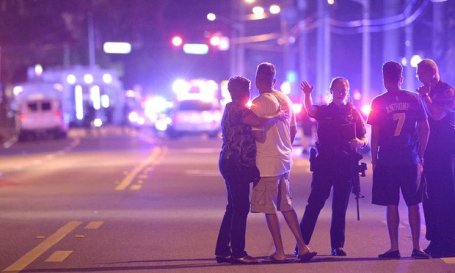
This is one of the lessons we’re learning from what has become the worst mass shooting in U.S. history carried out early this morning around 2 o’clock at a nightclub in Orlando.
The shooter’s name was Omar Mateen. He had drawn the attention of the FBI in the past, and before he carried out his terror attack, he called 911 to pledge his allegiance to ISIS. By the time his AR-15-style rifle and his handgun were silenced, 50 people were dead and over 50 were injured. Mr. Mateen himself was killed by law enforcement officials while he was holed up in one of the club’s bathrooms with hostages.
News reports have been filled with people expressing shock, sadness, and outrage. All of these responses are certainly appropriate, but what especially grieves me is that they are also entirely predictable. We know how people will respond to a terror attack emotionally precisely because we have had so much practice responding to terror attacks emotionally. Paris. San Bernardino. Brussels. But this tragedy – like the ones that have come before it – is too important not to respond. When human life is senselessly and violently taken, we should stop and we should reflect and we should respond. Here are a few things, then, to keep in mind.
Do not be afraid.
This is not the first time I have written this in the face of a terror attack. But this is also something that bears repeating. After all, whenever an attack like this one unfolds, our natural and almost reflexive reaction is to ask, “Am I next? Am I safe?” But such questions are unhelpful because such questions are utterly unanswerable. There is no way for us to control the future. This is why the apostle Paul commends us to be people of prayer rather than people of worry and fear: “Do not be anxious about anything, but in every situation, by prayer and petition, with thanksgiving, present your requests to God” (Philippians 4:6). We may not be able to control the future, but we do know someone who holds the future. We are called to present our fear to Him and place our trust in Him.
I should point out that there is a difference between being afraid and being vigilant. Fear happens when a person mulls over all sorts of possible, though unverifiable, bad scenarios for the future. Vigilance is when a person looks for clues of trouble in the present and reports them to the appropriate authorities for investigation. Being vigilant is helpful. Being afraid is needless.
Remember, there is a reason attacks like the one in Orlando are called acts of terror. They are attacks specifically designed to instill fear. Don’t let these attacks have their way in your heart. Christ is stronger than terror.
Be careful connecting dots.
One of the major focal points of this story has been the clientele to whom this night club in Orlando catered. The club at which these attacks were carried out is called the Pulse, which is well-known as a hotspot for those in the LGBT community. Shortly after the attacks, GLAAD, a gay rights advocacy group, tweeted, “Our hearts break for the victims and families of this horrific act of violence. We stand in solidarity with the LGBTQ community in #Orlando.” The call to stand in a solidarity of care, concern, and compassion is well-taken.
At the same time, many in the media and beyond are already wondering and conjecturing out loud concerning whether or not the fact that this is an LGBT club in any way served as a motive for the shooter. In an article for the Huffington Post, Michelangelo Signorile offers a brief history of attacks against LGBT spaces, strongly intimating that the Orlando attack was probably more of the same.
Whether or not the patronage of this nightclub is somehow connected to the motive of the shooter is certainly a question that needs to be asked and answered. At this point, however, overly confident pronouncements can do more harm than good. A good rule of thumb is this: investigation precedes correlation. In other words, let’s not jump to conclusions.
As a Christian, this is something that I must regularly remember. It can be far too tempting to search for some pious, consoling, and grandiose reason why a God who Scripture reveals to be a strong and sure defense would allow a horrific tragedy like this to happen. But correlating current events to overly specific divine purposes is a theological fool’s errand. Theologically, I must say only what I can know for sure according to Scripture: (1) that such a shooting is an expression of deep sinfulness and depravity (Romans 3:15); (2) that events of death grieve the heart of God because death is not a part of His design (1 Corinthians 15:20-22); and (3) that God is with and cares for those who have lost loved ones (Psalm 23:4).
Connecting disparate facts now will only leave you looking a fool later. So be careful.
Remember Christianity’s unique message.
As I have said in the past, I am sympathetic to those who claim that ISIS does not represent Islamic theology, at least in any responsible sense. Just as I do not see the theological stances of, let’s say, the Westboro Baptist Church to be authentically Christian in any regular sense of the term, I can understand why many Muslim theologians would decry and deny that ISIS represents their faith. But even if ISIS does not represent the Islamic faith in any theologically and academically rigorous way, it does represent some sort of faith – even if the faith it represents calls on its adherents to destroy those it hates. And this is where Christianity stands apart. The beauty of the Christian faith is that it centers around a man who loved those who hated Him and sought to destroy Him. Moreover, whereas ISIS calls on its fighters to lay down their lives in order to bring death to infidels, Christianity has a Savior who laid down His life in order to bring life to sinners. In other words, Christianity serves as the perfect foil to all the terror ISIS is dishing out. Christianity loves when ISIS hates. Christianity promises life when ISIS seeks death. This is why, on a day that is full of plenty of reasons to hate and to grieve, I once again to turn to Christ who gives me reasons to love and to hope. And I ask you to join me in doing the same.
May Christ reveal His love and His life to Orlando.
Same-Sex Marriage, Transgenderism, and Oppression

It was the fourth-century church father Gregory of Nazianzus who wrote of God:
The three most ancient conceptions concerning God are Anarchia, Polyarchia, and Monarchia … Anarchy is a thing without order; and Polyarchy is like civil war, and thus anarchical, and thus disorderly. For both of these tend toward the same thing, namely disorder; and this to dissolution, for disorder is the first step to dissolution. But Monarchy is that which we hold in honor.[1]
Gregory is speaking here of the Trinity and is making the point that the persons of the Godhead are not independent of each other and unconcerned with each other in a kind of divine anarchy, nor are they vying for power against each other as in a polyarchy. Rather, God is a monarchy – at perfect peace in Himself as three persons and one God. This is why the apostle Paul can describe the nature of God as “not a God of disorder but of peace” (1 Corinthians 14:33).
Order is essential to the nature and character of God. And the order of God shows up in that which He creates. What God creates during the first three days of creation, for instance, are filled in a very orderly fashion by what He creates in the second three days of creation (cf. Genesis 1:1-26). When God makes human beings, he orders them as “male and female” (Genesis 1:27). When God assigns humans work, He creates an order that places people as the crown and the stewards of what He has made (cf. Genesis 1:28-30). And when God creates human relations, He outlines an order by which “a man will leave his father and mother and be united to his wife, and they will become one flesh” (Genesis 2:24).
Recently, the transgender movement has been grabbing headline after headline. A simple search on The New York Times website revealed that, in one 24-hour period, the paper ran 19 stories dealing with transgender concerns. This comes on the heels of a pitched battle over same-sex marriage last year. In both cases, these battles have been framed in terms of oppression. To deprive gay couples of the ability to legally marry was oppressive, same-sex marriage advocates argued. To ask questions about whether or not a person’s internal gender identification can be unflinchingly determinative of someone’s being as a male or female has also been called oppressive and discriminatory. In light of such oppression, the argument has gone, what is needed is freedom – freedom to marry whoever you like and freedom to be the gender you perceive yourself as, even if your biological sex does not match your internal orientation.
Because freedom is such an integral part of the American ethos, to argue against freedom – whether that be the freedom to marry or the freedom to transition from a male to a female or a female to a male – seems almost sacrilegious. But what if our starting category for these debates over same-sex marriage and transgenderism needs shifting? What if we need to begin by asking questions not about oppression, but about order? What if the orderliness of God and of His creation really does have a bearing on the way we order our lives – not in an oppressive way, but in a graciously protective way?
If not being able to marry who you want and live as the gender you internally identify as is oppressive, then it makes sense to push toward freedom. Freedom is, after all, generally a good thing. But if these strictures are not about oppression, but about order, then to push against them is not to strive for freedom, but to create chaos. And chaos can be disastrous.
Scripture is clear that true freedom must be guided by Godly order. In the words of the apostle Paul, “Where the Spirit of the Lord is, there is freedom” (2 Corinthians 3:17). It is the orderly Spirit who must be present to give and to guide good freedom. Freedom without such order degenerates into chaos. And, as any number of Middle Eastern countries can tell you, chaos makes a society ripe for an oppressor. To deny a Godly order is to invite an oppressive orderer.
In our current discussions over transgenderism and same-sex marriage, it is perhaps worth it to ask ourselves as Christians: for what are we striving? Are we striving to oppress, marginalize, and stigmatize the LGBT community, which has, sadly, admittedly happened in the past, or are we striving to call all people to a helpful order for their lives? The first goal is clearly self-righteous and sinful. But the second is Godly and needed – even if many outside the Church don’t see it that way.
_______________________
[1] Gregory of Naziansus, Select Orations 29:2
The Baylor Scandal: Reflections on Human Sexuality

Credit: sportsday.dallasnews.com
Art Briles began his career at Baylor in 2007 when the football program was the pitiable laughingstock of the Big 12. But since 2011, Briles led the Bears to a 50-15 record. The team went from being the doormats of the Big 12 to being the darlings. But while he was winning games, Briles was also covering up sexual assaults by his players.
The details of Baylor University’s sexual assault scandal are shocking. ESPN’s Outside the Lines reports that, in several instances:
School officials either failed to investigate, or failed to adequately investigate, allegations of sexual violence. In many cases, officials did not provide support to those who reported assaults, in apparent violation of Title IX federal law … Baylor did not investigate a sexual assault report made against football players Tre’Von Armstead and Shamycheal Chatman for more than two years, despite the school’s obligation to do so under federal law. They never faced charges.[1]
In another report, Outside the Lines told the story of a victim who, when she reported to university officials that she had been assaulted, was told, “There is nothing we can do, because the assault happened off campus.”[2] In a particularly disturbing twist, it was also revealed that Baylor recruited defensive end Sam Ukwuachu, even though “officials either knew, or should have known, that Ukwuachu had a history of violent incidents at Boise State.”[3]
All this has led not only to Art Briles’ dismissal, but to Athletic Director Ian McCaw’s sanctioning and to University President Ken Starr’s demotion. It seems as though a desire to win football games overshadowed the basic moral imperative to make sure the players of the team behaved nobly – both on and off the field. Human dignity and decency was sacrificed at the altar of winning seasons and bids to bowl games.
It is a tragedy that the university administration did not address these horrific acts of sexual violence quickly and forcefully. But it is an even deeper tragedy that such acts happened in the first place. That any person is ever raped betrays the fact that our society fundamentally misunderstands and distorts sex. It is time for us to remember what sex is and what it is for. So let me state this as a clearly as I can:
Sex is meant and designed by God to be a servant.
All too often, sex is treated as an end to itself. It is a pleasure to be chased. It is a thrill to be had. In the case of these Baylor football players, it seems as though it became a right to be demanded. In the wake of the LGBT movement, sex has become a cornerstone of a person’s identity to be celebrated. But sex is none of these things.
Sex is meant and designed by God to be a servant.
Sex was never designed by God to be an end all or a be all. Instead, it was given to us by Him to serve other, greater purposes. Here are three of those other, greater purposes.
1. Sex is meant and designed by God to serve unity.
There is a reason why, when the apostle Paul warns against committing sexual immorality with prostitutes, he asks, “Do you not know that he who unites himself with a prostitute is one with her in body” (1 Corinthians 6:16)? Paul asks this because he knows that sexual intimacy unites people in a powerful way. Despising such unification by sleeping around before marriage or committing adultery while married does not empower people sexually. It diminishes their dignity.
2. Sex is meant and designed by God to serve procreation.
The biology of this statement is self-evident enough, as a bit of reflection on our very existence, in conjunction with a visit to the maternity ward of any hospital, will reveal. But this biological reality has its roots in a divine creative arrangement. When God creates men and women, He commands them, “Be fruitful and increase in number; fill the earth and subdue it” (Genesis 1:28). God gives sex, at least in part, for procreation. And though sex does not always result in children, to casually reject sex’s procreative possibility altogether is to reject one of God’s goals for sex itself.
3. Sex is meant and designed by God to serve your spouse.
This, finally, is why rape is so dreadful. Rape is heinously and hideously selfish. An intimacy that is meant to be a way to serve, honor, love, and cherish one’s spouse is taken as a way to engorge and indulge a lustful desire. Such a use of sex is tragic – and evil.
Ultimately, the Baylor sexual assaults – along with their concealment – are only symptoms of a deeper problem. Our culture’s view of human sexuality has turned selfish. We don’t want to serve unity, so we have sex outside of marriage. We don’t want to be bothered with children, so we go to extraordinary lengths to prevent – or even to terminate – pregnancy. We don’t even want to serve the very person with whom we are being intimate, so we rape or, at the very least, engage in listless, loveless, mechanical sex. This is where selfish sex has gotten us.
Baylor’s administration covered up sexual assault. And now, many in that administration are forced to pay a steep price for their sins with their jobs, their reputations, and their futures. Perhaps it is time for us, as a society, to stop making excuses for and covering up selfish sex before we too incur a steep price for our sins. For selfish sex cannot only take a toll on our bodies in the forms of pain and disease, but on our souls in the forms of broken hearts and regret.
Sex is meant for better than that. And we are in need of better than that.
________________________
[1] Paula Lavigne and Mark Schlabach, “Police records detail several more violence allegations against Baylor football players,” ESPN (5.19.2016).
[2] Paula Lavigne, “Baylor faces accusations of ignoring sex assault victims,” ESPN (2.2.2016).
[3] Jessica Luther and Dan Solomon, “Silence at Baylor,” Texas Monthly (8.20.2015).
Venezuelan Victims

As our national attention is riveted on a myriad of local stories, most of which are political in nature, the people of Venezuela are languishing. In what is perhaps one of the most underreported stories of this year, Venezuelans are on the brink of staging an all out revolt. Tensions are so high in this volatile South American nation that even the future of Venezuelan president Nicolás Maduro is uncertain.
A confluence of calamities has brought the country to the brink of collapse. Plummeting crude oil prices have pilfered Venezuela’s economy and a severe drought has strained the nation’s hydroelectric power supply, forcing the government to enact rolling blackouts and enforce a two-day work week just to save power. Along with these troubles, food is becoming scarce and medical care is becoming even poorer than it already was. A headline from The New York Times says it all: “Dying Infants and No Medicine: Inside Venezuela’s Failing Hospitals.”
Venezuela’s humanitarian crisis is something that deserves and demands our attention and thoughtfulness. There are lessons to be learned here.
We can learn that corruption – no matter how powerful it may seem for a season – cannot stand. Like Hugo Chavez before him, Mr. Maduro is a corrupt head of a corrupt government. By one count, government officials there have stolen some $350 billion public tax dollars, using them to line their personal pockets. Outside economic factors certainly play a roll in Venezuela’s high poverty rate, but the government isn’t helping matters. Venezuela’s politicians are stealing from their own people, taxing them into poverty while they live in luxury. And the people have had enough. And they are revolting.
The apostle Paul reminds us that the government is “that which God has established” (Romans 13:1). And this is certainly true. God establishes governing authorities and we are to respect and pray for them. But, to borrow a phrase from Job, “The LORD gives, and the LORD takes away” (Job 1:21). If history is any indication, the Lord has no problem wresting power from governments that would misuse and abuse their authority against their own people. And the Venezuelan government’s turn for downfall – with Mr. Maduro at its head – may be coming soon.
It is also important to point out that human crises, no matter how foreign or far away they may seem from our perspective, cry out for our compassion and attention. Scenes of cold incubators and critically wounded people in squalid conditions betray not only the incompetence and corruption of a government that demands our repudiation, but the pain and fear of a people who deserve our compassion. Stories of people’s pain – even if they’re a hemisphere away – demand our engagement.
All this is to say that Venezuela needs a change. What is happening there now cannot continue. Americans, understandably, have not been all too friendly with the Venezuelan government. And this is wise. Cozying up to corruption, after all, only breeds and makes one complicit in further corruption. Furthermore, sending relief to the Venezuelan people is complicated. What we send often ends up in the wrong hands. But even with these complicating factors, the Venezuelan people are hurting. And as such, they deserve our notice – and our prayers.
May they find the relief, the resources, and the freedom they seek.


 Pastor Zach's Blog