Posts filed under ‘Current Trends’
Saving Marriage from the Heartbreak Hotel

Credit: Viator.com
It seems as though declining marriage rates are not just changing our society sociologically, but are stressing the wedding capital of the world, Las Vegas, economically. In an article for Bloomberg, Jeanna Smialek explains how:
Roland August has officiated at thousands of weddings in Las Vegas, the self-proclaimed capital of “I do.”
But these days August – who often presides dressed as Elvis Presley – has a rare vantage point from which to observe the nation’s long shift toward “I don’t.” …
The wedding chapels where August works have seen business dwindle, he said, and Vegas is pushing to reverse the decline in an industry that generates as much as $3 billion in economic activity annually. In 2015 the surrounding county introduced a $14 surcharge on marriage licenses to pay for marketing, and local business leaders helped start a Wedding Chamber of Commerce last year.
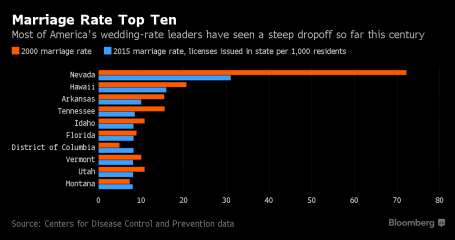
A drop in weddings, it seems, amounts to a drop in revenue for a city that is known as being flush with cash. Of course, this is all part of a broader nationwide trend. The Pew Research Center reports that, whereas 72% of adults 18 years of age or older were married in 1960, now, only 50% are. But, if the graph published by Bloomberg is any indication, the nationwide decline in marriage has hit Nevada especially hard.
In one way, none of this is particularly surprising. For all the fun and levity, which are not bad things in and of themselves, that I’m sure Mr. August brings to the weddings he performs, vows taken without things like spiritual guidance from a pastor or other religious mentor, serious prior consideration of all the things marriage entails, a commitment to make marriage alone the sacred space for sex, and, often, even a baseline of sobriety do little more than to cheapen and make a mockery out of the whole institution. And when something becomes cheap, it inevitably becomes expendable. After all, if Britney Spears can drunkenly marry her childhood friend in Las Vegas and then have their marriage annulled 55 hours later, one has to wonder: why bother with marriage in the first place?
They key to reversing the decline in marriage and the denigration of marriage is not to try to repristinate the marriage-saturated days of 1960, hoping that, somehow, marriage rates will soar again if we just yell enough at the cultural forces that have damaged the institution. No, the key to a deeper appreciation of and desire for marriage is to consider what marriage is really meant to reflect. So here are three things that we can say, as Christians, marriage reflects.
Marriage reflects community in Christ.
One of the great mysteries of Christian teaching is that of the Trinity – that God is one, yet, at the same time, He is also three persons: Father, Son, and Holy Spirit. Thus, God is in community, in some sense, with Himself. For centuries, professional theologians and Sunday School teachers alike have tried to explain this mystery in a way that is comprehensible. My Sunday School teacher, for instance, mused that the Trinity is like an apple. There is the peel, the flesh, and the core. These are three parts, and yet they are all part of one apple. The problem with this illustration, however, is that God is indivisible. He cannot be divided like an apple. He is not made up of three parts, but actually is three persons.
Thankfully, the Bible presents us with its own object lesson to help us understand the Trinity. What is this object lesson? Marriage. When marriage is given by God, He explains that it is meant to be when “a man leaves his father and mother and is united to his wife, and they become one flesh” (Genesis 2:24). In marriage, there are two persons, and yet they are one flesh, even as in God, there are three persons, yet He is one God. Moreover, throughout this life, a husband and wife ought to be indivisible, as is God. This is why Jesus says divorce is so damaging – not only because it hurts the people involved, but because it tarnishes the very reflection of God! Thus, community in marriage, even if it is broken by sin, is meant to reflect the perfect community of the Trinity.
Marriage reflects the sacrifice of Christ.
As anyone who has been married for any amount of time will tell you, marriage requires sacrifice. It requires laying down your own wants, needs, and desires for the sake of another. The apostle Paul eloquently explains the sacrificial nature of marriage when he writes:
Husbands, love your wives, just as Christ loved the church and gave Himself up for her to make her holy, cleansing her by the washing with water through the word, and to present her to Himself as a radiant church, without stain or wrinkle or any other blemish, but holy and blameless. (Ephesians 5:25-27)
Paul notes that the sacrifice a husband makes for his wife ought to reflect the sacrifice that Christ made for His church, even if that sacrifice includes laying down his very life, as it did for Christ. Thus, at the same time marriage gives a community that reflects the Trinity, it also eats away at our proclivity toward selfishness. Marriage is fundamentally centered not on yourself, but on your spouse, even as God is fundamentally centered on us and on our salvation.
Marriage reflects eternity with Christ.
The best marriage is not the one you celebrate once a year on your anniversary. The best marriage is the one that is still to come:
I heard what sounded like the roar of a great multitude in heaven shouting: “Hallelujah! For our Lord God Almighty reigns. Let us rejoice and be glad and give Him glory! For the wedding of the Lamb has come, and His bride has made herself ready.” (Revelation 19:1, 6-7)
When the apostle John gets a window into eternity, he sees that every wedding on earth between a husband and wife is ultimately meant to reflect a perfect wedding in heaven between Christ and His people. Marriage in this age, then, however wonderful it can be, is not an end in and of itself. It is a sign pointing to something even greater. This is why Jesus, when He is questioned by the religious leaders about marriage in eternity, says, “At the resurrection people will neither marry nor be given in marriage” (Matthew 22:30). Marriage between people till death do them part is meant to point to perfect communion with God where death no longer reigns. Marriage, then, at the same time it fills a longing, should also create a longing. It should create a longing for a deeper community that not even your spouse can meet. It should create a longing for a deeper community that only Christ can fill in His wedding feast.
This is what marriage is meant to reflect. It cannot be reduced, then, to a Vegas jag, or, for that matter, a well-planned out and exorbitantly expensive ceremony and reception. These things are not necessarily bad on their own terms, but if they become the things of marriage, they reduce marriage to something that is entertaining, cheap, and contrived. But marriage cannot stand if it is this. Marriage must stand as a gift from God that gives you community, costs you your very self, and points you to the One who gave Himself for you so that, on the Last Day, He can walk you down His eternal aisle.
No neon or Elvis costumes needed.
Charlie Gard and the Tenacity of Hope

Credit: Independent
There is a hardly a more compelling example of the ravages of disease warring against the hope for life than that of Charlie Gard. Charlie is almost a year old now, born last August in the U.K. Shortly after his birth, it was discovered that he had a rare genetic condition known as mitochondrial DNA depletion syndrome, which affects vital internal organs such as, as in Charlie’s case, the kidneys and brain. At present, Charlie is being kept alive by a ventilator, but the hospital at which Charlie is staying asked a judge back in March to rule that life support should be discontinued, which the judge ruled in support of in April. Charlie’s parents appealed the ruling, but did not get it overturned. Both President Trump and Pope Francis have signaled their support for Charlie, with the pope even offering Charlie a spot at the Vatican pediatric hospital for continuing treatment. Charlie’s parents have asked to have their son transferred to the U.S. for an experimental treatment, which has had some limited success, but the U.K. hospital has refused to do so, citing legal hurdles.
The issues in this dispute are legion. Should a judge have the ability to trump parents’ wishes with regard to their own child, provided that the parents are seeking the genuine welfare and, in this case, the continued life, of their son? Are Charlie’s parents seeking the correct course of action, considering their son is not able to live, at least at this point, apart from extraordinary and continuous medical intervention? And what are the hopes for some sort of improvement or change in Charlie’s condition if he is moved elsewhere to receive treatment?
It is the last of these questions that is most captivating to me because it is the question that sits in the background of the first two questions. The U.K. believes there is no real hope for Charlie’s recovery. Charlie’s parents believe there is enough hope for, at minimum, some sort of improvement that they want to continue his life support and investigate an experimental treatment. This battle royal, then, boils down to hope.
Over the course of my ministry, I have known more than one person who was terminally ill and, when presented with an option for an experimental treatment, declined and instead chose to go into hospice because they did not see any real hope for healing, even with the treatment. This does not mean, however, that these people did not have any hope. Their hope was simply located in a different place – not in a treatment, but in a Lord who can call even the dead to life. Whether it is a temporary stay on death by means of a medical treatment, or an eternal resurrection on the Last Day by means of a trumpet call and a returning Christ, hope for life, it seems, will not be squelched.
Theologically, the irrepressibility of hope for life makes sense because, in the beginning, death was not part of God’s plan. Contrary to Yoda, death is not a natural part of life – and we know it, even if only intuitively. Death, Scripture says, is an enemy to be defeated. And though Charlie’s parents cannot conquer death like Christ, they do seem voraciously intent on confronting death through the very best that medicine has to offer their son.
It does unsettle me that a judge would arrogate to himself the prerogative of telling two parents whether or not their son can receive a potentially life-saving treatment. I will confess that, according to the information at hand, the hospital is probably correct in its estimation of Charlie’s recovery prospects. But hope has a funny way of looking beyond the information at hand to divine intervention. And that is a hope that is worth holding on to. Indeed, as Christians, we know that is the hope Jesus died to give and rose to secure. I hope the hospital and the British legal system can respect that hope.
Christianity ≠ Morality

Credit: Dietmut Teijgeman-Hansen
One of the topics I address often on this blog is that of morality. With a collapsing cultural consensus on what morality looks like around issues like human sexuality, childbearing, childrearing, gender, justice, and political discourse – to name only a few examples – offering a Christian perspective on what it means to be moral is, I believe, important and needed.
There is an implicit danger, however, in spending all of one’s energy arguing for a Christian morality in a secular society. Far too often, when we, as Christians, do nothing more than argue for a Christian morality in the public square, it can begin to appear that Christianity itself is nothing more than a set of moral propositions on controversial questions. Like in the 1980s, during the height of the Christian Moral Majority, Christianity can be perceived to be conterminous with a particular system of morality.
A couple of years ago, an op-ed piece appeared in the LA Times titled, “How secular family values stack up.” In it, Phil Zuckerman, a professor of sociology and secular studies at Pitzer College, argues that godless parents do a better job raising their children than do godly parents. He writes:
Studies have found that secular teenagers are far less likely to care what the “cool kids” think, or express a need to fit in with them, than their religious peers. When these teens mature into “godless” adults, they exhibit less racism than their religious counterparts, according to a 2010 Duke University study. Many psychological studies show that secular grownups tend to be less vengeful, less nationalistic, less militaristic, less authoritarian and more tolerant, on average, than religious adults.
Much of what these kids raised in secular homes grow up to be is good. A resistance to peer pressure, an eschewing of racism, a willingness to forgive, a measured sobriety about the positives and negatives of one’s country, a desire to avoid violence, a willingness to serve instead of to command, and a charitable tolerance toward all people are certainly all noble traits. Professor Zuckerman argues that since secular parenting has a statistically higher probability than does Christian parenting of producing children who act morally in these categories, Christian parenting serves no real purpose. But it is here that he misunderstands the goal of Christian parenting. The goal of Christian parenting is not to make your kids moral. It is to share with your kids faith in Christ. Morality is wonderful, but, in Christianity, faith comes first.
James, the brother of Jesus, describes the proper relationship between Christian morality and Christian faith when he writes:
What good is it, my brothers and sisters, if someone claims to have faith but has no deeds? Can such faith save them? Suppose a brother or a sister is without clothes and daily food. If one of you says to them, “Go in peace; keep warm and well fed,” but does nothing about their physical needs, what good is it? In the same way, faith by itself, if it is not accompanied by action, is dead. But someone will say, “You have faith; I have deeds.” Show me your faith without deeds, and I will show you my faith by my deeds. (James 2:14-18)
James here explains the absurdity of claiming to have faith apart from any sort of moral deeds. He says that if someone claims to have faith and no moral deeds, he really has no faith at all. He even goes so far as to challenge his readers to show him someone who has faith, but no moral deeds. This, in James’ mind, is an impossibility. Why? Because James knows that faith inevitably produces some sort of moral action. The real danger is not so much that someone will have faith and no moral action, but that someone will have plenty of moral action and no faith! Indeed, this is the problem Jesus has with the religious leaders when He says of them, “These people honor Me with their lips, but their hearts are far from Me” (Matthew 15:8). The religious leaders were supremely moral. But they did not have faith in Christ.
In our crusade to argue for a Christian morality in the midst of a morally relativistic secular society, let us be careful not to spend so much time trying to make people moral that we forget to share with them faith in Christ. For a Christianity that only makes people moral, ultimately, leads them the to same place that a secular moral relativism does – it leads to death. Morality, no matter what type of morality it is, cannot offer life. Only Christ can do that.
We are not here just to try to make people good. We are here to show people the One who is perfectly good. Let’s not forget what our real mission really is.
When Politics Leads to Bloodshed

Credit: Shawn Thew / EPA
When 66-year old James Hodgkinson opened fire on a ball field in Alexandria, Virginia this past Wednesday, he seemed to be targeting Republican members of Congress, who were engaged in a friendly game of baseball. Shortly before the shooting, the suspect asked two representatives if the congressional members playing that day were Republicans or Democrats. When they responded that they were Republicans, he left. But when he returned, he came toting a rifle, which he used to wound four people, including the majority whip for the House of Representatives, Steve Scalise, who sustained severe injuries. He remains in critical condition at an area hospital.
Following the shooting, investigators sprang into action and quickly discovered that Hodgkinson had a sharp disdain for Republicans, posting many virulently anti-Republican messages on social media.
This is where we are. Our nation has become so bifurcated politically that a difference in party can become a motive for attempted murder.
In general, recent times have not proven to be good ones for political discourse in our country. From a magazine cover depicting a comedian holding a severed, bloodied head bearing a curious resemblance to the president’s head, to a modernized telling of Shakespeare’s Julius Caesar in a New York park that portrays the assassination of someone who, again, appears strikingly similar to the president, to the president himself joking during his campaign that he could stand in the middle of Fifth Avenue in New York and shoot someone and his voters would still support him, political discourse has, to put it mildly, taken a nosedive.
So often, such reckless political flame-throwing is defended on the grounds of the blessed freedom of speech that we enjoy in our country. “If we can say it, we will say it,” the thinking goes. Indeed, no matter what political views you may hold, it is likely that some in your political camp have said things about opposing political factions that, though they might be legal according to the standards of free speech, are certainly not moral according to the guidances of God’s good Word. Free speech does not always equate to appropriate speech. Perhaps we should ask ourselves not only, “Can I say this?” but, “Should I say this?”
Part of the problem with our political discourse is that so often, so many seem to be so content with ridiculing the other side that they forget to offer cogent arguments for the benefits of their side. But when we define ourselves by how we belittle our opponent, we turn our opponents into nothing short of evil monsters. We stop disagreeing with them and begin hating them. And our political discourse turns toxic.
President John F. Kennedy, shortly after the Cuban Missile Crisis, gave a commencement address at American University where he called for a recognition of and an appreciation for the humanity we share even in the midst of stark political differences. He said:
No government or social system is so evil that its people must be considered as lacking in virtue. As Americans, we find communism profoundly repugnant as a negation of personal freedom and dignity. But we can still hail the Russian people for their many achievements – in science and space, in economic and industrial growth, in culture and in acts of courage …
So, let us not be blind to our differences – but let us also direct attention to our common interests and to the means by which those differences can be resolved. And if we cannot end now our differences, at least we can help make the world safe for diversity. For, in the final analysis, our most basic common link is that we all inhabit this small planet. We all breathe the same air. We all cherish our children’s future. And we are all mortal.
President Kennedy had no qualms about vigorously defending American democracy against the dangers and evils of Soviet communism. But he also never forgot that communists – yes, even communists – are people too.
The tragedy of this past Wednesday is a stark and dark reminder of what happens when we forget that our political adversaries are still our brothers and sisters in humanity. To put it in uniquely theological terms: our political adversaries are still God’s image-bearers. This means a Republican has never met a Democrat who is not made in God’s image. And a Democrat has never met a Republican who is not the same. So may we guard our actions, guard our tongues, and, above all, guard our hearts as we engage those with whom we disagree. After all, our hearts were made not to hate our opponents, but to love them.
Let’s use our hearts as God intended.
In Praise of Fathers

Just in time for Father’s Day this Sunday comes a new study detailing the impact fathers have on their daughters’ behavior patterns. In an online article published in Developmental Psychology, researchers from the Universities of Utah and Albany “compared the outcomes of older and younger full biological sisters who experienced the divorce or separation of their parents while growing up, and thus spent differing amounts of time living with their fathers.” They found that “when fathering was high quality…older sisters were less likely to affiliate with sexually risky peers during adolescence compared to their younger sisters” because they had more time with their fathers pre-divorce than did their younger siblings post-divorce.
This research is sobering, but it is not particularly surprising. The profoundly formative effect fathers have on their children has been well-documented. This study serves as both an encouragement for fathers and a challenge to fathers. It serves as an encouragement for fathers because it is a yet another reminder that they matter – greatly. In a culture that has enclaves that can, at times, belittle, disparage, and minimize the roles men play in families and in society, this study reminds us of the blessing of dads. It reminds us that fathers, by how they treat their daughters when they are little, can shape their daughters’ expectations and views of men as they grow up. But this study also presents a challenge to fathers. In an age when far too many men make children but do not raise them, this study is a clarifying indictment of the steep price that a man’s absence can incur on his children. This must change.
In a society that obsesses over personal autonomy and choice, fatherhood is a countercultural sacrifice and call. Fatherhood compels men to sacrifice many of their freedoms and hobbies for the sake of loving, providing for, and raising their children. And whether the call of fatherhood comes expectedly or unexpectedly, it should and must be answered wholeheartedly, regardless of whether or not a man feels he’s ready to be a dad.
Many men I know are quite competitive. They have a desire to beat those who are strong by being even stronger themselves. Fatherhood, instead of pushing men to be stronger than the strong, invites men to be tender with the vulnerable – their children. Fatherhood calls for a strength that does not conquer, but loves. And this is the highest strength of all. Which is why fathers are worth celebrating.
Physician-Assisted Suicide and Who We Really Are

Physician-assisted suicide has gained limited acceptance in many regions of the country because it has been peddled, in part, as an option for those suffering from the excruciating pain of certain types of terminal illnesses. Supervised suicide was sold as a way to alleviate physical misery. A new study published in The New England Journal of Medicine, however, suggests that the actual reasons people choose assisted suicide are quite different from that of physical suffering. One of the researchers in the study, Madeline Li, explains that many people consider assisted suicide because of:
…what I call existential distress. [For some people,] their quality of life is not what they want. They are mostly educated and affluent – people who are used to being successful and in control of their lives, and it’s how they want their death to be.
In one instance cited in this study, a marathon runner found herself confined to her bed because of cancer. She wanted to take her own life because “that was not how she saw her identity,” Li explained. In another case, a university professor wanted to die because, according to Li, “he had a brain tumor, and he didn’t want to get to the point of losing control of his own mind, [where he] couldn’t think clearly and couldn’t be present.”
This study reveals that physician-assisted suicide can turn out to be not so much a palliative response to physical pain, but an angry response to the loss of how we see ourselves. A marathon runner wants to end her life when she can longer run marathons. A university professor sees no reason to live if he is no longer able to think at the level he once was. It turns out that when people lose what gives them their identities, they often lose the very will to live.
If nothing else, this study should serve as a warning concerning the dangers of finding your meaning, purpose, and identity in something you are or in something you do, for these types of identities can all too easily be shattered by the wily ravages of this world and this life. This is why, as Christians, we are called to find who we are in Christ.
When a rich man comes to Jesus in Mark 10 and asks Him, “What must I do to inherit eternal life?” Jesus responds by citing a sampling of the Ten Commandments: “You shall not murder, you shall not commit adultery, you shall not steal, you shall not give false testimony, you shall not defraud, honor your father and mother.” When the man boasts to Jesus, “All these I have kept as a little boy,” Jesus responds, “One thing you lack. Go, sell everything you have and give to the poor, and you will have treasure in heaven. Then come, follow Me.” The rich man, the story says, “went away sad, because he had great wealth.” It turns out that this man found his meaning, purpose, and identity in his wealth. And when Jesus asked him to give up the source of his earthly identity, he could not – even to follow Jesus eternally. May we never make the same devastating mistake.
Physician-assisted suicide carries with it a whole host of ethical problems, including the temptation to place profits over people. Just last week, The Washington Times reported on a doctor who claimed that some Nevada insurance companies refused to cover certain life-saving treatments he requested for his patients because they were too expensive. Instead, these companies offered to help his patients end their lives. If this story is true, such a practice is nothing short of appalling. But sadly, far too many people do not need a creepy suggestion from a greedy insurance company to consider taking their own lives. They only need to be so turned in on who they are in this life that they forget about who they are in Christ.
Suicide may be some people’s answer to a loss of identity. But suicide cannot give someone a new identity. It cannot give someone hope. Only Jesus can do that. So let us find ourselves in Him.
“I consider that our present sufferings are not worth comparing with the glory that will be revealed in us.” (Romans 8:18)
Reflections on London

As I finish my preparations for worship at Concordia tomorrow, I do so knowing that people across the world are hurting tonight as terrorists have launched an attack yet again, this time in London.
As I’ve been reflecting on another tragic night, I cannot help but hold out hope. Here’s why. Terrorists strike. They quickly detonate a bomb, or mow down people using a car. Terrorists strike. Our God, however, does something more. He abides. He abides with us to comfort us in our distress. He abides with us to dry our eyes when they are filled with tears. He abides with us to give us strength when we are weak. Terrorists strike. Our God abides.
And abiding is better.
Abiding is better because it outlasts a strike. Abiding is better because long after terrorists disappear into the shadows to plan their next sinister attack, our God remains by the sides of those who have lost loved ones. Abiding is better because long after the police clear, loved ones are laid to rest, and today’s tragic story gets coopted by the next big tragic story, our God will not forget the events of this night.
One of my favorite hymns is “Abide with Me.” Two of its verses are especially poignant to me tonight. The first of these verses is for those who are mourning losses in these attacks. The hymn reminds us of how Christ’s abiding presence can comfort us in our loss:
Come not in terrors, as the King of kings;
But kind and good, with healing in Thy wings;
Tears for all woes, a heart for every plea;
Come, Friend of sinners, and abide with me!
In a world of terror, we do not need Christ to be our terrible Judge. Instead, we need Him to be our gentle Healer. May Christ begin the healing process in all those who are grieving.
The second of the verses reminds us of the hope that we have for the lost:
I fear no foe, with Thee at hand to bless;
Ills have no weight, and tears no bitterness:
Where is death’s sting? Where, grave, thy victory?
I triumph still if Thou abide with me.
Terrorists struck tonight. And with them, death struck. But when Christ abides with us, we triumph.
Terrorism doesn’t stand a chance.
Praying for London.
Terror in Manchester

Terror struck again, this time at an Ariana Grande concert in Manchester, England. What began as a night of fun for fans of the pop music diva ended with 22 dead, many of them children, and 59 others wounded when a suicide bomber detonated himself in the middle of the concert arena. ISIS quickly claimed responsibility for the attack, which was carried out by 22-year-old Salman Abedi who seems to have become radicalized after travelling to Syria.
Once again, the world is left struggling with what can only be described as a senseless and ghastly act of violence. As I have after other similar attacks, I want to offer a few thoughts on how to process yet another week marred by a terrorist’s malice. Here are three things to consider.
Sin is real.
In general, we want to believe that people are good. Sure, there may an occasional evil outlier, but, overall, we like to assume that people are hardwired for goodness. The steady stream of terrorist attacks, however, indicates differently. Indeed, the tragedy in Manchester was the most widely reported terrorist attack of last week, but three additional attacks were also launched this past week – one in Egypt, another in the Philippines, and yet another in Indonesia. Heinous acts of evil are rampant. Sin is all too real.
It is true that the vast majority of people, thankfully, will never be party to a terrorist plot. Every one of us, however, will struggle with some kind of sin. Whether it be the sin of deception, or lust, or pride, or anger, none of us can escape the sirens of our sinister sides. Because we live in a broken world, we have to live with the sad fact that the sin of terrorism will continue to be “out there.” But because we ourselves are broken people, we also have to live with the sad fact that we will continue to struggle with sin in us. The apostle Paul is right when he writes, “For all have sinned” (Romans 3:23). Sin is real and is everywhere.
Righteousness is real.
We may struggle against sin, but we also yearn for righteousness. We recoil in disgust against terrorism precisely because we know it’s wicked and we yearn for what is right. But how do we know what is right and that terrorism is wrong? Paul explains that, even if we do not know God, we know what is right and wrong because God has written righteousness on our hearts: “When [people], who do not have the law, do by nature things required by the law, they are a law for themselves, even though they do not have the law. They show that the requirements of the law are written on their hearts” (Romans 2:14-15). This is why, in the face of evil, we appeal to and press toward righteousness.
Justice is coming.
In his famous “I Have a Dream” speech, Martin Luther King Jr. declared, “We refuse to believe that the bank of justice is bankrupt.” At a time when racism was rampant, Dr. King believed justice would ultimately triumph. And although racism still spreads its ugly tentacles through our society, justice has been slowly but surely bludgeoning the evil of racism over the 54 years since Dr. King’s speech. What is true of racism is also true of ISIS and other organizations like it. The evil of ISIS is simply no match for the justice of God. ISIS may delight in the death of the innocent, but a day will come when “there will be no more death” (Revelation 21:4), for “death will be swallowed up in victory” (1 Corinthians 15:54) through Christ. Indeed, Christ has already defeated death by His resurrection. And because of Christ’s resurrection, those who lose their lives in Him do not lose their lives forever. Death, for them, is but a pause in the drumbeat of life. Their resurrections are soon to come when Jesus comes.
So after a week when a terrorist did his worst, we can take comfort in the biblical promise of everlasting life. To quote the poet and pastor John Donne:
One short sleep past, we wake eternally
And death shall be no more; Death, thou shalt die.
Trump, Lavrov, Comey, and Flynn

What a week it’s been at the White House. Last week brought what felt like a one-two punch of political crises. First, The Washington Post reported this past Monday that President Trump, in an Oval Office meeting, shared highly classified information concerning terrorist activity with Russian Foreign Minister Sergei Lavrov. Because the information the president shared was first shared with us by one of our allies, the potential exists, according to some experts, to compromise our intelligence sharing relationships with these allies. Then, the very next day, The New York Times published a story claiming that President Trump had asked the now former FBI director, James Comey, to end his investigation into the president’s fired national security advisor, Michael Flynn. As soon as the story broke, many began to raise questions about whether or not the president potentially obstructed justice. The president has since denied The New York Times’ report.
As politicians and pundits debate the consequences, the legality, and the constitutionality of the president’s alleged actions and their implications for our country, and as our political discourse continues down a path that seems to be increasingly marked by fear, distrust, and anger, here are a few reminders for us, as Christians, to help us navigate these heady times.
Pray for the president and for all our leaders.
Whether you love him, hate him, or are on the fence about him, President Trump needs our prayers. Scripture commands us to pray for him along with all those who serve in our nation’s government: “I urge, then, first of all, that petitions, prayers, intercession and thanksgiving be made for all people – for kings and all those in authority” (1 Timothy 2:1-2). This means Republicans should be praying for Democrats and Democrats should be praying for Republicans. Political leadership is not only geopolitically treacherous because of the power it wields, it is spiritually perilous because of the prideful temptations it brings. Politicians need our prayers.
Love the truth more than you love your positions.
In February, Elizabeth Kolbert wrote a piece for The New Yorker titled, “Why Facts Don’t Change Our Minds.” In it, she cites a Stanford study in which researchers rounded up two groups of students: one group that believed capital punishment deterred crime and another group that believed capital punishment did not deter crime. Both groups of students were then given two studies, one of which presented data that showed capital punishment did deter crime and the other of which presented data that showed capital punishment had no effect on crime. Interestingly, both of these studies were completely fabricated so the researchers could present, objectively speaking, equally compelling cases. So what happened? The students who were pro-capital punishment applauded the study that bolstered their position while dismissing the study that called it into question. Likewise, the students who were anti-capital punishment applauded the study that agreed with their position while dismissing the other study. These two groups were so entrenched in their positions that they dismissed, out of hand, any information that called their positions into question, even if that information was presented as factual. In other words, they loved their positions more than they loved the truth.
Politics seems to be custom-made for the kind of thinking that is more interested in holding positions than in seeking truth. I have seen several social media posts where people boast openly that they no longer watch this or that news channel. Instead, they receive their news only from outlets that are sympathetic to their positions. As Christians, we should humbly recognize that there is truth in all sorts of sources – even in sources that disagree with and call into question our political positions.
The nature of truth is that some of it will always make us uncomfortable. Sin, at its root, is based on lies, which means that some lies will inevitably appeal to us more than some truth, for all of us are sinners. Indeed, if some truth never makes us uncomfortable, then we are probably missing the truth!
Senator Ben Sasse of Nebraska offered a great bit of moral clarity on the subject of truth in political discourse when he said recently on a morning news show:
Both of these parties, going back a couple of decades now, regularly act like your main duty is to – if here’s the truth, and you think the other side’s going to say this – you think you’re supposed to say this to try to counterbalance it. I think that’s a bunch of hooey … You’re supposed to say what you think is true and try to persuade people to come alongside with you. You’re not trying to counterbalance one falsehood with another.
This is exactly right. You don’t fight one political tall tale with a tall tale of your own. Truth trumps political posturing. In the words of the prophet Jeremiah, we are to “deal honestly and seek the truth” (Jeremiah 5:1). We are not to blindly and sycophantically defend the positions of our favorite politicians.
Trust in the Lord; not in an earthly leader.
In politics, crises will always abound. Politicians, after all, are fallen human beings who are prone to making the same mistakes we are and can, at times, even intentionally and malevolently sin. This is why we cannot trust in them for deliverance from our plights and blights. Only the Lord can deliver us from these things.
Perhaps the thing that disturbs me the most about our current political environment is not what our politicians do, but what so many of us believe our politicians can do. So many of us seem tempted to fashion our politicians not as public servants, but as civil saviors. Sometimes, we can be tempted to believe our politicians can usher in a humanly wrought utopia (think of some of the hopes that rested on the chant, “Yes, we can!”) while at other times, we can be tempted to believe our politicians can repristinate a bygone America full of wistful nostalgia (think of some of the discourse that surrounded the slogan, “Make America great again!”). As Christians, our hope lies not in utopia or in nostalgia, but in Parousia – the day when Christ will return and sin and death will be conquered by Him once and for all. That is our hope. He is our hope. So let’s devote ourselves to proclaiming Christ, Him crucified, Him resurrected, and Him coming again.
A Forgiveness That Kills Death

When Mark Zuckerberg first unveiled Facebook Live, he touted it as a service that allowed people to express themselves in “raw” and “visceral” ways:
Because it’s live, there is no way it can be curated. And because of that it frees people up to be themselves. It’s live; it can’t possibly be perfectly planned out ahead of time. Somewhat counterintuitively, it’s a great medium for sharing raw and visceral content.
This is true. But I’m not sure broadcasting a murder on social media is what Mr. Zuckerberg had in mind. But on Easter Sunday, last weekend, this is exactly what happened.
74-year-old Robert Godwin Sr. was walking home from an Easter meal with his family when he was stopped by Steve Stephens. Before Mr. Godwin knew what was happening, he was dead and Stephens was on the run. The following day, Stephens was spotted in Pennsylvania at a McDonald’s drive-thru. When police took pursuit, Stephens took his own life.
This is a shocking story. But it took an even more shocking turn when Mr. Godwin’s family was interviewed by CNN’s Anderson Cooper. The anchor asked the family what they learned from their father. They answered:
The thing that I would take away the most from my father is he taught us about God, how to fear God, how to love God, and how to forgive. And each one of us forgives the killer, murderer.
Clearly shocked, Mr. Cooper asked, “You do?” To which the family responded:
We want to wrap our arms around him…And I promise you I could not do that if I didn’t know God, if I didn’t know Him as my God and my Savior…It’s just what our parents taught us. It wasn’t that they just taught it, they didn’t just talk it, they lived it. People would do things to us and we would say, “Dad, are you really going to forgive them, really?” and he would say, “Yes, we have to.” My dad would be really proud of us, and he would want this from us.
Mr. Cooper, amazed at this family’s willingness to forgive a man who murdered their father in cold blood, wrapped up the segment by saying:
You talked about how your friends would say they wish they were Godwins. I know a lot of people watching tonight – and certainly I speak for myself – I wish I was a Godwin right now because you all represent your dad very well.
Jesus famously said, “Love your enemies and pray for those who persecute you” (Matthew 5:44). Anyone who has ever had to face down an enemy has probably found this to be a nice sentiment in theory, but painfully difficult to practice. And yet, Jesus commanded us to live this way because He knew it was the only way to confront sin and destroy it. When someone sins against us and we retaliate, we have only traded injury for injury. But when someone sins against us and we love and forgive them, as the Godwins did, we have taken their sin and, instead of meeting it with something similar, we destroy it with something better.
Easter is a day when we celebrate life. Steve Stephens tried to turn it into a day of death. But death lost when the Godwin family forgave. For where there is forgiveness, there is life. After all, how do you think we receive eternal life? Only through the forgiveness of sins that comes in Christ.
“God has rescued us from the dominion of darkness and brought us into the kingdom of the Son He loves, in whom we have redemption, the forgiveness of sins.” (Colossians 1:13-14)


 Pastor Zach's Blog