Posts filed under ‘Current Trends’
The Dogs of North Korea

Credit: Korean Central News Agency
The more we learn about North Korea, the more sickening the regime there looks. Recently, U.N. Ambassador Nikki Haley held a meeting on human rights in North Korea, which featured Ji Hyeon-A, a woman who escaped from North Korea to South Korea in 2007. Fox News reported on her remarks:
“Pregnant women were forced into harsh labor all day,” she said. “At night, we heard pregnant mothers screaming and babies died without ever being able to see their mothers.”
North Korea does not allow for mixed-race babies, she said. At one detention center, she described how inmates starved to death. Their dead bodies, she said, were given to the guard dogs for food.
This is horrifying. But it is also tragically common in this isolated nation. So, how are we to respond?
First, we should pray for the protection of the citizens of North Korea. Living under the nation’s current dictator, Kim Jong-un, or its prior dictator, Kim Jong-il, as did Ji Hyeon-A, has to be terrifying emotionally, psychologically, spiritually, and physically. Just this past week it was reported that North Korea’s top military official, Hwang Pyong-so, second only to Kim Jong-il himself, is suspected dead after falling out of favor with the supreme leader. In North Korea, there is no reasonable assurance of life. Thus, prayers for the thousands whose lives are in danger every day are in order. In Psalm 22, the Psalmist prays:
But You, LORD, do not be far from me. You are my strength; come quickly to help me. Deliver me from the sword, my precious life from the power of the dogs. (Psalm 22:19-20)
The Psalmist’s prayer echoes an all-too-literal North Korean fear. For those who face the grisly specter of being fed to dogs, we must pray. For those who are oppressed or threatened in any way in North Korea, we must pray.
But we must go further. Our prayers must include not only petitions for protection, but cries for justice. The evil of the North Korean regime must be stopped.
When John has a vision of heaven in Revelation, he sees both those saved by God’s grace and those condemned by God’s judgment. He explains the scene thusly:
Blessed are those who wash their robes, that they may have the right to the tree of life and may go through the gates into the city. Outside are the dogs, those who practice magic arts, the sexually immoral, the murderers, the idolaters and everyone who loves and practices falsehood. (Revelation 22:14-15)
John offers a laundry list of those who will be “outside” salvation on the Last Day. But what is most interesting about this list is who heads it: “the dogs.” Considering dogs are such a ubiquitous part of American families that they have garnered the moniker of “man’s best friend,” the idea that dogs would be excluded from God’s kingdom may puzzle us. But in the ancient world, dogs were considered to be not pets, but dangerous, disease-ridden scavengers. They were reviled. In his vision, then, John sees dogs as symbols of all that is evil.
Those who feed people who have died to literal dogs can only be called dogs themselves, in the biblical sense. Yet, we have the assurance that, one day, these dogs will find themselves on the “outside,” just like John foresees – whether this means they lose power in this age, or in the age to come.
In Psalm 22, shortly before the Psalmist prays that God would deliver him from the dogs, he declares:
Dogs surround me, a pack of villains encircles me; they pierce my hands and my feet. (Psalm 22:16)
This psalm, it turns out, is not only a prayer for deliverance, but a prophecy of things to come – a prophecy of One who, just like in the psalm, would be surrounded by His enemies and pierced for them (Psalm 22:16; Luke 24:39), a prophecy of One who, just like in the psalm, would die humiliated as His enemies divided His clothes and cast lots for them (Psalm 22:18; Matthew 27:35), and a prophecy of one who, just like in the psalm, would cry out in despair, “My God, My God, why have You forsaken Me” (Psalm 22:1; Matthew 27:46)?
Jesus, just like the North Koreans, knew the horror of being surrounded by dogs while in the throes of death. Jesus, just like the North Koreans, experienced the most diabolical evils humans could perpetrate. But Jesus, while suffering death at the hands of evil, was not overcome by it. The dogs that surrounded Him were defeated when His tomb turned up empty. And the dogs that surround many in North Korea will be defeated when our tombs turn up empty too.
The dogs may maul. But Jesus’ resurrection is the promise of their defeat, and it is offered to all.
Christmas When Disaster Strikes

Though wildfires in Southern California are not an unusual occurrence, the ones now tearing through the Los Angeles area are truly historic. Hundreds of thousands residents are under mandatory evacuations, hundreds of thousands of acres have been burned, and many of the fires are not contained. The fires are effortlessly jumping major freeways, including the 405, and engulfing everything in their path.
The stories emerging from the wildfires are heartbreaking. On NBC Nightly News, images and stories of grieving and tearful people who have lost their homes have been commonplace. In one image, a man stands on his roof staring down a massive wildfire with a garden hose in hand. He doesn’t even look hopeful. He knows it’s futile.
Even as I see tears and hear sobs, it is difficult for me to imagine how these people must feel. At a time of year that is known for its bounty of gifts, there are thousands who have suffered the loss of so much.
One of my favorite Christmas carols is “Joy to the World.” Its famously bouncy melody, however, can mask its realistic estimation of the trials of this world:
No more let sins and sorrows grow,
Nor thorns infest the ground;
He comes to make His blessings flow
Far as the curse is found.
This world, the carol concedes, is full of sins, sorrows, and thorns. And yet, the hope of Christmas is that a Savior has been born who “comes to make His blessings flow far as the curse is found.” The tension of this lyric is thick. A catastrophe like the California fires is certainly a result of the curse – a world broken by sin. Natural disasters were never meant to be part of God’s good creation. But God comes into this world, cursed by sin, to make His blessings flow. In other words, even in the midst of the fires, God’s blessings are not withheld, but bestowed. But when you’re fighting a massive fire with a garden hose, God’s blessings can be awfully tough to spot.
Christmas can help us see how God’s blessings arrive, even when all we see is the curse. God’s blessings arrive not in brash and bold and bawdy ways, but in small and poor and humble ways. They arrive in little towns like Bethlehem. They arrive through peasant people like Mary and Joseph. They arrive with a baby who sleeps in some hay. In other words, they arrive in ways that are easy to miss in a world where the curse looms large. But those who take the time to see these blessings cannot help but be changed by them.
One story coming out of the California fires involves a family whose mansion burned to the ground last week. When firefighters ordered an evacuation of the area shortly before the fires engulfed this family’s home, one firefighter asked the homeowner, “If we could save just one thing, what would you want it to be?” The homeowner replied, “Please save my Christmas tree for my kids because it’s got so many memories.” The family no longer has a home. But they still have their tree. They still have a reminder of this season and what it’s all about – the greatest blessing of God’s Son. The curse may have taken this family’s house, but it did not take this family’s Christmas.
He comes to make His blessings flow
Far as the curse is found.
He really does – even if it’s in the smallest of ways.
ISIS and Sufis

Credit: Akhtar Soomro / Reuters
Because it was over the long Thanksgiving weekend, the ISIS attack on an Egyptian Sufi mosque that killed 305 people a week ago Friday received some attention, but not as much as it might have normally. But it is important. The sheer scope of the tragedy is gut-wrenching. The mass shooting at the Mandalay Bay in Las Vegas claimed 59 lives. The mass shooting at the First Baptist Church in Sutherland Springs claimed 26. The attack on this mosque killed over 300. It is sobering to try to fathom.
Part of what makes this attack so disturbing is that one group of Muslims – or at least self-identified Muslims – in ISIS perpetrated this attack against another group of Muslims who are Sufi. At its heart, this attack was driven not by political or cultural differences, but by an all-out holy war. Rukmini Callimachi, in a report for The New York Times, explains:
After every attack of this nature, observers are perplexed at how a group claiming to be Islamic could kill members of its own faith. But the voluminous writings published by Islamic State and Qaeda media branches, as well as the writings of hard-liners from the Salafi sect and the Wahhabi school, make clear that these fundamentalists do not consider Sufis to be Muslims at all.
Their particular animus toward the Sufi practice involves the tradition of visiting the graves of holy figures. The act of praying to saints and worshiping at their tombs is an example of what extremists refer to as “shirk,” or polytheism.
Certainly, the veneration of the dead is a problem – not only for many Islamic systems of theology, but for orthodox Christianity as well. When the Israelites are preparing to enter the Promised Land, God warns them:
Let no one be found among you who sacrifices their son or daughter in the fire, who practices divination or sorcery, interprets omens, engages in witchcraft, or casts spells, or who is a medium or spiritist or who consults the dead. Anyone who does these things is detestable to the LORD; because of these same detestable practices the LORD your God will drive out those nations before you. (Deuteronomy 18:10-12)
On this, many Christians and Muslims agree: venerating the dead is not only superstitious and paganistic, it smacks of polytheism by exalting a departed soul to the position of God, or, at minimum, to a position that is god-like. Yet, one can decry the veneration of the dead without creating more dead, an understanding that many others in the Muslim world, apart from ISIS, seem to be able to maintain with ease. Theological disagreements can be occasions for robust debate, but they must never be made into excuses for bloodshed.
There are some in the Christian world, who, like Sufi Muslims, venerate those who are dead in ways that make other Christians very uncomfortable. Catholicism’s veneration of the saints, for instance, is rejected as unbiblical and spiritually dangerous by many Protestants, including me. But this does not mean that there are not many theological commitments that I don’t joyfully share with my Catholic brothers and sisters, including a creedal affirmation of Trinitarian theology as encapsulated in the ecumenical creeds of the Church. I may disagree with Catholics on many important points of doctrine, but they are still my friends in Christ whom I love.
Jesus famously challenged His hearers to “love your enemies and pray for those who persecute you” (Matthew 5:44). Part of what I find so compelling about Jesus’ challenge is not just its difficulty – though it is indeed very demanding to try to love someone who hates you – but its keen insight into the devastating consequences of hate. If you love your enemy, even when it’s difficult, you can most certainly love your friends, and, by God’s grace, you may even be able to make friends out of enemies when they become overwhelmed by your love. But if you hate your enemy, even your friends will eventually become your enemies, and you will hate them too. Why? Because hate inevitably begets more hate.
ISIS has made a theological system out of hate. Thus, they have no friends left to love. They only have enemies to kill, including other Muslims. Christians, however, worship a God who not only has love, but is love (1 John 4:16). For all the Sufis who are mourning, then, we offer not only our condolences, but our hearts, and we hold out the hope of the One who is not only the true God, but the one Savior, and who makes this promise: ISIS’s hate that leads to death is no match for Jesus’ love and His gift of life.
The Scandals Keep Coming

It’s far better to take refuge in the LORD than to trust any human. It’s far better to take refuge in the LORD than to trust any human leader. (Psalm 118:8-9)
If there were ever words we needed to read, re-read, and take to heart in the chaos of our heady political milieu, it would be these. Our human leaders fail us again and again – time after time, leader after leader, politician after politician.
The latest political failures come conveniently in both a left and a right form – a liberal scandal and a conservative one. On the liberal side, there is U.S. Senator Al Franken from Minnesota, who was revealed to have groped a radio newscaster during a 2006 U.S.O. tour. The senator has issued an apology, but there are already questions boiling under the surface as to whether or not this kind of behavior was common for him.
On the conservative side, there is the candidate for the U.S. Senate, Judge Roy Moore from Alabama, who stands accused making unwanted advances at female teenagers in the early 80s and, according to the two most serious allegations, sexually assaulting one girl who, at the time, was 14 and attacking another girl who, at the time, was 16, by squeezing her neck and attempting to force her head into his groin. Judge Moore was in his 30s when the alleged assaults took place and he has denied the allegations.
Senators Mitch McConnell and Chuck Schumer have called for an investigation of Senator Franken by the Senate Ethics Committee, a move which Senator Franken himself supports. Politicians on both sides of the aisle have called on Judge Moore to drop out of the Alabama Senate race, with some interesting exceptions. Alabama State Auditor Jim Zeigler defended the judge’s alleged actions using what can only be described as a tortured – and, it must be added, an incorrect and incoherent –theological logic, saying:
Take the Bible – Zechariah and Elizabeth, for instance. Zechariah was extremely old to marry Elizabeth and they became the parents of John the Baptist. Also, take Joseph and Mary. Mary was a teenager and Joseph was an adult carpenter. They became parents of Jesus. There’s just nothing immoral or illegal here. Maybe just a little bit unusual.
Alabama Representative Mo Brooks defended Judge Moore more straightforwardly by calculating the political cost of electing a Democrat to the Senate instead of a firebrand conservative like the judge. He said:
America faces huge challenges that are vastly more important than contested sexual allegations from four decades ago … Who will vote in America’s best interests on Supreme Court justices, deficit and debt, economic growth, border security, national defense, and the like? Socialist Democrat Doug Jones will vote wrong. Roy Moore will vote right. Hence, I will vote for Roy Moore.
Whether among Democrats or Republicans, it seems as though the stakes on every election, every seat, every position, and every appointment – yea, every scrap of political power – have become sky high. A national apocalypse, it can feel like, is only one political loss away.
New York Times columnist David Brooks recently bemoaned how our perceived astronomical political stakes have turned politics itself into an idol for many in our society. He wrote:
People on the left and on the right who try to use politics to find their moral meaning are turning politics into an idol. Idolatry is what happens when people give ultimate allegiance to something that should be serving only an intermediate purpose, whether it is money, technology, alcohol, success or politics.
In his column, Mr. Brooks quotes Andy Crouch, who is the executive editor at Christianity Today, and his excellent description of what idols do in his book Playing God:
All idols begin by offering great things for a very small price. All idols then fail, more and more consistently, to deliver on their original promises, while ratcheting up their demands, which initially seemed so reasonable, for worship and sacrifice. In the end they fail completely, even as they make categorical demands. In the memorable phrase of the psychiatrist Jeffrey Satinover, idols ask for more and more, while giving less and less, until eventually they demand everything and give nothing.[1]
This is most certainly true. All idols fail. This means that if we fancy our politicians to be saviors who can rescue us from the wiles of our political opponents and some looming national apocalypse, those for whom we vote will inevitably fail – sometimes modestly by an inability to pass key legislation, and other times spectacularly in some grave moral collapse. Senator Franken and Judge Moore are just the latest examples of this.
David French, in a recent article for National Review concerning the Judge Moore scandal, wrote simply, “There is no way around dependence on God.” These scandals serve to remind us of this profound truth. The fact that our politicians fail should grieve us, as sin always should, but it should not scare us. After all, even if a national apocalypse should come, it is still no match for the Apocalypse, when, instead of a politician, a perfect Potentate will appear to set the world right. That’s not an apocalypse of which to be scared; that’s an apocalypse by which to be comforted. I hope you are.
_____________________________
[1] Andy Crouch, Playing God: Redeeming the Gift of Power (Downers Grove, IL: InterVarsity Press), 56
Stopping Sexual Assault

Credit: Netflix
Roger Ailes. Harvey Weinstein. Kevin Spacey.
These are just a few of the more recent names that have turned right-side-up the seamy underbelly of sickening sexual power-plays for the world to see. Charges that these men sexually assaulted people with whom they worked have sparked a social media movement among countless victims of sexual assault, who are now declaring, #MeToo. These men’s alleged sexual crimes have been roundly condemned, both in word and deed. Roger Ailes, who has now passed, was ousted from the powerful cable news network he founded. Harvey Weinstein was likewise booted from his own company. Production on Kevin Spacey’s hit show “House of Cards” has been suspended.
Sexual assault is one of those issues on which all people with any moral center can agree: it should never happen. So, why does it? From a theological perspective, sexual assault can be said to be a result of humanity’s fall into sin, a fact to which the many gruesome stories in the Bible of sexual assault attest. And no inexorable march of human history toward increasing moral enlightenment seems to be able to arrest the problem.
So, what can make a change, or even a dent, in the tragedy of sexual assault?
Our modern sexual ethics have, in many ways, been reduced to the word “consent.” As long as people consent to any kind of sexual activity, any kind of sexual activity is permissible and, yes, even moral. Indeed, in our sexually indulgent culture, it is considered immoral to restrain and contain one’s sexual desires, for sexual desire is considered to be at least a window, if not the window, into a person’s core identity. But, as David French points out in an article for National Review:
The practical result of consent-focused morality is the sexualization of everything. With the line drawn at desire alone, there is no longer any space that’s sex-free. Work meetings or restaurants can be creative locations for steamy liaisons. Not even marriage or existing relationships stand as a firewall against potential hookups …
When everything is sexualized and virtually every woman is subject to the potential “ask,” scandals like those that rocked Hollywood, Fox News, and – yes – the Trump campaign become inevitable. And they’re replicated countless times on a smaller scale in schools and workplaces across the land. Desire is elevated over fidelity and certainly over propriety, so bosses bully, spouses stray, hearts break, and families fracture.
Mr. French is precisely right. Sexual assault is a huge problem. It is a huge problem in and of itself, which is why we must stand with the women – and the men – who are victimized by it and declare, “No more!” But it is also symptomatic of another huge problem – a sexual ethic that has become so attenuated that it amounts to little more than a “yes” or “no” answer to an ask.
Andrew T. Walker, the Director of Policy Studies for the Ethics and Religious Liberty Commission of the Southern Baptist Convention, tweeted last month:
So much cultural & personal hurt due to sexual sin. Maybe the church should see its sexual ethics as a gift of common grace to the world.
– Andrew T. Walker (@andrewtwalk) October 10, 2017
Mr. Walker packs a lot of profundity into 138 characters as he invites us to entertain a wholly different, and certainly a more robust, sexual ethic than that of our culture’s as the remedy to our sexual assault problem – a uniquely Christian sexual ethic.
The Christian sexual ethic is wholly different from our culture’s not only because its content is sweeping, as any glance through Leviticus 18 will quickly reveal, but because its very trajectory is countercultural. In a culture that approvingly trends toward the permissive, Christianity vigilantly trends toward the restrictive. This is why Jesus says things like: “You have heard that it was said, ‘You shall not commit adultery.’ But I tell you that anyone who looks at a woman lustfully has already committed adultery with her in his heart” (Matthew 5:27-28). In sexual ethics, Jesus goes far beyond consent. He cuts straight to the heart. Even what happens in one’s interior life can be an opportunity for sexual immorality.
Why would Jesus trend toward the restrictive with regard to sexuality? Is He a prude? Or a prig? Or a Puritan? Hardly. He simply knows that with great power comes great responsibility. And sex does, in fact, carry with it great power. So, Jesus is inviting us to handle with care. To quote David French again:
It virtually goes without saying that the sex drive is incredibly powerful. Sex is also a remarkably intimate act that often has a profound emotional impact. An ethic that indulges that drive while also denying the emotional significance of sex will inevitably wreck lives. The wise person understands that desire – even mutual desire – can be dangerous.
It is time for us to take a step back and recognize this reality. In a culture that lionizes consent when it comes to sexuality, Christians have something much more profound to protect and prosper sexuality – a conviction that sex is best when sex is contained, not so that joy in sex may be decreased, but so that joy in sex may be released.
Sutherland Springs, Texas
I am growing weary of the phrase “active shooter situation.” Whenever I hear the phrase, I know what it means. It means more bodies counted. It means more families shattered. It means more communities terrified. It means more tranquility robbed. It means more tears shed. It means more loss endured.
This time, an active shooter situation came for Sutherland Springs, Texas – a town that, admittedly, although I’ve heard of it and live right up the road from it in San Antonio, I had to look up on Google Maps to jog my memory as to its precise location.
The numbers out of Sutherland Springs are awful. 26 people have been killed, including several children, the youngest of which was only 18 months old, and nearly two dozen more have been injured after a gunman opened fire at the First Baptist Church there during its morning worship service. It is the deadliest mass shooting at a house of worship in American history and the deadliest mass shooting period in Texas’ history.
So, once again, we pray. And, once again, we grieve. And, once again, we hope this will be the last mass shooting. And, once again, we know that, in spite of our hopes, it probably will not be. Though law enforcement officials have not yet discerned a definite motive, we know that the prospect of fame, even if it comes in the form of infamy, the chance at revenge, or the allure of making one’s voice heard through bullets seems to be so enticing that it overwhelms even the most basic of moral instincts – the moral instinct to celebrate and protect life.
As with other tragedies, people want to know why and how this could have happened. Why would a man who lived in New Braunfels drive 45 minutes south to open fire on a country Baptist congregation? How did no one see this coming? How do we protect ourselves when so many places in our communities and neighborhoods, simply by virtue of the fact that we live in a free society, are soft targets for people with evil intent?
One of the blessings of being a part of a church family is that, if the church family is healthy, it tends to feel safe. It is a safe place for people to worship with their families. It is a safe place to make friends and grow in relationships. It is a safe place to turn when a sickness strikes or a loved one is lost in order to receive prayers and support. It is a safe place to process struggles and ask questions about faith and God. But this feeling of safety has been severely tested by this tragedy.
It is important to remember that this feeling of safety that can sometimes seem so indigenous to some churches was not – and still is not – a normal feature of families of faith. Churches all across the world are being bombed, shot up, and terrorized because of their confession of Christ. The apostle Paul, in Romans 8:36, writes about what it was like to be a member of a church in the first century when he quotes Psalm 44:22: “For Your sake we face death all day long; we are considered as sheep to be slaughtered.” This does certainly not sound safe. Yet, what makes Paul’s words especially poignant at a time like this are their context. Paul begins by asking:
Who shall separate us from the love of Christ? Shall trouble or hardship or persecution or famine or nakedness or danger or sword? As it is written: “For Your sake we face death all day long; we are considered as sheep to be slaughtered.” No, in all these things we are more than conquerors through Him who loved us. (Romans 8:35-37)
Even the sword of a Roman soldier – and, yes, even the bullet from an assailant’s rifle – cannot separate us from the love of Christ. We are, Paul says, more than conquerors of those things because Christ loves us through those things.
Jesus once said, “My friends, do not be afraid of those who kill the body and after that can do no more” (Luke 12:4). A shooter at a church in Sutherland Springs killed some bodies – but he can do no more. So, we should not be afraid. Why? Because there was a moment in history when instead of a mass murderer mowing down dozens of people with an assault rifle, a mass of murderers brutally executed one man on a cross. But their murder didn’t take. Because three days later, He came back. The murders of the congregants at the First Baptist Church in Sutherland Springs won’t take either. Because one day – on the Last Day – these worshipers will come back when the One who once rose Himself will return to raise them – and us.
The worship service that those congregants were participating in yesterday morning at 11:30 – singing God’s praises and hearing God’s Word – didn’t end when a gunman opened fire and the victims drew their final breaths. It just moved. It just moved to a place around a throne where there sits a Lamb of God who takes away every sin by His death and grants eternal life by His life. And one day, we’ll join them around that same throne. May that day come quickly.
Maranatha.
ISIS Takes a Tumble

Credit: Erik de Castro / Reuters
ISIS’s caliphate has fallen.
This is the news that broke last week when the Syrian Democratic Forces, who are backed by the U.S., finally broke the terrorist group’s last metropolitan stronghold in Raqqa. The New York Times reports that:
Celebrations erupted in Raqqa, where residents had lived under the repressive rule of militants who beheaded people for offenses as minor as smoking. Fighters could be seen cheering and firing celebratory gunfire in the streets, according to residents reached by phone and text message.
One video shows a woman ripping off her burqa and chanting joyfully, overcome with emotion that her city has been liberated.
Even with this victory, Raqqa is still a plenty dangerous place. ISIS still probably has suicide bombers in hiding waiting to launch attacks. The terrorist group has also booby-trapped many areas with improvised explosive devices. Moreover, the city of Raqqa itself has been devastated. The New York Times published another article featuring images from cities across Iraq, including Raqqa. All of them lie in ruins.
Still, this is an important milestone victory against a terrorist group whose territory, at its height in 2014, covered 34,000 square miles in Syria and Iraq and whose tactics against defectors and dissidents were nothing short of gruesomely brutal. In Paradise Square in the center of Raqqa, later fittingly renamed Hell Square:
Prisoners were tossed from tall buildings, beheaded, lashed or shot while the crowds gathered … Hands and feet were chopped off. Others were stoned to death … Bodies and severed heads were carefully placed around the square by Islamic State militants and would remain there for days. Those who lived and escaped to tell the tale would describe how the bodies were labeled, identifying the victim’s crime in a deliberate warning to others.
Sadly, as chilling as these macabre parades were, we know that, even if scenes like these are in the past for now, they may not be in the past forever. Wickedness is horrifyingly resilient. But even if the war against the wickedness of ISIS has not yet been fully won, we can be thankful that a major battle has been. We can also be thankful that, no matter how brutal a regime may be, we have a perfect Sovereign who, in the words of the prophet Daniel, graciously and often necessarily, “deposes kings and raises up others” (Daniel 2:21).
Daniel’s words about God’s power over world affairs come as he is interpreting a dream for Nebuchadnezzar, king of Babylon. The king has a dream where he sees his kingdom, the kingdom of Babylon, along with four future kingdoms: the kingdom of the Medes and the Persians, the kingdom of the Greeks, the kingdom of the Romans, and the kingdom of God. In his vision, only one kingdom lasts. Daniel, in his interpretation of Nebuchadnezzar’s vision, reveals to the king which kingdom will endure:
The God of heaven will set up a kingdom that will never be destroyed, nor will it be left to another people. It will crush all those kingdoms and bring them to an end, but it will itself endure forever. (Daniel 2:44)
Only the kingdom of God, Daniel says, will endure. Every other kingdom, including Nebuchadnezzar’s, will fall.
In a world where a kingdom like ISIS’s can have its say, we can be thankful that the kingdom of God will eventually carry the day. So, as grateful as I am that ISIS’s caliphate is waning, I’m ultimately hopeful for a perfect kingdom that is coming. For when that kingdom comes on the Last Day, ISIS will not only lose the prospect of further victories like they have now thanks to the brave work of the Syrian Democratic Forces, they’ll lose even their past victories, as the death they have wrought will be swallowed up by the eternal life that Christ, by the cross, has bought.
ISIS has an even bigger loss to come.
Against Our Better Judgment

Credit: Dan Mason
I also mentioned in my Bible class that hardly better examples of our struggle with making appropriate judgments can be found than in the realm of politics. When an elected official is not a member of whatever party we prefer, we can sometimes treat them as if they can do no right, even if they have some noble achievements or proposals. But if a person is a member of our preferred party, we can sometimes treat them as if they can do no wrong, even if they have acted wickedly and inexcusably. We minimize what they have done simply by pointing to an opposing political ideology that, in our minds, is “even worse.”
In his daily news briefing, the president of Southern Baptist Theological Seminary, Albert Mohler, brought to my attention two op-ed pieces, both published a week ago Sunday across from each other in the opinion pages of The New York Times. One was by the left-leaning Jennifer Weiner and titled “The Flagrant Sexual Hypocrisy of Conservative Men.” The other was by the right-leaning Ross Douthat and titled “The Pigs of Liberalism.” Here, conveniently divided by the fold in the newspaper, is our political divide laid bare, nestled neatly in newsprint. Ms. Weiner decried the breathtaking schizophrenia of Representative Tim Murphy, a Republican from Pennsylvania, who, while taking a consistently pro-life stance as a politician and voting for pro-life legislation, quietly encouraged his mistress to get an abortion when she found out she was pregnant. Mr. Douthat’s piece chronicled the all-around sliminess of Hollywood mogul and liberal icon Harvey Weinstein, who, in a bombshell piece of investigative reporting in The New York Times, was revealed to have harassed and, perhaps, even sexually assaulted dozens of women over the course of decades.
Though both Mr. Murphy and Mr. Weinstein’s actions, because of the egregiousness of their offenses, have been, thankfully, broadly and forcefully denounced regardless of their political commitments, oftentimes, excusing the inexcusable has become par for the course in many of our political debates, particularly, interestingly enough, when it comes to sexual misdeeds. A desire to see a political ideology defeated can often eclipse a commitment to get some basic ethical principles right.
In one way, this is not surprising. The Pew Research Center published a report earlier this month on the widening political divides in American life. Most striking is this chart, which shows just how far apart Republicans and Democrats have drifted – or, as the case may be, run – away from each other ideologically since 1994.
 When political ideologies become this disparate, it is not surprising that a desire to promote your preferred ideology generally can trump and excuse the public proponents of your ideological stripe when they do not practice your ideological commitments specifically.
So, what is the way through all of our excuses, minimizations, and rationalizations of people who tout a particular political ideology publicly while, at the same time, shirking it personally? First, we must understand that such instances of hypocrisy are not, at their root, political. They are spiritual. A particular political ideology that we don’t like is not our ultimate problem. Sin is our ultimate problem. This is why both conservatives and liberals can fall prey to vile sinfulness, as the cases of Mr. Murphy and Mr. Weinstein illustrate. The titles of the recent op-ed pieces in The New York Times could have just as easily, and perhaps more accurately, been titled “The Flagrant Sexual Hypocrisy of Sinful Men” and “The Pigs of Depravity.” As long as we pretend that a particular political ideology is a categorical evil to be defeated, we will only fall prey to more evil. Political ideologies certainly have problems, but they are not, in and of themselves, the ultimate problem. We are.
Second, we must also be careful not to conclude that because someone espouses a certain ideology while not living up to it, their ideology is ipso facto wrong. There are many factors that can make an ideology – or an aspect of an ideology – wrong, but a failure to live up to the ideology in question is not necessarily one of them. A pro-life ideology is still morally right in principle even if Mr. Murphy was wrong in is his actions. A strong ideology against sexual assault and harassment is still morally right in principle even if Mr. Weinstein was wrong in his failure to live up to this strong ideology.
Third, in a culture that regularly falls short of its values, we must not fall prey to the temptation to indiscriminately shift values to excuse behavior. Instead, we must call those who espouse certain ideological values to actually live according to them. In other words, we need to learn how to lovingly judge people’s actions according to rigorous ethical commitments and call people to repentance instead of downplaying and downgrading ethical commitments because we’re desperate to gain or to retain some kind of power. After all, power without ethical commitments can never be exercised well, no matter which side of the political divide exercises it, because power that is not subject to a higher moral power can, if not held accountable, quickly degenerate into tyranny.
Jesus famously said, “Stop judging by mere appearances, but instead judge correctly” (John 7:24). It is time for us to look beyond the surface of our political divides and peer into the character of our culture. What we find there will probably unsettle us, but it will also call us to some sober reflection and compel us to want something better for ourselves and for our society. I pray we have the wherewithal for such reflection.
The Faces of Las Vegas
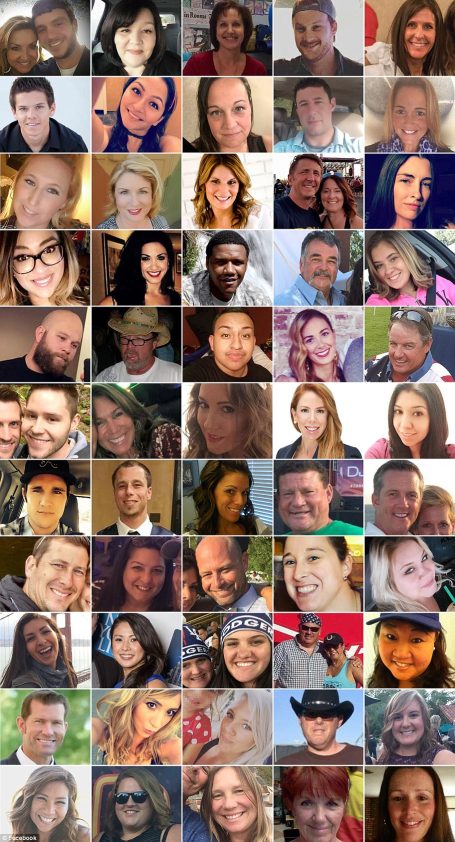
These are the faces of lives lost. These are some of the people who went to a country music festival in Las Vegas for a fun night out only to find themselves on the deadly end of a mass murderer’s bullet. These are mothers and fathers, husbands and wives, sisters and brothers, coworkers and friends – human beings made in God’s image.
From the moment SWAT officers burst into Stephen Paddock’s hotel room on the 32nd floor of the Mandalay Bay, investigators began to ask the question, “Why?” Why would a man with no ostensible axe to grind or radical ideology to vindicate carry out the largest mass murder in modern American history? Why would he pick this venue? Why would he do so without leaving any apparent clues as to his motivation like a manifesto of his grievances or a record for his place in history? Why?
These are the types of questions that have been the primary drivers of countless news stories over this past week. And “why” questions are indeed very important, for their answers have the potential of helping prevent another attack like this one. But they may also be unanswerable. Indeed, one of the strangest features of this tragedy is that a week has passed and, still, the motive of this man has remained elusive. So, rather than asking “why?” I want to take a moment to focus on “who.” Who was it that lost their life a week ago Sunday?
Bill Wolfe Jr. coached youth wrestling and Little League in Shippensburg, Pennsylvania. He had worked for an engineering firm and was well-known as being fun-loving and “a devoted Christian.”
Candice Bowers was described as a woman who “was so busy taking care of everyone else…that she rarely took time for herself.” She lived in Garden Grove, California and had recently adopted her two-year-old niece, Ariel. She also had two older children, ages 20 and 16, and worked as a waitress.
Christopher Roybal was a 28-year-old Navy veteran whose mom was supposed to join him at the concert that night, but before she could meet up with him, shots rang out. He was medically discharged from the Navy in 2012 after going mostly deaf in his left ear. He was a man who would graciously watch chick flicks with and for his mom and had the Lord’s Prayer tattooed on his side. He worked as a fitness trainer in North Colorado Springs, Colorado.
Sandy Casey was a special education teacher in Manhattan Beach, California. She was engaged and was attending the concert with her fiancé. The Superintendent of the Manhattan Beach Unified School District described Sandra as “a spectacular teacher who devoted her life to helping some of our most needy students.”
Charleston Hartfield was a Las Vegas police officer and was off-duty when attending the concert. He was a 34-year-old military veteran who coached youth football. He published a book titled Memoirs of a Public Servant, detailing his time on the Las Vegas Police Force. He leaves behind a wife, a son, and a daughter.
These are the names of only five of the victims who lost their lives a week ago Sunday. 58 were murdered in all. That leaves 53 other names. 53 other faces. 53 other stories. 53 other people. I would encourage you to take some time to learn more about them.
The questions of “why” will always be, in some sense, unanswerable – even if a motive is discovered and a record of the assailant’s thinking is uncovered. Shooting up a concert full of innocent people can never be made to make actual sense, even if investigators uncover what made it make sense to the perpetrator. Sin never leads people to act sanely. Before sin ever affects our actions, it infiltrates and corrupts our minds. This is why the questions of “why,” though they may be important to investigators, cannot eclipse the stories of the people who lost their lives. They matter most. For they are the reason families are grieving and a nation is reflecting. May we never become so obsessed with the motive for a crime that we forget about the people hurt – and, sadly, taken – by this crime.
Praying for Las Vegas

Credit: David Becker / Getty Images
This morning, stories of heroism are already emerging. On NBC’s Today, an eyewitness described police officers and military trained personnel standing up during the shooting while everyone else was crouching down, looking for the injured so that they could render immediate aid. These brave souls put their own lives at risk for the sake of those who were in danger of losing theirs.
Certainly, this will be a story that dominates our headlines and, in one way or another, messes with our heads and hearts. It is difficult to fathom how evil could move someone to commit an indiscriminate act of mass murder like this. It is chilling to imagine what it must have been like to be there.
Right now, on this dark morning, there are two things for us, as a people, to do together. First, we should pray. We should pray for the families of loved ones who have lost their lives. We should pray for the medical professionals who, right now, are tending to many who are critically injured in level one trauma centers. We should pray for law enforcement as they seek to unravel what has happened. And we should pray for Las Vegas. Here is yet another community that has been marred and scarred by tragedy.
Second, as a part of our prayers, we should not forget to give thanks. We should not forget to give thanks for the heroes proven in a terrible time of deadly strife. We should not forget to give thanks for those who risked their own lives to place their fingers in the bullet holes of the wounded. We should not forget to give thanks for those who were willing to sacrifice their own lives to save the lives of others.
As a Christian, I know that salvation never comes without sacrifice. This is what makes the message of the cross both awful and wonderful all at the same time. The cross is the place where the Son of God was unjustly murdered. That is awful. But the cross is also the place where I was graciously given life. And that is wonderful – and the reason I have hope.
At the Mandalay Bay, the unthinkably awful happened. But even the unthinkably awful cannot undo, or even outdo, the bravery of the heroes who were willing to sacrifice themselves for the sake of others. So, for the wounded and grieving I pray. And, for the heroes of this morning I give thanks.
I hope you will join me in doing the same.


 Pastor Zach's Blog