Posts filed under ‘Current Trends’
Sharia Law and Biblical Grace

“All have sinned and fall short of the glory of God” (Romans 3:23). This is the apostle Paul’s sobering summary of the human condition. And he’s right. Not only is there is not a person alive who lives up to God’s standards of righteousness, there is also not a person alive who lives up to the standards of righteousness he sets for himself, as any person who has ever attempted – and failed at – a New Year’s resolution can tell you. Sin is universal.
The Wall Street Journal reports that, in the Indonesian province of Aceh, two Christians were publicly whipped, according to the dictates of Sharia law, “for playing a game at a children’s entertainment complex in a way authorities say amounted to gambling.” Aceh’s population is 98 percent Muslim, and people can face floggings for acts including “drinking alcohol, adultery, gay sex, gambling or having romantic relationships before marriage.” Indeed, the province’s courts are imposing hundreds of whippings a year for acts like these. Last January, a Christian was sentenced to 36 lashes for selling alcohol.
I do not believe that drinking or selling alcohol, in and of itself, is sinful, though I do believe that drunkenness is. Likewise, I don’t believe that a good-natured raffle for a few laughs is inherently wicked, though I am also well aware and wary of the dangerous greed that gambling can stoke and how the gambling industry, especially in the form of state lotteries, cynically preys on the economically disadvantaged. I do believe in a traditional sexual ethic. So, I would say, as do the courts in Aceh, that any sexual activity outside of the confines of marriage strays from what is appropriate. In short, though I would qualify certain things, I find myself in broad agreement with Aceh’s moral concerns. But I also find myself fundamentally at odds with Aceh’s response to these concerns.
The radicalized form of Islamic law that Aceh’s theocratically-minded courts seem to be bent on propagating addresses sin through judgment. Each sin, in these courts’ minds, deserves a flogging. Christianity, however, addresses sin in a whole different way. Christianity acknowledges the reality and ubiquity of human sinfulness – “All have sinned and fall short of the glory of God” (Romans 3:23) – but addresses such sinfulness not with judgment, but by grace: “All are justified freely by God’s grace through the redemption that came by Christ Jesus” (Romans 3:24).
In John 8, Jesus is famously confronted by some religious leaders who bring to Him a woman who has been caught in the act of adultery. In a breathtaking display of theocratic virtue signaling, they crow: “In the Law Moses commanded us to stone such women. Now what do You say” (John 8:5)? In their recounting of Mosaic law, the religious leaders conveniently overlook the fact that it was both the adulteress and the adulterer who were to be punished by death, as, in this case, they bring to Jesus only the adulteress. They also needlessly restrict the method of execution to that of stoning, even though Moses makes no such specification. Nevertheless, they are broadly correct that adultery was, according to Mosaic law, punishable by death. Jesus, however, instead of debating the finer points of where the adulterer is and what method of execution should be used, simply responds:
“Let any one of you who is without sin be the first to throw a stone at her.” At this, those who heard began to go away one at a time, the older ones first, until only Jesus was left, with the woman still standing there. Jesus straightened up and asked her, “Woman, where are they? Has no one condemned you?” “No one, sir,” she said. “Then neither do I condemn you,” Jesus declared. “Go now and leave your life of sin.” (John 8:7, 9-11)
Here, Jesus brilliantly puts His finger on the problem with responding to sin with judgment instead of with grace. If one responds to sin with only judgment, there will finally be no one left to mete out any judgment, because no one is without sin. Everyone will have been stoned. Only grace can address sin in a way that leaves anyone standing.
Christianity certainly understands and accepts the role governing authorities play to discourage wickedness by means of penalties. But Christianity also knows that people need more than a penalty in the face of sin. They need a Savior who does not condemn them, but forgives them. And this is what a theocracy like Aceh’s, which plays the roles of both political and religious authorities, cannot provide.
Interestingly, the Bible does accept lashings as appropriate remuneration for sin. But the lashes do not fall on us. They fall on God’s Son:
He was pierced for our transgressions, He was crushed for our iniquities; the punishment that brought us peace was on Him, and by His wounds we are healed. (Isaiah 53:5)
The courts of Aceh, it turns out, are lashing out far too late for it to do any good. The lashing that was really needed already happened 2,000 years ago.
It’s time to put the whips down.
In Memoriam: Billy Graham (1918-2018)

Credit: Associated Press
Billy Graham was 99 when he entered his rest with Jesus last Wednesday. The man who was a pastor to presidents and plebeians alike leaves a legacy that is difficult to overestimate. Reverend Graham accomplished many things over his long ministry. He founded what has become the practically official periodical of evangelical Christianity, Christianity Today. He served as the president of Youth for Christ and headed the Billy Graham Evangelistic Association. He steadfastly, but also humbly, confessed a traditional, broadly orthodox Christianity, defending such doctrines as justification by faith, the sufficiency of Christ as the world’s singular Savior, the reality of heaven and hell, and the inspiration and inerrancy of Scripture. He declared these doctrines at a time when many churches, especially in the mid-twentieth-century, were drifting into modernism and began to deny these, along with many other, core tenets. But Reverend Graham will perhaps be most remembered for his moving crusades, where he preached the gospel to stadiums chocked full of eager listeners and curious onlookers. His association estimates that he preached the gospel to an estimated 215 million people in 185 countries over the course of his ministry.
I remember attending one of Billy Graham’s crusades as a child. His passion for the gospel was infectious as his preaching resonated sonorously through the stadium in which I was sitting. At the end of the evening, as he always did, he invited people to trust in Christ and come forward to receive prayer. Thousands walked down to the stage that night as strains of “Just As I Am” wafted across the hall. To say the least, it was a moving experience.
Whenever I remember my experience at this Billy Graham crusade, I am reminded of a conversation that Jesus has with Martha shortly after her brother Lazarus has died of a devastating illness. Martha, understandably, is distraught and politely registers her disappointment that Jesus was not around before her brother died to lend some help and, perhaps, a miraculous healing to him. “Lord,” Martha complains, “if You had been here, my brother would not have died” (John 11:21). Jesus, who never intended to heal Lazarus of the sickness that ailed him, but instead to raise Lazarus from the death that overtook him, responds, “I am the resurrection and the life. The one who believes in Me will live, even though they die; and whoever lives by believing in Me will never die” (John 11:25-26). These words are some of the most famous in Scripture not only because they describe what Jesus would do for Lazarus, but because they reveal who Jesus is for everyone. Jesus is the resurrection and the life. What is less famous, however, is the question that Jesus asks Martha next: “Do you believe this” (John 11:26)?
This simple question was the question behind every Billy Graham crusade. After Reverend Graham would proclaim Christ and His death for sinners, after he would declare that Christ’s resurrection can mean your resurrection, and after he would explain how Christ can bear your burdens and carry your cares, he would ask, “Do you believe this?”
When Jesus asks this question of Martha, she responds, “Yes, Lord” (John 11:27). When Reverend Graham asked it of millions, they responded with a “yes” as well.
As one who is part of the Lutheran confession of the Christian faith, I have, over the years, heard many in my tradition criticize Reverend Graham for the way in which he often spoke of faith in terms of a “decision.” His ministry even publishes a magazine titled Decision. It is certainly true that Scripture does not speak of faith as a decision of the will, but as a gift from God. The apostle Paul writes, “It is by grace you have been saved, through faith – and this is not from yourselves, it is the gift of God” (Ephesians 2:8). Unfortunately, some in my tradition have become so concerned about the possibility of implying that faith is somehow an act of the will that they refuse to invite people to faith at all. They forget to ask Jesus’ question: “Do you believe this?”
It is in this precious question of Christ that we can best come to understand and appreciate Reverend Graham’s legacy. He was never afraid to ask this question. And neither should we. Sometimes, a simple invitation, because it is a reflection of Jesus’ invitation, bears the fruit of faith. This is why this question is the question our world needs. When was the last time you asked it?
Even without a sermon, a choir, and a stadium, when you ask this question, someone might just answer, “Yes.” And all of heaven will rejoice (Luke 15:7) – including, with what I would guess might be an especially bright smile, Billy Graham.
The Parkland Innocents

It happened again, this time at Marjory Stoneman Douglas High School in Parkland, Florida. Near the close of the school day last Wednesday, a gunman opened fire in the high school’s freshman hall, killing 17 and wounding another 14.
The scenes that unfolded in Parkland have become achingly familiar. There were law enforcement officials swarming the campus. There were kids filing out with their hands on their heads. There were paramedics, rushing to stabilize the wounded and, awfully, to confirm the dead.
Besides the horror of the shooting itself, there is the added tragedy that the sheer volume of these kinds of events has, in some ways, deadened their effect on our collective psyche. And yet, long after the SWAT teams and paramedics leave, long after the news crews move on to the next story, and long after the national attention fades, for the students and staff of Marjory Stoneman Douglas High School, the pain and terror of this shooting will remain. Days like these may be forgotten by those who watch them on the news, but they will not be forgotten by those who live through them in real time.
Sadly, these types of tragedies have also become occasions for hot takes filled with political rancor, with those who offer their “thoughts and prayers” being labeled as disingenuous by some while those who argue for a debate on gun control being accused as opportunistic by others. Fights erupt on social media while comfort and aid to victims often get overlooked.
As Christians, we are called to “mourn with those who mourn” (Romans 12:15). It is incumbent upon us, then, to care about and, if opportunities arise, to care for those who are affected. While many in our culture are fighting predictably, we should be thinking critically about what events like these say about and mean for our culture so that we can offer a hopeful voice on behalf of the innocents who have had their lives unjustly extinguished.
According to the liturgical tradition of the Church, this past Wednesday was both Ash Wednesday and the Feast Day of Saint Valentine. Ash Wednesday marks the beginning of the season of Lent, when the Church focuses on Christ’s death and resurrection for us and for our salvation. Saint Valentine was a third-century bishop in Rome who was beheaded for his faith, tradition has it, on February 14, 269.
The death of Saint Valentine reminds us that, all too often, innocents can unjustly lose their lives at the hands of evil perpetrators, as did the innocents in Parkland. The season of Lent promises us, however, that even when innocents are killed, their lives are not ultimately lost. For Lent points us to a moment when an innocent – The Innocent – was unjustly killed on a cross by evil perpetrators. But in this instance, the evil perpetrators didn’t win. The Innocent did when He conquered their cross. And this Innocent promises life by faith in Him to the many innocents who have lost their lives since – be that by beating, by beheading, by blade, or by bullet.
A gunman took the lives of 17 students this past Wednesday. But Jesus has plans to bring their lives back.
A rifleman, it turns out, is no match for a resurrection.
Wall Street’s Wild Week

Credit: Richard Drew / Associated Press
Are we in a bull or a bear market? It’s hard to tell.
Last week was a roller coaster ride for Wall Street, to put it mildly. The Dow Jones opened the week down over 1,100 points on Monday for the single largest one-day drop by raw points, though certainly not by overall percentage. This freefall followed another precipitous drop the previous Friday of over 650 points. On Tuesday, the Dow rebounded by 568 points. But this was followed by another mammoth drop of over 1,000 points on Thursday.
Though the financial ride over these past several days has been bumpy, most economists believe the fundamentals of our economy remain strong. This has not stopped investors from being jittery, however. These kinds of swings are simply too disorienting not to have an effect on investor confidence.
After a financially tense week like this one, it is worth it for those of us who are Christians to remind ourselves of what a proper perspective on money looks like.
On the one hand, we are called, as Christians, to be stewards of money. This means we can earn money, save money, invest money, and, of course, share money! As people who steward money, financial news should be of interest to us. Having at least a passing awareness of what is happening in the stock market, the commodities market, the derivatives market, the futures market, and the many other types of financial markets can help us steward whatever resources God has given us as best as we possibly can.
On the other hand, we are also called, as Christians, not to put our hope in money. For when we put our hope in money, we don’t just manage it wisely; we look to it for our security, our identity, and our future. When we put our hope in money, all it takes is a slide in the stock market for our hope to be shattered and our joy to be sapped. When we put our hope in money, we are putting our hope in something that is volatile instead of in Someone who is solid.
To steward money means we think about the future of our money. To hope in money means we think about our money as the future. But as this latest stock market roller coaster ride has reminded us, hope that is placed in money is no real hope at all. Money can be earned and lost. Investments can rise and fall. Financial futures can soar and sag. Hope that is placed in money will always be a hope that eventually falters. This is why hope does not belong in money. Hope belongs in Jesus. After all, the return on His investment is far better than the return on our investments of a few dividends. The return on His investment of blood is our salvation.
Try finding that payout anywhere else.
You know that it was not with perishable things such as silver or gold that you were redeemed from the empty way of life handed down to you from your ancestors, but with the precious blood of Christ, a lamb without blemish or defect.
(1 Peter 1:18-19)
Advocating for Life

Over these past few weeks, lots of big news has been breaking regarding the abortion industry. Perhaps most notably, it was announced a week ago that Cecile Richards, who is the president of Planned Parenthood, has decided to step down from her position. Mrs. Richards’ time at the helm of Planned Parenthood has been marked by scandal, as a series of exposés were published accusing her organization of trafficking fetal parts, and by a total of some 3.5 million abortions.
Also in the news, new research has been published in the controversial Journal of American Physicians and Surgeons, which claims to shed light on the emotional pain that many women experience after going through an abortion. If the study’s findings are even close to accurate, they are shocking:
13% reported having visited a psychiatrist, psychologist, or counselor prior to the first pregnancy resulting in an abortion, compared to 67.5% who sought such professional services after their first abortion. Only 6.6% of respondents reported using prescription drugs for psychological health prior to the first pregnancy that ended in abortion, compared with 51% who reported prescription drug use after the first abortion.
Abortion, this study asserts, has deep, lasting, and adverse effects on women’s emotional health.
Digging deeper into the study, some of the individual responses given by women to researchers concerning how their abortions affected them are nothing short of heartbreaking. When asked, “What are the most significant positives, if any, that have come from your decision to abort?” one woman responded:
None, there are no positives. My life is no better, it is much worse. I carry the pain of a child lost forever. Although I know I am forgiven and have worked through the guilt and shame, the heart-wrenching pain is still there. I would rather have been a single mother of two and have my baby here to love and dote on than the pain of empty arms.
Another woman explained:
My child is dead and by my own choice. I spent years of anger, shame, and grief. It damaged my relationship with my husband, my children, and my God. For 30 years I did not speak of it to anyone but my husband. My grief overwhelmed him and left him powerless and ashamed. For years I cried every Sunday in church, experienced dark depressions, thoughts of suicide, and flashes of anger.
Clearly, the abortions these women endured were devastating to their emotional health.
Along with this research, there is also a proposed bill that addresses the care of babies who are born alive in failed abortion attempts. Representative Marsha Blackburn has introduced the “Born-Alive Abortion Survivors Protection Act,” which requires doctors, if a baby is born alive during an attempted abortion, to provide the same level of care for that child that would be offered to any child born at the same gestational age and to immediately admit that child to a hospital for further care. The House of Representatives has already passed the bill. It now awaits consideration in the Senate.
In all this news, opponents of abortion, among which I count myself, have much on which to reflect. A successful and, I should add, gigantic March for Life in Washington D.C. a few weeks ago demonstrates that the advocates for babies in the womb are both many and organized. Through academic investigation, state and federal legislation, mass demonstration, and, of course, one-on-one conversation, the cause of life marches forward. It marches forward for the babies who have yet to be born, and it marches forward for the women who have been emotionally scarred by their decisions to terminate their pregnancies. Babies in the womb deserve our protection and advocacy. Women who are hurting because of a decision to abort deserve our sympathy and support. The devastation abortion leaves – both in the lives of mothers and the deaths of children – must be revealed for what it is.
As a Christian, I am a firm believer that life is stubborn. It wants to triumph, even over death. This the promise of Easter. And this is what leads to hope for a world without abortion.
Victory, Truth, and Politics

When there’s the potential for dirt on everyone’s hands, it is easy to turn that dirt into mud to sling against your political opponents. This is what we are learning from the ongoing saga of Robert Mueller’s special counsel investigation into collusion between the Trump campaign and Russia during the 2016 presidential election. News broke last week that Mr. Mueller has interviewed some of the most powerful officials in Washington, including former FBI Director James Comey and Attorney General Jeff Sessions. Many are speculating that Mr. Mueller is close to asking for an interview with the president himself, and is moving beyond his initial collusion investigation and is now building a case for obstruction of justice against the Trump administration.
But it’s not just the Trump administration that is the subject of severe suspicion. Mr. Mueller and the FBI are too. Recently uncovered texts between two FBI agents who once worked for Mueller’s team seem to reveal a manifest “anti-Trump” bias. Coupled with the fact that some of the texts between these two agents seem to reveal that the FBI intentionally tempered an investigation they were conducting at the time into Mr. Trump’s opponent, Hillary Clinton, many people are becoming worried that something foul is afoot. Calls are now coming to appoint a special counsel to investigate the special counsel.
None of this, of course, is good. But neither is any of this particularly surprising. Politics, after all, is a dirty business and can often evolve into nothing far short of outright combat. It is also not surprising that, depending on your political convictions, you may find yourself rooting for one of these stories to overtake the other. Democrats are hoping that the Mueller investigation will reveal something that will discredit and perhaps even destroy the Trump presidency while Republicans are hoping that the Mueller investigation itself will be discredited and destroyed by the anti-Trump bias that was apparently harbored by some of the FBI agents connected to it.
Sadly, in politics, there seems to be an ascendant attitude that victory over an opponent is more important than the truth about an issue. Thus, overlooking shady dealings in the president’s administration if you’re a Republican, or ignoring serious questions of integrity in the FBI if you’re a Democrat, is simply an expedient necessity to achieve what many believe to be “the greater good” of their particular political party’s continued empowerment.
Christianity knows that real victory cannot be gained without a commitment to truth. The two go hand in hand. This is why, for instance, the Psalmist can implore God: “In Your majesty ride forth victoriously in the cause of truth, humility, and justice” (Psalm 45:4). The Psalmist knows that victory from the Lord is inexorably connected to the truth of the Lord.
As Christians, our hope and consolation are that what has been written about Christ’s victory over sin, death, and the devil is actually true! If it’s not, then there is no real victory. Thus, in a culture and in a political landscape that can sometimes love victory more than truth, let’s love both. Otherwise, we just might wind up with neither.
And that would be a tragedy.
One Perfect Parent

The Turpin House / Credit: Reuters
One of their only contacts with the outside world was when four of the kids were allowed to step outside their house in Perris, California to install some sod in the front yard, with their mother coldly watching from inside the front window. A neighbor who passed by and offered a friendly greeting to the children was surprised when none of them spoke a word in return to her. But one of the children, a 17-year-old girl, had been plotting her escape from the family compound where her parents, David and Louise Turpin, had held her and her twelve siblings, who range in age from 2 to 29, captive for years. She ran away and called the police using a cell phone she had found in the house.
As details of the children’s living arrangements have emerged, the picture that they paint is nothing short of horrifying. To keep their abuse from being discovered, the Turpin parents made their children stay up all night and sleep all day. They also tortured their children by feeding them next to nothing while they ate pies in front of them, by punishing them for getting water on their wrists while washing their hands, by allowing them to shower only once a year, and by tying them up with chains and padlocks. The couple has pleaded not guilty to the accusations and are each being held on $9 million bail.
Obviously, it is difficult to deduce and decipher the pure evil that would move two parents to commit such heinous crimes against their own children. Then again, it is also difficult to overestimate and over-celebrate the righteous bravery of a 17-year-old girl whose phone call to the police not only led to her own rescue, but to the rescue of her brothers and sisters.
It is at a time like this in the face of a story like this that we need to be reminded that, even as some earthly parents do their worst, we have a heavenly Father who loves us well. The Turpin children were forced to stay up in the dark. We have a heavenly Father who invites us to walk in His light (Isaiah 2:5). The Turpin children were deliberately starved. We have a heavenly Father who gives us food at just the right times (Psalm 104:27). The Turpin children were denied basic hygiene needs and baths. We have a heavenly Father who invites us to joyfully bathe in the waters of baptism (1 Peter 3:21). The Turpin children were tied up. We have a heavenly Father who sent His Son to untie us from that which binds us (Luke 13:15-16).
As a pastor, I have heard story after story of people who have been hurt by their parents. Though, thankfully, none of the stories I have encountered have been nearly as horrific as the story of the Turpins, there are many children – both young and grown – who carry around deep scars. There are many children who need the Father to fill what their father, or mother, would not or could not give to them. There are many children who need the Father to love them like their father, or mother, would not or could not love them.
Our Father in heaven has the love that we need. He loves us so much, the Scriptures say, that even our worst sins need not incur His eternal wrath. In the book of Hosea, the nation of Israel is repeatedly betraying the one true God by chasing after many false gods. Yet, even in the midst of their deep sin, while the Father declares His displeasure, He nevertheless promises, “I will show love…and I will save them…they will be called ‘children of the living God’” (Hosea 1:7, 10).
While some earthly parents may abuse their children for no apparent reason, we have a heavenly Father who loves us in spite of our sin for just one reason – the reason of His grace. His grace is a grace so strong that it makes us His children through His Son.
Now that’s some awesome parenting.
Persons, Nations, and Immigration

What a week it has been in politics. Immigration took center stage this past week with President Trump first holding a meeting with both Republicans and Democrats in front of the cameras, discussing everything from the DACA to a border wall to chain migration to comprehensive immigration reform. This televised meeting, however, was quickly eclipsed by some comments the president allegedly made behind closed doors, where he expressed, supposedly in vulgar terms, dismay at accepting immigrants from places like Haiti and Africa and wondered out loud why the U.S. was not more interested in encouraging emigration from places like Norway. The president has since denied that he made the disparaging remarks attributed to him, tweeting:
The language used by me at the DACA meeting was tough, but this was not the language used. What was really tough was the outlandish proposal made – a big setback for DACA!
– Donald J. Trump (@realDonaldTrump) January 12, 2018
Whatever the president’s actual remarks were, his alleged remarks, predictably, ignited a firestorm of a debate over how we should view other countries and the peoples from those countries. Some found the president’s alleged remarks to be simply a realistic diagnosis of the awful living conditions that plague third-world countries. Others decried his remarks as racist. Is there any way forward?
The famed poet Dorothy Sayers once wrote:
What is repugnant to every human being is to be reckoned always as a member of a class and not as an individual person. A certain amount of classification is, of course, necessary for practical purposes … What is unreasonable is to assume that all one’s tastes and preferences have to be conditioned by the class to which one belongs.[1]
In the midst of a white-hot debate over immigration, Sayers’ insight is a good one for us to keep in mind. The problem with making or defending disparaging remarks concerning whole countries with regard to immigration is that whole countries do not immigrate. Individual persons do. And individuals ought to be treated as unique, precious, and worthy of our consideration and compassion.
But, as Sayers also notes, this does not mean that we should dismiss any and every classification. For instance, the Scriptures themselves use the classifications of “image” and “child.” “Image” is a classification that applies to creation. Every person, Scripture says, is created in God’s image. “Child” is a classification that applies specifically to redemption. When one believes in Christ, they are adopted as God’s child. And though these two classifications are certainly not comprehensive, they can be instructive in that they remind us that the classifications we use, first, should be generous. Disparaging classifications are generally not helpful or productive.
Scripture cautions us against both an arrogant individualism and a dismissive collectivism. It is important for us to remember that we are not solely individuals who have only ourselves to thank for who we are. We are who we are due in large part to our cultural backgrounds, our experiences with others, and the help we receive from others, among many other factors. All of these things collectively shape us. At the same time, we are still individuals, specially and preciously created and redeemed, one at a time, by God, and we are always more than the sum total of our cultural backgrounds, our experiences with others, and the help we receive from others. This is why, in Christ, we come to realize that so many of the classifications we once used to define ourselves, and that others use to define us, are not ultimate or unabridged. As the apostle Paul writes:
In Christ Jesus you are all children of God through faith, for all of you who were baptized into Christ have clothed yourselves with Christ. There is neither Jew nor Gentile, neither slave nor free, nor is there male and female, for you are all one in Christ Jesus. (Galatians 3:26-28)
In the middle of a debate over what does and does not constitute appropriate classifications for nations, let us never forget who we are as persons. And, by God’s grace, let us treat each other accordingly.
__________________________________
[1] Dorothy L. Sayers, Are Women Human? (Grand Rapids: Eerdmans, 2005), 24-25.
All You Need Is the Sermon on the Mount
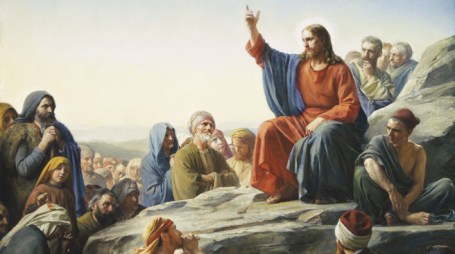
In what has become a kind of tradition for him, New York Times columnist Nicholas Kristof published an op-ed piece a couple of days before Christmas with this question: “Am I a Christian?” This time, he asked the question to Cardinal Joseph Tobin, but he has posed the same question to President Jimmy Carter and Pastor Timothy Keller in past columns.
Mr. Kristof is an admitted skeptic of many of the claims of Christianity. He opens his conversation with Cardinal Tobin like this:
Merry Christmas! Let me start with respectful skepticism. I revere Jesus’ teachings, but I have trouble with the miracles – including, since this is Christmas, the virgin birth. In Jesus’ time people believed that Athena was born from Zeus’ head, so it seemed natural to accept a great man walking on water or multiplying loaves and fishes; in 2017, not so much. Can’t we take the Sermon on the Mount but leave the supernatural?
Mr. Kristof holds a view of Christianity that sees Jesus as a talented and even a uniquely enlightened teacher. Believing that He was a worker of supernatural feats, however, is a bridge too far. Mr. Kristof’s Christianity is one that would prefer to, in his own words, “take the Sermon on the Mount but leave the supernatural” behind.
Mr. Kristof, of course, is not the only one who stumps for this kind of Christianity. President Obama, when he was making a case for same-sex unions back when he was campaigning for the presidency in 2008, stated:
If people find that controversial, then I would just refer them to the Sermon on the Mount, which I think is, in my mind, for my faith, more central than an obscure passage in Romans.
Instead of pitting against the miracles of Christ against the Sermon on the Mount, as does Mr. Kristof, President Obama pits the letters of Paul against the Sermon on the Mount, but the net effect is the same: if one wants a Christianity that is palatable, passable, and practical for the 21st century, Jesus’ Sermon on the Mount is the place to go.
Really?
Surely Mr. Kristoff can’t be talking about the Sermon on the Mount. He must have some other sermon in mind. For in the Sermon on the Mount Jesus says all sorts of things that are unmistakably contrary to our enlightened and modern sensibilities.
If Mr. Kristof finds a virgin birth impossible, what can he possibly find plausible about Jesus’ claim in the Sermon on the Mount to fulfill all of Scripture?
Do not think that I have come to abolish the Law or the Prophets; I have not come to abolish them but to fulfill them. (Matthew 5:17)
It should be pointed out that Jesus’ claim to fulfill “the Prophets” would include a prophecy about a virgin who will give birth, as Matthew so aptly notes at the beginning of his Gospel:
An angel of the Lord appeared to [Joseph] in a dream and said, “Joseph son of David, do not be afraid to take Mary home as your wife, because what is conceived in her is from the Holy Spirit. She will give birth to a son, and you are to give Him the name Jesus, because He will save His people from their sins.” All this took place to fulfill what the Lord had said through the prophet: “The virgin will conceive and give birth to a son, and they will call Him Immanuel” (which means “God with us”). (Matthew 1:20-23)
To hold to what Jesus says in the Sermon on the Mount would be to hold to who Jesus claims to be: the perfect fulfillment of around 1,000-years-worth of ancient literature. Is this really what Mr. Kristof believes?
Of course, Jesus says lots of other things in His Sermon on the Mount too, like:
You have heard that it was said, “You shall not commit adultery.” But I tell you that anyone who looks at a woman lustfully has already committed adultery with her in his heart. (Matthew 5:27-28)
And:
It has been said, “Anyone who divorces his wife must give her a certificate of divorce.” But I tell you that anyone who divorces his wife, except for sexual immorality, makes her the victim of adultery, and anyone who marries a divorced woman commits adultery. (Matthew 5:31-32)
And:
Be perfect, therefore, as your heavenly Father is perfect. (Matthew 5:48)
And:
Seek first [God’s] kingdom and His righteousness, and all these things will be given to you as well. (Matthew 6:33)
And:
Enter through the narrow gate. For wide is the gate and broad is the road that leads to destruction, and many enter through it. But small is the gate and narrow the road that leads to life, and only a few find it. (Matthew 7:13-14)
Do people who want to take Jesus’ Sermon on the Mount while leaving behind other portions of the Scriptures take Jesus at His word in all these matters?
I have a suspicion that when people argue for the primacy of Jesus’ Sermon on the Mount, they are arguing for the primacy of a very abridged version of the sermon, which usually amounts to some nice thoughts about loving your enemies, except, of course, if they are our political enemies, along with some other nice thoughts about not judging others, except, of course, when someone holds a position we deem worthy of mockery. It turns out that a Christianity that strips away the rest of the Scriptures in favor of the Sermon on the Mount only winds up stripping away the Sermon on the Mount itself.
So, allow me to make a suggestion. If you think all of Christianity can be competently considered using Jesus’ Sermon on the Mount, fine. But then take the whole Sermon on the Mount seriously. Believe that Jesus is the fulfillment of every jot and tittle of the Old Testament. Decry lust and divorce. Aim not just for respectable goodness, but for perfect righteousness. Put God’s kingdom first in every decision. Learn to love all those who hate you in a way that you are willing even to sacrifice for them. Guard against being judgmental, even of those you find intolerable. See Jesus as your narrow road to salvation.
Live like that.
But be warned: if you do live like that, you might just find yourself in agreement not only with Jesus’ Sermon on the Mount, but with the rest of the Scriptures as well, which means that perhaps Jesus’ sermon was actually what a sermon was always meant to be: not some stand-alone speech that can be divorced from everything around it, but a testimony to all of God’s truth as contained in the Scriptures.
Try as you might, to take the Sermon on the Mount seriously, you must take the rest of the Scriptures seriously. And if you take the rest of the Scriptures seriously, you will take Jesus seriously, for the Scriptures testify to Him. And if you take Jesus seriously, you may find out that He was not just another teacher, but One who has perfect authority over us, insight into us, and salvation for us.
Now, if you’re willing to believe all that about Jesus, which is what the Sermon on the Mount calls us to believe, is a virgin birth really all that difficult to fathom?
2017 in Review

2017 is officially history. And what a whirlwind of a year it was. As we gear up for what will more than likely be another fast-paced year in 2018, it is worth it to reflect on some of the biggest news stories of this past year and ask ourselves, “What lessons can we learn from what we’ve experienced?” After all, though the news cycle is continually churning out new tragedies, scandals, stresses, and messes to capture our immediate attention, the lessons we learn from these stories should linger, even if the stories themselves do not. Wisdom demands it. So, here is my year in review for 2017.
January
By far, the biggest story of January was the inauguration of Donald J. Trump into the office of President of the United States. After a campaign that was both contentious and raucous, many were on edge when he was inaugurated. As our nation increasingly fractures along partisan lines, Mr. Trump’s presidency continues to inspire both sycophantic adoration and overwrought incredulity.
February
A debate over immigration led the headlines in February as fallout over President Trump’s executive order banning immigrants from nations with known terror sympathies – including Iraq, Syria, Iran, Libya, Somalia, Sudan, and Yemen – came fast and fierce. The president’s travel ban was, until very recently, the subject of endless court battles.
March
The headlines jumped across the Atlantic in March when Khalid Masood, a British-born citizen apparently inspired by online terrorist propaganda, drove an SUV into pedestrians on the Westminster Bridge, leaving four dead and forty injured. After crashing his vehicle outside Parliament, he ran, fatally stabbing a police officer before he was fatally shot by law enforcement.
April
In one of the strangest stories of the year, Vice-President Mike Pence was both criticized and, at times, even mocked for refusing to dine alone with any woman who was not his wife or one of his close relatives. Many people interpreted his boundary as needlessly prudish. Mr. Pence viewed it as a wise way to guard his integrity.
May
Another story of terror echoed through the headlines in May, this time in Manchester, England, when suicide bomber Salman Abedi detonated himself at an Ariana Grande concert leaving 22 dead and 59 wounded.
June
The terrorist attacks continued in June as seven were killed and another 48 were wounded in London when a vehicle barreled into pedestrians on London Bridge. Three attackers then emerged to go on a stabbing rampage. Also, Steve Scalise, the majority whip for the House of Representatives, was seriously wounded when 66-year-old James Hodgkinson opened fire during a congressional baseball game.
July
President Trump and Pope Francis offered to provide medical care for the family of Charlie Gard, a baby born with mitochondrial DNA depletion syndrome. A judge in the UK, where the Gard family resides, ordered that Charlie be taken off life support because he saw no hope for Charlie’s recovery, which prompted the president’s and the pope’s overtures. Charlie was eventually removed from life support and passed away.
August
James Alex Fields killed one person and injured nineteen when he plowed his Dodge Challenger into a group of counter-protesters at an event called “Unite the Right” in Charlottesville, Virginia, which was protesting a decision by the city to remove a statue of Confederate General Robert E. Lee. Hurricane Harvey also ripped through Texas, devastating the Coastal Bend, the Houston area, and the Golden Triangle on the Texas-Louisiana border.
September
Hurricane Irma churned its way across Cuba, the Bahamas, Turks and Caicos, the Virgin Islands, Antigua, Barbuda, and, finally, Florida, leaving mass devastation in its wake.
October
The worst mass shooting in American history took place when James Paddock broke the window in his hotel suite at the Mandalay Bay in Las Vegas and fired onto a crowd of country concert goers below, killing 59 and injuring hundreds. In a much more heartwarming moment, the Christian Church celebrated the 500th anniversary of the Protestant Reformation.
November
On the heels of one mass shooting came another – this time at a tiny church outside San Antonio in Sutherland Springs. 26 people were killed when a gunman opened fire on the congregants inside in the middle of a Sunday service. A sexual assault epidemic also broke wide open, as man after man – from Hollywood moguls to politicians to television news personalities – were revealed to have engaged in sexually inappropriate behavior.
December
Devastating wildfires ripped through southern California, scorching thousands of acres and forcing hundreds of thousands of residents to evacuate.
These are only a few of the stories from 2017. There are, of course, countless others that I did not mention. So, what is there to learn from all these stories?
First, when I compare this year in review with others I have written, I am struck by how, in the words of Solomon, there really is “nothing new under the sun” (Ecclesiastes 1:9). Other years have featured other terrorist attacks, natural disasters, mass shootings, and political upheavals. Even the freshly revealed charges of sexual assault chronicle things that happened years, if not decades, ago. The news cycle seems to have a certain, sordid rhythm to it. The news may be saddening, but I’m not so sure it’s surprising.
Second, if anyone ever needed a bit of empirical verification of the biblical doctrine of human depravity, the news cycle would be a good place to find it. Both the drumbeat of dreariness in our news cycle and the fact that we, as a matter of course, are often more riveted by horrific stories than we are by uplifting ones are indications that something is seriously wrong in our world.
Finally, at the same time the news cycle testifies to human depravity, it must not be forgotten that, regardless of how bad the news cycle gets during any given year, hope seems to spring eternal for a better set of stories in the coming year. Yes, we may brace ourselves for the worst. But this cannot stop us from hoping for the best. Such a hope is a testimony to the fact that God has “set eternity in the human heart” (Ecclesiastes 3:11) – an eternity when everything that is wrong in this age will be set right in the next. We cannot help but yearn for that age to come.
So, here’s to hoping for a grand 2018. Yes, the news cycle may indeed take a turn toward the sour, but we also know that God has promised a new age to come, even if we do not yet know its day or hour.


 Pastor Zach's Blog