Posts filed under ‘Current Trends’
Hurricane Michael

It’s been a busy hurricane season. This time, it was Hurricane Michael that slammed into the Florida Panhandle with Gulf-churned sustained winds of 155 miles per hour – the strongest storm ever to hit the region and the third most intense storm to make landfall in the United States. The storm moved fast – some 13 miles per hour – but that kind of wind does not have to be around long to do serious damage. So far, the death count stands at 16. Tens of thousands are still without power. Mexico Beach, where the storm made landfall, is devastated. And now begins the long, slow process of cleaning up and rebuilding.
Last week, I was delighted when a cold front moved through San Antonio – not only because it brought us clear blue skies and lower temperatures, but because I recently had new grass installed in my yard and the rain meant my sprinklers could take a break and my water bill could take a dive. Rain is good – except when there’s too much. Then we call rain a flood. Sun is also good – except when there’s too much. Then we call sun a drought.
A hurricane is the poster child for “too much.” With a hurricane comes not a cooling breeze, but a battering gale. With a hurricane comes not a needed shower to quench a parched land, but a torrential downpour to deluge an already saturated ground. With a hurricane comes not a peaceful wave on a picturesque beach, but, in the case of Hurricane Michael, an eight-foot storm surge that floods neighborhoods and guts homes.
The book of Jonah famously tells the story of a reluctant prophet who does not want to carry out his God-assigned preaching mission to a town called Nineveh, which is, in Jonah’s day, the capital of the Assyrian Empire. Jonah cannot stand the city of Nineveh because it represents, in Jonah’s view, all that is wicked and vile – violence, decadence, and religious irreverence. So, Jonah seeks to scuttle his preaching obligation by hopping a ship heading in the opposite direction of this miscreant metropolis. But God is having none of it. A storm comes upon the ship in which Jonah is stowing away. The sailors, who quickly realize that this storm is bigger than they can handle, each cry out “to his own god” (Jonah 1:5). But the sailors’ gods sit silent. It isn’t until Jonah calls upon his God, and surrenders his stubborn will to his God by allowing Him to transport him to Nineveh via a titanic tuna, that the sea is finally calmed.
Storms like Michael and like Jonah’s are reminders of just how little power we have over the wind and the waves. In an article for The Atlantic, Sam Kemp recounts a time when a Nobel Prize winning chemist, Irving Langmuir, led a 1947 experiment to slow a hurricane:
On October 13, 1947, a mild hurricane named King sliced through Miami and began drifting northeast, out into the Atlantic Ocean. Because King seemed to be dying anyway, Cirrus officials decided to seed it the next day. A B-17 puttered out to meet it and scattered 180 pounds of dry-ice pellets into the eyewall. Everyone sat back and waited for the eye to widen and for King to collapse. Instead, the storm grew stronger, fiercer. To everyone’s horror, it then pivoted – taking an impossible 135-degree turn – and began racing into Savannah, Georgia, causing $3 million in damage ($32 million today) and killing one person.
Though, at the time, people blamed Langmuir for making the storm worse, in reality, he didn’t make the storm do anything at all. The storm was simply beyond even a Nobel laureate’s control.
The Psalmist reminds us that it is the Lord alone who can still “the storm to a whisper” and hush “the waves of the sea” (Psalm 107:29). Yes, storms may be out of our control. But they are not out of God’s. And although we may not understand why God does not always still storms before they collide with coastlines, we do know that God Himself willingly goes through them. Jesus, after all, claims to be another Jonah: “For as Jonah was three days and three nights in the belly of a huge fish, so the Son of Man will be three days and three nights in the heart of the earth” (Matthew 12:40). Jonah’s stormy salvation finds its counterpart in Jesus’ tempestuous tomb. Jesus went through the storm of sin – and conquered it. And if He can go through a storm that fierce, I’m sure He hasn’t left – and He won’t leave – anyone alone in the aftermath of Michael.
Today, then, Jesus lovingly stands with the people of Florida. He knows how they feel. Perhaps we should stand with them too.
Jekyll, Hyde, and Mr. Cosby

Credit: Flickr, weisspaarz.com
Last Tuesday, Bill Cosby was sentenced to three to ten years in state prison for drugging and sexually assaulting Andrea Constand. Though it was Mrs. Constand’s charges that ultimately landed Mr. Cosby in prison, she is just one of 60 women accusing the famous actor and comedian of sexual assault.
In an age where the ugliness of sexual immorality is bubbling to the top all around us, Mr. Cosby’s case is another reminder of what happens when power, lies, and lust all coalesce. People get used. Tracks get covered. Spirits get shorn.
One of the things that makes Mr. Cosby’s case so difficult to process is the massive disconnect between the doting dad America knew as Dr. Huxtable on the Cosby Show in the 80s and the sickening nature of his alleged and, until recently, secretive crimes with multiple women. “Hypocrisy” feels like too weak a word to describe his actions.
Dallas Willard once wrote, “We are a whole being, and our true character pervades everything we do.” In other words, people may try, as did Mr. Cosby, to be one person in public while being someone completely different in private. Eventually, however, everyone gets revealed for who they really are. Dr. Jekyll inevitably gets mown down by Mr. Hyde. Or, as Jesus puts it:
“There is nothing hidden that will not be disclosed, and nothing concealed that will not be known or brought out into the open.” (Luke 8:17)
The secret sins of Mr. Cosby eventually caught up to the perfect persona of Dr. Huxtable. And now a legacy of laughter is clouded and a whole string of abused women are shattered.
The Bible testifies that human sexuality has been disordered for a very long time. King David used the power of his throne to commit adultery and murder his lover’s husband. A group of religious leaders tried to stone a woman caught in adultery, all the while speciously ignoring the sins of her male counterpart. From marital unrighteousness to incorrigible self-righteousness, there is plenty of sexual sin to go around.
God calls us to something different and better than sexual licentiousness and laziness. God calls us to a sexual commitment that is ultimately selfless instead of selfish. The apostle Paul writes of marital intimacy:
The husband should fulfill his marital duty to his wife, and likewise the wife to her husband. The wife does not have authority over her own body but yields it to her husband. In the same way, the husband does not have authority over his own body but yields it to his wife. (1 Corinthians 7:3-4)
In a cultural milieu that can egg people on to chase what they want sexually, Scripture invites husbands and wives to serve each other tenderly. Intimacy is not meant to be taken, but given. It is not meant to be violative, but restorative.
Let’s take what intimacy is meant to be, and let’s make a promise: this is what intimacy will be for me. And this is how I will use intimacy for thee. Your spouse will thank you. And others who are struggling in sexual brokenness just might take note of you.
A Judge and #MeToo

Credit: Wikipedia
Last week was a raucous one in politics. Last Sunday, The Washington Post published a bombshell investigative report detailing allegations of sexual assault against President Trump’s nominee to the Supreme Court, Brett Kavanaugh. Christine Blasey Ford, a professor of clinical psychology at Palo Alto University, claimed that Judge Kavanaugh, at a party in the early 1980s, when they were both in high school:
…pinned her to a bed on her back and groped her over her clothes, grinding his body against hers and clumsily attempting to pull off her one-piece bathing suit and the clothing she wore over it. When she tried to scream, she said, he put his hand over her mouth.
The details of this account, if true, are deeply distressing. Yesterday, another accusation was leveled against the judge, this one concerning some sexually aggressive behavior in his college years during an alcohol-fueled party. Hearings on the initial accusation are tentatively set to begin on Thursday.
While these stories continue to unfold, and facts, evidence, and debate continue to trickle – and, in some instances, flood – in, there are some important lessons for us to consider from what we already know.
We can learn something about honor.
Whether or not these accusations ultimately prove to be credible, this much is indisputably true: we live in a culture that has lost its way sexually. These allegations may turn out to be false. But so many others have turned out to be, if the preponderance of evidence is to be believed, true. Harvey Weinstein. Les Moonves. Charlie Rose. Bill Cosby. Al Franken. Roy Moore. Matt Lauer. Kevin Spacey. Steve Wynn. And there are many more.
This must stop. Sex is not a right, a rite of passage, or an unrestrainable drive. Sex was created to be an expression of love and commitment, which sometimes results in the blessing of children, between a husband and a wife in marriage. Committing to a woman publicly before God and a group of witnesses to be a faithful, gentle, and servant-hearted husband till death do you part is the most honorable thing a man can do for a woman before he lays a hand on her sexually. Ripping sex out of this commitment and context provides a seedy breeding ground for sexual entitlement instead of gentle chivalry.
We can learn something about power.
Dr. Ford’s allegation against Judge Kavanaugh first came to light in the middle of a contentious and hyper-politically-charged Supreme Court confirmation hearing. Sadly, partisans on both sides have proven to be more concerned about the political power in play than the moral rectitude at stake. From a supporter of Judge Kavanaugh came an argument that it doesn’t really matter if the judge is guilty of sexual assault, because his good deeds clearly outweigh his bad deeds overall. The judge should get a pass. Conversely, a detractor of the judge who knew of these accusations as early as late July and decided to sit on them and not address them, now appears to be using them to maximize the political chaos surrounding Judge Kavanaugh’s nomination.
When partisans on either side engage in these kinds of arguments and actions, they insult justice. The treat the terrible truths of two women’s claims or the shameful besmirching of a man’s character as less important than a political victory. Human lives get trampled for the sake of maintaining and extending political power, which, by definition, sounds less like a democracy where human dignity is supreme, and more like a tyranny.
We can learn something about truthfulness.
There is really no way to assert that both Judge Kavanaugh and his accusers are being truthful. Two women have made accusations. Judge Kavanaugh has categorically denied them. Contrary to some clumsy efforts to try to exonerate all parties, someone is almost certainly lying. In a cultural consensus that seems all too content to bake deceit into some sort of pragmatic cake because “everybody lies,” and to downplay the need for the truth as secondary to other, supposedly larger, concerns, this case reminds us that the truth really does matter. Lives, reputations, and, in this case, the public good are stake. This is why, for the sake of justice, and for the sake of our country, I hope the truth comes out.
For now, we’ll have to wait and see.
Hurricane Florence Batters the Carolinas
Credit: NASA Johnson
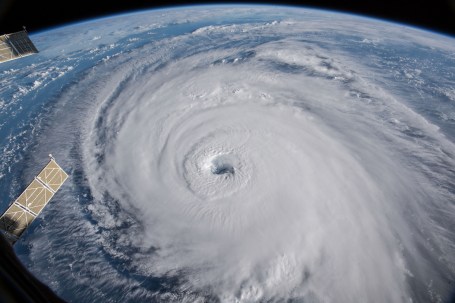
The remains of Hurricane Florence continue to pummel the East Coast. The devastation already done by the monster storm is startling. The death toll seems to rise nearly by the hour. Nearly one million are without power. And by midday Saturday, North Carolina received over 30 inches of rain from the storm, shattering the previous rainfall record of 24.06 inches, set during Hurricane Floyd in 1999.
As the storm sluggishly dissipates and the recovery begins, we are once again left grappling with the chaos that is endemic to a creation disordered by sin. The pictures pouring in of wind-battered beaches, tree-split homes, flood-ravaged communities, and terrified-looking residents speak for themselves. The cleanup and rebuilding process will most certainly be long and arduous. This summer, I vacationed in Port Aransas, Texas with my family, the spot where Hurricane Harvey came ashore last summer. The condo complex at which I stayed still had whole buildings that were missing their roofs. The amount of work yet to be done in that family-friendly beach town is simply more than contractors can complete in a timely manner. I have a feeling the coastal towns of the Carolinas will be enduring much the same experience.
When Jesus’ disciples find themselves in the throes of a massive storm of the Sea of Galilee, they come face-to-face with the chaos – and the danger – of a disordered creation. As they are battered by the wind and the waves, they cry out to Jesus, who is in the storm with them, “Lord, save us” (Matthew 8:25)! And He does. He “rebukes the winds and the waves, and it is completely calm” (Matthew 8:26).
The disciples’ simple and desperate prayer is still a plea worth making, even as Florence passes. The Lord can still help, even after the wind and the waves have been stilled and the floods have receded. He can give us empathy for the injured and a resolve to rebuild. And so, we pray that God would provide us with all that we need during a time that is fraught with exhaustion and heartbreak.
J.I. Packer, in his book on prayer, quipped that we should ask God “what we ourselves might need to do to implement answers to our prayers.” As the Carolinas begin the process of rebuilding, this is certainly a question worth asking. We can make donations to the victims. We can help our loved ones – and, perhaps, even strangers – rebuild. And we can refuse to forget that, long after the headlines of the hurricane fade, the need will continue to be real.
For all the damage that Florence has done, we must never forget that Jesus was in the storm, lovingly caring for all those who suffered – and continue to suffer – from the storm. Jesus does not always stop storms, but neither does He shirk them. He stands in them with us. And He’s a good guy to have when you’re in the wind and the waves.
Who Needs Friends When You Have God?

A new study from the University of Michigan suggests that those who have a strong faith in God are often isolated from others. Todd Chan, a doctoral student at the university, explains:
For the socially disconnected, God may serve as a substitutive relationship that compensates for some of the purpose that human relationships would normally provide.
This is an interesting hypothesis, but studies like these do not seem to provide consistent results. W. Bradford Wilcox, the Director of the National Marriage Project at the University of Virginia, has found that:
…religion generally fosters more happiness, greater stability, and a deeper sense of meaning in American family life, provided that family members – especially spouses – share a common faith.
In other words, contrary to what Mr. Chan found, faith in God can actually deepen and sustain relationships instead of serving as a substitute for relationships.
Certainly, there are people of deep faith who find themselves bereft of human companionship and, consequently, lonely. The Bible admits as much, while also seeking to offer comfort and a promise of companionship to those in isolated situations:
A father to the fatherless, a defender of widows, is God in His holy dwelling. God sets the lonely in families. (Psalm 68:5-6)
God does indeed promise to be there for someone when they have no one. But He doesn’t stop there. He also “sets the lonely in families.” In other words, He doesn’t just serve as a substitute for human companionship, He actually grants human companionship.
Christianity has always confessed a Triune God, in relationship with Himself from eternity, as the model for and the giver of deeper and better relationships with others. This is part of the reason why Christianity first took root in the more densely populated urban areas and why it was initially less prevalent among more rural areas. As Rodney Stark notes in his book The Triumph of Christianity:
The word pagan derives from the Latin word paganus, which originally meant “rural person,” or more colloquially “country hick.” It came to have religious meaning because after Christianity had triumphed in the cities, most of the pagans were rural people.
Christianity first flourished in cities because those were where the largest communities of people were. Christianity, it turns out, is irreducibly communal.
Jesus famously summarizes the whole of Old Testament law thusly:
“Love the Lord your God with all your heart and with all your soul and with all your mind.” This is the first and greatest commandment. And the second is like it: “Love your neighbor as yourself.” (Matthew 22:37-39)
Jesus is clear. A relationship with God can and should lead to better relationships with others. Regardless of what Mr. Chan’s study may assert sociologically, theologically, God is not a second-string substitute for human relationships. Instead, a human, who had an intimate relationship with God and was Himself God, became our substitute on a cross so that we could have a relationship with God in spite of our sin. God is not a last resort relationship when you’re lonely, but a first love relationship who promises never to leave you alone. And there’s just no substitution for that.
Everybody Wants To Be Famous

Credit: Wikipedia
Simon Cowell has finally received his star on the Hollywood Walk of Fame – an honor that was long overdue, at least if you ask Mr. Cowell. He began his remarks at a ceremony honoring him by quipping, “Before we start, I would just like to ask you: why did this take so long?” He quickly added, “I’m kidding.”
Mr. Cowell rose to fame in the early 2000s when he joined Paula Abdul and Randy Jackson as a judge on the hit show “American Idol,” which he created. His acerbic personality, which often revealed itself in biting criticisms of the show’s singing contestants, garnered him both affection and hatred from the millions who watched him. But whether you loved him or hated him, you knew him. He was – and still is – famous. Hence, his newly concreted star in Hollywood history.
At the conclusion of his remarks, Mr. Cowell noted how much he enjoyed being famous: “If anyone says fame is a bad thing, I don’t know what you’re talking about. It’s the best thing in the world.” I appreciate that Mr. Cowell admits what many of us only secretly think: fame is awesome!
People covet fame because it generally rests at the intersection of money and power. With fame, there often comes a fat paycheck as people are willing to pay top dollar for a star’s appearances and work. With fame, there also normally comes throngs of people who hang on a star’s every word and an entourage of handlers who attend to a star’s every wish. It’s no wonder Simon Cowell thinks fame is awesome.
But, of course, this is not a complete portrait of fame. Scripture is clear that with great fame comes great responsibility – and no shortage of great danger.
One of the most famous figures in the Bible is King David. David gained his fame by his monumental military accomplishments. 2 Samuel 8 outlines David’s victories in battle and includes this note: “David became famous” (2 Samuel 8:13). But David’s fame went to his head. He not only set out to conquer Israel’s enemies, just three chapters later, in 2 Samuel 11, he set out to cover up his own sin. After having an affair with a woman who was not his wife, he had this woman’s husband Uriah, a famous warrior in his own right, killed when it was discovered that she was pregnant by David and that her husband would be able to quickly discern that the baby was not his. A man who had made a name for himself in battle killed another man who had made a name for himself in battle all in an attempt to ensure that his fame would not become infamy.
Nearly 400 years after David, the prophet Habakkuk wrote:
LORD, I have heard of Your fame; I stand in awe of Your deeds, LORD. Repeat them in our day, in our time make them known; in wrath remember mercy. (Habakkuk 3:2)
Habakkuk knew what fame chasers often forget – the most important fame we can desire is not our own. It is the Lord’s.
The Lord freely grants fame to people out of His grace. The Lord gave Israel “fame and honor high above all the nations” (Deuteronomy 26:19). He made Joshua’s “fame spread throughout the land” (Joshua 6:27). Fame, in and of itself, is not bad. But man’s fame, as the old saying goes, lasts only briefly – 15 minutes or so, if you believe Andy Warhol. God’s fame, however, endures. Which is good. Because God is famous for His compassion, grace, and salvation. And everyone should know about that. Because everyone needs plenty of that.
A Senator, A Pope, And A Shooter

Credits: Gage Skidmore, Catholic Church, Getty Images
This past weekend was a busy one in the news, to say the least. Friday, it was announced that Senator John McCain would discontinue treatment for his brain cancer. 24 hours later, he passed away. Around this same time Saturday, news broke that Pope Francis may have known of accusations against one of his closest confidants, former Washington D.C. archbishop Cardinal Theodore McCarrick, who resigned this summer after it was discovered that he may have sexually abused a minor some 50 years ago. Then, yesterday afternoon, a gunman opened fire in a Jacksonville, Florida bar during a Madden 19 video game tournament, killing three and wounding eleven.
After a weekend like this one, it is easy to be left reeling and restive. When cancer takes the life of an American hero, when a spiritual leader is accused of covering for sexual abuse, and when another – yes, another – mass shooting unfolds on another soft target, it can be extremely difficult to take everything in, much less to make sense of much or any of it.
So, how do we process any of this?
During relatively peaceful times, which seem fewer and farther between these days, we can be lured into a false sense of security. We can be tricked into forgetting that, in the words of God to Cain, “sin is crouching at the door” (Genesis 4:7) and it can rear its head at any moment. However, during tumultuous times, which seem to have become all too common, we can become drawn into alarmism and catastrophism. We can have a false sense that, in the words of Chicken Little, “the sky is falling.” Both senses are false. Generally, things are never quite as bad or quite as good as we think they are.
The message of Christ can provide us with a reality check after a weekend like this one. Jesus has no problem warning the world of the full damage and devastation that human sinfulness can wreak. Jesus warns that, in this age, there will be an “increase of wickedness, and the love of most will grow cold” (Matthew 24:12). But Jesus also is clear that He has come to overcome sin. In the words of Jesus’ dear friend John, Jesus is “the light shines in the darkness, and the darkness has not overcome it” (John 1:5). Sin will not ultimately get its way.
Christians can respond to the tragedies of our world with both a sober realism and an indefatigable hope. The death of a man as well regarded and as widely celebrated as John McCain can serve as a reminder of the brokenness of our political system and the often illogical rancor that eats away at any generative discourse. The promise of the man Jesus Christ is that He has come to bring peace between divided peoples and parties. The alleged secrecy of a man like Pope Francis in the face of a terrible crime like the one allegedly committed by Theodore McCarrick reminds us that sin runs for cover so it can continue its damaging and damning work. The promise of the man Jesus Christ is that He has come not only to reveal sin, but to heal those ravaged by it. The murderous intentions of a man like Jacksonville’s mass shooter is a reminder that death comes for everyone – sometimes at the times we least expect it. The promise of the man Jesus Christ is that by His death, He has conquered death.
Every tragedy yearns for a Savior. Christianity promises that every tragedy has a Savior. And after a weekend like this one, that’s what we need to know most – and believe deeply.
The Dioceses of Pennsylvania

In what is the biggest sex scandal to rock the Roman Catholic Church yet, a report from a Pennsylvania grand jury, released last Tuesday, found that over 300 priests from across six dioceses in that state abused sexually abused more than 1,000 victims over a period of 70 years.
As The New York Times explains, the report:
…catalogs horrific instances of abuse: a priest who raped a young girl in the hospital after she had her tonsils out; a victim tied up and whipped with leather straps by a priest; and another priest who was allowed to stay in ministry after impregnating a young girl and arranging for her to have an abortion.
Even more tragically, the report also notes that there are likely many more victims who were and are too afraid to come forward.
How was this able to continue for so long among so many? According to the grand jury, church officials seemed to have a method of intentionally and even maliciously obfuscating what was happening. For instance, the grand jury reports that when a sexual assault came to light, church records would never clearly identify a horrific crime like rape. Instead church officials would employ euphemisms such as “inappropriate contact” or “boundary issues” to describe the crime. Many priests who sexually assaulted children, instead of being defrocked, would simply be moved to another parish where their sins were not known.
This is gut wrenching stuff. But it is more than that. It is downright wicked. It is godless. It is satanic. But it is also, terrifyingly, human.
What humans are capable of is truly shocking. History is littered with numberless testaments to the bottomlessness of human depravity. The prophet Jeremiah aptly describes the horrifying proclivities of the human heart when he says, “The heart is deceitful above all things, and desperately wicked: who can know it” (Jeremiah 17:9)? Jeremiah is not being hyperbolic here. The human heart and all it entails – emotions, desires, and drives – really is deceitful above everything else. There is nothing so dangerous as the human heart.
Jeremiah’s question of the heart – “Who can know it?”, or, as another translation puts it, “Who can understand it?” – takes on fresh meaning in light of this scandal. It seems nearly impossible to fully understand how any heart can commit this kind of sin for so long against so many. But even if we could understand the darkness in the hearts behind these crimes, it would, ultimately, do us no good. Understanding cannot undo a crime, restore a violated little body, or comfort a crushed soul. What we need is not understanding, but change. We don’t need to analyze the human heart; we need to guard our own hearts. In the words of Solomon, “Above all else, guard your heart, for everything you do flows from it” (Proverbs 4:23).
Yes, indeed. What we do flows from what’s in our hearts. That is why our hearts must always be Christ’s home.
Another Revelation Rocks Willow Creek
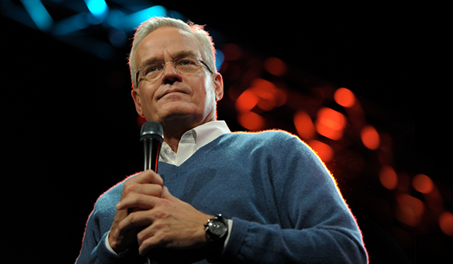
This year was one unlike any other for the Willow Creek Association’s Global Leadership Summit, which was held last week. The annual event, which began in 1995 at Willow Creek Community Church in South Barrington, Illinois, has drawn some of the biggest names in the world as its speakers – from U2’s Bono to President Bill Clinton to Prime Minister Tony Blair. The Summit is broadcast all over the world, including at over 600 locations in the U.S. alone. But when the Chicago Tribune published an expose last March accusing the Summit’s founder and former Senior Pastor at Willow Creek, Bill Hybels, of making sexually inappropriate advances toward multiple women over a period of decades, the event found itself facing an unprecedented crisis. Over 100 congregations withdrew as satellite host sites. Speakers who were scheduled to teach at the Summit, including Denzel Washington, cancelled their appearances.
This past week, the Summit and Willow Creek suffered yet another blow as the New York Times published its own bombshell report chronicling a new story of another woman accusing Mr. Hybels of making sexually illicit advances toward her. The revelations were so shocking that the church’s lead teaching pastor, Steve Carter, resigned his position the next day, citing his grave concern about the:
…church’s official response, and its ongoing approach to these painful issues. After many frank conversations with our elders, it became clear that there is a fundamental difference in judgment between what I believe is necessary for Willow Creek to move in a positive direction, and what they think is best.
This past Wednesday, the congregation’s other lead pastor, Heather Larson, along with the elder board, resigned their positions after apologizing for not more sensitively and thoroughly addressing and investigating the accusations leveled against Mr. Hybels. A church that was once the gold standard for leadership, witness, teaching, and worship has been laid low in a matter of months.
As I have written before, Willow Creek has had a formative influence on me in my ministry. I am thankful for all the congregation has given the worldwide Church. Unfortunately, it is now offering the Church a lesson it certainly never planned or wanted to – a first-hand warning of what happens when hypocrisy and secrecy overtakes integrity and transparency. The results speak for themselves.
Several years ago, Bill Hybels wrote a book titled, Who You Are When No One’s Looking. In it, he extolled the value of character, which he defined as “what we do when no one is looking.” Character is being the same person in private as you present yourself to be in public. He was right in what he wrote. It appears he was very wrong in how he lived. And now, not only are he and his legacy left in tatters, the church and Summit he founded, the staff he led, and the family who thought they knew him are paying an inestimably steep price. Lapses in integrity never affect only the perpetrator.
Because we are all sinful, none of us live with full integrity. We are all, to one extent or another, hypocrites. The best way to deal with inevitable lapses in integrity is to tell the truth about them fully and immediately. Sin is killed by confession. Unfortunately, our reflex is not to confess our sin, but to cover it up. When Adam and Eve committed history’s first sin by eating fruit from a tree of which God had commanded they should not, Genesis 3:8 says, “They hid from the LORD.” Adam and Eve thought it would be better to keep the secret of their sin than to tell the truth about their sin. They were wrong – a fact to which all of history is still testifying as we endure the effects of their first sin and cover-up.
Secrets, especially when they cover shameful realities, can be awfully easy to keep. And the truth, when it is embarrassing and damaging, can be awfully hard to tell. But secrets come with a steep price, as Willow Creek is painfully learning. The truth, however, even when it is tough to tell, comes with a blessed return of freedom. Which, in the long run, do you think is better?
The Biggest Humanitarian Crisis In The World

Credit: USAID
Katherine Zimmerman, a Middle East expert, has called it the biggest humanitarian crisis in the world. In 2014, war broke out in the poverty-stricken nation of Yemen when Iranian-backed rebels stormed and occupied Yemen’s capital city of Sanaa. Since then, a Saudi-led coalition, along with the Yemeni government, has been trying to take back the city. Over 10,000 people have died, half of which have been civilians, as a direct result of the fighting. Indirect casualties are even higher. Save the Children reports that 130 children are dying every day in Yemen. Ms. Zimmerman fears that conditions in the country will continue to deteriorate, explaining, “As the conflict goes on, the people are suffering, and it’s to the point now where we’re looking at a cholera epidemic, and massive risk of famine.”
Sadly, this crisis, half a world away, has been regularly eclipsed by a steady stream of riveting domestic intrigue. But the cries of these victims of war deserve our listening ears and concerned hearts.
One of the most common prayers in the Bible, especially in the Psalms, is that the Lord would hear the cries of the oppressed:
- “Hear my cry for help, my King and my God, for to You I pray.” (Psalm 5:2)
- “Hear my cry for mercy as I call to You for help, as I lift up my hands toward Your Most Holy Place.” (Psalm 28:2)
- “Hear my cry, O God; listen to my prayer.” (Psalm 61:1)
The glorious promise is that the Lord does hear the cries of the oppressed:
- “The LORD has heard my cry for mercy; the LORD accepts my prayer.” (Psalm 6:9)
- “Praise be to the LORD, for He has heard my cry for mercy.” (Psalm 28:6)
- “I love the LORD, for He heard my voice; He heard my cry for mercy.” (Psalm 116:1)
If the Lord hears the cries of the downtrodden, we should too. So please join me in lending your prayers to the cries of the Yemenis, asking God to bring this crisis to an end. Pray also that famine and disease would not overtake this land.
In a world where our news cycles regularly revolve around the powerful, it can be all too easy to forget about those on the margins of our societies. The gospel, however, reminds us that we worship a God who marginalized Himself by being born into a poor village called Bethlehem and growing up as a poor carpenter from Nazareth only to become a poor rabbi who was executed by His enemies on a cross. Jesus lived His life as a marginalized man. This man on the margins, however, has promised to use His very marginalization on the cross to draw all people to Himself (cf. John 12:32). This man on the margins has turned out to be nothing less than the very center of history.
Jesus’ method of marginalization should most certainly inform our mission of reaching and loving the world for Him and in Him. So, let’s keep our peripheral vision peeled to see those others miss and love those our world overlooks. For this is what Jesus has done with us.


 Pastor Zach's Blog