Posts filed under ‘ABC Extra’
ABC Extra – Atonement: Universal or Limited?
 This weekend in worship and ABC, we continued our “Credo!” series with a study of the doctrine of the atonement. As I mentioned in ABC, the word “atonement” comes to us via the sixteenth century, literally meaning, “at-one-ment.” That is, the doctrine of the atonement teaches that whereas sin separates us from God, God makes us “at-one” with Him through the death and resurrection of His Son, Jesus Christ. The apostle Paul explains it well:
Therefore, if anyone is in Christ, he is a new creation; the old has gone, the new has come! All this is from God, who reconciled us to Himself through Christ and gave us the ministry of reconciliation: that God was reconciling the world to Himself in Christ, not counting men’s sins against them. (2 Corinthians 5:17-20)
With these words, Paul offers a simple, yet eloquent, definition of the doctrine of the atonement. The atonement is God’s reconciliation of the world to Himself through Christ. Yet, this definition has caused more than a little debate over the years.
Two opposite and equal errors have been made with regard to the doctrine of the atonement. The first error is that of “universal atonement.” “Universal atonement” teaches that, because God has reconciled the world to himself through Christ, ultimately, no one will stand condemned. Everyone will be saved. Indeed, this what the great church father Origen taught:
So then, when the end has been restored to the beginning…so that when all feeling of wickedness has been removed, and the individual has been purified and cleansed, He who alone is the one good God becomes to him “all,” and that not in the case of a few individuals, or of a considerable number, but He Himself is “all in all.” (Origen, De Prinicipiis, 3.6.3).
Origen’s borrows the phrase “all in all” from 1 Corinthians 15:28 to assert that God will not just save “a few individuals, or a considerable number,” but all people! Everyone will be saved! This is the doctrine of universal atonement. And it is a false doctrine. Not all people will be saved.
The second error that has crept into the doctrine of atonement is that of “limited atonement.” “Limited atonement” notes that, even though Paul writes “that God was reconciling the world to Himself in Christ,” not all are saved. Some are cast into hell (cf. Revelation 20:15). Thus, “limited atonement” teaches that God did not reconcile the whole world to Himself in Christ; rather, He reconciled only the world of the elect, or those He has chosen for salvation, to Himself. Indeed, this is the teaching of many modern day Calvinists, although it is debatable as to whether or not Calvin himself taught this.
So what is the way through these debates? Is universal atonement or limited atonement correct? Actually, neither is correct. Lutherans have long made a distinction between objective justification and subjective justification. Objective justification states that when Christ died, He did so for the sins of the whole world. God sought to reconcile the whole world to Himself in Christ. Subjective justification notes that Christ’s objective work on the cross must be received subjectively, or personally, through faith. This is what the Lutheran Confessions call “personal faith”: “Personal faith – by which an individual believes that his or her sins are remitted on account of Christ and that God is reconciled and gracious on account of Christ – receives the forgiveness of sins and justifies us” (Apology IV:45). In other words, the Lutheran confessors teach that Christ’s objective work on the cross does you no good if you don’t trust in it for your forgiveness of sins, life, and salvation! This is why the Scriptures contain constant calls to personal faith (e.g., Romans 10:9-10).
Both objective and subjective justification are needed. Subjective justification is needed because it invites us to have faith and reminds us that without faith, we will be damned (cf. Luke 8:12). Objective justification is important because it reminds us that Christ’s work on the cross is not just for some, but for the whole world. Indeed, it is for you! God not only reconciles the world to Himself in Christ, He reconciles you, for He loves you. This is the true doctrine of the atonement!
Want to learn more on this passage? Go to
www.ConcordiaLutheranChurch.com
and check out audio and video from Pastor Tucker’s
message or Pastor Zach’s ABC!
Weekend Extra – The Incarnation
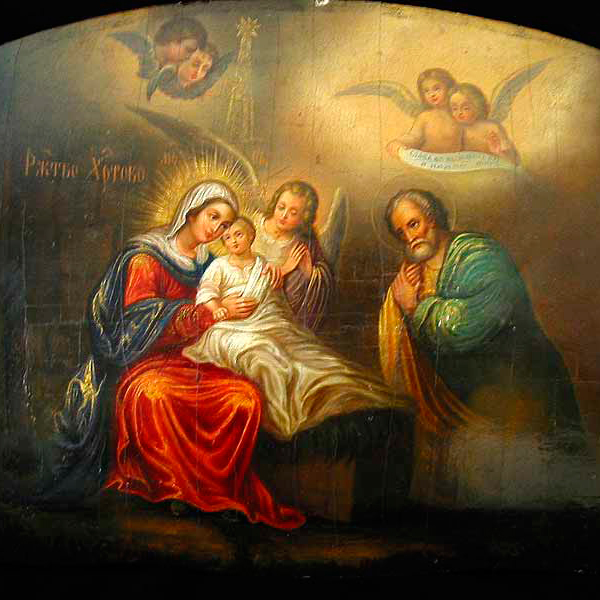 In one of my favorite lines in the Old Testament, Solomon, as he is dedicating the newly finished temple to the Lord, asks in a prayer, “But will God really dwell on earth with men” (2 Chronicles 6:18)? The answer to Solomon’s query, at least according to the ancient Greeks, was, “No.”
At its root, Greek philosophy was dualistic in nature. That is, it held to a strict bifurcation between the material and immaterial, believing the material to be inherently evil while declaring the immaterial, or the spiritual, to be good. An example of this kind of thinking comes in the work of Philo, a first century Jewish philosopher who sought to wed Judaism with Greek philosophy. Philo talks at length about the creation of the world and the refrain which sounds throughout the creation story, “And it was good” (cf. Genesis 1:10,12,18,21,25). The question that Philo seeks to answer is this: If creation, as that which is material, is inherently evil according to Greek philosophy, how can God call it good? Philo answers:
In reference to which it is said in the sacred Scriptures, “God saw all that He had made, and, behold, it was very good,” what God praised was not the materials which He had worked up into creation, destitute of life and melody, and easily dissolved, and moreover in their own intrinsic nature perishable, and out of all proportion and full of iniquity, but rather His own skillful work. (Philo, Quis Rerum Divinarum Heres Sit §32)
In order to avoid calling anything material “good,” Philo says that creation’s refrain, “And it was good,” refers only to the skill of God and not that which God’s skill produced – a material creation! Thus is the extent to which the Greek philosophers would go to maintain their allegiance to a sharp dualism.
It is because of this sharp dualism that Greek philosophy abhorred the idea that God could ever dwell on earth with man. After all, the immaterial and perfect God would never deign to dwell among a material and evil world! And yet, this is exactly what the doctrine of the incarnation proposes. The incarnation teaches that the second person of the Trinity, Jesus Christ, took on human flesh and “made His dwelling among us” (John 1:14).
Such a doctrine raised the rankles of many Jews and Greeks alike who spent much time trying to discredit Christianity on the basis of the incarnation. Consider, for instance, these quotes from Celsus, a second century Greek philosopher and antagonist of Christianity:
God is good and beautiful and happy, and exists in the most beautiful state. If then He comes down to men, He must undergo change, a change from good to bad, from beautiful to shameful, from happiness to misfortune, and from what is best to what is most wicked. (Origen, Contra Celsum 4.14)
Dear Jews and Christians, no God or child of God has either come down or would have come down from heaven! (Contra Celsum 5.2)
Clearly, the Greeks believed that the perfect God of the universe would never take on the frail flesh of humanity. But this is precisely what the Christians believed. And this is precisely what the Christians taught.
The doctrine of the incarnation is foundational and fundamental to the Christian faith. Why? First, the incarnation assures us that Jesus is like us. The preacher of Hebrews reminds us that, thanks to the incarnation, Christ is a God who can “sympathize with our weaknesses” (Hebrews 4:15). This stands in sharp contradistinction to the ancient Greek conception of God which called God apathes (“not suffering”), from whence we get our English word “apathy.” The God of Greek philosophy was anything but concerned with human suffering and pain. Jesus, however, is. Second, the incarnation also assures us that Jesus is not like us. After all, Jesus is not just a mere man. He is God who became a man. This means that Jesus has the divine power and prerogative to help us. As Ben Witherington III states, “Jesus was as we are, and therefore He will help; He was not like we are, and therefore He can help” (Ben Witherington III, The Indellible Image, vol. 1, 423). Jesus’ divinity means that He has the power to save us. And this, finally, is why He became incarnate. The incarnation is not simply an amazing feat, or a mind stretching wonder, or a theological locus. Rather, God became incarnate to rescue us from sin, death, and the devil. And so we confess that Jesus “Came down from heaven and was incarnate by the Holy Spirit of the Virgin Mary, and was made man.” Why did He do this? “For us men and for our salvation.”
Want to learn more on this passage? Go to
www.ConcordiaLutheranChurch.com
and check out audio and video from Pastor Tucker’s
message or Dr. Paul Maier’s ABC!
ABC Extra – On The Multiverse
 This past weekend in worship and ABC, we continued our series ”Credo!” with a look at the doctrine of creation. As part of our study, talked about how the how the modern, broad consensus among scientists concerning the universe’s origins is often antagonistic and dismissive toward the biblical account of creation. Thus, many scientists and theologians alike have sought to reconcile these two seemingly conflicting accounts using different theories, two of which I briefly mentioned in ABC: the “Day-Age Theory” and the “Theistic Evolution Theory.”
In order for the theory of evolution to be correct, two things are needed: lots and lots of time and lots and lots of death. You need lots and lots of time because one species does not evolve into another overnight. Rather, billions of years are needed for one species to adapt in such a way that it actually becomes another species. You needs lots and lots of death because the mechanism by which evolution functions is natural selection, a.k.a., the survival of the fittest. In other words, for evolution to happen, species with less desirable traits must die out and give rise to species with more desirable traits. The “Day-Age Theory” of creation, which asserts that each of the days in Genesis 1 are equal to thousands, and probably millions, of years, accounts for the lots and lots of time that evolution requires, while the theory of Theistic Evolution, which states that God got the ball rolling on creation, but then it pretty much evolved the way scientists say it did, accounts for the lots and lots of death demanded by natural selection.
And yet, there is something else needed. Scientists have long noted that the earth and, indeed, even our solar system and universe, seems “fine-tuned” to support our life. In other words, there is a constellation of factors, each of which, if they were even the slightest bit different, would not have allowed evolution to happen at all because the environment would not have supported any life at all, no matter how strong or desirable an organism’s traits might have been! Scientists describe this as the “anthropic principle.” In a recent article for the Wall Street Journal, Stephen Hawking, professor at the University of Cambridge, explains:
The emergence of the complex structures capable of supporting intelligent observers seems to be very fragile. The laws of nature form a system that is extremely fine-tuned. What can we make of these coincidences? Luck in the precise form and nature of fundamental physical law is a different kind of luck from the luck we find in environmental factors. It raises the natural question of why it is that way. (Stephen Hawking and Leonard Mlodinow, “Why God Did Not Create the Universe,” Wall Street Journal, 9/3/10)
It is Hawking’s final question, posed as a statement, “It raises the natural question of why it is that way,” that he spends the balance of his article seeking to address. And he seeks to address it apart from God:
Our universe seems to be one of many, each with different laws…Each universe has many possible histories and many possible states. Only a very few would allow creatures like us to exist.
Stephen Hawking adds another need to the arsenal of requirements for our existence. Not only does our existence require lots and lots of time and lots and lots of death according to the theory of evolution, it also needs lots and lots of space according to the theory of the origins of the universe. For evolution, as it stands, can account only for the existence of life on this planet, not the existence of this planet itself. Something else must account for that. If this something else is not accounted for, then evolution becomes somewhat of a “red herring” theory, for how can evolution account for one form of life giving rise to another form of life, and even a form of non-life giving rise to the first form of life, if it cannot account for that non-life material itself? Enter Stephen Hawking’s theory. Hawking postulates that there are an infinite number of universes, each with their own laws, which have spontaneously arisen out of nothing. Thus, if there are “multiverses” which, taken in toto, exhaust every possible combination of astrophysical laws, it is not surprising at all that our universe and our solar system and our planet with our life should exist. It is merely the inevitable consequence of a countless number of universes doing a countless number of different things.
How does Hawking know these multiple universes exist? Has he observed them? Has he tested them? No! Instead, the multiverse theory “is a consequence predicted by many theories in modern cosmology.” In other words, it is a theory predicated on other theories. Is it just me, or does that sound a little speculative for science? Thus, according to Hawking, “It is not necessary to invoke God to light the blue touch paper and set the universe going.” It is here that we find Hawking’s real motive for postulating the multiverse: it makes the need for God’s creative hand even more obsolete than does evolution. It puts God out of business, so to speak.
It is important to note that Hawking’s theory is nothing new. He, along with other scientists, have promoted the multiverse theory before. And there are many who are scrambling to explain why God is still needed even if there are indeed many universes. But we need not join them in their scramble. For rather than adopting a “God-in-the-gaps” strategy, where we seek to shoehorn God into the spots that science cannot answer by means of its speculative, naturalistic mechanisms, I would suggest that it’s better to take the creation account as it stands, believing in the best intentions of its human author and the divine inspiration of its giver. For the doctrine of creation does not exist merely to explain how God set into motion all the stuff for which science cannot account. Rather, it assures that we have a God who not only created the heavens and the earth a long time ago, but also:
Has given me my body and soul, eyes, ears, and all my limbs, my reason, and all my senses, and still preserves them…He provides me richly and daily with all that I need to support this body and life, protects me from all danger, and guards me and preserves me from all evil; and all this out of pure, fatherly, divine goodness and mercy, without any merit or worthiness in me…This is most certainly true! (Martin Luther, Small Catechism, First Article of the Creed)
And this is most certainly the proper doctrine of creation!
Want to learn more on this passage? Go to
www.ConcordiaLutheranChurch.com
and check out audio and video from Pastor Tucker’s
message or Pastor Zach’s ABC!

ABC Extra – Credo! The History and Value of the Creeds
 This past weekend, we kicked off a new series at Concordia titled, “Credo! Trusting in the Truth.” In this series, we are examining some of the foundational doctrines of biblical Christianity using the contours of the Apostles’ Creed. Because we are using to the Apostles’ Creed to guide us through our doctrinal foray, I thought it might be helpful to offer a little bit of background on the origin and formulation of this creed.
The Apostles’ Creed finds its birth between AD 100 and 120 when it was used as a baptismal liturgy to guide new converts in the true faith. A legend from the fifth or sixth century conjectures that the Creed was written by the twelve apostles themselves, each contributing a line to it. According to the legend, Peter opened the Creed: “I believe in God, the Father Almighty,” with Andrew then adding, “And in Jesus Christ, His only Son, our Lord,” while James the elder continued, “Who was conceived by the Holy Spirit.” Although this legend may seem pious, it is also certainly apocryphal.
In reality, the Apostles’ Creed was formalized, though not completely standardized, among Christians by the second century. Writings from the early church fathers echo creedal language. Consider, for instance, these two passages:
Be deaf, therefore, whenever anyone speaks to you apart from Jesus Christ, who is of the stock of David, who is of Mary, who was truly born, ate and drank, was truly persecuted under Pontius Pilate, was truly crucified and died in the sight of beings of heaven, of earth and the underworld, who was also truly raised from the dead. (Ignatius of Antioch, Letter to the Trallians 9:1-2, c. AD 107)
We also know in truth one God, we know Christ we know the Son, suffering as He suffered, dying as He died, and risen on the third day, and abiding at the right hand of the Father, and coming to judge the living and the dead. And in saying this we say what has been handed down to us. (Hippolytus, Profession of the Presbyters of Smyrna, c. AD 180)
In both of these statements from Ignatius and Hippolytus, we find creedal language. Thus, the great doctrines of Christianity as confessed in the creeds are as old as Christianity itself.
Whenever I speak on or write about the creeds, an inevitable objection, often stated as a question, arises: “But why do we need the creeds? We already have the Bible! Shouldn’t we have no other creed than the Bible?” The Bible, as God’s inspired, inerrant, infallible Word most definitely gets the first – and for that matter, the last – word. The creeds, however, are nevertheless invaluable to the Church and ought to be retained by the Church for three reasons.
The Bible itself contains creeds. The idea for Christian creeds comes directly from the Bible itself! Creeds contained in the Bible include, “Jesus is Lord” (1 Corinthians 12:3), “Christ died for our sins according to the Scriptures, He was buried, and He was raised on the third day according to the Scriptures” (1 Corinthians 15:2-3), and, of course, the beautiful and poetic confession of Christ as God in Philippians 2:5-11. And these are just a few examples of creeds contained in the Scriptures. Christians have always wanted to be able to confess their faith and creeds afford opportunities to do this. So it is only natural that Christians would have creeds.
The creeds hit the high points. There is a reason the children’s song “Jesus Loves Me” has stood the test of time. It simply and whimsically expresses the foundational truths of the gospel in a compact and comprehendible way. So it is with the creeds. If you want to know Christian doctrine in a nutshell, then turn the creeds! Indeed, in my ABC, I cited this insight from Cyril of Jerusalem:
For since all cannot read the Scriptures, some being hindered as to the knowledge of them by want of learning, and others by a want of leisure, in order that the soul may not perish from ignorance, we comprise the whole doctrine of the faith in a few lines…So for the present listen while I simply say the Creed, and commit it to memory…For the articles of the faith were not composed as seemed good to men; but the most important points collected out of all the Scripture make up one complete teaching of the Faith. (Cyril of Jerusalem, Catechetical Lectures, V:12, AD 347)
Even in the fourth century, not every Christian was as familiar with his faith as he should have been. Thus, Cyril employs the Apostles’ Creed as a tool to teach the cardinal canons of the Christian faith. The creeds can do the same for us.
The creeds guard against error. The Apostles’ Creed was, in ancient parlance, referred to as “the rule of faith.” That is, it served as a guideline by which to distinguish orthodoxy from heresy. Indeed, part of the problem with those who say, “I have no other creed than the Bible” is that many sects pervert the Scriptures to suit their own twisted teachings, even as the apostle Peter warns: “Ignorant and unstable people distort…the Scriptures to their own destruction” (2 Peter 3:16). For example, the Jehovah’s Witnesses claim only to use the Bible to arrive at their doctrines, yet they deny the doctrine of the Trinity. The creeds, especially the Nicene and Athanasian Creeds, will let you do no such thing. I had a professor in seminary who would tell his classes, “You need the creeds because they keep you from getting weird.” This precisely right. The creeds guide us along the course of true faith.
It is with this in mind that we hope you’ll join us these next several weeks at Concordia as we revisit the basics of Christian doctrine to which we can joyfully proclaim, “Credo!” – I believe!
Want to learn more on this passage? Go to
www.ConcordiaLutheranChurch.com
and check out audio and video from Pastor Tucker’s
message or Pastor Zach’s ABC!
Weekend Extra – The Gift of the Gospel
 In the book of Esther, the good queen Esther foils a plot by the evil Haman to exterminate the Jews after Haman becomes enraged when one Jew in particular, Mordecai, refuses to bow down and pay him homage. Being an egomaniac, Mordecai’s insult infuriates Haman so much that “he scorned the idea of killing only Mordecai. Instead Haman looked for a way to destroy all Mordecai’s people, the Jews, throughout the whole kingdom of Xerxes” (Esther 3:6). When Mordecai learns of Haman’s nefarious intentions, he calls Esther, a relative of his and also a Jewess, and pleads with her to go entreat the king for the lives of the Jews. But Esther knows that such a request cannot be made without peril:
All the king’s officials and the people of the royal provinces know that for any man or woman who approaches the king in the inner court without being summoned the king has but one law: that he be put to death. The only exception to this is for the king to extend the gold scepter to him and spare his life. (Esther 4:11)
To approach the king, Esther’s will have to put her life on the line. But with great courage, Esther approaches the king uninvited:
Esther put on her royal robes and stood in the inner court of the palace, in front of the king’s hall. The king was sitting on his royal throne in the hall, facing the entrance. When he saw Queen Esther standing in the court, he was pleased with her and held out to her the gold scepter that was in his hand. So Esther approached and touched the tip of the scepter. Then the king asked, “What is it, Queen Esther? What is your request? Even up to half the kingdom, it will be given you.” (Esther 5:1-3)
With the king’s words, Esther can take comfort in the fact that her life is no longer in danger. For the king has spared her life and has even offered to grant her request, whatever it may be. “It will be given you,” the king says. The story finds its happy ending when Esther requests a banquet with Haman and the king only to foil Haman’s plot against the Jews. Providentially, the king was willing to give Esther her banquet which she leveraged to save her people.
“It will be given you.” These are not only the words of a king. These are also the words of the gospel. For the gospel is a gift. Jesus promises: “Ask and it will be given to you” (Matthew 7:7). And the greatest gift that Jesus has given to humanity, of course, is His own death and resurrection. For this gift brings our salvation.
In our reading from this past weekend from Revelation 19, we catch a breathtaking glimpse of the end of time when Satan is finally conquered the Church is wed to Christ once and for all. The song of praise at this wedding is beautiful:
Hallelujah! For our Lord God Almighty reigns. Let us rejoice and be glad and give him glory! For the wedding of the Lamb has come, and his bride has made herself ready. Fine linen, bright and clean, was given her to wear. (Revelation 19:6-8)
A Church once stained by the sin and depravity of her people is now arrayed in “fine linen, bright and clean.” How does she obtain such linen? It is “given her to wear.” Even at the end of time, God’s gospel goes on. The church does not earn her linens, nor does she merit them; rather, they are given to her.
Just as the bride of the king was given life by an extended gold scepter, the bride of Christ is given life by His arms, extended on a cross. And when Jesus extends His arms on a cross, He does so with a promise on His lips: “It will be given you! Forgiveness will be given you! Life will be given you! Salvation will be given you! Fine linen of holiness, unsoiled by sin will be given you! It will be given you!” This is why, on the Last Day, when the wedding of the Lamb of God to His Church finally arrives, we will be stained no more by sin. For Christ will have given us all we need – even perfection into eternity. It will be given you. What a gift!
Want to learn more on this passage? Go to
www.ConcordiaLutheranChurch.com
and check out audio and video from Pastor Hower’s
message!
ABC Extra – Filioque: Funny Word, Serious Debate
 It’s called the filioque. It is a Latin word meaning, “and the Son.” As it turns out, this one little word actually split the Christian Church.
The year was 381. The Church was meeting together in an ecumenical council at Constantinople to finish a job they had begun some years earlier in 325 in Nicaea. At Nicaea, the Church had formulated a Creed to refute Arianism, which claimed that though Jesus was divine in some sense, He was not the one, true God. In response, the Council of Nicaea formulated the Nicene Creed, confessing Christ to be “God of God, Light of Light, very God of very God, begotten, not made, being of one substance with the Father.” In other words, the Council of Nicaea confessed Jesus to be the true God along with the Father!
But now in Constantinople, it was time to confess the same about the third person of the Godhead: the Holy Spirit. And so the Council confessed: “I believe in the Holy Spirit, the Lord and giver of life, who proceeds from the Father, who with the Father and the Son together is worshiped and glorified.”
Now, if you’ve ever said the Nicene Creed in any church that is not Eastern Orthodox, then you perhaps noticed that a phrase went missing: “I believe in the Holy Spirit, the Lord and giver of life, who proceeds from the Father and the Son.” Or, in Latin, filioque. But this word was not part of the original Creed as it was drafted as Constantinople. Instead, it was added later in 589 at the Third Council of Toledo. And when it was added, those in the Eastern Church and those in the Western Church began down a path of controversy and schism that remains to this day.
According to the Eastern Church, the filioque distorts Eastern Orthodox triadology by making the Spirit a subordinate member of the Trinity. Traditional triadology insists that any trait of the Godhead must be either common to all the Persons of the Trinity or unique to one of them. Thus, Fatherhood is unique to the Father, while begottenness is unique to the Son, and procession is unique to the Spirit. Thus, the Spirit cannot proceed from the Father and the Son, for that would mean that the Father and Son would share a trait not also shared by the Spirit.
The addition of the filioque so upset the East that the great Eastern Patriarch Photius I declared the filioque heresy and excommunicated the pope at this time, Pope Nicholas I. Indeed, this debate was one of the precipitating causes of the Great Schism of 1054, when the Eastern Church and the Western Church mutually excommunicated each other. For the first time in history, the Christian Church had split in two.
For the most part, the posturing and lofty rhetoric over the filioque has faded, yet the fissure between the East and the West remains. Eastern Christians still do not include “and the Son” in their recitation of the Nicene Creed.
Finally, one must ask, “What does Scripture say about the filioque?” Our reading in both worship and ABC this past weekend from John 21 recounted two post-resurrection appearances of Jesus – the first being on Easter evening to ten of His apostles minus the now late Judas and the absent Thomas with the second being a week later to all of the living apostles including Thomas. In His first appearance, Jesus recommissions His disciples to carry out the Office of the Keys, which I discussed at length in my ABC. Jesus explains the Office thusly: “If you forgive anyone his sins, they are forgiven; if you do not forgive them, they are not forgiven” (John 20:23). Such is a weighty responsibility – to proclaim forgiveness to the repentant and warn the unrepentant of impending Divine judgment! But Jesus does not leave the exercise of this Office ad hominem. Instead, right before He commissions His apostles to the Office of the Keys, He breathes on them and says, “Receive the Holy Spirit” (John 20:22). Jesus imparts the Holy Spirit to His disciples as they go about ministry in His name. The Spirit proceeds from the Son as well as the Father. The filioque is correct.
It is a shame that such an acerbic debate over the filioque had to split the Church, especially in light of Jesus’ clarion call to unity (cf. John 17:11). And yet, the Church is called always to Holy Scripture, listening carefully to its voice and deriving – and in some cases correcting –doctrine according to its pages. The Church can do no less than this. Thus, the filioque was a debate worth debating and it is a word worth keeping. For it is a word which describes a promise and the power of our Savior: “I tell you the truth…Unless I go away, the Counselor will not come to you; but if I go, I will send Him to you” (John 16:6). Jesus has sent us His Spirit! May we praise the Father for His precious gift to us ex Filius – from the Son.
Want to learn more on this passage? Go to
www.ConcordiaLutheranChurch.com
and check out audio and video from Pastor Tucker’s
message or Pastor Zach’s ABC!
Sermon Extra – The Heart of the Gospel
 “But now a righteousness from God, apart from law, has been made known, to which the Law and the Prophets testify. This righteousness from God comes through faith in Jesus Christ to all who believe” (Romans 3:21-22).
More magnificent words have nary been written. Paul’s words in these verses constitute the heart and soul of the gospel. Because Paul’s words are so foundational to everything we believe, teach, and confess as Christians, I thought for this week’s “Extra,” I would simply take some time to briefly unpack some key phrases, specifically in verse 22.
From God…
This phrase describes the source of righteousness. A Christian’s righteousness is not of his own making or doing. Rather, it is “from God.” A Christian knows that, apart from God, “There is no one righteous, not even one” (Romans 3:10), “for all have sinned and fall short of the glory of God” (Romans 3:23). Thus, in order for someone to be declared “righteous,” that righteousness must come from somewhere else, or, more accurately, from someone else. Paul declares that this “someone else” is God.
Through faith…
This phrase describes the application of righteousness, that is, how God’s righteousness gets from God to us. Some people try to apply God’s righteousness to themselves by ascending to God via nebulous mysticism or good works or deep knowledge. But Paul’s answer of how God’s righteousness gets applied to us involves no steep ascent to the Divine through various contortions of the soul, body, or mind. Rather, the way that God’s righteousness gets applied to us is through faith. And for Paul, faith is simple trust – trust that God is indeed righteous and trust that God indeed wants to share His righteousness with us as a completely free gift, apart from any merit or worthiness on our parts.
In Christ…
This phrase describes the object of righteousness. The object of righteousness – the One to whom we look to see God’s righteousness on display – is Jesus Christ. He is the epitome and the embodiment of God’s righteousness. Indeed, He is God’s righteousness come to earth. Thus, if we do not trust in Christ, we cannot receive God’s righteousness. Much debate has swirled around this phrase as it appears in Greek: dia pisteos Iesou Christou. Grammatically, this phrase can be translated in one of two different ways. One the one hand, it can be translated as above: “through faith in Jesus Christ.” This takes the phrase Iesou Christou as an objective genitive. In other words, Jesus Christ is the object of our faith. But this phrase can also be translated as a subjective genitive: “through the faithfulness of Jesus Christ.” Here, Jesus becomes the subject of the faith. Although grammatically, the former is probably to be preferred, theologically, both are important. For we must have faith in Christ for God’s righteousness to be applied to us. But God’s righteousness cannot be applied to us through Christ unless Christ is righteous, that is, faithful (cf. Hebrews 3:6)! Thus, we have faith in the faithful Christ.
To all who believe…
This phrase describes the destination of righteousness. That is, God desires that His righteousness find its destination in every person. It is important to understand that God’s righteousness is undiscriminating. He does not desire to give it to one person while desiring to withhold it from another. Thus, anyone can receive God’s righteousness, no matter how wicked, debase, or depraved they might be. No one need remain outside the grasp of God’s righteousness. This is why we share the gospel of God’s righteousness.
This, then, is the gospel: that God gives to us His righteousness through faith because of the faithfulness of Jesus to anyone who believes that His righteousness is for them. This is the gospel that the Christian church has stewarded for some 2,000 years. And who knows? We may be stewarding it for some 2,000 more. By God’s grace, may we steward it well. For it is the most precious treasure to humankind. For it is the message of our forgiveness, life, and salvation. And there can be no greater treasure than that.
Want to learn more on this passage? Go to
www.ConcordiaLutheranChurch.com
and check out audio and video from Pastor Zach’s
message or Pastor Hower’s ABC!
ABC Extra – Deep Anxiety
 It’s called hematidrosis. Dr. Frederick Zugibe, the Chief Medical Examiner of Rockland County, New York, explains the disease: “Around the sweat glands, there are multiple blood vessels in a net-like form. Under the pressure of great stress the vessels constrict. Then as the anxiety passes the blood vessels dilate to the point of rupture. The blood goes into the sweat glands. As the sweat glands are producing a lot of sweat, it pushes the blood to the surface – coming out as droplets of blood mixed with sweat.” What a gruesome picture Dr. Zugibe paints of someone so stressed and so anxious that he actually sweats blood!
The evangelist Luke recounts Jesus’ final hours:
Jesus went out as usual to the Mount of Olives, and His disciples followed Him. On reaching the place, He said to them, “Pray that you will not fall into temptation.” He withdrew about a stone’s throw beyond them, knelt down and prayed, “Father, if You are willing, take this cup from Me; yet not My will, but Yours be done.” An angel from heaven appeared to Him and strengthened Him. And being in anguish, He prayed more earnestly, and His sweat was like drops of blood falling to the ground. (Luke 22:39-44)
Jesus’ final hours before His crucifixion were so anxiety inducing that He developed a case of hematidrosis. Indeed, when Luke relays that Jesus was “in anguish” in verse 44, the Greek word is agonia. I’ll let you guess to what English word this is related. But needless to say, it’s not related to a word for peace and serenity.
One of the things that never ceases to impress me about Jesus’ life and ministry is how Jesus not only experiences all that we experience, but He experiences it in a deeper and fuller way that we experience it. We experience anxiety. Jesus experiences anxiety to such a level that He develops the extremely rare condition of hematidrosis. It is not surprising, then, that the preacher of Hebrews would say of Christ, “We do not have a high priest who is unable to sympathize with our weaknesses, but we have One who has been tempted in every way, just as we are – yet was without sin” (Hebrews 4:15). Being tempted in every way means that a mammoth amount of temptation was leveled at Jesus, greater temptation than any of us know, for who of us can say, “I have been tempted in every way?” But Jesus was. Jesus experienced it all – literally. Thus, it behooves us to take Jesus at His word when He says things like:
Do not worry, saying, “What shall we eat?” or “What shall we drink?” or “What shall we wear?” For the pagans run after all these things, and your heavenly Father knows that you need them. But seek first His kingdom and his righteousness, and all these things will be given to you as well. Therefore do not worry about tomorrow, for tomorrow will worry about itself. Each day has enough trouble of its own. (Matthew 6:31-34)
If Jesus warns us against anxiety, then perhaps we ought to listen. Because if there’s one person who knows anxiety, it’s Jesus. After all, He experienced tremendously – indeed, He experienced it infinitely – in the Garden.
So then, how are we to combat anxiety, for anxiety is something which we all experience? Jesus says that pagans try to combat anxiety by running. They run after food and drink and clothes, thinking that if they could just acquire the right things or the right knowledge or the right securities, then their anxieties would be alleviated. But such a run is futile. It only results in more anxiety. Instead, we are to seek. We are to seek the things of God, even as Jesus Himself seeks the will of God as He experiences anxiety in the Garden. Jesus prays, “Not My will, but Yours be done” (Luke 22:42). May we, like Jesus, seek God in our anxieties. For He alone can give us strength to confront them and walk through them.
Want to learn more on this passage? Go to
www.ConcordiaLutheranChurch.com
and check out audio and video from Pastor Tucker’s
message or Pastor Zach’s ABC!
ABC Extra – Omnipresence and the Sacramental Union
 Every time I teach on a text which sets forth the Lord’s Supper, I am always amazed by the “theological heavy lifting” that needs to be done. The debates over the Supper have raged so hot for so long that I always find it necessary to address these debates, all the while, trying to proclaim the clear words of Christ. Such was the case in the Adult Bible Class that I taught this weekend on Mark 14:22-24: “While they were eating, Jesus took bread, gave thanks and broke it, and gave it to His disciples, saying, ‘Take it; this is My body.’ Then He took the cup, gave thanks and offered it to them, and they all drank from it. ‘This is My blood of the covenant, which is poured out for many,’ He said to them.” The crux of the debate over Jesus’ words rests on His statements, “This is My body…This is My blood.”
In Adult Bible Class, I outlined three main positions that have been taken concerning Jesus’ words, “This is My body…This is My blood.” The first is the position of Transubstantiation which contends that the bread and the wine turn into the literal, real body and blood of Jesus and, thus, the bread and the wine are no longer present in the Sacrament. The second is the position of Symbolism which asserts that the bread and the wine are only symbolic of Jesus’ body and blood and Jesus’ body and blood are not literally, really present. The third is the position of the Sacramental Union which explains that when Jesus declares, “This is My body…This is My blood,” His body and blood becomes really, literally present along with the bread and the wine. The Lutheran position is that of the Sacramental Union.
While I spent a fair amount of time addressing the position of Transubstantiation in Adult Bible Class, I wanted to spend some time addressing the position of Symbolism in this blog. Interestingly, the main objection of those who hold to a Symbolic view of the Sacrament is that Christ is now seated at the right hand of the Father in heaven and so His body and blood cannot be on earth on church altars worldwide.
Lutheran theologians have traditionally responded to this objection by asserting a Christological tenet known as Genus Majestaticum, which states that since there are two natures in Christ – a human nature and a divine nature – the divine nature can affect the human nature in such a way that the human nature can do things which it would not otherwise be able to do. For example, a mere human could not walk on water, but because Jesus was both divine and human, He could. Or, a mere human could not rise from death, but Jesus, as both God and man, did! Luther used this understanding of the two natures in Christ to argue that even though Jesus is seated at the right hand of the Father, His body and blood can still be on Christian altars because He, as God, is omnipresent, even if other humans are not, and indeed cannot be, omnipresent.
Luther’s primary antagonist in this debate, the great Swiss reformer Ulrich Zwingli, responded to Luther’s use of the Genus Majestaticum by saying that Christ’s body would then be in every piece of bread and even every corner of nature. This, of course, is pantheism and is a pagan, not a Christian, conception of God. Thus, according to Zwingli, Christ’s body and blood could not be with the bread and the wine. Luther’s response to Zwingli’s accusation of pantheism remains one of the finest defenses ever of the doctrine of the Sacramental Union in the Lord’s Supper:
It is one thing if God is present, and another if He is present for you. He is there for you when He adds his Word and binds Himself, saying, “Here you are to find Me.” Now when you have the Word, you can grasp and have Him with certainty and say, “Here I have Thee, according to Thy Word.” Just as I say of the right hand of God: although this is everywhere, as we may not deny, still because it is also nowhere, as has been said, you can actually grasp it nowhere, unless for your benefit it binds itself to you and summons you to a definite place. This God’s right hand does, however, when it enters into the humanity of Christ and dwells there. There you surely find it, otherwise you will run back and forth throughout all creation, groping here and groping there yet never finding, even though it is actually there; for it is not there for you. So too, since Christ’s humanity is at the right hand of God, and also is in all and above all things according to the nature of the divine right hand, you will not eat or drink Him like the cabbage and soup on your table, unless He wills it. He also now exceeds any grasp, and you will not catch Him by groping about, even though He is in your bread, unless He binds himself to you and summons you to a particular table by His Word, and He Himself gives meaning to the bread for you, by His Word, bidding you to eat Him. This He does in the Supper, saying, “This is My body,” as if to say, “At home you may eat bread also, where I am indeed sufficiently near at hand too; but…when you eat this, you eat My body, and nowhere else. Why? Because I wish to attach Myself here with My Word, in order that you may not have to buzz about, trying to seek Me in all the places where I am; this would be too much for you, and you would also be too puny to apprehend Me in these places without the help of my Word.” (AE 37:68)
Luther does not deny that Christ’s omnipresence allows Him to be everywhere at once, even, in my favorite line, in “the cabbage and soup on your table.” But this matters not to Luther. What matters to Luther is not just that Christ is present, but that Christ is present “for you.” For when Christ is present “for you,” He is present with His promise of forgiveness of sins, life, and salvation. And He is present in such a way in Communion, even as He promises: “This is my blood of the covenant, which is poured out for many for the forgiveness of sins” (Matthew 26:28). Christ has promised to be present with the bread and the wine for the forgiveness of our sins.
The point of all of the above “heavy theological lifting” is finally very simple: We can be comforted by Communion because Christ’s body and blood are as close as the bread and the wine. And as I mentioned in Adult Bible Class, that closeness is precious. Because whereas our sins against God and our betrayals of God separate us from God, He promises to come close by means of His holy meal. And I would have Communion no other way. For when I receive Communion, this is what I desire – to actually commune with God. To have Him close. And I know He is. For He has promised it.
Want to learn more on this passage? Go to
www.ConcordiaLutheranChurch.com
and check out audio and video from Pastor Josh’s
message or Pastor Zach’s ABC!


 Pastor Zach's Blog