Posts tagged ‘Sin’
It’s Time For A Change

Credit: Mateusz Stachowski
Periodically, I receive email solicitations encouraging me to “take a stand.” I need to “take a stand” against abortion. I need to “take a stand” against sexual immorality. I need to “take a stand” against poverty. There is a whole myriad of things against which I need to “take a stand.”
Now, on the one hand, it is important to stand for truth in a world full of lies. The apostle Paul makes this clear enough when he writes of the armor of God: “Stand firm then, with the belt of truth buckled around your waist” (Ephesians 6:14). Indeed, I have written about the importance taking a stand elsewhere. On the other hand, if all we’re doing is standing against sin in our world, we are falling woefully short of our calling as Christians.
When Martin Luther sparked a reformation of the Church by posting 95 theses for discussion to a church door in Wittenberg, Germany in 1517, his first thesis described the heart and soul of what it means to be – and for that matter, to become – a Christian: “When our Lord and Master, Jesus Christ, said ‘Repent,’ He called for the entire life of believers to be one of repentance.”[1] The Christian life, Luther asserted, is grounded in repentance.
In Greek, the word “repentance” is metanoia, which is made up of two parts. The prefix meta means “to change” and the noun nous refers to the mind. To repent, then, means “to change your mind.” For instance, if a husband wants to divorce his wife because he is no longer happy in his marriage, for him to repent would mean that he stop thinking his marriage is all about his happiness and instead see it as a reflection of the commitment that Christ has to His bride, the Church. Repentance requires a shift in one’s worldview. It asks a person to stop thinking the way he used to think.
When Christ launched His ministry, He launched it with a message of repentance: “Repent, for the kingdom of heaven has come near” (Matthew 4:17). Christ’s desire was not just to take a stand against sin, but to change people’s minds about sin. He wanted people who looked at infants as disposable entities who could be left outside to die – which many in the ancient world did – to change their minds and believe that every life is precious to God. He wanted people who believed it was fine to sleep around – as many in Jesus’ day did – to change their minds and instead be faithful and tender to their spouses. He wanted people who looked past the impoverished – as the rich man in Jesus’ story about the beggar Lazarus did – to change their minds and offer what they could in Jesus’ name.
I have heard many a discussion about the sins that beset our culture and how the Church should respond to these sins. Sadly, more often than not, people want the Church only to “take a stand” while ignoring the fact that, first and foremost, the Church is to help “make a change.” The Church is to call people to repentance.
How can the Church do this? By making two shifts.
First, we must stop looking at people who are far from God as merely evil and start looking at them as lost. Looking at people who are far from God as merely “evil” incites our indignation. Seeing them as “lost” arouses our compassion.
I heard a story last week at a conference I was attending about a man who was at the deathbed of his brother. His brother was a recalcitrant non-believer. He refused to trust in Jesus, even as he was drawing his final gasping breaths. As this man stood by his brother’s bedside, trying to comfort him, the thought passed through his mind: “This is the last time my brother will ever experience any comfort. After this, it will only be eternal separation from Christ.” If that doesn’t break your heart, I don’t know what will.
There are millions of people headed for the same destiny as this man’s brother. How can we only get angry at them as evil without caring for them as lost?
Second, we must stop playing only defense when it comes to evil and start playing offense. I get the impression that some people think if we could just outlaw certain evils, our problems would be solved. But legislation against evil only defensively curbs it. It doesn’t offensively change people’s mind about the fundamental nature of right and wrong. This is why legislation passed in one Congress is so easily reversed by the next Congress. As Christians, our legislative efforts need to take a backseat to our desire to understand and empathize with how our culture thinks so we can winsomely respond to what our culture thinks. If you need a good place to start learning how to do this, I would recommend reading The Reason for God by Timothy Keller. I would also add that changing people’s minds takes time. Sometimes, it takes lots of time. So be patient! A mind changed is worth the wait.
“Taking a stand” may reveal the sin in our world. However, “making a change” – repentance – conquers the sin in our world because it leads people to Christ. And I’d much rather win against sin instead of just complaining about sin.
____________________________
[1] Martin Luther, “Disputation on the Power and Efficacy of Indulgences,” (October 31, 1517).
Weary from Work

Credit: http://www.celalteber.com
It’s that time of year again. You know, the time of year when school begins, extracurricular activities increase, social events get scheduled, and work projects pile up. This time of year is difficult and wearisome for many – from parents right down to their kids. When the calendar fills up, it can be easy to throw your hands up in resignation. How does one navigate the wiles of overwhelming obligations?
It must be understood that becoming weary from a sometimes heavy workload is simply part of living in a sinful, fallen, broken world. This is why, after the first man Adam eats of the fruit of the tree of which God has warned, “You shall not eat” (cf. Genesis 2:16-17), God says to Adam:
Cursed is the ground because of you; through painful toil you will eat of it all the days of your life. It will produce thorns and thistles for you, and you will eat the plants of the field. By the sweat of your brow you will eat your food until you return to the ground, since from it you were taken; for dust you are and to dust you will return. (Genesis 3:17-19)
When sin enters the world, Adam’s work gets hard. He must earn his wages by the sweat of his brown and be nicked and pricked by thorns and thistles. And he cannot escape this. He must simply deal with this.
So where, then, is the hope for those weary from work? The hope is in Jesus. There’s a reason Jesus contrasts His work with our work in the world by saying:
Come to Me, all you who are weary and burdened, and I will give you rest. Take my yoke upon you and learn from Me, for I am gentle and humble in heart, and you will find rest for your souls. For My yoke is easy and My burden is light. (Matthew 11:28-30)
Jesus says this because He knows whereas the brokenness of this world’s work can drain us, the glory of His work can fill us. Jesus’ work on our behalf on the cross and our labor under His name for the sake of His Kingdom can bring contentment and joy like no other work can.
Finally, we can take comfort in the promise that the wearisome work of this world will not go on forever. The prophet Isaiah speaks of a time when “instead of the thornbush will grow the pine tree, and instead of briers the myrtle will grow” (Isaiah 55:13). Rather than the thorns and thistles of Genesis 3, Isaiah reminds us that in eternity we will enjoy lush pines and myrtles. In other words, the pain of this world’s work will be wiped away in favor of work that bring joy, peace, and fulfillment. Work lasts forever. Wearying work, however, does not.
So if you feel overwrought by your work right now, take heart that you will one day feel overjoyed by serving God in glory.
Casting Stones

Credit: Ciro Miguel via Flickr
From the department of the inane but entertaining, the real estate site Movoto.com recently published its list of America’s most sinful cities. Surprisingly, the city famed for its profligate sinfulness, Las Vegas, didn’t make the list. An article in The Street explains how the list was compiled:
The study analyzed 95 of the nation’s 100 most-populous communities…to see how often locals commit the Catholic Church’s seven major sins: Envy, Gluttony, Greed, Lust, Pride, Sloth and Wrath…
[They then matched] each behavior on the church’s 1,400-year-old list of sins with a modern-day measure of immorality.
For instance, [they] gauged Wrath by looking at the FBI’s annual report on each U.S. city’s violent-crime rate – the number of murders, robberies, aggravated assaults, rapes and non-negligent manslaughter cases reported each year per 1,000 residents.[1]
Here’s what the study found.
Coming in at number five is Milwaukee. According to CDC obesity rates, Milwaukee falls prey to the sin of gluttony. Spot number four belongs to Pittsburgh, which struggles with pride. In this city, there is one cosmetic surgeon for every 3,170 residents. Minneapolis garnered spot number three. Over 30% of Minneapolis’s residents are inactive, making this city super slothful. Place number two belongs to Orlando, which, like Minneapolis, struggles with sloth. And spot number one belongs to – drumroll, please – St. Louis! Movoto found “the Gateway to the West places number two for Wrath and Envy, with 20 violent crimes and 65 property incidents per year for every 1,000 St. Louis residents.” If it’s banal carnality you want, St. Louis is the place to go.
Of course, it’s hard to take a study like this too seriously. But I have to admit, I breathed a sigh of relief when my town of San Antonio didn’t make the list. Then again, I used to live in St. Louis. I went to seminary there. So I guess that means, according to this article, I once lived in a den of iniquities.
What makes a study like this one so comical for Christians is that we know that sin defies such simplistic statistical quantification and comparison. This is the apostle Paul’s point when he writes, “There is no difference, for all have sinned and fall short of the glory of God” (Romans 3:22-23). There is no difference, Paul says, between one sin and another in God’s eyes. Every sin leads to death. Every sin leads to damnation. Before God and apart from Christ, sin is sin. Period.
This is why, when an angry mob of religious leaders seek to have a woman caught in adultery stoned for her sin, Jesus disarms this mob’s self-righteous pretenses by saying, “If any one of you is without sin, let him be the first to throw a stone at her” (John 8:7). Underlying this statement is an assumption that we have no right to use our own self-styled righteousness as a benchmark against which we can measure and condemn other people’s sinfulness. The only benchmark that may be used to distinguish righteousness from sinfulness is God’s. Everything else is just casting stones.
So, although I won’t cast stones at my old seminary town, I will eat concrete if I ever return for a visit. And if that previous line doesn’t make any sense to you, just click here.
[1] Jerry Kronenberg, “5 Most Sinful Cities in America,” The Street (7.17.13).
More Than A Little
 I suffer from calorie creep. It’s amazing. If I wake up in the morning and commit to making wise food choices, staying away from sweets, and considering the calories of what I put in my mouth before those calories get there, I can usually keep the number of my calories down and the quality of my calories up. But if I don’t…
It only takes a little. “I’ll just have a little bit of ice cream for dessert,” I think to myself after lunch. But it’s amazing how much ice cream I can cram into even a little bowl. And by the time supper rolls around, a second bowl of ice cream begins to sound awfully enticing. The more junk food I eat, the more junk food I want. A little always turns into a lot.
“It’s just a little white lie.” “We were just kicking back a little.” “A little bit of fun never hurt anyone!” It’s amazing how many times I have heard these statements or statements like these as excuses for sin. How are they excuses? They’re excuses because they sanction sin by arguing that what they’re supporting is only “a little” sin. But a little always turns into a lot.
Solomon makes this precise point when he talks about the sin of laziness: “A little sleep, a little slumber, a little folding of the hands to rest – and poverty will come on you like a thief and scarcity like an armed man” (Proverbs 24:33-34). Solomon says that sin adds up faster than you think. And this means that sin can wreak havoc in your life quicker than you think.
When the apostle Paul is writing to the Galatians, he warns them against tolerating even a little sin with a metaphor: “A little yeast works through the whole batch of dough” (Galatians 5:9). Paul says that just like it only takes a little yeast to make bread rise, it only takes a little sin to make wickedness rise.
The other day, I came across some thoughts from the Archbishop Chaput, the current Archbishop of Canterbury, worth citing here:
We live in a culture where our marketers and entertainment media compulsively mislead us about the sustainability of youth; the indignity of old age; the avoidance of suffering; the denial of death; the nature of real beauty; the impermanence of every human love; the oppressiveness of children and family; the silliness of virtue; and the cynicism of religious faith. It’s a culture of fantasy, selfishness, sexual confusion and illness that we’ve brought upon ourselves …
As the historian Gertrude Himmelfarb observed more than a decade ago, “What was once stigmatized as deviant behavior is now tolerated and even sanctioned; what was once regarded as abnormal has been normalized.” But even more importantly, she added, “As deviancy is normalized, so what was once normal becomes deviant. The kind of family that has been regarded for centuries as natural and moral – the ‘bourgeois’ family as it is invidiously called – is now seen as pathological” and exclusionary, concealing the worst forms of psychic and physical oppression.
My point is this: Evil talks about tolerance only when it’s weak. When it gains the upper hand, its vanity always requires the destruction of the good and the innocent, because the example of good and innocent lives is an ongoing witness against it. So it always has been. So it always will be.[1]
His last paragraph is key. A little bit of evil will ask you to tolerate it so it can get itself in the door of your life. But once it gains access to your heart’s hallways, it will grow – gradually, perhaps, but inexorably. And what it asked for itself in the name of tolerance it will not give to goodness. For it has come to destroy goodness. It has come to destroy you. And that is why Jesus has come to destroy it.
Stand firm, then. For even a little sin is a little too much.
[1] Archbishop Charles J. Chaput, “A Thread for Weaving Joy,” Voices Online Edition, vol. XXVII, no. 1 (Lent – Eastertide 2012).
Adam Is For Real
 In 1906, theologian and philanthropist Albert Schweitzer published The Quest of the Historical Jesus, surveying theologians’ attempts to understand who Jesus was historically apart from what Schweitzer thought to be the layers of mythologizing that had been overlaid on Him by the Bible. Schweitzer finally concluded that Jesus saw Himself as One whose suffering and death would bring in the Parousia, or the final appearance of God. In Schweitzer’s own words: “He must suffer for others…that the Kingdom might come.”[1] But Jesus proved mistaken in His imminent expectations of God’s Kingdom and Christianity has been grappling with Jesus’ failed apocalyptic expectations ever since:
The whole history of “Christianity” down to the present day, that is to say, the real inner history of it, is based on the delay of the Parousia, the non-occurrence of the Parousia, the abandonment of eschatology, the progress and completion of the “de-eschatologising” of religion which has been connected therewith.[2]
Interestingly, Schweitzer later abandoned his quest for the historical Jesus, considering it futile. After all, reconstructing who Jesus was apart from and skeptical toward the record of Jesus in the Bible is a tall order!
Over one hundred years after Schweitzer’s quest, Christianity Today published an article titled “The Search for the Historical Adam.”[3] Much like the quest for the historical Jesus a century earlier, this quest seeks to reconstruct who Adam was quite apart from the biblical record of him. But this quest questions not only what Adam did and did not do – for example, “Did he really eat some forbidden fruit?” – this quest questions whether Adam even existed. The argument against Adam’s existence, which is where the shining stars of this quest have broadly landed, runs thusly: because evolution is true, a historical Adam cannot be. Instead, the human race emerged out of the chaos of natural selection, albeit this natural selection was guided by the detached hand of theism, rather than according to the simple and succinct word of the personal Creator.
It is important to note that cries to dispense with a historical Adam are not few and far between, nor are they outside the mainstream of Evangelical Christianity. Consider this argument against the existence of a historical Adam:
What is a “given” for Paul is the saving event of Jesus’ death and resurrection. The other things he says, especially about sin, the Law, and eschatology, are reinterpretations that grow from the fundamental reality of the Christ event. Recognizing this relieves the pressure that sometimes builds up around a historical Adam…We can now recognize that Adam is not the foundation on which the system of Christian faith and life is built, such that removing him means that the whole edifice comes crashing down. Instead, the Adam of the past is one spire in a large edifice whose foundation is Christ. The gospel need not be compromised if we find ourselves having to part ways with Paul’s assumption that there is a historical Adam, because we share Paul’s fundamental conviction that the crucified Messiah is the resurrected Lord over all.[4]
From where does such an argument against the historicity of Adam arise? From J.R. Daniel Kirk, and associate professor at Fuller Theological Seminary, a one-time bastion of classic evangelical orthodoxy. Denying the historical existence of Adam has gone mainstream.
Contrary to the sentiments of many, I would argue that it is theologically and logically necessary for the historical Adam to have existed. It is theologically necessary because no mythical character can account for real sin. And the apostle Paul identifies Adam as the original sinner: “Sin entered the world through one man, and death through sin, and in this way death came to all men, because all sinned” (Romans 5:12). It is logically necessary because it is incoherent to make an argument for Christ’s death and resurrection, boldly contradicting the consensus of the scientific community that dead people do not come back to life, on the one hand while arguing against the historicity of Adam because of the general consensus of the scientific community concerning evolution by natural selection on the other hand.
What Professor Kirk engages in is nothing less than a full on gospel reductionism. That is, Professor Kirk is willing to cede the integrity and veracity of the biblical record on whether or not Adam really existed as long as he can hold on to the gospel that Christ died and rose again. But once one lets go of what the Bible says in general, he will not be able to hold on to what the Bible says about the gospel in specific for long! The church body of which I am a part, the Lutheran Church – Missouri Synod, has explained it this way:
The Gospel is not normative for theology in the sense that beginning with it as a fundamental premise, other items of the Christian system of doctrine are developed as provisional, historically conditioned responses to a given situation which will need to be revised for another situation.[5]
This is precisely what Professor Kirk does in his article. He assumes that we can reinterpret the historicity of Adam for our situation because Paul’s insistence on a historical Adam was only a “provisional, historically conditioned response to a given situation.” But this false view of Adam can only lead to a false view of the gospel. In the words of G.E. Ladd, who was addressing those who were undermining the historicity of the Gospels’ accounts of Jesus’ life:
Jesus was a historical person. His words were historical events. His deeds involved other people; but they were far larger than the boundaries of personal existence. His deeds included interpersonal fellowship, healings of bodies as well as minds. His mission created a new fellowship of men; and this fellowship after the resurrection because the Christian church which has become one of the most influential institutions in Western culture. All of this happened in history; and it is only because certain events first happened in history that other results were experienced in their existential dimension. Existential import results only from historical event.[6]
What is true of Jesus is true of Adam. The existential reality of sin can only be meaningfully explained by an existentially historical Adam. Evangelically orthodox Christians must settle for nothing less.
[1] Albert Schweitzer, The Quest of the Historical Jesus (Mineola, Dover Publications, Inc., 2005), 387.
[2] The Quest of the Historical Jesus, 358.
[3] Richard N. Ostling, “The Search for the Historical Adam,” Christianity Today (6.3.2011).
[4] J.R. Daniel Kirk, “Does Paul’s Christ Require a Historical Adam?” Fuller Theology News & Notes (Spring 2013).
[5] The Commission on Theology and Church Relations of the Lutheran Church – Missouri Synod, “Gospel and Scripture” (November 1972), 9.
[6] G.E. Ladd, The Pattern of New Testament Truth (Grand Rapids: Eerdmans, 1968), 64.
Clothing the Naked

“The Taking of Christ” by Caravaggio, 1602
It must have been a terrifying ordeal. The man who twelve men had followed, loved, learned from, and staked their lives on was being arrested by an angry mob, led by a man who used to be among their ranks: Judas. Mark depicts the scene like this:
Judas, one of the Twelve, appeared. With him was a crowd armed with swords and clubs, sent from the chief priests, the teachers of the law, and the elders. Now the betrayer had arranged a signal with them: “The one I kiss is the man; arrest him and lead him away under guard.” Going at once to Jesus, Judas said, “Rabbi!” and kissed Him. The men seized Jesus and arrested Him. Then one of those standing near drew his sword and struck the servant of the high priest, cutting off his ear. “Am I leading a rebellion,” said Jesus, “that you have come out with swords and clubs to capture Me? Every day I was with you, teaching in the temple courts, and you did not arrest Me. But the Scriptures must be fulfilled.” Then everyone deserted Him and fled. A young man, wearing nothing but a linen garment, was following Jesus. When they seized him, he fled naked, leaving his garment behind. (Mark 14:43-52)
This final detail about this young man who flees naked is unique to Mark’s Gospel, leading many scholars to believe that it may have been Mark himself who, overcome with fear, fled the scene. But what is recorded here is more than an incidental historical detail. What is recorded here is a tragic historical pattern:
Then the man and his wife heard the sound of the LORD God as He was walking in the garden in the cool of the day, and they hid from the LORD God among the trees of the garden. But the LORD God called to the man, “Where are you?” He answered, “I heard You in the garden, and I was afraid because I was naked; so I hid.” (Genesis 3:8-10)
Mark wasn’t the first to flee the Lord naked and afraid. Adam did too.
In the Bible, nakedness is often used as a symbol of shameful sin:
- “Your nakedness will be exposed and your shame uncovered. I will take vengeance; I will spare no one.” (Isaiah 47:3)
- Jerusalem has sinned greatly and so has become unclean. All who honored her despise her, for they have seen her nakedness; she herself groans and turns away. (Lamentations 1:8)
- “I am against you,” declares the LORD Almighty. “I will lift your skirts over your face. I will show the nations your nakedness and the kingdoms your shame.” (Nahum 3:5)
Sin and nakedness go hand in hand. But the promise of Scripture is that when sin leaves us shamefully naked, Jesus clothes us with His righteousness: “I delight greatly in the Lord; my soul rejoices in my God. For He has clothed me with garments of salvation and arrayed me in a robe of His righteousness” (Isaiah 61:10). Even as we flee from the horror of the cross naked in sin, Jesus draws us back to His cross, covering our nakedness with His atoning blood. The death on a cross that once caused everyone to flee now beckons all to its promise of salvation. During this Holy Week, this is what we remember. And this is what we believe.
Hope in the Midst of a Colorado Tragedy

The Century 16 Theatre at which James Holmes opened fire during the movie, “Batman: The Dark Knight Rises.”
When 24 year-old neuroscience Ph.D. candidate dropout James Holmes burst into an Aurora, Colorado theatre at a midnight premier of “Batman: The Dark Knight Rises” in full tactical gear with a semi-automatic rifle, a shotgun, and a pistol, packing as many as 6,000 rounds, the carnage was nearly instant. Twelve are dead. Over fifty are wounded.
Almost immediately, investigators sprung into action, trying to answer the same question they always try to answer after an act of senseless violence like this: “Why?” So far, Holmes hasn’t left us much to go on.
One of the things that strikes me about this mass shooting is how utterly elusive Holmes’ motive seems to be. He has no Facebook page to scour for clues. He has no Twitter account to review. He didn’t host a blog. He wasn’t connected to anyone on LinkedIn. In an era of ubiquitous social media, investigators have not been able to turn to any of these standard-fare communal clearinghouses for insight into this man’s mind. His police record has left investigators just as mystified. One traffic violation in 2011. That’s it. No arrests. No prior investigations. Nothing that would lead officers to believe this man could or would explode in a rampage of mass murder.
The L.A. Times has been hard at work trying to understand Holmes’ motive, interviewing several people who knew him, albeit not very well. Here is how they describe him:
- “A generally pleasant guy…James was certainly not someone I would have ever imagined shooting somebody.” – James Goodwin, high school classmate
- “He was very quiet…He was a nice guy when you did occasionally talk to him. But he was definitely more introverted.” – Tori Burton, fellow with the National Institutes of Health
- “A super-nice kid…kinda quiet…really smart…He didn’t seem like a troublemaker at all. He just seemed like he wanted to get in and out, and go to college.” – Dan Kim, UC San Diego student[1]
The portrait of Holmes, even if not particularly profound, is incredibly consistent. He was nice. He was smart. He was studious. He was introverted. And he did what? He massacred how many?
Jesus says to the religious leaders of His day, “On the outside you appear to people as righteous but on the inside you are full of hypocrisy and wickedness” (Matthew 23:28). Jesus knew the goodness a person presents on the outside often conflicts with the darkness he harbors on the inside. And as it was with the religious leaders, so it is with James Holmes. On the outside, Holmes looked like a bright, promising Ph.D. student. But on the inside, as we are now learning, he was full of dark aspiration.
The Bible has a word for this conflict between a person’s externally righteous appearance and his internally depraved heart: hypocrisy. This is why Jesus begins His diatribe against the religious leaders by saying, “Woe to you, teachers of the law and Pharisees, you hypocrites” (Matthew 23:13)! In the ancient world, a “hypocrite” was an actor – someone who put on a mask to perform in a play. Though the actor presented himself as one person on stage, he was, in reality, another person in his day-to-day life.
What is so sad about James Holmes is that, as he burst into that theatre filled with moviegoers, he was not necessarily being hypocritical, at least in a theological sense. Instead, he was – as the doctrine of human depravity makes all too horrifyingly clear – just being himself. He was carrying out in a shower of gunfire the sin that, exacerbated by what seems to be an apparent mental illness, had been smoldering in his heart for a long time. And lest we pontificate on Holmes’ wickedness from a position of self-righteous arrogance, we must remember that the same depraved root of sinfulness that lives in Holmes’ heart lives in every human heart – even in our hearts. As the prophet Jeremiah soberly says, “The heart is deceitful above all things and beyond cure. Who can understand it” (Jeremiah 17:9)?
In a situation as devastating as this one, Christians are in a unique position both to minister to the hurting on the one hand and to speak honestly about the depth of human wickedness on the other. To the hurting – especially to those who have lost loved ones – we can offer a shoulder to cry on and a message of hope: “Christ conquers death!” To those who ask “Why?” we can respond with one, simple word: “sin.” Sin led to this act. Sin leads to all wicked acts. Sin leads to our wicked acts. But, like with death, Christ conquers sin.
As this story continues to unfold, we are sure to learn more about the gunman – his background, his possible motive, and, perhaps, his personal demons. But no matter how much we may learn about his past, we cannot change the past. Loved ones will still be lost. Survivors will still bear physical and emotional scars from that dreadful night. And the hearts of so many will still be broken. The past will stand as it is right now: tragic. Only Christ can take this terrible moment from our past and redeem it in the future – when He calls those who trust in Him to rise from death to eternal life, unscarred and unmarred even by a gunman’s bullets. And so in our distress, we hope and trust in Him. What else can we do?
[1] “Complex portrait emerges of suspected Colorado gunman James Holmes,” Los Angeles Times (7.20.12).
What We Say (And Don’t Say) About Homosexual Practice
 When President Obama declared his support for same-sex marriage in an interview with ABC News on May 9,[1] I knew I would get a lot of questions. And sure enough, I did. This is why the pastors of Concordia have prepared a Christian response to same-sex marriage specifically and homosexual practice generally. You can find the response here. This response will also be published this week in a booklet along with an appendix which will answer some of the questions we have received in response to the document.
I have found this whole brouhaha (to use a technical, theological term) to be fascinating – not so much because of the common, perennial questions I have received concerning same-sex marriage, but because of the way many prominent Christians have responded to this now top-of-mind topic.
It saddens me that when questions are asked, so many Christian people have responded in a breathtakingly nebulous way. Take, for instance, popular Christian blogger Rachel Held Evans. In her blog, “How To Win A Culture War And Lose A Generation,” she decries the way in which the Church has responded to homosexuality:
Every single student I have spoken with believes that the Church has mishandled its response to homosexuality.
Most have close gay and lesbian friends.
Most feel that the Church’s response to homosexuality is partly responsible for high rates of depression and suicide among their gay and lesbian friends, particularly those who are gay and Christian.
Most are highly suspicious of “ex-gay” ministries that encourage men and women with same-sex attractions to marry members of the opposite sex in spite of their feelings.
Most feel that the church is complicit, at least at some level, in anti-gay bullying.[2]
Here, Evans has no problem being sharply specific. Evans places her finger squarely on the pulse of something profoundly tragic: Those who are not Christian feel belittled and berated by the way traditional, orthodox Christians have often responded to homosexuality. They have come across as judgmental, self-righteous, bigoted, and they have even contributed, at least in a complicit way, to the heart-wrenching stories of anti-gay bullying we read in the news. Tragic.
So what is Evans’ way forward? Her last sentence, “Stop waging war and start washing feet,” seems to present itself as her proposed solution, but I am still left puzzled. Though I know there are some bigoted, self-righteous, mean-spirited Christians who delight in waging culture wars, brandishing about the word “sinner” like a weapon of mass destruction while refusing to serve and love according to Jesus’ call and command, I know many other Christians who make it their life’s work to humbly call sinners to repentance while serving them in love. I see the service part of a Christian’s vocation in her statement, “Start washing feet,” but what about the calling to repentance part? Are we not supposed to do both?
Interestingly, Evans wrote a follow-up post where she proposes yet another solution: “We need to listen to one another’s stories.”[3] People’s stories do matter. And listening is terrific, yes. But to what end? Do we have nothing other than our own stories to share? Isn’t the glory of Christianity that it is extra nos, that is, “outside of us” – that we have a righteousness not our own to save us from sin all too tragically our own (cf. Philippians 3:9)? We need to come to grips with the fact that what Jesus says about us is far more important than what we say about ourselves. His story matters more than ours because His story redeems ours.
There’s an old country song by Aaron Tippin where he sings, “You’ve got to stand for something, or you’ll fall for anything.”[4] I fear that, when it comes to homosexual practice and same-sex marriage, we have abdicated our duty of standing – not charging, not belittling, not berating, not politicking – but just standing – standing in the truth and speaking that truth with grace.
The apostle Paul writes, “Stand firm in the faith” (1 Corinthians 16:13). Notice the definite article in front of the word “faith.” We are to stand firm not just in any faith, but in the faith. This means that we say what the faith says: Homosexual practice is a sin. It is one of a million ways that humans have invented for themselves to break God’s law, just like I invent for myself a million ways to break God’s law too. But God loves sinners. God loves you. That’s why He sent Jesus to die and be raised for you. So repent of your sin and trust in Him. And please allow me to walk with you and love you as do so, or even if you do not.
There. Was that so hard?
[1] “Obama Affirms Support For Same Sex Marriage,” ABC News (5.9.12).
[2] Rachel Held Evans, “How To Win A Culture And Lose A Generation” (5.9.12).
[3] Rachel Held Evans, “From Waging War To Washing Feet: How Do We Move Forward?” (5.11.12).
[4] Aaron Tippin, “You’ve Got To Stand For Something,” RCA Records (1991).
Good Friday
 On this Good Friday, the words of the prophet Isaiah are especially striking to me:
He had no beauty or majesty to attract us to Him, nothing in His appearance that we should desire Him. He was despised and rejected by men, a man of sorrows, and familiar with suffering. Like one from whom men hide their faces He was despised, and we esteemed Him not. (Isaiah 53:2-3)
It is important to remember that before Good Friday was “good,” it was ugly. As Isaiah explains, Jesus, in His hours on the cross, because the most ugly, hideous, depraved, grotesque creature this world has ever known – so ugly, in fact, that people hid their faces in repulsion. For Jesus, in His hours on the cross, bore the sins of the world. Martin Luther explains:
God sent His Son into the world, heaped all the sins of all men upon Him, and said to Him: “Be Peter the denier; Paul the persecutor, blasphemer, and assaulter; David the adulterer; the sinner who ate the apple in Paradise; the thief on the cross. In short, be the person of all men, the one who has committed the sins of all men. And see to it that You pay and make satisfaction for them.” Now the Law comes and says: “I find Him a sinner, who takes upon Himself the sins of all men. I do not see any other sins than those in Him. Therefore let Him die on the cross!” And so it attacks Him and kills Him. (AE 26, Galatians 3:13)
History’s most infamous sins were heaped upon the head of Christ. What an ugly Friday this so-called “Good Friday” must have been! What an ugly Christ the people gathered around the cross must have beheld! Indeed, at the cross, it looked as though the ugliness of sin had overtaken the very beauty of God. But then, all the ugly sins of humanity encountered something for which they never bargained. Again, Luther explains:
The sins of the entire world, past, present, and future, attack Christ, try to damn Him, and do in fact damn Him. But because in the same Person, who is the highest, the greatest, and the only sinner, there is also eternal and invincible righteousness, therefore these two converge: the highest, the greatest, and the only sin; and the highest, the greatest, and the only righteousness. Here one of them must yield and be conquered, since they come together and collide with such a powerful impact. (AE 26, Galatians 3:13)
One of these – either man’s sinfulness or God’s righteousness – must yield and be conquered. So which one yields? Which one is conquered?
It is here that we find what’s “good” in Good Friday. For on the cross, a truly bloody battle was waged between righteousness and sinfulness. And righteousness won. This is the good news of Good Friday.
As you gaze upon the ugliness of cross today, remember that God’s beautiful righteousness is hiding there. And righteousness won. And not only did righteousness win, but righteousness is now given to you and me by God’s grace on account of our faith. And this makes this Friday a very good Friday indeed!

Pondering Christ’s Passion
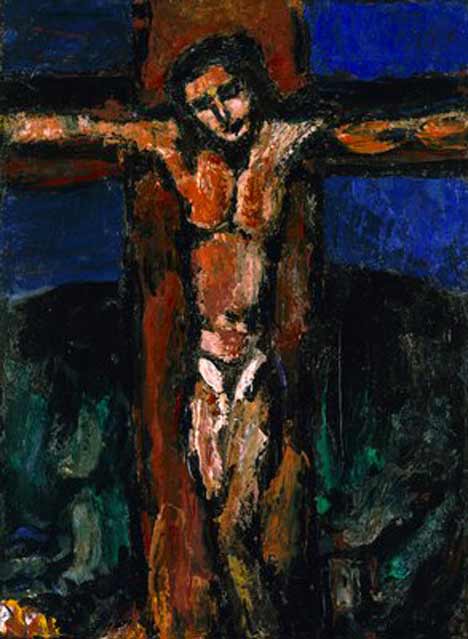 It is a traditional devotional practice during the season of Lent for Christians to take some time to reflect on Christ’s sacrifice for us on the cross. As we are in the midst of this special season, I thought it would be appropriate to share with you some selections from Martin Luther’s Meditation on Christ’s Passion from 1519. This meditation was one of Luther’s favorites. At one point he called it his “very best book.” Indeed, it is a brilliant reflection as Luther focuses with laser like clarity on Christ’s sacrifice.
As you read these words, I would encourage you to notice the way in which Luther draws a sharp distinction between God’s Law and God’s Gospel. God’s Law is expressed in a way that is harsh and inescapable. Luther’s expression and condemnation of our sinfulness might sound shocking, but it is certainly Scriptural. But Luther does not leave us in despair. With the heart of a pastor, he points us to the sacrifice of Christ and gloriously sets forth for us how it is all-sufficient for our sin.
And so I invite you to ponder now on Christ’s holy Passion. May this reflection be a blessing to you.
They contemplate Christ’s passion aright who view it with a terror-stricken heart and a despairing conscience. This terror must be felt as you witness the stern wrath and the unchanging earnestness with which God looks upon sin and sinners, so much so that he was unwilling to release sinners even for his only and dearest Son without his payment of the severest penalty for them. Thus he says in Isaiah 53:8, “I have chastised him for the transgressions of my people.” If the dearest child is punished thus, what will be the fate of sinners? It must be an inexpressible and unbearable earnestness that forces such a great and infinite person to suffer and die to appease it. And if you seriously consider that it is God’s very own Son, the eternal wisdom of the Father, who suffers, you will be terrified indeed. The more you think about it, the more intensely will you be frightened.
You must get this thought through your head and not doubt that you are the one who is torturing Christ thus, for your sins have surely wrought this. In Acts 2:36–37, St. Peter frightened the Jews like a peal of thunder when he said to all of them, “You crucified him.” Consequently three thousand alarmed and terrified Jews asked the apostles on that one day, “O dear brethren, what shall we do now?” Therefore, when you see the nails piercing Christ’s hands, you can be certain that it is your work. When you behold his crown of thorns, you may rest assured that these are your evil thoughts, etc.
We must give ourselves wholly to this matter, for the main benefit of Christ’s passion is that man sees into his own true self and that he be terrified and crushed by this. Unless we seek that knowledge, we do not derive much benefit from Christ’s passion.
After man has thus become aware of his sin and is terrified in his heart, he must watch that sin does not remain in his conscience, for this would lead to sheer despair. Just as our knowledge of sin flowed from Christ and was acknowledged by us, so we must pour this sin back on him and free our conscience of it. Therefore beware, lest you do as those perverse people who torture their hearts with their sins and strive to do the impossible, namely, get rid of their sins by running from one good work or penance to another, or by working their way out of this by means of indulgences. Unfortunately such false confidence in penance and pilgrimages is widespread.
You cast your sins from yourself and onto Christ when you firmly believe that his wounds and sufferings are your sins, to be borne and paid for by him, as we read in Isaiah 53:6, “The Lord has laid on him the iniquity of us all.” St. Peter says, “in his body has he borne our sins on the wood of the cross” (1 Peter 2:24). St. Paul says, “God has made him a sinner for us, so that through him we would be made just” (2 Corinthians 5:21). You must stake everything on these and similar verses. The more your conscience torments you, the more tenaciously must you cling to them. If you do not do that, but presume to still your conscience with your contrition and penance, you will never obtain peace of mind, but will have to despair in the end. If we allow sin to remain in our conscience and try to deal with it there, or if we look at sin in our heart, it will be much too strong for us and will live on forever. But if we behold it resting on Christ and see it overcome by his resurrection, and then boldly believe this, even it is dead and nullified. Sin cannot remain on Christ, since it is swallowed up by his resurrection. Now you see no wounds, no pain in him, and no sign of sin. Thus St. Paul declares that “Christ died for our sin and rose for our justification” (Romans 4:25). That is to say, in his suffering Christ makes our sin known and thus destroys it, but through his resurrection he justifies us and delivers us from all sin, if we believe this.
Luther’s Works: American Edition, Volume 42, pages 8-12


 Pastor Zach's Blog