Posts tagged ‘Sermon on the Mount’
All You Need Is the Sermon on the Mount
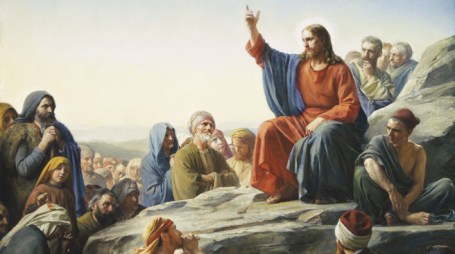
In what has become a kind of tradition for him, New York Times columnist Nicholas Kristof published an op-ed piece a couple of days before Christmas with this question: “Am I a Christian?” This time, he asked the question to Cardinal Joseph Tobin, but he has posed the same question to President Jimmy Carter and Pastor Timothy Keller in past columns.
Mr. Kristof is an admitted skeptic of many of the claims of Christianity. He opens his conversation with Cardinal Tobin like this:
Merry Christmas! Let me start with respectful skepticism. I revere Jesus’ teachings, but I have trouble with the miracles – including, since this is Christmas, the virgin birth. In Jesus’ time people believed that Athena was born from Zeus’ head, so it seemed natural to accept a great man walking on water or multiplying loaves and fishes; in 2017, not so much. Can’t we take the Sermon on the Mount but leave the supernatural?
Mr. Kristof holds a view of Christianity that sees Jesus as a talented and even a uniquely enlightened teacher. Believing that He was a worker of supernatural feats, however, is a bridge too far. Mr. Kristof’s Christianity is one that would prefer to, in his own words, “take the Sermon on the Mount but leave the supernatural” behind.
Mr. Kristof, of course, is not the only one who stumps for this kind of Christianity. President Obama, when he was making a case for same-sex unions back when he was campaigning for the presidency in 2008, stated:
If people find that controversial, then I would just refer them to the Sermon on the Mount, which I think is, in my mind, for my faith, more central than an obscure passage in Romans.
Instead of pitting against the miracles of Christ against the Sermon on the Mount, as does Mr. Kristof, President Obama pits the letters of Paul against the Sermon on the Mount, but the net effect is the same: if one wants a Christianity that is palatable, passable, and practical for the 21st century, Jesus’ Sermon on the Mount is the place to go.
Really?
Surely Mr. Kristoff can’t be talking about the Sermon on the Mount. He must have some other sermon in mind. For in the Sermon on the Mount Jesus says all sorts of things that are unmistakably contrary to our enlightened and modern sensibilities.
If Mr. Kristof finds a virgin birth impossible, what can he possibly find plausible about Jesus’ claim in the Sermon on the Mount to fulfill all of Scripture?
Do not think that I have come to abolish the Law or the Prophets; I have not come to abolish them but to fulfill them. (Matthew 5:17)
It should be pointed out that Jesus’ claim to fulfill “the Prophets” would include a prophecy about a virgin who will give birth, as Matthew so aptly notes at the beginning of his Gospel:
An angel of the Lord appeared to [Joseph] in a dream and said, “Joseph son of David, do not be afraid to take Mary home as your wife, because what is conceived in her is from the Holy Spirit. She will give birth to a son, and you are to give Him the name Jesus, because He will save His people from their sins.” All this took place to fulfill what the Lord had said through the prophet: “The virgin will conceive and give birth to a son, and they will call Him Immanuel” (which means “God with us”). (Matthew 1:20-23)
To hold to what Jesus says in the Sermon on the Mount would be to hold to who Jesus claims to be: the perfect fulfillment of around 1,000-years-worth of ancient literature. Is this really what Mr. Kristof believes?
Of course, Jesus says lots of other things in His Sermon on the Mount too, like:
You have heard that it was said, “You shall not commit adultery.” But I tell you that anyone who looks at a woman lustfully has already committed adultery with her in his heart. (Matthew 5:27-28)
And:
It has been said, “Anyone who divorces his wife must give her a certificate of divorce.” But I tell you that anyone who divorces his wife, except for sexual immorality, makes her the victim of adultery, and anyone who marries a divorced woman commits adultery. (Matthew 5:31-32)
And:
Be perfect, therefore, as your heavenly Father is perfect. (Matthew 5:48)
And:
Seek first [God’s] kingdom and His righteousness, and all these things will be given to you as well. (Matthew 6:33)
And:
Enter through the narrow gate. For wide is the gate and broad is the road that leads to destruction, and many enter through it. But small is the gate and narrow the road that leads to life, and only a few find it. (Matthew 7:13-14)
Do people who want to take Jesus’ Sermon on the Mount while leaving behind other portions of the Scriptures take Jesus at His word in all these matters?
I have a suspicion that when people argue for the primacy of Jesus’ Sermon on the Mount, they are arguing for the primacy of a very abridged version of the sermon, which usually amounts to some nice thoughts about loving your enemies, except, of course, if they are our political enemies, along with some other nice thoughts about not judging others, except, of course, when someone holds a position we deem worthy of mockery. It turns out that a Christianity that strips away the rest of the Scriptures in favor of the Sermon on the Mount only winds up stripping away the Sermon on the Mount itself.
So, allow me to make a suggestion. If you think all of Christianity can be competently considered using Jesus’ Sermon on the Mount, fine. But then take the whole Sermon on the Mount seriously. Believe that Jesus is the fulfillment of every jot and tittle of the Old Testament. Decry lust and divorce. Aim not just for respectable goodness, but for perfect righteousness. Put God’s kingdom first in every decision. Learn to love all those who hate you in a way that you are willing even to sacrifice for them. Guard against being judgmental, even of those you find intolerable. See Jesus as your narrow road to salvation.
Live like that.
But be warned: if you do live like that, you might just find yourself in agreement not only with Jesus’ Sermon on the Mount, but with the rest of the Scriptures as well, which means that perhaps Jesus’ sermon was actually what a sermon was always meant to be: not some stand-alone speech that can be divorced from everything around it, but a testimony to all of God’s truth as contained in the Scriptures.
Try as you might, to take the Sermon on the Mount seriously, you must take the rest of the Scriptures seriously. And if you take the rest of the Scriptures seriously, you will take Jesus seriously, for the Scriptures testify to Him. And if you take Jesus seriously, you may find out that He was not just another teacher, but One who has perfect authority over us, insight into us, and salvation for us.
Now, if you’re willing to believe all that about Jesus, which is what the Sermon on the Mount calls us to believe, is a virgin birth really all that difficult to fathom?
Christian Persecution Under the Stars and Stripes
 Are rabid secularists persecuting Christians in the United States? This is the question Robert Boston of Salon takes up. His answer is an unambiguous and unapologetic “no way.” He opens his article in an almost combative tenor:
Certain words should not be tossed around lightly. Persecution is one of those words.
Religious right leaders and their followers often claim that they are being persecuted in the United States. They should watch their words carefully. Their claims are offensive; they don’t know the first thing about persecution.
One doesn’t have to look far to find examples of real religious persecution in the world. In some countries, people can be imprisoned, beaten, or even killed because of what they believe. Certain religious groups are illegal and denied the right to meet. This is real persecution. By contrast, being offended because a clerk in a discount store said “Happy Holidays” instead of “Merry Christmas” pales. Only the most confused mind would equate the two.[1]
Boston goes on to rehearse a litany of privileges that religious institutions enjoy in our society along with some examples of what he considers to be true religious persecution:
Go to Saudi Arabia, where it’s illegal to even open a Christian church, and experience the fear of those Christian believers who dare to worship in private homes, aware that at any moment they may be imprisoned.
Visit North Korea, where all religions have been swept away and replaced with a bizarre form of worship of the state and its leader that purports to promote self-reliance but, in reality, merely serves as a vehicle for oppression.
Visit any region under the control of the Taliban, a movement so extreme that, in Afghanistan, they trashed that nation’s cultural heritage by blowing up two sixth-century statutes of Buddha because they were declared false idols by religious leaders who are intolerant of any other faith but Islam.
There is real religious persecution in the world. Right-wing Christians in America aren’t experiencing it.
On the one hand, there are some things to affirm in Boston’s article. First, I agree that it is awfully tough to make the leap from someone wishing a Christian “Happy Holidays” rather than “Merry Christmas” to religious persecution. That is not only a questionable example of persecution, but a silly one. Second, I wholeheartedly and unequivocally affirm that compared to what Christians are experiencing in other countries, Christians who live “in the land of the free and the home of the brave” have it great. There is no reason – ever – for Christians in this country to compare themselves to Christians who are, let’s say, awaiting execution in North Korea.[2]
But…
There’s always a “but,” isn’t there?
For all of Boston’s bravado about how Christians in the States are not persecuted, I’m not sure he really understands Christianity or persecution.
Boston rails against what he calls “right-wing Christians” and “religious conservatives.” Just in case we’re unclear as to what he means, headlining his piece is a picture of Glenn Beck, Phil Robertson, and Michelle Bachmann. His implicit message seems to be that those who claim that Christian persecution is taking place in the States are nothing more than puppets and parrots of conservative political groups. But this is not fair to the breadth or the depth of Christianity. Christian theology is much better defined in terms of “orthodoxy” and “heresy” rather than in terms of “liberalism” and “conservatism.” After all, Christianity is much more concerned with the right teaching of divine truths than with a particular 21st century political ideology. This is why there are Christians who are Republicans and Democrats. No earthly political party can claim a monopoly on the Kingdom of God.
Second, though I understand Boston’s concern with Christians who brandish about the word “persecution” carelessly, I can’t help but suspect that he is guilty of precisely that which he rails against in his article. I find it strange that while writing about Christian persecution, Boston never pauses to consider what Christ has to say on the subject! So let’s do it ourselves. Jesus says, “Blessed are you when people insult you, persecute you and falsely say all kinds of evil against you because of Me” (Matthew 5:11). Notice that Jesus here explains persecution in terms of words rather than actions. Jesus says that people will both insult and tells lies about His followers. There can be little doubt that this does indeed happen – even in the United States. And this, Jesus says, is part of persecution. Thus, Boston’s stipulations on what qualifies as Christian persecution are far too restrictive – at least according to Christ.
I am aware there is quite a gap between the definition of persecution theologically and the definition of persecution popularly. It is dangerous to throw out a word like “persecution” without any sort of background on how this word is used biblically and theologically. Hopefully, the dust up during the Romney campaign over whether or not Mormonism is a cult taught us that not all people define all words the same way.[3] Thus, if we’re going to apply the word “persecution” to anything that happens to Christians in the States, we need to explain what we mean.
Whatever you may think does or does not qualify as persecution, what is most important is how Christians respond to those who are against them. Boston says Christians have reacted to that which they perceive to be persecution with “so much carping.” This, I agree, is tragic. When Christians are persecuted, our response should not be one of carping, whining, or fretting. After all, according to Jesus’ Beatitudes, when we are persecuted, we are not victimized, but “blessed.” This is why, when the apostles experience physical persecution at the hands of the Sanhedrin, they leave “rejoicing because they had been counted worthy of suffering disgrace for the Name” (Acts 5:41).
I like what Robert Morgan of the Huffington Post says about Christian persecution:
The Bible anticipated [persecution] years ago. The founder of Christianity, after all, was tortured to death and His original 12 followers were all persecuted; most were slain. Though His message was a Gospel of peace, His critics nailed Him to a cross but failed to keep Him in the tomb. They hated Him but could not contain Him. They sought to limit His influence, but they only broadened His impact.[4]
Ultimately, no matter how badly Christianity may be persecuted, threatened, belittled, cajoled, and legislatively restricted, it just won’t die. Why? Because its Founder lives.
[1] Robert Boston, “The ultimate guide to debunking right-wingers’ insane persecution fantasies,” Salon (3.16.2014).
[2] Cheryl Chumley, “Kim Jong-un calls for execution of 33 Christians,” Washington Times (3.6.2014).
[3] Richard Oppel & Erik Eckholm, “Prominent Pastor Calls Romney’s Church a Cult,” New York Times (10.7.2011).
[4] Robert Morgan, “The World’s War on Christianity,” Huffington Post (1.14.2014).


 Pastor Zach's Blog