Posts tagged ‘Scripture’
You’re not smart enough or good enough, even if people like you
 It was Stuart Smalley, played by Al Franken on Saturday Night Live, who said, “I’m good enough, I’m smart enough, and, doggone it, people like me!” As it turns out, many took Smalley’s credo to heart. And the results have been sadly predictable.
Case in point: the American Bible Society, in conjunction with the Barna Group, recently published its “State of the Bible” report for 2014. The report opens with plenty of punch:
Now there are just as many Americans skeptical of the Bible as there are engaged with the Bible. According to the fourth annual State of the Bible survey, 19 percent said that they were skeptical of the Bible. This number is up from 10 percent in 2011.
This trend is even more pronounced among the Millennial generation (who range in age from 18-29). According to the State of the Bible report, Millennials are
– Less likely to view the Bible as sacred literature (64 percent in comparison to 79 percent of adults),
– Less likely to believe the Bible contains everything a person needs to know to lead a meaningful life (35 percent in comparison to 50 percent of adults), and
– More likely to never read the Bible (39 percent compared in comparison to 26 percent of adults).[1]
It turns out that America’s latest generation is more suspicious of the Bible than any that has come before it.
Now, on the one hand, such suspicion requires solid biblical apologists – people who can argue for Scripture’s veracity, historicity, consistency, and even morality to a society that is increasingly questioning Scripture on all these fronts. Indeed, one factoid that came out of this report is that while 50 percent of all adults believe the Bible has too little influence on society, only 30 percent of Millennials believe this. This is, in part, because many Millennials no longer accept the basic premise that the Bible teaches right from wrong. Instead, many Millennials now believe the Bible promotes wrong rather than right – for instance, on topics like sexual ethics. Thus, they see the Bible as having a negative, rather than a positive, influence on society – one they would be happy to see continue to wane.
But there is more to this report than just what Millennials believe about the Bible. The statistic I found most telling from this report is this one: 19 percent of Millennials believe no literature is sacred compared to 13 percent of all adults who believe no literature is sacred. In other words, it’s not just that Millennials have a problem with the Bible in particular, it’s that they struggle with any literature that claims to be sacred in general.
It is here that we arrive at the core of this new generation’s struggle. For to claim a particular piece of literature is sacred is, at the same time, to say something about its authority. After all, something with a sacred, or divine, origin is, by definition, “above” me and can therefore make certain claims on me and demands from me. But this is something this current generation simply cannot endure. For to believe a book like the Bible has divine authority is to concede that if I disagree with the Bible, the Bible gets the right of way. But when I’ve been told, “I’m good enough, I’m smart enough, and, doggone it, people like me,” I cannot stand to have my goodness or moral intelligence questioned by some backward work from ancient antiquity. My modern, enlightened sensibilities cannot be wrong. I must be right. The only sacred literature left, then, is the moral script I’ve written for myself and carry around in myself – hence, the reason so many Millennials see not only the Bible as unsacred, but any religion’s holy book as unsacred.
So with all of this in mind, perhaps it’s worth it to do a little reflection on our assumption concerning the sapience and sacredness of our moral sensibilities. We have been told we are smart enough. But are we, really? Have we never made a wrong call, a tragic error, or a bumbling fumble? We have been told we are good enough. But are we, really? Have we never broken our own moral boundaries or changed them over time because of a shifting perspective, or, more cynically, because of coldly calculated expedience? A little bit of honest introspection is enough to remind us that what Stuart Smalley taught us is profoundly untrue. Indeed, it is downright silly. And it is supposed to be. That’s why it aired on Saturday Night Live.
So let’s stop looking to ourselves for truth and morality and start looking to something higher. Let’s take an honest look at the Bible. Who knows? We may find it’s smarter and better than even we are. And, doggone it, we might even learn to like that.
____________________________
[1] “State of the Bible 2014,” American Bible Society.
S.B. 1062
Credit: LA Times
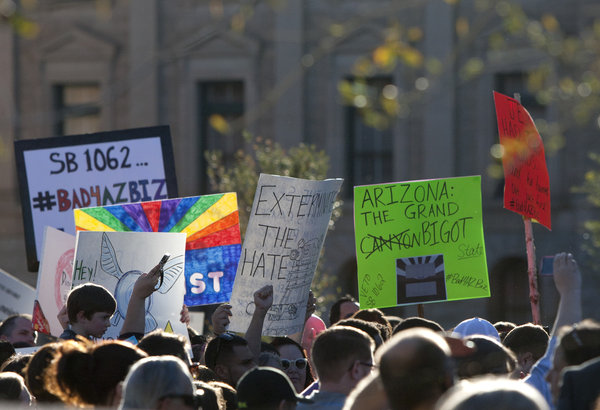
A funny thing happened on my way back from a recent trip I took to Arizona. The state became embroiled in a heated political battle over Senate Bill 1062.[1] Okay, it may not have been funny. But these kinds of battles are common.
According to some, S.B. 1062 championed religious liberty, allowing business owners with religious convictions to deny service to a party if the business owner felt that serving that party would substantially burden or contradict his religious convictions. According to others, S.B. 1062 violated the civil rights of homosexuals by formally and legally legitimatizing discrimination against them.
Last Wednesday, Governor Jan Brewer vetoed the bill, explaining, “I have not heard of one example in Arizona where business owners’ religious liberty has been violated … The bill is broadly worded and could result in unintended and negative consequences.”[2] Of course, the political pressure on Governor Brewer was hot:
Companies such as Apple Inc. and American Airlines, and politicians including GOP Sen. John McCain and former Republican presidential nominee Mitt Romney were among those who urged Brewer to veto the legislation. The Arizona Super Bowl Host Committee, which is overseeing preparations for the 2015 game, came out with a statement against the legislation. The Hispanic National Bar Association on Wednesday said it canceled its 2015 convention in Phoenix over the measure.[3]
In observing the volley between supporters and detractors of this bill, two things strike me.
First, homosexuality – and, specifically, gay rights – is not only a hot topic in our society, it is the hot topic in our society. Interestingly, nowhere does S.B. 1062 mention homosexuality. It simply speaks of “the free exercise of religion.” Yet, USA Today reported on Governor Brewer’s veto of the bill with this headline: “Arizona governor vetoes anti-gay bill.”[4] These days, how a piece of legislation will affect the gay community is the litmus test as to whether or not a bill can or should pass, even if that bill does not specifically mention the gay community. Gay rights, then, are front and center. They are the battleground du jour of our society.
Second, there are a lot of homosexuals who deeply despise Christians with orthodox beliefs concerning the sinfulness of homosexual activity and will go to great – and even duplicitous – lengths to paint Christians as homophobic bigots. Stories abound of people who have concocted heinous hate crimes against themselves. Take, for instance, the lesbian couple that spray-painted their own garage with the message “Kill the gay.”[5] Or how about the Tennessee man who falsely claimed that three men beat him and robbed his store in an anti-gay attack?[6] Then, of course, there was the famed incident of the waitress who falsely claimed she was stiffed on a tip because she was a lesbian.[7] Personally, I don’t want to think of anyone in the homosexual community as my enemy. Life is too short to keep an enemies’ list. But I am not so naïve as to believe that there aren’t some in the homosexual community who think of me as their enemy.
So what am I to do?
Jesus’ admonition to pray for those who are on the outs with you (cf. Matthew 5:44) seems to be especially apropos for a time such as this. To this end, I would invite you to join me in praying for three things as the culture war over sexual rights continues to rage.
First, pray for forgiveness. Though it is painful to admit, it was not too long ago that it was exponentially more likely for a message like “Kill the gay” to be spray painted not by someone self-imposing a hate crime, but by someone committing one. And sometimes, that someone was even a self-professed Christian. This, of course, directly defies a myriad of biblical commandments concerning our conduct as Christians. Our call to tell the truth about sin must never be a license to commit sin – especially the sin of hate. We need forgiveness for our missteps – which are plenty – in this debate.
Second, pray for understanding. I want to be understood. I want people to understand and believe that I am not a homophobic hate monger who wants to oppress, humiliate, and exile those who do not share my same faith and ethical commitments. But if I want this for myself, it is only fair that I afford the same courtesy to others. Martin Luther summarized the Eighth Commandment by saying that, when dealing with our neighbors, we should “put the best construction on everything.”[8] I can think of no better way to respond to those who put the worst construction on Christians’ intentions than by putting the best construction on theirs. Generous understanding offers our greatest hope for peace in the midst of a hotly contested and, sadly, dirtily fought culture war.
Third, pray that true love would prevail. The “true” is just as important as the “love” here, for our society has settled for a counterfeit love that reduces love to nothing more than tolerance. Just the other day, I heard a caller to a radio talk show explain how one of the primary virtues of Christianity is tolerance. Really? A quick search of the word “tolerate” in the Bible brings up verses like these:
- Whoever slanders their neighbor in secret, I will put to silence; whoever has haughty eyes and a proud heart, I will not tolerate. (Psalm 101:5)
- Your eyes are too pure to look on evil; You cannot tolerate wrongdoing. Why then do You tolerate the treacherous? (Habakkuk 1:13)
- It is actually reported that there is sexual immorality among you, and of a kind that even pagans do not tolerate: A man is sleeping with his father’s wife. (1 Corinthians 5:1)
Tolerance does not seem to be the high brow Scriptural virtue that some would like to peddle it as. This is not to say that we shouldn’t live with, work alongside with, and care for people who do not share our same moral commitments. In this way, we should indeed be tolerant. But tolerance does not necessarily entail endorsement.
Ultimately, as Christians, we ought to aspire to a much higher value than that of tolerance. We ought to aspire to love. “Love,” the apostle Paul reminds us, “does not delight in evil but rejoices with the truth” (1 Corinthians 1:6). To love someone well, we must tell him the truth, even when the truth is unpopular. This is our calling with all sin – sexual and otherwise.
So these are my prayers. Now, it’s your turn. Will you join me in praying the same?
[2] Aaron Blake, “Arizona governor vetoes bill on denying services to gays,” The Washington Post (2.26.2014).
[3] Bob Christie, “Arizona Religious Bill That Angered Gays Vetoed,” ABC News (2.27.2014).
[4] Dan Nowicki, Yvonne Wingett Sanchez and Alia Beard Rau, “Arizona governor vetoes anti-gay bill,” USA Today (2.26.2014).
[5] Alyssa Newcomb, “Lesbian Couple Charged With Staging Hate Crime,” ABC News (2.19.2012).
[6] Chuck Ross, “Report: Man falsified police report in alleged anti-gay attack,” The Daily Caller (12.26.2013).
[7] Cavan Sieczkowski, “New Jersey Waitress In Anti-Gay Receipt Saga Reportedly Let Go From Job,” The Huffington Post (12.9.2013).
A Camel Controversy
 And you thought it was it only impossible for a camel to go through the eye of a needle.
As it turns out, threading camels isn’t the only thing that’s impossible according to some archaeologists. Domesticating them before the tenth century B.C. also turns out to be quite the trick. Writing for the New York Times, John Noble Wilford provocatively declares, “Camels Had No Business in Genesis.”[1] Wilford explains:
There are too many camels in the Bible, out of time and out of place.
Camels probably had little or no role in the lives of such early Jewish patriarchs as Abraham, Jacob and Joseph, who lived in the first half of the second millennium B.C., and yet stories about them mention these domesticated pack animals more than 20 times. Genesis 24, for example, tells of Abraham’s servant going by camel on a mission to find a wife for Isaac.
How does Wilford know that camels had no role in the era of the biblical patriarchs? He cites a study, recently published by two archaeologists from Tel Aviv University, which employed radiocarbon dating to test some camel bones found in the Aravah Valley. This study found the bones to be from the last third of the tenth century B.C., which, Wilford notes, is “centuries after the patriarchs lived and decades after the kingdom of David, according to the Bible.” So there you have it. Thanks to some late breaking bones, Genesis is discredited – at least the parts that talk about camels.
Now, before we fall prey to camel chaos, a few things should be noted. First, the Tel Aviv archaeologists, by declaring that camels could not have been used in the way Genesis 24 describes them, are making an argument from silence. Their assumption runs like this: because we do not have domesticated camel fossils dating before first millennium B.C., there must have been no domesticated camels before the first millennium B.C. The Bible must be wrong. But a lack of evidence does not necessitate a lack of existence. One need to only think back to 1961. This was the year the “Pilate Stone” was discovered at Caesarea Maritima. It had an inscription dedicated to the emperor of Rome at the time, Tiberius Caesar: “To the Divine Augustus Tiberieum: Pontius Pilate, prefect of Judea has dedicated this.” Before this stone was discovered, because there was no hard archaeological evidence of Pontius Pilate, many assumed that Pilate was a fictional character, made up out of the sacred authors’ over-active imaginations. Whoops. So much for that argument from silence.
It should also be noted that the archaeologists who discovered these bones do not even have complete silence in favor of their argument against camels during the time of the biblical patriarchs. They only have archaeological silence. There are extra-biblical references to domesticated camels prior to the first millennium B.C. Titus Kennedy, adjunct professor at Biola University, notes that a camel is mentioned in a list of domesticated animals from Ugarit, dating anywhere from 1950 to 1600 B.C. In an interview with Christianity Today, Kennedy explains:
For those who adhere to a twelfth century B.C. or later theory of domestic camel use in the ancient Near East, a great deal of archaeological and textual evidence must be either ignored or explained away …
[Israel] doesn’t have much writing from before the Iron Age, 1000 B.C. … So there aren’t as many sources to look at. Whereas in Egypt, you have writing all the way back to 3000 B.C. and in Mesopotamia the same thing.[2]
Kennedy concludes that there were not only domesticated camels at the time of the biblical patriarchs, but before the time of the biblical patriarchs. Thus, the biblical record is quite believable. There is no reason that Abraham could not have acquired “sheep and cattle, male and female donkeys, male and female servants, and camels” (Genesis 12:16), just as Genesis says.
Ultimately, the difficulties with the premature conclusions drawn from this discovery reach much deeper than simply whether camels were around in the second millennium B.C. These difficulties are summed up in Wilford’s conclusion:
These anachronisms are telling evidence that the Bible was written or edited long after the events it narrates and is not always reliable as verifiable history. These camel stories “do not encapsulate memories from the second millennium,” said Noam Mizrahi, an Israeli biblical scholar, “but should be viewed as back-projections from a much later period.”
In other words, the Bible cannot be trusted to get its facts straight – at least not all of them. When reading the Bible, then, skepticism must be given preference over faith.
Finally, if I assume camels could not have been in Genesis based on an argument from paleontological silence, it is only reasonable for me to assume that a Savior cannot rise from death based on medical science. After all, doctors have long known that dead people tend to stay that way. Thus, Jesus’ resurrection must have never happened. But if this is true, then my “faith is futile; I am still in my sins … [and] I am to be pitied more than all men” (1 Corinthians 15:17, 19). Wow, that’s a downer.
Let’s hope the archaeologists are wrong on this one. After all, I don’t really like to be pitied.
[1] John Noble Wilford, “Camels Had No Business in Genesis,” New York Times (2.10.2014).
[2] Gordon Govier, “The Latest Challenge to the Bible’s Accuracy: Abraham’s Anachronistic Camels?” Christianity Today (February 2014).
It’s Not Tricky … It’s Really Not
 It seems like it’s been happening to me a lot lately.
The other day on the radio, I heard a commercial for “The Biblical Money Code,” a program that claims to be able to make millions for the person who follows it:
Imagine if you had a secret code for making money … a code buried deep within biblical text. A code that certain investment titans have quietly exploited to amass billions. And what if this code could be used by you, today, to unlock vast amounts of wealth — safely and ethically.[1]
Now, forget the fact that what the Bible has to say about money is about as straightforward and sharp as it can be. For instance: “No one can serve two masters. Either he will hate the one and love the other, or he will be devoted to the one and despise the other. You cannot serve both God and Money” (Matthew 6:24). Forget the fact that God nowhere promises that you can or will amass billions. Forget the fact that the Bible doesn’t even find it particularly desirable that a person would amass billions. All of what’s in this program has to be in the Bible. You just have to unlock the code.
But that’s not the only biblical “code” I’ve run across recently.
The other day, I received an email from a friend claiming the prophet Muhammad was identified by name in the Old Testament. Where? Song of Songs 5:16: “His mouth is sweetness itself; he is altogether lovely. This is my lover, this my friend, O daughters of Jerusalem.” How does this refer to Muhammad? The Hebrew word for “altogether lovely” is machamadim, which sounds like “Muhammad.” Now, forget the fact that, in context, this is a statement by a wife about her husband. Forget the fact that machamadim is a Hebrew word and Muhammad is an Arabic name. Forget the fact that there is nothing in this verse that would indicate this is a prophetic statement. These two words sound similar, so they must be related. You just have to unlock the code.
But that’s not the only biblical “code” I’ve run across recently.
I remember a conversation I had with some Mormon friends about the kingdoms of glory in the afterlife. “We can enter a telestial, terrestrial, or celestial kingdom,” my friends explained. From where do they get this? 1 Corinthians 15:40 (KJV): “There are also celestial bodies, and bodies terrestrial: but the glory of the celestial is one, and the glory of the terrestrial is another.” Now, forget the fact that Paul’s point here is not to talk about afterlife destinations, but to speak of the kind of body we will receive at the resurrection of the dead, as he makes abundantly clear at the conclusion of his argument:
So will it be with the resurrection of the dead. The body that is sown is perishable, it is raised imperishable; it is sown in dishonor, it is raised in glory; it is sown in weakness, it is raised in power; it is sown a natural body, it is raised a spiritual body. (1 Corinthians 15:42-44)
Forget the fact that this verse doesn’t even mention telestial bodies. Forget the fact that no one in the Church interpreted this verse in this way before Joseph Smith. Paul has to be talking about different afterlife destinations. You just have to unlock the code.
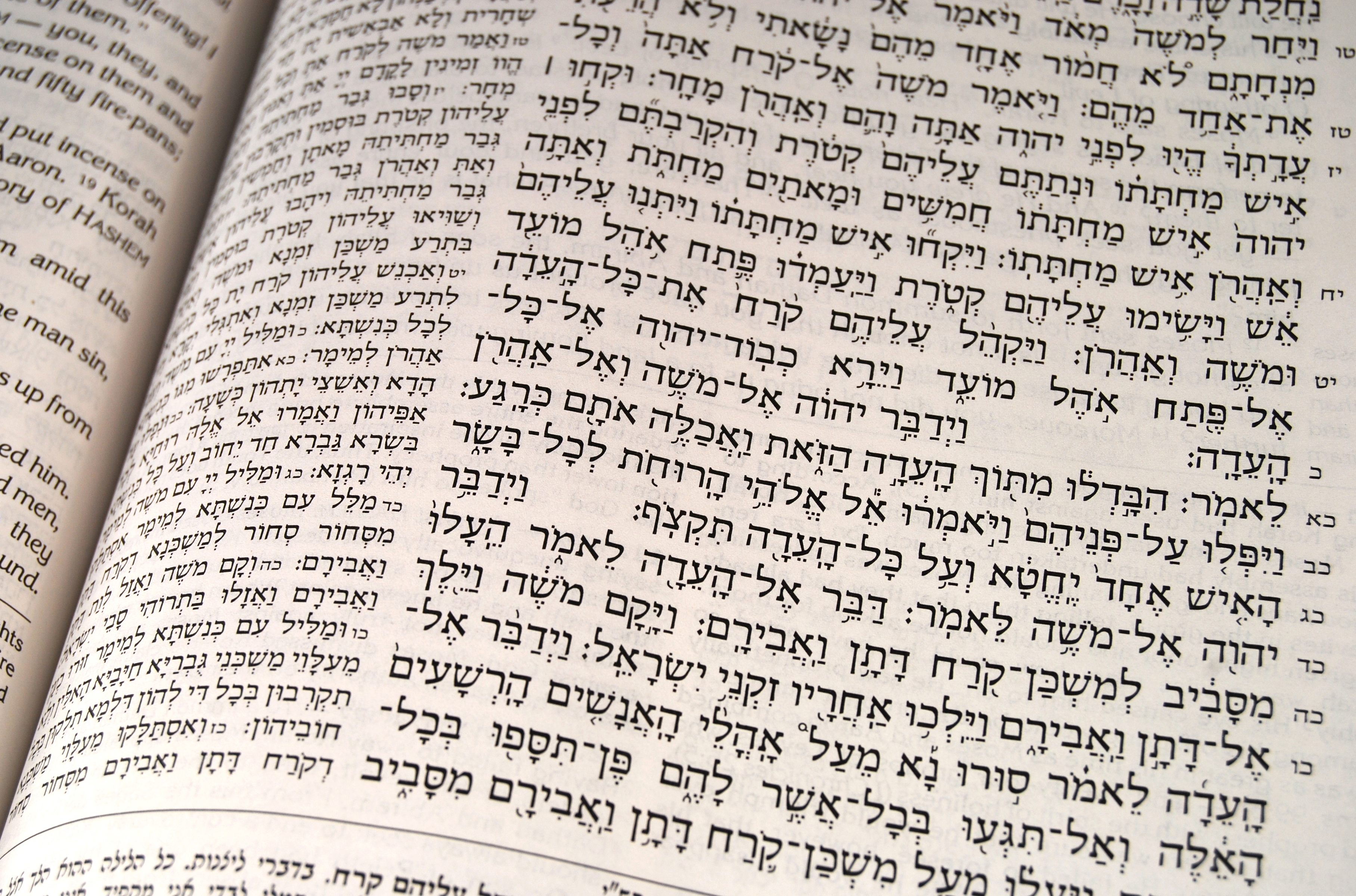
With so many so-called “religious experts” peddling so many biblical codes, it is worth it to remind ourselves of the principle of perspicuity. Perspicuity is from a Latin word meaning “clearness.” And classically, the Church has ascribed this characteristic to Holy Writ. The Lutheran dogmatician Francis Pieper summarizes biblical perspicuity thusly: “The perspicuity of Scripture consists in this, that it presents, in language that can be understood by all, whatever men must know to be saved.”[2] Pieper goes on to note that Scripture testifies to its own perspicuity in places like Psalm 19:7: “The statutes of the LORD are trustworthy, making wise the simple.” One can be simple intellectually and still gain wisdom from Scripture, for Scripture is clear. Understanding the Good Book does not take a Ph.D. in theology.
Now, this is not to say that every verse of the Bible is equally easy to understand. No less than the great preacher Chrysostom explains that some parts of the Bible can indeed be difficult to interpret:
Let us suppose … rivers … are not of the same depth. Some have a shallow bed, others one deep enough to drown one unacquainted with it. In one part there are whirlpools, and not in another … Why then art thou bent on drowning thyself in those depths?[3]
Chrysostom compares different parts of Scripture to different rivers. Some parts are shallow and easy to navigate. Other parts are deeper and more difficult to wade through. But though some parts of Scripture are richly deep, none are nefariously tricky. In other words, the biblical authors are not trying to hide things from us with a code, but reveal things to us under the guidance of God’s Holy Spirit.
The long and short of biblical perspicuity, then, is this: finding codes, mysteries, and secrets that cater to our sinful lusts like greed, play “sound like” games with words across languages, and rip words out of a text and shoehorn them into meaning something which, contextually, they clearly do not and cannot mean are not only not biblical, they’re evil. God wants us to understand and follow His Word – not be confused by it and misinterpret it.
So the next time you open your Bible, don’t pull out your decoder ring, pull out your reading glasses. They’ll work much better. And you’ll be much more edified.
[1] “The Biblical Money Code,” newsmax.com
[2] Francis Pieper, Christian Dogmatics, vol. 1 (St. Louis: Concordia Publishing House, 1950), 320.
[3] John Chrysostom, A Select Library of the Nicene and Post-Nicene Fathers of the Christian Church, series 1, vol. 13, P. Schaff, ed. (New York: Christian Literature Company, 1889), 507.
Where You Begin and Where You End
 I have often said, when teaching in various settings, “Where you begin is where you end.” This is my axiomatic, though admittedly somewhat simplistic, way of expressing the truth that all of us come to a situation, a problem, or a challenge with our own preconceived notions and biases. These preconceived notions and biases, in turn, inevitably color the conclusions we draw and the solutions we formulate. This is especially true when it comes to working with the text of Scripture. If you approach the Bible with a stance of pessimism and incredulity, what you find will be appropriately pessimistic and incredulous. Conversely, if you approach the Bible with a stance of awe and a desire to “give the Bible the benefit of the doubt,” as it were, the conclusions you draw will strengthen your faith soothe your troubled soul. It is no secret that I am in the latter camp of how I approach Holy Scripture. In light of my ABC yesterday on the doctrine of the inspiration of Scripture, I thought that this quote from Ben Witherington III, given at the Greer-Heard Forum last Saturday at New Orleans Baptist Seminary, offered some keen insight into why I am in this latter camp:
I don’t believe in “justification by doubt.” I don’t believe that philosophical skepticism is the same thing as critical thinking, and I also don’t think that the sort of historiography that is undergirded by such a prioris can help us very much with the question are the Gospels reliable, truthful witnesses when it comes to the historical Jesus. In fact, if you want to actually get at the truth of something, you have to enter into dialogue with that source giving it the benefit of the doubt, allowing it to have its say, and while one doesn’t put one’s critically thinking cap aside, if you do not approach the material with an open mind and a willingness to learn from it, you won’t get at the truth of the matter, not even the historical truth of the matter. You can’t possibly analyze the actual nature of a raging fire, by pouring cold water on it, and then picking over the ashes and charcoal thereafter.
Weekend Extra – It’s Crystal Clear!
 In 2008, the Pew Forum on Religious and Public Life conducted one of the largest surveys ever of Americans’ religious beliefs. Though it found that 92 percent of people believe in God, when asked to specify who God is or make hard and fast distinctions between their faith systems and the faith systems of other religions, respondents struggled. Instead, most Americans have an increasingly nonexclusive attitude when it comes to faith. 70 percent of people surveyed believe that many paths lead to God. Gregory Smith, a research fellow at the Pew Forum, explains: “Even though Americans tend to take religion quite seriously and are a highly religious people, there is a certain degree of openness and a lack of dogmatism in their approach to faith and the teachings of their faith” (“Most Americans Believe in Higher Power, Poll Finds,” Washington Post, 9.24.08).
In all honesty, the Pew Foundation’s survey offers no real surprises. Though it is one of the largest surveys ever conducted, the results are a dime a dozen. Survey after survey has demonstrated that, though most Americans are “spiritual” and believe in “God,” they have no real cohesive doctrinal system nor do they subscribe wholeheartedly to an external source of authority such as the Bible. People claim to be spiritual, but their spirituality is fuzzy.
Long before researchers were around to conduct in-depth surveys on people’s religious attitudes, the apostle Paul foresaw that such misguided faith would be the order of the day for many: “The Spirit clearly says that in later times some will abandon the faith and follow deceiving spirits and things taught by demons” (1 Timothy 4:1). In a world which subscribes to fuzzy spirituality, Paul seeks to inject some clarity from the Holy Spirit: “The Spirit clearly says…” True faith in God is never ill-defined. It is as clear as the Gospel itself. Indeed, according to Paul, a faith that does not find its clarity vis-à-vis the Gospel is not a faith in God, but a faith from demons. And for the nebulous faiths of demons, Paul warns, “some will abandon the faith.” Two things are notable in this phrase. First, the Greek word for “abandon” is apostesontai, from which we get our English word “apostasy,” a word which, etymologically, means “to stand apart.” Paul’s argument, then, is that standing apart from faith in Christ means standing with demons. Second, the arthrous phrase “the faith” reminds us that, quite distinct from the popular conception that many faiths lead to God, there is only one true faith – faith in Jesus Christ.
What is the way out of the fuzzy spirituality which plagues our culture? Paul cites two remedies. First, fuzzy spirituality must be remedied by the Gospel: “This is a trustworthy saying that deserves full acceptance (and for this we labor and strive), that we have put our hope in the living God, who is the Savior of all men, and especially of those who believe” (1 Timothy 4:9-10). Hope in the living God and His Savior, Jesus Christ, leads to salvation. Period. Of this we can be clear and sure. No nebulous spirituality can promise salvation like the Gospel can. It can only conjure up shady specters of possible hereafters. Second, fuzzy spirituality must be remedied by the authority of Scripture: “Devote yourself to the public reading of Scripture, to preaching and to teaching” (1 Timothy 4:13). The Gospel is revealed in, by, and through the pages of Scripture. Thus, if we desire clarity on the Gospel specifically and theology generally, we turn to Scripture and submit to its authority and believe its promises. With the Gospel and Scripture in our hearts and hands, clarity is given to things spiritual, with even more clarity being promised in eternity: “Now we see but a poor reflection as in a mirror; then we shall see face to face. Now I know in part; then I shall know fully, even as I am fully known” (1 Corinthians 13:12). Praise be to God for the clarity which comes from our Creator!
Want to learn more on this passage? Go to
www.ConcordiaLutheranChurch.com
and check out audio and video from Pastor Tucker’s
message or Doctor Player’s ABC!


 Pastor Zach's Blog