Posts tagged ‘Mercy’
Thanksgiving Lessons From Lincoln

Credit: Luminary PhotoProject / Flickr
I have made it a tradition of sorts to read one of Abraham Lincoln’s Thanksgiving proclamations each year during this time. His proclamations are not only extraordinarily well-crafted pieces of oratory statecraft, they are also genuinely theologically rich. In his Thanksgiving Proclamation of 1863, Mr. Lincoln recounts the blessings God has bestowed on this nation and then declares:
No human counsel hath devised nor hath any mortal hand worked out these great things. They are the gracious gifts of the Most High God, who, while dealing with us in anger for our sins, hath nevertheless remembered mercy.
President Lincoln beseeches the nation to give thanks on its knees, humbly recognizing that anything it has is not due to some inherent civic merit or to some twisted theology of a manifest destiny (a concept Mr. Lincoln resolutely opposed), but to the unmerited mercy of God. In other words, the president recognized that rather than judging this nation as its sins deserved in wrath, God instead blessed this nation apart from its sins out of grace. And for this, Mr. Lincoln was thankful.
What struck me the most about President Lincoln’s Thanksgiving Proclamation as I read it this year was how the president believed divine mercy should lead to concrete action. Mr. Lincoln concludes his proclamation thusly:
I recommend to them that while offering up the ascriptions justly due to God for such singular deliverances and blessings they do also, with humble penitence for our national perverseness and disobedience, commend to His tender care all those who have become widows, orphans, mourners, or sufferers in the lamentable civil strife in which we are unavoidably engaged, and fervently implore the interposition of the Almighty hand to heal the wounds of the nation and to restore it, as soon as may be consistent with the divine purposes, to the full enjoyment of peace, harmony, tranquility, and union.
In view of God’s mercy, the president invites the American people to three things: repentance, remembrance, and restoration. He invites the American people to repent of their sins, both in the North and in the South, understanding that any snooty swagger of self-righteousness can never receive mercy from God because it does not understand the need for the grace of God. He also invites the American people to a remembrance of those who are suffering – those who have become widows, orphans, and mourners in the strife of the Civil War. He finally calls the American people to restoration – to be healed from a wound of division that runs so deep that it has led Americans to take up arms against Americans.
As I reflect on the wisdom in President Lincoln’s proclamation, the words of the teacher in Ecclesiastes come to mind: “What has been will be again, what has been done will be done again; there is nothing new under the sun” (Ecclesiastes 1:9). Today, as in Mr. Lincoln’s day, examples of delusional self-righteousness abound – both among the secular and the spiritual – which close us off to appreciating and receiving God’s mercy. Today, as in Mr. Lincoln’s day, widows, orphans, and mourners still live among us, often unnoticed and sometimes even ill-regarded, suffering silently and in desperate need of our help. Today, as in Mr. Lincoln’s day, America still suffers from a wound of division, which some, almost masochistically, delight in ripping open farther and cutting into deeper for their own cynical political purposes. The problems that plagued our nation in 1863 still plague our nation today in 2017. Our problems persist. But so too does the mercy of God.
154 years later, we are still extravagantly blessed with bounty. 154 years later, our republic has not dissolved, even as it has frayed. 154 years later, God still is not treating us as our sins deserve. Our sinful rebellion, it seems, cannot thwart the tenacious grace of God. And for that, on this Thanksgiving, I am thankful.
The Price of Mercy
 If I was David, I would have been tempted to say, “The devil made me do it.”
When “Satan rises up against Israel and incites David to take a census of Israel” (1 Chronicles 21:1), David can’t resist the opportunity to figure out just how big and powerful his empire really is. David, it seems, has become more prone to glorifying his nation than he is to glorifying his God. But the Lord is not pleased. So “He punishes Israel” (1 Chronicles 21:7).
David may be easily conned by folly, but, in this instance, he is also a man of quick repentance: “I have sinned greatly by doing this. Now, I beg you, take away the guilt of your servant. I have done a very foolish thing” (1 Chronicles 21:8). God answers by giving David three options for punishment. Israel can (1) endure three years of famine; (2) endure three months of attacks from surrounding enemies; or (3) suffer three days of attacks by the Lord Himself against Israel. David chooses option three, citing this reasoning: “Let me fall into the hands of the LORD, for His mercy is very great; but do not let me fall into human hands” (1 Chronicles 21:13).
God gets to work. In a flash, 70,000 people die. David’s census numbers must be amended. God then sends His angel to destroy Jerusalem, but “as the angel was doing so, the LORD saw it and relented concerning the disaster and said to the angel who was destroying the people, ‘Enough! Withdraw your hand’” (1 Chronicles 21:15). It is at this point that it becomes clear that what David has said about God is true of God: His mercy really is very great. Three days would have been more than enough time for God to destroy everything. But instead, God preserves most things.
David, however, is not convinced that God’s tour of destruction has ended. So he cries out to God, “Was it not I who ordered the fighting men to be counted? I, the shepherd, have sinned and done wrong. These are but sheep. What have they done? LORD my God, let Your hand fall on me and my family, but do not let this plague remain on Your people” (1 Chronicles 21:17). To a God who David has just called “merciful,” David offers his blood. David may say God is merciful, but he doesn’t really seem to trust in His mercy.
But God does have mercy – even for David. Indeed, God, mercifully, does not ask for David’s blood. But He does ask for an altar and a sacrifice: “Then the angel of the LORD ordered Gad to tell David to go up and build an altar to the LORD on the threshing floor of Araunah the Jebusite” (1 Chronicles 21:18). So David goes to Araunah who offers both his land and all the materials needed as a gift to David so he can make his offering. But David refuses Araunah’s gift: “No, I insist on paying the full price. I will not take for the LORD what is yours, or sacrifice a burnt offering that costs me nothing” (1 Chronicles 21:24). David deems it unacceptable to offer to God a sacrifice that costs him nothing.
But why?
Abraham didn’t seem to have any problem offering God a sacrifice that cost him nothing when, in place of his son Isaac, he offered a ram caught in the thicket – a ram that God Himself provided. And the very sacrifice to end all sacrifices – the sacrifice of God’s Son – cost humanity nothing even as it cost God everything. The best sacrifices, it seems, are the ones that come as gifts.
God acts mercifully toward David when He tells him to go the field of a man who will offer everything David needs to make a sacrifice, but David can’t quite bring himself to receive the gift. He’d rather pay. David may call God merciful, but again, he doesn’t really seem ready to rejoice in His mercy.
It is true that sacrifices can be costly for those who offer them. Indeed, sometimes, sacrifices should be costly for those who offer them. Such sacrifices can stretch us and help us grow in our faith. But sacrifices can also come as free gifts. And it’s not wise to despise a gift.
How often do we, like David, confess God to be merciful as a matter of doctrinal truth, but then refuse the very mercy that God tries to give? We’d rather pay.
God received David’s sacrifice, even though David did not receive Araunah’s gift: “The LORD answered David with fire from heaven on the altar of burnt offering” (1 Chronicles 21:26). But I can’t help but wonder what would have happened if rather than saying to Araunah, “Let me pay!” David simply said, “Thank you.” I can’t help but wonder if God would have been pleased with David’s sacrifice just the same.
The apostle Paul writes, “I urge you, brothers and sisters, in view of God’s mercy, to offer your bodies as a living sacrifice, holy and pleasing to God – this is your true and proper worship” (Romans 12:1). A holy and pleasing sacrifice does not require a payment from us. Rather, a holy and pleasing sacrifice can simply flow from the mercy of God.
So the next time God is merciful to you (which should be in no time at all), remember to receive His mercy. You don’t need to pay. You can just say, “Thank you.”
Serving Others In Jesus’ Name
Credit: CBS News
A state of emergency has been declared in Liberia. Guinea, Sierra Leone, and Nigeria have lost more than 930 people to the virus. Monrovia has set up a military blockade to keep people from regions known to have high instances of infections from entering the city.[1] And the World Health Organization is meeting to discuss whether or not to use experimental drugs to try to help those infected by the virus.[2]
All this over a virus called Ebola.
The problem is that there is no known cure for Ebola and, as President Sirleaf of Nigeria noted, “ignorance and poverty, as well as entrenched religious and cultural practices, continue to exacerbate the spread of the disease.”[3] Indeed, many people infected by the virus, rather than being quarantined at medical facilities to stem Ebola’s spread, remain at home and pass the virus on to their families.
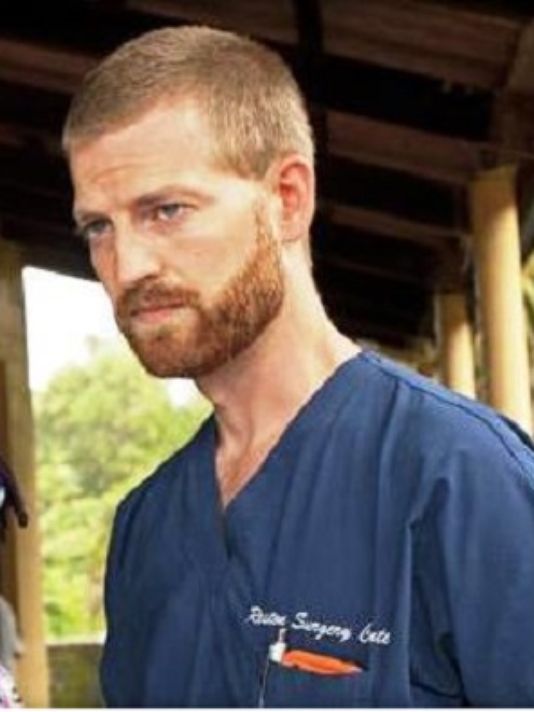
The fear surrounding this outbreak is intense. When Dr. Kent Brantly, a medical missionary who contracted the disease while treating patients in Liberia, was brought home for treatment here in the States, some questioned the wisdom of bringing a man infected by a dreaded disease into this country.[4] Others took their criticism farther, like political pundit Ann Coulter, who lambasted Dr. Brantly for going to Africa in the first place:
I wonder how the Ebola doctor feels now that his humanitarian trip has cost a Christian charity much more than any services he rendered.
What was the point?
Whatever good Dr. Kent Brantly did in Liberia has now been overwhelmed by the more than $2 million already paid by the Christian charities Samaritan’s Purse and SIM USA just to fly him and his nurse home in separate Gulfstream jets, specially equipped with medical tents, and to care for them at one of America’s premier hospitals …
Can’t anyone serve Christ in America anymore?[5]
I would point out to Ms. Coulter that there are, in fact, many people and organizations that do indeed serve Christ in America like, well, Samaritan’s Purse. You can learn more about their local relief efforts here. I would also point out that Christ’s commission is to make disciples of “all nations” (Matthew 28:19), which, by definition, includes nations other than our own. Finally, I would point out that the Christian Church has a long and storied history of reaching out to those in dire medical need. For instance, in the 160s, and again in the 260s, a series of plagues struck the Roman Empire. These plagues were so devastating that during one smallpox epidemic, a quarter to a third of the population died. When these plagues swept through, most people – scared of becoming infected – took the sick and threw them into the streets to die. But Christians, rather than casting the sick out, brought the sick in. Dionysius, the bishop of Alexandria during the second sweep of plagues, writes about how Christians responded to these outbreaks:
Most of our brother Christians showed unbounded love and loyalty; never sparing themselves and thinking only of one another. Heedless of danger, they took charge of the sick, attending to their every need and ministering to them in Christ, and with them departed this life serenely happy; for they were infected by others with the disease, drawing on themselves the sickness of their neighbors and cheerfully accepting their pains. Many, in nursing and caring for others, transferred their death to themselves and died in their stead.[6]
The Christians in Dionysius’ day, like Dr. Brantly in our day, cared for the sick – many of them dying because of their efforts. Dr. Brantly’s faithfulness is to be commended, not derided as Ann Coulter has done.
With this being said, all Christians need not travel to Liberia to respond faithfully to this worldwide health crisis. We can be faithful in our prayers that the spread of Ebola would be stemmed, and we can certainly join in prayer for Dr. Brantly and others like him. Finally, we can reach out in Christian love to the sick in our own communities, offering them our prayers and support.
When I think of Dr. Brantly’s efforts, I can’t help but believe he will hear some very pleasant words one day: “I was sick and you looked after Me” (Matthew 25:36). Let’s make it our goal to hear these words too.
__________________________________
[1] “Liberia declares state of emergency over Ebola virus,” BBC News (8.7.2014).
[2] Sydney Lupkin, “World Health Organization to Debate Ethics of Using Experimental Ebola Drug in Outbreak,” ABC News (8.6.2014).
[3] “Liberia declares state of emergency over Ebola virus,” BBC News (8.7.2014).
[4] Joel Achenbach, Brady Dennis, & Caelainn Hogan, “American doctor infected with Ebola returns to U.S.,” The Washington Post (8.2.2014).
[5] Ann Coulter, “Ebola Doc’s Condition Downgraded To ‘Idiotic,’” anncoulter.com (8.6.2014).
[6] Dionysius of Alexandria in Rodney Stark, The Rise of Christianity: How the Obscure, Marginal Jesus Movement Became the Dominant Religious Force in the Western World in a Few Centuries (San Francisco: Harper Collins, 1997), 82.


 Pastor Zach's Blog