Posts tagged ‘Jesus’
Election Day 2012 – It’s Almost Here
 Election Day is tomorrow. I am, as I’m sure you are, praying for our country and for her leaders. I am also praying that much of the fear that surrounds this election will be calmed by the peace of God that transcends all human understanding (cf. Philippians 4:7).
This week, my blog is a simple one. Yesterday in Adult Bible Class, I talked about Mark 12:13-17 with a special emphasis on what Jesus says about paying taxes and honoring God in verse 17: “Give to Caesar what is Caesar’s and to God what is God’s.” I wanted to put into transcript form (with some slight editing for the sake of readability) my conclusion from Adult Bible Class. For as we head into voting booths across our land, I think it’s important to reiterate what we talked about – that no matter who occupies the Oval Office, there is only one Occupant on the throne of heaven. And that alone should be enough to quell our fears and give us hope. Here is what I said:
I’m going to go on the record today and say that I think it’s time for us to have a smaller government. But when I say that – before you get too excited or too angry depending on your political persuasion – I’m not talking about tax policy and how we’re going to pay for this or that government program. I’m not talking about what social programs we should or should not keep. I’m not talking about whether we should be for or against the Affordable Health Care Act. I’m not talking about the size of government in Washington at all. I’m talking about the size of government in our imaginations. For government – and its attendant greatness or ghoulishness – has captured far too large a place in our hearts and minds.
Here’s what’s happened: whether Republican or Democrat, many people have bought into this myth that if the wrong guy makes it into office – which always happens to be the guy they’re not voting for – that’s the end of the line. That’s the demise of our nation. That’s the disintegration of everything good and moral and noble and righteous in our world. And people get all revved up and riled up, determined to save what is most important to them by getting their guy into office.
Folks, when this happens, you’re not voting for a president, you’re seeking a Messiah. And that job has already been filled.
I love what a New York Times columnist named Ross Douthat writes about this:
The party in power claims to be restoring American greatness; the party out of power insists that the current administration is actually deeply un-American – heretics in the holy temple of the U.S.A., you might say – and promises to take our country back…And the country keeps cycling through savior figures, hoping each time that this one will be the One that we’ve been waiting for.[1]
Folks, the One we’ve been waiting for has already come. And His name is not Barack Obama. His name is not Mitt Romney. His name is Jesus Christ. And, by the way, not only has He come, He’ll come again.
So cast your vote. Be a good citizen. But remember that even if Caesar gets the coins, Jesus holds your heart.
And that’s what matters most.
[1] Ross Douthat, Bad Religion: How We Became a Nation of Heretics (New York: Free Press, 2012), 269.
The Real Relationship Between Closed Doors and Opened Windows
 Last week, Melody and I were startled awake to the sound of our shih tzu, Bandit, growling and barking frenziedly. My hackles – and nerves – were immediately raised. “What is he barking at?” I thought to myself. “Is something wrong in the house? Is something on fire? Is there an invader?” After I wiped the sleep out of my eyes, I sat up to see Bandit sitting on our bedroom floor, tail wagging back and forth, barking ferociously…at our cat. There was no fire or invader. Just a feline, as frustrated as we were at Bandit’s barking.
Melody was not at all amused by this nocturnal rowdiness, nor was she amused at the fact that, rather than putting an end to Bandit’s snarling, I just sat in bed, taking it all in. “Get those animals out of here!” she exclaimed. The dog and cat did eventually settle down. But a few hours later, they were at it again. And Melody was awoken again. After kicking the animals out of the bedroom, I did what I should have done earlier that night: I closed the door. And peace ensued.
In our text for this past Sunday from Revelation 21, we catch a glimpse into the new Jerusalem, that is, the new creation which God will usher in on the Last Day. In John’s description of this heavenly hub, I find this to be especially notable: “On no day will Jerusalem’s gates ever be shut, for there will be no night there” (verse 25). Like I shut our bedroom door at night to keep out the pets, ancient cities would often shut their gates at night to keep out nefarious invaders. For example, when the city of Jericho learns that the Israelites are drawing near to attack, the book of Joshua notes, “Now Jericho was tightly shut up because of the Israelites. No one went out and no one came in” (Joshua 6:1). Ancient cities closed their gates. The new Jerusalem will not.
Why will the new Jerusalem’s gates always be open? Because unlike the municipalities of antiquity, the this cosmic metropolis will have no foes of which to be afraid. For all of the city’s enemies will have been conquered, even as John says: “But the cowardly, the unbelieving, the vile, the murderers, the sexually immoral, those who practice magic arts, the idolaters and all liars – their place will be in the fiery lake of burning sulfur” (verse 8). Thus, Jesus opens the city’s doors.
Jesus is in the business of opening doors. As Jesus Himself says, “Knock and the door will be opened to you” (Matthew 7:7). Paul, after a mission tour through Iconium, Lystra, and Derbe rejoices that God “had opened the door of faith to the Gentiles” (Acts 14:27). He later prays “that God may open a door for our message, so that we may proclaim the mystery of Christ, for which I am in chains” (Colossians 4:3). Christ’s desire is to open doors for His followers. Even at the beginning of Revelation, Jesus exclaims to the church at Philadelphia, “See, I have placed before you an open door that no one can shut (Revelation 3:8).
There’s an old, oft-repeated, and tired Christian cliché: “Whenever God closes one door, He always opens a window.” The premise of this statement is that God will make a way, even when things don’t turn out how you might expect or want them to. As much as I appreciate the general sentiment, I’m not so sure that the specific imagery is accurate. For when it comes to this specific image of a door, Scripture portrays God as one who opens doors rather than closing them. If we run up against a roadblock, before we blame God for slamming a door in our face, perhaps we should wonder if the door was ever open in the first place. Or perhaps we should consider whether it was our own sinfulness that closed a door rather than God. In fact, the only time that God is portrayed as closing a door is in Luke 13:23-28 when someone asks Jesus:
“Lord, are only a few people going to be saved?” He said to them, “Make every effort to enter through the narrow door, because many, I tell you, will try to enter and will not be able to. Once the owner of the house gets up and closes the door, you will stand outside knocking and pleading, ‘Sir, open the door for us.’ But He will answer, ‘I don’t know you or where you come from.’ Then you will say, ‘We ate and drank with You, and You taught in our streets.’ But He will reply, ‘I don’t know you or where you come from. Away from Me, all you evildoers!’ There will be weeping there, and gnashing of teeth.”
The door out of hell, it seems, will be locked up tight by Christ so that the gates of the new Jerusalem can be left open, free from the fear of God’s enemies.
So today, rather than bemoaning the “closed doors” in your life, why don’t you thank God for the ones He has opened for you? For they are many. He has opened the door to his knowledge through the pages of Scripture. He has opened the door to forgiveness through His Son, Jesus Christ. And He has opened the gates of His new Jerusalem so that we may come in. I can’t wait to walk through.
The Problem with Our Politics
 “Our politics is broken.” I don’t know how many times I’ve heard a political pundit utter these words on a cable news show. Usually, when a pundit speaks of broken politics, he or she is referring to the divisive and downright derogatory displays that so regularly parade across our national stage. These pundits long for the days when politicians could reach across the aisle and work with others who held different points of view to get things done and to move our nation into a bold and bright new future. “Why can’t we all just get along?” these pundits wonder.
This dream, of course, is encapsulated in our nation’s de facto, though not official, longtime motto: E pluribus unum. “Out of many, one.” We dream of the day when those in the halls of power – and the population who votes for them – will finally be able act civilly. And yet, as nice of a sentiment as E pluribus unum is, it is neither Scriptural nor realistic. Simple observation verifies this. We may be many in this nation. But we are certainly not one.
This is why the Scriptural vision of unity, rather than being ad hoc and accidental, is grounded in Christ and is intentional. The apostle Paul explains:
There is one body and one Spirit – just as you were called to one hope when you were called – one Lord, one faith, one baptism; one God and Father of all, who is over all and through all and in all. (Ephesians 4:4-6)
Paul uses the adjective “one” seven times in these verses. And in each instance, the adjective modifies God and His gifts. Thus, true unity can only be founded in the one true, Triune God. Scriptural unity begins with oneness of God and not with the multiplicity of man, as does our folksy national motto.
But our problem goes deeper than a simple lack of political unity. For disunity is merely a symptom of a more systemic and sinister problem. Our deeper problem is that we buy into so many of the impossibly lofty things our politics and politicians promise. We have saddled our politics with the responsibility of:
Fostering unity, creating jobs, saving the environment, caring for the poor, reducing the deficit, cutting spending, supporting unions and workers’ rights, formulating corporately friendly economic policies, reforming entitlements, ensuring the long-term fiscal solvency of Social Security, Medicare, and Medicaid, providing for a world-class education, both deporting illegal immigrants and providing them a path to citizenship, and restoring prosperity.
If we just had all of that, then we would be happy. Hmmm. Is it any wonder we’re disaffected and disillusioned? Does anyone really believe any human institution can deliver on all that?
Last week, I came across a column by New York Times writer Ross Douthat, where he poetically and succinctly summarizes the problem with the demands we make on our politics. Douthat writes:
When strong religious impulses coexist with weak religious institutions, people become more likely to channel religious energy into partisan politics instead, and to freight partisan causes with more metaphysical significance than they can bear. The result, visible both in the “hope and change” fantasies of Obama’s 2008 campaign and the right-wing backlash it summoned up, is a politics that gives free rein to both utopian and apocalyptic delusions, and that encourages polarization without end.[1]
This is precisely right. For all the help politics and politicians might be able to offer, and for all the good they might be able to do (cf. Romans 13:1-5), they are not up to carrying the weight of the metaphysical freight of the divine. The expansive power of God is simply too much for them to bear. Indeed, it is too much for any human to bear. This is why strong religious institutions, as Douthat duly notes, that strongly trust in and teach the providence of God are so important. For they proclaim the message that there is only one Messiah of metaphysical proportions and powers –and His name is Jesus. Anyone else who attempts to do Jesus’ job for Him will fail miserably. It is foolish to place superhuman hopes on simple humans, be they politicians or anyone else.
The upshot of placing superhuman hopes on simple humans can do nothing but result in the disastrous vacillation between “utopian and apocalyptic delusions” to which Douthat refers. When a new politician is elected, we speak of him as if he will be able to usher in an eternal golden age of prosperity and unity. When he unsurprisingly fails, we cry that the sky is falling.
I would submit that the Church stands at a particularly privileged position in our current political environment. For we can serve as advocates for the One who can and does do what politics and politicians can only dream of. We can serve as advocates for the One who not only provides for human beings, but changes human hearts. We can serve as advocates for Jesus. Sadly, many Christians have all too readily and willingly traded an advocacy of Jesus for advocacy of a certain candidate or political position. Not that it is bad in and of itself to thoughtfully support a candidate, but we must remain clear on what our politics and politicians can and cannot do. For our politics and politicians will not last. And they also will not deliver – at least not in the way we might hope. Jesus and His promises, however, will last and they will deliver. In fact, not only will Jesus last and deliver, He will prevail. As the Church, then, our call is to advocate for Him first.
[1] Ross Douthat, “A Nation of Osteens and Obamas,” The Washington Post (5.16.12).
ABC Extra – How Firm A Foundation
 Some of my fondest memories as a child are of our family trips to the beach. The sun, the white sand, the clear blue water. Wait, check that. I grew up in Oregon. It was always cloudy, the sand was rocky, and the water was murky. But I loved the beach nonetheless. And even in the rocky sand, I loved to build sandcastles. I would always make sure I had my pail and spade in tow, ready to create an impenetrable fortress right there at the base of beach. Except that, inevitably, my fortress would always be penetrated – and washed away – by the water. For sand castles, no matter how well you build them, never last. They always succumb to the relentless pounding of the surf.
This past weekend in worship and ABC, we were introduced to one of history’s most infamous rulers – Herod the Great. Known for his ruthlessness and megalomania, Herod would stop at nothing to protect and extend his reign and rule as “king of the Jews,” a title bestowed on him by the Roman Senate in 40 BC. He was married to no fewer than ten women over his life, most of whom he married out of political expediency rather than out of love. He banished his first wife, Doris, because he wanted to marry his second wife, Miriamne. He eventually had her executed after they got into a fight. He also killed his mother-in-law, brother-in-law, as well as three of his sons under suspicion that they were trying to usurp his power. Herod was a tyrant indeed.
But for all of Herod’s tyranny, he was also a monarch of great skill and vision. Most notably, Herod was a master builder. He built a whole city called the Caesarea Maritima, situated on the banks of the Mediterranean Sea, which had a breathtaking manmade harbor spanning more than forty acres. He built himself a palace which included baths, a pool, a colonnaded garden, and a 600 foot long terrace. He named it, modestly, the Herodium. But most famously, Herod rebuilt the temple in Jerusalem bigger and better than ever. He plastered it in marble and gold. It ascended higher than a fifteen-story building. It was truly a monument to Herod’s skill as an artisan. Herod began his work on the temple in 19 BC. It was not completely finished until 68 years after his death. If Herod died, as the German theologian Emil Schürer asserted, in 1 BC, that means the temple was finally finished in AD 67. In AD 70, the Roman general Titus laid siege to the city of Jerusalem and destroyed its temple. Herod’s completed temple stood for only three years.
Like my sandcastles on the beach, Herod’s building projects weren’t as enduring as he thought they would be. His crowing achievement, the Jerusalem temple, was destroyed only a few years after it was completed. His architecture succumbed to the relentless march of human history.
Jesus once told a story about the fate of building projects:
Everyone who hears these words of Mine and puts them into practice is like a wise man who built his house on the rock. The rain came down, the streams rose, and the winds blew and beat against that house; yet it did not fall, because it had its foundation on the rock. But everyone who hears these words of Mine and does not put them into practice is like a foolish man who built his house on sand. The rain came down, the streams rose, and the winds blew and beat against that house, and it fell with a great crash. (Matthew 7:24-27)
Jesus warns that man’s building projects can and do fall. The only way to make them last is to build them upon a firm foundation – and that firm foundation is Christ. Herod never learned this. Indeed, we learn in Matthew 2:16 that he wanted to kill Christ, not build his life and legacy on Him.
What are you building? And more importantly, on whom are you building? The things you build to your own fame will inevitably fall. But what is built on the rock of Christ and to His glory will endure. Do you build on the rock of Christ at your job, with your family, and throughout your life? Or, like Herod, are you only building monuments to your own greatness, which are really no sturdier than sandcastles? As the apostle Paul warns, “If any man builds…his work will be shown for what it is, because the Day will bring it to light. It will be revealed with fire, and the fire will test the quality of each man’s work” (1 Corinthians 3:12-13). May our work not be found wanting – not because of our skill, but because of Christ’s foundation.
Want to learn more? Go to
www.ConcordiaLutheranChurch.com
and check out audio and video from Pastor Tucker’s
message or Pastor Zach’s ABC!
ABC Extra – Heart Cleaning
 When I was a little kid, one of the places my dad used to take me was the zoo. I loved to see the animals – the bears, the giraffes, the elephants, and the otters. I especially liked the otters. They always seemed so playful and energetic. But as much as I enjoyed seeing the animals, they were never my favorite part of my zoo trips. No, the highlight of these trips was always my ride on the zoo train. At my local zoo, they had a real, coal burning, steam engine which ran a mile long trek around the perimeter of the zoo grounds. And I loved to ride it. The wail of the train whistle, the chug, chug, chug of the pistons, and the waft of the smoke rising from the train’s stack always mesmerized me. I also loved the open-air cars. There was nothing like having the wind blow in your face as lots of beautiful scenery whizzed by beside you. In fact, I always wanted to hang my head out the side of the car and feel the wind rush through my hair. But in each car, they had these notices posted: “Please remain seated and keep your hands and arms inside the car until the ride has come to a complete stop.” I despised these notices. And my dad would never allow me to fudge the rules…not one bit. Whenever I’d try to stick my hand out the side of the car to feel the breeze, my dad would grab it and point it up to the notice. I could look at the scenery whizzing by outside, but I could not stick my hand out the window to get closer to it. I had to keep my hands to myself.
In worship and ABC this weekend, we looked at the story of a sinful woman who comes to anoint Jesus as He is dining with a Pharisee named Simon. As I mentioned in ABC, many scholars believe this woman not only lived a sinful life, but a scandalous one as a prostitute. When Simon sees this woman weeping over Jesus and pouring perfume on Him, Simon mutters to himself, “If this man were a prophet, He would know who is touching Him and what kind of woman she is – that she is a sinner” (Luke 7:39). Simon is upset that this sinful woman would dare to touch Jesus…and that Jesus would allow her to do so! In fact, from this, Simon deduces that Jesus cannot be a true prophet – for a true prophet would never let a sinful woman come into contact with Him. Simon believes this woman should keep her hands and arms inside her own little space at all times. She should keep her hands to herself.
According to Old Testament law, coming into contact with something or someone which was physically, spiritually, or ceremonially unclean rendered you unclean. For instance, Moses writes:
If a person touches anything ceremonially unclean – whether the carcasses of unclean wild animals or of unclean livestock or of unclean creatures that move along the ground – even though he is unaware of it, he has become unclean and is guilty. Or if he touches human uncleanness – anything that would make him unclean – even though he is unaware of it, when he learns of it he will be guilty. (Leviticus 5:2-3)
Moses is warning, “Be careful what you touch! Because if you touch the wrong thing, you will get the wrong result – you will be rendered ‘unclean’!” So please keep your hands and arms inside your own little space at all times. Keep your hands to yourself.
A touch can defile. This was the way the religious leaders viewed sinfulness and righteousness, uncleanness and purity. This is why Simon is so upset with Jesus. After all, He is allowing a clearly unclean prostitute to defile His ceremonial cleanness without so much as a wince! Jesus, however, knows better about purity and uncleanness:
Nothing outside a man can make him “unclean” by going into him. Rather, it is what comes out of a man that makes him “unclean.” For from within, out of men’s hearts, come evil thoughts, sexual immorality, theft, murder, adultery, greed, malice, deceit, lewdness, envy, slander, arrogance and folly. All these evils come from inside and make a man “unclean.” (Mark 7:15, 21-23)
Jesus knows that a sinful woman cannot defile a pure person, for a person becomes sinful not because of some external source of wickedness, but because of his own sinful heart! The Lutheran Confessions explain, “Neither sin nor righteousness should be placed in meat, drink, clothing and like things” (Apology XXVIII 7). These external things cannot defile us. It is our own hearts which make us wicked.
This sinful woman’s touch does not defile Jesus’ purity. But Jesus’ purity does cleanse this sinful woman. Jesus announces to her, “Your sins are forgiven” (Luke 7:48). This woman’s sinfulness is no match for Jesus’ forgiveness. And the same is true for us. We are cleansed through faith in Christ!
Want to learn more? Go to
www.ConcordiaLutheranChurch.com
and check out audio and video from Pastor Tucker’s
message or Pastor Zach’s ABC!
A Simple Thought from the Life of Steve Jobs
 “It’s really hard to design products by focus groups. A lot of times, people don’t know what they want until you show it to them.” – Steve Jobs[1]
When I was in college, I worked as a DJ at the number one radio station in Austin. It was a country station, owned by a former mayor of Austin, and operated by a general manager who seemed to have a knack for picking the next country hit and formatting the station in such a way to draw in thousands upon thousands listeners – even those far beyond the Austin city limits. But then, in 1998, the station was sold to a large conglomerate that operated hundreds of stations across the country. The changes to station came almost instantaneously. The corporation set up several focus groups, asking listeners what they wanted out of a country station. Changes to the format were then made accordingly. And the ratings plummeted. In fact, they were cut in half.
How could this have happened? After all, the corporation was only listening to the listeners! But then, the listeners stopped listening to the very things for which they asked! Perhaps they should have taken a lesson from Steve Jobs: “It’s really hard to design products by focus groups. A lot of times, people don’t know what they want until you show it to them.”
There has never been, nor will there probably ever be, anyone quite like Steve Jobs. He revolutionized – quite literally – the way we interact not only with technology, but they way we interact with each other and our world. The products he dreamed up are everywhere. In fact, I have to chuckle to myself even as I type this blog. I am typing it on my MacBook Pro. On my desk, sits my iPhone, on which I have already texted and talked this morning, as well as my iPad, on which I read the news of Steve Jobs’ passing.
One of the secrets to Steve Jobs’ success seems to have been his ability to dream. Rather than reacting to what people wanted, he dreamed of what could be. He figured that if his dreams of what could be captured his imagination, they might capture the imaginations of others as well. Indeed, Jobs often described his own creations as “magical.” Now there’s a word that captures the human imagination!
Apple’s products have certainly captured my imagination. Just three years ago, I did all my work on a PC. Now, I do everything on Apple products. Why? Because Steve Jobs cast a vision for me of a highly integrated system of devices that would increase my productivity and, of course, be a lot of fun to use! This is something I would never have dreamed of for myself. But I’m happy that somebody dreamed it for me – and for countless others.
People don’t know always what they need. So someone must dream what people need for them. Understanding this simple truth has served as a catalyst for many of the most visionary corporations in our world today. It is also the simple truth of the gospel. The fact of the matter is this: On our own, we do not know what we need. We do not know that we need a Savior. As Jesus tells the Sadducees, a group of religious leaders who thought they knew God well, “You are in error because you do not know the Scriptures or the power of God” (Matthew 22:29). On our own, we cannot fathom the seriousness of our sinfulness. On our own, we cannot confess the depth of our depravity. On our own, we cannot recognize our requirement for a Redeemer. This is why, rather than leaving us grappling to understand the desperate state of our wicked and wretched plight, God sends us Jesus to tell us what we need. And what we need is simple: We need Him. And so Jesus gives us Himself on a cross to sanitize us from our sinfulness, destroy our depravity, and escort us into eternity.
Steve Jobs was a brilliant man. And I am thankful for his life and his legacy. But as great as his technological innovations may have been, they cannot save us. They cannot save him. Only Jesus can do that. I hope you know that you need Him…even more than your iPad.
[1] “Back To The Future At Apple,” Business Week (May 25, 1998).
ABC Extra – Jesus Isn’t Gentle (At Least Not All The Time)
 Even if you’ve never specifically articulated it, you have at least a general impression of Jesus. “Jesus is loving.” “Jesus was a good man.” “Jesus accepts all people no matter where they’re from or what they’ve done.” These are but a few of the most common impressions of Jesus. Even our hymnody seems to endorse these types of impressions. As a child, I learned to sing: “Gentle Jesus, meek and mild, look upon a little child. Pity my simplicity, suffer me to come to Thee.” Yep, this is Jesus: He’s meek and mild.
As I’ve grown older and have spent more time reading the Scriptures, the impression of Jesus as meek and mild that I had as a child has been challenged. More often than not, in the Scriptures, Jesus doesn’t seem all that meek and mild. In fact, in some instances, Jesus doesn’t even seem nice! Indeed, we encountered one of these instances in this past weekend’s ABC.
In Mark 4:1-20, Jesus shares with His disciples what I like to call “The Parable of the Parable.” He tells His disciples a parable which describes what happens when He tells a parable! “A farmer goes out to sow some seed,” Jesus begins. “Some falls on a hard path, some falls on rocky soil, and some lands in the nearby thorn bushes. And none of these seeds last. They either do not sprout at all or they sprout and quickly wither. But there is some seed that falls on soft soil. And this seed germinates and grows up to be healthy, full, and whole.” As I mentioned, this parable describes what happens when Jesus tells a parable! There are some people who out and out reject His teaching while others get carried away by the rocks and thorny trials of this world. Some, however, not only hear and understand Jesus’ parables, but believe them. They are the soft soiled ones who take Jesus’ parables to heart.
Sadly, Jesus warns that many will not take His parables to heart: “To those on the outside everything is said in parables so that, ‘they may be ever seeing but never perceiving, and ever hearing but never understanding; otherwise they might turn and be forgiven’” (Mark 4:11-12). These are some biting words! Jesus says that to those on the outside, He intentionally speaks in coded parables, lest these outsiders actually understand Jesus’ message and believe in His mission! This certainly doesn’t sound nice. This doesn’t sound like a gentle Jesus, meek and mild!
In His words, Jesus quotes Isaiah 6:9-10, where God gives the prophet a similar mission of veiling God’s Word and message, lest people understand and believe: “Go and tell this people: ‘Be ever hearing, but never understanding; be ever seeing, but never perceiving.’ Make the heart of this people calloused; make their ears dull and close their eyes. Otherwise they might see with their eyes, hear with their ears, understand with their hearts, and turn and be healed.” There is no ambiguity in God’s commission to Isaiah. Isaiah is to specifically and deliberately “make the heart of the people calloused.” That is, he is to turn people away from God. What a strange – and harsh – mission for a prophet!
The Septuagint, a Greek translation of the Old Testament from the third century BC, translates Isaiah 6:9-10 like this: “You will be ever hearing, but never understanding; you will be ever seeing, but never perceiving. This people’s heart has become calloused; they hardly hear with their ears, and they have closed their eyes.” Take careful note of the difference between the two versions. In the Hebrew text of Isaiah 6, Isaiah is specifically charged with hardening the hearts of the people. But in the Greek translation of this text, the hearts of the people are already calloused long before Isaiah begins his ministry. So which one is it? Is it Isaiah who callousing the hearts of the people? Or do the people who hear Isaiah come with already calloused hearts, ready to reject his message?
Actually, it’s both. Long before Isaiah arrives on the scene, the people of Israel have been busy callousing their hearts through their rebellion and carousing. Isaiah paints a bleak picture of Israel’s spiritual condition in his opening chapter: “Ah, sinful nation, a people loaded with guilt, a brood of evildoers, children given to corruption! They have forsaken the LORD; they have spurned the Holy One of Israel and turned their backs on Him” (Isaiah 1:4). Israel is already calloused. Thus, Isaiah is called only to callous hearts through his preaching which are have already been calloused by sin. This, then, is God’s warning to sinners: “If you callous your hearts by sin, I will callous your hearts in judgment of that sin.”
This, therefore, is finally what Jesus is doing in His parables. He speaks of hiding the meaning of His parables from “those on the outside” not because He hates these people or wants to see them consigned to damnation, but because they have already chosen to be on the outside, apart from Jesus. And so now, Jesus is simply giving these sinners what they want – what they demand. He is callousing their hearts through His parables.
The portrait of Jesus as purely meek and mild is surely inaccurate. In Jesus’ “Parable of the Parable,” we learn that Jesus most certainly allows people to fall under the judgment they deserve and desire. And yet, this is not Jesus’ final will. His will is that these people would indeed “turn and be forgiven,” even though He knows that some will not.
This, then, is Jesus’ invitation to you: Do not be calloused! By the Spirit’s strength, instead, be soft soil. Have a tender heart! Receive and believe God’s Word…and watch it grow in you – even unto salvation.
Want to learn more on this passage? Go to
www.ConcordiaLutheranChurch.com
and check out audio and video from Pastor Tucker’s
message or Pastor Zach’s ABC!
Weekend Extra – Mind Your Maker
 The other day, I stumbled across an internet quiz which, if you answered a few simple questions, claimed to tell you whether you follow your head or your heart. The questions included, “Is kissing in public cute or should it be avoided?” “Are flowers, little romantic notes, and romantic restaurants an important part of dating for you?” After seven simple questions, I learned that I followed my head more than my heart. I’m not surprised. After all, I’ve considered this characteristic of my personality before…in my head.
There is a regularly peddled belief, often lapped up by our emotionally inundated society, that it is better to follow your heart rather than your head. Just look at the sappy sentiments that permeate greeting cards which are being given all over our country on this Valentine’s Day. In her book Eat, Pray, Love, Elizabeth Gilbert chronicles how she traveled the world after divorcing her husband, looking for insight into life, which she gains from a medicine man in Bali. Apparently, even a Divinely witnessed moral commitment made in marriage is no match for the whims of a human heart. And, indeed, it shouldn’t be according to Gilbert. To follow a moral commitment made in marriage rather than your heart would be no less than, well, immoral!
Certainly, the human heart is important. The wise man of Proverbs reminds us, “Above all else, guard your heart, for it is the wellspring of life” (Proverbs 4:23). But at the same time the human heart is capable of great good, it is also prone to deep evil. Jesus warns, “Out of the heart come evil thoughts, murder, adultery, sexual immorality, theft, false testimony, slander” (Matthew 15:19). The heart, then, cannot and should not be the summit and sum of human decisions and desires. This is why Jesus, in our text for this past weekend, says, “Hear, O Israel, the Lord our God, the Lord is one. Love the Lord your God with all your heart and with all your soul and with all your mind and with all your strength” (Mark 12:30). In His words, Jesus is quoting the Shema, a Hebrew word meaning, “Hear,” based on Deuteronomy 6:4-5: “Hear, O Israel: The LORD our God, the LORD is one. Love the LORD your God with all your heart and with all your soul and with all your strength.” Faithful Jews still recite the Shema two times a day and it is traditional for them to recite this as their last words before they die.
What is so striking about Jesus’ recitation of the Shema in Mark 12 is His addition to it. The original Shema reads: “Love the LORD your God with all your heart and with all your soul and with all your strength.” But Jesus adds another way in which we can love the Lord, our God. Not just with our hearts and souls and strength, but also with our minds: “Love the Lord your God with all your heart and with all your soul and with all your mind and with all your strength.” It is not just the heart that loves God and follows Him, it is also the mind. The mind is important to Jesus!
The apostle Paul writes, “Do not conform any longer to the pattern of this world, but be transformed by the renewing of your mind. Then you will be able to test and approve what God’s will is—his good, pleasing and perfect will” (Romans 12:2). In order to follow God, we need not just properly disposed hearts, but miraculously transformed minds. Minds which love to ponder the things of God. Minds which diligently studies the Scriptures. Minds which use their intellectual capabilities to study God’s world and marvel at its grandeur and intricacies.
Do you love the Lord, your God, with all your mind? Are you learning new things about God and His Word? If you’re not, you’re missing out on a fantastic part of your life in Christ. So join a Bible study, listen to good teaching, and ponder anew what the Almighty can do. For our God always gives us something new – and exciting – to think about.
Want to learn more on this passage? Go to
www.ConcordiaLutheranChurch.com
and check out audio and video from Pastor Tucker’s
message or Pastor Zach’s ABC!
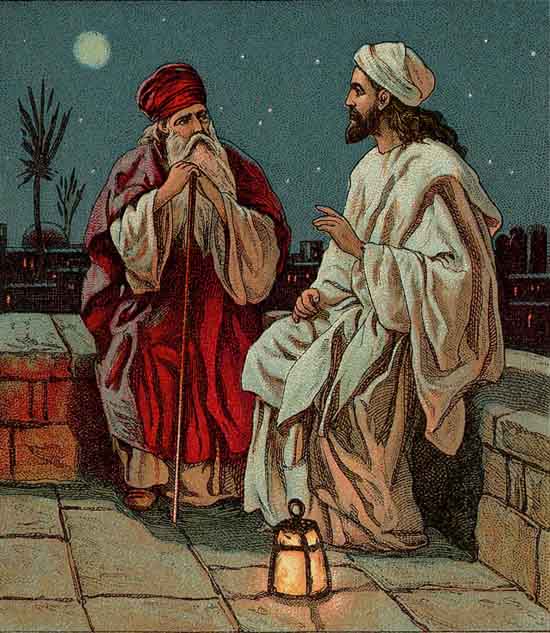
ABC Extra – Darkness to Light – John 3:1-16
 Fitness. According to the Bible, it’s not just a diet program or an exercise regimen, it involves everything we are. For God desires us to be fit in every aspect of our lives, be that physically, emotionally, spiritually, relationally, or otherwise. Indeed, Jesus describes his mission thusly: “I have come that they may have life, and have it to the full” (John 10:10). Jesus desires not only that we have life, but that we have it to the full. And a full life can be found only in him.
Ultimately, a perfectly full life can never be had in this life, for this life will end. Thus, a full life, given by Jesus, involves a promise of a new life beyond this one – a new, eternal life beyond this one. This new, eternal life is the topic of conversation between Jesus and a Pharisee named Nicodemus in John 3. The chapter opens:
Now there was a man of the Pharisees named Nicodemus, a member of the Jewish ruling council. He came to Jesus at night and said, “Rabbi, we know you are a teacher who has come from God. For no one could perform the miraculous signs you are doing if God were not with him.” (John 3:1-2)
Especially notable in these verses is the timing of this conversation between Nicodemus and Jesus. It is “at night” (John 3:2). On the one hand, as I mentioned in Adult Bible Class, John’s gospel regularly uses the image of darkness to express not only physical darkness, but spiritual darkness. As Jesus later says in this same chapter: “This is the verdict: Light has come into the world, but men loved darkness instead of light because their deeds were evil” (John 3:19). Thus, Nicodemus’ timing in his visit to Jesus seems to express something concerning his spiritual state: he is in darkness.
But at the same time the setting of this encounter alludes to Nicodemus’ spiritual darkness, it alludes to something else: his faithfulness. According to ancient traditions, religious communities, such as the community of the Pharisees, were to study Scripture late into the night. We read in the Dead Sea Scrolls: “The general membership [of a religious community] will be diligent together for the first third of every night of the year, reading aloud from the Book, interpreting Scripture, and praying together” (1QS 6:7-8). Thus, at night, as during the day, Nicodemus was to study Scripture with his fellow Pharisees. So when Nicodemus comes to Jesus, he probably does so right after he has studied the Scriptures.
Eventually, Nicodemus comes to faith in Jesus. We read near the end of John’s gospel:
Later, Joseph of Arimathea asked Pilate for the body of Jesus. Now Joseph was a disciple of Jesus, but secretly because he feared the Jews. With Pilate’s permission, he came and took the body away. He was accompanied by Nicodemus, the man who earlier had visited Jesus at night. Nicodemus brought a mixture of myrrh and aloes, about seventy-five pounds. Taking Jesus’ body, the two of them wrapped it, with the spices, in strips of linen. This was in accordance with Jewish burial customs. At the place where Jesus was crucified, there was a garden, and in the garden a new tomb, in which no one had ever been laid. Because it was the Jewish day of Preparation and since the tomb was nearby, they laid Jesus there. (John 19:38-42)
Interestingly, by this time, Nicodemus does not seem to be nearly so shy concerning his commitment to Jesus as he was in John 3. He accompanies Joseph of Arimathea to Pontius Pilate, the very prefect of Judah. Mark records that such an act “took courage” (Mark 15:43), for Pilate could have easily condemned the two men.
Not only does Nicodemus boldly approach Pilate with Joseph, he also embalms Jesus’ body on “the Jewish day of Preparation” (John 19:42), that is, the day before the Sabbath. Jewish days were reckoned from sundown to sundown. This means that Nicodemus would have to tend to the details of Jesus’ burial before sundown – while it was still daylight.
Nicodemus’ first encounter with Jesus was under the cover of night. Nicodemus’ final encounter with Jesus was in broad daylight. Perhaps all those late night study sessions of the Scriptures helped Nicodemus after all. For hours upon hours of studying the light of God’s Word eventually led him to faith in God’s Light of the world.
Before you go to bed tonight, after it becomes dark, take a cue from Nicodemus: take a few brief moments to read and ponder the light of God’s Word, thanking God for his Light of the world.
Want to learn more on this passage? Go to
www.ConcordiaLutheranChurch.com
and check out audio and video from Pastor Tucker’s
message or Pastor Zach’s ABC!


 Pastor Zach's Blog